Global Protein Hydrolysate for Animal Feed Market Size, Share, Growth & Forecast 2026–2035

Signixa Market Intelligence and Business Consulting  |  Base Year: 2025  |  Forecast Period: 2026–2035

Market Size (2025)
USD 748.70 Mn
Market Size (2035)
USD 1,233.56 Mn
CAGR (2026–2035)
5.12%
Leading Region
Asia-Pacific

Protein Hydrolysate for Animal Feed Market Overview

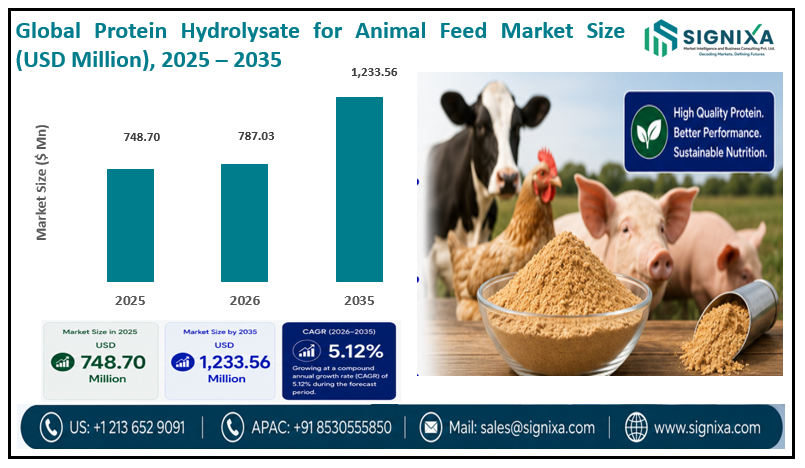
The global protein hydrolysate for animal feed market was valued at approximately USD 748.70 Million in 2025 and is projected to reach around USD 1,233.56 Million by 2035, growing at a compound annual growth rate (CAGR) of 5.12% during the forecast period. The report evaluates growth opportunities, emerging trends, and challenges across the industry, offering a comprehensive analysis of market dynamics, segmentation, regional outlook, and competitive landscape.

Protein hydrolysates are extensively used in animal nutrition due to their enhanced digestibility, superior bioavailability, and well-characterized amino acid profile. Derived through enzymatic or chemical hydrolysis of animal or plant proteins, these hydrolysates provide superior digestibility, enhanced amino acid availability, and functional benefits including improved gut health and immunity — characteristics that make them especially valuable in young animal diets including piglets, calves, chicks, and aquatic species where early-stage nutrition is critical for healthy development and long-term productive performance. These hydrolysates, sourced from animal tissues, fish, plants, and milk, are gaining prominence as functional feed ingredients in intensive livestock farming, aquaculture, and the rapidly expanding premium pet food sector.

As livestock producers seek to maximize feed efficiency and reduce reliance on antibiotic growth promoters, protein hydrolysates are gaining preference for their ability to support growth performance and disease resistance through purely nutritional mechanisms. In aquaculture, the shift toward sustainable and cost-effective feeds is increasing the use of fish protein hydrolysates and plant-based alternatives to replace conventional fishmeal, aligning with the industry's sustainability goals. Technological advancements in hydrolysis processes and protein extraction, along with the circular economy trend of valorizing food and fish processing waste into high-value hydrolysate ingredients, are enabling companies to meet the diverse nutritional needs of the global animal feed market while improving sustainability credentials across the value chain.

Key Findings

  • The global market is projected to grow at a CAGR of 5.12% between 2026 and 2035, with market value rising from USD 748.70 Million in 2025 to USD 1,233.56 Million by 2035.
  • Enzymatic hydrolysis is the dominant production technology, accounting for over 60% of global revenue in 2025, due to its ability to produce highly digestible proteins with minimal nutrient degradation and superior bioactive peptide retention.
  • Aquaculture and Poultry remain the key consuming livestock segments, with aquaculture contributing over 30% of total market revenue in 2025 — driven by the protein-intensive diet requirements of salmon, trout, and shrimp species.
  • Powder form holds the largest share at approximately 75% of market volume in 2025, attributed to ease of storage, extended shelf life, and compatibility with standard feed manufacturing processes.
  • Fish Protein Hydrolysates lead the source segment with around 35% of market revenue in 2025, while plant-based hydrolysates are gaining momentum due to sustainability credentials and cost-effectiveness.
Protein Hydrolysate For Animal Feed Market

Protein Hydrolysate for Animal Feed Market Dynamics

Rising Demand for Functional, High-Digestibility Feed & Antibiotic Reduction Mandates

The increasing demand for functional and easily digestible animal feed is the primary driver of the protein hydrolysate market. Protein hydrolysates provide a rich source of low molecular weight peptides and free amino acids that enhance feed efficiency particularly in aquaculture and young animals — which is crucial in intensive farming environments where rapid growth and high feed conversion ratios are directly linked to profitability. Their superior digestibility over conventional protein sources such as soybean meal and fishmeal means they are more efficiently absorbed, reducing gastrointestinal stress and promoting optimal development in neonatal and weaning animals. The global shift away from antibiotic growth promoters — driven by consumer demand for antibiotic-free meat and dairy products and regulatory bans across the EU and other major markets — is accelerating adoption of functional feed ingredients like protein hydrolysates that contribute to disease resistance and overall herd health through nutritional pathways, providing a viable antibiotic replacement strategy for livestock producers.

Sustainability Goals, Circular Economy & Plant-Based Hydrolysate Innovation

Sustainability and regulatory compliance are further fueling the adoption of plant and fish-based protein hydrolysates as the global animal feed industry faces growing pressure to minimize its environmental footprint. Hydrolysates derived from renewable and clean sources — including fish processing by-products, plant proteins, and novel insect-derived proteins — offer viable alternatives to conventional protein ingredients that may carry sustainability concerns. Their ability to improve nutrient uptake and reduce nitrogen excretion in animal waste is gaining favor among environmentally conscious producers, especially in Europe and North America where environmental compliance costs are significant. The circular economy trend — emphasizing resource efficiency and waste valorization — strongly supports the use of hydrolysates derived from food and fish processing waste streams, transforming what were previously disposal challenges into high-value nutritional ingredients that simultaneously reduce production costs and improve sustainability profiles for feed manufacturers investing in this approach.

R&D Innovation in Enzymatic Processes & Species-Specific Formulation Development

Innovation and R&D are reshaping the protein hydrolysate market dynamics as manufacturers focus on optimizing hydrolysis techniques, improving protein yield, and reducing production costs to expand the addressable market beyond current premium feed applications. Enzymatic hydrolysis has emerged as the preferred production method due to its ability to maintain nutritional integrity, preserve bioactive peptides, and limit the formation of unwanted by-products — providing consistency and functional advantages that support premium product positioning. Companies are investing in proprietary enzyme systems and process optimization to customize peptide molecular weight profiles for species-specific feed formulations, enabling tailored nutritional strategies that optimize performance in each target species. Plant-based protein hydrolysates — derived from soy, wheat, and pea — are gaining substantial momentum as sustainable alternatives to animal-derived sources, addressing both environmental concerns and expanding market reach in regions with dietary or religious restrictions against the use of certain animal by-products in feed formulations.

Protein Hydrolysate for Animal Feed Market Segmentation Analysis

By Technology Segment Analysis

Enzymatic Hydrolysis

Enzymatic hydrolysis dominates the protein hydrolysate for animal feed market, accounting for over 60% of global revenue in 2025, due to its ability to produce highly digestible proteins with minimal degradation of valuable nutritional components. This method uses specific protease enzyme systems to cleave protein chains at targeted peptide bonds — producing a controlled distribution of peptide molecular weights and free amino acids that preserves the amino acid profile and retains bioactive peptides with immunostimulatory, gut health-promoting, and palatability-enhancing functions. These characteristics make enzymatically produced hydrolysates ideal for sensitive and high-value animal groups including salmon and shrimp in aquaculture, calves in the dairy replacement sector, and young pigs and chicks in intensive production systems where feed quality has the most measurable impact on early-life performance and long-term productivity. Ongoing investment in proprietary enzyme development and continuous process optimization is enabling manufacturers to improve hydrolysate consistency, species-specific peptide customization, and production economics simultaneously.

Acid Hydrolysis

Acid hydrolysis, while a cost-effective and established production method for protein hydrolysates, is expected to see slower growth through the forecast period due to inherent limitations in nutritional quality outcomes compared to enzymatic methods. The use of strong mineral acids at elevated temperatures for protein chain cleavage — while efficient for rapid, high-volume hydrolysate production — can result in the destruction of sensitive amino acids including tryptophan and degradation of some bioactive peptides, reducing the functional nutritional value of the resulting hydrolysate relative to enzymatically produced equivalents. However, acid hydrolysis retains relevance in cost-sensitive commodity applications — particularly in the production of hydrolyzed vegetable protein from plant sources where the amino acid loss profile is less critical than in sensitive animal applications — and in markets where price competitiveness remains the primary procurement criterion for feed ingredient buyers with less emphasis on functional performance differentiation.

By Livestock Segment Analysis

The protein hydrolysate for animal feed market serves diverse livestock species, each with distinct nutritional requirements, protein digestibility demands, and performance sensitivity to feed quality:

Aquaculture

Aquaculture holds a significant share, contributing to over 30% of total market revenue in 2025. Species including salmon, trout, sea bass, sea bream, tilapia, and shrimp benefit greatly from protein hydrolysates due to their protein-intensive dietary requirements, highly developed chemosensory responses to peptide palatability stimulants, and the critical importance of immune system support in intensive aquaculture environments where pathogen pressure is elevated. Fish protein hydrolysates are especially valued in aquaculture for their ability to replace a portion of whole fishmeal in formulated diets while maintaining or improving feed intake, growth rate, and feed conversion efficiency — which is central to the aquaculture industry's strategic goal of reducing dependency on marine-derived fishmeal as global supplies tighten and sustainability pressures increase. The rapid expansion of global aquaculture production — driven by rising seafood demand from a growing global population and wild fishery supply constraints — is the single most important structural demand driver for protein hydrolysates in the animal feed market.

Poultry

Poultry — particularly broilers and layers — is another dominant livestock segment for protein hydrolysates, supported by the globally high volume of poultry meat and egg production and the performance-driven nutritional management that characterizes modern integrated poultry operations. The high global demand for poultry as the most widely consumed meat protein creates consistent large-scale demand for feed additives that can improve feed conversion ratios, reduce mortality rates, and improve uniformity in broiler flocks — outcomes where protein hydrolysates with immunostimulatory peptides and optimized amino acid profiles deliver measurable commercial returns. Protein hydrolysates are particularly valuable in starter feed formulations for day-old chicks, where gut colonization patterns and digestive capacity are still maturing and the bioavailability advantage of hydrolyzed versus intact proteins is most significant for early-phase growth and health outcomes.

Swine

Swine feed formulations are increasingly incorporating protein hydrolysates to improve feed conversion rates and health outcomes, particularly during the critical early growth stages — especially the weaning transition period when piglets shift from maternal milk to dry compound feed. This transition phase is associated with significant gastrointestinal stress, reduced feed intake, and elevated disease susceptibility — all of which are mitigated by including highly digestible hydrolyzed protein sources that minimize the digestive challenge of the dietary shift while providing the amino acids and bioactive peptides needed to support intestinal development and immune maturation. The global trend toward reduced or eliminated antibiotic use in swine production is creating particularly strong demand for functional feed ingredients including protein hydrolysates that can maintain performance metrics in post-weaning pigs without relying on sub-therapeutic antibiotic administration as a growth promotion or disease prevention strategy.

Cattle & Calves

Cattle and calves represent distinct but complementary segments for protein hydrolysate inclusion in feed formulations. For calves — particularly dairy replacement heifers and veal calves consuming milk replacer in the first weeks of life — milk protein hydrolysates provide an exceptionally bioavailable protein source that supports rapid early growth and gut health during the period when the gastrointestinal tract is undergoing rapid development and immunological maturation. The growing global dairy industry and the increasing economics of precision calf rearing — where early-life nutrition investment returns measurable long-term productivity benefits in the dairy cow — create sustained demand for premium protein hydrolysates in calf nutrition. For adult cattle, protein hydrolysates are primarily used in specialized performance nutrition contexts — including high-producing dairy cow transition nutrition and finishing beef cattle diets where amino acid bioavailability improvements translate to measurable production efficiency gains.

Pet

The pet food segment represents one of the highest-value and fastest-growing applications for protein hydrolysates, driven by the premiumization of companion animal nutrition and the growing clinical application of hydrolyzed protein diets in veterinary practice. In pet nutrition, the rising demand for premium products that offer hypoallergenic, highly palatable, and easily digestible protein sources is pushing manufacturers to include hydrolysates in both prescription veterinary diets and premium commercial pet food formulations. Hydrolyzed proteins — where intact protein antigens have been broken into peptides below the size threshold required to trigger allergic responses — are the gold standard protein source in veterinary hypoallergenic diet formulations for dogs and cats with food sensitivities and inflammatory bowel conditions. The humanization of pet care in North America, Europe, and increasingly in Asia-Pacific is expanding the market for premium functional pet nutrition beyond the veterinary prescription channel into mainstream premium pet food retail.

By Form Segment Analysis

Powder

Powder form accounted for approximately 75% of the market share by volume in 2025, attributed to its ease of storage, extended shelf life, and broad compatibility with standard dry feed manufacturing processes including pelleting, extrusion, and mixing operations across the full range of commercial feed mill configurations. Powdered hydrolysates are preferred in large-scale feed manufacturing operations where uniformity of ingredient distribution, handling efficiency through pneumatic conveying systems, and consistent batch-to-batch nutritional composition are operational priorities. The powder form also offers practical advantages for international trade and long-distance distribution, as the low moisture content minimizes microbiological spoilage risk during extended storage and transportation across global supply chains connecting hydrolysate producers in Europe and Southeast Asia with feed manufacturers across major livestock and aquaculture markets worldwide.

Paste

Paste form protein hydrolysates are primarily used in specialized feed applications — particularly in wet feeds, liquid milk replacer formulations, and targeted concentrated supplements where higher moisture content and concentration are technically acceptable or preferable. In aquaculture, paste hydrolysates are used in moist pellet formulations for certain marine species where ingredient palatability and water stability of the feed are critical performance parameters. In calf nutrition, liquid or paste hydrolysate formats are used in milk replacer formulations where they are blended into aqueous media for reconstitution and feeding through automated calf feeding systems. The paste format allows for easier incorporation into wet processing systems without the spray-drying costs associated with powder production, making it a cost-competitive option for certain specialized applications where powder's handling advantages are less relevant.

By Source Segment Analysis

Fish Protein Hydrolysates

Fish protein hydrolysates lead the source segment with approximately 35% of market revenue in 2025, due to their high protein concentration, excellent digestibility profile, balanced essential amino acid composition closely matching the requirements of carnivorous fish and shrimp species, and beneficial essential fatty acid content. Produced from whole fish, fish processing by-products, and marine invertebrate sources, fish protein hydrolysates are the most widely used and most nutritionally valued source of protein hydrolysate in aquaculture diets — where their palatability, digestibility, and amino acid profile advantages over plant-based alternatives create both functional and economic justifications for inclusion at meaningful dietary levels. The growing global aquaculture industry and the strategic priority of reducing whole fishmeal inclusion in aquaculture diets — while maintaining or improving production performance — is creating sustained demand for high-quality fish protein hydrolysates produced through sustainable marine raw material sourcing and efficient enzymatic processing technologies.

Plant Protein Hydrolysates

Plant protein hydrolysates — derived from soy, wheat gluten, pea, and other legume and cereal protein concentrates — are gaining significant momentum across the animal feed market due to their combination of sustainability credentials, cost-effectiveness relative to marine-derived alternatives, and non-GMO appeal in markets where genetically modified crop-derived ingredients face consumer resistance or regulatory restrictions. Soy protein hydrolysates are particularly well-established in swine and poultry feed applications, where their amino acid profile complements cereal-based diets effectively and their hydrolysis improves digestibility beyond what is achievable with intact soy protein concentrate in young animal diets. The development of high-quality pea protein hydrolysates — aligned with the broader growth of pea protein as a versatile, sustainable, and allergen-friendly plant protein source — is expanding the range of plant-derived options available to feed formulators seeking sustainable protein hydrolysate ingredients for inclusion in diversified aquaculture and livestock feed formulations.

Animal Protein Hydrolysates

Animal protein hydrolysates — derived from poultry by-products, porcine tissues, bovine blood, and rendered animal proteins — are primarily used in swine and ruminant feed formulations where cost-effectiveness and amino acid complementarity with other feed ingredients are the primary selection criteria. Poultry by-product hydrolysates are well-established feed ingredients in compound feed for pigs and other non-ruminant livestock, offering a cost-competitive and nutritionally effective protein source that upcycles valuable amino acid-rich materials from the poultry processing industry into high-value feed ingredients aligned with circular economy principles. Regulatory constraints in some markets — particularly the EU's restrictions on the use of certain processed animal proteins in ruminant feed — shape the specific application profile of animal protein hydrolysates across different livestock species and geographic markets, with compliance requirements varying significantly by protein source and target species.

Milk Protein Hydrolysates

Milk protein hydrolysates — derived from casein, whey, and whole milk protein through enzymatic hydrolysis — are used in calf nutrition and high-value feed products due to their superior essential amino acid profile, exceptional digestibility, and well-documented physiological benefits in neonatal and young animals whose gastrointestinal tracts are adapted to efficiently absorb milk-derived nutrients. Whey protein hydrolysates in particular provide an excellent profile of branched-chain amino acids and bioactive peptides with demonstrated immunomodulatory and gut-protective functions — characteristics that make them the highest-quality but also highest-cost protein hydrolysate option available in the animal feed market. Their premium positioning limits volume applications to the highest-value feed segments where the nutritional return on investment justifies the ingredient cost premium — primarily early-life calf milk replacers, specialty piglet creep feeds, and premium companion animal nutrition formulations where performance and quality differentiation support a premium pricing strategy.

Report Attributes & Market Scope

Report Attribute Details
Market Size Value in 2025 USD 748.70 Million
Market Size Value in 2035 USD 1,233.56 Million
CAGR (2026–2035) 5.12%
Base Year Used for Estimation 2025
Historic Data 2020 – 2025
Forecast Period 2026 – 2035
Segments Covered – By Technology
  • Acid Hydrolysis
  • Enzymatic Hydrolysis
Segments Covered – By Livestock
  • Poultry
  • Swine
  • Cattle
  • Calves
  • Aquaculture
  • Equine
  • Pet
Segments Covered – By Form
  • Powder
  • Paste
Segments Covered – By Source
  • Animal Protein Hydrolysates
  • Fish Protein Hydrolysates
  • Plant Protein Hydrolysates
  • Milk Protein Hydrolysates
Regions Covered North America, Europe, Asia Pacific, Latin America, Middle East and Africa
Major Countries Covered U.S., Canada, Mexico, Germany, UK, France, Italy, Spain, Russia, China, Japan, South Korea, India, Southeast Asia Countries, Brazil, Argentina, GCC Countries, Turkey, Iran, Israel, South Africa, Egypt, Nigeria, etc.
Key Companies Profiled Bio-Marine Ingredients Ireland, Diana Aqua (Symrise), Copalisa Solutions, SOPROPECHE, Hofseth BioCare ASA, Cargill Inc., TripleNine Group, MILSEA, Gelita AG, and SARIA Group, among others.

Protein Hydrolysate for Animal Feed Market Regional Analysis

The Asia-Pacific region dominates the global protein hydrolysate for animal feed market, supported by the region's large aquaculture and livestock populations — particularly in China, India, Vietnam, Thailand, and Indonesia. North America and Europe are expected to show steady growth driven by advanced feed practices, regulatory pressure for antibiotic alternatives, and strong pet food industry demand. Latin America and the Middle East & Africa are emerging regions with increasing focus on animal productivity, sustainable farming practices, and food security investments.

Asia-Pacific (Dominant Region)

Asia-Pacific holds a dominant position in the global protein hydrolysate for animal feed market, driven by rapid industrialization of the livestock and aquaculture sectors across China, India, Vietnam, Thailand, and Indonesia. The region's booming aquaculture industry — particularly intensive salmon, shrimp, and tilapia farming in China and Southeast Asia — is a major consumer of protein hydrolysates due to their high digestibility, bioavailable amino acid profiles, and ability to enhance immunity in fish and shrimp in environments where disease pressure is elevated. Beyond aquaculture, the poultry and swine industries across Asia-Pacific are expanding rapidly to meet the dietary protein needs of growing urban populations — adopting protein hydrolysates as functional feed additives to improve feed conversion ratios, accelerate growth, and reduce antibiotic growth promoter reliance. Government initiatives promoting sustainable farming practices, safe feed production, and food security investments are contributing to market expansion, while domestic and international players are investing in local production facilities leveraging the region's abundant raw materials including soybean, fish, and poultry by-products.

North America

North America represents a significant market for protein hydrolysate in animal feed, supported by its advanced livestock and companion animal nutrition industries. The U.S. and Canada are at the forefront, driven by increased consumer demand for high-quality meat, dairy, and companion animal products with clean-label and antibiotic-free credentials. The well-established cattle, poultry, and swine industries emphasize performance, animal health, and sustainable practices — factors that make protein hydrolysates a preferred premium feed component. The rapidly expanding pet food segment in the U.S. is adopting hydrolyzed proteins for hypoallergenic and easily digestible formulas in both veterinary prescription and premium commercial product lines — a market expanding substantially faster than conventional livestock feed. Regulatory clarity from agencies including the FDA and AAFCO ensures quality control and safety frameworks that encourage responsible hydrolysate adoption in feed production, while sustainable sourcing and waste reduction strategies are driving the valorization of animal by-products into high-value hydrolysates aligned with circular economy principles.

Europe

Europe holds a prominent position in the global protein hydrolysate for animal feed market, supported by its robust livestock sector, stringent regulatory environment, and a strong focus on sustainable and high-performance animal nutrition. Countries including Germany, France, the Netherlands, and Spain are major consumers — benefiting from advanced animal husbandry practices and growing demand for nutrient-rich, antibiotic-free feed solutions. The European Union's strict regulations around feed additives, antibiotic use, and animal welfare are driving innovation and increased adoption of alternative functional ingredients such as hydrolyzed proteins. Feed manufacturers are incorporating hydrolysates derived from fish, poultry by-products, and plant sources to comply with environmental and health standards while maintaining nutritional efficiency. The circular feed economy trend — emphasizing the upcycling of protein-rich waste streams from fish processing, slaughter by-products, and food processing into valuable hydrolysate ingredients — is strongly aligned with EU sustainability policy objectives and is supported by dedicated research funding and regulatory frameworks that facilitate novel feed ingredient approval. In the pet nutrition space, Europe has seen a surge in demand for premium and hypoallergenic products, with hydrolyzed proteins widely used in both veterinary diet formulations and mainstream premium pet food products.

Latin America

Latin America is an emerging market for protein hydrolysates in animal feed, with increasing awareness of functional feed additives and growing investment in modern livestock and aquaculture production practices across Brazil, Chile, Peru, Mexico, and Argentina. Brazil and Chile are the region's primary markets — driven by extensive broiler and swine industries in Brazil and the globally significant Chilean salmon aquaculture sector where high-quality protein hydrolysates deliver measurable performance benefits and partially substitute for imported fishmeal in formulated diets. Peru is an important regional market both as a major global fish meal producer and as a growing market for protein hydrolysate inclusion in domestic aquaculture feed. The region's large-scale livestock operations are progressively adopting performance nutrition approaches — including protein hydrolysates in young animal diets — as producers seek to improve feed efficiency and compete in export markets that increasingly require antibiotic-free production protocols.

Middle East & Africa

The Middle East and Africa region presents a growing opportunity for protein hydrolysates in animal feed, fueled by rising demand for quality animal protein, expansion of aquaculture production, and increasing government investment in livestock productivity as part of national food security strategies. Countries including Saudi Arabia, the UAE, Egypt, and South Africa are progressively adopting advanced feed solutions to meet the nutritional demands of poultry, ruminants, aquaculture species, and companion animals. In GCC countries, the strategic imperative for food self-sufficiency is driving development of modern animal farming facilities that require high-performance feed inputs, with protein hydrolysates gaining interest as the sector moves toward more efficient and sustainable production systems. In sub-Saharan Africa, particularly in Kenya and Nigeria, protein hydrolysates are being gradually introduced in niche segments including aquaculture — where fish farming is expanding due to increasing domestic seafood consumption and export opportunities — and premium pet food. Limited awareness and cost constraints remain challenges, but ongoing education, improved regional distribution networks, and expanding local feed mill capacity are expected to progressively integrate functional protein hydrolysate ingredients into mainstream feed formulations across the MEA region through the forecast period.

Recent Developments in the Protein Hydrolysate for Animal Feed Market

  • 2026

    Cargill Inc. Expanded its animal nutrition portfolio with advanced protein-based feed ingredients designed to improve feed efficiency, nutrient absorption, and livestock performance.

    Hofseth BioCare ASA Increased production of salmon-derived protein hydrolysates to support growing demand from aquaculture, pet food, and specialty animal nutrition markets.

    Gelita AG Expanded research efforts focused on bioactive protein hydrolysates for animal feed applications, targeting improved digestion and nutrient utilization.

  • 2025

    Bio-Marine Ingredients Ireland Expanded marine protein hydrolysate production capacity to meet increasing demand from aquaculture and premium pet nutrition sectors.

    TripleNine Group Increased production capabilities for marine-based feed ingredients to support growing global demand for sustainable animal nutrition products.

    ScanBio Marine Group Expanded processing operations for fish-based protein hydrolysates, focusing on high-quality ingredients for aquaculture and livestock feed applications.

Protein Hydrolysate for Animal Feed Market: Competitive Landscape

Major players in the market include Bio-Marine Ingredients Ireland, Diana Aqua (Symrise), Copalisa Solutions, SOPROPECHE, Hofseth BioCare ASA, Cargill Inc., TripleNine Group, MILSEA, Gelita AG, and SARIA Group. Companies are focusing on R&D to enhance digestibility and nutritional efficiency of their products while exploring novel protein sources including insect protein, single-cell protein, and fermentation-derived hydrolysates. Strategic collaborations, capacity expansions, and proprietary innovation in enzymatic processes are helping companies strengthen their positions in the growing protein hydrolysate market for animal feed applications.

The competitive landscape is characterized by a mix of large, diversified agri-food and specialty ingredient companies — including Cargill, Symrise, and Evonik — that bring broad commercial scale, global distribution capabilities, and integrated R&D resources alongside more specialized players such as Hofseth BioCare, SOPROPECHE, and TripleNine Group that focus specifically on marine-derived hydrolysate production from sustainable Norwegian and European fishery sources. Competitive differentiation is increasingly achieved through proprietary enzyme system development for hydrolysate production optimization, species-specific formulation expertise, sustainability and traceability certifications that support premium positioning in European and North American markets, and strategic alliances with aquaculture feed manufacturers that provide stable demand volumes and collaborative development of tailored functional ingredient solutions. The growing emphasis on circular economy principles and waste valorization is creating new competitive dynamics as companies develop efficient processes for converting fish processing offal, poultry by-products, and food industry protein waste streams into high-value hydrolysate ingredients that simultaneously improve producer economics and environmental sustainability credentials.

Key Companies Profiled

  • Bio-Marine Ingredients Ireland
  • Diana Aqua (Symrise)
  • Copalis Sea Solutions
  • SOPROPECHE
  • Hofseth BioCare ASA
  • Cargill Inc.
  • TripleNine Group
  • MILSEA
  • Gelita AG
  • SARIA Group
  • ScanBio Marine Group
  • Bioiberica S.A.U.
  • Janatha Fish Meal & Oil Products
  • Nutrifish
  • Omega Protein Corporation

Global Protein Hydrolysate for Animal Feed Market Segmentation Summary

By Technology

  • Acid Hydrolysis
  • Enzymatic Hydrolysis

By Livestock

  • Poultry
  • Swine
  • Cattle
  • Calves
  • Aquaculture
  • Equine
  • Pet

By Form

  • Powder
  • Paste

By Source

  • Animal Protein Hydrolysates
  • Fish Protein Hydrolysates
  • Plant Protein Hydrolysates
  • Milk Protein Hydrolysates

By Region

  • North America
    • U.S.
    • Canada
    • Mexico
  • Europe
    • Germany
    • France
    • UK
    • Spain
    • Italy
    • Rest of Europe
  • Asia-Pacific
    • China
    • Japan
    • India
    • Australia
    • South Korea
    • Southeast Asia
    • Rest of Asia-Pacific
  • Latin America
    • Brazil
    • Argentina
    • Rest of Latin America
  • The Middle East & Africa
    • GCC Countries
    • South Africa
    • Rest of the Middle East & Africa

Frequently Asked Questions (FAQs) About the Protein Hydrolysate for Animal Feed Market

What is Protein Hydrolysate for Animal Feed?

Protein hydrolysate for animal feed refers to a mixture of peptides and free amino acids derived from the enzymatic or chemical hydrolysis of animal or plant-based proteins. It is used as a nutritional additive in animal feed to enhance protein digestibility, boost immune response, and support faster growth in livestock, aquaculture, and poultry.

Which key factors will influence the protein hydrolysate for animal feed market growth over 2026–2035?

The market will expand due to the growing need for high-performance and digestible protein feed additives, increasing aquaculture production, rising awareness about animal health and welfare, and a shift toward antibiotic-free nutrition solutions across global livestock and pet food industries.

What will be the value of the protein hydrolysate for animal feed market during 2026–2035?

According to the study, the global protein hydrolysate for animal feed market size was worth around USD 748.70 Million in 2025 and is projected to grow to approximately USD 1,233.56 Million by 2035.

What will be the CAGR value of the protein hydrolysate for animal feed market during 2026–2035?

The CAGR value of the protein hydrolysate for animal feed market is expected to be around 5.12% during the forecast period from 2026 to 2035, driven by increasing demand for high-quality and highly digestible protein ingredients in animal nutrition.

Which region will contribute notably towards the protein hydrolysate for animal feed market value?

Asia-Pacific and Europe will lead the market, driven by rapid aquaculture development in countries like China, India, and Vietnam, and growing demand for sustainable feed ingredients in Norway, Germany, and the Netherlands. Asia-Pacific holds the dominant market share due to its large aquaculture and livestock industries.

Which are the major players leveraging the protein hydrolysate for animal feed market growth?

The global protein hydrolysate for animal feed market is led by companies such as Cargill Inc., Evonik Industries AG, Archer Daniels Midland Company (ADM), Bio-Marine Ingredients Ireland Ltd., TripleNine Group, Diana Aqua (Symrise AG), Hofseth Biocare ASA, Alltech Inc., Gelita AG, and Copalis Sea Solutions.

What can be expected from the global protein hydrolysate for animal feed market report?

The report explores essential aspects of the market, including detailed growth drivers and restraints, future opportunities, recent industry developments, regional insights, competitive dynamics, and comprehensive segmentation by technology, source, form, and livestock application across the 2026 to 2035 forecast period.

Table of Content

  1. Introduction

    1. Report Description

    2. Purpose of the Report

    3. USP & Key Offerings

    4. Key Benefits for Stakeholders

    5. Report Scope

  2. Executive Summary

    1. Protein Hydrolysate for Animal Feed Market Snapshot

    2. Global Protein Hydrolysate for Animal Feed Market, Revenue (USD Million) and Volume (Kilo Tons), 2020 - 2035

  3. Protein Hydrolysate for Animal Feed Market – Industry Analysis

    1. Introduction

    2. Market Drivers

      1. Driving Factor 1 Analysis

      2. Driving Factor 2 Analysis

      3. Driving Factor 3 Analysis

    3. Market Restraints

      1. Restraining Factor 1 Analysis

      2. Restraining Factor 2 Analysis

      3. Restraining Factor 3 Analysis

    4. Growth Opportunities

      1. Opportunity 1

      2. Opportunity 1

    5. Porter’s Five Forces Analysis

    6. Value Chain Analysis

    7. PESTEL Analysis

  4. Key Investment Pockets Analysis

    1. Protein Hydrolysate for Animal Feed Market Attractiveness Analysis, By Region

    2. Protein Hydrolysate for Animal Feed Market Attractiveness Analysis, By Technology

    3. Protein Hydrolysate for Animal Feed Market Attractiveness Analysis, By Livestock

    4. Protein Hydrolysate for Animal Feed Market Attractiveness Analysis, By Form 

    5. Protein Hydrolysate for Animal Feed Market Attractiveness Analysis, By Source

  5. Competitive Landscape

    1. Company Market Share Analysis – 2025

    2. Global Protein Hydrolysate for Animal Feed Market: Company Revenue Market Share, 2025

    3. Global Protein Hydrolysate for Animal Feed Market: Company Volume Market Share, 2025

    4. Strategic Developments

      1. Acquisitions & Mergers

      2. New Product Launch

      3. Regional Expansion

  6. Protein Hydrolysate for Animal Feed Market – By Technology Segment Analysis

    1. Protein Hydrolysate for Animal Feed Market Overview, by Technology Segment

    2. Protein Hydrolysate for Animal Feed Market Revenue Share, By Technology, 2025 and 2035

    3. Protein Hydrolysate for Animal Feed Market Volume Share, By Technology, 2025 and 2035

      1. Acid Hydrolysis

      2. Enzymatic Hydrolysis

  7. Protein Hydrolysate for Animal Feed Market – By Livestock Segment Analysis

    1. Protein Hydrolysate for Animal Feed Market Overview, by Livestock Segment

    2. Protein Hydrolysate for Animal Feed Market Revenue Share, By Livestock, 2025 and 2035

    3. Protein Hydrolysate for Animal Feed Market Volume Share, By Livestock, 2025 and 2035

      1. Poultry

      2. Swine

      3. Cattle

      4. Calves

      5. Aquaculture

      6. Equine

      7. Pet

  8. Protein Hydrolysate for Animal Feed Market – By Form Segment Analysis

    1. Protein Hydrolysate for Animal Feed Market Overview, by Form Segment

    2. Protein Hydrolysate for Animal Feed Market Revenue Share, By Form, 2025 and 2035

    3. Protein Hydrolysate for Animal Feed Market Volume Share, By Form, 2025 and 2035

      1. Powder

      2. Paste

  9. Protein Hydrolysate for Animal Feed Market – By Source Segment Analysis

    1. Protein Hydrolysate for Animal Feed Market Overview, by Source Segment

    2. Protein Hydrolysate for Animal Feed Market Revenue Share, By Source, 2025 and 2035

    3. Protein Hydrolysate for Animal Feed Market Volume Share, By Source, 2025 and 2035

      1. Animal Protein Hydrolysates

      2. Fish Protein Hydrolysates

      3. Plant Protein Hydrolysates

      4. Milk Protein Hydrolysates

  10. Protein Hydrolysate for Animal Feed Market – Regional Analysis

    1. Protein Hydrolysate for Animal Feed Market Overview, by Region Segment

    2. Global Protein Hydrolysate for Animal Feed Market Revenue Share, By Region, 2025 and 2035

    3. Global Protein Hydrolysate for Animal Feed Market Volume Share, By Region, 2025 and 2035

    4. Regions

      1. Global Protein Hydrolysate for Animal Feed Market Revenue, By Region, 2020 - 2035 (USD Million)

      2. Global Protein Hydrolysate for Animal Feed Market Volume, By Region, 2020 - 2035 (Kilo Tons)

    5. Technology

      1. Global Protein Hydrolysate for Animal Feed Market Revenue, By Technology, 2020 - 2035 (USD Million)

      2. Global Protein Hydrolysate for Animal Feed Market Volume, By Technology, 2020 - 2035 (Kilo Tons)

    6. Livestock

      1. Global Protein Hydrolysate for Animal Feed Market Revenue, By Livestock, 2020 - 2035 (USD Million)

      2. Global Protein Hydrolysate for Animal Feed Market Volume, By Livestock, 2020 - 2035 (Kilo Tons)

    7. Form

      1. Global Protein Hydrolysate for Animal Feed Market Revenue, By Form, 2020 - 2035 (USD Million)

      2. Global Protein Hydrolysate for Animal Feed Market Volume, By Form, 2020 - 2035 (Kilo Tons)

    8. Source

      1. Global Protein Hydrolysate for Animal Feed Market Revenue, By Source, 2020 - 2035 (USD Million)

      2. Global Protein Hydrolysate for Animal Feed Market Volume, By Source, 2020 - 2035 (Kilo Tons)

  11. North America Protein Hydrolysate for Animal Feed Market – Country Analysis

    1. North America Protein Hydrolysate for Animal Feed Market Overview, by Country Segment

    2. North America Protein Hydrolysate for Animal Feed Market Revenue Share, By Country, 2025 and 2035

    3. North America Protein Hydrolysate for Animal Feed Market Volume Share, By Country, 2025 and 2035

    4. North America

      1. North America Protein Hydrolysate for Animal Feed Market Revenue, By Country, 2020 - 2035(USD Million)

      2. North America Protein Hydrolysate for Animal Feed Market Volume, By Country, 2020 - 2035 (Kilo Tons)

      3. Technology

        1. North America Protein Hydrolysate for Animal Feed Market Revenue, By Technology, 2020 - 2035 (USD Million)

        2. North America Protein Hydrolysate for Animal Feed Market Volume, By Technology, 2020 - 2035 (Kilo Tons)

      4. Livestock

        1. North America Protein Hydrolysate for Animal Feed Market Revenue, By Livestock, 2020 - 2035 (USD Million)

        2. North America Protein Hydrolysate for Animal Feed Market Volume, By Livestock, 2020 - 2035 (Kilo Tons)

      5. Form

        1. North America Protein Hydrolysate for Animal Feed Market Revenue, By Form, 2020 - 2035 (USD Million)

        2. North America Protein Hydrolysate for Animal Feed Market Volume, By Form, 2020 - 2035 (Kilo Tons)

      6. Source

        1. North America Protein Hydrolysate for Animal Feed Market Revenue, By Source, 2020 - 2035 (USD Million)

        2. North America Protein Hydrolysate for Animal Feed Market Volume, By Source, 2020 - 2035 (Kilo Tons)

          1. U.S.

          2. Canada

          3. Mexico

  12. Europe Protein Hydrolysate for Animal Feed Market – Country Analysis

    1. Europe Protein Hydrolysate for Animal Feed Market Overview, by Country Segment

    2. Europe Protein Hydrolysate for Animal Feed Market Revenue Share, By Country, 2025 and 2035

    3. Europe

      1. Europe Protein Hydrolysate for Animal Feed Market Revenue, By Country, 2020 - 2035 (USD Million)

      2. Europe Protein Hydrolysate for Animal Feed Market Volume, By Country, 2020 - 2035 (Kilo Tons)

      3. Technology

        1. Europe Protein Hydrolysate for Animal Feed Market Revenue, By Technology, 2020 - 2035 (USD Million)

        2. Europe Protein Hydrolysate for Animal Feed Market Volume, By Technology, 2020 - 2035 (Kilo Tons)

      4. Livestock

        1. Europe Protein Hydrolysate for Animal Feed Market Revenue, By Livestock, 2020 - 2035 (USD Million)

        2. Europe Protein Hydrolysate for Animal Feed Market Volume, By Livestock, 2020 - 2035 (Kilo Tons)

      5. Form

        1. Europe Protein Hydrolysate for Animal Feed Market Revenue, By Form, 2020 - 2035 (USD Million)

        2. Europe Protein Hydrolysate for Animal Feed Market Volume, By Form, 2020 - 2035 (Kilo Tons)

      6. Source

        1. Europe Protein Hydrolysate for Animal Feed Market Revenue, By Source, 2020 - 2035 (USD Million)

        2. Europe Protein Hydrolysate for Animal Feed Market Volume, By Source, 2020 - 2035 (Kilo Tons)

          1. Germany

          2. France

          3. UK

          4. Italy

          5. Spain

          6. Russia

          7. Rest of Europe

  13. Asia Pacific Protein Hydrolysate for Animal Feed Market – Country Analysis

    1. Asia Pacific Protein Hydrolysate for Animal Feed Market Overview, by Country Segment

    2. Asia Pacific Protein Hydrolysate for Animal Feed Market Revenue Share, By Country, 2025 and 2035

    3. Asia Pacific

      1. Asia Pacific Protein Hydrolysate for Animal Feed Market Revenue, By Country, 2020 - 2035 (USD Million)

      2. Asia Pacific Protein Hydrolysate for Animal Feed Market Volume, By Country, 2020 - 2035 (Kilo Tons)

      3. Technology

        1. Asia Pacific Protein Hydrolysate for Animal Feed Market Revenue, By Technology, 2020 - 2035 (USD Million)

        2. Asia Pacific Protein Hydrolysate for Animal Feed Market Volume, By Technology, 2020 - 2035 (Kilo Tons)

      4. Livestock

        1. Asia Pacific Protein Hydrolysate for Animal Feed Market Revenue, By Livestock, 2020 - 2032 (USD Million)

        2. Asia Pacific Protein Hydrolysate for Animal Feed Market Volume, By Livestock, 2020 - 2032 (Kilo Tons)

      5. Form

        1. Asia Pacific Protein Hydrolysate for Animal Feed Market Revenue, By Form, 2020 - 2035 (USD Million)

        2. Asia Pacific Protein Hydrolysate for Animal Feed Market Volume, By Form, 2020 - 2035 (Kilo Tons)

      6. Source

        1. Asia Pacific Protein Hydrolysate for Animal Feed Market Revenue, By Source, 2020 - 2035 (USD Million)

        2. Asia Pacific Protein Hydrolysate for Animal Feed Market Volume, By Source, 2020 - 2035 (Kilo Tons)

          1. China

          2. Japan

          3. South Korea

          4. India

          5. Australia

          6. Southeast Asia

          7. Rest of Asia Pacific

  14. Latin America Protein Hydrolysate for Animal Feed Market – Country Analysis

    1. Latin America Protein Hydrolysate for Animal Feed Market Overview, by Country Segment

    2. Latin America Protein Hydrolysate for Animal Feed Market Revenue Share, By Country, 2025 and 2035

    3. Latin America

      1. Latin America Protein Hydrolysate for Animal Feed Market Revenue, By Country, 2020 - 2035 (USD Million)

      2. Latin America Protein Hydrolysate for Animal Feed Market Volume, By Country, 2020 - 2035 (Kilo Tons)

      3. Technology

        1. Latin America Protein Hydrolysate for Animal Feed Market Revenue, By Technology, 2020 - 2035 (USD Million)

        2. Latin America Protein Hydrolysate for Animal Feed Market Volume, By Technology, 2020 - 2035 (Kilo Tons)

      4. Livestock

        1. Latin America Protein Hydrolysate for Animal Feed Market Revenue, By Livestock, 2020 - 2035 (USD Million)

        2. Latin America Protein Hydrolysate for Animal Feed Market Volume, By Livestock, 2020 - 2035 (Kilo Tons)

      5. Form

        1. Latin America Protein Hydrolysate for Animal Feed Market Revenue, By Form, 2020 - 2035 (USD Million)

        2. Latin America Protein Hydrolysate for Animal Feed Market Volume, By Form, 2020 - 2035 (Kilo Tons)

      6. Source

        1. Latin America Protein Hydrolysate for Animal Feed Market Revenue, By Source, 2020 - 2035 (USD Million)

        2. Latin America Protein Hydrolysate for Animal Feed Market Volume, By Source, 2020 - 2035 (Kilo Tons)

          1. Brazil

          2. Argentina

          3. Rest of Latin America

  15. Middle East Protein Hydrolysate for Animal Feed Market – Country Analysis

    1. Middle East Protein Hydrolysate for Animal Feed Market Overview, by Country Segment

    2. Middle East Protein Hydrolysate for Animal Feed Market Revenue Share, By Country, 2025 and 2035

    3. Middle East

      1. Middle East Protein Hydrolysate for Animal Feed Market Revenue, By Country, 2020 - 2035 (USD Million)

      2. Middle East Protein Hydrolysate for Animal Feed Market Volume, By Country, 2020 - 2035 (Kilo Tons)

      3. Technology

        1. Middle East Protein Hydrolysate for Animal Feed Market Revenue, By Technology, 2020 - 2035 (USD Million)

        2. Middle East Protein Hydrolysate for Animal Feed Market Volume, By Technology, 2020 - 2035 (Kilo Tons)

      4. Livestock

        1. Middle East Protein Hydrolysate for Animal Feed Market Revenue, By Livestock, 2020 - 2035 (USD Million)

        2. Middle East Protein Hydrolysate for Animal Feed Market Volume, By Livestock, 2020 - 2035 (Kilo Tons)

      5. Form

        1. Middle East Protein Hydrolysate for Animal Feed Market Revenue, By Form, 2020 - 2035 (USD Million)

        2. Middle East Protein Hydrolysate for Animal Feed Market Volume, By Form, 2020 - 2035 (Kilo Tons)

      6. Source

        1. Middle East Protein Hydrolysate for Animal Feed Market Revenue, By Source, 2020 - 2035 (USD Million)

        2. Middle East Protein Hydrolysate for Animal Feed Market Volume, By Source, 2020 - 2035 (Kilo Tons)

          1. GCC Countries

          2. Israel

          3. Turkey

          4. Iran

          5. Rest of Middle East

  16. Africa Protein Hydrolysate for Animal Feed Market – Country Analysis

    1. Africa Protein Hydrolysate for Animal Feed Market Overview, by Country Segment

    2. Africa Protein Hydrolysate for Animal Feed Market Revenue Share, By Country, 2025 and 2035

    3. Africa

      1. Africa Protein Hydrolysate for Animal Feed Market Revenue, By Country, 2020 - 2035 (USD Million)

      2. Africa Protein Hydrolysate for Animal Feed Market Volume, By Country, 2020 - 2035 (Kilo Tons)

      3. Technology

        1. Africa Protein Hydrolysate for Animal Feed Market Revenue, By Technology, 2020 - 2035 (USD Million)

        2. Africa Protein Hydrolysate for Animal Feed Market Volume, By Technology, 2020 - 2035 (Kilo Tons)

      4. Livestock

        1. Africa Protein Hydrolysate for Animal Feed Market Revenue, By Livestock, 2020 - 2035 (USD Million)

        2. Africa Protein Hydrolysate for Animal Feed Market Volume, By Livestock, 2020 - 2035 (Kilo Tons)

      5. Form

        1. Africa Protein Hydrolysate for Animal Feed Market Revenue, By Form, 2020 - 2035 (USD Million)

        2. Africa Protein Hydrolysate for Animal Feed Market Volume, By Form, 2020 - 2035 (Kilo Tons)

      6. Source

        1. Africa Protein Hydrolysate for Animal Feed Market Revenue, By Source, 2020 - 2035 (USD Million)

        2. Africa Protein Hydrolysate for Animal Feed Market Volume, By Source, 2020 - 2035 (Kilo Tons)

          1. South Africa

          2. Egypt

          3. Nigeria

          4. Rest of Africa

  17. Company Profiles

    1. Bio-Marine Ingredients Ireland

      1. Company Overview

      2. Product Portfolio

      3. Financial Overview

      4. Recent Developments

      5. Growth Strategy

      6. SWOT Analysis

    2. Diana Aqua (Symrise)

      1. Company Overview

      2. Product Portfolio

      3. Financial Overview

      4. Recent Developments

      5. Growth Strategy

      6. SWOT Analysis

    3. Copalisa Solutions

      1. Company Overview

      2. Product Portfolio

      3. Financial Overview

      4. Recent Developments

      5. Growth Strategy

      6. SWOT Analysis

    4. SOPROPECHE

      1. Company Overview

      2. Product Portfolio

      3. Financial Overview

      4. Recent Developments

      5. Growth Strategy

      6. SWOT Analysis

    5. Hofseth BioCare ASA

      1. Company Overview

      2. Product Portfolio

      3. Financial Overview

      4. Recent Developments

      5. Growth Strategy

      6. SWOT Analysis

    6. Cargill Inc.

      1. Company Overview

      2. Product Portfolio

      3. Financial Overview

      4. Recent Developments

      5. Growth Strategy

      6. SWOT Analysis

    7. TripleNine Group

      1. Company Overview

      2. Product Portfolio

      3. Financial Overview

      4. Recent Developments

      5. Growth Strategy

      6. SWOT Analysis

    8. MILSEA

      1. Company Overview

      2. Product Portfolio

      3. Financial Overview

      4. Recent Developments

      5. Growth Strategy

      6. SWOT Analysis

    9. Gelita AG

      1. Company Overview

      2. Product Portfolio

      3. Financial Overview

      4. Recent Developments

      5. Growth Strategy

      6. SWOT Analysis

    10. SARIA Group

      1. Company Overview

      2. Product Portfolio

      3. Financial Overview

      4. Recent Developments

      5. Growth Strategy

      6. SWOT Analysis

List of Figures

  1. Global Protein Hydrolysate for Animal Feed Market Revenue, Revenue (USD Million) and Volume (Kilo Tons), 2020 - 2035

  2. Competition Analysis

  3. Porter’s Five Forces Analysis

  4. Value Chain Analysis

  5. PESTEL Analysis

  6. Protein Hydrolysate for Animal Feed Market Attractiveness Analysis, By Region

  7. Protein Hydrolysate for Animal Feed Market Attractiveness Analysis, By Technology

  8. Protein Hydrolysate for Animal Feed Market Attractiveness Analysis, By Livestock

  9. Protein Hydrolysate for Animal Feed Market Attractiveness Analysis, By Form

  10. Protein Hydrolysate for Animal Feed Market Attractiveness Analysis, By Source

  11. Company Revenue Share Analysis, 2025

  12. Protein Hydrolysate for Animal Feed Market – Company Revenue Market Share, 2025

  13. Protein Hydrolysate for Animal Feed Market – Company Volume Market Share, 2025

  14. Protein Hydrolysate for Animal Feed Market Revenue Share, By Technology, 2025 and 2035

  15. Global Protein Hydrolysate for Animal Feed Market for Acid Hydrolysis, Revenue (USD Million) and Volume (Kilo Tons), 2020 - 2035

  16. Global Protein Hydrolysate for Animal Feed Market for Enzymatic Hydrolysis, Revenue (USD Million) and Volume (Kilo Tons), 2020 - 2035

  17. Protein Hydrolysate for Animal Feed Market Revenue Share, By Livestock, 2025 and 2035

  18. Global Protein Hydrolysate for Animal Feed Market for Poultry, Revenue (USD Million) and Volume (Kilo Tons), 2020 - 2035

  19. Global Protein Hydrolysate for Animal Feed Market for Swine, Revenue (USD Million) and Volume (Kilo Tons), 2020 – 2035

  20. Global Protein Hydrolysate for Animal Feed Market for Cattle, Revenue (USD Million) and Volume (Kilo Tons), 2020 – 2035

  21. Global Protein Hydrolysate for Animal Feed Market for Calves, Revenue (USD Million) and Volume (Kilo Tons), 2020 – 2035

  22. Global Protein Hydrolysate for Animal Feed Market for Aquaculture, Revenue (USD Million) and Volume (Kilo Tons), 2020 – 2035

  23. Global Protein Hydrolysate for Animal Feed Market for Equine, Revenue (USD Million) and Volume (Kilo Tons), 2020 – 2035

  24. Global Protein Hydrolysate for Animal Feed Market for Pet, Revenue (USD Million) and Volume (Kilo Tons), 2020 – 2035

  25. Protein Hydrolysate for Animal Feed Market Revenue Share, By Form, 2025 and 2035

  26. Global Protein Hydrolysate for Animal Feed Market for Powder, Revenue (USD Million) and Volume (Kilo Tons), 2020 - 2035

  27. Global Protein Hydrolysate for Animal Feed Market for Paste, Revenue (USD Million) and Volume (Kilo Tons), 2020 – 2035

  28. Protein Hydrolysate for Animal Feed Market Revenue Share, By Source, 2025 and 2035

  29. Global Protein Hydrolysate for Animal Feed Market for Animal Protein Hydrolysates, Revenue (USD Million) and Volume (Kilo Tons), 2020 - 2035

  30. Global Protein Hydrolysate for Animal Feed Market for Fish Protein Hydrolysates, Revenue (USD Million) and Volume (Kilo Tons), 2020 – 2035

  31. Global Protein Hydrolysate for Animal Feed Market for Plant Protein Hydrolysates, Revenue (USD Million) and Volume (Kilo Tons), 2020 - 2035

  32. Global Protein Hydrolysate for Animal Feed Market for Milk Protein Hydrolysates, Revenue (USD Million) and Volume (Kilo Tons), 2020 - 2035

  33. Global Protein Hydrolysate for Animal Feed Market Revenue Share, By Region, 2025 and 2035

  34. Global Protein Hydrolysate for Animal Feed Market Volume Share, By Region, 2025 and 2035

  35. North America Protein Hydrolysate for Animal Feed Market Revenue Share, By Country, 2025 and 2035

  36. North America Protein Hydrolysate for Animal Feed Market Volume Share, By Country, 2025 and 2035

  37. Europe Protein Hydrolysate for Animal Feed Market Revenue Share, By Country, 2025 and 2035

  38. Latin America Protein Hydrolysate for Animal Feed Market Revenue Share, By Country, 2025 and 2035

  39. Latin America Protein Hydrolysate for Animal Feed Market Volume Share, By Country, 2025 and 2035

  40. Middle East Protein Hydrolysate for Animal Feed Market Revenue Share, By Country, 2025 and 2035

  41. Middle East Protein Hydrolysate for Animal Feed Market Volume Share, By Country, 2025 and 2035

  42. Africa Protein Hydrolysate for Animal Feed Market Revenue Share, By Country, 2025 and 2035

  43. Africa Protein Hydrolysate for Animal Feed Market Volume Share, By Country, 2025 and 2035

  44. Growth Strategy

  45. SWOT Analysis

  46. Research Methodology


List of Tables

  1. Global Protein Hydrolysate for Animal Feed Market: Snapshot

  2. Drivers for the Protein Hydrolysate for Animal Feed Market: Impact Analysis

  3. Restraints for the Protein Hydrolysate for Animal Feed Market: Impact Analysis

  4. Global Protein Hydrolysate for Animal Feed Market Revenue, By Region, 2020 - 2026 (USD Million)

  5. Global Protein Hydrolysate for Animal Feed Market Volume, By Region, 2020 - 2026 (Kilo Tons)

  6. Global Protein Hydrolysate for Animal Feed Market Revenue, By Region, 2027 - 2035 (USD Million)

  7. Global Protein Hydrolysate for Animal Feed Market Volume, By Region, 2027 - 2035 (Kilo Tons)

  8. Global Protein Hydrolysate for Animal Feed Market Revenue, By Technology, 2020 - 2026 (USD Million

  9. Global Protein Hydrolysate for Animal Feed Market Volume, By Technology, 2020 - 2026 (Kilo Tons)

  10. Global Protein Hydrolysate for Animal Feed Market Revenue, By Technology, 2027 - 2035 (USD Million)

  11. Global Protein Hydrolysate for Animal Feed Market Volume, By Technology, 2027 - 2035 (Kilo Tons)

  12. Global Protein Hydrolysate for Animal Feed Market Revenue, By Livestock, 2020 - 2026 (USD Million)

  13. Global Protein Hydrolysate for Animal Feed Market Volume, By Livestock, 2020 - 2026 (Kilo Tons)

  14. Global Protein Hydrolysate for Animal Feed Market Revenue, By Livestock, 2027 - 2035 (USD Million)

  15. Global Protein Hydrolysate for Animal Feed Market Volume, By Livestock, 2027 - 2035 (Kilo Tons)

  16. Global Protein Hydrolysate for Animal Feed Market Revenue, By Form, 2020 - 2026 (USD Million)

  17. Global Protein Hydrolysate for Animal Feed Market Volume, By Form, 2020 - 2026 (Kilo Tons)

  18. Global Protein Hydrolysate for Animal Feed Market Revenue, By Form, 2027 - 2035 (USD Million)

  19. Global Protein Hydrolysate for Animal Feed Market Volume, By Form, 2027 - 2035 (Kilo Tons)

  20. Global Protein Hydrolysate for Animal Feed Market Revenue, By Source, 2020 - 2026 (USD Million)

  21. Global Protein Hydrolysate for Animal Feed Market Volume, By Source, 2020 - 2026 (Kilo Tons)

  22. Global Protein Hydrolysate for Animal Feed Market Revenue, By Source, 2027 - 2035 (USD Million)

  23. Global Protein Hydrolysate for Animal Feed Market Volume, By Source, 2027 - 2035 (Kilo Tons)

  24. North America Protein Hydrolysate for Animal Feed Market Revenue, By Country, 2020 - 2026 (USD Million)

  25. North America Protein Hydrolysate for Animal Feed Market Volume, By Country, 2020 - 2026 (Kilo Tons)

  26. North America Protein Hydrolysate for Animal Feed Market Revenue, By Country, 2027 - 2035 (USD Million)

  27. North America Protein Hydrolysate for Animal Feed Market Volume, By Country, 2027 - 2035 (Kilo Tons)

  28. North America Protein Hydrolysate for Animal Feed Market Revenue, By Technology, 2020 - 2026 (USD Million

  29. North America Protein Hydrolysate for Animal Feed Market Volume, By Technology, 2020 - 2026 (Kilo Tons)

  30. North America Protein Hydrolysate for Animal Feed Market Revenue, By Technology, 2027 - 2035(USD Million)

  31. North America Protein Hydrolysate for Animal Feed Market Volume, By Technology, 2027 - 2035 (Kilo Tons)

  32. North America Protein Hydrolysate for Animal Feed Market Revenue, By Livestock, 2020 - 2026 (USD Million)

  33. North America Protein Hydrolysate for Animal Feed Market Volume, By Livestock, 2020 - 2026 (Kilo Tons)

  34. North America Protein Hydrolysate for Animal Feed Market Revenue, By Livestock, 2027 - 2035 (USD Million)

  35. North America Protein Hydrolysate for Animal Feed Market Volume, By Livestock, 2027 - 2035 (Kilo Tons)

  36. North America Protein Hydrolysate for Animal Feed Market Revenue, By Form, 2020 - 2026 (USD Million)

  37. North America Protein Hydrolysate for Animal Feed Market Volume, By Form, 2020 - 2026 (Kilo Tons)

  38. North America Protein Hydrolysate for Animal Feed Market Revenue, By Form, 2027 - 2035 (USD Million)

  39. North America Protein Hydrolysate for Animal Feed Market Volume, By Form, 2027 - 2035 (Kilo Tons)

  40. North America Protein Hydrolysate for Animal Feed Market Revenue, By Source, 2020 - 2026 (USD Million)

  41. North America Protein Hydrolysate for Animal Feed Market Volume, By Source, 2020 - 2026 (Kilo Tons)

  42. North America Protein Hydrolysate for Animal Feed Market Revenue, By Source, 2027 - 2035 (USD Million)

  43. North America Protein Hydrolysate for Animal Feed Market Volume, By Source, 2027 - 2035(Kilo Tons)

  44. Europe Protein Hydrolysate for Animal Feed Market Revenue, By Country, 2020 - 2026 (USD Million)

  45. Europe Protein Hydrolysate for Animal Feed Market Volume, By Country, 2020 - 2026 (Kilo Tons)

  46. Europe Protein Hydrolysate for Animal Feed Market Revenue, By Country, 2027 - 2035 (USD Million)

  47. Europe Protein Hydrolysate for Animal Feed Market Volume, By Country, 2027 - 2035 (Kilo Tons)

  48. Europe Protein Hydrolysate for Animal Feed Market Revenue, By Technology, 2020 - 2026 (USD Million

  49. Europe Protein Hydrolysate for Animal Feed Market Volume, By Technology, 2020 - 2026 (Kilo Tons)

  50. Europe Protein Hydrolysate for Animal Feed Market Revenue, By Technology, 2027 - 2035 (USD Million)

  51. Europe Protein Hydrolysate for Animal Feed Market Volume, By Technology, 2027 - 2035 (Kilo Tons)

  52. Europe Protein Hydrolysate for Animal Feed Market Revenue, By Livestock, 2020 - 2026 (USD Million)

  53. Europe Protein Hydrolysate for Animal Feed Market Volume, By Livestock, 2020 - 2026 (Kilo Tons)

  54. Europe Protein Hydrolysate for Animal Feed Market Revenue, By Livestock, 2027 - 2035 (USD Million)

  55. Europe Protein Hydrolysate for Animal Feed Market Volume, By Livestock, 2027 - 2035 (Kilo Tons)

  56. Europe Protein Hydrolysate for Animal Feed Market Revenue, By Form, 2020 - 2026 (USD Million)

  57. Europe Protein Hydrolysate for Animal Feed Market Volume, By Form, 2020 - 2026 (Kilo Tons)

  58. Europe Protein Hydrolysate for Animal Feed Market Revenue, By Form, 2027 - 2035 (USD Million)

  59. Europe Protein Hydrolysate for Animal Feed Market Volume, By Form, 2027 - 2032 (Kilo Tons)

  60. Europe Protein Hydrolysate for Animal Feed Market Revenue, By Source, 2020 - 2026 (USD Million)

  61. Europe Protein Hydrolysate for Animal Feed Market Volume, By Source, 2020 - 2026 (Kilo Tons)

  62. Europe Protein Hydrolysate for Animal Feed Market Revenue, By Source, 2027 - 2032 (USD Million)

  63. Europe Protein Hydrolysate for Animal Feed Market Volume, By Source, 2027 - 2032 (Kilo Tons)

  64. Asia Pacific Protein Hydrolysate for Animal Feed Market Revenue, By Country, 2020 - 2026 (USD Million)

  65. Asia Pacific Protein Hydrolysate for Animal Feed Market Volume, By Country, 2020 - 2026 (Kilo Tons)

  66. Asia Pacific Protein Hydrolysate for Animal Feed Market Revenue, By Country, 2027 - 2035 (USD Million)

  67. Asia Pacific Protein Hydrolysate for Animal Feed Market Volume, By Country, 2027 - 2032 (Kilo Tons)

  68. Asia Pacific Protein Hydrolysate for Animal Feed Market Revenue, By Technology, 2020 - 2026 (USD Million

  69. Asia Pacific Protein Hydrolysate for Animal Feed Market Volume, By Technology, 2020 - 2026 (Kilo Tons)

  70. Asia Pacific Protein Hydrolysate for Animal Feed Market Revenue, By Technology, 2027 - 2035 (USD Million)

  71. Asia Pacific Protein Hydrolysate for Animal Feed Market Volume, By Technology, 2027 - 2032 (Kilo Tons)

  72. Asia Pacific Protein Hydrolysate for Animal Feed Market Revenue, By Livestock, 2020 - 2026 (USD Million)

  73. Asia Pacific Protein Hydrolysate for Animal Feed Market Volume, By Livestock, 2020 - 2026 (Kilo Tons)

  74. Asia Pacific Protein Hydrolysate for Animal Feed Market Revenue, By Livestock, 2027 - 2032 (USD Million)

  75. Asia Pacific Protein Hydrolysate for Animal Feed Market Volume, By Livestock, 2027 - 2032 (Kilo Tons)

  76. Asia Pacific Protein Hydrolysate for Animal Feed Market Revenue, By Form, 2020 - 2026 (USD Million)

  77. Asia Pacific Protein Hydrolysate for Animal Feed Market Volume, By Form, 2020 - 2026 (Kilo Tons)

  78. Asia Pacific Protein Hydrolysate for Animal Feed Market Revenue, By Form, 2027 - 2032 (USD Million)

  79. Asia Pacific Protein Hydrolysate for Animal Feed Market Volume, By Form, 2027 - 2032 (Kilo Tons)

  80. Asia Pacific Protein Hydrolysate for Animal Feed Market Revenue, By Source, 2020 - 2026 (USD Million)

  81. Asia Pacific Protein Hydrolysate for Animal Feed Market Volume, By Source, 2020 - 2026 (Kilo Tons)

  82. Asia Pacific Protein Hydrolysate for Animal Feed Market Revenue, By Source, 2027 - 2032 (USD Million)

  83. Asia Pacific Protein Hydrolysate for Animal Feed Market Volume, By Source, 2027 - 2032 (Kilo Tons)

  84. Latin America Protein Hydrolysate for Animal Feed Market Revenue, By Country, 2020 - 2026 (USD Million)

  85. Latin America Protein Hydrolysate for Animal Feed Market Volume, By Country, 2020 - 2026 (Kilo Tons)

  86. Latin America Protein Hydrolysate for Animal Feed Market Revenue, By Country, 2027 - 2032 (USD Million)

  87. Latin America Protein Hydrolysate for Animal Feed Market Volume, By Country, 2027 - 2032 (Kilo Tons)

  88. Latin America Protein Hydrolysate for Animal Feed Market Revenue, By Technology, 2020 - 2026 (USD Million

  89. Latin America Protein Hydrolysate for Animal Feed Market Volume, By Technology, 2020 - 2026 (Kilo Tons)

  90. Latin America Protein Hydrolysate for Animal Feed Market Revenue, By Technology, 2027 - 2032 (USD Million)

  91. Latin America Protein Hydrolysate for Animal Feed Market Volume, By Technology, 2027 - 2032 (Kilo Tons)

  92. Latin America Protein Hydrolysate for Animal Feed Market Revenue, By Livestock, 2020 - 2026 (USD Million)

  93. Latin America Protein Hydrolysate for Animal Feed Market Volume, By Livestock, 2020 - 2026 (Kilo Tons)

  94. Latin America Protein Hydrolysate for Animal Feed Market Revenue, By Livestock, 2027 - 2032 (USD Million)

  95. Latin America Protein Hydrolysate for Animal Feed Market Volume, By Livestock, 2027 - 2032 (Kilo Tons)

  96. Latin America Protein Hydrolysate for Animal Feed Market Revenue, By Form, 2020 - 2026 (USD Million)

  97. Latin America Protein Hydrolysate for Animal Feed Market Volume, By Form, 2020 - 2026 (Kilo Tons)

  98. Latin America Protein Hydrolysate for Animal Feed Market Revenue, By Form, 2027 - 2032 (USD Million)

  99. Latin America Protein Hydrolysate for Animal Feed Market Volume, By Form, 2027 - 2032 (Kilo Tons)

  100. Latin America Protein Hydrolysate for Animal Feed Market Revenue, By Source, 2020 - 2026 (USD Million)

  101. Latin America Protein Hydrolysate for Animal Feed Market Volume, By Source, 2020 - 2026 (Kilo Tons)

  102. Latin America Protein Hydrolysate for Animal Feed Market Revenue, By Source, 2027 - 2032 (USD Million)

  103. Latin America Protein Hydrolysate for Animal Feed Market Volume, By Source, 2027 - 2032 (Kilo Tons)

  104. Middle East Protein Hydrolysate for Animal Feed Market Revenue, By Country, 2020 - 2026 (USD Million)

  105. Middle East Protein Hydrolysate for Animal Feed Market Volume, By Country, 2020 - 2026 (Kilo Tons)

  106. Middle East Protein Hydrolysate for Animal Feed Market Revenue, By Country, 2027 - 2032 (USD Million)

  107. Middle East Protein Hydrolysate for Animal Feed Market Volume, By Country, 2027 - 2032 (Kilo Tons)

  108. Middle East Protein Hydrolysate for Animal Feed Market Revenue, By Technology, 2020 - 2026 (USD Million

  109. Middle East Protein Hydrolysate for Animal Feed Market Volume, By Technology, 2020 - 2026 (Kilo Tons)

  110. Middle East Protein Hydrolysate for Animal Feed Market Revenue, By Technology, 2027 - 2032 (USD Million)

  111. Middle East Protein Hydrolysate for Animal Feed Market Volume, By Technology, 2027 - 2032 (Kilo Tons)

  112. Middle East Protein Hydrolysate for Animal Feed Market Revenue, By Livestock, 2020 - 2026 (USD Million)

  113. Middle East Protein Hydrolysate for Animal Feed Market Volume, By Livestock, 2020 - 2026 (Kilo Tons)

  114. Middle East Protein Hydrolysate for Animal Feed Market Revenue, By Livestock, 2027 - 2032 (USD Million)

  115. Middle East Protein Hydrolysate for Animal Feed Market Volume, By Livestock, 2027 - 2032 (Kilo Tons)

  116. Middle East Protein Hydrolysate for Animal Feed Market Revenue, By Form, 2020 - 2026 (USD Million)

  117. Middle East Protein Hydrolysate for Animal Feed Market Volume, By Form, 2020 - 2026 (Kilo Tons)

  118. Middle East Protein Hydrolysate for Animal Feed Market Revenue, By Form, 2027 - 2032 (USD Million)

  119. Middle East Protein Hydrolysate for Animal Feed Market Volume, By Form, 2027 - 2032 (Kilo Tons)

  120. Middle East Protein Hydrolysate for Animal Feed Market Revenue, By Source, 2020 - 2026 (USD Million)

  121. Middle East Protein Hydrolysate for Animal Feed Market Volume, By Source, 2020 - 2026 (Kilo Tons)

  122. Middle East Protein Hydrolysate for Animal Feed Market Revenue, By Source, 2027 - 2032 (USD Million)

  123. Middle East Protein Hydrolysate for Animal Feed Market Volume, By Source, 2027 - 2032 (Kilo Tons)

  124. Africa Protein Hydrolysate for Animal Feed Market Revenue, By Country, 2020 - 2026 (USD Million)

  125. Africa Protein Hydrolysate for Animal Feed Market Volume, By Country, 2020 - 2026 (Kilo Tons)

  126. Africa Protein Hydrolysate for Animal Feed Market Revenue, By Country, 2027 - 2032 (USD Million)

  127. Africa Protein Hydrolysate for Animal Feed Market Volume, By Country, 2027 - 2032 (Kilo Tons)

  128. Africa Protein Hydrolysate for Animal Feed Market Revenue, By Technology, 2020 - 2026 (USD Million

  129. Africa Protein Hydrolysate for Animal Feed Market Volume, By Technology, 2020 - 2026 (Kilo Tons)

  130. Africa Protein Hydrolysate for Animal Feed Market Revenue, By Technology, 2027 - 2032 (USD Million)

  131. Africa Protein Hydrolysate for Animal Feed Market Volume, By Technology, 2027 - 2032 (Kilo Tons)

  132. Africa Protein Hydrolysate for Animal Feed Market Revenue, By Livestock, 2020 - 2026 (USD Million)

  133. Africa Protein Hydrolysate for Animal Feed Market Volume, By Livestock, 2020 - 2026 (Kilo Tons)

  134. Africa Protein Hydrolysate for Animal Feed Market Revenue, By Livestock, 2027 - 2032 (USD Million)

  135. Africa Protein Hydrolysate for Animal Feed Market Volume, By Livestock, 2027 - 2032 (Kilo Tons)

  136. Africa Protein Hydrolysate for Animal Feed Market Revenue, By Form, 2020 - 2026 (USD Million)

  137. Africa Protein Hydrolysate for Animal Feed Market Volume, By Form, 2020 - 2026 (Kilo Tons)

  138. Africa Protein Hydrolysate for Animal Feed Market Revenue, By Form, 2027 - 2032 (USD Million)

  139. Africa Protein Hydrolysate for Animal Feed Market Volume, By Form, 2027 - 2032 (Kilo Tons)

  140. Africa Protein Hydrolysate for Animal Feed Market Revenue, By Source, 2020 - 2026 (USD Million)

  141. Africa Protein Hydrolysate for Animal Feed Market Volume, By Source, 2020 - 2026 (Kilo Tons)

  142. Africa Protein Hydrolysate for Animal Feed Market Revenue, By Source, 2027 - 2032 (USD Million)

  143. Africa Protein Hydrolysate for Animal Feed Market Volume, By Source, 2027 - 2032 (Kilo Tons)