
Barcode Software Market Overview
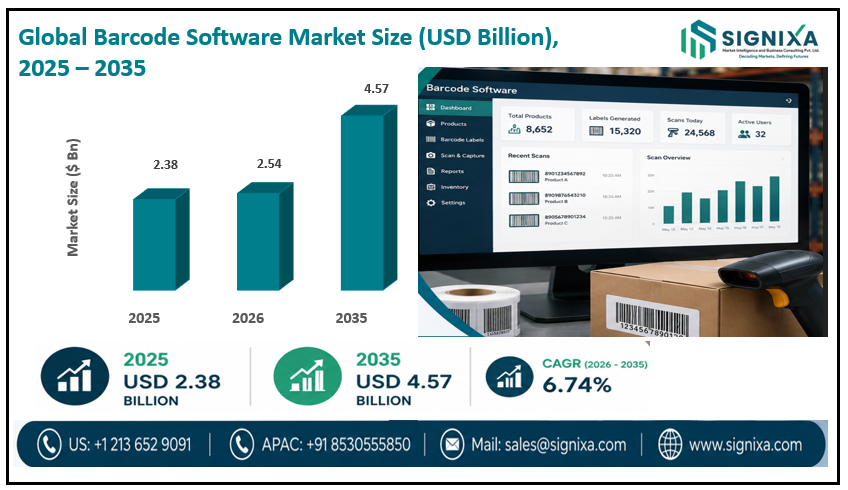
The global barcode software market was valued at approximately USD 2.38 Billion in 2025 and is forecasted to reach USD 4.57 Billion by 2035, growing at a compound annual growth rate (CAGR) of 6.74% from 2026 to 2035. The report assesses the market's drivers, restraints, and opportunities, offering a detailed analysis of growth factors influencing the demand throughout the forecast period.
Barcode software is increasingly used in various sectors such as healthcare, retail, manufacturing, and logistics for inventory management, asset tracking, and compliance. Barcode solutions allow for the automation of critical business processes, enhancing productivity and accuracy while reducing human error. As more businesses seek to streamline operations and improve operational efficiency, barcode software adoption continues to grow.
The barcode software market is an indispensable component of modern business operations, acting as the digital engine behind the ubiquitous physical barcodes seen on virtually every product. This software encompasses solutions for generating, printing, scanning, decoding, and managing barcode data, playing a critical role in streamlining processes across a multitude of industries. From basic 1D barcodes (like UPC/EAN) to more complex 2D barcodes (such as QR codes and Data Matrix), barcode software enables efficient data capture, eliminating manual entry errors and significantly improving accuracy. The market's consistent growth is primarily fuelled by the increasing need for automated data collection, improved inventory management, enhanced supply chain visibility, and the rising demand for product traceability in a globalized marketplace. Businesses across retail, manufacturing, logistics, healthcare, and e-commerce rely on barcode software to optimize workflows, reduce operational costs, and make data-driven decisions.
A major dynamic shaping the barcode software market is the relentless drive towards digitalization and automation across various business functions. As industries transition from paper-based processes to digital workflows, barcode software serves as a crucial bridge, enabling quick and accurate data capture that seamlessly integrates with enterprise resource planning (ERP) systems, warehouse management systems (WMS), point-of-sale (POS) systems, and other business applications. This integration eliminates data silos, provides real-time insights into inventory levels, sales trends, and asset locations, and ultimately enhances operational efficiency. Furthermore, the proliferation of mobile devices with built-in camera scanning capabilities has democratized barcode scanning, allowing businesses to leverage smartphones and tablets for various tasks, from inventory counts in small businesses to mobile payment applications. This mobile-first approach, combined with cloud-based deployment models, offers greater flexibility, scalability, and cost-effectiveness, making barcode software accessible to a broader range of organizations, including small and medium-sized enterprises (SMEs).
The market is also profoundly influenced by the growing demand for advanced analytics and intelligent features. Beyond basic scanning and data capture, modern barcode software solutions are increasingly incorporating sophisticated capabilities like artificial intelligence (AI) and machine learning (ML). AI-powered barcode readers can decode damaged, poorly printed, or low-contrast barcodes with greater accuracy and speed, even in challenging industrial environments. This reduces errors and minimizes downtime caused by unreadable codes. Furthermore, the integration of barcode data with business intelligence tools allows for deeper analysis of inventory movement, sales patterns, and supply chain performance, enabling predictive analytics and more informed decision-making. The shift towards "smarter" barcode solutions, capable of handling complex data sets and providing actionable insights, is driving innovation and expanding the market's reach and value proposition across manufacturing, logistics, and retail.
Key Findings
- The barcode software market is expected to grow at a CAGR of 6.74% from 2026 to 2035.
- In terms of revenue, the market was valued at USD 2.38 Billion in 2025 and is projected to reach USD 4.57 Billion by 2035.
- The cloud-based deployment model is gaining traction due to its flexibility and cost-effectiveness, with an increasing number of businesses shifting to cloud-based solutions.
- The retail sector is the largest application area for barcode software, driven by the need for efficient point-of-sale systems and inventory management.
- North America is expected to dominate the barcode software market during the forecast period due to advanced infrastructure and high technology adoption rates.
Barcode Software Market Dynamics
Rising Automation Demand, E-Commerce Growth & Real-Time Inventory Tracking
The barcode software market is expanding due to several key drivers, including the increasing need for automation in various industries, the rise in e-commerce, and the demand for real-time inventory tracking. Barcode software improves accuracy and efficiency by automating data capture, reducing human errors, and streamlining processes. In retail, the growth of e-commerce is pushing companies to optimize their inventory and supply chain management, leading to higher demand for barcode solutions. These solutions also provide real-time insights, enabling better decision-making and reducing operational costs.
Healthcare Adoption & Logistics Digitization Driving Sector-Level Demand
The healthcare sector is also experiencing a strong uptake in barcode software usage, as hospitals and healthcare facilities look for ways to enhance patient safety, manage medications, and improve asset tracking. Barcode software can streamline operations, reduce medical errors, and support regulatory compliance in the healthcare industry. Moreover, increased emphasis on patient care and safety protocols is driving the demand for efficient tracking and monitoring solutions. In the logistics and transportation sector, barcode software is being used for real-time tracking of goods, improving operational efficiency and delivery timelines.
Industry 4.0, IoT Integration & Advanced Barcode Type Evolution
The ongoing digital transformation across industries, particularly in manufacturing and government sectors, is further propelling market growth. The adoption of Industry 4.0 technologies, including IoT and AI, is integrating barcode software with advanced systems, enabling real-time tracking of assets, inventory, and shipments. As production processes become more automated and connected, the demand for barcode software is anticipated to grow. Furthermore, technological advancements in barcode types such as QR codes and 2D barcodes, offering enhanced data storage and faster scanning, are also contributing to the growth of the market.
Cloud Migration, Mobile Scanning & Smarter AI-Powered Barcode Solutions
The barcode software market is undergoing a significant transformation, primarily driven by the imperative for digitalization and automation across various industries. Barcode software serves as a crucial enabler in this digital shift, providing the tools to generate, print, scan, and manage barcode data seamlessly. The proliferation of mobile devices, with their integrated camera scanning capabilities, has further democratized barcode scanning, making it a cost-effective solution for small and medium-sized enterprises (SMEs) as well. The move towards cloud-based deployment models also offers greater flexibility, scalability, and accessibility, removing the need for hefty on-premise infrastructure and reducing initial investment costs, thereby broadening the market's reach. The integration of AI and ML into barcode software is revolutionizing accuracy and efficiency, enabling AI-powered readers to decode damaged or low-contrast barcodes with greater reliability and enabling predictive analytics for operational optimization.
Implementation Costs, Integration Complexity & Data Security Challenges
Despite its robust growth, the barcode software market faces significant challenges that influence its adoption and evolution. One of the primary hurdles is the initial cost of implementation, particularly for comprehensive systems that require specialized hardware, software licenses, and integration with existing enterprise systems. While the long-term return on investment (ROI) is evident through improved efficiency and cost savings, the upfront capital expenditure can be a deterrent for smaller businesses. Another challenge lies in ensuring data compatibility and seamless integration with disparate legacy systems, requiring significant technical expertise. Furthermore, data security and privacy concerns are increasingly relevant, as barcode systems handle vast amounts of product and operational data. Protecting this information from unauthorized access, cyber threats, and ensuring compliance with evolving data protection regulations (like GDPR) is a continuous challenge that requires robust security measures and careful software design.
Barcode Software Market Segmentation Analysis
By Deployment Segment Analysis
Cloud-Based
The cloud-based deployment model has gained popularity due to its cost-effectiveness and scalability. The global cloud-based barcode software market is expected to grow significantly, with a CAGR of 7.3% from 2026 to 2035. Cloud solutions reduce the need for on-premise hardware and enable seamless integration across different business operations. The ability to access barcode data remotely, scale capacity on demand, and receive automatic software updates without disruption makes cloud deployment increasingly preferred by businesses across all size segments. Growing adoption among SMEs, where limited IT infrastructure makes cloud particularly attractive, is a key contributor to this segment's strong growth trajectory.
On-Premise
On-premise barcode software, while more traditional, remains a strong choice in industries requiring high security and control over data. This segment is projected to grow at a CAGR of 5.1%, with businesses in sectors such as healthcare and government continuing to prefer on-premise solutions for critical operations. Organizations with stringent data sovereignty requirements, complex legacy system integrations, or regulatory mandates that restrict cloud usage continue to rely on on-premise deployments. The segment also benefits from one-time licensing models that can be more cost-effective for large enterprises with stable, long-term operational needs.
By Application Segment Analysis
Inventory Management
Inventory management remains the largest application for barcode software, with a market share of approximately 40%. As businesses focus on reducing inventory costs and improving supply chain efficiency, barcode software provides real-time tracking, better stock visibility, and more accurate inventory counts, contributing to the sector's growth. The rise of omnichannel retail and just-in-time manufacturing strategies has further elevated the importance of accurate, real-time inventory data, making barcode-enabled inventory management an essential operational capability across industries globally.
Asset Tracking
The asset tracking application is gaining traction, particularly in industries such as manufacturing and healthcare. The asset tracking market is expected to grow at a CAGR of 8.2%, driven by the growing need for efficient asset management and reduced operational costs. Organizations are increasingly deploying barcode-based asset tracking systems to monitor the location, usage, and maintenance status of equipment and tools in real time, minimizing asset loss and improving utilization rates across facilities.
Point of Sale
The point of sale application is a significant market segment for barcode software, especially in retail. Barcode software helps retail businesses streamline checkout processes, manage inventory, and improve customer experience, contributing to a projected growth rate of 6.1%. The ongoing shift to omnichannel retailing and the integration of POS systems with loyalty programs, digital receipts, and real-time inventory updates are further driving the adoption of sophisticated barcode-enabled POS solutions across both large retail chains and independent merchants globally.
Shipping and Receiving
Barcode software used in shipping and receiving operations helps businesses track goods in transit. The market for this application is forecasted to grow at a CAGR of 6.3%, driven by the growing demand for real-time visibility and process automation in logistics. E-commerce expansion and the increasing complexity of global supply chains are compelling logistics operators to adopt advanced barcode solutions for accurate parcel tracking, proof of delivery, and error-free warehouse operations across entire distribution networks.
Compliance Management
Compliance management is a growing application of barcode software, particularly in regulated industries like pharmaceuticals and food. This segment is expected to expand at a CAGR of 7.5%, as businesses face increasing pressure to adhere to regulatory requirements and manage compliance data efficiently. Serialization mandates in pharmaceutical supply chains, traceability requirements in food and beverage, and lot-tracking needs in chemical manufacturing are all driving adoption of barcode-enabled compliance management systems globally.
By Vertical Segment Analysis
Healthcare
Barcode software adoption is booming in healthcare, with the sector witnessing a CAGR of 7.9%. Barcode software helps track medical equipment, manage medication, and improve patient safety, which is critical in maintaining healthcare standards and improving operational efficiency. Patient wristband scanning for identity verification, medication barcode verification at point of care, and surgical instrument tracking are all expanding use cases driving rapid adoption of sophisticated barcode solutions in clinical and hospital settings worldwide.
Manufacturing
In manufacturing, barcode software plays a key role in streamlining production processes and improving inventory management. This sector is expected to grow at a CAGR of 6.7%, driven by the industry's increasing focus on automation and digital transformation. Industry 4.0 adoption is accelerating the integration of barcode systems with production line sensors, ERP platforms, and quality control systems, enabling end-to-end product traceability from raw material intake to finished goods dispatch.
Retail
Retail remains a dominant vertical, driven by the need for efficient inventory management and point-of-sale systems. The retail barcode software market is projected to grow at a CAGR of 6.2%, with the increasing shift to omnichannel retailing. The proliferation of self-checkout stations, mobile POS solutions, and BOPIS (buy online, pick up in store) fulfillment models is expanding the breadth of barcode software applications across both physical retail environments and e-commerce fulfillment centers.
Transportation & Logistics
Barcode software is essential for tracking shipments and managing logistics operations. The sector is projected to grow at a CAGR of 6.8%, with increased e-commerce activities and the push for supply chain optimization. Last-mile delivery tracking, cross-docking operations, and automated sortation systems in large distribution centers are all driving the deployment of advanced barcode scanning technologies and integrated software management platforms across the global logistics industry.
Government & Public Sector
Barcode software in the government and public sector, used for asset management and tracking, is expected to grow at a CAGR of 5.3%, as governments invest in technologies to improve efficiency and transparency. Library management systems, property and evidence tracking in law enforcement, vehicle registration management, and public utility asset monitoring are key use cases driving steady barcode software adoption across local, state, and federal government agencies globally.
By Barcode Type Segment Analysis
1D Barcodes
1D barcodes are widely used in retail and logistics for tracking products and shipments. This segment holds a market share of 55% and is projected to grow steadily, with a CAGR of 5.8%, as they remain a cost-effective and efficient solution for many applications. The simplicity, low printing cost, and universal hardware compatibility of 1D barcodes (including UPC, EAN, and Code 128 formats) ensure their continued dominance as the baseline standard for product identification across global retail and supply chain operations.
2D Barcodes
2D barcodes, including Data Matrix and PDF417, are used in industries like manufacturing and healthcare for more complex data storage. The 2D barcode market is expected to grow at a CAGR of 8.1%, as they enable higher data capacity and more secure tracking. Their ability to store hundreds of characters of alphanumeric data in a compact label footprint makes them ideal for pharmaceutical serialization, aerospace component tracking, and electronics manufacturing where comprehensive part-level data must accompany products throughout their lifecycle.
QR Codes
QR codes are becoming increasingly popular in mobile commerce, marketing, and payments. The market for QR codes is projected to grow at a CAGR of 9.2%, driven by their widespread use in consumer-facing applications and the increasing adoption of smartphones. Contactless payment systems, restaurant digital menus, product authentication campaigns, event ticketing, and the GS1 Digital Link standard enabling QR codes to replace traditional barcodes on product packaging are all fueling explosive growth in QR code software adoption globally.
Report Attributes & Market Scope
| Report Attribute | Details |
|---|---|
| Market Size Value in 2025 | USD 2.38 Billion |
| Market Size Value in 2035 | USD 4.57 Billion |
| CAGR (2026-2035) | 6.74% |
| Base Year Used for Estimation | 2025 |
| Historic Data | 2020 -2025 |
| Forecast Period | 2026 -2035 |
| Segments Covered -By Deployment |
|
| Segments Covered -By Application |
|
| Segments Covered -By Vertical |
|
| Segments Covered -By Barcode Type |
|
| Regions Covered | North America, Europe, Asia Pacific, Latin America, Middle East and Africa |
| Major Countries Covered | U.S., Canada, Mexico, Germany, UK, France, Italy, Spain, Russia, China, Japan, South Korea, India, Southeast Asia Countries, Brazil, Argentina, GCC Countries, Turkey, Iran, Israel, South Africa, Egypt, Nigeria, etc. |
| Key Companies Profiled | Zebra Technologies, Honeywell International, SATO Holdings Corporation, Datalogic, Cognex Corporation, Intermec Technologies (now part of Honeywell), Teklynx International, and BarTender Software. |
Barcode Software Market Regional Analysis
North America is expected to dominate the global barcode software market due to its technological advancements, high adoption rate, and a strong presence of key players in the region. The U.S. is a leader in implementing barcode technology across healthcare, manufacturing, and retail sectors. Europe also holds a significant market share, with rapid adoption of barcode software in industries such as healthcare and logistics. The Asia-Pacific region is projected to witness the fastest growth, driven by industrialization, e-commerce, and growing infrastructure needs in countries like China, India, and Japan. Latin America and the Middle East & Africa are emerging markets, with increasing adoption of barcode technology driven by logistics, retail, and government initiatives.
North America (Dominant Region)
North America holds a dominant position in the global barcode software market, driven by a highly digitized industrial landscape, widespread adoption of automation technologies, and a mature retail and e-commerce sector. The United States, in particular, is a significant contributor, with a vast number of businesses across manufacturing, logistics, healthcare, and retail heavily relying on barcode solutions for efficient inventory management, asset tracking, and point-of-sale operations. The region benefits from the presence of numerous key barcode software providers and a strong emphasis on integrating barcode data with enterprise resource planning (ERP) and warehouse management systems (WMS). The increasing digitalization trend across industries, coupled with the growing preference for cloud-based barcode software solutions for their scalability and accessibility, further fuels market expansion. The continuous evolution towards 2D barcodes and the adoption of AI-powered barcode readers for enhanced accuracy in challenging environments are also prominent trends shaping the North American market.
Europe
Europe holds a significant share of the global barcode software market, with rapid adoption across healthcare, logistics, manufacturing, and retail sectors. The region's stringent regulatory environment -including EU serialization mandates in pharmaceuticals and traceability requirements in food -is a major driver of barcode software adoption. European manufacturers are embracing Industry 4.0 principles, integrating barcode systems with smart factory infrastructure to enable end-to-end production traceability. The region's well-established logistics and e-commerce infrastructure further supports demand, while GDPR compliance requirements are driving the development of security-enhanced barcode data management solutions. Leading economies including Germany, France, and the UK are at the forefront of enterprise barcode software adoption.
Asia-Pacific
The Asia-Pacific region is projected to witness the fastest growth in the barcode software market, driven by industrialization, e-commerce expansion, and growing infrastructure needs in countries like China, India, and Japan. China's massive manufacturing sector and the rapid adoption of QR codes for payments and consumer engagement are significant contributors to regional market growth. India's booming e-commerce ecosystem and government digital transformation initiatives are accelerating barcode software adoption across logistics and retail. Japan continues to lead in advanced barcode applications within precision manufacturing and healthcare. Growing smartphone penetration across Southeast Asia is also enabling mobile barcode scanning solutions to reach new user segments in previously underserved markets.
Middle East & Africa
The Middle East and Africa represent emerging markets for barcode software, with increasing adoption driven by logistics, retail, and government initiatives. GCC countries, particularly the UAE and Saudi Arabia, are investing in smart logistics infrastructure and digital retail transformation as part of broader economic diversification programs including Vision 2030. Government e-governance projects requiring asset tagging and tracking are creating new demand for barcode software across the public sector. In Africa, growing mobile penetration and the expansion of formal retail and logistics networks are gradually creating conditions for broader barcode solution adoption, particularly in South Africa, Nigeria, and Kenya.
Latin America
Latin America is an emerging market for barcode software, with growing adoption driven by expanding retail, logistics, and government sectors. Brazil and Mexico are the primary contributors, with established retail chains, automotive manufacturers, and e-commerce operators increasingly adopting barcode solutions for inventory management and supply chain tracking. Government mandates related to tax compliance and product traceability -particularly in Brazil's complex fiscal environment -are creating regulatory-driven demand for barcode labeling and management software. Growing cross-border e-commerce flows and the modernization of customs and logistics infrastructure are expected to sustain steady barcode software market expansion across the region through 2035.
Recent Developments in the Barcode Software Market
-
2026
Zebra Technologies better scanning and visibility with AI that will automate software capabilities.
Datalogic launched eco-designed Gryphon 4600 series of handheld barcode scanners.
Honeywell sold its Productivity Solutions and Services business to Brady Company for $1.4 billion.
-
2025
Zebra Technologies the software and scanning ecosystem expanded for retail and supply-chain automation.
Cognex released AI-enabled DataMan 290 and 390 series barcode readers to bolster manufacturing-speed decoding.
Datalogic continues to augment its data-capture and barcode-scanning portfolio in multiple markets.
Honeywell scanning with SwiftDecoder Vision Software for advanced barcode decoding and character recognition.
Barcode Software Market: Competitive Landscape
Key players in the barcode software market include Zebra Technologies, Honeywell International, Datalogic, Sato Holdings, and Cognex Corporation. The competitive landscape is characterized by ongoing technological advancements and innovations. Companies are focusing on enhancing the performance of their software and integrating advanced features such as cloud-based solutions, real-time analytics, and AI-powered capabilities to stay ahead in the market. Additionally, major players are focusing on partnerships and acquisitions to expand their product offerings and gain market share. The demand for barcode solutions is expected to rise as businesses increasingly recognize their value in optimizing operations and improving efficiency across various sectors.
The competitive dynamics of the barcode software market are increasingly shaped by the convergence of hardware and software capabilities. Established hardware manufacturers like Zebra Technologies and Honeywell are deepening their software portfolios to offer end-to-end solutions, while pure-play software providers are differentiating through specialized applications and deep vertical expertise. Cloud-native barcode software startups are disrupting traditional on-premise incumbents by offering subscription-based pricing, rapid deployment, and seamless integration with popular ERP and e-commerce platforms. The ability to deliver mobile-first, API-driven barcode solutions that connect physical scanning events to broader enterprise data ecosystems is emerging as a critical competitive differentiator.
Investment in research and development remains central to competitive strategy, with leading players exploring the next frontier of barcode technology including GS1 Digital Link standards that enable QR codes to serve dual purposes for both supply chain and consumer engagement applications. Strategic acquisitions continue to reshape the competitive landscape, with larger players acquiring specialized solution providers to rapidly expand their capabilities in high-growth verticals such as healthcare and pharmaceutical compliance. Channel strategy is also evolving, with vendors building robust partner ecosystems of system integrators, value-added resellers, and independent software vendors to accelerate market penetration across geographies and industry verticals.
Key Companies Profiled
- Zebra Technologies
- Honeywell International
- SATO Holdings Corporation
- Datalogic
- Cognex Corporation
- Intermec Technologies (Honeywell)
- Teklynx International
- BarTender Software
- Wasp Barcode Technologies
- TEKLYNX International
- Seagull Scientific
- Loftware
- NiceLabel
- Bluebird Inc.
- Toshiba TEC Corporation
- Denso Wave Incorporated
- Scandit AG
- Opticon
- NCR Corporation
- TEC-IT Datenverarbeitung GmbH
- Jolly Technologies
Global Barcode Software Market Segmentation Summary
By Deployment
- Cloud-based
- On-premise
By Application
- Inventory Management
- Asset Tracking
- Point of Sale
- Shipping and Receiving
- Compliance Management
By Vertical
- Healthcare
- Manufacturing
- Retail
- Transportation and Logistics
- Government and Public Sector
By Barcode Type
- 1D Barcodes
- 2D Barcodes
- QR Codes
By Region
- North America
- U.S.
- Canada
- Mexico
- Europe
- Germany
- France
- UK
- Spain
- Italy
- Rest of Europe
- Asia-Pacific
- China
- Japan
- India
- Australia
- South Korea
- Southeast Asia
- Rest of Asia-Pacific
- Latin America
- Brazil
- Argentina
- Rest of Latin America
- The Middle East & Africa
- GCC Countries
- South Africa
- Rest of the Middle East & Africa
Frequently Asked Questions (FAQs) About the Barcode Software Market
What is Barcode Software?
Barcode software is a tool used to generate, read, and manage barcodes in various formats (such as 1D, 2D, QR codes). It enables businesses to track and manage inventory, assets, sales transactions, shipping, and compliance.
Which key factors will influence the Barcode Software market growth over 2026-2035?
The Barcode Software market is expected to grow due to increasing demand for inventory management solutions, the adoption of automated systems for asset tracking, and the expansion of e-commerce and retail sectors. Advancements in cloud technology, AI integration, and the need for more efficient point-of-sale systems will also drive growth.
What will be the value of the Barcode Software market during 2026-2035?
According to the study, the global Barcode Software market size was worth around USD 2.38 Billion in 2025 and is predicted to grow to around USD 4.57 Billion by 2035.
What will be the CAGR value of the Barcode Software market during 2026-2035?
The CAGR value of the Barcode Software market is expected to be around 6.74% during the forecast period from 2026 to 2035.
Which region will contribute notably towards the Barcode Software market value?
The global Barcode Software market is led by North America and Europe, driven by strong industrial development, technological advancements, and high adoption across retail, logistics, and healthcare. The Asia-Pacific region is expected to experience significant growth due to the rise in manufacturing and e-commerce activities.
Which are the major players leveraging the Barcode Software market growth?
The global Barcode Software market is led by players such as Zebra Technologies, Honeywell International, SATO Holdings Corporation, Datalogic, Cognex Corporation, Intermec Technologies (now part of Honeywell), Teklynx International, and BarTender Software.
What can be expected from the global Barcode Software market report?
The report explores critical aspects of the Barcode Software market, providing an in-depth analysis of growth drivers, restraints, and future opportunities. It offers detailed segmentation covering deployment models, applications, verticals, and barcode types, along with competitive landscape and regional insights that impact the market's development.