
Medical Simulation Market Overview
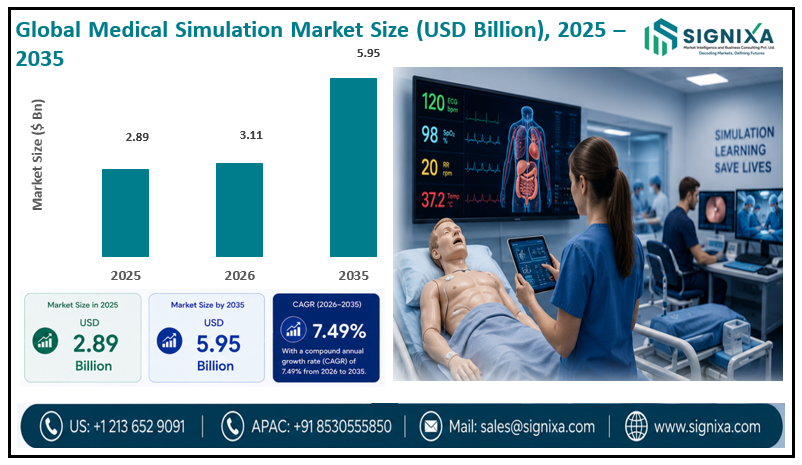
The size of the global medical simulation market was worth around USD 2.89 Billion in 2025 and is predicted to grow to around USD 5.95 Billion by 2035, with a compound annual growth rate (CAGR) of roughly 7.49% between 2026 and 2035. The report analyzes the medical simulation market's drivers and restraints, as well as the impact they have on demand throughout the projection period. In addition, the report examines global opportunities in the global medical simulation market.
The medical simulation market encompasses a range of technologies and products designed to enhance medical training and education by replicating clinical scenarios. Simulation tools help professionals improve their decision-making and procedural skills without risking patient safety. The market is gaining momentum due to the growing emphasis on patient safety, increased use of minimally invasive surgeries, and the demand for virtual training due to technological advancements. Medical simulation is now a key part of modern healthcare education across hospitals, academic institutions, and military training facilities.
The medical simulation market is rapidly advancing as healthcare institutions increasingly adopt immersive technologies to enhance clinical training and patient safety. Medical simulation enables realistic, risk-free practice environments for students, surgeons, and nursing professionals, reducing errors and improving outcomes. High-fidelity manikins, AR/VR-based platforms, and computer-based simulation models are being used to replicate emergency scenarios, surgical procedures, and patient interactions. Academic institutions and hospitals are integrating simulation labs into medical curricula to train students in procedural skills, decision-making, and team coordination. The COVID-19 pandemic significantly boosted adoption, highlighting the value of remote and virtual training tools. Medical licensing bodies and accrediting organizations are also encouraging simulation-based assessments as part of certification processes, making simulation an indispensable part of workforce training globally.
Key Findings
- As per the analysis shared by our research analyst, the global medical simulation market is estimated to grow annually at a CAGR of around 7.49% over the forecast period (2026-2035).
- In terms of revenue, the global medical simulation market size was valued at around USD 2.89 Billion in 2025 and is projected to reach USD 5.95 Billion by 2035.
- Based on Type, the Simulation Software segment is expected to grow significantly due to increasing adoption in remote learning.
- By Application, the Surgical Simulation segment is projected to command the largest market share.
- On the basis of End Use, Hospitals are anticipated to lead the market throughout the forecast period.
- By Region, North America is projected to dominate the global market due to advanced healthcare infrastructure and investment in medical education.
Medical Simulation Market Dynamics
Patient Safety Imperative & Minimally Invasive Surgery Growth Driving Simulation-Based Training Adoption
One of the major drivers for the medical simulation market is the increasing emphasis on patient safety and the growing demand for minimally invasive procedures. Simulation training allows healthcare professionals to practice complex techniques, improve patient outcomes, and reduce medical errors. With growing awareness about adverse events caused by untrained personnel, simulation-based training programs have become an essential part of curricula across healthcare institutions. The growing complexity of clinical procedures, combined with ethical concerns around training on real patients, is accelerating demand for simulation solutions that provide safe, repeatable, and assessable practice environments. The rising number of medical institutions, nursing schools, and the need for continuous medical education is supporting market growth, with academic institutions increasingly adopting simulation labs and digital modules to supplement conventional learning.
VR, AR, AI & Haptic Feedback Innovations Creating Immersive, Real-Time Clinical Decision-Making Training Environments
Another important factor driving the market is the rising demand for advanced technologies like virtual reality and haptic feedback in medical training. These innovations offer an immersive and interactive learning environment for students and professionals. Virtual reality-based simulations create real-time scenarios where users can experience and respond to dynamic clinical situations, thereby improving clinical decision-making skills. Research in cognitive load theory, skill retention, and team-based learning has validated the effectiveness of simulation-based education, prompting widespread adoption in academic and clinical settings. Innovations like VR, AR, and AI are enabling dynamic, lifelike scenarios that mimic rare or complex clinical situations, allowing trainees to practice high-stakes interventions — such as emergency surgeries and critical care — without risking patient lives.
Regulatory Endorsement, Certification Requirements & Post-Pandemic Digital Training Acceleration Sustaining Market Momentum
Governments and medical boards are increasingly recognizing simulation in certification and licensure, fueling demand for standardized simulation programs. In low-resource settings, portable and cost-efficient simulation models are being developed through research partnerships. Additionally, post-pandemic emphasis on remote training and digital health tools has further accelerated market momentum. The market dynamics of medical simulation are being shaped by a strong focus on patient safety, advances in research-driven simulation technology, and the growing need for skilled healthcare professionals. As healthcare becomes more interdisciplinary, simulation supports collaborative training across specializations, improving communication and decision-making. Cloud-based simulation software is gaining traction due to its flexibility, scalability, and accessibility across geographies, enabling institutions to conduct remote training and assessments. As evidence continues to demonstrate improved outcomes from simulation-based learning, investment and innovation in this space are expected to grow rapidly through the forecast period.
Medical Simulation Market Segmentation Analysis
By Type Segment Analysis
The market is segmented by product type, with each category addressing distinct modalities of clinical training — from digital software platforms to physical high-fidelity equipment and anatomical practice models — across diverse healthcare education settings:
Simulation Software
Simulation Software accounted for the highest revenue share in 2025, driven by increased use in online and remote training programs. Valued at over USD 1.10 Billion in 2025, this segment benefits from growing digitization in medical education. Simulation software in the medical field plays a vital role in enhancing healthcare training, decision-making, and patient safety. These platforms recreate clinical scenarios through computer-generated environments, allowing medical professionals and students to practice procedures, diagnose conditions, and manage emergencies without risk to real patients. The software often integrates technologies like 3D modeling, artificial intelligence, and haptics to deliver immersive, interactive experiences across various specialties — such as surgery, anesthesiology, and trauma care. Cloud-based simulation software is gaining traction due to its flexibility, scalability, and accessibility across geographies, enabling institutions to conduct remote training and assessments. Its continuous evolution supports standardized skill development, promotes critical thinking, and ultimately contributes to higher standards of care delivery.
Simulation Equipment
Simulation Equipment also plays a vital role in high-fidelity physical models and virtual environments. This segment encompasses high-fidelity patient simulators (manikins), laparoscopic trainers, endoscopy simulators, surgical robot training systems, and other physical training devices that provide hands-on procedural practice for clinical trainees. High-fidelity simulation equipment can replicate complex physiological responses including breathing, pulse, pupil reactions, and vascular dynamics, enabling realistic clinical scenario training that is not achievable through software alone. The integration of simulation equipment with software platforms creates comprehensive training ecosystems where trainee performance is captured, analyzed, and fed back in real time. Growing simulation center investments by hospitals and academic medical centers globally are sustaining strong demand for advanced simulation equipment across all clinical specialties through the forecast period.
Simulation Models
Simulation Models are expected to grow steadily due to their adoption in hands-on practice scenarios for anatomy and procedural training across hospitals and educational institutions. These physical models include task trainers, anatomical models, IV insertion arms, suturing practice pads, and organ models that enable targeted skill practice for specific clinical procedures. Simulation models offer a cost-effective entry point to simulation-based training, making them particularly valuable for institutions with limited budgets or for supplementing higher-cost high-fidelity simulation equipment. The ongoing demand for procedural skill training in nursing education, medical school anatomy courses, and paramedic training programs sustains a large and stable market for simulation models. Growing adoption of 3D-printed anatomical models and synthetic tissue replicas — which provide enhanced realism at accessible price points — is driving innovation within this segment through the forecast period.
By Application Segment Analysis
Surgical Simulation
Surgical Simulation dominates the application segment, contributing over 35% of global revenue in 2025. This is driven by its critical role in improving skills for laparoscopic and robotic surgeries. Surgical simulation is revolutionizing medical training by offering a risk-free, realistic environment for surgeons to practice complex procedures. Advanced platforms replicate human anatomy and surgical scenarios using technologies such as VR, AR, haptic feedback, and 3D modeling. Trainees can perform incisions, sutures, and laparoscopic maneuvers with lifelike precision, improving their technical skills and decision-making before entering the operating room. Surgical simulation supports repeated practice, immediate feedback, and performance analytics, making learning both efficient and standardized. With growing emphasis on patient safety and outcomes, simulation helps reduce medical errors and build surgical confidence. Institutions increasingly rely on surgical simulators for competency assessments and continuing education, especially in specialties like orthopedics, neurosurgery, and minimally invasive procedures. As technology advances, surgical simulation continues to integrate AI-driven personalization and realistic patient variability, cementing its role as a critical pillar in surgical education and preparedness.
Patient Simulation
Patient Simulation follows surgical simulation, gaining traction in ICU and emergency care training. Patient simulation uses advanced manikins and computer-controlled physiological models to recreate complex clinical scenarios involving full patient assessment and management — including cardiac arrest response, respiratory failure management, anaphylaxis treatment, and obstetric emergencies. High-fidelity patient simulators that can breathe, speak, and exhibit realistic physiological responses enable clinicians and teams to practice complete clinical decision-making sequences from patient assessment through intervention. The growing adoption of team-based simulation training programs — that bring together physicians, nurses, paramedics, and other healthcare professionals to practice coordinated emergency responses — is creating sustained and growing demand for advanced patient simulation systems throughout the forecast period.
Procedural Simulation
Procedural Simulation is increasingly used for invasive tasks such as catheter insertion and airway management. This application segment covers targeted simulation training for specific clinical procedures including central venous catheter insertion, lumbar puncture, bronchoscopy, ultrasound-guided procedures, and vascular access. Procedural simulators provide realistic tactile feedback, anatomical accuracy, and performance measurement capabilities that enable clinicians to develop proficiency in high-risk, technically demanding procedures before performing them on patients. The growing body of clinical evidence demonstrating that simulation-based procedural training significantly reduces complication rates and improves first-attempt success rates is driving adoption across hospitals and medical schools globally. Regulatory requirements for documented procedural competency in many healthcare systems are further supporting the institutionalization of procedural simulation training programs through the forecast period.
Virtual Reality Simulation
Virtual Reality Simulation is expanding rapidly with advancements in wearable VR devices and increasing demand for immersive training experiences. VR simulation creates fully immersive three-dimensional clinical environments where trainees interact with virtual patients, clinical settings, and medical equipment using intuitive gesture and controller-based inputs. The scalability and content flexibility of VR simulation platforms — which can deploy diverse clinical scenarios ranging from routine patient assessments to rare emergency events — makes them increasingly attractive for medical schools and hospitals seeking to expand their simulation program offerings without corresponding increases in physical infrastructure. The rapid decline in VR hardware costs, combined with improving visual quality and motion tracking accuracy, is making VR simulation increasingly viable as a mainstream medical training tool. Integration with AI-driven patient behavior modeling and remote multi-user collaboration features is further expanding the application scope of VR simulation through the forecast period.
By End Use Segment Analysis
Hospitals
Hospitals held the largest share of the medical simulation market in 2025, accounting for over USD 1.35 Billion. The segment benefits from increasing integration of simulation training for clinical staff to improve response times and reduce errors. Major hospitals and health systems are investing in dedicated simulation centers equipped with high-fidelity manikins, surgical simulators, and VR platforms to provide ongoing training for nurses, residents, and attending physicians. The growing emphasis on measurable clinical competency, combined with accreditation requirements from organizations like the Joint Commission that mandate regular simulation-based training for specific clinical skills, is sustaining strong hospital sector demand. Hospitals are also increasingly using simulation for new technology onboarding — training clinical teams on new surgical robots, imaging systems, and monitoring equipment in simulation environments before first clinical use — creating recurring demand for simulation platform upgrades and content updates throughout the forecast period.
Academic Institutions
Academic Institutions also contribute significantly, particularly in undergraduate and postgraduate medical education. Medical schools, nursing programs, and allied health programs are integrating simulation labs as core components of their curricula, with simulation-based assessments increasingly used for graduation and licensing requirements. The validation of simulation as an effective pedagogical tool by medical education research — combined with accreditation standards from bodies like the Liaison Committee on Medical Education (LCME) in the U.S. that encourage or require simulation program implementation — is supporting consistent investment in simulation infrastructure at academic institutions globally. Large academic medical centers with affiliated teaching hospitals are creating comprehensive simulation ecosystems that serve both educational and clinical training purposes, representing some of the largest individual simulation infrastructure investments in the market through the forecast period.
Military Organizations
Military Organizations use simulation extensively for combat medicine training. Military medical training programs face unique requirements training personnel to manage traumatic injuries under combat conditions, with limited resources and in austere environments far from tertiary care facilities. Medical simulation provides a safe and repeatable platform for training combat medics, flight surgeons, and military nurses in trauma management, mass casualty triage, and advanced life support under simulated field conditions. Military organizations are significant investors in high-fidelity simulation technology, driving innovation in portable and ruggedized simulation systems that can be deployed to field training environments. The growing recognition of combat casualty care as a critical military capability is sustaining continued investment in advanced military medical simulation programs across NATO and allied nations through the forecast period.
Healthcare Providers
Healthcare Providers such as private clinics are adopting simulation tools to ensure quality treatment and certification of staff. This segment encompasses private outpatient clinics, specialty care centers, diagnostic imaging providers, and other healthcare organizations outside the hospital and academic settings. As simulation-based training becomes an increasingly expected component of clinical staff competency verification, private healthcare providers are investing in simulation solutions to support staff onboarding, procedural skill refreshment, and clinical protocol training. The growing adoption of tele-simulation and cloud-based simulation platforms is making simulation-based training accessible to smaller private healthcare providers that lack the resources to establish dedicated on-site simulation facilities, expanding the addressable market for simulation solutions across the broader healthcare provider segment through the forecast period.
By Technology Segment Analysis
High-Fidelity Simulation
High-Fidelity Simulation technology led the market in 2025, accounting for over 42% of the total market value. These solutions offer realistic and immersive training, critical for developing proficiency in complex procedures. High-fidelity simulators replicate human physiological responses with exceptional accuracy — including spontaneous breathing, realistic heart sounds, vascular pulses, pupillary reactions, and dynamic vital sign changes in response to clinical interventions. This level of physiological realism enables trainees to develop not only technical procedural skills but also the clinical pattern recognition and critical decision-making abilities essential for managing complex or deteriorating patients. The premium positioning of high-fidelity simulation is supported by robust evidence of superior learning outcomes in complex clinical scenarios, sustaining institutional investment despite the higher acquisition cost compared to lower-fidelity alternatives. Ongoing technological advances are continuously improving the realism, reliability, and connectivity of high-fidelity simulation systems through the forecast period.
Low-Fidelity Simulation
Low-Fidelity Simulation continues to serve basic skill development and is popular in budget-constrained settings. Low-fidelity simulation encompasses task trainers, simple manikins, role-play standardized patients, and basic anatomical models that provide focused practice for specific clinical skills such as IV insertion, wound care, and basic life support. While lacking the physiological realism of high-fidelity systems, low-fidelity simulation is highly effective for initial skill acquisition and provides excellent cost-effectiveness for high-volume basic skills training. The widespread availability and low acquisition cost of low-fidelity simulation tools makes them the predominant simulation modality in developing countries and resource-constrained settings where the high upfront investment of sophisticated simulation systems is not feasible. Government programs and international development partnerships focused on healthcare education in low-income countries are sustaining demand for cost-effective low-fidelity simulation solutions through the forecast period.
Virtual Simulation
Virtual Simulation is rapidly gaining ground due to scalability and cost-effectiveness, making it ideal for remote education and large-scale training programs across institutions. Virtual simulation encompasses software-based clinical scenario platforms, VR/AR training applications, and computer-based patient management simulations that deliver clinical training without requiring physical infrastructure or consumable materials. The ability to deploy standardized simulation experiences simultaneously to unlimited learners across geographically distributed locations makes virtual simulation particularly valuable for national medical education programs, health system-wide training initiatives, and institutions with large student cohorts. The post-pandemic normalization of digital learning in medical education has significantly accelerated adoption of virtual simulation platforms. Continuous improvement in graphics quality, haptic integration, and AI-driven patient modeling is progressively closing the realism gap between virtual and high-fidelity physical simulation, expanding the clinical training applications addressable by virtual simulation through the forecast period.
Report Attributes & Market Scope
| Report Attribute | Details |
|---|---|
| Market Size Value in 2025 | USD 2.89 Billion |
| Market Size Value in 2035 | USD 5.95 Billion |
| CAGR (2026–2035) | 7.49% |
| Base Year Used for Estimation | 2025 |
| Historic Data | 2020 - 2025 |
| Forecast Period | 2026 - 2035 |
| Segments Covered – By Type |
|
| Segments Covered – By Application |
|
| Segments Covered – By End Use |
|
| Segments Covered – By Technology |
|
| Regions Covered | North America, Europe, Asia Pacific, Latin America, Middle East and Africa |
| Major Countries Covered | U.S., Canada, Mexico, Germany, UK, France, Italy, Spain, Russia, China, Japan, South Korea, India, Southeast Asia Countries, Brazil, Argentina, GCC Countries, Turkey, Iran, Israel, South Africa, Egypt, Nigeria, etc. |
| Key Companies Profiled | CAE Healthcare, Laerdal Medical, 3D Systems, Simulab Corporation, Gaumard Scientific, Limbs & Things, Mentice AB, VirtaMed, Surgical Science Sweden AB, and Kyoto Kagaku, among others. |
Medical Simulation Market Regional Analysis
North America is the leading region in the global medical simulation market, accounting for over 40% of global revenue in 2025. This dominance is attributed to strong healthcare infrastructure, substantial investments in simulation centers, and active participation from academic institutions. Europe follows closely, led by Germany and the UK, where simulation-based training is mandatory in many medical schools. Asia-Pacific is the fastest-growing region, with China, India, and Japan showing rapid adoption due to rising healthcare expenditure and growing awareness. Latin America and the Middle East & Africa are emerging regions, with increasing investment in healthcare education driving market opportunities.
North America (Dominant Region)
North America is the leading region in the global medical simulation market, accounting for over 40% of global revenue in 2025. This dominance is attributed to strong healthcare infrastructure, substantial investments in simulation centers, and active participation from academic institutions. The United States has hundreds of dedicated medical simulation centers at major academic medical centers, teaching hospitals, and independent simulation facilities that serve both educational and clinical training purposes. The accreditation framework established by the Society for Simulation in Healthcare (SSH) and the integration of simulation into licensing and credentialing processes by medical boards provide strong institutional drivers for continued simulation investment. The presence of major global simulation technology companies — including CAE Healthcare, Laerdal Medical, and Gaumard Scientific — with North American headquarters ensures a highly supportive innovation ecosystem for the region's continued market leadership through the forecast period.
Europe
Europe's medical simulation market is witnessing strong growth driven by innovation, academic collaboration, and regulatory backing. Countries like Germany, the UK, France, and the Netherlands are leading in adopting simulation-based training across medical universities and hospitals. Research institutions are increasingly integrating advanced technologies such as virtual reality, augmented reality, and 3D anatomical modeling to enhance realism in training scenarios. European healthcare systems emphasize patient safety and procedural accuracy, and simulation tools have become vital for training clinicians in complex procedures like laparoscopic surgeries, cardiac interventions, and emergency care. Regional bodies and medical education boards are supporting standardized simulation programs to ensure consistency in learning outcomes across countries. The presence of established simulation centers and government-funded initiatives to develop digital healthcare infrastructure further accelerate adoption. Cross-border research projects and public-private partnerships continue to expand the simulation landscape, making Europe a robust and collaborative hub for medical simulation innovation.
Asia-Pacific (Fastest-Growing Region)
The Asia Pacific medical simulation market is experiencing robust growth driven by increasing investment in healthcare infrastructure, rising demand for skilled healthcare professionals, and the integration of cutting-edge technologies. Countries like China, India, Japan, and South Korea are spearheading adoption through government-supported initiatives and digital health education reforms. Medical institutions across the region are deploying VR, AR, and AI-based simulators to enhance training quality and patient safety. The shift toward minimally invasive surgeries and telemedicine has further fueled simulation demand, especially in remote learning environments. Mobile simulation units and cloud-based platforms are gaining traction for training in rural or underserved regions. Educational institutions and hospitals are collaborating with tech providers to develop localized, cost-effective simulators tailored to regional medical challenges. While urban centers embrace high-fidelity manikins and full-scale simulation labs, developing regions focus on low-cost, portable models to improve accessibility, positioning Asia Pacific as a key innovation hub for simulation technology through the forecast period.
Middle East & Africa
The Middle East & Africa (MEA) medical simulation market is experiencing progressive growth, fueled by a rising focus on improving healthcare training, reducing clinical risks, and adopting innovative technologies. Countries like the UAE, Saudi Arabia, and South Africa are making significant strides by investing in simulation centers equipped with advanced mannequins and virtual reality tools for surgical and emergency care training. The growing collaboration between academic institutions and healthcare providers is promoting simulation-based education to enhance clinical proficiency. In regions with limited resources, low-cost simulation tools and mobile training units are being introduced to extend access. Additionally, initiatives like tele-simulation are helping bridge gaps in rural and underserved areas. Although infrastructure limitations and high setup costs remain challenges, governments and private sector players are increasingly supporting simulation-based programs to improve medical outcomes. With rising awareness about patient safety and continuous professional development, MEA is steadily evolving into a promising landscape for simulation technologies in healthcare education and training.
Latin America
Latin America is an emerging region for medical simulation, with increasing investment in healthcare education driving market opportunities. Brazil and Mexico are the primary contributors, each benefiting from growing networks of medical schools, nursing programs, and teaching hospitals that are progressively adopting simulation-based training to improve the quality and standardization of healthcare professional education. Government health policy initiatives focused on improving healthcare quality and reducing medical errors are creating institutional pressure to invest in simulation infrastructure. The growing private healthcare sector across Latin America is also adopting simulation for staff training and quality assurance purposes. International simulation equipment manufacturers and software providers are increasingly establishing distribution and support partnerships in the region to capture growing demand, with localized content development and Spanish/Portuguese language simulation platforms becoming important competitive differentiators through the forecast period.
Recent Developments in the Medical Simulation Market
-
2026
Kyoto Kagaku introduced new clinical skills trainers and anatomical simulators to support competency-based medical education and healthcare workforce development.
Limbs & Things expanded its procedural training portfolio with advanced task trainers focused on emergency medicine, surgery, and nursing education.
Inovus Medical increased the adoption of portable laparoscopic and robotic surgery simulators through partnerships with hospitals and medical training centers.
-
2025
Mentice AB expanded its endovascular simulation technologies to provide more realistic catheter-based procedure training for healthcare providers.
Gaumard Scientific launched upgraded high-fidelity patient simulators with enhanced physiological modeling and improved performance feedback capabilities.
Laerdal Medical broadened its immersive simulation portfolio with advanced patient safety and resuscitation training solutions for healthcare professionals and academic institutions.
Medical Simulation Market: Competitive Landscape
Key players in the global medical simulation market include CAE Healthcare, Laerdal Medical, 3D Systems, Simulab Corporation, Gaumard Scientific, Limbs & Things, Mentice AB, VirtaMed, Surgical Science Sweden AB, and Kyoto Kagaku. These companies are focused on product innovation, partnerships with educational institutions, and expanding their geographic presence. As competition intensifies, players are investing in AI-powered analytics, cloud-based simulation platforms, and portable simulation units to cater to growing demand across both developed and emerging regions.
The competitive landscape of the medical simulation market is driven by a strong focus on research and development, with companies and institutions actively advancing simulation technologies to replicate real-world clinical environments. A key strategy involves the launch of high-fidelity manikins, VR-based modules, and AI-enabled training platforms that allow precise performance tracking and feedback. Simulation providers are also working closely with medical universities and healthcare institutions to align their offerings with evolving curriculum requirements and accreditation standards. Customization of simulation modules to meet region-specific needs, language integration, and compatibility with local medical guidelines is another competitive factor. Continuous product upgrades, regulatory compliance, and training support services are now seen as part of a holistic offering, enabling companies to retain long-term institutional partnerships. As medical education embraces digital transformation, the competitive edge will hinge on who can best blend clinical accuracy, learner engagement, and scalability in their simulation solutions.
Key Companies Profiled
- CAE Healthcare
- Laerdal Medical
- 3D Systems
- Simulab Corporation
- Gaumard Scientific
- Limbs & Things
- Mentice AB
- VirtaMed
- Surgical Science Sweden AB
- Kyoto Kagaku
- Medical-X
- Intelligent Ultrasound Group plc
- Cardionics Inc.
- Anatomage Inc.
- Inovus Medical Ltd.
Global Medical Simulation Market Segmentation Summary
By Type
- Simulation Software
- Simulation Equipment
- Simulation Models
By Application
- Surgical Simulation
- Patient Simulation
- Procedural Simulation
- Virtual Reality Simulation
By End Use
- Hospitals
- Academic Institutions
- Military Organizations
- Healthcare Providers
By Technology
- High-Fidelity Simulation
- Low-Fidelity Simulation
- Virtual Simulation
By Region
- North America
- U.S.
- Canada
- Mexico
- Europe
- Germany
- France
- UK
- Spain
- Italy
- Rest of Europe
- Asia-Pacific
- China
- Japan
- India
- Australia
- South Korea
- Southeast Asia
- Rest of Asia-Pacific
- Latin America
- Brazil
- Argentina
- Rest of Latin America
- The Middle East & Africa
- GCC Countries
- South Africa
- Rest of the Middle East & Africa
Frequently Asked Questions (FAQs) About the Medical Simulation Market
What is Medical Simulation?
Medical simulation refers to the use of advanced technology and educational tools to replicate real-life clinical scenarios for training, research, and evaluation purposes. It includes simulation software, manikins, models, and virtual reality systems to improve the skills of healthcare professionals without risk to patients.
Which key factors will influence the medical simulation market growth over 2026–2035?
The global medical simulation market is expected to grow due to the rising need for patient safety, growing use of minimally invasive procedures, increasing demand for hands-on training, and advancements in high-fidelity and virtual simulation technologies.
What will be the value of the medical simulation market during 2026–2035?
According to the study, the global medical simulation market size was valued at approximately USD 2.89 Billion in 2025 and is projected to reach around USD 5.95 Billion by 2035.
What will be the CAGR value of the medical simulation market during 2026–2035?
The CAGR value of the medical simulation market is expected to be around 7.49% during the forecast period of 2026 to 2035.This growth is primarily driven by the increasing demand for advanced healthcare training solutions, rising emphasis on patient safety, and the growing adoption of simulation-based learning in medical education.
Which region will contribute notably towards the medical simulation market value?
North America is expected to lead the global medical simulation market due to strong healthcare infrastructure, early adoption of simulation-based education, and support from medical boards. Asia-Pacific is anticipated to grow at the fastest rate, driven by healthcare modernization and increasing medical education investments.
Which are the major players leveraging the medical simulation market growth?
Key players in the global medical simulation market include CAE Inc., Laerdal Medical, 3D Systems Corporation, Simulab Corporation, Gaumard Scientific Company, Kyoto Kagaku Co. Ltd., Mentice AB, Limbs & Things Ltd., Intelligent Ultrasound Group plc, and VirtaMed AG.
What can be expected from the global medical simulation market report?
The report offers a comprehensive analysis of the medical simulation industry, covering current trends, market dynamics, segmentation, technological advancements, and competitive landscape. It also highlights growth opportunities, key challenges, and future outlook through 2035.