

Bio-Renewable Chemicals Market Overview
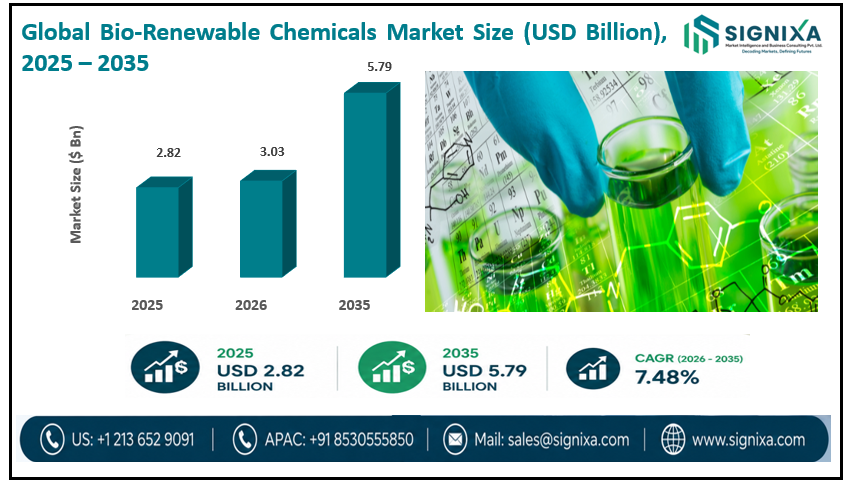
The global bio-renewable chemicals market was valued at approximately USD 2.82 Billion in 2025 and is projected to reach around USD 5.79 Billion by 2035, expanding at a compound annual growth rate (CAGR) of roughly 7.48%from 2026 to 2035. This report provides an in-depth analysis of the market drivers and challenges, as well as opportunities shaping the future landscape of the bio-renewable chemicals industry.
Bio-renewable chemicals are derived from biomass sources and act as sustainable substitutes to conventional petrochemicals. There is a growing market demand for bio-renewable chemicals because industries like packaging, personal care, chemical, and food & beverage are increasing their use of these sustainable alternatives. Carbon emissions policies around the world and the need for sustainable production methods have pushed companies to invest in renewable chemical technologies.
The bio-renewable market is emerging as a transformative force across multiple industries, driven by increasing environmental awareness, volatile fossil fuel prices, and rising pressure to reduce carbon emissions. This market comprises products derived from biological sources—such as plants, algae, and waste biomass—that can be replenished sustainably. These include bio-based chemicals, fuels, polymers, lubricants, and solvents, all serving as greener alternatives to petroleum-based counterparts. The shift toward circular economies, supported by governmental policies, subsidies, and international climate commitments, has further accelerated the adoption of bio-renewable technologies in both developed and developing regions.
Industries such as automotive, packaging, construction, agriculture, and personal care are increasingly integrating bio-renewables into their supply chains to meet consumer demand for sustainable products and to enhance brand image. Technological advancements in fermentation, enzymatic processing, and genetic engineering have significantly improved yield, cost efficiency, and performance of bio-based materials. Furthermore, corporate sustainability targets and ESG compliance have encouraged investment in scalable bio-refinery infrastructures. However, the market still faces challenges such as feedstock availability, land use conflicts, cost parity with conventional products, and underdeveloped collection systems for organic waste. Despite these hurdles, continued R&D, favourable policy frameworks, and collaborative public-private partnerships are expected to propel the global bio-renewable market forward, making it a key pillar in the transition toward a low-carbon, sustainable economy.
Key Findings
- The global andriod POS market is estimated to grow at a CAGR of 7.48% %over the forecast period (2026-2035), reaching a market size of USD 5.79 Billion by 2035 from USD 2.82 Billion in 2025.
- The Lactic Acid segment is anticipated to grow significantly due to its extensive use in the production of biodegradable plastics, food additives, pharmaceuticals, personal care products, and bio-based solvents.
- The Chemical Industry segment will dominate the application segment, owing to growing emphasis on reducing carbon emissions and replacing petroleum-derived chemicals with environmentally friendly alternatives is further driving segment expansion.
- North America is projected to lead the global Bio-Renewable Chemicals market, followed closely by Europe and Asia-Pacific.
Bio-Renewable Chemicals Market Dynamics
Increasing environmental concerns and government incentives are major catalysts for the bio-renewable chemicals industry. Strict regulations around chemically based fossil fuel emissions is pushing for greener alternatives. Leading to several companies around the world looking to transition to more sustainable inputs and meet ESG requirements leading to a lot of demand and strong interest for sectors like packaging and agriculture. The uptick in production for biodegradable plastics is also directly increasing bio-renewable chemical consumption.
Investments in R&D and biotechnology innovation are creating new opportunities for bio-renewable chemicals applications. With fermentation technology, bio-based acids and alcohols can be produced at scale and cost-efficiently and can be cost-competitive alternatives to petrochemical feedstocks. Furthermore, the rise in awareness and demand for organic cosmetics and environmentally-friendly personal care products has led to a rise in demand for bio-based feedstocks. Companies are also responding to the rising trend of consumers demanding sustainability for their products and making bio-renewable and/or bio-based solutions available to enhance brand position or share.
The bio-renewable market is experiencing significant momentum due to growing environmental concerns, increasing demand for sustainable alternatives, and rising government support across regions. Consumers and industries are becoming more conscious of the environmental impacts of traditional fossil-based products, prompting a shift toward bio-based alternatives. Governments are implementing regulations and offering incentives, such as tax credits and subsidies, to encourage the adoption of bio-renewable materials. Additionally, international climate agreements and net-zero goals are motivating countries to explore greener pathways, where bio-renewables play a key role. Innovation in biotechnological processes, such as enzymatic hydrolysis and microbial fermentation, has further improved the efficiency and scalability of bio-based production. As industries look to decarbonize and reduce dependency on finite resources, bio-renewables are becoming essential components in sectors ranging from packaging to automotive.
On the other hand, challenges persist that could impact the pace of market expansion. High production costs, competition with food crops for feedstock, and logistical issues in biomass collection continue to hinder large-scale adoption. Moreover, limited consumer awareness in some regions and the lack of well-established supply chains pose additional barriers. Land-use issues and questions around the sustainability of certain bio-based products also spark debate within environmental circles. Despite these obstacles, the market is being reshaped by strategic investments in research and development, as well as collaborative partnerships between governments, startups, and large corporations. As bio-refinery technologies mature and economies of scale improve, bio-renewables are expected to gain broader market acceptance and become critical to long-term sustainability efforts worldwide.
Bio-Renewable Chemicals Market Segmentation Analysis
By Type Segment Analysis
By Type, Lactic Acid type leads the market in share, as it has a large presence in applications including biodegradable plastics, food preservation, and personal care products. NatureWorks reported that global PLA (polylactic acid) demand was 480 kilotons in 2025 which indicates large-scale adoption. Lactic acid is also important in biopharma for pH quality control, and as a green polymer monomer, thus Lactic acid has a larger share of the Bio-renewable types of Bioplastics. The use of succinic acid is continuing to expand as a platform chemical for biodegradable polymers, solvents, and resins. A projected total global demand of more than 250 kilotons by 2035 suggests exciting times for its prospects as a chemical, especially due to its role as an ingredient source for bio-based BDO (1,4-Butanediol). As the bio-succinic acids are cleaner to produce than petroleum-derived succinic acid sources, they are being recognized for their emerging roles in sustainable building materials and the automotive sector.
Acetone derived from bio feedstock is used in cosmetics, pharmaceuticals, and resins as a solvent. The total market for acetone is far smaller than lactic or succinic acid; however, the market is expanding. The trend is towards safer, more sustainable solvents, which is leading to market growth. In Europe and the U.S., market reports indicate that demand is rising for bio-acetone as consistent regulatory restrictions are placed on volatile organic compound (VOC) emitting chemicals. Glycerol is a by-product of biodiesel and is used in food additives, pharmaceuticals and cosmetics. Glycerol's versatility and low toxicity make it an acceptable bio-renewable feedstock. There were an estimated one-million metric tons of glycerol produced in 2025--of which a large part entered into cosmetics and wellness. This segment encompasses other emerging bio-renewables, such as bio-ethanol, itaconic acid, and levulinic acid. These are gaining traction due to their roles in bio-resins, coatings, and specialty chemicals. However, as the pace of innovation grows, it is assumed that their relevance and volume share will continue to expand.
By Application Segment Analysis
By Application wise, the Personal Care and Cosmetics segment is steadily shifting to a growth area of clean-label and natural ingredients. Bio-renewable chemicals such as glycerol, lactic acid, and bio-alcohols are substituting synthetic additives with continued strong growth. The global natural cosmetics market was USD 13.2 Billion in 2025, showing the demand for renewable feedstocks in personal care. The chemical sector continues to be the largest application due to the high demand for renewable inputs, including plasticizers, adhesives, solvents, and surfactants. With the increased adoption of green chemistry and governmental directives, bio-based succinic and lactic acid are being increasingly used in the production of polymers and resins, making this a foundational segment for the sector.
The chemical sector plays a pivotal role in the bio-renewable market by integrating green chemistry principles into traditional manufacturing processes. It is actively transitioning toward sustainable feedstocks such as biomass, plant-based oils, and waste-derived materials to produce bioplastics, biofuels, and bio-based chemicals. This shift is driven by rising regulatory pressure, consumer demand for eco-friendly products, and the push for net-zero emissions. Innovations in catalysis, fermentation, and bioconversion are enabling efficient and scalable bio-renewable production. The sector is also witnessing increased investments in circular economy models, aiming to reduce carbon footprints and dependence on petrochemicals. As industries embrace renewable resources, the chemical sector is positioned as a key enabler of sustainable transformation across global manufacturing value chains. Applications include food & beverage packaging, agriculture, textiles, and lubricants. The demand for biodegradable packaging is increasing exponentially, as the global biodegradable plastic market is projected to exceed USD 9.3 Billion by 2025, as a sign of continuing growth in this area. Bio-renewable chemicals are also key ingredients in making sustainable packaging materials and food safe coatings.
Report Attributes & Market Scope
| Report Attribute | Details |
|---|---|
| Market Size Value in 2025 | USD 2.82 Billion |
| Market Size Value in 2035 | USD 5.79 Billion |
| CAGR (2026–2035) | 7.48% |
| Base Year Used for Estimation | 2025 |
| Historic Data | 2020 - 2025 |
| Forecast Period | 2026 - 2035 |
| Segments Covered – By Type |
|
| Segments Covered – By Application |
|
| Regions Covered | North America, Europe, Asia Pacific, Latin America, Middle East and Africa |
| Major Countries Covered | U.S., Canada, Mexico, Germany, UK, France, Italy, Spain, Russia, China, Japan, South Korea, India, Southeast Asia Countries, Brazil, Argentina, GCC Countries, Turkey, Iran, Israel, South Africa, Egypt, Nigeria, etc. |
| Key Companies Profiled | Corbion, NatureWorks LLC, BASF SE, Braskem, DuPont, Myriant Corporation, Cargill Inc., Genomatica, Novozymes, BioAmber, Solvay, Unilever PLC, ZeaChem, Amyris, Elevance Health, Gevo Inc., and Vizag Chemical, among others. |
Bio-Renewable Chemicals Market Regional Analysis
The North America region is the leader in the market side of things, due to a host of reasons such as well-established biotech infrastructures, strong governmental policies, and high investment levels in green innovation. Europe is in second place due to its many regulatory environmental initiatives and the high level of consumer awareness. The fastest growing region is Asia-Pacific due to its broader industrial growth, governmental policies, and consumer demand for green alternatives (especially in China, Japan, and India). Latin America and MEA are both still emerging, but compounded by the desire to design, develop, and adopt cheaper green chemical alternatives.
Europe represents a mature and innovation-driven region in the global bio-renewable market, characterized by progressive regulations, strong sustainability goals, and robust investments in green technologies. The European Union’s Green Deal and bioeconomy strategy serve as key drivers, pushing industries to transition from fossil-based resources to renewable biological alternatives. Countries like Germany, France, the Netherlands, and the Nordic nations are leading the adoption of bio-based chemicals, fuels, and materials. Industries such as packaging, agriculture, automotive, and construction are increasingly integrating bio-renewables to comply with stringent emission targets and enhance their environmental credentials.
The presence of advanced research institutions and government-backed programs has fostered technological innovation, especially in biomass conversion, enzymatic processing, and microbial fermentation. Large-scale bio-refineries and bioplastic production facilities are gaining momentum, supported by both public and private investments. The EU’s Circular Economy Action Plan and renewable energy directives are further encouraging the use of sustainable feedstocks and the development of low-carbon products. However, the region also faces challenges including high production costs, limited availability of non-food biomass, and regulatory complexities across member states. Trade restrictions and raw material dependency can also affect supply chain continuity. Despite these challenges, Europe is well-positioned to lead the bio-renewable transition, thanks to its policy coherence, technological expertise, and growing consumer awareness. As industries strive to meet ESG benchmarks and reduce their carbon footprint, the region is expected to witness steady growth in the adoption of bio-renewable solutions, making it a critical hub for sustainable material development in the coming years.
Asia Pacific is emerging as a dynamic and high-potential region in the global bio-renewable market, driven by rapid industrialization, urbanization, and growing environmental awareness. Countries such as China, India, Japan, South Korea, and Australia are at the forefront of developing bio-based industries to reduce dependence on fossil fuels and meet climate commitments. Government initiatives promoting clean energy, sustainable agriculture, and circular economy practices are catalyzing investments in bio-renewables. In particular, the rising demand for bio-based packaging, bioplastics, and biofuels in response to mounting waste and pollution concerns is fuelling market expansion. The region benefits from abundant agricultural and forestry biomass, which provides a strong feedstock base for bio-renewable production. Technological advancements in enzymatic conversion, fermentation, and biomass processing are being adopted to boost production efficiency and scalability. Public-private partnerships and academic collaborations are also increasing, aiming to develop cost-effective, localized solutions for bio-based product development.
Additionally, consumer preference is gradually shifting toward eco-friendly goods, prompting manufacturers to integrate bio-renewables into their product lines across sectors like textiles, automotive, and consumer goods. However, challenges such as inconsistent regulations, lack of infrastructure, and high capital costs in developing countries may hinder uniform growth. Nonetheless, as governments implement stricter environmental policies and support innovation through funding and incentives, the market is expected to mature further. Asia Pacific is likely to become a significant contributor to global bio-renewable supply, offering scalable solutions for sustainable development and reinforcing its role as both a manufacturing hub and a major consumer of green technologies.
The Middle East and Africa (MEA) region is gradually gaining momentum in the bio-renewable market, driven by growing environmental consciousness, governmental sustainability initiatives, and the urgent need to diversify economies beyond fossil fuels. Countries such as the United Arab Emirates, Saudi Arabia, South Africa, and Egypt are increasingly recognizing the strategic importance of bio-renewables in meeting future energy demands, reducing carbon emissions, and achieving long-term economic resilience. National visions like Saudi Arabia’s Vision 2030 and the UAE’s Net Zero by 2050 strategy are accelerating investments in bio-based technologies and clean energy sources. Abundant agricultural residues and underutilized biomass resources across parts of Africa offer significant potential for local feedstock generation. Several African nations are leveraging this advantage to develop bioenergy solutions to address rural electrification and waste management issues.
Moreover, international collaboration and funding support from development agencies and global green investment bodies are helping pilot projects and small-scale bio-refineries take shape. Biofertilizers, biogas, and bio-based materials are also gaining interest for their role in supporting sustainable agriculture and reducing import dependency. However, the region faces notable challenges including limited research infrastructure, inconsistent policy frameworks, and a lack of skilled workforce. High initial investment requirements and logistical bottlenecks further constrain scalability. Despite these obstacles, the growing alignment of government priorities with global sustainability goals, coupled with increasing awareness and demand for eco-friendly products, is expected to unlock significant growth. MEA’s vast untapped resources and emerging green economy initiatives position it as a future growth frontier in the global bio-renewable landscape.
Recent Developments in the Bio-Renewable Chemicals Market
-
2026
BASF broadened its renewable raw material initiatives across key international markets to support the development of lower-emission amines and sustainable industrial chemical solutions.
Braskem enhanced the reach of it’s “I’m green™” product line by improving operational efficiency and increasing the availability of renewable polyethylene materials worldwide.
ADM entered a strategic collaboration with OCOchem to support the commercial rollout of carbon-negative format technology using bio-based carbon streams from ethanol production facilities in the United States.
-
2025
BASF shifted its European amines manufacturing operations to renewable power sources, reinforcing the company’s long-term commitment to environmentally responsible chemical production.
BASF Coatings strengthened its sustainable product portfolio in North America by introducing additional biomass-balanced coating technologies for automotive and industrial end-use sectors.
Bio-Renewable Chemicals Market: Competitive Landscape
Important contributors in the bio-renewable chemicals business include Corbion, NatureWorks LLC, BASF SE, Braskem, DuPont, Myriant Corporation, Cargill Inc., Genomatica, Novozymes, and BioAmber. Players are pursuing strategy collaborations, increasing capacity, and developing high-purity bio-based inputs to capitalize on new market opportunities. Innovation in fermentation and feedstock resourcefulness will continue to distinguish the leading players in the years ahead. The competitive landscape of the bio-renewable market is characterized by a mix of established chemical manufacturers, emerging green technology firms, and regional players focused on sustainable alternatives. As the demand for environmentally friendly products grows, companies are shifting their R\&D efforts toward bio-based innovations such as bio-polymers, bio-solvents, biofuels, and renewable chemicals. Strategic priorities include improving process efficiency, reducing production costs, and expanding feedstock flexibility to make bio-renewables commercially viable across industries like packaging, agriculture, automotive, construction, and personal care.
Intellectual property and technological differentiation play a key role in maintaining competitive advantage, with players investing in enzymatic conversion, microbial engineering, and fermentation-based technologies. Many firms are entering into joint ventures or partnerships with agricultural cooperatives, biotechnology startups, and universities to access biomass feedstock, enhance innovation pipelines, and accelerate time-to-market. Additionally, companies are integrating backward to control raw material sourcing, particularly lignocellulosic biomass, algae, and plant oils.
Sustainability certifications, lifecycle assessments, and compliance with environmental regulations have also become major differentiators in securing long-term contracts and investor interest. Market competition is further shaped by regional policies, subsidies, and mandates for bio-content or carbon reduction targets. While the sector remains fragmented due to varying levels of technology maturity, regional feedstock availability, and policy support, the long-term outlook is competitive and innovation-driven. Companies capable of balancing sustainability, performance, and cost will continue to strengthen their position as global adoption of bio-renewables accelerates across diverse end-use sectors.
Key Companies Profiled
- Corbion
- NatureWorks LLC
- BASF SE
- Braskem
- DuPont
- Myriant Corporation
- Cargill Inc.
- Genomatica
- Novozymes
- BioAmber
- Solvay
- Unilever PLC
- ZeaChem
- Amyris
- Elevance Health
- Gevo Inc.
- Vizag Chemical
Global Bio-Renewable Chemicals Market Segmentation Summary
By Type
- Lactic Acid
- Succinic Acid
- Glycerol
- Acetone
- Others
By Application
- Packaging
- Food and Beverages
- Personal Care and Cosmetics
- Chemical Industry
- Others
By Region
- North America
- U.S.
- Canada
- Mexico
- Europe
- Germany
- France
- UK
- Spain
- Italy
- Rest of Europe
- Asia-Pacific
- China
- Japan
- India
- Australia
- South Korea
- Southeast Asia
- Rest of Asia-Pacific
- Latin America
- Brazil
- Argentina
- Rest of Latin America
- The Middle East & Africa
- GCC Countries
- South Africa
- Rest of the Middle East & Africa
Frequently Asked Questions (FAQs) About the Bio-Renewable Chemicals Market
What is Bio-Renewable Chemicals?
Bio-renewable chemicals are chemicals derived from renewable biomass sources such as plant oils, sugars, starch, lignocellulose, and microorganisms. They are used as sustainable alternatives to petroleum-based chemicals in industries such as packaging, food & beverages, cosmetics, textiles, and agriculture.
Which key factors will influence the Bio-Renewable Chemicals Market growth over 2026–2035?
The market is expected to grow due to rising environmental concerns, government support for sustainable chemical production, increasing demand for bio-based products, and advances in biotechnological processes that improve cost-efficiency and scalability.
What will be the value of the Bio-Renewable Chemicals Market during 2026–2035?
According to industry estimates, the global bio-renewable chemicals market was valued at around USD 2.82 Billion in 2025 and is projected to reach approximately USD 5.79 Billion by 2035.
What will be the CAGR value of the Bio-Renewable Chemicals Market during 2026–2035?
The global bio-renewable chemicals market is expected to grow at a CAGR of 7.48%during the forecast period from 2026 to 2035.
Which region will contribute notably towards the Bio-Renewable Chemicals Market value?
Asia-Pacific leads the global market, driven by the rapid growth of packaging, textiles, cosmetics, and chemical industries in countries such as China, India, and South Korea. North America also holds a significant share due to strong regulatory frameworks and government initiatives promoting bio-based products.
Which are the major players leveraging the Bio-Renewable Chemicals Market growth?
Key players include Cargill, BASF SE, DuPont de Nemours, Inc., Solvay, Unilever PLC, ZeaChem, Amyris, Elevance Health, Gevo Inc., and Vizag Chemical. These companies are focusing on R&D, product innovation, and sustainable value chains.
What can be expected from the global Bio-Renewable Chemicals Market report?
The report provides comprehensive insights into market dynamics, including growth drivers, restraints, emerging opportunities, and industry challenges. It offers detailed segmentation analysis by type and application, competitive benchmarking, and regional outlook, supporting strategic decision-making for stakeholders and investors.