
On-the-go Packaging Market Overview
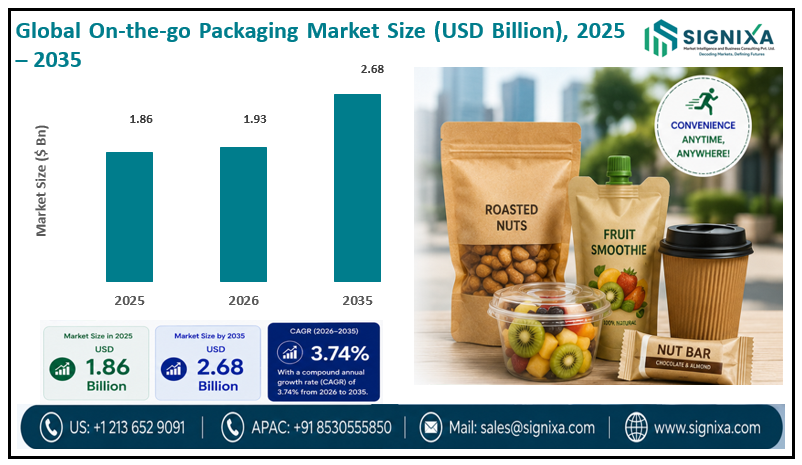
The size of the global On-the-go Packaging market was worth around USD 1.86 Billion in 2025 and is predicted to grow to around USD 2.68 Billion by 2035, with a compound annual growth rate (CAGR) of roughly 3.74% between 2026 and 2035. The report analyzes the On-the-go Packaging market's drivers and restraints, as well as the impact they have on demand throughout the projection period. In addition, the report examines global opportunities in the global On-the-go Packaging market.
The global on-the-go packaging market will be primarily driven by the rising consumer demand for convenience, growth of quick-service restaurants (QSRs), and increase in food delivery services. Active urban lifestyles have increased demand for portable, single-serve packaging options. QSRs and food delivery applications like Uber Eats and DoorDash are growing rapidly, creating a need for efficient, durable packaging. Moreover, eco-friendly innovations in biodegradable and recyclable packaging materials appeal to sustainability-oriented consumers, additionally enabling growth in both developed and emerging economies.
Advancements in technology related to lightweight and flexible packaging such as multi-layer pouches, compostable films, and recyclable plastics have had a dramatic impact on on-the-go packaging, enabling custom shapes, resealability, and longer shelf life without compromising portability. Improvements in barrier properties and product durability as well as sustainable sourcing has continued to support brands in the shifting consumer preferences toward eco-friendly processes. Organizations have invested heavily in biodegradable and plant-based alternatives. All of these developments have made packaging more functional and attractive to consumers, addressing safety, convenience, and sustainability — evolving key factors behind the increasing demand across food, beverage, and personal care categories.
Key Findings
- As per the analysis shared by our research analyst, the global On-the-go Packaging market is estimated to grow annually at a CAGR of around 3.74% over the forecast period (2026-2035).
- In terms of revenue, the global On-the-go Packaging market size was valued at around USD 1.86 Billion in 2025 and is projected to reach USD 2.68 Billion by 2035.
- Rising demand for convenience among urban consumers is driving the need for portable, easy-to-carry packaging solutions for fast food, snacks, and beverages.
- Based on Material, the Plastic segment is growing at a high rate and will continue to dominate the global market.
- On the basis of Type, the Single-use packaging segment is anticipated to command the largest market share.
- In terms of Product Type, the Bags & Pouches segment is anticipated to command the largest market share.
- By Region, Asia-Pacific is projected to dominate the global market during the forecast period.
On-the-go Packaging Market Dynamics
Rapid Urbanization & Busy Consumer Lifestyles Driving Portable Single-Serve Packaging Demand Globally
The rapid pace of urbanization has altered the way consumers lead their lives, especially in urban centers, where individuals tend to look for quick and convenient meal options because of long workdays and busy lifestyles. Packaging for on-the-go consumption meets this need for easy-to-carry and consume food and beverage options. According to the UN, in 2023, more than 56 percent of the world's population lived in urban areas, and this number is expected to increase. Urbanization creates demand for packaging that provides functional efficiency to support mobile eating and drinking habits across consumers. The increasing urbanization of consumers, the demand for convenience foods, and the growth of food delivery services are contributing to the expansion of the on-the-go packaging industry, with busy urban consumers preferring food, snacks, and beverages packaged in single-serve, portable, and easy-to-carry convenience packaging across all categories.
Food Delivery Platform Boom & QSR Expansion Creating Large-Scale Demand for Durable On-the-go Packaging
The recent boom in take-away food delivery applications such as Uber Eats, Zomato, and DoorDash has created an imperative for stable, leak-proof, and aesthetically pleasing packaging. Quick-service restaurants such as global chains including McDonald's and KFC are entirely dependent on disposable packaging to maintain product quality and freshness. Food delivery sales are projected to be more than USD 500 Billion (globally) by 2030, and packaging to facilitate hygiene, brand visibility, and product integrity are paramount. The rise of online food delivery services, as well as the convenience of quick service restaurants, has increased demand for durable and efficient packaging to support customers. The growth in cloud kitchens and ghost restaurant formats — operating exclusively through delivery channels without physical dining spaces — is creating particularly high-volume demand for functional on-the-go packaging solutions as these models scale across major urban markets globally through the forecast period.
Flexible Packaging Innovation, Biodegradable Alternatives & Sustainability Mandates Reshaping Material Preferences
The continued innovation of flexible packaging materials such as pouches and wraps also enhances product presentation and usability. The trend in sustainable packaging is significantly influencing the on-the-go packaging landscape, with brands and foodservice operators responding to both consumer preferences and regulatory mandates targeting single-use plastic reduction. Eco-friendly innovations in biodegradable materials, compostable films, and recyclable plastics are creating viable sustainable alternatives across all on-the-go packaging product categories. Government regulations in Europe, North America, and increasingly Asia-Pacific — banning or levying fees on single-use plastics — are accelerating the shift toward paper-based, fiber-based, and biodegradable packaging alternatives in the QSR and food delivery sectors. Major global foodservice brands have committed to ambitious packaging sustainability targets, creating significant procurement-driven demand for innovative sustainable on-the-go packaging solutions through the forecast period.
On-the-go Packaging Market Segmentation Analysis
By Material Segment Analysis
The market is divided into different segments based on material, with each material offering distinct performance, sustainability, cost, and recyclability characteristics that determine its suitability for specific on-the-go packaging applications:
Plastic
Plastic is still the most common material used in packaging on-the-go, as it is durable, flexible, and inexpensive. Plastic represents more than 40% of the world's on-the-go packaging consumption. Its lightweight properties make it well suited for pouches, bottles, and clamshells. Polyethylene terephthalate (PET) and polyethylene (PE) are common plastics, and variants made from these plastics are often used in food and beverage applications. Sustainability is an issue, but recyclability and the speed at which plastics can be made on high-speed production lines has kept plastic in the global market. In 2025, the value of the global plastic packaging market exceeded USD 400 Billion, with on-the-go segments representing a significant contribution. Ongoing innovation in bio-based plastics, chemically recycled content, and lightweighting technologies is helping manufacturers maintain plastic's functionality advantages while progressively improving its sustainability credentials to meet evolving regulatory and consumer expectations through the forecast period.
Paper & Paperboard
The use of paper and paperboard packaging is increasing because of heightened environmental consciousness and regulations related to single-use plastics. They are biodegradable, recyclable, and consumers view them as more sustainable. In 2025, paper packaging represented approximately 28% of the on-the-go packaging market share. Paper is frequently used for cartons, cups, and wraps, as they have sufficient strength while also meeting printing and branding requirements. Major food chains such as Starbucks and McDonald's are also moving toward using paper for packaging to reach their sustainability goals, increasing the adoption of paper packaging in global markets. Advances in water- and grease-resistant barrier coatings for paper packaging — enabling paper to replace plastic in direct food contact applications like burger wrappers, sandwich boxes, and hot beverage cups — are expanding the functional performance range of paper-based on-the-go packaging solutions to match the requirements previously only addressable by plastics through the forecast period.
Metal
Among packaging materials, metal packaging — particularly aluminum cans and tins — is recognized for its outstanding barrier characteristics and recyclability. Aluminum packaging is largely used in beverages and ready-to-eat food. Aluminum has a worldwide recycling rate of about 75%, making aluminum packaging attractive for circular economy objectives. Despite metal being heavier and more expensive than plastic, it achieves a longer shelf life and resists tampering, especially in drinks and canned foods. The global market size for metal packaging crossed USD 130 Billion in 2025, with a growing share attributed to ready-to-drink consumption. Ongoing lightweighting processes and resealable can designs are expanding cans' usability in on-the-go formats. In addition, cans are increasingly used in ready-to-drink coffee and cocktails, allowing them to move beyond a traditional soft drink format into higher-margin premium beverage categories that value the perceived quality and sustainability credentials of aluminum packaging.
Glass
While glass is not as prevalent as other materials used for on-the-go packaging due to its weight and breakage risks, it is still designated for some premium beverages, sauces, and baby foods. Glass is notable for its strong chemical resistance, non-reactivity, and luxurious infinite recyclability. Globally, the glass packaging market was approximately USD 68 billion in 2023, with a minimal contribution from on-the-go packs. Package formation for segments with higher product purity and brand value tends toward glass. However, glass is becoming less frequently utilized in fast-paced consumption contexts due to its considerable weight and the possibility of injury if broken, as it has been partially replaced by lighter and often shatter-resistant alternatives. The continuing premiumization trend in beverages — particularly in craft beers, artisanal juices, and specialty coffee formats — is sustaining demand for glass in the premium on-the-go beverage segment despite its inherent practical limitations in high-volume quick-service contexts through the forecast period.
Biodegradable Materials
Biodegradable packaging materials such as PLA (polylactic acid), bagasse, and starch-based polymers are experiencing rapid growth driven by eco-aware consumers and bans on plastics. The biodegradable packaging segment hit USD 15 Billion in 2025 and anticipates strong growth of more than 10% year over year. These are compostable materials that reduce landfill waste, and are suitable for wraps, trays, and food containers. While they are more expensive than conventional plastics, growing investment in sustainable innovation in addition to government incentives is making them a realistic option for brands offering on-the-go packaging options. The proliferation of industrial composting infrastructure across Europe and North America — combined with improved home-compostable formulations that don't require industrial composting conditions — is progressively expanding the practical end-of-life options for biodegradable on-the-go packaging, strengthening the sustainability case for adoption by foodservice operators and retailers through the forecast period.
Others
Various materials used for on-the-go packaging include hybrid or composite materials, fabrics, foils, and molded fiber. These materials typically are used for niche or specialty applications, such as reusable lunch kits or insulated wraps, and represent less than 5% of the market, yet provide useful features like insulation, cushioning, or brand differentiation. They will see slow growth due to technology advancements creating smart packaging and compostable coatings. Customization and performance will be essential in a fast-paced and competitive foodservice and retail market. Molded fiber packaging — made from recycled paper pulp and capable of replacing plastic clamshells and trays in many food applications — is an important emerging sub-category within this segment, gaining significant commercial traction as foodservice operators seek cost-effective, scalable alternatives to plastic packaging that can meet both performance and sustainability requirements through the forecast period.
By Type Segment Analysis
Single-Use Packaging
Single-use packaging will continue to prevail in the on-the-go packaging market, consuming over 85% of global packaging in 2025. The packaging consists of disposable trays, cups, wrappers, bottles and pouches for quick-service foods, treats, and drinks. Single-use packaging is popular for its low cost, lightweight, hygienic, and easy to dispose of packaging, which is important for people consuming packaged food in fast-paced urban areas, as well as food-delivery formats. With estimates placing food delivery revenues at over USD 500 Billion by 2030, demand for effective single-use formats continues to grow, especially in the Asia-Pacific and North America region, despite growing food packaging regulations. The shift toward improved recyclability and compostable single-use formats — rather than the elimination of single-use packaging — represents the primary sustainability transition pathway for this segment, as manufacturers develop single-use solutions that deliver both practical performance and improved end-of-life sustainability compared to conventional non-recyclable plastics through the forecast period.
Reusable Packaging
Reusable packaging constitutes a smaller but steadily growing portion — around 15% of the on-the-go packaging market in 2025. Increased consumer knowledge concerning plastic pollution along with regulatory pressure has helped propel this segment, which includes containers, bottles, and wraps designed for reusable purposes. Initiatives spearheaded by companies like Loop and others in the EU and North America are accelerating adoption of reusable systems across retail and foodservice settings. Reusable packaging costs slightly more at the outset, but consumers — especially urbanites — are encouraged by the long-term savings as well as the environmental aspects of sustainability. Growth is strongest in the premium food and beverage space as well as among eco-conscious consumers. The EU's Single Use Plastics Directive — which mandates the availability of reuse options for takeaway beverages and food containers from 2026 — is a significant regulatory driver for reusable on-the-go packaging adoption in European markets, creating near-term demand for compliant reusable systems from foodservice operators through the forecast period.
By Product Type Segment Analysis
Bags & Pouches
Bags and pouches hold the position as the most popular product type in the global on-the-go packaging market, representing greater than 30% of the market in 2025. The wide use of bags and pouches can be attributed to their lightweight characteristics, usable resealability, and material efficiency. Bags and pouches are most commonly seen in the form of snacks, ready meals, and beverages from juices to baby foods. Bags and pouches present the possibility of branding while allowing for portability. Their flexible design allows manufacturers to reduce both logistics costs and materials waste. Recent innovations like spouted pouches and microwaveable modules are creating more use applications. Advantages exist in recent innovations creating more use applications for bags and pouches — their unique design is an exceptionally good fit with consumer demands in convenience and portability. The growing adoption of retort pouches for shelf-stable ready meals — offering the convenience of canned food with the lighter weight and reduced storage footprint of flexible packaging — is an important growth driver for the bags and pouches segment through the forecast period.
Bottles
Bottles, especially in plastic, have a strong share in the on-the-go beverage segment, covering beverages such as water, juice, and ready-to-drink teas. In rigid container types, PET (polyethylene terephthalate) bottles are most common because of their lightweight nature and recyclability. Bottles made up around 20% share in the on-the-go beverage packaging market in 2025. Recyclable PET is used due to low costs of production and longer shelf life. Despite growing environmental concerns about plastics, demand remains strong specifically in the Asia-Pacific and North America regions. Innovations with plant-based plastics and lightweighting technology and materials are helping to maintain the use of bottles while reducing materials used and carbon footprint. The growing adoption of rPET (recycled PET) in beverage bottles — supported by both regulatory requirements for recycled content and brand sustainability commitments — is driving significant investment in PET recycling infrastructure globally, improving the circularity credentials of the bottles segment through the forecast period.
Cans
Cans, mainly aluminum, are common use for carbonated drinks, energy drinks, and alcoholic beverages, especially as they are well-regarded for their durability, tamper-audibility, and overall life span. Cans accounted for almost 18% of the global market share in 2025 for on-the-go beverage packaging. Cans can be recycled over 75% of the time, which contributes to their popularity amid sustainability and environmentally friendly concerns, especially in regions like Europe. Ongoing lightweighting processes and resealable can designs are allowing cans to demonstrate their usability in on-the-go formats. In addition, cans are increasingly used in ready-to-drink coffee and cocktails, allowing cans to move beyond a traditional soft drink format. The hard seltzer, canned wine, and canned cocktail categories have driven significant aluminum can volume growth in recent years, with new product formats attracting consumers who might previously have purchased glass-bottled beverages into the more sustainable and on-the-go-convenient aluminum can format through the forecast period.
Trays & Clamshells
Trays and clamshells are often utilized in salads, sandwiches, baked goods, and takeout meals. They made up roughly 12% in the global on-the-go packaging market in 2025. Rigid packaging formats protect the product and offer product visibility, which is vital in deli and bakery sections. Clear clamshells made from PET and polypropylene are commonly used because of the materials' clarity and heat resistance. The trend in plastic bans is relevant to the industry's general movement toward fiber-based and compostable alternatives for trays and clamshells. Their sturdy structure and ability to hold different food types are key parts of QSR and retail store operations. The growing adoption of sugarcane bagasse and molded pulp trays and clamshells — offering comparable functional performance to plastic equivalents at increasingly competitive price points — is enabling foodservice operators to transition away from plastic rigid containers while meeting both food safety and sustainability requirements through the forecast period.
Cups
Cups, designed for hot and cold drinks, yogurt and desserts, made up almost 10% of the on-the-go packaging market in 2025. Paper and plastic cups are widely utilized by coffee chains, convenience stores, and fast-food outlets. The increase in ready-to-drink products and café culture has stimulated demand. Companies are making the transition to double-wall, recyclable, and biodegradable versions in response to sustainability issues. The grab-and-go coffee segment continues to drive high volume demand for insulated and spill-resistant cup formats in the Asia-Pacific and North America markets. The rapid expansion of coffee chain outlets across Asia-Pacific — particularly in China, South Korea, and Southeast Asia — is creating a major new demand center for premium paper cup formats, with coffee consumption habits shifting significantly toward café visits and takeaway coffee in markets that were previously dominated by tea consumption, driving substantial cup volume growth through the forecast period.
Boxes & Cartons
Boxes and cartons are key packaging options for sandwiches and wraps, dry snack items, and liquid items such as milk and juices. In 2025, boxes and cartons were roughly 8% of the market share. Paperboard cartons are lightweight, easy to print on, and frequently recyclable, and therefore offer a more sustainable option than plastic. The Tetra Pak format, and similar variations, primarily dominate the market for liquid packaging, especially in Europe. Cartons provide good product protection, good functionality for stacking, and generally provide better logistics efficiency. The continued move towards eco-friendly options has allowed for additional investment into fiber-based boxes with barrier coatings to combat moisture resistance. The growth of premium snacking formats — including protein bars, trail mix, and health-oriented snack products packaged in branded paperboard boxes — is creating growing demand for high-quality, shelf-impact printable carton formats that serve both functional packaging and brand communication purposes in the premium on-the-go snacking category through the forecast period.
Sachets
Sachets are small unit-dose packaging types for condiments, sauces, shampoo, and instant or 3-in-1 beverages. In 2025, sachets represented about 6% of on-the-go packaging formats because sachets are ultra-portable and low-cost. These are particularly attractive formats in Asia and Africa to appeal to low economic status consumers who are interested in low-cost unit doses. While sachets are convenient formats, they have received negative attention regarding recyclability. Although development is happening, there are innovations taking place to develop recyclable and biodegradable films for sachets. Sachets are still relevant in terms of categories in FMCG and foodservice and will continue to be in-demand particularly in emerging markets. The development of recyclable mono-material sachet structures — replacing conventional multi-layer laminates that are difficult to recycle — represents a critical innovation frontier for the sachet segment, as brand owners seek to maintain the unit-dose affordability benefits of sachets while improving their environmental credentials to meet evolving consumer and regulatory expectations through the forecast period.
Wraps
Wraps, such as foil, wax paper, and biodegradable films, are utilized for items like burgers, sandwiches, and bakery products. They represent around 5% of the global market for on-the-go packaging in 2025. These materials offer grease resistance, insulation, and ease of delivery. The demand for paper wraps is expanding in preference to plastic-coated paper wraps as more sustainable options. Fast food chains are quick to use wraps because they are often cheaper and can be personalized to aid branding efforts and marketing strategies. While wraps may provide less overall protection than a rigid container, they offer flexibility and disposability, and create an experience for handheld food eaten in the short duration. The growing adoption of fluorocarbon-free grease-resistant paper coatings — as food safety concerns drive the elimination of PFAS (per- and polyfluoroalkyl substances) from food contact packaging — is driving significant reformulation activity in the wraps category as manufacturers develop safer alternative barrier technologies for paper wraps through the forecast period.
By Application Segment Analysis
Quick-Service Restaurants (QSRs)
Quick-service restaurants represent the biggest application segment of on-the-go packaging, capturing greater than 45% of global demand during 2025. Leading chains like McDonald's, KFC, and Subway are reliant on single-use trays, wraps, cups, and boxes to promote efficiency, hygiene, and convenience for customers. The global market for fast food restaurants and QSRs was valued at USD 800 billion, and the packaging format is well known for enhancing branding and store efficiency. As solutions expand in dining and takeaway facilitation, demand continues to increase for inexpensive and repeatable on-the-go solutions for QSR packaging options. The accelerating expansion of global QSR chains into emerging market cities across Asia, Africa, and Latin America — combined with the rapid growth of local QSR operators in these markets — is creating significant new packaging demand volume outside the traditionally dominant North American and European QSR markets, providing a key international growth engine for on-the-go packaging manufacturers serving this application segment through the forecast period.
Food Delivery Services
Food delivery services represent a rapidly growing sector, accounting for approximately 30% of the on-the-go packaging market in 2025. The boom of delivery platforms such as Uber Eats, DoorDash, and Zomato facilitated over USD 430 Billion in global food delivery revenues in 2025. Because food is often not eaten immediately after delivery, food delivery services often require packaging that keeps food hot and fresh, guarantees liquids do not leak, and provides a positive unboxing experience. Food brands are investing in packaging that is tough, tamper-evident, eco-friendly, insulated, and protects the food inside while enhancing the overall experience. Digital food ordering is increasingly becoming woven into urban lifestyles, which will require durable packaging solutions that meet the needs of food delivery. The development of packaging systems specifically engineered for delivery performance — including thermally insulated bags with temperature-maintenance properties and tamper-evident sealing mechanisms — is a growing area of packaging innovation that is creating premium pricing opportunities within the food delivery packaging segment through the forecast period.
Report Attributes & Market Scope
| Report Attribute | Details |
|---|---|
| Market Size Value in 2025 | USD 1.86 Billion |
| Market Size Value in 2035 | USD 2.68 Billion |
| CAGR (2026–2035) | 3.74% |
| Base Year Used for Estimation | 2025 |
| Historic Data | 2020 - 2025 |
| Forecast Period | 2026 - 2035 |
| Segments Covered – By Material |
|
| Segments Covered – By Type |
|
| Segments Covered – By Product Type |
|
| Segments Covered – By Application |
|
| Regions Covered | North America, Europe, Asia Pacific, Latin America, Middle East and Africa |
| Major Countries Covered | U.S., Canada, Mexico, Germany, UK, France, Italy, Spain, Russia, China, Japan, South Korea, India, Southeast Asia Countries, Brazil, Argentina, GCC Countries, Turkey, Iran, Israel, South Africa, Egypt, Nigeria, etc. |
| Key Companies Profiled | Graphic Packaging International, Huhtamaki, Kemira, Colpac, Lollicup Store, Genpak, ProAmpac, Togo Packaging, Jabil, Greiner Packaging, among others. |
On-the-go Packaging Market Regional Analysis
The Asia-Pacific region leads the global market for on-the-go packaging and is responsible for the largest revenue share of over 35% in 2025. The remarkable growth of the Asia-Pacific on-the-go packaging market is primarily due to rapid urbanization and the rapid growth of the food delivery ecosystem with a significant amount of QSRs present in markets like China, India, Japan, and South Korea. Latin America is becoming a vital region following an increase in urbanization, income expansion among the middle class, and a greater demand for convenience food.
Asia-Pacific (Dominant Region)
The Asia-Pacific region leads the global market for on-the-go packaging and is responsible for the largest revenue share of over 35% in 2025. The remarkable growth of the Asia-Pacific on-the-go packaging market is primarily due to rapid urbanization and the rapid growth of the food delivery ecosystem with a significant amount of Quick-Service Restaurants (QSRs) present in markets like China, India, Japan, and South Korea. The on-the-go packaging market also benefits from factors like the young population growth, rising disposable income, and expanding middle class in this region, all contributing to growing consumption of ready-to-eat and takeout food. The on-the-go packaging market is supported by strong manufacturing capabilities and low-cost packaging manufacturing from overseas sources. Furthermore, e-commerce and mobile food ordering will solidify the region's leadership in the on-the-go packaging market. China and India in particular have world-leading food delivery markets, with platforms like Meituan, Eleme, Swiggy, and Zomato generating enormous packaging demand volumes through the forecast period.
North America
North America represents a major and mature market for on-the-go packaging, driven by one of the world's densest QSR networks, high food delivery platform penetration, and a culture of convenience-oriented eating. The United States is home to the world's largest QSR chains and is a primary driver of global on-the-go packaging demand through both domestic consumption and the international expansion of U.S.-based restaurant chains. Strong regulatory pressure at the state and municipal level particularly in California and New York is accelerating the adoption of compostable and recyclable packaging formats in the foodservice sector. The North American market is also a center of packaging innovation, with companies investing in sustainable packaging R&D to develop solutions that meet both consumer convenience expectations and increasingly stringent environmental regulations. The growing food delivery market — dominated by DoorDash, Uber Eats, and Grubhub is creating significant demand for premium delivery-optimized packaging formats that maintain food quality across extended delivery times through the forecast period.
Europe
Europe's on-the-go packaging market is being actively reshaped by some of the world's most ambitious packaging sustainability regulations, including the EU Single Use Plastics Directive and the proposed Packaging and Packaging Waste Regulation (PPWR). These regulations are mandating the elimination of many single-use plastic packaging formats and establishing minimum requirements for recycled content, recyclability, and reuse systems driving significant packaging material substitution and format innovation across the European on-the-go packaging market. Germany, the UK, France, and the Netherlands are leading in the adoption of paper-based and compostable packaging alternatives across the QSR and food delivery sectors. The café culture prevalent across European cities drives strong cup and hot food container demand, while the growing food delivery market led by Deliveroo, Just Eat Takeaway, and Delivery Hero is creating expanding demand for delivery-optimized sustainable packaging solutions through the forecast period.
Latin America
Latin America is becoming a vital region for the on-the-go packaging sector following an increase in urbanization, income expansion among the middle class, and a greater demand for convenience food. In Brazil, Mexico, and Argentina, there is an increase in food delivery applications and QSR chains, which is driving the need for creative, efficient packaging types. The availability of increased internet access and the use of smartphones is supporting the trend towards online food ordering. Government incentives aimed at sustainable packaging are generating incremental innovation, designing Latin America to be a viable growth region for the future. The rapid digital adoption by Latin American consumers combined with a young, urban population that is comfortable with app-based food ordering is driving explosive growth in food delivery platform usage across the region, creating significant new packaging demand from restaurant partners and ghost kitchen operators that is supporting sustained market growth through the forecast period.
Middle East & Africa
The Middle East & Africa region presents growing opportunities for on-the-go packaging, driven by distinct demand dynamics across its sub-regions. In the Middle East, particularly the GCC countries, a young and affluent population with high digital adoption and a strong café and fast-food culture is creating robust demand for premium on-the-go packaging across beverages, snacks, and takeaway food categories. The UAE and Saudi Arabia in particular have rapidly growing food delivery markets and dense QSR networks that generate significant packaging volumes. In Africa, rapid urbanization across major cities including Lagos, Nairobi, Cairo, and Johannesburg is creating a growing urban middle class with increasing disposable income and appetite for convenience food driving demand for affordable on-the-go packaging solutions that meet the specific functional and price requirements of emerging market foodservice applications through the forecast period.
Recent Developments in the On-the-go Packaging Market
-
2026
Graphic Packaging International expanded its portfolio of fiber-based foodservice packaging solutions designed to replace single-use plastics and support sustainability goals in the convenience food and beverage sector.
Huhtamaki Oyj introduced new recyclable and compostable on-the-go food packaging products aimed at quick-service restaurants (QSRs), takeaway outlets, and convenience food providers.
Colpac Ltd. expanded its range of recyclable and FSC-certified grab-and-go packaging products for bakery, food-to-go, and retail applications.
Sonoco Products Company expanded sustainable packaging offerings with recyclable paper containers and fiber-based packaging formats targeting convenience food markets.
-
2025
Graphic Packaging International expanded its paperboard foodservice packaging portfolio with new recyclable solutions for quick-service restaurants and convenience food retailers.
Huhtamaki Oyj introduced innovative fiber-based packaging products designed for takeaway meals, beverages, and grab-and-go food applications.
Colpac Ltd. expanded production capacity for sustainable food-to-go packaging solutions in response to growing demand from retailers and foodservice operators.
Lollicup USA Inc. launched new environmentally friendly cups, lids, and food containers to strengthen its position in sustainable takeaway packaging.
On-the-go Packaging Market: Competitive Landscape
The global On-the-go Packaging market features major players such as Graphic Packaging International, Huhtamaki, Kemira, Colpac, Lollicup Store, Genpak, ProAmpac, Togo Packaging, Jabil, and Greiner Packaging. The On-the-go Packaging market is highly competitive, with major players driving technological advancements across a range of applications. Companies are competing on factors such as product innovation, cost-efficiency, geographical reach, and sustainability, which are all essential for gaining market share in the growing On-the-go Packaging industry.
Competition in the on-the-go packaging market centers on several strategic dimensions: sustainable material innovation and recyclability credentials, supply chain resilience and raw material sourcing security, production cost efficiency and manufacturing scale, customization capabilities for branded packaging, and geographic distribution reach to serve global foodservice chain customers consistently. The accelerating shift toward sustainable packaging is creating a race for proprietary sustainable material solutions and patented barrier coating technologies that can replace conventional plastic functionality in food contact applications. Companies that can demonstrate both functional performance parity with incumbent materials and verified environmental benefit through lifecycle assessments are gaining significant commercial advantage in procurement decisions by major QSR chains and food delivery platforms that have made public packaging sustainability commitments.
Key Companies Profiled
- Graphic Packaging International
- Huhtamaki Oyj
- Kemira Oyj
- Colpac Ltd.
- Lollicup USA Inc.
- Genpak LLC
- ProAmpac Holdings LLC
- Togo Packaging Pty Ltd.
- Jabil Inc.
- Greiner Packaging International GmbH
- Amcor plc
- Berry Global Group, Inc.
- Sealed Air Corporation
- Mondi plc
- Sonoco Products Company
Global On-the-go Packaging Market Segmentation Summary
By Material
- Plastic
- Paper & Paperboard
- Metal
- Glass
- Biodegradable Materials
- Others
By Type
- Single-use Packaging
- Reusable Packaging
By Product Type
- Bottles
- Cans
- Bags & Pouches
- Trays & Clamshells
- Cups
- Boxes & Cartons
- Sachets
- Wraps
By Application
- Quick-Service Restaurants (QSRs)
- Food Delivery Services
By Region
- North America
- U.S.
- Canada
- Mexico
- Europe
- Germany
- France
- UK
- Spain
- Italy
- Rest of Europe
- Asia-Pacific
- China
- Japan
- India
- Australia
- South Korea
- Southeast Asia
- Rest of Asia-Pacific
- Latin America
- Brazil
- Argentina
- Rest of Latin America
- The Middle East & Africa
- GCC Countries
- South Africa
- Rest of the Middle East & Africa
Frequently Asked Questions (FAQs) About the On-the-go Packaging Market
What is On-the-go Packaging?
On-the-go packaging refers to portable, convenient, and easy-to-carry packaging solutions designed for quick consumption of food and beverages, catering to busy lifestyles, urban consumers, and increasing demand for ready-to-eat and takeaway products.
Which key factors will influence the On-the-go Packaging market growth over 2026–2035?
Key factors supporting growth include rising demand for convenience foods, expansion of food delivery services, increasing urbanization, and consumer preference for portable, sustainable packaging solutions that fit fast-paced, on-the-move lifestyles.
What will be the value of the On-the-go Packaging market during 2026–2035?
According to the study, the global On-the-go Packaging market size was worth around USD 1.86 Billion in 2025 and is predicted to grow to around USD 2.68 Billion by 2035.
What will be the CAGR value of the On-the-go Packaging market during 2026–2035?
The CAGR value of the On-the-go Packaging market is expected to be around 3.74% during 2026–2035, driven by the increasing demand for convenient, portable, and ready-to-consume food and beverage products among busy urban consumers.
Which region will contribute notably towards the On-the-go Packaging market value?
Asia Pacific dominates due to rapid urbanization, a large young population, growing demand for convenience foods, strong presence of foodservice chains, and expanding e-commerce and delivery networks across countries like China, India, and Japan.
Which are the major players leveraging the On-the-go Packaging market growth?
The global On-the-go Packaging market is led by players such as Graphic Packaging International, Huhtamaki, Kemira, Colpac, Lollicup Store, Genpak, ProAmpac, Togo Packaging, Jabil, and Greiner Packaging.
What can be expected from the global On-the-go Packaging market report?
The report explores crucial aspects of the On-the-go Packaging market, including a detailed discussion of existing growth factors and restraints while also analyzing future growth opportunities and challenges that impact the market.