
Chip on Board (COB) LED Market Overview
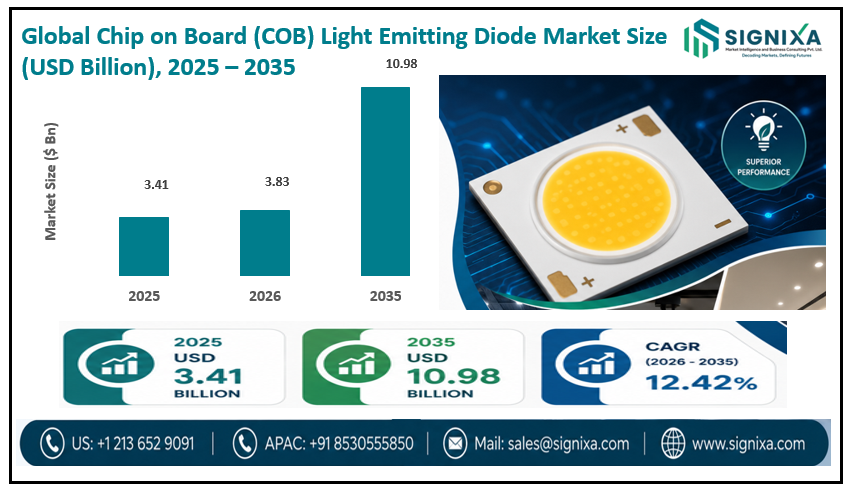
The size of the global Chip on Board (COB) Light Emitting Diode market was worth around USD 3.41 Billion in 2025 and is predicted to grow to around USD 10.98 Billion by 2035, with a compound annual growth rate (CAGR) of roughly 12.42% between 2026 and 2035. The report analyzes the COB LED market's drivers and restraints, as well as their impact on demand throughout the projection period, while also examining global opportunities shaping the market landscape.
Chip on Board (COB) Light Emitting Diodes consist of several LED chips directly attached to a substrate and constituting one lighting module. They are smaller in design, provide better thermal performance, and deliver more consistent light output. The market is primarily driven by increasing demand for energy-efficient lighting in commercial and industrial applications, as well as the rising adoption of LED lighting in automotive headlamps and backlighting, as a result of higher lumen output compared to traditional lighting technologies. In addition, the expansion of the smart lighting market is expected to shape the future commercialization of COB LED technology.
The COB LED market is witnessing strong growth driven by increasing demand for high-efficiency lighting in commercial, industrial, and residential applications. COB LEDs offer significant advantages over traditional lighting technologies, including superior thermal management, compact size, uniform light output, and higher lumen density. These attributes make them ideal for applications like downlights, high bay lights, automotive headlights, and street lighting. As global emphasis on energy conservation intensifies, COB LEDs are being rapidly adopted due to their long lifespan, low power consumption, and improved color rendering. Technological advancements have led to the development of COB LEDs with enhanced performance under high temperatures and variable voltages, further broadening their use across demanding environments. The market also benefits from innovations in materials, such as ceramic substrates and silicone encapsulants, which boost reliability and heat dissipation. The rise of smart lighting systems and increased integration of LEDs in smart homes, offices, and retail spaces are fueling demand, with growing support from government energy-efficiency programs and favorable regulatory standards continuing to propel market expansion.
Key Findings
- The global COB LED market is estimated to grow annually at a CAGR of around 12.42% over the forecast period (2026-2035).
- In terms of revenue, the global market size was valued at around USD 3.41 Billion in 2025 and is projected to reach USD 10.98 Billion by 2035.
- Rising demand for energy-efficient lighting in commercial and industrial sectors is driving COB LED adoption, as these modules offer superior brightness, lower power consumption, and longer lifespan.
- Based on Product, the COB LED Modules segment is growing at a high rate and will continue to dominate the global market.
- On the basis of Substrate Material, the Ceramic Substrates segment is anticipated to command the largest market share.
- In terms of Application, the Illumination segment is anticipated to command the largest market share.
- By Region, Asia Pacific is projected to dominate the global market during the forecast period.
Chip on Board (COB) LED Market Dynamics
Surging Demand for Energy-Efficient Lighting & Government LED Promotion Initiatives
The COB LED market is expanding due to increased demand for energy-efficient lighting solutions in residential, commercial, and industrial settings, combined with increasing government initiatives to encourage LED usage in order to reduce electricity consumption. The world is seeing an increase in energy consumption, leading to a continuing transition to energy-efficient lighting solutions, with an emphasis on COB LEDs. According to the International Energy Agency, lighting accounts for almost 15% of global electrical consumption. Once end-users transition to efficient systems with COB LEDs, they can achieve as much as 50% energy savings. These factors drive widespread COB LED adoption across government energy efficiency measures, commercial operations, and everyday consumer use.
Government LED Programs, Subsidies & Phase-Out Regulations Accelerating Adoption
Governments globally are promoting LED lighting to meet rising energy demands and reduce carbon emissions. India's UJALA scheme has distributed over 360 Million LED bulbs, leading to significant energy savings. COB LEDs with high luminous efficacy and low cost are the favored technology for this type of initiative. In addition, subsidies, tax incentives, and laws to phase out incandescent bulbs are increasing momentum for COB in rural and urban settings and overall market growth worldwide. Regulatory frameworks in the EU, US, and China continue to mandate progressively higher efficiency standards, creating sustained policy-driven demand for COB LED technology across both public and private sectors.
Continuous Technological Innovation in COB LED Performance, Packaging & Materials
The improvement of COB LEDs has, reflective of technological innovations, noticeably enhanced their performance attributes and user acceptance in a variety of applications. COB LEDs are now able to offer greater thermal management properties, higher lumen-per-watt efficacy measurements, and compact structures that allow for more aesthetically developed designs. This leads to improved, compact applications that offer greater efficiency and brightness, such as automotive and high-end architectural lighting. Manufacturer R&D departments are continually improving packaging, density of light-emitting chips, and quality of materials — including ceramic substrates and silicone encapsulants — that have continued to improve COB LED experiences and have expedited their development and client acceptance for next-generation lighting technologies.
Chip on Board (COB) LED Market Segmentation Analysis
By Product Segment Analysis
The COB LED market is segmented by product type, with each format offering distinct packaging configurations, integration levels, and end-use suitability across lighting applications globally:
COB LED Modules
COB LED modules are pre-assembled units consisting of COB chips incorporated with heat sinks and drivers for easy installation and use. They are widely preferred for their plug-and-play design and ability to fit the wide range of available lighting fixtures. COB modules make up over 45% of all COB LED installations in commercial, office, and retail applications. The combination of high luminous flux and thermal efficacy makes them a strong option for retail and office lighting, where consistent brightness is important while requiring little maintenance. Their ease of integration into existing fixture architectures continues to make COB modules the dominant product format across commercial renovation and new construction projects globally.
COB LED Arrays
COB LED arrays have many LED chips bonded onto a substrate that functions as one lighting unit. They have better uniformity and brightness than traditional packaged LED solutions, which lends them well to street, automotive, and industrial applications. Companies like Lumileds and Cree have stated that COB arrays can supply over 15,000 lumen output from one array. Their high efficiency minimizes fixture count and energy costs, driving market adoption. The physical size and minimal glare output of COB arrays make them even more efficient for precision lighting applications including sports facilities, retail display lighting, and demanding outdoor infrastructure projects where consistent wide-area illumination is required.
COB LED Components
COB LED components are assembled core chips without external housing, intended for original equipment manufacturers (OEMs) and customized fixture solutions. Their form factors enable manufacturers to customize lighting solutions based on lumen requirements and heat dissipation. The rapid adoption of COB components is driven by high-end architectural lighting and automotive interiors where reliability and performance under thermal stress are required. Their growth also facilitates the use of smart lighting systems that require highly integrated, space-efficient light source platforms. The flexibility offered by bare COB components supports a wide range of design configurations across industrial, horticultural, medical, and specialty lighting applications.
By Substrate Material Segment Analysis
Ceramic Substrates
Ceramic substrates have excellent thermal conductivity (20-25 W/m·K) and electrical insulation properties, making them ideal substrates for high-power COB LEDs used in automotive and industrial illumination. They maintain performance through high temperatures for long-term stability and reliability. Ceramic substrates account for over 40% of high-end COB LED usage. Their reliability and robustness to high heat and current loads contributes to their popularity in high-end applications, including UV curing, medical devices, and aerospace illumination systems where thermal endurance and long service life are non-negotiable design requirements.
Metal Core PCBs (MCPCBs)
MCPCBs, especially those made of aluminum, are a common substrate used for mid-range COB LED applications because of their satisfactory cost, thermal conductivity (about 2-5 W/m·K), and structural properties. They are typically used in general illumination, street lighting, and signs. According to industry estimates, MCPCBs account for approximately 60% of COB substrate usage globally. MCPCBs are relatively easy to manufacture and are gaining more popularity due to demands for energy-efficient, long-lasting public and residential lighting where cost-competitive thermal management is sufficient for the application requirements, making them the workhorse substrate across mainstream COB LED market segments.
By Application Segment Analysis
Illumination
Illumination accounts for over 45% of the COB LED market, making it the largest application segment. COB LEDs can be quickly applied to residential, commercial, and industrial lighting segments because they can provide high lumen output, uniform light distribution, and minimize electricity usage. Switching to efficient lighting such as COB LEDs can result in over 50% reduction in electricity use for lighting. Their compact size and thermal performance characteristics are a perfect arrangement for illumination infrastructures such as downlights, high bays, and streetlights. Within illumination, sub-applications include residential, office space, industrial, shop area, hospitality industry, outdoor, and architectural lighting — each with distinct performance requirements that COB LEDs are well-positioned to address.
Automotive
The automotive lighting segment accounted for about 20% of the COB LED market in 2025. Many vehicle headlights, daytime running lights, and interior lights use COB LEDs. Vehicle manufacturers prefer COBs because they produce high levels of brightness and energy efficiency, last longer than conventional lighting, and can be integrated into compact spaces. Consistent color and durability during thermal stress are important for vehicle safety and aesthetic experience. Demand for advanced, energy-efficient lighting continues to increase globally as electric and autonomous vehicles proliferate in popularity, with COB LEDs featured across headlamp, side lamp, DRL, and rear light exterior applications, as well as interior ambient lighting systems.
Backlight
COB LEDs are utilized in backlighting applications for LCDs, displays, and signage, providing slim form factors, consistent brightness, and low energy consumption. Backlighting accounted for approximately 15% of the overall COB LED market in 2025. Demand is especially strong for tablets, monitors, and automotive displays where continuous illumination and long-lasting performance are essential. With newly increased use of smart displays and infotainment systems, especially within automotive and smart home applications, demand for COB LEDs continues to grow for precision backlighting solutions. Sub-applications include LED televisions, monitors, handheld devices, and screen display lighting across consumer electronics and commercial signage environments.
Others
The "Others" segment encompasses applications such as medical devices, agricultural lighting, and UV curing, accounting for close to 10% of the market in 2025. While relatively smaller in share, these areas are developing steadily based on the unique nature of COB LEDs, including characteristics like high density, focused spectral output, and small form factor. In horticulture, COB LEDs are employed in lighting for plant growth and germination, thanks in part to spectral control and high-energy efficiency. In the medical and industrial spaces, they support applications requiring dense, focused, and high-intensity light output, further extending their addressable markets into UV curing, laboratory diagnostics, and specialized industrial inspection systems.
Report Attributes & Market Scope
| Report Attribute | Details |
|---|---|
| Market Size Value in 2025 | USD 3.41 Billion |
| Market Size Value in 2035 | USD 10.98 Billion |
| CAGR (2026-2035) | 12.42% |
| Base Year Used for Estimation | 2025 |
| Historic Data | 2020 - 2025 |
| Forecast Period | 2026 - 2035 |
| Segments Covered -By Product |
|
| Segments Covered -By Substrate Material |
|
| Segments Covered -By Application |
|
| Regions Covered | North America, Europe, Asia Pacific, Latin America, Middle East and Africa |
| Major Countries Covered | U.S., Canada, Mexico, Germany, UK, France, Italy, Spain, Russia, China, Japan, South Korea, India, Southeast Asia Countries, Brazil, Argentina, GCC Countries, Turkey, Iran, Israel, South Africa, Egypt, Nigeria, etc. |
| Key Companies Profiled | Lumileds, Bridgelux, Cree LED, Ledrise, GM Leds, PCB Online, Excelitas, Jupiter Opto Semiconductors, Rayna Industries, Belyyse LED, and Heraeus, among others. |
Chip on Board (COB) LED Market Regional Analysis
The COB LED market is primarily dominated by the Asia Pacific region, which consists of a robust manufacturing base, lower costs of production, and high domestic market demand, notably from China, Japan, and South Korea. China accounted for over 50% of the global LED market in 2025 based on government incentives and rapid urbanization. Emerging regions such as Latin America, the Middle East, and Africa will see further growth based on their growing infrastructure investments, electrification, and transitioning to energy-efficient lighting.
Asia Pacific (Dominant Region)
The COB LED market is primarily dominated by the Asia Pacific region, which consists of a robust manufacturing base, lower costs of production, and high domestic market demand, notably from China, Japan, and South Korea. China accounted for over 50% of the global LED market in 2025, supported by government incentives and rapid urbanization. The region is also experiencing additional growth in smart lighting, electronics, and automotive applications. Countries like India are implementing large-scale LED adoption schemes such as the UJALA initiative, creating sustained volume demand for cost-effective COB LED technology. Growing consumer electronics manufacturing and expanding automotive production across Southeast Asia are providing further momentum for regional COB LED market expansion through the forecast period.
North America
North America holds a significant position in the COB LED market, driven by growing demand for energy-efficient lighting, strong technological adoption, and stringent regulatory standards promoting sustainable solutions. The U.S. and Canada are witnessing rapid integration of COB LEDs across commercial, residential, and industrial spaces, particularly in architectural lighting, retail displays, high-bay warehouses, and smart street lighting systems. North American manufacturers and research institutions are investing in advanced COB packaging techniques and innovative materials to boost performance and reliability. Government incentives such as tax benefits and rebates for energy-efficient upgrades are accelerating commercial and public sector deployment. The growing popularity of smart lighting controls and IoT-enabled systems is encouraging the integration of COB LEDs in connected lighting networks across the region.
Europe
Europe is a mature and steadily advancing market for COB LEDs, driven by stringent energy efficiency regulations, progressive environmental policies, and a high emphasis on quality lighting solutions. Countries such as Germany, the UK, France, and the Netherlands are at the forefront of adopting COB LED technologies across residential, commercial, and industrial sectors. COB LEDs are particularly favored in Europe for architectural lighting, museum and gallery illumination, high-end retail environments, and public infrastructure projects. The region's push toward smart cities and intelligent lighting systems is accelerating demand for high-performance COB modules. EU-wide initiatives such as the Ecodesign Directive continue to support energy-efficient lighting upgrades. The shift toward human-centric lighting and sustainability is encouraging the adoption of low-glare, dimmable, and color-tunable COB solutions across the European market.
Middle East & Africa
The Middle East and Africa are emerging markets for COB LED technology, benefiting from growing infrastructure investments, expanding electrification programs, and a gradual transition to energy-efficient lighting across both public and private sectors. GCC countries, particularly Saudi Arabia and the UAE, are investing heavily in smart city initiatives and large-scale infrastructure projects that are creating demand for high-performance commercial and outdoor lighting solutions. Consumer awareness of energy savings and the introduction of policies that subsidize COB LED features will further establish this technology across the region. The long-term outlook is positive as healthcare, education, and commercial facility construction continues to expand, creating sustained demand for modern, energy-efficient lighting infrastructure.
Latin America
Latin America will see further COB LED market growth based on growing infrastructure investments, electrification, and transitioning to energy-efficient lighting. Brazil and Mexico are the primary contributors, each benefiting from government-backed energy efficiency programs, expanding urban construction activity, and growing commercial retail and industrial sectors that are increasingly specifying LED-based lighting solutions. The expansion of public street lighting replacement programs with energy-efficient LED fixtures across major Latin American cities is creating strong volume demand for cost-competitive COB LED arrays and modules. Rising consumer awareness of long-term energy cost savings and improving access to COB LED products through expanding distribution networks are accelerating adoption throughout the region.
Recent Developments in the COB LED Market
-
2025
Daktronics introduced its Flip-Chip COB LED display technology, enhancing its Narrow Pixel Pitch (NPP) product line. This innovation offers tighter pixel spacings from 1.8mm to 0.9mm, improved durability, and lower power consumption, aiming to provide a superior customer experience.
-
2023
Sharp NEC launched the NEC LED FC Series featuring COB technology, designed for high contrast, durability in public spaces, and energy efficiency, utilizing established F-style cabinets for flexible usage and easy maintenance.
Chip on Board (COB) LED Market: Competitive Landscape
The global COB LED market features major players such as Lumileds, Bridgelux, Cree LED, Ledrise, GM Leds, PCB Online, Excelitas, Jupiter Opto Semiconductors, Rayna Industries, Belyyse LED, and Heraeus, among others. The market is highly competitive, with these companies driving technological advancements across a range of applications. Companies are competing on factors such as product innovation, cost-efficiency, geographical reach, and sustainability, which are all essential for gaining market share in the growing COB LED industry.
The competitive dynamics of the COB LED market are shaped by intense rivalry between established global lighting conglomerates and a growing number of specialized regional manufacturers, particularly from Asia Pacific. Leading companies invest heavily in R&D to achieve higher lumen efficacy, improved thermal management, and wider color temperature ranges, while simultaneously working to reduce manufacturing costs to maintain competitiveness in price-sensitive market segments. The ability to supply consistent quality at scale, combined with strong application engineering support for OEM customers, is a key differentiator. Companies are also actively pursuing partnerships with fixture manufacturers, automotive OEMs, and system integrators to secure design-wins in high-growth application areas such as smart city lighting, electric vehicle headlighting systems, and commercial connected lighting networks.
Innovation in packaging technology is central to the competitive strategy of leading COB LED players. The development of flip-chip COB architectures, which eliminate wire bonding and improve thermal conductivity and reliability, represents a significant technology frontier. Advances in phosphor chemistry and optical encapsulant materials are enabling higher color rendering index values and improved spectral quality, addressing the demands of high-end architectural, retail, and museum lighting applications. The integration of driver electronics directly into COB modules is simplifying system design for fixture manufacturers, reducing bill-of-materials costs, and enabling faster time-to-market for new lighting products. These innovation vectors collectively define the competitive battleground in the global COB LED market through the forecast period.
Key Companies Profiled
- Lumileds
- Bridgelux
- Cree LED
- Ledrise
- GM Leds
- PCB Online
- Excelitas
- Jupiter Opto Semiconductors
- Rayna Industries
- Belyyse LED
- Heraeus
Global Chip on Board (COB) LED Market Segmentation Summary
By Product
- COB LED Modules
- COB LED Arrays
- COB LED Components
By Substrate Material
- Ceramic Substrates
- Metal Core PCBs (MCPCBs)
By Application
- Illumination -Residential, Office, Industrial, Shop Area, Hospitality, Outdoor, Architectural
- Automotive -Interior, Exterior (Headlamp, Side Lamp, DRLs, Rear Light)
- Backlight -LED TV, Monitor, Handhelds, Screen Display Lighting
- Others (Medical, Agricultural, UV Curing)
By Region
- North America
- U.S.
- Canada
- Mexico
- Europe
- Germany
- France
- UK
- Spain
- Italy
- Rest of Europe
- Asia-Pacific
- China
- Japan
- India
- Australia
- South Korea
- Southeast Asia
- Rest of Asia-Pacific
- Latin America
- Brazil
- Argentina
- Rest of Latin America
- The Middle East & Africa
- GCC Countries
- South Africa
- Rest of the Middle East & Africa
Frequently Asked Questions (FAQs) About the Chip on Board (COB) LED Market
What is Chip on Board (COB) Light Emitting Diode?
Chip on Board (COB) Light Emitting Diode is a compact LED packaging technology where multiple LED chips are directly mounted onto a substrate, creating a single lighting module with improved brightness, efficiency, and thermal performance.
Which key factors will influence the Chip on Board (COB) LED market growth over 2026-2035?
The COB LED market is driven by rising demand for energy-efficient lighting, compact and high-lumen output designs, growing smart lighting applications, and increased adoption across automotive, commercial, and residential sectors globally.
What will be the value of the Chip on Board (COB) LED market during 2026-2035?
According to the study, the global COB LED market size was worth around USD 3.41 Billion in 2025 and is predicted to grow to around USD 10.98 Billion by 2035.
What will be the CAGR value of the Chip on Board (COB) LED market during 2026-2035?
The CAGR value of the Chip on Board (COB) LED market is expected to be around 12.42% during the forecast period of 2026-2035.
Which region will contribute notably towards the Chip on Board (COB) LED market value?
Asia Pacific dominates the COB LED market due to robust electronics manufacturing in China, South Korea, and Japan, rising infrastructure development, government energy-saving initiatives, and strong demand from automotive, industrial, and residential lighting applications.
Which are the major players leveraging the Chip on Board (COB) LED market growth?
The global COB LED market is led by players such as Lumileds, Bridgelux, Cree LED, Ledrise, GM Leds, PCB Online, Excelitas, Jupiter Opto Semiconductors, Rayna Industries, Belyyse LED, and Heraeus, among others.
What can be expected from the global Chip on Board (COB) LED market report?
The report explores crucial aspects of the COB LED market, including a detailed discussion of existing growth factors and restraints, analysis of future growth opportunities and challenges, segmentation by product type, substrate material, and application, and regional and competitive landscape insights covering the forecast period 2026 to 2035.