
Tissue Paper Market Overview
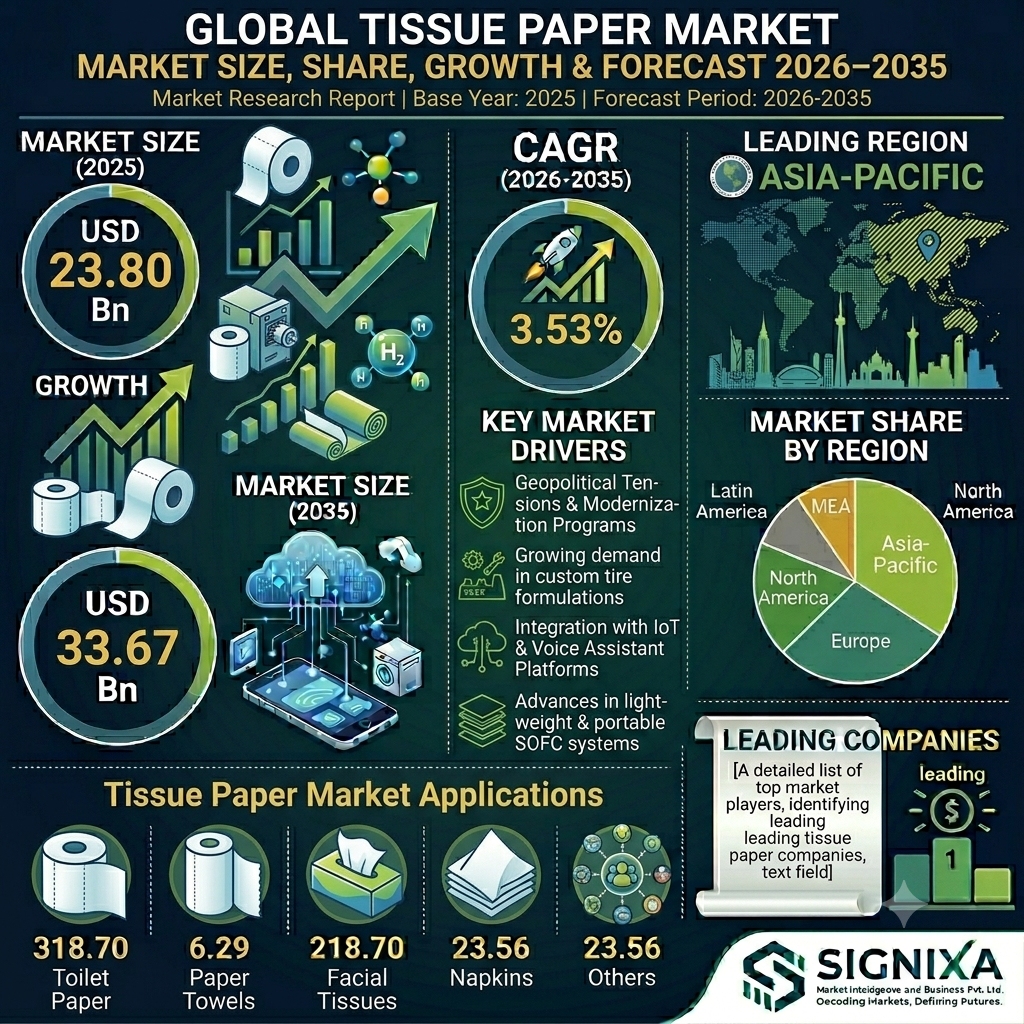
The size of the global Tissue Paper market was worth around USD 23.80 billion in 2025 and is predicted to grow to around USD 33.67 billion by 2035, with a compound annual growth rate (CAGR) of roughly 3.53% between 2026 and 2035. The tissue paper market is expanding steadily, driven by growing awareness of personal hygiene, rising disposable incomes, and increasing demand from both residential and commercial sectors.
Tissue paper products — including toilet paper, facial tissues, paper towels, napkins, and wipes — serve essential daily needs and hygiene practices worldwide. Consumer preference is shifting toward eco-friendly and biodegradable tissue papers made from recycled fibers, reflecting increasing environmental consciousness. Innovations in softness, strength, and absorbency are enhancing product appeal. The market benefits from rising urbanization, increasing hospitality and healthcare infrastructure, and growing use in offices, restaurants, and hotels. E-commerce channels are gaining prominence, offering greater accessibility and convenience for consumers. Health-related awareness has also increased significantly post-COVID, with germ and virus propagation concerns driving sustained consumer demand for disposable tissue products.
The market also faces challenges such as raw material price fluctuations and competition from alternative hygiene products. Overall, the tissue paper market is characterized by innovation, expanding applications, and increasing consumer focus on both quality and sustainability, positioning it for sustained growth globally.
Key Findings
- The global Tissue Paper market is estimated to grow annually at a CAGR of around 3.53% over the forecast period (2026–2035).
- In terms of revenue, the global Tissue Paper market size was valued at around USD 23.80 billion in 2025 and is projected to reach USD 33.67 billion by 2035.
- Rising hygiene awareness, increasing urbanization, and demand for convenient disposable products are key drivers, especially in emerging economies with growing middle-class populations.
- Based on Product Type, the Toilet Paper segment is growing at a high rate and will continue to dominate the global market.
- On the basis of Distribution Channel, the Online segment is anticipated to command the largest market share.
- In terms of End Users, the Household segment (60%+ global share) is anticipated to command the largest market share.
- By Region, Asia-Pacific is projected to dominate the global market during the forecast period.
Tissue Paper Market Dynamics
Post-COVID Hygiene Consciousness & 70%+ Daily Tissue Usage Cementing Tissue Paper as an Essential Consumer Staple
With the rise in public health awareness, especially after the pandemic, consumers are making hygiene and cleanliness more of a priority. This development resulted in increased demand for tissue products including facial tissues, toilet paper, and paper towels. Surveys of global consumers show that more than 70% of consumers use tissue products for daily hygiene. This increased emphasis on sanitation behavior at home and in public spaces will continue to drive the market forward, particularly in urban and semi-urban areas of Asia, Europe, and North America. Innovations in the product — including eco-friendly, anti-bacterial, and lotion-infused tissue paper — have created interest from environmentally conscious and health-conscious consumers, further accelerating overall growth. The post-COVID behavioral shift toward maintaining higher sanitation standards at home and in public settings has proven durable, sustaining elevated tissue consumption levels well beyond the acute pandemic period through the forecast period.
UN-Projected 68% Urban Population by 2050 Driving Packaged Hygiene Product Accessibility & Modern Retail Format Expansion
Rapid urbanization is shifting consumer behavior, especially in developing markets. As the population moves to urban areas, modern retail formats and packaged hygiene products like tissue paper become more accessible. According to the UN, in 2023, about 56% of the world's population lived in urban areas, a figure projected to grow to 68% by 2050. This trend supports increased tissue consumption, particularly toilet paper and kitchen towels, as an important component of convenient and clean urban lifestyles. Urban lifestyles normalize disposable hygiene product usage and expose consumers to broader tissue product categories through organized retail and e-commerce channels. The rapid growth of organized retail in emerging economies — including supermarkets, hypermarkets, and convenience store chains — is dramatically improving tissue product accessibility for consumers who previously relied on unpackaged alternatives through the forecast period.
6% Annual Healthcare Infrastructure Growth in Low- & Middle-Income Countries & Hospitality Expansion Driving Commercial Tissue Demand
The international growth of hotels, restaurants, and healthcare facilities has increased the amount of tissue paper being used in commercial settings. The hotel industry utilizes high volumes of toilet paper, napkins, and facial tissues; healthcare facilities use a multitude of disposable hygiene products that aim to control infection. According to the World Health Organization, healthcare infrastructure investment is growing at 6% per year in low- and middle-income countries, which is enhancing tissue demand. The growing hospitality sector in tourism-oriented economies is also a major contributor to global tissue consumption. The expansion of quick-service restaurant chains globally — which rely heavily on tissue napkins and paper towels for hygienic food service — is creating consistent commercial sector demand that is less subject to economic cyclicality than premium consumer tissue products through the forecast period.
Tissue Paper Market: Segmentation Analysis
By Product Type Segment Analysis
Toilet Paper
The largest share in the global tissue paper market is held by Toilet Paper, which is driven by its indispensable use in hygiene and sanitation in households and commercial establishments. Globally, per capita consumption of toilet paper amounted to over 5.5 kg in developed countries. Growing consumer awareness of personal hygiene will also provide additional traction with regard to demand, along with population growth, and increased access to sanitation in developing regions. Emerging innovations in biodegradable and recycled paper alternatives are helping to drive overall demand, particularly in sustainability-oriented markets like North America and Europe. The premiumization trend in toilet paper — including the growth of multi-ply, quilted, and lotion-infused variants commanding higher price points — is enabling consistent revenue growth in markets where volume growth is more constrained by high baseline penetration. The expanding sanitation access programs in South and Southeast Asia, sub-Saharan Africa, and Latin America are progressively incorporating toilet paper into daily hygiene routines as access to improved sanitation infrastructure grows through the forecast period.
Facial Tissues
Facial tissues are commonly used for personal hygiene, skincare, and during a cold or allergic reaction. This category is expanding because of the increasing consumer awareness for cleanliness and preferences for soft, lotion-infused, or anti-bacterial tissues. Facial tissues are expected to grow at more than 4% CAGR through 2030. The Asia Pacific region is a major contributor due to the rising middle class and lifestyle change. The demand for facial tissues is also positively impacted by seasonal spikes during cold and flu season. The growing crossover between facial tissues and skincare — with product variants that include aloe vera, vitamin E, and other skin-conditioning ingredients — is creating premium consumer propositions that attract health and beauty conscious consumers. The expanding convenience culture in emerging markets is driving facial tissue adoption among younger urban consumers who previously relied on handkerchiefs through the forecast period.
Paper Towels
Paper towels are in high demand for use during household cleaning and food service. They are valued for their absorbency, convenience, and hygiene. The market for paper towels was over USD 12 billion in 2022 and is expected to rise at a steady pace. The COVID-19 pandemic significantly enhanced the demand by increasing consumers' use of surface-cleaning products, with many consumers still using these products more often than before the pandemic. North America leads in paper towel consumption, because of the strong culture of using disposable paper products for the kitchen and sanitation. The growing adoption of paper towels in foodservice applications globally — including cafeterias, street food vendors, and quick-service restaurants in emerging markets — is expanding the consumer base beyond the North American and European strongholds through the forecast period.
Napkins
Tissue napkins are commonly used in households, restaurants, and events for personal hygiene and table settings. Growing food service industry growth and casual dining trends are supporting the market segment. Sales of napkins are estimated to expand at a 3.5% CAGR through 2028. Product innovation in designs, print customization, and biodegradable solutions are boosting market prospects. Europe and North America are the largest markets, but the Asia-Pacific region is growing rapidly due to increased adoption of tissue napkins in hospitality and food delivery sectors. The surge in organized food delivery services globally — which regularly include napkins in order packaging — is creating a substantial and growing consumption channel that supplements the traditional restaurant and household segments through the forecast period.
Wrapping Tissue
Wrapping tissue is mainly utilized as a protective covering for delicate items including gifts, garments, and glassware. The growth of online shopping and premium packaging has increased demand for wrapping tissue. The use of wrapping tissue is expected to grow at a CAGR of roughly 3.8% by 2030. Retailers and e-commerce sites are increasingly using wrapping tissue to elevate product presentation and improve the customer experience. Concerns about sustainability are also driving interest in wrapping tissue made from recyclable and unbleached variants. The luxury retail sector's increasing emphasis on premium unboxing experiences — where tissue paper wrapping is an integral component of the brand presentation inside packaging — is creating demand for high-quality, branded, and sustainably sourced wrapping tissue. The wedding, event, and gifting industry represents a seasonal but significant demand spike that supports consistent wrapping tissue market activity through the forecast period.
Specialty Tissue
Specialty tissue comprises premium-grade or functional tissue manufactured for specific uses in niche markets including medical wipes, scented tissues, and moisturizing tissues. Specialty tissue is currently experiencing demand growth from health, cosmetics, and baby care applications. The specialty tissue segment is projected to grow at a CAGR of just over 5% through 2035 — the fastest among all tissue product types. North America and Europe are the leading regions because of innovation around product features and strong demand for value-added hygiene solutions. Increased consumer interest in skincare and health benefits continues to foster specialty tissue growth. The baby care sub-segment — including ultra-soft baby facial tissues and moist wipes — benefits from premium positioning and high brand loyalty among new parents, creating a recurring high-value consumer relationship that supports above-average pricing through the forecast period.
By Distribution Channel Segment Analysis
Online
Online channels have gained tremendous traction because of increased internet penetration and ease of delivery to people's homes. Consumers utilize e-commerce platforms for bulk purchasing and subscriptions of tissue paper products. Global e-commerce sales in the FMCG space are projected to exceed $400 billion by 2026. Online channels also allow brands to reach consumers in remote areas, offering broader product assortments and price comparisons. Discounts, product reviews, and convenient payment methods further contribute to consumer preference for this channel, especially among younger tech-savvy consumers. The subscription model for tissue products — where consumers set a regular delivery frequency and enjoy automatic replenishment without repeat ordering — is proving particularly effective for household consumers, reducing brand switching and improving customer lifetime value. Direct-to-consumer tissue brands that operate exclusively online are gaining market share by emphasizing sustainability credentials, premium quality, and competitive pricing relative to traditional retail through the forecast period.
Due to the habit-forming nature of purchasing tissue paper and the immediate purchase availability in supermarkets, hypermarkets, and convenience stores, offline retail is still the preferred channel. Nielsen reports that more than 75% of tissue paper sales globally took place through offline stores in 2023. Many consumers prefer inspecting quality, texture, and quantity in person before purchasing. Offline stores also serve bulk buyers — such as restaurants and hospitals — and provide critical functions in commercial distribution. Promotion displays and loyalty programs incentivize foot traffic and bring predictability to physical retail stores. The physical retail environment remains particularly important for premium tissue product launches, where tactile qualities — softness, thickness, texture — are most effectively communicated through in-store product sampling and display. The growing format of specialty health and personal care retail stores, which dedicate significant shelf space to premium tissue and hygiene products, is creating new differentiated offline retail opportunities beyond traditional grocery through the forecast period.
By End Use Segment Analysis
The household segment leads the global tissue paper market, driven by daily consumer needs for hygiene and convenience. Items such as toilet paper, facial tissues, paper towels, and napkins are consumables typically found in homes around the world. According to Euromonitor, household tissue paper held more than 60% of the global market share in 2023. The growth of the segment is bolstered by ongoing urbanization, rising disposable income, and enhanced awareness associated with personal hygiene post-pandemic. The household segment will continue to grow with demand for softness, thickness, and eco-friendly options geared toward family or individual usage. The proliferation of household tissue product variants — including recycled-content toilet paper, bamboo-based facial tissues, and multi-use cleaning sheets — is expanding the household tissue market into premium segments that command higher margins and support revenue growth beyond volume increases through the forecast period.
The commercial sector involves the usage of tissue paper in offices, hotels, shopping malls, hospitals, and schools. The demand is fueled primarily by the number of visitors to such places, and the need to maintain hygiene requirements is paramount. The commercial tissue paper market will grow at a CAGR of 4.1% through 2030. The purchasing of bulk orders from facility management companies, and the increasing use of dispenser-based products, help efficiency and cost savings in the commercial sector. The commercial sector will benefit from the growth in the hospitality and healthcare industries, especially in emerging markets with more stringent hygiene regulations. The growing adoption of controlled-use tissue dispensing systems — which portion tissue usage automatically to reduce per-unit consumption and lower costs — is driving commercial sector interest in integrated dispenser and tissue supply solutions through the forecast period.
The industrial segment, while smaller, provides specific service in designated manufacturing and processing environments where hygiene and surface cleaning are critical. Industries focused on food processing, pharmaceuticals, and electronics typically utilize tissue papers in controlled environments. Industrial tissue application is growing at an estimated 3% CAGR, reflecting the increased hygiene and cleanliness standards for production facilities. The demand is growing for durable, absorbent, and lint-free variants. Although this segment is a smaller portion of the total market, it plays an important role in maintaining operational cleanliness and regulatory compliance in sensitive industrial workflows. The growing pharmaceutical manufacturing sector — particularly in Asia-Pacific, where major production capacity additions are underway — is creating consistent demand for cleanroom-compatible tissue wipes and cleaning materials that meet stringent contamination control specifications through the forecast period.
Report Attributes & Market Scope
| Report Attribute | Details |
|---|---|
| Market Size Value in 2025 | USD 23.80 Billion |
| Market Size Value in 2035 | USD 33.67 Billion |
| CAGR (2026–2035) | 3.53% |
| Base Year Used for Estimation | 2025 |
| Historic Data | 2020 - 2025 |
| Forecast Period | 2026 - 2035 |
| Segments Covered – By Product Type |
|
| Segments Covered – By Distribution Channel |
|
| Segments Covered – By End Use |
|
| Regions Covered | North America, Europe, Asia Pacific, Latin America, Middle East and Africa |
| Major Countries Covered | U.S., Canada, Mexico, Germany, UK, France, Italy, Spain, Russia, China, Japan, South Korea, India, Southeast Asia Countries, Brazil, Argentina, GCC Countries, Turkey, Iran, Israel, South Africa, Egypt, Nigeria, etc. |
| Key Companies Profiled | Green Tree Papers, Lotus Tissues, Garnett Paper, Paras Polymers, Wonder Tissues, Green Tissues, Ajanta Paper Products, Origami Tissues, Kempt Tissues Pvt. Limited, Georgia Pacific, Charmin, among others. |
Tissue Paper Market Regional Analysis
The Asia-Pacific region leads the worldwide tissue paper market, propelled by population size, growing disposable incomes, and heightened awareness of hygiene. North America holds a significant share supported by high per capita consumption and well-established distribution networks. Europe's market is marked by strong consumer awareness of hygiene and an increasing focus on sustainability.
Asia-Pacific (Dominant Region)
The Asia-Pacific region leads the worldwide tissue paper market, propelled by factors such as population size, growing disposable incomes, and heightened awareness of hygiene. Countries such as China, India, and Japan play a significant role, with urbanization and a rise in living standards contributing to the demand for household and institutional tissue products. Government policies that boost sanitation markets and an expanding retail market have also propelled tissue growth. The Middle East & Africa and Latin America are developing regions, growing as a result of improved access to hygiene products, developing hospitality sectors, and growing awareness of health and cleanliness. India's rapidly growing tissue paper manufacturing sector — with multiple new tissue machine installations in 2025 expanding domestic production capacity — is reducing import dependence and improving product accessibility and affordability for consumers through the forecast period.
North America
North America holds a significant share in the tissue paper market, supported by high per capita consumption and well-established distribution networks. The United States and Canada lead demand, driven by rising hygiene awareness, strong healthcare infrastructure, and growth in hospitality and foodservice industries. Consumers increasingly prefer premium tissue products that offer softness, strength, and added benefits such as lotion or aloe infusion. There is a growing trend toward sustainable and recycled tissue papers, reflecting rising environmental concerns and stringent regulations on waste and resource management. Commercial demand from offices, hotels, and healthcare facilities further bolsters the market, emphasizing bulk and specialty tissue paper purchases. Despite occasional raw material price volatility, the market remains resilient due to consistent consumer demand and ongoing product development through the forecast period.
Europe
Europe's tissue paper market is marked by strong consumer awareness of hygiene and an increasing focus on sustainability, which is driving demand for eco-friendly and recycled tissue products. Countries such as Germany, France, the UK, and Italy lead consumption, supported by well-developed retail infrastructure and high living standards. European consumers prioritize products that combine softness, durability, and environmental responsibility, prompting manufacturers to innovate with biodegradable materials and sustainable packaging. Regulatory frameworks across the region encourage the reduction of carbon footprints and waste, pushing companies to adopt greener manufacturing processes. Advancements in tissue technology are improving product performance, offering multi-functional options like antibacterial or lotion-infused tissues. Europe's combination of consumer sophistication, regulatory support, and innovation ensures steady growth and evolving market trends through the forecast period.
Latin America & Middle East/Africa
Latin America and the Middle East & Africa are developing regions demonstrating growing adoption of tissue paper products as a result of improved access to hygiene products, developing hospitality sectors, and growing awareness of health and cleanliness. In Latin America, Brazil and Mexico lead demand, driven by rising hygiene standards, growing middle-class populations, and expanding organized retail chains that improve tissue product accessibility. The broader hospitality expansion driven by international tourism in Latin American destinations is creating robust commercial sector demand for napkins, toilet paper, and paper towels. In the Middle East, expanding healthcare and hospitality infrastructure — particularly in the GCC countries which host major hotel and medical facility development programs — is generating growing institutional tissue demand. The tissue paper market in these regions benefits from a relatively low baseline penetration that creates strong incremental growth potential as income levels and urbanization continue to rise through the forecast period.
Recent Developments in the Tissue Paper Market
-
2025
Gayatrishakti Paper & Boards entered India's tissue paper market with a 35,000 TPA AHEAD tissue machine by Toscotec in Gujarat, enhancing quality and efficiency with advanced drying and control systems.
-
2025
Supreme Paper Mills targets leadership in Eastern India's tissue products market by installing a 50 TPD tissue machine and launching its own brand 'SOFMAX', with plans to expand operations driven by strong regional demand.
Tissue Paper Market: Competitive Landscape
The global Tissue Paper market features major players such as Green Tree Papers, Lotus Tissues, Garnett Paper, Paras Polymers, Wonder Tissues, Green Tissues, Ajanta Paper Products, Origami Tissues, Kempt Tissues Pvt. Limited, Georgia Pacific, and Charmin. The Tissue Paper market is highly competitive, with companies competing on factors such as product innovation, cost-efficiency, geographical reach, and sustainability, which are all essential for gaining market share in the growing industry. As the market continues to expand, companies need to focus on further improving the performance of their tissue paper products and broadening their application scope to capitalize on the growing demand across household, commercial, and industrial end use segments.
Key Companies Profiled
Global Tissue Paper Market Segmentation Summary
By Product Type
By Distribution Channel
By End Use
By Region
Frequently Asked Questions (FAQs) About the Tissue Paper Market
What is Tissue Paper?
Tissue paper is a lightweight, soft, and absorbent paper product designed for personal hygiene and household use. Common types include toilet paper, facial tissues, napkins, and paper towels, offering convenience and cleanliness.
Which key factors will influence the Tissue Paper market growth over 2026–2035?
Key factors influencing the tissue paper market include rising hygiene awareness, growing demand for disposable products, population growth, urbanization, and increased healthcare spending, especially in developing regions, along with innovations in eco-friendly and premium tissue variants.
What will be the value of the Tissue Paper market during 2026–2035?
According to the study, the global Tissue Paper market size was worth around USD 23.80 billion in 2025 and is predicted to grow to around USD 33.67 billion by 2035.
What will be the CAGR value of the Tissue Paper market during 2026–2035?
The CAGR value of the Tissue Paper market is expected to be around 3.53% during 2026–2035.
Which region will contribute notably towards the Tissue Paper market value?
Asia Pacific dominates the tissue paper market due to its large population, rapid urbanization, increasing hygiene awareness, and expanding middle class, with countries like China and India driving strong demand across both household and commercial sectors.
Which are the major players leveraging the Tissue Paper market growth?
The global Tissue Paper market is led by players such as Green Tree Papers, Lotus Tissues, Garnett Paper, Paras Polymers, Wonder Tissues, Green Tissues, Ajanta Paper Products, Origami Tissues, Kempt Tissues Pvt. Limited, Georgia Pacific, and Charmin.
What can be expected from the global Tissue Paper market report?
The report explores crucial aspects of the Tissue Paper market, including a detailed discussion of existing growth factors and restraints while also analyzing future growth opportunities and challenges that impact the market.