
PPE Market Overview
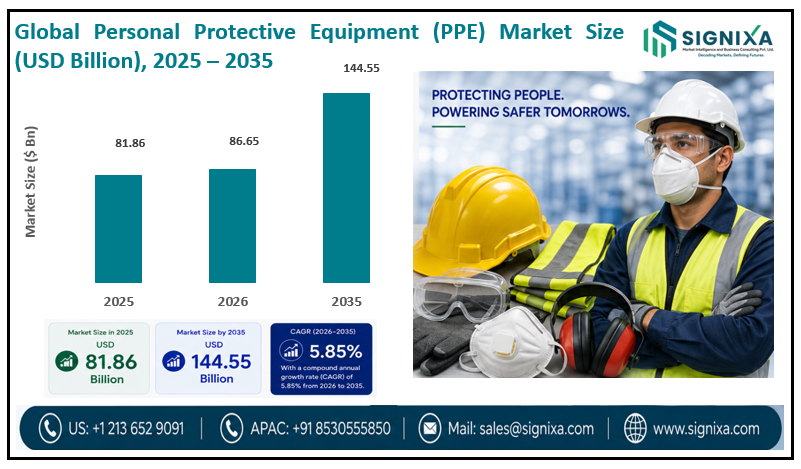
The size of the global personal protective equipment (PPE) market was worth approximately USD 81.86 Billion in 2025 and is projected to grow to around USD 144.55 Billion by 2035, with a compound annual growth rate (CAGR) of roughly 5.85% between 2026 and 2035. The report provides a detailed evaluation of the drivers, restraints, and opportunities influencing market demand, along with global and regional trends in the PPE market.
The worldwide PPE market includes several product categories deployed across diverse industries and hazard environments where protection and regulatory compliance are required. There is an increased global effort to address workplace safety, a growing number of government regulations enforced by bodies such as OSHA, NIOSH, EU-OSHA, and ANSI, and rising job-related accidents worldwide all of which are driving the PPE market forward. The expanding end-use sectors — including construction, oil & gas, healthcare, manufacturing, mining, and pharmaceuticals are requiring stronger and increasingly diversified PPE protections across an expanding range of hazard types and work environments.
The COVID-19 pandemic significantly accelerated PPE adoption, particularly in healthcare and frontline occupations, establishing a heightened long-term focus on infection prevention and worker protection that has reshaped procurement practices and safety culture globally. Technological advancements in PPE materials including lightweight, flame-resistant, chemical-resistant, and breathable fabrics are improving user comfort and protection levels simultaneously, driving higher worker compliance and expanding voluntary adoption beyond regulatory minimums. The growing integration of smart features such as wearable sensors for monitoring fatigue or hazardous gas exposure are shaping next-generation PPE solutions. As companies align with ESG goals, eco-friendly and reusable PPE options are gaining increasing commercial interest, and e-commerce distribution channels are improving product accessibility particularly for small and medium enterprises that previously faced barriers to certified PPE procurement.
Key Findings
- The global PPE market is forecasted to grow at a CAGR of 5.85% from 2026 to 2035, with market revenue rising from USD 81.86 Billion in 2025 to USD 144.55 Billion by 2035.
- Hand Protection and Respiratory Protection are expected to witness the most substantial demand among product segments, with hand protection accounting for over 25% of PPE demand driven by high industrial incident rates.
- Construction and Healthcare are anticipated to command the largest market shares by end-use, with construction exceeding 22% share and healthcare approximately 18% of the global PPE market in 2025.
- Regionally, North America holds the dominant market share, supported by stringent OSHA and ANSI regulations and mature end-use industries, while Asia-Pacific is the fastest-growing region driven by rapid industrialization and expanding safety compliance frameworks.
- Smart PPE integration including sensors for hazard monitoring and fatigue detection and the growing preference for eco-friendly, reusable PPE are emerging as key product innovation trends reshaping competitive dynamics through the forecast period.
PPE Market Dynamics
Stringent Occupational Safety Regulations & Employer Compliance Mandates
The global PPE market is primarily driven by the increasing emphasis on occupational safety and health standards across various industries. Governments and regulatory bodies worldwide are reinforcing safety mandates to protect workers from exposure to physical, chemical, biological, and radiological hazards. In sectors including construction, oil & gas, mining, and manufacturing, employees face daily risks of injuries, respiratory threats, or chemical burns. Regulatory authorities including OSHA, EU-OSHA, and ANSI have introduced stringent guidelines mandating the use of certified protective equipment, compelling employers to invest in high-quality PPE compliant with applicable standards. The heightened awareness of litigation risks and workers' compensation claims is also pushing companies to proactively embed PPE usage into their operational safety culture making certified protective gear a non-negotiable operational requirement rather than a discretionary safety investment. The COVID-19 pandemic further reinforced this cultural shift, demonstrating the critical role PPE plays in minimizing infection risks and sustaining essential operations during public health emergencies.
Industrialization in Emerging Economies & Post-Pandemic Hygiene Awareness
Increased industrialization and associated workplace hazards in emerging economies especially across Asia-Pacific have markedly increased demand for high-performance PPE across the construction, manufacturing, and infrastructure development sectors. The focus on hygiene and respiratory safety established during the pandemic continues to benefit PPE manufacturers, as organizations that adopted elevated protective protocols have maintained these practices as institutional standards rather than reverting to pre-pandemic minimums. Businesses are also investing more in ergonomic protective gear and comfortable PPE to improve worker compliance rates recognizing that protective equipment only delivers value when workers consistently and correctly wear it throughout their shifts. High-performance materials are also evolving, including anti-fog optical coatings, durable cut-resistant fabrics, and lighter composite hard hat constructions making PPE simultaneously safer, more functional, and more comfortable for extended daily use across industrial environments.
High Certification Costs, SME Affordability Barriers & User Compliance Challenges
Despite the strong growth potential, the PPE market faces notable restraints particularly among small and medium enterprises (SMEs) in developing economies due to the high costs associated with certified protective gear that meets regulatory standards. Many SMEs struggle with affordability and may resort to low-cost, non-compliant PPE that fails to deliver adequate protection or regulatory compliance, creating legal risk and worker safety shortfalls. The complexity of complying with multiple regional safety regulations and certification requirements across different jurisdictions often creates confusion and delays procurement decisions, particularly for companies operating across borders. User resistance due to discomfort, poor ergonomic design, or insufficient safety training reduces the effective utilization of PPE even where it is procured undermining the investment in worker protection. Advanced smart PPE solutions offer better protection but feature higher price points due to integrated sensor technology and advanced materials, limiting their adoption in cost-sensitive markets. Balancing compliance, quality, and cost remains a key challenge hindering effective PPE market penetration across fragmented and price-conscious sectors and geographies.
PPE Market Segmentation Analysis
By Product Type Segment Analysis
The PPE market is served across a comprehensive range of product categories, each addressing distinct hazard types and body protection needs across the wide variety of industrial and occupational environments where PPE is mandated or recommended:
Hand Protection
Hand Protection products are likely to dominate the PPE market due to the high incidence rate of hand injuries across manufacturing and construction industries. OSHA data indicates that hand protection accounted for over 25% of total PPE demand, with hand injuries representing nearly 40% of all industrial incidents making hand protection both the most frequently required and most frequently misused category of PPE. Gloves manufactured from nitrile, latex, and neoprene are progressively being adopted for their excellent resistance to chemical agents, durable performance under mechanical stress, and broad applicability across healthcare, chemical processing, food handling, and industrial maintenance applications. The availability of task-specific glove formulations — including cut-resistant, thermal protective, anti-vibration, and sterile varieties ensures that hand protection remains the single largest product category within the global PPE market through the forecast period.
Respiratory Protection
Respiratory Protection is expected to be the most rapidly growing segment within the PPE market due to rising concerns around industrial air quality, occupational dust and chemical vapor exposure, and the post-pandemic institutionalization of infection control protocols across healthcare and public-facing occupations. Respiratory protection contributed approximately 18% to total PPE revenue in 2025. Products in this segment including filtering facepiece respirators (FFP2/N95), half-face and full-face elastomeric respirators, powered air-purifying respirators (PAPRs), and supplied-air breathing apparatus — were adopted with vigour following the COVID-19 pandemic and have maintained elevated demand as awareness of occupational respiratory disease risk has been permanently elevated. Regulatory pressure in sectors including pharmaceuticals, mining, construction (silica dust), and industrial chemical processing continues to drive compliance-driven purchasing across both disposable and reusable respiratory protection product lines.
Protective Footwear
Protective Footwear continues to be a particularly relevant and consistently large PPE segment, especially within the construction and mining industries where foot injury risk from falling objects, punctures, and slip hazards is significant and regulatory requirements for protective boots are well established. Protective footwear accounted for more than 15% of PPE market revenue in 2025. The demand for heavy-duty work footwear has seen significant growth due to the increasing availability and customer awareness of advanced protective features including composite-toe or steel-toe caps, puncture-resistant midsoles, slip-resistant outsole formulations, electrical hazard insulation, metatarsal guards, and ergonomic insole designs that reduce worker fatigue during extended standing shifts. Growing infrastructure development across Asia-Pacific, the Middle East, and Latin America is creating robust pipeline demand for regulatory-compliant protective footwear across the expanding construction and industrial workforce in these regions.
Fall Protection
Fall Protection systems are becoming increasingly prevalent in the construction and oil & gas industries as both regulatory requirements and awareness of fall-related fatality risk intensify across major construction markets. According to the U.S. Bureau of Labor Statistics, falls accounted for 33% of all construction industry fatalities in 2025 underscoring the critical importance of effective fall protection solutions including personal fall arrest systems (PFAS), safety harnesses, self-retracting lifelines (SRLs), anchor points, and fall prevention guardrail systems. This segment will continue to grow, especially in North America and the Middle East, as rising infrastructure project volumes and evolving regulatory enforcement of working-at-height regulations create structural demand for comprehensive fall protection programs. Growing adoption of pre-task planning and fall hazard assessment methodologies by construction safety managers is further expanding fall protection procurement beyond individual harness purchases toward complete system solutions.
Hearing Protection
Hearing Protection products including earplugs, earmuffs, and banded hearing protectors are essential in manufacturing, heavy industry, and construction environments where noise levels routinely exceed the 85-decibel threshold above which NIOSH and OSHA mandate hearing conservation programs. Hearing protection accounted for approximately 7% of the PPE market revenue share in 2025. As awareness of noise-induced hearing loss (NIHL) one of the most prevalent but preventable occupational diseases globally continues to grow, and as regulatory enforcement of noise exposure limits and hearing conservation programs tightens, demand for both disposable and reusable hearing protection solutions is steadily increasing. The development of intelligent hearing protection products that electronically attenuate harmful noise while allowing safe-level communication signals to pass through is creating a premium product sub-segment that is gaining traction in environments where communication and protection must both be maintained.
By End Use Segment Analysis
The PPE market serves a wide range of end-use industries, each presenting distinct hazard profiles, regulatory requirements, and PPE product category preferences:
Construction
Construction is expected to hold the largest share of the PPE market by end-use at over 22% in 2025. Increasing construction of infrastructure projects across North America, Asia-Pacific, and the Middle East is creating strong demand for the full spectrum of construction PPE including hard hats, safety boots, gloves, high-visibility vests, fall protection harnesses, eye protection, and respiratory dust protection. Construction workers face a uniquely broad range of simultaneous hazards including fall risk, struck-by hazards, electrical exposure, silica dust inhalation, and hand injury risk making comprehensive, multi-category PPE procurement essential for site safety compliance. The ongoing global infrastructure investment wave, including transportation networks, energy infrastructure, and urban residential development, ensures that construction remains the single largest and most diverse end-use segment for the global PPE market through the forecast period.
Healthcare
Healthcare remains under consistent and elevated pressure as a PPE end-use sector, making up approximately 18% of the global PPE market in 2025. The COVID-19 pandemic solidified the irreplaceable significance of protective masks, face shields, gloves, and gowns in healthcare settings permanently elevating the standard of care for infection prevention and personal protection among healthcare professionals. Healthcare PPE procurement is characterized by high product quality and regulatory compliance requirements, with many products subject to medical device or CE marking certification requirements that ensure appropriate barrier performance. The ongoing demand for healthcare PPE is sustained by routine infection control requirements, the aging global population expanding healthcare service demand, increasing surgical and procedural volumes, and growing awareness of healthcare worker protection as a critical occupational health and patient safety issue in hospital infection control programs.
Manufacturing
Manufacturing industries are important and consistent contributors to the global PPE market, accounting for over 15% of 2025 PPE market demand. Workers in manufacturing environments are exposed to a broad myriad of hazards including heat, chemical exposure, machinery contact injury risk, noise, and vibration making multipurpose and task-specific PPE critical for comprehensive worker protection. The broad hazard profile of manufacturing environments drives multi-category PPE procurement needs spanning hand protection, eye protection, hearing protection, respiratory protection, and protective clothing simultaneously creating higher average PPE spend per worker compared to some other end-use industries. Growing automation in manufacturing is also creating new PPE requirements for workers interacting with collaborative robots and automated systems, driving innovation in proximity detection and ergonomic protective solutions for the evolving manufacturing environment.
Oil & Gas
Oil & Gas has an important role as a high-value PPE end-use sector due to the extreme and multifaceted hazard environments characteristic of upstream, midstream, and downstream operations. Oil & Gas accounted for approximately 12% of the global PPE market share in 2025. The sector drives particularly high demand for premium PPE categories including flame-resistant (FR) and arc flash protective clothing, respiratory protection for toxic gas and vapor exposure, certified safety helmets, anti-static safety footwear, chemical-resistant gloves and suits, and fall protection systems for elevated platform work. The high-consequence nature of PPE failure in oil & gas environments where fire, explosion, chemical release, and confined space hazards can result in catastrophic fatalities — creates strong motivation for investment in the highest-performing certified protective equipment, supporting premium pricing and product innovation within this demanding end-use segment.
Chemicals & Pharmaceuticals
The Chemicals and Pharmaceuticals sectors collectively held approximately 10% of the global PPE market in 2025, driven by strict hygiene and contamination control requirements that create persistent PPE demand regardless of general economic conditions. In chemical processing, workers require PPE that provides reliable barrier protection against corrosive liquids, toxic vapors, reactive materials, and carcinogenic compounds making high-performance chemical-resistant gloves, protective suits, face protection, and respirators essential daily-use items rather than emergency equipment. In pharmaceutical manufacturing and cleanroom environments, PPE serves the dual purpose of protecting workers from potent compounds and protecting product batches from human contamination — creating strict requirements for sterile gloves, cleanroom coveralls, face masks, and hair and shoe covers that meet both occupational health and Good Manufacturing Practice (GMP) regulatory standards simultaneously.
Report Attributes & Market Scope
| Report Attribute | Details |
|---|---|
| Market Size Value in 2025 | USD 81.86 Billion |
| Market Size Value in 2035 | USD 144.55 Billion |
| CAGR (2026–2035) | 5.85% |
| Base Year Used for Estimation | 2025 |
| Historic Data | 2020 – 2025 |
| Forecast Period | 2026 – 2035 |
| Segments Covered – By Product Type |
|
| Segments Covered – By End Use |
|
| Regions Covered | North America, Europe, Asia Pacific, Latin America, Middle East and Africa |
| Major Countries Covered | U.S., Canada, Mexico, Germany, UK, France, Italy, Spain, Russia, China, Japan, South Korea, India, Southeast Asia Countries, Brazil, Argentina, GCC Countries, Turkey, Iran, Israel, South Africa, Egypt, Nigeria, etc. |
| Key Companies Profiled | 3M Company, Honeywell International Inc., DuPont de Nemours Inc., Ansell Ltd., Kimberly-Clark Corporation, MSA Safety Incorporated, Lakeland Industries Inc., Alpha Pro Tech Ltd., Bullard, and Uvex Safety Group, among others. |
PPE Market Regional Analysis
North America continues to lead the global PPE market, supported by stringent safety regulations from OSHA and ANSI, mature end-use industries, and strong legal and cultural emphasis on workplace safety compliance. Asia-Pacific will experience the fastest growth due to rapid industrialization, growing infrastructure investment, and increasing adoption of formal safety norms across China, India, and Southeast Asia. Europe is well positioned as the second-largest revenue contributor with strong regulatory frameworks including EU PPE Regulation 2016/425. Latin America and the Middle East & Africa are newer markets with growing safety awareness and increasing regulatory development.
North America (Dominant Region)
North America leads the global PPE market, supported by the most stringent occupational safety regulatory environment globally anchored by OSHA's comprehensive workplace safety standards, NIOSH product certification requirements, and ANSI performance standards across all major PPE categories. The United States leads the regional market with the greatest awareness and legal accountability for workplace safety, where employers face significant workers' compensation liability exposure and OSHA citation penalties that create powerful financial incentives for PPE investment beyond simple regulatory compliance. Mature end-use industries across construction, healthcare, oil & gas, and chemical manufacturing sustain consistent high-volume PPE demand, while early adoption of advanced PPE technologies including smart sensors and ergonomic next-generation designs creates premium market opportunities for innovative manufacturers. Strong e-commerce PPE distribution infrastructure and large safety distributor networks ensure ready product availability across the full range of industrial end-users from large enterprises to small contractors.
Europe
Europe represents a mature yet steadily evolving PPE market, supported by stringent worker safety regulations, a highly industrialized economy, and strong enforcement of occupational health standards under the EU PPE Regulation (EU) 2016/425. Western European nations including Germany, France, and the UK dominate the market with sustained demand for high-performance gear spanning flame-resistant clothing, respiratory protection, eye and face protection, and safety footwear. The healthcare sector especially following the COVID-19 pandemic — has significantly increased reliance on disposable gloves, gowns, and masks, while the pharmaceutical and cleanroom industries continue to use specialized PPE to maintain GMP hygiene standards. Sustainability is gaining traction across the European PPE market, with growing preference for eco-friendly and reusable solutions driven by corporate ESG commitments and evolving procurement policies. Smart PPE featuring sensors for monitoring vital signs and environmental hazards are being piloted in industrial settings, with Germany and the Netherlands leading innovation in connected worker safety technology adoption.
Asia Pacific (Fastest-Growing Region)
Asia-Pacific represents a robust and rapidly expanding growth landscape for the global PPE market, driven by rapid industrialization, increasing worker safety awareness, and evolving regulatory frameworks across China, India, Japan, South Korea, and Australia. Government-led industrial safety initiatives including India's "Make in India" occupational health reforms and China's ongoing strengthening of occupational health regulations are compelling organizations to adopt advanced PPE across the expanding manufacturing and construction workforce. The construction boom and infrastructure development surge across Southeast Asia are driving substantial demand for helmets, gloves, safety harnesses, and high-visibility clothing, while heightened respiratory protection awareness shaped by urban air quality concerns and the COVID-19 pandemic legacy sustains strong demand for masks and respiratory protective devices. Local PPE manufacturing investment is growing, aiming to reduce import dependency and strengthen domestic supply chains, while manufacturers are developing climate-appropriate designs suited to the hot and humid conditions prevalent across much of Asia's industrial geography.
Latin America
Latin America is an emerging and growing PPE market, with Brazil, Mexico, Colombia, Argentina, and Chile as the primary contributors. Increasing industrialization, growing infrastructure construction programs, and gradually strengthening occupational safety regulatory frameworks are driving PPE demand across the region's construction, mining, manufacturing, and oil & gas sectors. Brazil represents the largest national market, supported by extensive mining operations, a large construction sector, and increasingly active enforcement of occupational safety regulations through the Brazilian Ministry of Labor and its Regulatory Norms (Normas Regulamentadoras). Mexico's manufacturing growth particularly in automotive and electronics sectors benefiting from nearshoring trends — is creating sustained demand for industrial PPE compliant with NOM (Norma Official Mexicana) occupational safety standards. Growing distribution networks and increasing penetration of online PPE procurement channels are improving product accessibility for smaller employers across the region, gradually addressing the historical challenge of informal workforce PPE access.
Middle East & Africa
The Middle East and Africa region is experiencing steady growth in the PPE market, driven by expanding industrialization, regulatory reforms, and heightened awareness of worker safety across GCC countries and major African economies. In the UAE and Saudi Arabia, GCC nations are implementing stricter occupational safety regulations aligned with international standards particularly in the context of large-scale Vision 2030 infrastructure development programs that are generating significant demand for construction, oil & gas, and industrial PPE. South Africa remains the key African market, supported by a large and well-regulated mining sector and improving health infrastructure. The healthcare sector across the MEA region witnessed increased demand for surgical masks, gowns, and gloves during and after the COVID-19 pandemic, establishing improved baseline PPE procurement infrastructure. Local PPE manufacturing capabilities are developing with efforts to localize production and improve distribution networks gaining pace across the region though continued reliance on imports from Europe and Asia characterizes the near-term supply landscape for the majority of the MEA market.
Recent Developments in the PPE Market
-
2026
- 3M Company expanded its portfolio of advanced respiratory protection and connected safety solutions, focusing on worker protection, real-time monitoring, and industrial safety compliance across high-risk workplaces.
- Ansell Ltd. expanded its hand and body protection portfolio with innovative gloves and protective garments designed for healthcare, life sciences, and industrial applications.
- Lakeland Industries, Inc. expanded manufacturing capabilities and introduced new flame-resistant and chemical-protective apparel to address increasing demand from industrial sectors.
-
2025
- 3M Company expanded its industrial safety portfolio with advanced respiratory protection technologies and worker safety solutions designed to improve workplace protection and compliance.
- Honeywell International Inc. introduced next-generation connected safety solutions integrating PPE with digital monitoring capabilities for industrial workers.
- Kimberly-Clark Corporation expanded its infection prevention and personal protection portfolio to address growing demand from healthcare and laboratory environments.
PPE Market: Competitive Landscape
The worldwide PPE market features key players including Honeywell International Inc., 3M Company, Ansell Ltd., DuPont de Nemours Inc., MSA Safety Inc., Kimberly-Clark Corporation, Alpha Pro Tech Ltd., Lakeland Industries Inc., Avon Protection Plc, and Mallcom India Ltd. These companies concentrate on product innovation, regulatory compliance, and strengthening their positions in specific regional markets. The competitive landscape is characterized by advancing technology integration, mergers and acquisitions, and active engagement with government and industry agencies to maintain alignment with evolving global safety standards.
Competition in the PPE market occurs across several distinct dimensions simultaneously. At the product level, leading manufacturers compete on performance certification, material innovation, ergonomic design, and smart technology integration. At the portfolio level, broad-line manufacturers including 3M and Honeywell compete by offering comprehensive PPE solutions across all major product categories enabling single-source procurement for large enterprise customers with complex multi-category PPE requirements. At the distribution level, competition centers on geographic reach, distributor relationship depth, e-commerce platform capability, and speed of product customization and delivery. At the sustainability level, growing corporate ESG purchasing criteria are creating competitive differentiation opportunities for manufacturers who can credibly demonstrate reduced environmental impact through reusable, recyclable, or bio-based PPE materials a dimension of competition that is expected to grow significantly in importance through the forecast period as corporate sustainability commitments translate into procurement policy requirements.
Key Companies Profiled
- 3M Company
- Honeywell International Inc.
- DuPont de Nemours, Inc.
- Ansell Ltd.
- Kimberly-Clark Corporation
- MSA Safety Incorporated
- Lakeland Industries, Inc.
- Alpha Pro Tech, Ltd.
- Bullard
- Uvex Safety Group
- Drägerwerk AG & Co. KGaA
- Radians, Inc.
- Delta Plus Group
- JSP Ltd.
- Mallcom (India) Limited
Global PPE Market Segmentation Summary
By Product Type
- Head Protection
- Eye Protection
- Face Protection
- Hearing Protection
- Protective Clothing
- Respiratory Protection
- Protective Footwear
- Fall Protection
- Hand Protection
- Others
By End Use
- Construction
- Manufacturing
- Oil & Gas
- Chemicals
- Food
- Pharmaceuticals
- Healthcare
- Transportation
- Mining
- Others
By Region
- North America
- U.S.
- Canada
- Mexico
- Europe
- Germany
- France
- UK
- Spain
- Italy
- Rest of Europe
- Asia-Pacific
- China
- Japan
- India
- Australia
- South Korea
- Southeast Asia
- Rest of Asia-Pacific
- Latin America
- Brazil
- Argentina
- Rest of Latin America
- The Middle East & Africa
- GCC Countries
- South Africa
- Rest of the Middle East & Africa
Frequently Asked Questions (FAQs) About the PPE Market
What is Personal Protective Equipment (PPE)?
Personal Protective Equipment (PPE) refers to protective gear designed to safeguard workers from hazards in the workplace. It includes items like helmets, gloves, goggles, face shields, masks, coveralls, safety shoes, and hearing protection. PPE is essential across various sectors including healthcare, construction, manufacturing, mining, and oil & gas.
Which key factors will influence the PPE market growth over 2026–2035?
The global PPE market is expected to grow due to increasing industrial safety regulations, rising awareness about worker health and safety, and sustained demand from the healthcare sector. Growth in construction and manufacturing industries, especially in emerging economies, will further support demand.
What will be the value of the PPE market during 2026–2035?
According to the study, the global Personal Protective Equipment (PPE) market size was worth around USD 81.86 Billion in 2025 and is predicted to grow to around USD 144.55 Billion by 2035, reflecting its widespread use in occupational safety and infection control.
What will be the CAGR value of the PPE market during 2026–2035?
The CAGR value of the global PPE market is expected to be around 5.85% during the forecast period of 2026 to 2035, driven by increasing workplace safety regulations, rising awareness of occupational health hazards, and growing demand for protective equipment across industries such as healthcare, construction, manufacturing, oil & gas, mining, and chemicals.
Which region will contribute notably towards the PPE market value?
The global PPE market is significantly driven by North America and Europe, owing to strong workplace safety regulations, high industry compliance, and robust healthcare infrastructure. Meanwhile, Asia-Pacific is emerging rapidly due to expanding manufacturing sectors and increasing investments in industrial safety.
Which are the major players leveraging the PPE market growth?
The global PPE market is led by players such as 3M Company, Honeywell International Inc., DuPont de Nemours Inc., Ansell Ltd., Kimberly-Clark Corporation, MSA Safety Incorporated, Lakeland Industries Inc., Alpha Pro Tech Ltd., Bullard, and Uvex Safety Group.
What can be expected from the global PPE market report?
The report provides in-depth analysis of the PPE market, covering key drivers, challenges, and trends influencing market dynamics. It offers detailed segmentation by product type, end-use industry, and region, alongside competitive benchmarking, regulatory analysis, and future growth opportunities across diverse applications from 2026 to 2035.