
Bipolar Plates for PEM Fuel Cells Market Overview
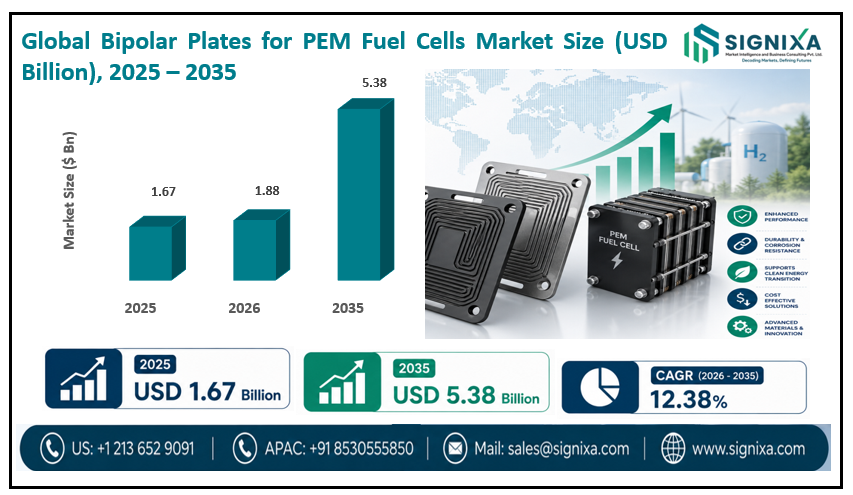
The size of the global Bipolar Plates for PEM Fuel Cells market was worth around USD 1.67 Billion in 2025 and is predicted to grow to around USD 5.38 Billion by 2035, with a compound annual growth rate (CAGR) of roughly 12.38% between 2026 and 2035. Key drivers of this growth are the increasing use of fuel cell technology for clean energy use, including applications in transportation and industrial sectors, along with the focus on decreasing carbon emissions globally. Furthermore, improvements in manufacturing processes and advances in material technologies have improved the price and performance of bipolar plates and are helping to drive growth in the market.
The bipolar plates market for Proton Exchange Membrane (PEM) fuel cells is gaining momentum due to increasing demand for clean and efficient energy systems in automotive, stationary power, and portable applications. Bipolar plates serve as key components in PEM fuel cells, enabling current collection, gas distribution, and heat management. The market is driven by the expansion of hydrogen-powered vehicles and fuel cell backup systems, particularly in regions focused on net-zero targets. Material innovation is crucial — graphite, metal, and composite-based plates are being engineered for improved conductivity, corrosion resistance, and cost-efficiency. Advanced manufacturing techniques like metal stamping and injection molding are enhancing production scalability. Notably, industries are exploring thin-coated metal plates for compact, high-performance stacks in electric mobility. Ongoing research into lighter, durable plate materials supports integration into commercial vehicles, drones, and material handling equipment. As fuel cell technology matures, the bipolar plates segment is expected to play a pivotal role in performance optimization and market scalability.
Key Findings
- The global Bipolar Plates for PEM Fuel Cells market is estimated to grow annually at a CAGR of around 12.38% over the forecast period (2026-2035).
- In terms of revenue, the global market was valued at around USD 1.67 Billion in 2025 and is projected to reach USD 5.38 Billion by 2035.
- Key drivers include the rising adoption of fuel cell technology in clean energy sectors, growing environmental regulations pushing for reduced emissions, and advancements in manufacturing and material technologies.
- Based on Material Type, the Graphite segment is growing at a high rate and will continue to dominate the global market, accounting for 65% of PEM fuel cell applications.
- In terms of Application, the Transportation segment is anticipated to command the largest market share; the global FCEV market exceeded USD 20 Billion in 2025 and is estimated to expand at a CAGR of 25% through 2035.
- By Region, North America is projected to dominate the global market during the forecast period.
- Composite bipolar plates are expected to expand at a CAGR of 18%, the fastest-growing material sub-segment.
Bipolar Plates for PEM Fuel Cells Market Dynamics
Hydrogen Vehicle Adoption -FCEV Cars, Buses, Trucks & Locomotives
The increasing adoption of hydrogen fuel vehicles in the transportation sector is a significant factor supporting the expansion of the bipolar plates market. The rise in hydrogen fuel cells is seen as a viable replacement for traditional internal combustion engines as the automotive industry and governments try to mitigate carbon emissions and advance sustainable transportation options. Market growth in the development of fuel cell powered cars, buses, trucks and locomotives is accelerating, creating demand for better performing bipolar plates to increase fuel cell efficiency and performance. The global FCEV market is expected to exceed USD 20 Billion in 2025 and is estimated to expand at a CAGR of 25% through 2035. Governments and automotive manufacturers are committing significant resources into hydrogen-related vehicles and infrastructure, with a forecast of 3,000+ hydrogen fueling stations being operational across the globe by 2035.
Environmental Regulations, Net-Zero Targets & Government Hydrogen Incentives
Heightened global awareness on climate change has led to the implementation of more stringent rules and policies focused on environmental standards to reduce carbon emissions. This has created demand for alternative energy sources, like PEM fuel cells, that can produce zero emissions. As manufacturers aim to comply with environmental standards, there is demand for bipolar plates, which is an integral part of fuel cell technology. These policies are motivating the automotive and stationary power markets to investigate fuel cell solutions as cleaner and more sustainable energy sources. Policies supporting hydrogen include the U.S. DOE Hydrogen and Fuel Cell Program, the EU's Clean Hydrogen Partnership, and national hydrogen strategies in Japan, South Korea, Germany, and China.
Material Science Advances - Composites, Coated Metal Plates & Manufacturing Scale-Up
Progress in materials and manufacturing capacity can foster advancements in developing lower-cost, more efficient bipolar plates for PEM fuel cells. New materials, such as advanced composites and metals, are being investigated by both researchers and companies with a goal of enhancing the conductivity, longevity, and performance of the bipolar plates. Advancements in manufacturing processes -such as precision stamping, chemical vapor deposition, and injection molding -are providing the manufacturing community with repeatable production processes that allow for higher precision, the capabilities of scale, and reduce the cost of bipolar plates. Advanced manufacturing techniques including photochemical etching and metal stamping are enabling mass production while maintaining quality and consistency. All of these are stepping stones to widespread adoption of PEM fuel cells applications.
By Material Type Segment Analysis
Graphite Bipolar Plates
Graphite is by far the most common material used in bipolar plates for PEM fuel cell applications, because of its advantageous electrical conductivities, corrosion resistance and manufacturing characteristics. Graphite accounts for a large portion of the market -approximately 65% of PEM fuel cell applications using graphite-type materials. Graphite has unique properties that allow for the ability to withstand the extreme conditions fuel cells create, including high temperatures and humidity. However, the drawback is that graphite is brittle, necessitating additional research to develop suitable materials with similar properties.
Metal bipolar plates, specifically stainless-steel bipolar plates, are gaining popularity as a more beneficial alternative because metal plates have better mechanical strengths and are, in the end, less expensive than graphite for mass production. Metal plates typically have about a 25% share in the PEM fuel cell market. In comparison to graphite plates, stainless steel bipolar plates have superior mechanical properties regarding strength and deflection under load. Metal plates can also be manufactured in larger quantities at lower costs. Metal plates still have limitations, such as corrosion and conductivity at high temperatures, that can be improved through advanced coatings.
Composite Bipolar Plates (Carbon Fiber Reinforced)
Composite bipolar plates combine the advantages of both graphite and metal technologies to provide superior mechanical properties, lighter weight, and higher conductivity. This segment is still in the nascent stage with composites accounting for approximately 12% market share. Composites are being developed to overcome the brittleness of graphite and the corrosion of metals while providing good properties in PEM fuel cells. New and developing composite types, such as carbon fiber reinforced polymers, should expand the use of composites for bipolar plates. Recent trends show that composites will continue to expand at 18% CAGR due to perceived benefits from performance increases and cost reductions.
By Application Segment Analysis
Transportation (FCEVs -Cars, Buses, Trucks, Locomotives)
The transportation sector is now the primary commercial application of PEM fuel cells, driven by the growing interest in hydrogen vehicles. The global FCEV market is expected to exceed USD 20 Billion in 2025 and is estimated to expand at a CAGR of 25% through 2035. Governments and automotive manufacturers are committing significant resources into hydrogen-related vehicle and infrastructure, with a forecast of 3,000+ hydrogen fuelling stations being operational across the globe by 2035. The growth of the PEM fuel cell market is generating demand for highly efficient and high-performing components for fuel cells, including bipolar plates, to allow maximum fuel cell performance.
Stationary Power (Backup Power, Microgrids, Commercial Buildings)
PEM fuel cells are also being used more frequently in stationary power applications including backup power systems and microgrids. The stationary fuel cell power system market is anticipated to reach USD 7 billion by 2028, driven by increased demand for clean, dependable power in both commercial and residential buildings. Fuel cells can provide a back-up power supply in regions with grid instability, and a reliable source of energy that does not rely on fossil fuels. The expansion of hydrogen-based stationary power applications is also supported by government subsidies and businesses seeking to achieve their sustainability objectives.
Portable Power (Laptops, Drones, Military Devices)
PEM fuel cells are being developed for portable power applications in small electronics and portable devices. The portable fuel cell market has an expected CAGR of 12% during the period of 2026-2035. Fuel cells benefit from being lighter and more efficient than batteries; therefore, they have a longer run time and shorter downtime for charge time. This is resulting in more portable battery devices that are using fuel cells like laptops, drones, and military portable devices. The portable power market is still niche; however, it is still focused on portable fuel cells that have compact and better performance.
Report Attributes & Market Scope
| Report Attribute | Details |
|---|---|
| Market Size Value in 2025 | USD 1.67 Billion |
| Market Size Value in 2035 | USD 5.38 Billion |
| CAGR (2026-2035) | 12.38% |
| Base Year | 2025 |
| Historic Data | 2020-2025 |
| Forecast Period | 2026-2035 |
| Material Type Segments |
|
| Application Segments |
|
| Regions Covered | North America, Europe, Asia Pacific, Latin America, Middle East and Africa |
| Major Countries Covered | U.S., Canada, Mexico, Germany, UK, France, Italy, Spain, Russia, China, Japan, South Korea, India, Southeast Asia Countries, Brazil, Argentina, GCC Countries, Turkey, Iran, Israel, South Africa, Egypt, Nigeria, etc. |
| Key Companies Profiled | Precision Micro, ElringKlinger, Ballard, Schaeffer India, Elcon Precisions, KOBELCO, Fuel Cell Store, Neklar, Hyfindr, Dana Incorporated, Bipolarplates, and others. |
Bipolar Plates for PEM Fuel Cells Market Regional Analysis
North America (Market Leader)
The market for PEM fuel cells is largest in North America, supported by influential contributions from the U.S. and Canada. The U.S. is known for cutting-edge research and development and high-level commercialization of fuel cells, while exhibiting substantial financing of hydrogen infrastructure -exemplified by the U.S. Department of Energy Hydrogen and Fuel Cell Program and the Hydrogen and Fuel Cell Technical Advisory Committee. North America's leadership in the PEM fuel cell market is further supported by the voices, commitments, and investments of automotive companies (e.g. Ford, Toyota) and by professional associations, as well as some government objectives that promote positive clean energy and transportation strategies through the adoption of hydrogen fuel cells in both transportation and stationary power.
Europe
Europe plays a significant role in advancing the bipolar plates market for PEM fuel cells, driven by the region's strong commitment to hydrogen energy and stringent decarbonization policies. Governments across Germany, France, the Netherlands, and the Nordic countries are investing heavily in hydrogen infrastructure, including large-scale fuel cell vehicle deployment and stationary power systems. This has led to growing demand for high-performance bipolar plates that are lightweight, corrosion-resistant, and cost-effective. European manufacturers and research institutions are pioneering innovations in coated metal and composite bipolar plates, offering improved electrical conductivity and mechanical strength. Initiatives like the EU's Clean Hydrogen Partnership and national hydrogen strategies are accelerating R&D and commercialization of next-generation fuel cell stacks.
Asia-Pacific
Asia Pacific is rapidly emerging as a powerhouse in the bipolar plates market for PEM fuel cells, fueled by aggressive investments in hydrogen infrastructure, government-backed clean energy targets, and a strong automotive manufacturing base. China leads the region with its Hydrogen Fuel Cell Vehicle (FCV) roadmap, promoting mass adoption of PEM fuel cells in commercial transport, logistics fleets, and urban mobility. The Chinese market is scaling up production of graphite and metallic bipolar plates, supported by state-owned enterprises and innovative startups. Japan is advancing fuel cell technologies through collaborations between government agencies and private giants, focusing on coated metal plates for durability and compact design, crucial for its expanding fleet of fuel cell vehicles and residential energy units. South Korea is also investing in PEM systems for buses and stationary power, with strong industry involvement.
Middle East & Africa
The MEA region, particularly the Gulf countries, is gaining traction with ambitious clean energy agendas. Saudi Arabia and the UAE are investing in hydrogen megaprojects like NEOM and Masdar, which include plans for PEM fuel cell integration. Though still nascent, local interest in hydrogen mobility and off-grid energy is creating opportunities for bipolar plate suppliers. Africa, led by South Africa and Morocco, is exploring fuel cell applications in remote power systems and mining. Together, Europe and MEA represent a mix of mature innovation and emerging demand, shaping a diverse and evolving landscape for PEM bipolar plate adoption.
Latin America
Latin America represents an emerging market opportunity for bipolar plates and PEM fuel cell components, with early-stage interest in hydrogen applications particularly in mining, industrial power, and clean transportation. Brazil has announced national hydrogen programs, while Chile and Argentina are exploring green hydrogen production driven by abundant renewable energy resources. As infrastructure investments and policy frameworks mature, Latin America is expected to represent a growing addressable market for PEM fuel cell component suppliers through 2035 and beyond.
Recent Developments
-
2023
Precision Micro secured a deal with a German engineering firm to produce fuel cell bipolar plates using its photochemical etching process. The components will be used in a fuel cell vehicle powertrain, adhering to IATF 16949 standards throughout production. The deal demonstrates growing commercialization of precision-manufactured metallic bipolar plates in automotive-grade fuel cell applications.
-
2022
EKPO (a joint venture between ElringKlinger and Plastic Omnium) received an order from a major European OEM to develop and supply bipolar plate prototypes for future fuel cell vehicle powertrains, focusing on high power density, compact design, and automotive-grade quality. The order reflects Europe's accelerating commitment to commercializing hydrogen fuel cell vehicles at scale.
Bipolar Plates for PEM Fuel Cells Market: Competitive Landscape
The competitive landscape of the bipolar plates market for PEM fuel cells is marked by rapid technological innovation, material diversification, and strategic collaborations. Companies are heavily investing in research and development to create lightweight, durable, and cost-efficient bipolar plates that enhance the overall efficiency and lifespan of fuel cell stacks. The market is witnessing a shift from traditional graphite plates toward coated metallic and composite alternatives, driven by the need for thinner, high-performance solutions suitable for automotive and portable applications. Innovations in manufacturing processes -such as precision stamping, chemical vapor deposition, and injection molding — are enabling mass production while maintaining quality and consistency. Stakeholders are also focusing on vertical integration and localized production to strengthen supply chains and reduce dependency on imports. Partnerships among automotive firms, energy integrators, universities, and government agencies are facilitating pilot programs and commercial rollouts. Moreover, as PEM fuel cells gain traction across vehicles, drones, telecom towers, and industrial backup systems, competition is intensifying in regions offering policy support and infrastructure readiness.
Key Companies Profiled
- Ballard Power Systems
- Dana Incorporated
- SGL Carbon
- Schunk Group
- Toyota Motor Corporation
- Hyundai Motor Company
- Neklar
- Nedstack Fuel Cell Technology
- ElringKlinger
- Intelligent Energy
- Bloom Energy
- Hyfindr
- Horizon Fuel Cell Technologies
- Doosan Fuel Cell
- Freudenberg Group
- FJ Composite
- POSCO Holdings
- Schaeffer India
- Elcon Precisions
- KOBELCO
Global Bipolar Plates for PEM Fuel Cells Market Segmentation Summary
By Material Type
- Graphite
- Metal/Stainless Steel
- Composite/Carbon Fiber
By Application
- Transportation
- Stationary Power
- Portable Power
By Region
- North America
- U.S.
- Canada
- Mexico
- Europe
- Germany
- France
- UK
- Spain
- Italy
- Rest of Europe
- Asia-Pacific
- China
- Japan
- India
- Australia
- South Korea
- Southeast Asia
- Rest of Asia-Pacific
- Latin America
- Brazil
- Argentina
- Rest of Latin America
- The Middle East & Africa
- GCC Countries
- South Africa
- Rest of the Middle East & Africa
Frequently Asked Questions (FAQs): Bipolar Plates for PEM Fuel Cells Market
What are bipolar plates for PEM fuel cells?
Bipolar plates for PEM fuel cells are critical components that facilitate the distribution of hydrogen and oxygen, enabling efficient chemical reactions. They also conduct electricity, provide structural support, and help manage heat and water in fuel cell systems.
Which key factors will influence the bipolar plates for PEM fuel cells market growth over 2026-2035?
Factors driving the bipolar plates for PEM fuel cells market include increasing demand for clean energy solutions, advancements in fuel cell technology, government incentives for hydrogen infrastructure, and the push for reduced carbon emissions in transportation and power sectors.
What will be the value of the bipolar plates for PEM fuel cells market during 2026-2035?
According to the study, the global bipolar plates for PEM fuel cells market size was worth around USD 1.67 Billion in 2025 and is predicted to grow to around USD 5.38 Billion by 2035.
What will be the CAGR value of the bipolar plates for PEM fuel cells market during 2026-2035?
The CAGR value of the bipolar plates for PEM fuel cells market is expected to be around 12.38% during 2026-2035.
Which region will contribute notably towards the bipolar plates for PEM fuel cells market value?
North America dominates the PEM fuel cell market due to strong government support, such as funding for hydrogen infrastructure, partnerships with automotive giants, and significant investments in clean energy solutions, particularly in transportation and stationary power sectors.
Which are the major players leveraging the bipolar plates for PEM fuel cells market growth?
The global bipolar plates for PEM fuel cells market is led by players such as Precision Micro, ElringKlinger, Ballard, Schaeffer India, Elcon Precisions, KOBELCO, Fuel Cell Store, Neklar, Hyfindr, Dana Incorporated, and Bipolarplates.
What can be expected from the global bipolar plates for PEM fuel cells market report?
The report explores crucial aspects of the bipolar plates for PEM fuel cells market, including a detailed discussion of existing growth factors and restraints while also analyzing future growth opportunities and challenges that impact the market.