

Biodiesel Market Overview
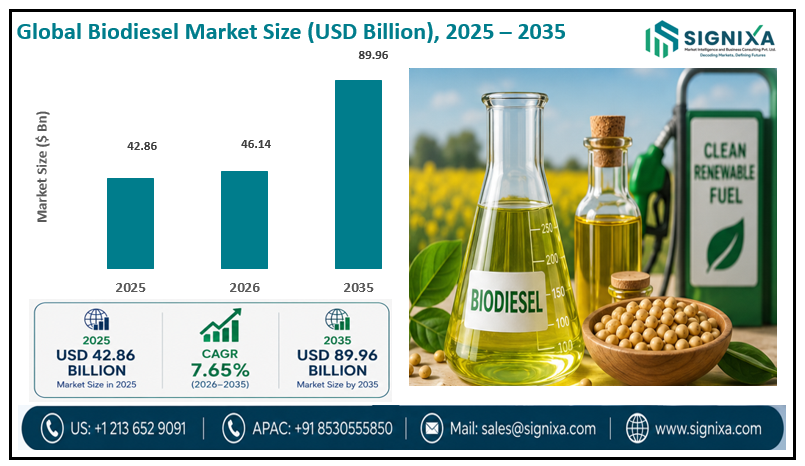
The size of the global Biodiesel Market was valued at approximately USD 42.86 Billion in 2025 and is projected to reach around USD 89.96 Billion by 2035, growing at a compound annual growth rate (CAGR) of 7.65% from 2026 to 2035. This report analyzes the key market drivers and restraints impacting demand and evaluates global opportunities for biodiesel across various feedstock and applications.
The global biodiesel market includes renewable fuel products derived from biological feedstock such as vegetable oils and animal fats, used in transport, power generation, and industrial heating. Biodiesel’s ability to lower greenhouse gas emissions, reduce reliance on fossil fuels, and integrate into existing diesel engines without modification is boosting its global demand. Government mandates, blending targets, and environmental sustainability goals are critical factors propelling the biodiesel industry across both developed and developing regions.
The biodiesel market is witnessing a transformative phase globally, as countries strive to reduce dependency on fossil fuels and curb greenhouse gas emissions. Derived from renewable sources such as vegetable oils, animal fats, and recycled cooking oil, biodiesel is increasingly recognized as a cleaner-burning alternative to conventional diesel. Governments and environmental agencies are actively promoting its use by implementing supportive regulations, subsidies, and blending mandates, particularly in the transportation and industrial sectors. The compatibility of biodiesel with existing diesel engines without significant modifications is a major advantage driving its acceptance across logistics, public transport, and agriculture. Moreover, the increasing emphasis on energy diversification and rural development is contributing to the expansion of local biodiesel production, often involving farmers and cooperatives. Feedstock availability and innovation in conversion technologies are playing a vital role in improving yields and reducing production costs. However, the market still faces challenges related to cold weather performance and indirect land use changes. Nonetheless, with strong policy backing and continuous R&D to address limitations, biodiesel is steadily emerging as a viable bridge in the transition toward low-carbon energy systems, especially in regions where full electrification remains economically or logistically challenging. This adaptability positions biodiesel as a strategic part of the global clean energy portfolio.
In recent years, the biodiesel market has benefited from shifting consumer and corporate attitudes toward sustainability, circular economy practices, and carbon footprint reduction. Major companies, particularly in the aviation, shipping, and logistics sectors, are adopting biodiesel to meet internal sustainability goals and comply with stricter emissions standards. This trend is fostering robust demand from commercial fleets and fuel infrastructure upgrades at fuel stations to accommodate higher biodiesel blends. Additionally, many countries are prioritizing domestic biodiesel production as a way to improve energy security and reduce reliance on imported petroleum products, particularly in the wake of global energy supply uncertainties. The versatility of biodiesel also supports its use in power generation and backup energy applications, further expanding its market scope. On the supply side, companies are investing in second-generation biodiesel technologies that utilize non-food feedstock such as algae, jatropha, and waste oils, addressing concerns over food-versus-fuel debates. These advancements are enabling biodiesel to become more sustainable and economically viable in the long run. Moreover, international collaboration, such as technology transfers and joint ventures between developed and developing countries, is promoting widespread adoption. As the world moves toward decarbonization, biodiesel is increasingly positioned as a practical, scalable solution that balances current infrastructure capabilities with future sustainability ambitions.
Key Findings
- The global Biodiesel market is expected to grow at a CAGR of 7.65% during the forecast period (2026–2035).
- The market was valued at USD 42.86 Billion in 2025 and is projected to reach USD 89.96 Billion by 2035.
- The Fuel segment is expected to dominate the market due to increasing biodiesel consumption in the transportation sector and supportive renewable fuel policies.
- Vegetable Oil is projected to remain the leading feedstock owing to its widespread availability, established supply chain, and high energy yield.
- North America is anticipated to hold the largest market share, followed by Europe and Asia-Pacific, driven by favorable government regulations, blending mandates, and expanding biofuel production infrastructure.
Biodiesel Market Dynamics
The biodiesel market is witnessing robust growth driven by rising global demand for cleaner fuels and carbon reduction strategies. With over 20 countries implementing biodiesel blending mandates ranging from 5% to 20% regulatory support is playing a pivotal role in promoting biodiesel use in transportation. Increasing public-private investments and bio-refinery expansions are enabling biodiesel producers to meet both domestic and export demand, particularly in regions like the U.S., Brazil, and Indonesia.
Energy security concerns and volatile crude oil prices are also pushing economies to diversify their fuel sources. Biodiesel offers a renewable, domestically produced alternative that improves engine performance and reduces dependence on imported petroleum. With advanced biodiesel technologies reducing production costs and enhancing fuel compatibility, industries and governments are accelerating the adoption of biodiesel for off-road vehicles, shipping, and power generation.
The biodiesel market is being driven significantly by the global push toward renewable energy. Governments and environmental organizations are emphasizing the transition from fossil fuels to cleaner, sustainable alternatives to mitigate climate change and reduce carbon emissions. Biodiesel, as a bio-based fuel, aligns with national and international energy agendas focused on reducing greenhouse gases. It is especially gaining traction in countries implementing aggressive policies toward net-zero targets. Biodiesel’s biodegradability and non-toxic characteristics make it an attractive choice over traditional diesel. Furthermore, its ability to integrate with current diesel engines without major retrofits makes it practical for both commercial and personal use. In emerging economies, biodiesel production is also seen as a means to reduce dependence on imported petroleum, thereby enhancing energy security. This macroeconomic alignment between energy independence and environmental preservation is creating a fertile ground for the biodiesel market to grow. As the demand for sustainable transport fuels continues to surge especially in logistics, shipping, and agriculture biodiesel stands out as an accessible and transitional solution. The support for its development has evolved from a purely environmental cause to a strategic priority in the energy portfolios of various nations, further strengthening the momentum behind biodiesel adoption across diverse regions and sectors.
Feedstock availability plays a critical role in determining biodiesel market dynamics. Biodiesel can be produced from a range of sources including soybean oil, rapeseed oil, palm oil, animal fats, and used cooking oil. The regional availability and cost of these raw materials directly affect production economics. For example, in Southeast Asia, palm oil dominates due to high local availability, while soybean oil is more prevalent in the U.S. However, fluctuations in agricultural output due to climate conditions and competition with food supply often result in volatility in feedstock pricing. To counter this, the industry is witnessing a surge in R&D efforts focused on next-generation feedstock like algae and non-edible plants such as jatropha, which offer high oil yield without impacting food crops. Technological advancements in transesterification and enzymatic processes are also improving conversion efficiency and lowering production costs. Furthermore, innovations such as continuous processing reactors and integrated biorefineries are helping scale up production sustainably. These advancements are also making biodiesel more consistent in quality, enhancing consumer confidence and market competitiveness. As technologies mature and diversify feedstock options become more commercially viable, the biodiesel market is expected to become more resilient to agricultural and commodity market fluctuations, ensuring more stable long-term growth.
Regulations and government policies are among the most influential drivers of the biodiesel market. Mandates for biodiesel blending in conventional diesel such as B5, B10, or even B20 are critical to ensuring a steady demand for biodiesel, especially in regions like the European Union, Brazil, Indonesia, and the United States. Tax credits, subsidies, and renewable energy certificates also help bridge the cost gap between biodiesel and fossil fuels, making biodiesel more competitive in price-sensitive markets. In some countries, government procurement policies favor biofuels in public transportation fleets and military applications, adding to baseline demand. However, inconsistent regulatory frameworks and frequent changes in policies can create uncertainty for manufacturers and investors. Moreover, global trade policies affecting the import and export of biodiesel and feedstock have a direct bearing on market access and pricing. The implementation of carbon pricing mechanisms and sustainability certifications like ISCC (International Sustainability and Carbon Certification) are encouraging producers to adopt environmentally responsible practices. As climate-related legislation continues to strengthen globally, the policy landscape will remain a central force shaping the evolution of the biodiesel market. Strong and stable regulatory support is essential for sustaining momentum, encouraging private sector participation, and securing long-term investments in biodiesel infrastructure and innovation.
The biodiesel market exists at the intersection of economic feasibility and environmental benefit, and navigating these trade-offs is central to its dynamics. While biodiesel provides a lower-emission alternative to fossil fuels, its production costs can be higher, particularly when using first-generation feedstock. This can deter adoption in price-sensitive segments or regions without government subsidies. Additionally, concerns over the environmental impact of large-scale feedstock cultivation such as deforestation for palm oil plantations or water-intensive soybean farming have led to debates on whether all biodiesel is truly sustainable. Lifecycle emissions, land use changes, and biodiversity impacts are increasingly scrutinized by regulators and environmentalists. On the economic side, biodiesel production offers opportunities for job creation in rural areas, supports agricultural economies, and contributes to energy diversification. These socio-economic benefits have made biodiesel attractive to policymakers, particularly in developing countries seeking to balance environmental goals with economic growth. Addressing the sustainability challenges through stricter certifications, improved land management practices, and adoption of second-generation feedstocks will be crucial in maintaining the credibility of biodiesel as a green fuel. Balancing economic viability with environmental responsibility remains an ongoing challenge that will shape the pace and pattern of biodiesel market development worldwide.
The competitive dynamics within the biodiesel market are shaped by both global energy giants and regional players. Large multinational oil and gas companies are increasingly investing in biofuels as part of their long-term transition strategies, acquiring or partnering with biodiesel producers to diversify their energy portfolios. At the same time, numerous small-to-mid-sized firms, particularly in Asia and Latin America, are capitalizing on local feedstock availability and government incentives to establish niche market positions. Strategic alliances, mergers, and vertical integration from feedstock cultivation to final biodiesel distribution are becoming common as companies seek to optimize supply chains and enhance profitability. Geographical expansion is also a priority, with firms targeting countries with newly implemented blending mandates or where diesel consumption is high, such as parts of Africa and Southeast Asia. Branding strategies that highlight environmental and social responsibility are gaining importance, especially for companies targeting commercial fleets and export markets. Additionally, collaborations with research institutions and participation in international sustainability platforms are helping firms build credibility and drive innovation. As the competitive landscape evolves, success in the biodiesel market will increasingly depend on adaptability, supply chain resilience, and the ability to meet evolving regulatory and consumer expectations across different regions.
Biodiesel Market Segmentation Analysis
By Feedstock Segment Analysis
Vegetable oil remains the primary feedstock for biodiesel production, accounting for over 70% of global output in 2025. Oils from soybeans, rapeseed, and palm are widely available, offering high lipid content and stable supply chains. Soybean oil dominates biodiesel feedstock in North America, while rapeseed and palm oil are preferred in Europe and Southeast Asia, respectively. The high yield and lower sulfur content of vegetable oil make it a preferred choice among producers, especially where food and fuel policies allow dual-purpose crops.
Animal fats such as tallow, lard, and poultry fat contribute to about 23% of the biodiesel feedstock pool. These by-products from the meat industry offer cost advantages and reduce reliance on virgin oils. In the U.S. and EU, incentives for using waste-derived or low-carbon-intensity inputs are driving up animal fat usage. The lower iodine value and high cetane number of animal fat biodiesel enhance ignition quality and engine efficiency, making them suitable for industrial and off-road uses.
By Application Segment Analysis
The fuel segment dominates the biodiesel market, contributing to over 80% of total consumption in 2025. It is primarily used as B5, B10, or B20 blends in diesel engines for transport and logistics. Biodiesel’s lower emissions profile cutting lifecycle CO₂ emissions by up to 78% compared to petroleum diesel makes it an attractive fuel for fleets looking to decarbonize operations. Countries like Brazil, Germany, and Indonesia have stringent blending mandates, ensuring strong long-term demand.
Biodiesel use in power generation is expanding, particularly in off-grid and backup power applications. The segment, while smaller, is expected to grow at a CAGR of over 6.5%, driven by demand in remote regions and for mobile generators. Biodiesel generators offer quick response and clean combustion, making them ideal for backup power in hospitals, telecom towers, and data centers. The non-toxic nature of biodiesel also makes it safer for storage and use in sensitive areas.
Others include applications such as heating oil, marine fuel, and industrial lubricants. Biodiesel is increasingly used as a low-emission heating alternative in regions like Northern Europe. Its use in marine fuels is gaining traction under IMO 2020 regulations limiting sulfur emissions. As emissions compliance tightens globally, biodiesel’s applications beyond road transport are expected to grow steadily.
Report Attributes & Market Scope
| Report Attribute | Details |
|---|---|
| Market Size Value in 2025 | USD 42.86 Billion |
| Market Size Value in 2035 | USD 89.96 Billion |
| CAGR (2026–2035) | 7.65% |
| Base Year Used for Estimation | 2025 |
| Historic Data | 2020 - 2025 |
| Forecast Period | 2026 - 2035 |
| Segments Covered – By Feedstock |
|
| Segments Covered – By Application |
|
| Regions Covered | North America, Europe, Asia Pacific, Latin America, Middle East and Africa |
| Major Countries Covered | U.S., Canada, Mexico, Germany, UK, France, Italy, Spain, Russia, China, Japan, South Korea, India, Southeast Asia Countries, Brazil, Argentina, GCC Countries, Turkey, Iran, Israel, South Africa, Egypt, Nigeria, etc. |
| Key Companies Profiled | Neste Corporation, Cargill Inc., Renewable Energy Group (Chevron), Bunge Limited, ADM, Wilmar International, TotalEnergies, Emami Agrotech, Louis Dreyfus Company, and FutureFuel Corporation, among others. |
Biodiesel Market Regional Analysis
North America leads the global biodiesel market with the U.S. being the top producer and consumer. Federal policies like the Renewable Fuel Standard (RFS) and state-level Low Carbon Fuel Standards (LCFS) have significantly driven demand. Europe is the second-largest market, supported by the EU Renewable Energy Directive II, which mandates 14% renewable energy in transport by 2035. The Asia-Pacific region is emerging rapidly, particularly in countries like Indonesia, China, and India where energy demand, population growth, and government incentives are fostering biofuel adoption. Latin America and the Middle East & Africa are witnessing rising adoption due to rural electrification efforts and energy diversification policies.
The biodiesel market in North America is primarily driven by strong regulatory frameworks and an increasing shift toward cleaner fuel alternatives. The United States, in particular, has implemented Renewable Fuel Standards (RFS) that mandate the blending of biofuels like biodiesel into transportation fuels. This has created a dependable demand base, especially in the commercial transport and agriculture sectors. The presence of large soybean production areas also ensures a steady supply of raw materials for biodiesel manufacturing. Canada is also witnessing a rise in biodiesel consumption, supported by provincial mandates and sustainability goals. Additionally, the presence of advanced refining infrastructure and R&D facilities has encouraged innovation in next-generation feedstock. North America’s biodiesel market benefits from policy consistency and industrial maturity, making it one of the most structured regional markets globally.
Asia Pacific’s biodiesel market is expanding rapidly, fueled by energy security concerns, agricultural surplus, and growing environmental awareness. Countries like Indonesia and Malaysia dominate production due to abundant palm oil feedstock, while India and China are focusing on used cooking oil and jatropha-based biodiesel to reduce reliance on imports. Government blending mandates and subsidies are instrumental in shaping biodiesel adoption across the region. Additionally, the expanding automotive and industrial sectors offer promising avenues for biodiesel penetration. Rapid urbanization and rising vehicular emissions are compelling policymakers to invest in biofuel infrastructure and cleaner alternatives. However, sustainability concerns related to feedstock cultivation and land use remain critical issues. Overall, the region presents a mix of large-scale production capacity and emerging consumption potential, positioning Asia Pacific as a key driver in global biodiesel dynamics.
Recent Developments in the Biodiesel Market
-
2026
Neste: Expanded renewable fuels production capabilities and increased the use of waste- and residue-based feedstocks to strengthen the supply of low-carbon biodiesel and renewable diesel for global markets.
Archer Daniels Midland (ADM): Continued investments in oilseed processing and renewable fuel feedstocks to support growing biodiesel demand driven by evolving biofuel policies in North America.
Bunge: Strengthened its biofuel value chain following the Viterra integration while expanding oilseed processing capacity to meet rising biodiesel feedstock demand, despite market uncertainty around biofuel regulations.
-
2025
Renewable Energy Group (Chevron): Announced the expansion of its biodiesel production capacity through a new manufacturing facility to improve renewable fuel output in North America.
Cargill: Launched a new biodiesel product portfolio derived from waste oils, reinforcing its focus on sustainable and circular biofuel solutions.
Verbio AG: Expanded advanced biofuel production and feedstock utilization to strengthen its biodiesel and renewable energy portfolio across European markets.
Louis Dreyfus Company: Expanded oilseed processing capabilities to enhance the supply of feedstocks for biodiesel production and support the global energy transition.
Biodiesel Market: Competitive Landscape
The global biodiesel market is moderately consolidated, with key players including Neste Corporation, Cargill Inc., Renewable Energy Group (Chevron), Bunge Limited, ADM, Wilmar International, TotalEnergies, Emami Agrotech, Louis Dreyfus Company, and FutureFuel Corporation. These companies focus on securing long-term feedstock contracts, expanding bio-refinery capacities, and optimizing production efficiency. Strategic collaborations, joint ventures with agricultural firms, and government-backed incentives are enabling these players to strengthen their market positions. Continuous technological innovation and cost reduction strategies remain central to achieving profitability and scalability in the competitive biodiesel landscape.
Key Companies Profiled
- Neste Corporation
- Cargill Inc.
- Renewable Energy Group (Chevron)
- Bunge Limited
- ADM
- Wilmar International
- TotalEnergies
- Emami Agrotech
- Louis Dreyfus Company
- FutureFuel Corporation
- Verbio SE
- Marathon Petroleum Corporation
- Darling Ingredients Inc.
- ENI S.p.A.
- BP p.l.c.
Global Biodiesel Market Segmentation Summary
By Feedstock
- Vegetable Oil
- Animal Fats
By Application
- Fuel
- Power Generation
- Others
- North America
- U.S.
- Canada
- Mexico
- Europe
- Germany
- France
- UK
- Spain
- Italy
- Rest of Europe
- Asia-Pacific
- China
- Japan
- India
- Australia
- South Korea
- Southeast Asia
- Rest of Asia-Pacific
- Latin America
- Brazil
- Argentina
- Rest of Latin America
- The Middle East & Africa
- GCC Countries
- South Africa
- Rest of the Middle East & Africa
By Region
Frequently Asked Questions (FAQs) About the Biodiesel Market
What is Biodiesel?
Biodiesel is a renewable, biodegradable fuel derived from vegetable oils, animal fats, or recycled restaurant grease through a process called transesterification. It is used in diesel engines and can be blended with petroleum diesel to reduce emissions and dependence on fossil fuels.
Which key factors will influence the Biodiesel Market growth over 2026–2035?
The global biodiesel market is projected to grow due to increasing demand for sustainable fuel alternatives, supportive government policies, rising concerns over greenhouse gas emissions, and growing use of biodiesel in transportation and industrial sectors.
What will be the value of the Biodiesel Market during 2026–2035?
The global Biodiesel Market accounted for around USD 42.86 Billion in 2025 and is forecast to attain a value of approximately USD 89.96 Billion by 2035.
What will be the CAGR value of the Biodiesel Market during 2026–2035?
The Biodiesel Market is projected to grow at a CAGR of 7.65% during the forecast period of 2026–2035, primarily driven by rising government mandates for renewable fuels, increasing demand for low-carbon transportation fuels, and growing investments in sustainable biofuel production technologies.
Which region will contribute notably towards the Biodiesel Market value?
The global biodiesel market is significantly driven by Europe and North America, supported by stringent emission regulations, established blending mandates, and widespread adoption of biofuels in transportation. Asia-Pacific is also emerging as a key region due to rising energy demand and government initiatives.
Which are the major players leveraging the Biodiesel Market growth?
Key players in the global biodiesel market include Neste Corporation, Renewable Energy Group (Chevron), Bunge Limited, Wilmar International, Louis Dreyfus Company, Cargill Inc., Argent Energy, Emami Agrotech Ltd., ADM Biodiesel, and BIOX Corporation.
What can be expected from the global Biodiesel Market report?
The report offers a comprehensive analysis of the biodiesel market, highlighting growth drivers, industry challenges, market trends, competitive landscape, and future opportunities. It provides insights into key segments, regional dynamics, policy frameworks, and investment potential across the 2026–2035 period.