
Intelligent Drone Market Overview
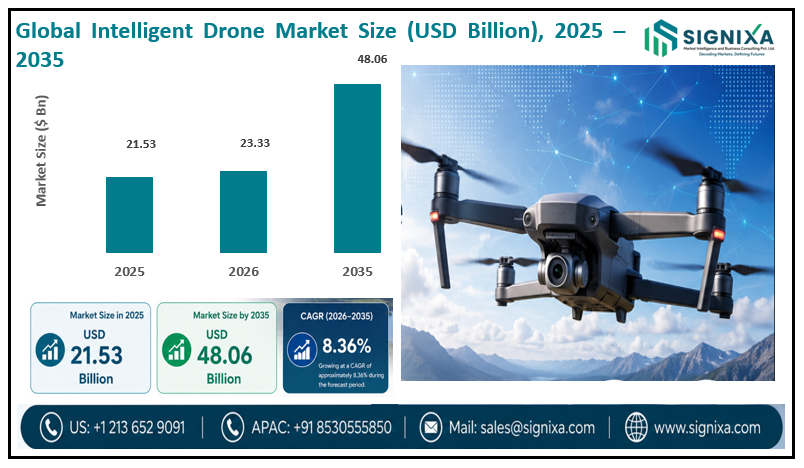
The global intelligent drone market was valued at USD 21.53 Billion in 2025 and is projected to reach USD 48.06 Billion by 2035, growing at a CAGR of approximately 8.36% during the forecast period. The report provides an in-depth analysis of drivers, restraints, and opportunities shaping the demand outlook of intelligent drones across various sectors, covering both global and regional perspectives.
The world drone market is evolving quickly across many industries, with adoption rising in agriculture, infrastructure inspection, transport and logistics, security and surveillance, and healthcare. Drones enhanced by artificial intelligence, sensors, and 5G communication networks are changing the way we automate systems, surveil locations, and enable delivery systems. Machine learning and real-time data analytics are expanding what drones can do with automation and cognition.
The intelligent drone market is witnessing robust growth globally, fuelled by advancements in artificial intelligence, automation, and sensor technologies that enable drones to perform complex tasks with minimal human intervention. These drones are equipped with features like real-time data processing, autonomous navigation, obstacle avoidance, and adaptive flight capabilities, making them indispensable across agriculture, defense, logistics, infrastructure, and filmmaking. Key trends include swarm intelligence, hybrid propulsion systems, and edge computing capabilities onboard drones. Rising investments in drone startups, R&D initiatives, and growing demand from government and private sectors point toward sustained market expansion as technology matures.
Key Findings
- The global intelligent drone market is projected to grow at a CAGR of 8.36% between 2026 and 2035.
- In terms of revenue, the market was valued at USD 21.53 Billion in 2025 and is expected to reach USD 48.06 Billion by 2035.
- Increasing adoption across commercial, industrial, and defense use cases — from precision agriculture to last-mile delivery — is propelling demand across all segments.
- Based on Technology, AI-powered drones will experience significant growth due to increasing automation needs across sectors.
- Among drone types, Multi-Rotor Drones are anticipated to dominate due to their operational flexibility and wide commercial availability.
- Agriculture and surveillance are the top application segments, driven by demand for precision monitoring and autonomous operations.
- By Region, North America leads the market due to high defense spending, tech adoption, and R&D investments.
Intelligent Drone Market Dynamics
Surging Multi-Sector Demand: Agriculture, Defense, Logistics & Infrastructure
The intelligent drone market is experiencing growth as demand surges in commercial, industrial, and defense use cases. In agriculture, precision application, crop health analysis, and irrigation surveying are important uses. In construction and real estate, drones quickly and efficiently perform land surveys and monitor job progress. In the surveillance and security space, drones are replacing human elements for crowd monitoring, border monitoring, emergency response, and situational awareness. The intelligent drone market is also evolving rapidly due to advancements in automation, AI, and real-time data analytics. Logistics companies are adopting drones to streamline last-mile delivery, especially in remote and congested areas, while construction firms use drone-based 3D mapping and site inspections to monitor project progress and identify structural issues early, significantly reducing labor dependency and operational costs.
AI Integration, 5G Connectivity & Regulatory Support Accelerating Commercial Deployment
AI-enabled drones can carry out object detection, facial recognition, obstacle avoidance, and route optimization autonomously. 5G connectivity ensures connectivity necessary for real-time messaging that is needed to enhance drone functionality, particularly for time-sensitive tasks like delivery and disaster response. More authorizations for drone use and infrastructure like air traffic management are expected to open up commercial drone corridors and spur increased use in logistics and emergency healthcare. Government initiatives and favorable drone usage regulations in countries like the U.S., China, and India are further propelling market growth. The ability of intelligent drones to integrate with edge computing and IoT platforms is enabling smarter, faster decision-making across all deployment scenarios.
Emerging DaaS Models, R&D Investment & Expanding Public Sector Adoption
Ongoing research and development efforts aim to address market challenges through the development of more durable batteries, lightweight materials, and AI-based self-diagnostic systems. Investment in drone-specific training programs and the emergence of drone-as-a-service (DaaS) models are enabling broader access to advanced drone capabilities, particularly for small and medium enterprises that cannot justify large upfront capital expenditures. Partnerships between universities, corporations, and defense organizations are accelerating innovation in areas such as autonomous navigation, swarm intelligence, and obstacle avoidance. Public safety agencies' utilization of drones for search-and-rescue missions, traffic monitoring, and disaster response is expanding the addressable market beyond commercial applications, while urban air mobility concepts and advanced drone traffic management systems (UTM) being piloted across major cities are expected to significantly shape the future of intelligent drone deployment globally.
Intelligent Drone Market Segmentation Analysis
By Application Segment Analysis
The intelligent drone market is segmented by application, with each use case defining distinct operational requirements, drone specifications, and technology integration levels across commercial, industrial, and public sector deployments globally:
Agriculture
Agriculture is the main sector using intelligent drones, deployed for seeding, pesticide spraying, crop imaging, and yield monitoring. These drones save human effort and optimize resource use while enabling farmers to make data-driven decisions based on real-time field analytics. Drones equipped with multispectral sensors help farmers monitor crop health, apply fertilizers precisely, and manage irrigation efficiently. In the agricultural sector, intelligent drones are transforming precision farming — in China, India, Japan, and Brazil, government-subsidized drone adoption programs are driving massive volume growth in agricultural UAV deployment. As global food security concerns intensify and farmland labor shortages accelerate in developed markets, agricultural drone adoption is expected to expand significantly through the forecast period across both precision cultivation and large-scale monitoring applications.
Surveillance & Security
Surveillance and security is among the top application segments, driven by demand for precision monitoring and autonomous operations. In defense and surveillance, intelligent drones enhance situational awareness, conduct reconnaissance, and support tactical operations. Drones are replacing human elements for crowd monitoring, border monitoring, emergency response, and perimeter security across both military and civilian contexts. AI capabilities including facial recognition, thermal imaging, and behavioral analytics expand their utility in emergency response and disaster management. The growing adoption of persistent aerial surveillance in public safety, critical infrastructure protection, and border security is creating sustained high-value procurement across both government defense agencies and commercial security service providers globally.
Logistics & Delivery
The logistics industry is adopting drone-based delivery systems, particularly in remote or congested areas, to improve last-mile delivery speed and cost-effectiveness. Logistics companies are actively piloting and scaling drone delivery programs, especially in suburban and remote areas. E-commerce giants and healthcare logistics operators are among the most active adopters, recognizing that drone delivery can dramatically reduce last-mile costs and delivery times for lightweight parcels and time-sensitive medical supplies. As urban air traffic management frameworks develop and regulatory approvals expand, the commercial drone delivery segment is expected to emerge as one of the fastest-growing application categories through the forecast period, with multiple major logistics operators committing to large-scale drone fleet deployments globally.
Construction & Infrastructure Inspection
Infrastructure and construction companies are leveraging drones for site inspection, 3D mapping, and progress monitoring, reducing risk and improving accuracy. Construction firms use drone-based aerial mapping, site inspection, and project status documentation to reduce the cost of labor and time in these activities. Energy grid inspections, bridge and tunnel assessments, wind turbine maintenance, and pipeline monitoring are significant infrastructure inspection use cases where drones offer substantial safety and cost advantages over traditional methods. The ability to capture high-resolution imagery and 3D point clouds using photogrammetry enables construction managers and infrastructure owners to detect structural issues, track progress against BIM models, and generate accurate volume measurements with speed and precision that was previously impossible.
Disaster Management
Disaster management is a growing application, where drones help find survivors or assess structural damage in dangerous and inaccessible areas. Drones are particularly valuable in the immediate aftermath of natural disasters — earthquakes, floods, wildfires — where they can rapidly survey affected areas, relay real-time imagery to incident commanders, and locate survivors before ground teams can safely reach them. In humanitarian missions and public health crises, drones are being deployed for medical supply delivery to cut-off communities and search-and-rescue operations in remote areas. The integration of AI-powered object detection and thermal imaging is making disaster response drones increasingly effective at identifying survivors and hazards, creating strong sustained demand from emergency management agencies and humanitarian organizations globally.
Media, Entertainment & Others
Media and entertainment represent a mature and commercially active intelligent drone application segment, encompassing aerial filmmaking, live event broadcasting, sports coverage, and real estate photography and videography. The proliferation of drone-captured aerial footage in feature films, television productions, sports broadcasting, and online video content has created a robust commercial market for professional-grade camera drones. Beyond media, the "Others" category encompasses environmental monitoring (air quality, wildlife tracking, climate indicators), healthcare (medical supply transport, patient monitoring), telecommunications (tower inspection, network maintenance), and insurance (site inspection, claims assessment, risk evaluation) — each representing distinct and growing sub-markets that collectively expand the intelligent drone market's total addressable opportunity significantly beyond its traditional defense and agriculture roots.
By Technology Segment Analysis
AI-Powered & Autonomous Drones
AI-enabled drones are likely to lead the way in the market due to their ability to fly autonomously with little human oversight. These drones utilize machine learning for object traceability, route planning, and behavior assessments. Autonomous drones can carry out object detection, facial recognition, obstacle avoidance, and route optimization without constant human intervention, making them highly valued for precision agriculture, infrastructure inspection, and defense reconnaissance. The rapid improvement of onboard AI processing capabilities — enabling complex computer vision tasks to be executed at the edge without cloud connectivity — is broadening the operational envelope of autonomous drones across challenging environments where reliable connectivity is not available, significantly expanding their deployable use cases in remote and critical infrastructure applications.
5G-Enabled Drones
Drones operating on a 5G network enhance many use cases through ultra-fast data transfer and real-time analytics, such as live broadcasting and autonomous supplies delivery. 5G connectivity provides the bandwidth and ultra-low latency required for real-time data transmission from drone-mounted sensors and cameras, enabling applications that were previously constrained by legacy wireless connectivity. 5G-enabled drones are particularly transformative for time-critical applications including emergency response coordination, live event broadcasting, and beyond-visual-line-of-sight (BVLOS) delivery operations where real-time command-and-control requires reliable, high-bandwidth connectivity. As 5G network coverage expands globally and spectrum licensing frameworks for drone operations develop, 5G-enabled drones are expected to become the standard connectivity architecture for next-generation commercial intelligent drone deployments.
By Type Segment Analysis
Multi-Rotor Drones
Multi-rotor drones hold the largest market share owing to their relative ease of use and price. Specific highlight characteristics include vertical take-off and landing, hover precision, and price and availability, making them the preferred drone on the market. They are the ideal drone for aerial photography, monitoring, and inspections that take place close to the ground. Their widespread commercial availability, extensive accessory ecosystem, and relatively straightforward pilot certification requirements make multi-rotor drones the entry point for most new commercial drone operators across agriculture, construction, real estate, media, and infrastructure inspection applications. The continuous improvement of multi-rotor battery life, payload capacity, and obstacle avoidance capabilities is further extending their operational utility across increasingly demanding professional applications.
Fixed-Wing Drones
Fixed-wing drones have the benefits of being able to endure for long periods of time and travel faster than multi-rotor drones, and are used to map large areas of land and in surveillance over larger areas. Their aerodynamic efficiency enables flight times of several hours on a single charge, making them the preferred platform for large-scale agricultural surveys, topographic mapping, environmental monitoring, and persistent area surveillance where multi-rotor flight endurance would be insufficient. Military and border security applications increasingly rely on fixed-wing UAVs for long-range reconnaissance and ISR (intelligence, surveillance, and reconnaissance) missions. The development of hybrid vertical take-off and landing (VTOL) fixed-wing systems is addressing the traditional limitation of fixed-wing drones requiring runways or launch equipment for deployment.
Tethered & Single Rotor Drones
Tethered drones are being adopted in the defense industry and for temporary surveillance applications where extended flight times and persistent aerial positioning are required without battery limitation concerns. The tether provides both continuous power supply and a secure data link, enabling indefinite operation at a fixed location for perimeter security, event monitoring, and military observation post applications. Single rotor drones, while representing a smaller overall market segment, offer superior payload efficiency and flight endurance compared to multi-rotor equivalents, making them valuable for agricultural spraying of large fields and specialized inspection tasks. Hybrid drones that have the endurance of fixed-wing drones, but the agility of multi-rotor drones are being deployed more often across applications requiring both long-range transit and precise hover capabilities.
By Payload Capacity & End User Segment Analysis
Lightweight Drones (Up to 5 kg)
Lightweight drones up to 5 kilograms dominate the payload segment because of their widespread applications in photography, inspection, and consumer and hobbyist activities. Their lower regulatory barriers, ease of transport, and wide commercial availability through consumer and professional retail channels make them the highest-volume segment in terms of units sold. These drones are widely used across real estate photography, aerial cinematography, infrastructure inspection, and personal recreational flying. The growing accessibility of high-quality camera systems and AI-powered flight assistance features in consumer and prosumer-grade lightweight drones has dramatically lowered the entry barrier for commercial drone operations, expanding the overall market across a broader base of commercial and individual users globally.
Medium Weight Drones (5–25 kg)
Medium-weight drones meet the needs of industry for agricultural precision, monitoring equipment, and inspections, with considerable prognostic demand expected as battery life and thrust increases. These drones balance payload capacity, flight endurance, and regulatory accessibility in a way that makes them the workhorses of professional agricultural, construction, and industrial inspection operations. Their ability to carry multispectral sensors, LiDAR units, thermal cameras, and agricultural spray systems makes them indispensable across precision farming and infrastructure monitoring use cases. The medium-weight segment is expected to register the fastest growth rate through the forecast period as battery energy density improvements extend flight range and payload capacity, and as agricultural drone adoption accelerates in emerging markets across Asia, Africa, and Latin America.
Heavyweight Drones (25 kg and above)
Heavyweight drones over 25 kilograms meet the demands of military logistics, firefighting, and medium-to-large cargo delivery applications where significant payload capacity is a mission requirement. In defense, heavyweight drones are essential for logistics resupply in contested or difficult terrain, tactical strike applications, and heavy surveillance platforms. In civilian applications, they are being developed for medical supply air bridges in remote areas, wildfire suppression support, and early-stage commercial cargo delivery services targeting remote island and mountainous communities where surface transport is impractical. As propulsion technology and battery energy density continue to improve, the operational viability of commercial heavyweight drone platforms is expected to expand significantly, creating new addressable markets in industrial cargo logistics and emergency response infrastructure.
Aerospace & Defense (Largest End User)
Aerospace and defense is the largest end-user segment due to increasing investments in military surveillance and reconnaissance applications. Defense agencies globally are the single largest buyers of intelligent drone systems by value, procuring sophisticated autonomous platforms for ISR, tactical strike, logistical support, and electronic warfare applications. The U.S. Department of Defense's investment in drone technology, combined with significant programs in China, Israel, and NATO member countries, makes defense the anchor segment of the global intelligent drone market by revenue. The growing deployment of drone swarm technologies, AI-guided target recognition systems, and counter-UAS defense capabilities in military operations further deepens the defense sector's investment in intelligent drone technology across the forecast period.
Report Attributes & Market Scope
| Report Attribute | Details |
|---|---|
| Market Size Value in 2025 | USD 21.53 Billion |
| Market Size Value in 2035 | USD 48.06 Billion |
| CAGR (2026–2035) | 8.36% |
| Base Year Used for Estimation | 2025 |
| Historic Data | 2020 - 2025 |
| Forecast Period | 2026 - 2035 |
| Segments Covered – By Application |
|
| Segments Covered – By Technology |
|
| Segments Covered – By Type |
|
| Segments Covered – By Payload Capacity |
|
| Segments Covered – By End Users |
|
| Regions Covered | North America, Europe, Asia Pacific, Latin America, Middle East and Africa |
| Major Countries Covered | U.S., Canada, Mexico, Germany, UK, France, Italy, Spain, Russia, China, Japan, South Korea, India, Southeast Asia Countries, Brazil, Argentina, GCC Countries, Turkey, Iran, Israel, South Africa, Egypt, Nigeria, etc. |
| Key Companies Profiled | DJI, Parrot, AeroVironment, Skydio, Zipline, Yuneec, Insitu, Teledyne FLIR, EHang, and Delair, among others. |
Intelligent Drone Market Regional Analysis
The intelligent drone market is led by North America, particularly the United States, driven by government and military investments, FAA regulations, and the presence of leading technology companies. Europe comes second with intelligent drones established in agricultural applications, logistics, and smart city growth. The Asia-Pacific market is expected to grow the fastest due to agricultural modernization, e-commerce delivery solutions, and infrastructure development in China, India, and Japan. For Latin America and the Middle East & Africa, significant growth in surveillance, environmental monitoring, and public safety applications is anticipated as governments and investors develop infrastructure.
North America (Leading Region)
North America remains a dominant region in the intelligent drone market, driven by advanced technological infrastructure, robust defense investments, and high commercial adoption across sectors. The United States leads the region due to its strong military budget, extensive R&D ecosystem, and the presence of numerous drone-focused tech startups and established aerospace firms. The Federal Aviation Administration (FAA) has introduced several regulatory frameworks enabling the safe use of UAVs, particularly in agriculture, logistics, public safety, and infrastructure inspection. In Canada, government agencies and private players are increasingly deploying drones for environmental monitoring, energy sector inspections, and wildlife conservation. The emergence of urban air mobility concepts and advanced drone traffic management systems (UTM) being piloted across major U.S. cities is expected to significantly shape the future of intelligent drone deployment in the region.
Europe
Europe's intelligent drone market is experiencing strong growth, supported by proactive regulatory frameworks, sustainability initiatives, and increasing adoption across public and private sectors. The European Union Aviation Safety Agency (EASA) has established uniform drone regulations, simplifying cross-border operations and accelerating commercial drone deployment. Countries like Germany, France, the U.K., and the Netherlands are leading in terms of research, development, and real-world drone applications. Intelligent drones are being widely utilized in precision agriculture, infrastructure monitoring, energy grid inspections, and environmental protection initiatives. Europe is also at the forefront of leveraging drones in smart city projects, with applications ranging from traffic monitoring and waste management to public safety. Investment in drone R&D is being bolstered by EU funding programs like Horizon Europe, which support innovation in AI integration, collision avoidance, and energy-efficient propulsion.
Asia Pacific (Fastest-Growing Region)
The Asia-Pacific market is expected to grow the fastest because of modernization and efficiency in the agricultural industry, e-commerce delivery solutions, and infrastructure development in China, India, and Japan. China is the world's dominant drone manufacturing hub — home to DJI, the global market leader — and has deployed agricultural drones at a scale unmatched anywhere else in the world, with government subsidy programs covering drone purchase costs for farmers. India's rapidly developing drone policy framework, combined with its large agricultural sector and growing e-commerce logistics market, is creating a fast-expanding addressable market. Japan's METI-backed drone programs and South Korea's urban mobility initiatives are further strengthening the region's position as the primary growth engine for global intelligent drone market expansion through the forecast period.
Middle East & Africa
The Middle East & Africa region is witnessing progressive growth in the intelligent drone market, driven by expanding adoption across defense, infrastructure, agriculture, and logistics sectors. Countries like the UAE and Saudi Arabia are embracing drone technologies as part of their national visions for digital transformation and smart cities. These nations are deploying drones for oil and gas pipeline monitoring, security surveillance, construction site mapping, and urban traffic management. Drone innovation hubs are being developed in cities like Dubai and Cape Town to promote R&D and local production. On the African continent, nations such as Kenya, South Africa, and Nigeria are using drones for crop health analysis, irrigation planning, livestock tracking, and humanitarian medical delivery missions. As connectivity infrastructure improves and awareness grows around autonomous aerial systems' benefits, MEA is expected to emerge as a promising frontier for intelligent drone deployment across diverse industrial and public service domains.
Latin America
Latin America is expected to see significant growth in the use of intelligent drones, primarily for surveillance, environmental monitoring, and agricultural applications as governments and investors develop infrastructure and the public safety sector. Brazil, with its vast agricultural sector and active precision farming adoption program, is the regional leader in agricultural drone deployment, while Chile and Argentina are emerging as significant users of drones for large-scale environmental monitoring and mining site inspection. Mexico's growing manufacturing sector and logistics industry are creating demand for industrial inspection and delivery drone applications. Government investment in public safety infrastructure and the growing recognition of drones' value in disaster response — particularly in hurricane and flood-prone regions across Central America and the Caribbean — are creating sustained demand for intelligent drone systems from public sector procurement agencies throughout the region.
Recent Developments in the Intelligent Drone Market
-
2026
DJI broadened its intelligent drone lineup by introducing the Avata 360, equipped with 8K panoramic imaging, advanced subject recognition, and autonomous flight features. The new platform enhances capabilities for aerial inspection, professional content creation, and enterprise operations, further strengthening DJI’s presence across commercial drone applications.
Skydio strengthened its autonomous drone ecosystem through the continued expansion of its Drone as First Responder (DFR) platform. The company’s AI-powered command software has supported millions of operational deployments, helping public safety agencies improve emergency response, situational awareness, and aerial mission management.
Anduril advanced innovation in autonomous aviation by launching the AI Grand Prix, an international competition designed to accelerate the development of AI-driven flight technologies. The initiative highlights the company’s focus on next-generation autonomous systems and intelligent decision-making capabilities for unmanned aerial platforms.
-
2025
Parrot enhanced its intelligent drone capabilities with the introduction of the CHUCK 3.0 sovereign AI autopilot platform. The solution provides advanced navigation, mission planning, and autonomous flight management features, supporting defense, security, and public safety applications requiring high levels of operational independence.
Parrot further demonstrated progress in autonomous drone technologies by participating in large-scale drone swarm demonstrations involving multiple AI-enabled micro-drones. These coordinated operations showcased the potential of intelligent swarming for reconnaissance, surveillance, and complex mission execution scenarios.
Skydio expanded the deployment of its autonomous drone solutions across public safety organizations and enterprise customers. By integrating advanced obstacle avoidance, intelligent navigation, and real-time data capabilities, the company continued to enhance operational efficiency and mission effectiveness in a wide range of commercial and government applications.
Intelligent Drone Market: Competitive Landscape
The intelligent drone market is filled with major players such as DJI, Parrot, AeroVironment, Skydio, Zipline, Yuneec, Insitu, Teledyne FLIR, EHang, and Delair. These companies compete based on innovation, payload capacity, autonomy, and cost factors. DJI continues to be the leading company in the world due to investing heavily in R&D and having a large global market reach. Zipline and Wing focus on healthcare and logistics delivery, while companies such as AeroVironment lead the defense markets. Alliances, acquisitions, and regular software and hardware update cycles for both B2B and B2C intelligent drones encapsulate how competition continues to evolve and shape market share.
The competitive landscape is characterized by clear specialization across market segments. Consumer and prosumer drone leadership is concentrated around DJI's dominant global market position, with challengers including Parrot (France), Autel Robotics, and Skydio competing on AI autonomy and data security. Defense-focused competition centers on AeroVironment, Insitu (Boeing), Northrop Grumman, and Lockheed Martin, where mission reliability, secure communication, and payload flexibility are the primary competitive dimensions. The agricultural drone segment sees intense competition among DJI Agras, XAG, and regional manufacturers across Asia, where government procurement relationships and local service network density are key determinants of market share. The emerging drone delivery segment is characterized by significant venture-backed startup activity — including Zipline, Wing, Matternet, and Manna — competing to demonstrate viable commercial models at scale ahead of full regulatory approval.
Innovation in AI capabilities, battery technology, and communication systems continues to define competitive advantage in the intelligent drone market. The integration of advanced computer vision, LiDAR-based obstacle avoidance, and edge AI processing is enabling increasingly autonomous operations across all drone categories. Companies are competing on their ability to deliver certified, reliable performance in demanding operational environments — from high-altitude agricultural terrain to urban delivery corridors — while building the regulatory compliance track records required to obtain BVLOS operating approvals that will unlock the highest-value commercial drone applications globally.
Key Companies Profiled
- DJI
- Parrot
- AeroVironment
- Skydio
- Zipline
- Yuneec
- Insitu
- Teledyne FLIR
- EHang
- Delair
- Anduril Industries
- Shield AI
- Draganfly Inc.
- Autel Robotics
- AgEagle Aerial Systems
- IdeaForge Technology
- Quantum Systems
- Wing Aviation
- Pegasus Aero Group
- Airobotics
Global Intelligent Drone Market Segmentation Summary
By Application
- Agriculture
- Construction
- Logistics and Delivery
- Surveillance and Security
- Media and Entertainment
- Infrastructure Inspection
- Disaster Management
By Technology
- Autonomous Drones
- Remotely Operated Drones
- Hybrid Drones
- AI-Powered Drones
- 5G-Enabled Drones
By Type
- Fixed-Wing Drones
- Multi-Rotor Drones
- Single Rotor Drones
- Hybrid Drones
- Tethered Drones
By Payload Capacity
- Lightweight Drones (Up to 5 kg)
- Medium Weight Drones (5 kg – 25 kg)
- Heavyweight Drones (25 kg and above)
By End Users
- Aerospace and Defense
- Real Estate
- Telecommunications
- Environmental Monitoring
- Healthcare and Pharmaceuticals
- Insurance
By Region
- North America
- U.S.
- Canada
- Mexico
- Europe
- Germany
- France
- UK
- Spain
- Italy
- Rest of Europe
- Asia-Pacific
- China
- Japan
- India
- Australia
- South Korea
- Southeast Asia
- Rest of Asia-Pacific
- Latin America
- Brazil
- Argentina
- Rest of Latin America
- The Middle East & Africa
- GCC Countries
- South Africa
- Rest of the Middle East & Africa
Frequently Asked Questions (FAQs) About the Intelligent Drone Market
What is an intelligent drone?
An intelligent drone is an unmanned aerial vehicle (UAV) equipped with advanced technologies such as artificial intelligence (AI), machine learning, real-time sensors, and GPS systems. These drones can perform autonomous or semi-autonomous operations, including navigation, data collection, obstacle avoidance, and decision-making, across industries like agriculture, logistics, defense, and infrastructure.
Which key factors will influence the intelligent drone market growth over 2026–2035?
The intelligent drone market is projected to grow due to rising demand for automation, increasing use in precision agriculture, growth of drone-based delivery and surveillance systems, technological innovations in AI and 5G, and expanding government support for commercial drone applications.
What will be the value of the intelligent drone market during 2026–2035?
According to the study, the global intelligent drone market size was worth around USD 21.53 Billion in 2025 and is predicted to grow to around USD 48.06 Billion by 2035.
What will be the CAGR value of the intelligent drone market during 2026–2035?
The CAGR value of the global intelligent drone market is expected to be around 8.36% during the forecast period from 2026 to 2035.
Which region will contribute notably towards the intelligent drone market value?
North America currently leads the intelligent drone market due to high adoption across defense and commercial sectors. Meanwhile, the Asia-Pacific region is expected to witness the fastest growth owing to increasing investments, agricultural drone use, and favorable government initiatives in countries like China, India, and Japan.
Which are the major players leveraging the intelligent drone market growth?
Key companies contributing to the growth of the intelligent drone market include DJI, Parrot SA, AeroVironment, Inc., Skydio, Zipline, Yuneec, Insitu, Teledyne FLIR, EHang, and Delair, among others. These players focus on innovation, partnerships, and expanding AI-based drone capabilities.
What can be expected from the global intelligent drone market report?
The report provides in-depth analysis of the intelligent drone industry, covering growth drivers, technological developments, regulatory impacts, and evolving application areas. It offers detailed segmentation by application, type, technology, payload, and region, along with competitive benchmarking and future market projections through 2035.