
Botanical Pesticide Market Overview
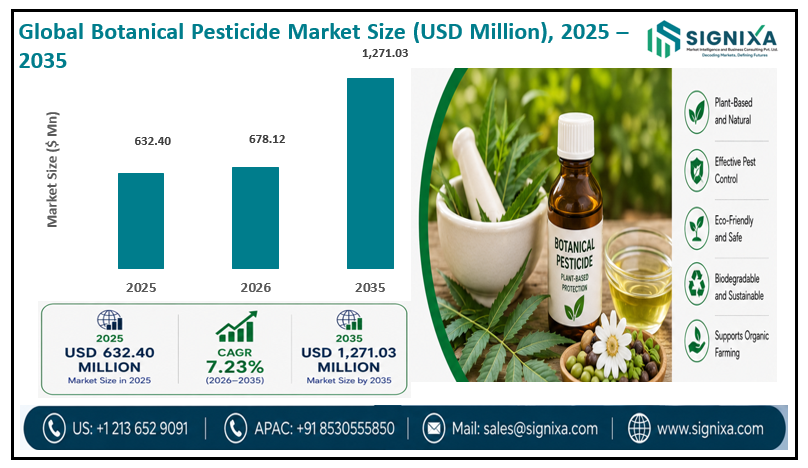
The size of the global botanical pesticide market was worth around USD 632.40 Million in 2025 and is predicted to grow to around USD 1,271.03 Million by 2035, with a compound annual growth rate (CAGR) of roughly 7.23% between 2026 and 2035. The report analyzes the botanical pesticide market's drivers and restraints, as well as the impact they have on demand throughout the projection period.
The botanical pesticide market includes bio-based solutions derived from plant extracts, essential oils, and natural chemicals that are used to control pests in agriculture. These products are gaining popularity due to their eco-friendly nature, lower toxicity, and compatibility with integrated pest management (IPM) systems. Regulatory encouragement for alternatives to synthetic chemicals and the demand for residue-free food products are propelling the market. Botanical pesticides derived from plant sources such as neem, pyrethrum, rotenone, and essential oils are gaining popularity due to their biodegradability, low toxicity to non-target organisms, and minimal residual effects.
Growing consumer preference for organic produce, coupled with tightening global regulations on chemical pesticide usage, is pushing farmers and agricultural enterprises toward sustainable alternatives. Regulatory bodies like the EU and EPA are promoting the use of plant-based biopesticides under integrated pest management programs, which further boosts adoption. Innovation and research into novel plant-derived compounds are accelerating market growth, with companies investing in developing effective formulations tailored for specific crops and pests, supported by advancements in formulation technologies such as microencapsulation and controlled release.
Key Findings
- The global botanical pesticide market is estimated to grow annually at a CAGR of around 7.23% over the forecast period (2026–2035).
- The market size was valued at around USD 632.40 Million in 2025 and is projected to reach USD 1,271.03 Million by 2035.
- Based on Type, the Insecticides segment is expected to dominate due to its wide application in controlling common crop pests, accounting for over 45% of revenue in 2025.
- On the basis of Active Substance, the Azadirachtin segment is projected to lead the market, contributing over 35% of total revenue in 2025.
- In terms of Crop Type, Vegetables & Fruits command the largest market share at nearly 50% in 2025.
- Asia-Pacific is projected to dominate the global market during the forecast period due to growing organic farming and government support.
Botanical Pesticide Market Dynamics
Regulatory Shift Away from Synthetic Pesticides & Tightening Chemical Restrictions
The global regulatory shift away from synthetic pesticides is a major driver for botanical pesticide adoption. Environmental agencies across the globe, including the European Food Safety Authority (EFSA), U.S. EPA, and Indian Central Insecticides Board, are imposing tighter restrictions on chemical pesticides due to their impact on soil health, groundwater contamination, and biodiversity loss. Many widely used synthetic pesticides have been banned or are under review, creating a regulatory vacuum that botanical pesticides are increasingly filling. These plant-derived products, with naturally occurring active ingredients and biodegradable profiles, offer a safer alternative and typically face fewer restrictions for use. As governments push for pesticide reduction targets and sustainable agriculture goals, demand for eco-labelled, non-toxic botanical formulations is increasing, particularly in export-driven agricultural economies.
Booming Organic Food Industry & Clean-Label Supply Chain Demand
The booming organic food industry is a significant catalyst for botanical pesticide growth. Consumers are increasingly prioritizing health, sustainability, and environmental ethics, leading to a surge in demand for chemical-free produce. This trend is particularly strong in North America, Europe, and parts of Asia-Pacific where organic food markets have matured. Botanical pesticides, being derived from natural plant sources and approved for use in certified organic systems, align well with organic farming principles. Their compatibility with organic certification bodies like USDA Organic and EU Organic ensures that they are preferred by farmers looking to tap into premium price markets. Supermarkets and retailers are also increasing pressure on agricultural suppliers to minimize pesticide residues, further pushing adoption across vegetables, fruits, herbs, and specialty grains.
Formulation Technology Advances & Pest Resistance Management Solutions
Advancements in formulation and delivery technologies are addressing traditional limitations of botanical pesticides and expanding their appeal across various farming systems. Innovations such as microencapsulation, nano-emulsion, and slow-release systems are significantly improving the stability, bioavailability, and effectiveness of botanical active compounds. Additionally, the widespread and prolonged use of chemical pesticides has led to a rise in pest resistance, reducing their effectiveness and pushing farmers to seek alternatives. Botanical pesticides, with their unique and varied modes of action, offer an effective solution for breaking resistance cycles, especially in rotational and integrated pest management systems. Unlike synthetic pesticides that often rely on a single mode of action, botanical formulations typically contain multiple active compounds that act synergistically, reducing the chances of resistance development.
Botanical Pesticide Market Segmentation Analysis
By Type Segment Analysis
Insecticides (Dominant Segment)
Insecticides hold the largest share of the botanical pesticide market, as they address the most common pest issues in vegetable and fruit crops. In 2025, insecticides accounted for over 45% of total market revenue due to the prevalence of pest-related yield losses and increasing resistance to synthetic insecticides. Botanical insecticides derived from neem, pyrethrum, and other plant sources target a broad range of sap-feeding and chewing insects through multiple modes of action including antifeedant effects, growth regulation, and contact toxicity that collectively reduce the likelihood of resistance development compared to single-target synthetic alternatives. The segment's dominance reflects the universal nature of insect pest pressure across virtually all crop types and growing regions globally, making botanical insecticides a foundational category within integrated pest management programs.
Herbicides & Fungicides
Botanical herbicides are gaining ground in regions emphasizing sustainable weed management, while botanical fungicides are being adopted in vineyards and high value crops prone to fungal diseases. Botanical herbicides derived from essential oils and plant extracts offer non-selective or selective weed suppression with rapid biodegradation, addressing growing concerns about herbicide resistance and groundwater contamination associated with synthetic herbicide overuse. Botanical fungicides often based on plant extracts with antimicrobial properties are particularly valued in high-value horticultural crops like grapes, where fungal disease pressure is severe and consumer demand for residue-free wine and table grapes creates strong commercial incentive for adopting plant-based disease management alternatives to conventional synthetic fungicides.
By Active Substance Segment Analysis
The botanical pesticide market is segmented by active substance, with each plant-derived compound offering distinct modes of action, regulatory profiles, and crop application suitability across global agricultural systems:
Azadirachtin
Azadirachtin, derived from neem, is the dominant active substance, contributing to over 35% of total botanical pesticide revenue in 2025. Its broad-spectrum efficacy against multiple pests, biodegradability, and regulatory approvals in Europe and North America make it a preferred choice. Azadirachtin functions primarily as an insect growth regulator and antifeedant, disrupting molting and feeding behavior across a wide range of insect pest species while exhibiting low toxicity to mammals, birds, and beneficial pollinator insects. The compound's extraction from neem seeds abundantly available in India and other tropical regions provides a cost-effective and sustainable raw material supply chain that supports azadirachtin's continued market leadership as global botanical pesticide demand scales.
Matrine
Matrine is gaining traction in Asia-Pacific due to its effectiveness and compatibility with organic farming practices. Derived from Sophora flavescens and related plant species native to East Asia, matrine has a long history of use in traditional Chinese agricultural pest management practices that is now being scientifically validated and scaled for commercial botanical pesticide formulations. Its effectiveness against a range of insect pests, combined with its compatibility with China's expanding organic and green agriculture certification programs, positions matrine for continued growth particularly within Asia-Pacific markets where local raw material availability and established cultivation knowledge provide manufacturing advantages over imported active substances.
Rotenone
Rotenone, though effective, faces usage limitations in some countries due to toxicity concerns. Derived from the roots of certain tropical plant species, rotenone has historically been valued for its broad insecticidal activity, but regulatory scrutiny over its toxicity to fish and certain mammalian systems has led several jurisdictions to restrict or phase out its agricultural use. This regulatory pressure has constrained rotenone's growth trajectory relative to other botanical active substances with more favorable toxicological profiles, though it retains application in specific pest management contexts where alternative botanical actives have not demonstrated comparable efficacy.
Pyrethrin & Nicotine
Pyrethrin, derived from chrysanthemum flowers, remains one of the most widely recognized and longest-established botanical insecticides, valued for its fast knockdown action against a broad range of insect pests and its relatively favorable environmental degradation profile compared to synthetic pyrethroid analogues. Nicotine-based botanical pesticides, while historically significant, face increasing regulatory restrictions in many markets due to mammalian toxicity concerns, similar to challenges faced by rotenone, limiting their growth potential relative to newer-generation botanical active substances with more favorable safety profiles for modern agricultural and consumer market requirements.
By Crop Type Segment Analysis
Vegetables & Fruits (Dominant Crop Type)
Vegetables & Fruits represent the largest application area, accounting for nearly 50% of botanical pesticide usage in 2025. The high frequency of pest infestations and consumer demand for organic produce fuel this segment. Fresh produce crops face intense and continuous pest pressure throughout their growing cycles, combined with the strongest consumer scrutiny around pesticide residue levels given their typically minimal processing before consumption making botanical pesticides particularly well-suited to address both the agronomic and market-access requirements of fruit and vegetable production. Premium pricing available for certified organic and residue-free produce in retail markets provides strong economic incentive for growers to adopt botanical pest management as part of their crop protection programs.
Oilseeds & Pulses, Turfs and Ornamentals
Oilseeds & Pulses follow, with rising demand for residue-free pulses and oil crops driving adoption. Turfs and Ornamentals are niche but growing segments, particularly in urban gardening, landscaping, and golf course maintenance where chemical-free treatments are increasingly preferred. The Turfs and Ornamentals segment benefits from growing consumer and municipal awareness around pesticide exposure in public and residential green spaces, with golf courses and parks departments increasingly adopting biopesticide-based maintenance programs to reduce environmental impact and address public health concerns about chemical pesticide exposure in spaces with frequent human contact, creating a distinct growth opportunity separate from traditional agricultural crop protection applications.
Report Attributes & Market Scope
| Report Attribute | Details |
|---|---|
| Market Size Value in 2025 | USD 632.40 Million |
| Market Size Value in 2035 | USD 1,271.03 Million |
| CAGR (2026–2035) | 7.23% |
| Base Year Used for Estimation | 2025 |
| Historic Data | 2020 - 2025 |
| Forecast Period | 2026 - 2035 |
| Segments Covered – By Type |
|
| Segments Covered – By Active Substance |
|
| Segments Covered – By Crop Type |
|
| Regions Covered | North America, Europe, Asia Pacific, Latin America, Middle East and Africa |
| Major Countries Covered | U.S., Canada, Mexico, Germany, UK, France, Italy, Spain, Russia, China, Japan, South Korea, India, Southeast Asia Countries, Brazil, Argentina, GCC Countries, Turkey, Iran, Israel, South Africa, Egypt, Nigeria, etc. |
| Key Companies Profiled | Andermatt Biocontrol AG, Certis Biologicals, UPL Ltd., Bioworks Inc., Valent BioSciences LLC, Sumitomo Chemical, Stockton Bio-Ag, FMC Corporation, Bionema Limited, and Parry America Inc. |
Botanical Pesticide Market Regional Analysis
The Asia-Pacific region leads the botanical pesticide market due to its large agricultural base, strong traditional knowledge of plant-based remedies, and increasing government support for organic farming. North America and Europe are witnessing rising demand from organic food producers and regulatory bodies encouraging alternatives to synthetic chemicals. Latin America and the Middle East & Africa are emerging markets with growing organic exports and food safety initiatives supporting botanical pesticide uptake.
Asia-Pacific (Leading Region)
Asia-Pacific represents the largest and fastest-growing botanical pesticide market, supported by vast agricultural activity, increasing awareness about pesticide residues, and expanding organic farming practices. Countries such as China, India, Japan, and Australia are spearheading demand due to rising health concerns and government-led programs promoting low-chemical-input agriculture. In India, the National Mission on Sustainable Agriculture and support for neem-coated urea have paved the way for increased acceptance of plant-based pesticides. China's emphasis on green development and organic labelling has also spurred local and international suppliers to invest in botanical product lines. The region benefits from the natural abundance of medicinal and pesticidal plants, leading to cost-effective raw material sourcing. Smallholder farmers, especially in Southeast Asia, are increasingly using neem, garlic, and turmeric-based pesticides in rice, vegetables, and tea cultivation.
Europe
Europe is a prominent market for botanical pesticides, owing to its strong policy framework supporting organic farming, biodiversity, and sustainable agriculture. Countries like Germany, France, Italy, and the Netherlands lead in demand, driven by widespread organic certifications, environmentally conscious consumers, and restrictions on chemical pesticides under EU directives. The European Green Deal and Farm to Fork Strategy aim to reduce pesticide use by 50% by 2030, creating a significant push for alternatives such as botanical formulations. Farmers are increasingly adopting bio-based crop protection as part of Integrated Pest Management, especially in vineyards, orchards, and horticultural crops. The presence of sophisticated regulatory structures through EFSA ensures product quality and market transparency, while growing emphasis on regenerative agriculture and the expansion of organic retail chains like Carrefour and Edeka are expected to further drive demand.
North America
North America's botanical pesticide market is driven by a well-established organic farming sector, stringent environmental regulations, and increasing consumer preference for chemical-free food products. The United States and Canada are at the forefront, with widespread adoption of Integrated Pest Management practices across fruits, vegetables, and grains. Regulatory frameworks such as the U.S. EPA's Biopesticide Registration system provide clarity and encourage the development and commercialization of plant-based pesticides. A highly aware farming community and extensive R&D efforts from major agrochemical companies and universities support innovation in botanical pest control, with demand also growing from residential gardening, turf management, and greenhouse cultivation segments.
Middle East & Africa
The botanical pesticide market in the Middle East & Africa is at an emerging stage but holds considerable potential, driven by growing agricultural reform, food security concerns, and increasing awareness of sustainable farming. In the Middle East, particularly the UAE, Saudi Arabia, and Israel, controlled-environment agriculture and organic food demand are prompting greater interest in non-chemical pest control solutions, with limited water availability and soil degradation in arid zones further supporting the use of botanical pesticides that are less harmful to beneficial microbes and water systems. Africa especially Kenya, South Africa, and Nigeria are witnessing a gradual shift toward eco-friendly farming, spurred by NGO support, government training programs, and export-oriented agribusiness, with botanical pesticides derived from local plants like neem, pepper, and eucalyptus gaining popularity among smallholder farmers due to affordability and local availability.
Latin America
Latin America is an emerging market with growing organic exports and food safety initiatives supporting botanical pesticide uptake. The region's significant agricultural export sector serving demanding markets in North America and Europe with strict residue tolerance standards creates strong commercial incentive for growers to adopt botanical pest management solutions that ensure compliance with importing country pesticide residue requirements. Brazil and Argentina's large-scale agricultural operations are increasingly incorporating botanical pesticides into integrated pest management programs, particularly for high-value export crops where access to premium international markets depends on demonstrating reduced synthetic chemical usage and compliance with evolving sustainability certification standards demanded by global retail and food service buyers.
Recent Developments in the Botanical Pesticide Market
-
2025
Sumitomo Chemical Co., Ltd. expanded its footprint in the botanical pesticides sector by strengthening its biological crop protection operations and distribution network in Europe, intended to boost availability of plant-derived pest control products and capture growing demand for eco-friendly agricultural inputs.
-
2024
Bayer AG introduced an upgraded botanical insecticide designed to control aphids and other sap-feeding insects across a range of crops, strengthening the company's biological crop protection portfolio as agricultural producers increasingly adopt sustainable and low-residue pest management solutions.
-
2024
Syngenta Group launched a plant-based insecticide derived from citrus extracts for use in crops such as rice and fruits in the Asia-Pacific region, supporting integrated pest management programs by lowering reliance on synthetic pesticides while maintaining effective pest suppression.
-
2023
Valent BioSciences LLC released a botanical bioinsecticide developed from plant-based essential oils aimed at controlling soft-bodied insect pests in horticultural crops. The OMRI-listed formulation provides longer residual effectiveness for organic farming applications.
-
2022
Certis Biologicals expanded its fungicide portfolio with a plant-extract-based product targeting grape and tomato diseases.
Botanical Pesticide Market: Competitive Landscape
Key players in the global botanical pesticide market include Andermatt Biocontrol AG, Certis Biologicals, UPL Ltd., Bioworks Inc., Valent BioSciences LLC, Sumitomo Chemical, Stockton Bio-Ag, FMC Corporation, Bionema Limited, and Parry America Inc. These companies are focusing on expanding product portfolios, forming partnerships for regional market penetration, and investing in R&D to develop multi-target botanical formulations. Competitive advantage is increasingly determined by product efficacy, compliance with organic standards, and adaptability across crop types and climatic conditions.
The competitive landscape reflects increasing convergence between traditional synthetic agrochemical leaders including Bayer, Syngenta, and Sumitomo Chemical that are expanding biological crop protection portfolios through internal R&D and acquisitions, and specialized biopesticide companies like Certis Biologicals, Valent BioSciences, and Andermatt Biocontrol that have built deep expertise in plant-derived active substance extraction and formulation. Raw material sourcing strategy is a key competitive differentiator, as companies with secure, vertically integrated supply chains for key botanical inputs like neem, pyrethrum, and essential oil crops maintain cost and quality advantages over competitors dependent on volatile commodity raw material markets. Regulatory navigation capability across the fragmented global biopesticide approval landscape, and demonstrated field efficacy data that builds farmer confidence relative to established synthetic alternatives, are the primary battlegrounds for market share competition going forward.
Key Companies Profiled
- Andermatt Biocontrol AG
- Certis Biologicals
- UPL Ltd.
- BioWorks Inc.
- Valent BioSciences LLC
- Sumitomo Chemical
- Stockton Bio-Ag
- FMC Corporation
- Bionema Limited
- Parry America Inc.
- Koppert Biological Systems
- Marrone Bio Innovations
- Biobest Group NV
- Gowan Company
- Syngenta Biologicals
Global Botanical Pesticide Market Segmentation Summary
By Type
- Insecticides
- Herbicides
- Fungicides
By Active Substance
- Azadirachtin
- Matrine
- Rotenone
- Pyrethrin
- Nicotine
By Crop Type
- Vegetables & Fruits
- Oilseeds & Pulses
- Turfs and Ornamentals
By Region
- North America
- U.S.
- Canada
- Mexico
- Europe
- Germany
- France
- UK
- Spain
- Italy
- Rest of Europe
- Asia-Pacific
- China
- Japan
- India
- Australia
- South Korea
- Southeast Asia
- Rest of Asia-Pacific
- Latin America
- Brazil
- Argentina
- Rest of Latin America
- The Middle East & Africa
- GCC Countries
- South Africa
- Rest of the Middle East & Africa
Frequently Asked Questions (FAQs) About the Botanical Pesticide Market
What are botanical pesticides?
Botanical pesticides are natural pest control agents derived from plants or plant extracts. They are used in agriculture and horticulture to manage pests, weeds, and plant diseases, offering an environmentally friendly alternative to synthetic chemical pesticides.
Which key factors will influence the botanical pesticides market growth over 2026–2035?
The global botanical pesticides market is expected to grow due to increasing demand for organic and sustainable farming practices, growing concerns over chemical pesticide residues, and rising regulatory support for bio-based pest control products.
What will be the value of the botanical pesticides market during 2026–2035?
According to the study, the global botanical pesticides market size was worth around USD 632.40 Million in 2025 and is predicted to grow to around USD 1,271.03 Million by 2035.
What will be the CAGR value of the botanical pesticides market during 2026–2035?
The CAGR value of the botanical pesticides market is expected to be around 7.23% during 2026–2035, the expansion of organic farming, rising investments in agricultural biologicals, and the growing need for residue-free crop protection are expected to fuel market growth throughout the forecast period.
Which region will contribute notably towards the botanical pesticides market value?
The global botanical pesticides market is led by the Asia-Pacific and North American regions, driven by the expansion of organic farming, favourable government policies, and increasing consumer awareness regarding pesticide safety and environmental impact.
Which are the major players leveraging the botanical pesticides market growth?
The global botanical pesticides market is led by players such as Bayer AG, Biobest Group, Isagro S.p.A., Valent BioSciences LLC, Andermatt Biocontrol AG, UPL Limited, Certis USA L.L.C., Parry America, T.Stanes and Company Limited, and MGK.
What can be expected from the global botanical pesticides market report?
The report explores crucial aspects of the botanical pesticides market, including a detailed discussion of existing growth drivers and restraints while also analyzing future growth opportunities and challenges that impact the market, alongside segmentation by type, active substance, crop type, regional outlook, and competitive landscape.