

Phosgene Market Overview
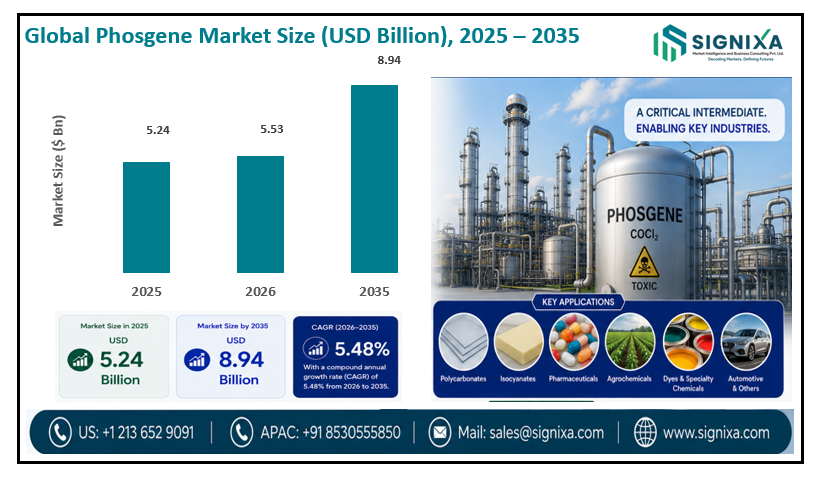
The size of the global phosgene market was worth around USD 5.24 Billion in 2025 and is predicted to grow to around USD 8.94 Billion by 2035, with a compound annual growth rate (CAGR) of roughly 5.48% between 2026 and 2035. The report analyzes the phosgene market's drivers and restraints, and examines global opportunities expected to shape the demand outlook over the forecast period.
Phosgene is a key industrial chemical intermediate used in the production of isocyanates, polycarbonates, agrochemicals, and pharmaceuticals. Its role as a chemical building block has expanded with rising global demand for polyurethane products, engineering plastics, and specialty chemicals. The phosgene market, while a niche segment within the broader chemical industry, plays an absolutely critical role as a key chemical intermediate in the production of a vast array of essential materials. Phosgene (COCl₂), despite its notorious historical use as a chemical weapon due to its high toxicity, is indispensable in modern industrial processes. Its primary application lies in the manufacturing of isocyanates, particularly methylene diphenyl diisocyanate (MDI) and toluene diisocyanate (TDI) the backbone of the polyurethane industry, which produces flexible foams used in furniture and bedding, rigid foams for insulation in construction and appliances, and thermoplastic polyurethanes (TPU) found in a diverse range of products from footwear to medical devices.
The market for phosgene is characterized by its highly controlled and regulated nature, given the extreme toxicity of the compound. Production and handling are subject to stringent safety protocols, environmental regulations, and often captive use within integrated chemical complexes to minimize transportation risks. Most phosgene is produced and immediately consumed on-site within the same facility to create its derivatives, rather than being transported over long distances. This vertical integration is a key feature of the industry, ensuring maximum safety and efficiency. Technological advancements in production processes are continuously focused on enhancing safety measures, reducing emissions, and optimizing efficiency. Despite its hazardous nature, the indispensable role of phosgene in manufacturing high-value products across multiple vital industries ensures its sustained demand and continuous, albeit highly regulated, production globally.
Key Findings
- The global phosgene market is estimated to grow annually at a CAGR of around 5.48% from 2026 to 2035.
- In terms of revenue, the global phosgene market was valued at approximately USD 5.24 Billion in 2025 and is projected to reach USD 8.94 Billion by 2035.
- Based on derivatives, the Isocyanates segment is projected to dominate the market due to its extensive usage in polyurethane production.
- By application, Polycarbonates are anticipated to witness the fastest growth due to rising demand in electronics and automotive sectors.
- Asia-Pacific is expected to dominate the global phosgene market throughout the forecast period.
Phosgene Market Dynamics
Surging Isocyanate Demand for Polyurethane Production in Construction, Automotive & Furniture Driving Phosgene Market
The phosgene market is being driven by rising demand for isocyanates in polyurethane production. Polyurethanes are essential for insulation, foams, and coatings in construction, electronics, and automotive sectors. Phosgene is a core intermediate in manufacturing MDI and TDI, two major isocyanates. As urbanization and infrastructure development surge globally, especially in emerging economies, the demand for polyurethane-based products rises, thereby boosting phosgene consumption. The burgeoning global demand for polyurethanes, driven by their widespread applications in construction (insulation, sealants), automotive (foams for seating and interiors), furniture (bedding and upholstery), and appliances (refrigeration insulation), directly fuels the consumption of phosgene derivatives. As urbanization and industrialization continue, particularly in emerging economies, the need for these versatile materials grows, creating a sustained demand for phosgene.
Pharmaceutical & Agrochemical Sector Expansion Creating Growing Demand for Phosgene Intermediates
The expansion of the pharmaceutical and agrochemical industries is also a major growth driver for the phosgene market. Phosgene derivatives like chloroformates and carbamoyl chlorides are essential in synthesizing active pharmaceutical ingredients (APIs) and pesticides. As global food security and healthcare become priorities, investments in crop protection chemicals and drug manufacturing are expected to increase, fueling demand for phosgene intermediates. The pharmaceutical sector's reliance on phosgene is driven by an aging global population, and the increasing prevalence of chronic diseases phosgene is a vital component in the synthesis of numerous pharmaceutical intermediates and APIs, without which the production of many essential drugs would be challenging. The agrochemical sector's reliance on phosgene for producing pesticides and herbicides to enhance crop yields for a growing global population further solidifies its demand through the forecast period.
Extreme Toxicity, Stringent EHS Regulations & High Barriers to Entry Constraining Market While Driving Innovation
Despite its critical industrial applications, the phosgene market is heavily constrained by its extreme toxicity and the severe health hazards associated with its production, handling, and transportation. Phosgene is a highly regulated substance globally, with stringent environmental, health, and safety (EHS) regulations imposed by authorities like the EPA, ECHA, and OSHA. Compliance necessitates significant investments in advanced safety systems, emission control technologies, and extensive workforce training, which collectively increase operational costs. This high-risk profile restricts the market to a few large, integrated chemical companies that possess the expertise and infrastructure for safe management, limiting the entry of new players. Nevertheless, the phosgene market presents opportunities from ongoing technological advancements, including more efficient and safer production processes with reduced energy consumption and lower emission profiles. The sustained growth of the polycarbonate industry — driven by demand from electronics, automotive, and construction sectors will continue to provide a strong demand base, while the increasing complexity of pharmaceutical molecules ensures phosgene's continued relevance in drug synthesis through the forecast period.
Phosgene Market Segmentation Analysis
By Derivative Segment Analysis
The market is segmented by derivative type, with each phosgene-derived compound serving distinct downstream industrial applications across polyurethane, pharmaceutical, agrochemical, and specialty chemical sectors
Isocyanates
Isocyanates dominate the phosgene derivatives market and are widely used in the production of polyurethane foams, elastomers, and coatings. In 2025, isocyanates accounted for over 55% of the total derivative demand. The demand is supported by rapid infrastructure growth and increasing usage in automotive and furniture sectors for insulation and cushioning applications. MDI (methylene diphenyl diisocyanate) and TDI (toluene diisocyanate) are the two primary isocyanates produced from phosgene, serving distinct polyurethane applications. MDI is the primary raw material for rigid polyurethane foam used in building insulation, refrigerator insulation, and structural composite applications. TDI is the primary raw material for flexible polyurethane foam used in furniture cushioning, mattresses, and automotive seating. The combined demand from construction energy efficiency regulations which drive insulation installation and consumer goods growth in emerging markets creates a robust and growing demand base for isocyanates and therefore phosgene through the forecast period.
Chloroformates
Chloroformates are valuable intermediates in pharmaceutical synthesis and polymer processing. This segment held a notable market share of around 18% in 2025, with demand rising due to the expanding drug manufacturing base across Asia and Europe. Their role in producing agrochemicals and specialty chemicals contributes to consistent market growth. Chloroformates formed by the reaction of phosgene with alcohols serve as highly reactive acylating agents that introduce carbonyl groups into complex organic molecules during pharmaceutical synthesis. Their high reactivity and selectivity make them particularly valuable in the synthesis of carbonate esters, urethane linkages, and amino acid protecting group chemistry that are critical steps in modern drug manufacturing workflows. The growth of generic pharmaceutical manufacturing in India and China which relies on efficient, scalable synthetic routes employing phosgene-derived intermediates including chloroformates is creating consistent demand growth for this derivative segment through the forecast period.
Carbamoyl Chlorides
Carbamoyl chlorides are essential for synthesizing herbicides, insecticides, and pharmaceutical compounds. In 2025, this segment represented approximately 14% of the total derivative demand. Their usage in high-value chemical synthesis supports steady adoption in regulated applications, especially in agriculture and healthcare. Carbamoyl chlorides produced by the reaction of phosgene with amines are key intermediates in the synthesis of carbamate pesticides and herbicides, which are widely used in both conventional and precision agriculture. The growing global demand for crop protection chemicals, driven by the need to improve agricultural productivity to feed a growing world population, is a sustained structural demand driver for carbamoyl chloride synthesis. The development of new herbicide and insecticide active ingredients for integrated pest management programs which require complex carbamate chemistry enabled by phosgene-derived intermediates is supporting continued innovation-driven demand for this derivative segment through the forecast period.
Other Derivatives
Other derivatives, including diphosgene and triphosgene, collectively contributed to about 13% of the market in 2025. They are used in laboratory research and specialty chemical manufacturing. Although niche, these products maintain relevance in advanced material synthesis and custom chemical applications. Diphosgene and triphosgene are safer solid alternatives to phosgene gas for use in laboratory and small-scale fine chemical synthesis settings, where the storage and dispensing of pressurized phosgene gas would create unacceptable safety risks. These phosgene equivalents enable pharmaceutical companies, contract research organizations, and specialty chemical manufacturers to access phosgene chemistry for small-scale synthesis without requiring the specialized high-pressure gas handling infrastructure needed for bulk phosgene use. The growing complexity of pharmaceutical molecular targets and the increasing use of phosgene chemistry in the synthesis of advanced materials and performance chemicals are sustaining demand for these specialty phosgene equivalent reagents through the forecast period.
By Application Segment Analysis
Polycarbonates
The polycarbonates segment accounted for 25% of the market share in 2025 and is anticipated to grow at the highest CAGR during the forecast period. This is due to the growing demand for lightweight, durable plastics in electronics, medical devices, and automotive applications where design flexibility and strength are critical. Polycarbonates produced from phosgene and bisphenol A via an interfacial polycondensation reaction are engineering thermoplastics with an exceptional combination of transparency, impact resistance, heat resistance, and dimensional stability. These properties make polycarbonates ideal for automotive lighting systems, electronic device housings, optical media, medical device components, greenhouse glazing, and safety equipment. The accelerating adoption of electric vehicles which require lightweight transparent polycarbonate components for sensor windows, lighting, and interior elements is creating a significant new demand driver for polycarbonate and therefore phosgene through the forecast period.
Agrochemicals
Agrochemicals accounted for nearly 20% of phosgene application demand in 2025, driven by increasing demand for high-yield pesticides and herbicides. The growing need to improve crop productivity across Asia and Latin America supports this trend, particularly amid food security concerns and expanding global populations. Phosgene-derived intermediates primarily carbamoyl chlorides and chloroformates are essential building blocks for a range of herbicide and insecticide active ingredients in the carbamate chemical class. The growing adoption of precision agriculture technologies, which rely on effective herbicides and pesticides to maximize crop productivity per hectare, is supporting consistent demand growth for phosgene-derived agrochemical intermediates. The development of new-generation crop protection active ingredients for resistance management programs as farmers require new chemistries to combat evolving weed and pest resistance to existing agrochemicals is sustaining innovation-driven demand in the agrochemicals application segment through the forecast period.
Pharmaceuticals
Pharmaceuticals consumed around 16% of the phosgene market in 2025, thanks to the rising production of APIs and drug intermediates. With increasing healthcare expenditure and demand for chronic disease medications, phosgene derivatives remain crucial in scalable drug manufacturing. Phosgene is a particularly effective carbonylating agent in pharmaceutical synthesis, enabling the efficient formation of carbamate bonds, urea linkages, and cyclic carbonate structures that are prevalent in the molecular architecture of many important drug classes including antivirals, antibiotics, anticancer agents, and cardiovascular drugs. The growing complexity of new molecular entity (NME) drug candidates in pharmaceutical R&D pipelines which increasingly feature carbamate and carbonate functional groups that require phosgene chemistry for efficient synthesis is creating sustained demand growth. The expansion of pharmaceutical API manufacturing capacity in India and China is particularly driving regional demand for pharmaceutical-grade phosgene intermediates through the forecast period.
Fine Chemicals
Fine chemicals made up about 14% of phosgene applications in 2025. These include solvents, stabilizers, and performance chemicals used across multiple industrial applications. The market is sustained by innovation in specialty formulations and rising demand for advanced materials. Fine chemicals produced using phosgene derivatives include high-purity intermediates for the electronics industry, performance additives for polymer processing, and specialized reagents for analytical chemistry and materials science applications. The growing electronics sector in Asia-Pacific particularly for semiconductor manufacturing, display technology, and advanced battery materials creates demand for high-purity fine chemicals produced using phosgene chemistry. The increasing use of phosgene-derived performance chemicals in coatings, adhesives, and specialty polymer applications that require precise molecular architecture is sustaining demand in the fine chemicals segment through the forecast period.
Specialty Chemicals
Specialty chemicals represented roughly 10% of the market in 2025. These include additives, plasticizers, and photochemical. The segment benefits from technological innovation and the trend toward custom solutions in high-performance materials. Specialty chemicals produced using phosgene derivatives serve high-value, performance-critical applications in industries including electronics, aerospace, automotive, and energy. Photochemical derived from phosgene including carbonate monomers for photoresist materials used in semiconductor lithography — represent a particularly high-value niche application where the precision of phosgene chemistry enables the specific molecular structures required for advanced photolithography processes. The growing demand for high-performance specialty materials in next-generation electronics, electric vehicle battery systems, and advanced aerospace structures is creating expanding demand for phosgene-derived specialty chemical intermediates that deliver precise molecular performance beyond the capability of commodity chemical alternatives through the forecast period.
Dyes
The dyes segment accounted for 8% of total demand in 2025. Phosgene derivatives are used in the synthesis of reactive dyes, particularly in textiles and printing. The resurgence of textile exports from countries like India, China, and Bangladesh is aiding segmental growth. Reactive dyes which form covalent bonds with cellulose fibers in cotton and other natural textiles during the dyeing process require chlorotriazine and other reactive anchoring groups that can be synthesized efficiently using phosgene-derived chlorinating agents. The growing global textile market, driven by rising consumer spending on apparel in emerging economies and the ongoing expansion of fast fashion production in Asia, sustains demand for phosgene-derived dye intermediates. The development of new reactive dye structures with improved fixation efficiency and reduced effluent burden important environmental improvements for the textile dyeing industry requires sophisticated phosgene-based chemistry, supporting continued innovation demand in the dyes application segment through the forecast period.
Others
Other applications, such as laboratory reagents and industrial intermediates, collectively accounted for about 7% of the market in 2025. These are driven by niche demands in R&D and specialty manufacturing units. This catch-all category encompasses phosgene applications in areas including polymer research, catalyst synthesis, advanced materials development, and custom chemical manufacturing for specific industrial processes. The growing investment in chemical R&D globally driven by the search for new materials for energy storage, carbon capture, drug delivery, and semiconductor applications — creates consistent demand for phosgene and its derivatives as research-grade chemical tools. The expanding contract research and manufacturing organization (CRMO) sector in Asia which handles the development and scale-up synthesis of complex molecules for pharmaceutical, and specialty chemical clients creates growing demand for phosgene-based synthesis capabilities in this segment through the forecast period.
Report Attributes & Market Scope
| Report Attribute | Details |
|---|---|
| Market Size Value in 2025 | USD 5.24 Billion |
| Market Size Value in 2035 | USD 8.94 Billion |
| CAGR (2026–2035) | 5.48% |
| Base Year Used for Estimation | 2025 |
| Historic Data | 2020 - 2025 |
| Forecast Period | 2026 - 2035 |
| Segments Covered – By Derivative |
|
| Segments Covered – By Application |
|
| Regions Covered | North America, Europe, Asia Pacific, Latin America, Middle East and Africa |
| Major Countries Covered | U.S., Canada, Mexico, Germany, UK, France, Italy, Spain, Russia, China, Japan, South Korea, India, Southeast Asia Countries, Brazil, Argentina, GCC Countries, Turkey, Iran, Israel, South Africa, Egypt, Nigeria, etc. |
| Key Companies Profiled | Bayer AG, Dow Chemical Company, BASF SE, Covestro AG, Mitsubishi Chemical Corporation, Wanhua Chemical Group Co., and Tosoh Corporation, among others. |
Phosgene Market Regional Analysis
Asia-Pacific is projected to dominate the global phosgene market through 2035, driven by strong manufacturing bases in China, India, and Japan. The region accounted for over 45% of global revenue in 2025. Europe and North America are mature markets, focusing on innovation, safety, and sustainable production. Latin America and the Middle East & Africa are emerging regions, where infrastructural growth, rising agrochemical usage, and investment in industrial chemicals are expected to spur demand.
Asia-Pacific (Dominant Region)
The Asia Pacific region dominates the global phosgene market, largely attributed to its rapidly expanding chemical industry, robust manufacturing capabilities, and burgeoning demand from various end-use sectors, particularly in China and India. The immense growth in the automotive, construction, and consumer goods industries across Asia Pacific directly fuels the demand for polyurethanes, making the region the largest consumer of phosgene for MDI and TDI production. Additionally, the flourishing pharmaceutical sector, driven by a large population and increasing healthcare access, significantly contributes to phosgene consumption for drug intermediates. The growing agricultural sector also drives demand for phosgene-derived agrochemicals like pesticides and herbicides. While the region benefits from lower labor and land costs, leading to competitive production expenses, it is also increasingly adopting stricter environmental and safety regulations for phosgene production and handling, aligning more closely with international standards to ensure responsible industrial growth through the forecast period.
North America
North America's phosgene market is characterized by a mature chemical industry, well-established manufacturing infrastructure, and a strong regulatory framework. The region, particularly the United States, is a significant consumer of phosgene, predominantly for the production of isocyanates like MDI and TDI, which are crucial for the robust polyurethane sector. Demand is driven by the automotive industry for vehicle interiors and components, the construction sector for insulation and sealants, and the furniture industry for foams. Furthermore, the burgeoning pharmaceutical industry in North America, with its extensive research and development activities, relies on phosgene as a key intermediate for synthesizing complex drug molecules and APIs. The region also sees demand from the agrochemical sector for pesticide and herbicide production. Given the high toxicity of phosgene, North American producers operate under stringent safety regulations and typically employ captive consumption models where phosgene is produced and immediately consumed on-site to minimize handling and transportation risks ensuring a highly controlled and secure supply chain through the forecast period.
Europe
Europe's phosgene market is shaped by a highly developed chemical industry, a strong focus on environmental and safety regulations, and a significant demand from downstream sectors. Countries like Germany, a chemical powerhouse and home to major global players including BASF and Covestro, are key producers and consumers. The market is primarily driven by the robust polyurethane industry, supplying various sectors including automotive, construction, and footwear. The European market also has a substantial pharmaceutical industry, where phosgene is an essential building block for numerous drug syntheses. However, due to the extreme toxicity of phosgene, European regulatory bodies impose some of the strictest standards globally for its production, handling, and emissions. This regulatory environment pushes manufacturers to invest heavily in advanced safety technologies, process optimizations, and emission control measures, often leading to higher operational costs but also ensuring a safer production footprint. The emphasis on sustainability in Europe also encourages research into alternative, non-phosgene routes for chemical synthesis, though widespread commercial adoption of these alternatives remains a long-term goal through the forecast period.
Latin America
Latin America is an emerging region for the phosgene market, where infrastructural growth, rising agrochemical usage, and investment in industrial chemicals are expected to spur demand. Brazil and Mexico are the primary markets, with Brazil's position as one of the world's largest agricultural producers creating substantial demand for agrochemical active ingredients derived from phosgene intermediates. The growing construction and infrastructure development sectors across Latin America are increasing demand for polyurethane-based insulation, adhesives, and sealants that require phosgene-derived isocyanates. The pharmaceutical manufacturing sector in Brazil and Mexico is also growing, creating incremental demand for phosgene-derived pharmaceutical intermediates. While most phosgene derivatives consumed in Latin America are imported from North America, Europe, and Asia due to the limited domestic production capacity, the growing scale of downstream chemical consumption is attracting interest in potential regional production investments through the forecast period.
Middle East & Africa
The Middle East and Africa (MEA) phosgene market is an emerging segment, primarily influenced by growing industrialization, particularly in the petrochemical and construction sectors. Countries within the Gulf Cooperation Council (GCC), with their abundant oil and gas resources, are investing in diversifying their economies through downstream chemical production, which includes the manufacturing of phosgene derivatives like isocyanates for polyurethanes. The increasing focus on infrastructure development and urbanization in the region also drives the demand for construction materials that utilize these derivatives. While the market is relatively smaller compared to other major regions, there is a gradual increase in demand from the automotive, furniture, and potentially the nascent pharmaceutical and agrochemical industries. However, the region faces challenges such as varying levels of regulatory enforcement, technological capabilities, and a less developed industrial base in some African countries. Despite these factors, ongoing investments in chemical complexes and a strategic push for industrial growth are expected to contribute to the steady expansion of the phosgene market in MEA through the forecast period.
Recent Developments in the Phosgene Market
-
2026
BASF SE expanded production capabilities for isocyanate intermediates to support increasing demand from the polyurethane, construction, and automotive sectors.
Covestro AG enhanced its MDI manufacturing network and implemented process optimization initiatives to improve efficiency and sustainability across its phosgene-based value chain.
Wanhua Chemical Group increased capacity for MDI and related phosgene-derived products to meet growing demand across global polyurethane markets.
-
2025
Tosoh Corporation expanded specialty chemical operations supporting phosgene-derived intermediates used in engineering plastics and industrial applications.
Vencorex increased focus on specialty isocyanates and advanced chemical intermediates for coatings, adhesives, and composite materials applications.
Atul Ltd. expanded its portfolio of phosgene-based intermediates to serve growing demand from pharmaceutical, agrochemical, and specialty chemical industries.
Phosgene Market: Competitive Landscape
The phosgene market features major players such as BASF SE, Covestro AG, Dow Inc., UPL Ltd., VanDeMark Chemical Inc., Atul Ltd., LANXESS AG, PPG Industries, Mitsui Chemicals, and Huntsman Corporation. The market is moderately consolidated with companies competing on capacity expansions, proprietary process technologies, safety innovations, and downstream integration. Regional players are also expanding their footprint to capture opportunities in pharmaceuticals, fine chemicals, and agrochemicals, where phosgene derivatives play a crucial role.
The competitive landscape of the phosgene market is highly concentrated, dominated by a limited number of global chemical giants. This is primarily due to the inherent dangers associated with phosgene production and handling, which necessitate massive investments in specialized infrastructure, advanced safety protocols, and rigorous environmental compliance. These large players operate highly integrated production facilities, where phosgene is typically generated and immediately consumed on-site for the manufacture of its derivatives, significantly minimizing transportation risks. Their competitive advantage stems from economies of scale, extensive R&D capabilities for process optimization and safety enhancements, and long-standing relationships with downstream industries. Given the extreme toxicity and stringent regulations surrounding phosgene, new market entrants face exceptionally high barriers — including capital expenditure for compliant production facilities, complexity of permitting, and specialized technical expertise requirements. Competition among existing players largely revolves around optimizing production efficiency, ensuring consistent supply to captive and external customers, and adhering to evolving global safety and environmental standards.
Key Companies Profiled
- BASF SE
- Covestro AG
- Dow Inc.
- Wanhua Chemical Group
- Mitsui Chemicals, Inc.
- Bayer AG
- Mitsubishi Chemical Corporation
- Tosoh Corporation
- VanDeMark Chemical Inc.
- Huntsman Corporation
- Vencorex
- Atul Ltd.
- Gujarat Alkalies and Chemicals Limited (GACL)
- Kumho Mitsui Chemicals, Inc.
- OCI Company Ltd.
Global Phosgene Market Segmentation Summary
By Derivative
- Isocyanates
- Chloroformates
- Carbamoyl Chlorides
- Other Derivatives
By Application
- Agrochemicals
- Pharmaceuticals
- Polycarbonates
- Fine Chemicals
- Dyes
- Specialty Chemicals
- Others
By Region
- North America
- U.S.
- Canada
- Mexico
- Europe
- Germany
- France
- UK
- Spain
- Italy
- Rest of Europe
- Asia-Pacific
- China
- Japan
- India
- Australia
- South Korea
- Southeast Asia
- Rest of Asia-Pacific
- Latin America
- Brazil
- Argentina
- Rest of Latin America
- The Middle East & Africa
- GCC Countries
- South Africa
- Rest of the Middle East & Africa
Frequently Asked Questions (FAQs) About the Phosgene Market
What is Phosgene?
Phosgene is a colorless, highly toxic gas used as a chemical intermediate in the production of isocyanates, chloroformates, and carbamoyl chlorides. These derivatives are essential in manufacturing agrochemicals, pharmaceuticals, polycarbonates, dyes, and specialty chemicals.
Which key factors will influence the phosgene market growth over 2026–2035?
The global phosgene market is expected to grow due to the rising demand for isocyanates and polycarbonates in automotive and construction industries, increasing agricultural chemical usage, and expanding pharmaceutical synthesis processes.
What will be the value of the phosgene market during 2026–2035?
According to the study, the global phosgene market size was worth around USD 5.24 Billion in 2025 and is predicted to grow to around USD 8.94 Billion by 2035.
What will be the CAGR value of the phosgene market during 2026–2035?
The CAGR value of the global phosgene market is expected to be around 5.48% during the forecast period from 2026 to 2035, primarily driven by increasing demand for phosgene-derived products such as isocyanates, chloroformates, and carbamoyl chlorides.
Which region will contribute notably towards the phosgene market value?
The global phosgene market is led by the Asia-Pacific region, driven by strong growth in chemical manufacturing, expanding agricultural and pharmaceutical sectors, and high demand for polycarbonates and isocyanates.
Which are the major players leveraging the phosgene market growth?
The global phosgene market is led by players such as Dow Chemical Company, Covestro AG, Mitsui Chemicals, Yantai Wanhua, BASF SE, VanDeMark Chemical Inc., Paushak Ltd., PPG Industries Inc., PMC ISOCHEM, and Vertellus Holdings LLC.
What can be expected from the global phosgene market report?
The report explores crucial aspects of the phosgene market, including a detailed analysis of derivative types and applications, regional dynamics, key market drivers and restraints, competitive strategies, recent developments, and forecasted growth trends through 2035.