

Petrochemicals Market Overview
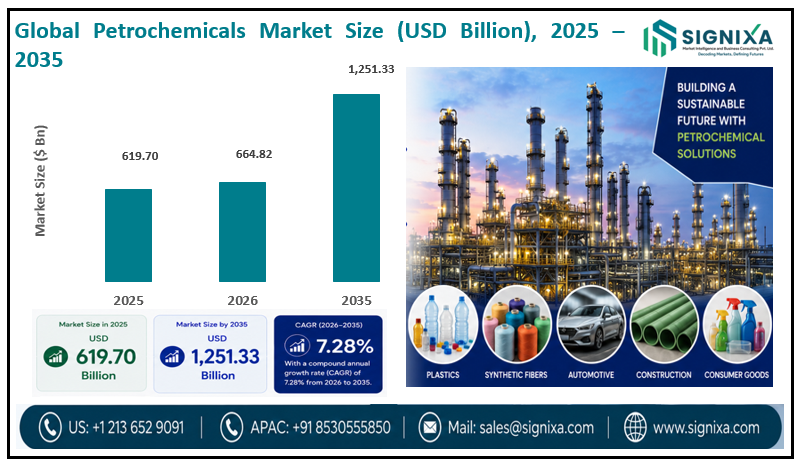
The size of the global petrochemicals market was worth around USD 619.70 Billion in 2025 and is predicted to grow to around USD 1,251.33 Billion by 2035, with a compound annual growth rate (CAGR) of roughly 7.28% between 2026 and 2035. The report analyzes key market dynamics, including the drivers, challenges, and opportunities shaping the market during the forecast period.
The petrochemicals market includes a wide range of chemical products derived from petroleum and natural gas. These are fundamental building blocks for various end-use industries such as plastics, textiles, automotive, construction, packaging, and healthcare. The petrochemical market is a cornerstone of the global economy, providing essential building blocks for a vast array of industrial and consumer products. Derived primarily from petroleum and natural gas, these chemicals including key olefins (ethylene, propylene, butadiene) and aromatics (benzene, toluene, xylene) are indispensable precursors for plastics, synthetic fibers, rubbers, detergents, fertilizers, and countless other everyday goods. The integration of petrochemical plants with refineries and the development of shale gas feedstock, especially in North America, are influencing supply-side dynamics positively.
The robust growth of the petrochemical market is directly linked to global industrialization, rapid urbanization, and increasing consumer spending, especially in emerging economies. As living standards improve worldwide, the demand for consumer goods, housing, automotive components, and infrastructure development surges, all of which heavily rely on petrochemical derivatives. Furthermore, the shift towards lighter, more durable, and cost-effective materials in sectors like automotive (for fuel efficiency) and construction (for performance and longevity) continues to fuel the demand for petrochemical-based polymers and chemicals. The industry is also witnessing significant investments in capacity expansion, particularly in regions with access to abundant and low-cost feedstocks, further solidifying its foundational role in modern manufacturing.
Key Findings
- The global petrochemicals market is projected to grow at a CAGR of around 7.28% from 2026 to 2035.
- The market was valued at USD 619.70 Billion in 2025 and is expected to reach USD 1,251.33 Billion by 2035.
- The Ethylene segment holds a significant share due to its extensive use in polyethylene and ethylene oxide production.
- In terms of applications, the Polymers segment dominates the global petrochemicals market.
- The Asia-Pacific region is expected to lead the global petrochemical market over the forecast period.
Petrochemicals Market Dynamics
Rising Demand for Plastics & Synthetic Materials Across Packaging, Construction & Automotive Driving Petrochemical Growth
One of the primary drivers of the petrochemicals market is the increasing demand for plastics and synthetic materials in various industries such as packaging, construction, automotive, and electronics. With the rise in urbanization and middle-class consumption, particularly in Asia-Pacific, there is a greater need for consumer products and infrastructure, which in turn fuels demand for petrochemicals-derived materials such as polyethylene, polypropylene, and polyvinyl chloride. These plastics are widely used due to their versatility, durability, and cost-effectiveness. The continuous growth of e-commerce and the associated expansion of flexible and rigid plastic packaging volumes are creating persistent and growing demand for petrochemical-derived polymer feedstocks, sustaining a strong structural demand driver for the petrochemicals market across both developed and emerging economies through the forecast period.
Refinery-Petrochemical Integration & Shale Gas Feedstock Revolution Transforming Production Economics
Another factor propelling the market is the growing integration of petrochemical facilities with crude oil refineries, particularly in regions like the Middle East and Asia. This integration improves operational efficiency and reduces feedstock costs. Additionally, the emergence of natural gas liquids (NGLs) and shale gas as cost-effective feedstocks, especially in North America, is transforming the petrochemical production landscape. The availability of low-cost ethane has boosted ethylene production and strengthened the competitive position of U.S.-based petrochemical manufacturers globally. Large-scale crude-oil-to-chemicals (COTC) projects — converting crude oil directly to petrochemical feedstocks with minimal fuel production represent a frontier investment trend in the Middle East and Asia that is reshaping the global petrochemical supply landscape, with Saudi Aramco, SABIC, and several Chinese operators leading capacity additions through the forecast period.
Environmental Regulations, Plastic Waste Pressure & Bio-based Innovation Creating Both Challenge & Opportunity
Environmental concerns and regulatory scrutiny over carbon emissions and plastic waste management are challenges that could restrict market growth. However, opportunities lie in the development of bio-based petrochemicals and advanced recycling technologies. Industry players are also investing in circular economy initiatives to ensure sustainability. Moreover, innovations in catalyst technologies and process optimization are expected to improve yield and efficiency, enhancing profitability and reducing the environmental impact of petrochemical operations. Despite its indispensable role and robust growth, the petrochemical market faces a complex web of challenges including the inherent volatility of feedstock prices (particularly crude oil and natural gas), concerns about greenhouse gas emissions from production processes, and the pervasive issue of plastic waste. The emergence of alternative materials and the push towards a circular economy model for plastics urge petrochemical companies to innovate and diversify their product portfolios to include more eco-friendly and recyclable options to ensure long-term sustainability and market relevance.
Petrochemicals Market Segmentation Analysis
By Petrochemical Type Segment Analysis
The market is segmented by petrochemical type, with each compound serving as a distinct primary building block for specific downstream chemical and material industries across global manufacturing value chains:
Ethylene
Ethylene accounted for a major share of the global market in 2025 due to its widespread use in producing polyethylene, ethylene oxide, and ethylene dichloride. It is a key building block for a wide variety of plastics and chemical compounds. According to the IEA, over 180 million tons of ethylene were produced globally in 2025. With the rising consumption of plastic packaging, household goods, and construction materials, demand for ethylene continues to escalate across both emerging and developed economies. The dominant share of polyethylene in global plastic consumption as the material of choice for packaging films, bottles, pipes, and containers ensures sustained and growing demand for ethylene feedstock. Continued investment in new steam crackers, particularly in the U.S. Gulf Coast utilizing cheap shale gas ethane, and in China and the Middle East, is expanding global ethylene capacity to meet growing downstream polymer demand through the forecast period.
Propylene
Propylene holds a substantial market share due to its critical role in producing polypropylene, acrylonitrile, propylene oxide, and cumene. Polypropylene accounts for over 20% of global plastic production, and its demand is growing in sectors like automotive interiors, food packaging, and textiles. In 2025, global propylene production exceeded 130 million tons. Advancements in propane dehydrogenation (PDH) technology are enhancing propylene output and supply chain flexibility. PDH plants which produce propylene from propane rather than relying on co-production from steam crackers or fluid catalytic crackers are rapidly expanding capacity particularly in China, providing dedicated propylene supply independent of refinery and cracker operating rates. The growing demand for lightweight polypropylene composites in the automotive sector, driven by fuel efficiency and electric vehicle weight reduction requirements, is a significant structural demand driver for propylene through the forecast period.
Butadiene
Butadiene is primarily used in manufacturing synthetic rubbers like polybutadiene and styrene-butadiene rubber (SBR), which are key materials in tire and automotive part production. The automotive industry's recovery post-pandemic and growing tire replacement market are boosting demand for butadiene. According to industry estimates, over 70% of butadiene is used in rubber production, making it a crucial material for mobility-focused applications. Butadiene is produced primarily as a by-product of ethylene steam cracking, meaning its supply is closely tied to ethylene production volumes and feedstock composition. The growing global vehicle fleet and expanding tire market in Asia-Pacific combined with the increasing use of high-performance synthetic rubber in specialty tires for electric vehicles that require different rubber compounds than conventional tire designs are creating sustained demand for butadiene through the forecast period.
Benzene
Benzene is widely utilized in the synthesis of chemicals like styrene, cumene, phenol, and aniline. These are essential in producing plastics, resins, synthetic fibres, and detergents. The global benzene market is expected to grow significantly due to increased demand from the automotive and construction sectors. As of 2025, benzene production volumes exceeded 50 Million Tons worldwide, driven largely by downstream uses in polystyrene and nylon production. The growing demand for styrene — the primary downstream application of benzene is driven by expanding polystyrene foam consumption in construction insulation, food packaging, and consumer goods applications. The development of bio-based benzene routes from renewable feedstocks is an emerging innovation area that could reduce the carbon footprint of benzene-derived chemical chains while maintaining the performance characteristics essential for downstream applications through the forecast period.
Toluene
Toluene is an important feedstock for producing benzene, toluene diisocyanate (TDI), and other solvents. It is widely used in paints, coatings, adhesives, and chemical intermediates. The growing construction and automotive repair industries are key demand drivers. In 2025, Asia-Pacific accounted for over 60% of global toluene consumption due to rapid industrialization and expansion of the coatings and paints sector. TDI, produced from toluene, is a critical raw material for flexible polyurethane foam used in furniture cushioning, bedding, and automotive seating all high-volume applications driven by urbanization and rising living standards in emerging economies. The growing use of waterborne coatings which require toluene-derived chemical intermediates in their formulation even as the solvents themselves are reduced is sustaining toluene demand from the construction and industrial coatings sectors through the forecast period.
Xylene
Xylene is primarily used to manufacture purified terephthalic acid (PTA), a precursor to polyester. The strong growth of the textile and packaging industries, especially in Asia, is driving demand. China alone contributes more than 50% of global PTA demand. The use of paraxylene as a raw material for producing polyester fibers and films remains a significant contributor to the xylene segment's expansion. PTA production from paraxylene (p-xylene) drives the vast majority of xylene demand globally, with polyester fiber for apparel and textiles, PET bottles for beverages, and polyester film for packaging representing the primary downstream applications. The rapidly growing recycled PET and chemical recycling sectors which rely on the same paraxylene/PTA/PET chemical chain are creating additional demand pull for xylene derivatives as the circular economy for polyester packaging and textiles scales up through the forecast period.
Methanol
Methanol plays a key role as a feedstock in the production of formaldehyde, acetic acid, and other petrochemicals. It is also gaining importance as an alternative fuel and in methanol-to-olefins (MTO) technology, particularly in China. Global methanol production surpassed 100 Million Tons in 2025, with growth driven by rising energy applications and cost-effective production methods based on natural gas feedstocks. The methanol-to-olefins (MTO) and methanol-to-propylene (MTP) conversion routes which allow olefin production from coal or natural gas via methanol as an intermediate have become strategically important for China's chemical industry as a means of reducing dependence on oil-based naphtha and ethane feedstocks. The growing interest in methanol as a marine fuel, a hydrogen carrier, and a component of sustainable aviation fuel formulations is creating new demand growth vectors for methanol beyond traditional chemical feedstock applications through the forecast period.
By Application Segment Analysis
Polymers
Polymers dominate the global petrochemicals market, accounting for a significant revenue share due to their extensive use in packaging, automotive, construction, and consumer goods. Polyethylene, polypropylene, and polystyrene are among the most widely consumed plastics globally. According to PlasticsEurope, global plastic production exceeded 400 Million Metric Tons in 2025, and over 80% of this output depends on petrochemical-derived polymers. The automotive industry's adoption of engineering polymers for weight reduction, the construction sector's use of PVC pipes, insulation, and windows, and the healthcare sector's dependence on medical-grade polymers for devices and packaging all contribute to the substantial and growing demand for petrochemical-derived polymers. The emergence of bio-based and chemically recycled polymer grades which maintain petrochemical feedstock dependence for their chemical backbone even when using renewable or recycled inputs is sustaining the polymer segment's dominance within the petrochemical's application landscape through the forecast period.
Paints and Coatings
The paints and coatings segment is experiencing robust demand due to rising construction activities, infrastructure development, and automotive refinishing. Petrochemical intermediates such as xylene and toluene are essential for the production of solvent-based paints and industrial coatings. The global market for paints and coatings was valued at over USD 180 Billion in 2025, with petrochemical feedstocks contributing significantly to its raw material base. The transition toward waterborne and high-solids coatings driven by VOC emission regulations in developed markets is reshaping the types of petrochemical intermediates used in coatings formulations, but not reducing the overall petrochemical content per unit of coating produced. Growing infrastructure investment in emerging markets across Asia, Africa, and Latin America is creating expanding demand for protective and decorative coatings that rely on petrochemical-derived resins, pigment dispersants, and film-forming agents through the forecast period.
Solvents
Solvents, including acetone, toluene, and xylene, are widely used in pharmaceuticals, cosmetics, printing inks, and cleaning products. Demand is driven by their solvency power, fast evaporation rates, and effectiveness in dissolving a wide range of materials. The increasing use of specialty chemicals and formulations in manufacturing processes supports growth in this application segment. The pharmaceutical industry's demand for high-purity solvent grades for drug synthesis, extraction, and formulation processes is a particularly stable and growing demand driver for petrochemical-derived solvents. The expansion of pharmaceutical manufacturing capacity in Asia particularly in India and China, which supply a large portion of global active pharmaceutical ingredient (API) production is creating growing demand for pharmaceutical-grade solvents that meets stringent purity specifications, supporting premium pricing and volume growth in the solvents segment through the forecast period.
Rubber
The rubber segment heavily depends on petrochemicals such as butadiene and styrene for producing synthetic rubber used in tires, industrial hoses, and belts. According to IRSG, global synthetic rubber production reached over 16 Million Metric Tons in 2025. As the automotive sector grows, particularly in emerging economies, demand for rubber-based components will continue to expand. The growing global installed base of electric vehicles which require specialized tire formulations with different rubber compounds than conventional vehicle tires to accommodate their higher weight and different torque characteristics is creating demand for next-generation synthetic rubber grades from petrochemical feedstocks. The expansion of tire manufacturing capacity in Asia, particularly in China and India as domestic automotive markets grow, is sustaining high-volume demand for butadiene, styrene, and other petrochemical-derived rubber monomers through the forecast period.
Adhesives and Sealants
Petrochemical derivatives such as ethylene-vinyl acetate (EVA), polyurethane, and synthetic rubber are critical ingredients in adhesive and sealant formulations. These materials are widely used in packaging, construction, and automotive sectors. The adhesives and sealants market was valued at over USD 60 Billion in 2025, and a large portion of its raw material input comes from petrochemical sources. The growing adoption of structural adhesives in automotive assembly replacing or supplementing mechanical fasteners in both conventional and electric vehicle construction is creating significant new demand for high-performance petrochemical-derived adhesive formulations. The expansion of flexible packaging applications that rely on laminating adhesives to bond layers of different materials is creating additional petrochemical demand from the adhesives sector, with growth particularly strong in emerging market food packaging applications through the forecast period.
Surfactants
Surfactants, made from petrochemical derivatives like linear alkylbenzene and ethylene oxide, are used extensively in detergents, personal care products, and industrial cleaners. With rising global hygiene standards and demand for cosmetic formulations, the surfactants segment is projected to grow steadily. Asia-Pacific dominates global surfactant production due to its massive detergent manufacturing base. The post-pandemic heightening of hygiene awareness which has been sustained in both consumer and institutional cleaning markets is maintaining elevated demand for surfactant-containing cleaning products globally. The growing personal care and beauty market in Asia-Pacific, Latin America, and Africa driven by rising incomes and increasing consumer spending on personal hygiene and cosmetic products is creating expanding demand for specialty surfactants derived from petrochemical intermediates, supporting continued market growth through the forecast period.
Dyes
Benzene and toluene serve as precursors for many synthetic dyes and pigments. These are essential in textiles, plastics, printing, and leather industries. The global synthetic dyes market was valued at over USD 10 Billion in 2025. The continued growth in the apparel and fashion industry, particularly in Asia, supports demand for petrochemicals used in dye production. The fast fashion industry's reliance on synthetic fiber dyeing using reactive, disperse, and acid dyes derived from petrochemical aromatic precursors creates particularly high-volume demand for petrochemical-based dye intermediates. Growing environmental regulations on dye wastewater treatment in major textile manufacturing countries are driving investment in higher-performance dye formulations with improved fixation rates, which requires more sophisticated petrochemical-derived dye intermediate chemistry and supports higher value-per-unit demand for specialty dye precursors through the forecast period.
Others
This segment includes petrochemical applications in agrochemicals, pharmaceuticals, and specialty chemicals. Petrochemical-based intermediates are essential for synthesizing herbicides, pesticides, and drug formulations. With the increasing global population and rising food and healthcare demand, this segment presents promising growth opportunities. The agrochemicals sub-segment is particularly significant, with benzene, toluene, and other aromatic petrochemicals serving as essential building blocks for the active ingredients in herbicides (glyphosate precursors), insecticides (organophosphates), and fungicides (triazoles) that underpin modern agricultural productivity. Growing food security concerns and the intensification of agricultural production across Asia, Africa, and Latin America to feed a growing global population are creating sustained demand for agrochemical active ingredients derived from petrochemical feedstocks, sustaining this as a high-growth application area within the broader petrochemicals market through the forecast period.
Report Attributes & Market Scope
| Report Attribute | Details |
|---|---|
| Market Size Value in 2025 | USD 619.70 Billion |
| Market Size Value in 2035 | USD 1,251.33 Billion |
| CAGR (2026–2035) | 7.28% |
| Base Year Used for Estimation | 2025 |
| Historic Data | 2020 - 2025 |
| Forecast Period | 2026 - 2035 |
| Segments Covered – By Type |
|
| Segments Covered – By Application |
|
| Regions Covered | North America, Europe, Asia Pacific, Latin America, Middle East and Africa |
| Major Countries Covered | U.S., Canada, Mexico, Germany, UK, France, Italy, Spain, Russia, China, Japan, South Korea, India, Southeast Asia Countries, Brazil, Argentina, GCC Countries, Turkey, Iran, Israel, South Africa, Egypt, Nigeria, etc. |
| Key Companies Profiled | SABIC, ExxonMobil Corporation, BASF SE, Mitsubishi Chemical Holdings Corporation, Formosa Petrochemical Corporation, Chevron Corporation, China National Petroleum Corporation (CNPC), and INEOS Group Ltd., among others. |
Petrochemicals Market Regional Analysis
Asia-Pacific holds the largest share of the global petrochemicals market, driven by massive industrial output, growing urbanization, and increasing demand for consumer and construction products. China and India are leading importers and producers of petrochemical derivatives, with China accounting for over 50% of global ethylene capacity additions in recent years. North America benefits from its low-cost shale gas feedstock, while Europe is focusing on sustainable and circular petrochemical solutions. The Middle East, with abundant oil reserves, is investing in integrated petrochemical complexes. Latin America and Africa are emerging markets with growing industrial needs.
Asia-Pacific (Dominant Region)
Asia-Pacific holds the largest share of the global petrochemicals market, driven by massive industrial output, growing urbanization, and increasing demand for consumer and construction products. China and India are leading importers and producers of petrochemical derivatives, with China accounting for over 50% of global ethylene capacity additions in recent years. China's petrochemical industry has undergone transformational growth, with massive new integrated complexes at Dalian, Zhoushan, and Guangdong incorporating state-of-the-art refinery-petrochemical integration on a scale unmatched globally. India's rapidly expanding petrochemical sector led by Reliance Industries' Jamnagar complex and new capacity investments by public sector companies is positioning India as a growing regional petrochemical hub. Southeast Asian nations including South Korea, Singapore, and Thailand are established regional production centers with significant export-oriented petrochemical capacity serving the broader Asia-Pacific market through the forecast period.
North America
North America holds a significant and rapidly growing share of the global petrochemical market, primarily propelled by the shale gas revolution in the United States. The abundant availability of low-cost natural gas liquids (NGLs), particularly ethane, has provided a substantial feedstock advantage, making the region a highly competitive production hub for ethylene and its derivatives. This cost advantage has incentivized massive investments in new cracking capacities and petrochemical facilities, particularly along the U.S. Gulf Coast, turning the region into a net exporter of certain petrochemicals. The packaging sector is the largest consumer, driven by the increasing consumption of packaged goods in food, healthcare, consumer goods, and e-commerce. The automotive industry also plays a crucial role, with a growing demand for lightweight plastics and composites to improve fuel efficiency and reduce emissions. While ethylene remains the largest product segment, methanol is expected to be the fastest-growing category, further diversifying the regional petrochemical landscape.
Europe
The European petrochemical market is a mature yet complex landscape, facing significant challenges related to feedstock costs and environmental regulations. Historically, Europe's petrochemical industry relied heavily on naphtha as a feedstock, making it more vulnerable to fluctuations in crude oil prices. High energy, regulatory, and labour costs have placed European producers at a competitive disadvantage against counterparts in North America and the Middle East. Despite these hurdles, Europe maintains a substantial petrochemical industry, driven by strong demand from its advanced manufacturing sectors. The automotive industry is a cornerstone, heavily reliant on petrochemical-based polymers for lightweight components, interiors, and synthetic rubber. The region's stringent environmental regulations and ambitious carbon reduction targets are pushing petrochemical companies to invest heavily in sustainable practices, explore bio-based alternatives, enhance recycling capabilities, and develop cleaner production technologies reshaping the product portfolio and operational strategies of European petrochemical manufacturers through the forecast period.
Middle East & Africa
The Middle East and Africa petrochemical market is characterized by significant growth and strategic importance, particularly in the Middle East due to its abundant and low-cost hydrocarbon feedstocks. Countries in the GCC region, such as Saudi Arabia, UAE, and Qatar, are major global players, leveraging vast reserves of crude oil and natural gas to produce a wide range of petrochemicals including ethylene, polyethylene, methanol, and ammonia. The region's petrochemical industry is highly export-oriented, with a strong focus on serving high-growth markets especially in Asia. This strong position is further cemented by ongoing massive capacity expansion projects and significant foreign investments. In Africa, demand is primarily driven by increasing urbanization, industrialization, and infrastructure development in countries like South Africa. Both sub-regions are witnessing diversification into downstream and specialty chemicals, aiming to capture higher value-added segments and reduce reliance on basic commodity petrochemicals through the forecast period.
Latin America
Latin America is an emerging market for petrochemicals, with growing industrial needs providing the foundation for market expansion. Brazil is the dominant regional market, with a significant petrochemical industry anchored by Braskem the largest petrochemical company in the Americas and its integrated production chain. The Brazilian agricultural sector is one of the world's largest, creating substantial demand for agrochemical intermediates derived from petrochemical feedstocks. Argentina's natural gas resources provide a competitive feedstock advantage for petrochemical production, though political and economic volatility has constrained investment. Mexico benefits from proximity to the U.S. petrochemical market and growing domestic manufacturing activity driven by nearshoring trends. The region's growing consumer goods, packaging, and construction sectors are creating consistent downstream demand growth for petrochemical derivatives, though the pace of domestic production capacity expansion has generally lagged demand growth, resulting in significant import volumes through the forecast period.
Recent Developments in the Petrochemicals Market
-
2026
SABIC expanded its specialty petrochemicals and circular polymer portfolio through investments in advanced recycling technologies and sustainable feedstock initiatives aimed at reducing carbon emissions.
BASF SE expanded production capabilities for performance chemicals and petrochemical intermediates while accelerating investments in low-carbon manufacturing technologies.
Reliance Industries Limited expanded petrochemical integration initiatives and enhanced downstream chemical production capacity to address growing domestic and international demand.
Chevron Phillips Chemical Company LLC expanded polyethylene and specialty chemical production capabilities to support increasing demand from packaging and industrial markets.
-
2025
SABIC introduced new circular polymer solutions utilizing certified recycled feedstocks, supporting sustainability objectives across packaging and consumer goods industries.
ExxonMobil Corporation expanded petrochemical manufacturing capabilities through strategic investments in integrated refining and chemical production assets.
BASF SE announced capacity expansions for petrochemical intermediates and specialty chemicals to address growing demand from automotive, construction, and electronics sectors.
Dow Inc. launched new performance materials and petrochemical derivatives designed to improve product sustainability and operational efficiency.
Petrochemicals Market: Competitive Landscape
Key players in the petrochemicals market include SABIC, ExxonMobil, BASF SE, LyondellBasell Industries, Dow Inc., Reliance Industries, INEOS, Chevron Phillips Chemical, Shell, and Mitsubishi Chemical Group. These companies focus on capacity expansion, vertical integration, and new technology adoption to maintain competitive advantage. As the market becomes increasingly globalized, strategic partnerships, regional diversification, and sustainable practices will play a vital role in shaping competitive dynamics.
These players leverage vast production capacities, often backward-integrated to feedstock sources, to achieve economies of scale and cost leadership. Regional strengths are evident, with North American companies benefiting from cheap shale gas, and Middle Eastern firms from abundant oil reserves. Competition is also fierce in product differentiation, with a growing focus on specialty chemicals and sustainable solutions like bio-based and recycled polymers to meet evolving environmental regulations and consumer demands. The race to develop cost-competitive chemical recycling technologies enabling recycled content in plastics that meets virgin material quality specifications — is becoming a significant competitive differentiator for major petrochemical companies seeking to maintain market position as regulatory requirements for recycled content in packaging and other applications escalate globally through the forecast period.
Key Companies Profiled
- SABIC
- ExxonMobil Corporation
- BASF SE
- LyondellBasell Industries N.V.
- Dow Inc.
- Reliance Industries Limited
- INEOS Group Holdings S.A.
- Chevron Phillips Chemical Company LLC
- Shell plc
- Mitsubishi Chemical Group Corporation
- China National Petroleum Corporation (CNPC)
- Sinopec (China Petroleum & Chemical Corporation)
- TotalEnergies SE
- LG Chem Ltd.
- Formosa Plastics Corporation
- Braskem S.A.
Global Petrochemicals Market Segmentation Summary
By Type
- Ethylene
- Propylene
- Butadiene
- Benzene
- Toluene
- Xylene
- Methanol
By Application
- Polymers
- Paints and Coatings
- Solvents
- Rubber
- Adhesives and Sealants
- Surfactants
- Dyes
- Others
By Region
- North America
- U.S.
- Canada
- Mexico
- Europe
- Germany
- France
- UK
- Spain
- Italy
- Rest of Europe
- Asia-Pacific
- China
- Japan
- India
- Australia
- South Korea
- Southeast Asia
- Rest of Asia-Pacific
- Latin America
- Brazil
- Argentina
- Rest of Latin America
- The Middle East & Africa
- GCC Countries
- South Africa
- Rest of the Middle East & Africa
Frequently Asked Questions (FAQs) About the Petrochemicals Market
What are petrochemicals?
Petrochemicals are chemical products derived from petroleum and natural gas. They include key compounds like ethylene, propylene, benzene, toluene, xylene, methanol, and butadiene, which are essential raw materials in producing polymers, solvents, paints, coatings, adhesives, rubber, and more.
Which key factors will influence the petrochemicals market growth over 2026–2035?
The global petrochemicals market is expected to grow due to increasing demand from packaging, automotive, and construction industries; advancements in petrochemical production technologies; and the shift towards more sustainable and efficient downstream chemical products.
What will be the value of the petrochemicals market during 2026–2035?
According to the study, the global petrochemicals market size was worth around USD 619.70 Billion in 2025 and is predicted to grow to around USD 1,251.33 Billion by 2035.
What will be the CAGR value of the petrochemicals market during 2026–2035?
The CAGR value of the petrochemicals market is expected to be around 7.28% during 2026–2035, driven by rising demand for petrochemical products across industries such as packaging, automotive, construction, electronics, textiles, and healthcare.
Which region will contribute notably towards the petrochemicals market value?
The global petrochemicals market is led by the Asia-Pacific region, primarily driven by rapid industrialization, strong demand from packaging and automotive sectors, and increasing investments in petrochemical manufacturing across countries like China and India.
Which are the major players leveraging the petrochemicals market growth?
The global petrochemicals market is led by companies such as BASF SE, ExxonMobil Corporation, Dow Inc., SABIC, LyondellBasell Industries N.V., INEOS Group, China National Petroleum Corporation (CNPC), Shell plc, Chevron Phillips Chemical, and Reliance Industries Limited.
What can be expected from the global petrochemicals market report?
The report explores critical elements of the petrochemicals market, including a thorough analysis of market dynamics, growth drivers, restraints, and opportunities. It also provides insights into key segments, regional performance, and recent strategic developments by leading industry players to help stakeholders make informed decisions.