
Body Contouring Devices Market Overview
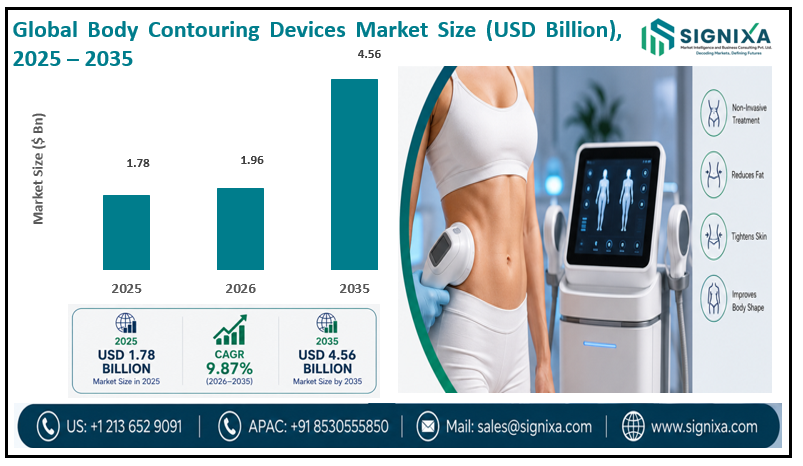
The size of the global body contouring devices market was worth around USD 1.78 Billion in 2025 and is projected to grow to around USD 4.56 Billion by 2035, with a compound annual growth rate (CAGR) of roughly 9.87% between 2026 and 2035. The report analyzes the body contouring devices market's drivers and restraints, as well as the impact they have on demand throughout the forecast period and examines global opportunities across this rapidly growing aesthetic technology sector.
The body contouring devices market comprises medical technologies designed for reshaping and refining body aesthetics through fat reduction, skin tightening, and related cosmetic procedures. These devices have witnessed rising adoption owing to growing consumer interest in non-invasive cosmetic treatments, the rising prevalence of obesity, and increasing healthcare expenditure on aesthetic procedures. Technological advancements, improved patient outcomes, and the popularity of minimally invasive solutions continue to boost market growth. The integration of ultrasound, laser, radiofrequency, and cryolipolysis modalities in modern devices allows for targeted fat reduction and improved skin tightening with fewer side effects innovations including temperature-controlled systems and real-time monitoring are improving treatment outcomes and expanding the scope of procedures that aesthetic clinics can offer, fostering higher adoption rates across both hospital and outpatient settings globally.
Key Findings
- The global body contouring devices market is expected to grow at a CAGR of around 9.87% over the forecast period (2026–2035), with market size rising from USD 1.78 Billion in 2025 to USD 4.56 Billion by 2035.
- Based on Product Type, the minimally invasive and non-invasive devices segment dominated the market in 2025 and is anticipated to maintain its lead, with non-invasive fat reduction procedures growing 21.1% in 2025 per the American Society for Aesthetic Plastic Surgery.
- On the basis of Application, fat reduction accounted for the largest share in 2025, driven by increasing obesity rates and proven treatment effectiveness of cryolipolysis and ultrasound-assisted lipolysis technologies.
- By End User, hospitals dominated the market in 2025, though clinics are growing rapidly due to increasing popularity of outpatient non-surgical services and expanding medispa networks.
- By Region, North America held the dominant position in the global market in 2025 and is projected to continue its dominance; Asia-Pacific is expected to witness the highest CAGR through the forecast period.
Body Contouring Devices Market Dynamics
Growing Preference for Minimally Invasive & Non-Invasive Aesthetic Procedures
One of the main drivers of the global body contouring devices market is the growing consumer preference for minimally invasive and non-invasive aesthetic procedures. Consumers are increasingly shifting away from traditional surgical procedures due to the associated pain, recovery time, and cost. Non-invasive body contouring devices such as cryolipolysis systems and radiofrequency platforms provide a safer, faster, and more convenient solution with minimal downtime boosting patient satisfaction and clinic demand for such equipment. The ability to undergo body sculpting treatments during a lunch break and return to normal activities immediately thereafter has dramatically expanded the addressable patient population for body contouring, removing the time and recovery barriers that historically limited the market to patients willing and able to commit to surgical procedures and extended recovery periods.
Rising Obesity Prevalence & Demand for Fat-Reduction Technologies
The increasing prevalence of obesity and lifestyle-related disorders has further spurred demand for fat-reduction technologies. According to the World Health Organization, over 1.9 Billion adults were overweight in 2022, with more than 650 Million classified as obese. As individuals seek solutions to manage localized fat deposits that resist diet and exercise common problem areas including the abdomen, flanks, thighs, and upper arms demand for body contouring solutions is projected to surge, particularly among middle-aged individuals seeking non-surgical aesthetic alternatives that can address the cosmetic component of weight management without the risks and recovery of bariatric or cosmetic surgery. The psychological dimensions of body image and self-confidence associated with localized fat deposits provide additional motivation that extends body contouring demand well beyond the medically obese population to include the much larger segment of consumers seeking aesthetic body refinement from a healthy starting point.
Technological Advancements in Energy-Based Aesthetic Devices
Technological advancements in energy-based devices have significantly enhanced the effectiveness and safety of body contouring treatments. The integration of ultrasound, laser, radiofrequency, and cryolipolysis modalities in modern devices allow for targeted fat reduction and improved skin tightening with fewer side effects. Innovations including temperature-controlled applicator systems and real-time treatment monitoring are improving outcomes and expanding the scope of procedures clinics can offer, fostering higher adoption rates. The introduction of combination platform devices such as those pairing radiofrequency heating with high-intensity focused electromagnetic (HIFEM+) technology for simultaneous fat reduction and muscle toning is creating new treatment categories that address multiple body composition goals in a single session, further expanding the clinical value proposition and commercial appeal of body contouring devices for both providers and patients.
Body Contouring Devices Market Segmentation Analysis
By Product Type Segment Analysis
Minimally Invasive and Non-Invasive Devices
The minimally invasive and non-invasive devices segment accounted for the largest market share in 2025, driven by rising consumer preference for pain-free treatments with shorter recovery periods. These devices including laser-based systems, cryolipolysis platforms, radiofrequency devices, and HIFU technologies are commonly used in outpatient settings and aesthetic clinics where patient throughput and convenience are primary commercial priorities. Non-invasive fat reduction procedures grew by 21.1% in 2025 according to the American Society for Aesthetic Plastic Surgery, reflecting the robust and accelerating demand for treatments that deliver measurable body shaping results without surgery. The continued miniaturization of device components, improvement in applicator ergonomics, and development of multi-zone treatment capabilities are enabling providers to expand service volumes while maintaining high patient satisfaction scores.
Invasive Devices
Invasive devices primarily used in liposuction procedures, laser-assisted lipolysis, and power-assisted fat removal remain relevant for patients requiring more extensive fat removal or structural body reshaping that non-invasive technologies cannot adequately address in a single treatment course. While their market share is comparatively smaller than the non-invasive segment, invasive body contouring devices maintain consistent demand from patients seeking significant, immediate, and permanent fat reduction results particularly in post-bariatric patients, patients with larger volume fat deposits, or those combining body contouring with other cosmetic surgical procedures. Continued technological refinement of minimally invasive liposuction cannulas and energy-assisted lipolysis devices is maintaining clinical relevance and gradual procedure volume growth despite the broader market shift toward non-invasive alternatives.
By Application Segment Analysis
Fat Reduction
Fat reduction dominated the application segment in 2025, owing to increasing obesity rates and strong consumer demand for body sculpting procedures that target localized fat deposits resistant to lifestyle modification. Treatments including cryolipolysis (fat freezing) and ultrasound-assisted lipolysis are widely used due to their proven clinical effectiveness, favorable safety profiles, and limited side effects that make them suitable for a broad patient population across age groups and body composition profiles. The proliferation of dedicated body contouring clinics and medispas offering these treatments often through membership or package pricing models that encourage course completion and repeat treatment is significantly expanding procedure volumes beyond what hospital and traditional clinical settings alone could achieve.
Skin Tightening
Skin tightening is the second-largest application segment, supported by aging demographics and increased awareness of post-weight-loss and post-pregnancy body treatment options where skin laxity is the primary aesthetic concern rather than fat volume. Radiofrequency and ultrasound-based skin tightening technologies including platforms delivering fractional RF, monopolar RF, and HIFU energy to the dermis and subdermal layers stimulate neocollagenesis that gradually tightens and lifts loose skin over several weeks following treatment, delivering results that were previously achievable only through surgical skin excision procedures. The growing segment of patients who have undergone significant weight loss whether through lifestyle change, GLP-1 receptor agonist medications, or bariatric surgery represents a particularly high-growth opportunity for skin tightening device demand as this population expands rapidly.
Other Applications (Cellulite Reduction, Muscle Toning)
Other applications including cellulite reduction and muscle toning are emerging niches with high growth potential, particularly among fitness-conscious populations seeking body composition optimization beyond what conventional fat reduction or skin tightening treatments alone can achieve. Muscle toning devices using high-intensity focused electromagnetic technology represent a new product category that addresses the active, health-focused consumer segment seeking performance enhancement alongside aesthetic improvement a positioning that opens body contouring device markets to consumer demographics that may not have previously considered traditional aesthetic body treatments as relevant to their self-image or lifestyle goals.
By End User Segment Analysis
Hospitals
Hospitals held the largest share of the body contouring devices market in 2025, driven by the availability of advanced infrastructure, qualified medical staff, and the ability to handle more complex procedures safely within a full clinical setting. Hospital-based body contouring programs benefit from established patient referral networks through plastic surgery and bariatric medicine departments, and from the credibility that institutional affiliation provides to patients seeking reassurance about procedure safety. The integration of body contouring device capabilities within comprehensive post-surgical or post-bariatric patient care programs represents a significant institutional use case that drives sustained hospital investment in this device category.
Clinics
Clinics including dedicated cosmetic clinics, dermatology practices, and aesthetic medicine centers are growing rapidly due to the increasing popularity of outpatient non-surgical body contouring services and the proliferation of medical spas and aesthetic centers offering these treatments outside hospital settings. The clinic model offers operational economics particularly well-suited to non-invasive body contouring lower overhead than hospital environments, flexible scheduling that accommodates after-hours patient demand, and the ability to build a specialized reputation and loyal patient base around a focused body aesthetics service offering. The growth of franchise-based aesthetic clinic networks is accelerating equipment adoption at the clinic level by providing operational templates, marketing support, and patient acquisition systems that reduce the risk of device investment for individual clinic operators.
Other End Users
Other end users including dermatology centers, wellness clinics, and medispas are also expanding their body contouring device portfolios in response to growing patient demand for these services in accessible, non-clinical environments. Dermatology practices in particular represent a growing body contouring market as the natural synergy between skin health services and skin tightening treatments makes body contouring a logical service extension that dermatologists can credibly offer to existing patient bases without dramatically expanding their clinical scope. Wellness clinics and medispas are adding body contouring devices as premium service differentiators within broader wellness and self-care service menus that integrate aesthetic treatments with fitness, nutrition, and mental wellness programming.
Report Attributes & Market Scope
| Report Attribute | Details |
|---|---|
| Market Size Value in 2025 | USD 1.78 Billion |
| Market Size Value in 2035 | USD 4.56 Billion |
| CAGR (2026–2035) | 9.87% |
| Base Year Used for Estimation | 2025 |
| Historic Data | 2020 – 2025 |
| Forecast Period | 2026 – 2035 |
| Segments Covered – By Product Type |
|
| Segments Covered – By Application |
|
| Segments Covered – By End User |
|
| Regions Covered | North America, Europe, Asia Pacific, Latin America, Middle East and Africa |
| Major Countries Covered | U.S., Canada, Mexico, Germany, UK, France, Italy, Spain, Russia, China, Japan, South Korea, India, Southeast Asia Countries, Brazil, Argentina, GCC Countries, Turkey, Iran, Israel, South Africa, Egypt, Nigeria, etc. |
| Key Companies Profiled | Cutera Inc., Cynosure LLC, BTL Aesthetics, InMode Ltd., Allergan (AbbVie Inc.), Lumenis, Alma Lasers, Lutronic, Hologic Inc., and Sciton Inc. |
Body Contouring Devices Market Regional Analysis
North America held the leading share in 2025, supported by high disposable income, a large obese population, and a well-established aesthetic medicine industry. Europe follows with substantial growth due to rising medical tourism and awareness about cosmetic treatments. Asia-Pacific is expected to witness the highest CAGR due to rapid urbanization, increasing healthcare access, and growing aesthetic consciousness. Emerging economies including Brazil and the UAE are also witnessing increased demand due to the expanding beauty industry.
North America (Leading Region)
North America held the leading share in the global body contouring devices market in 2025 and is projected to continue its dominance through the forecast period. The United States is the primary driver, supported by a high obesity rate that creates substantial demand for both medically motivated and aesthetically motivated body contouring treatments, a well-established network of cosmetic clinics and medispas equipped with advanced device technologies, high per-capita disposable income allocated to aesthetic procedures, and a mature regulatory framework that establishes clear pathways for device approval and clinical adoption. The presence of leading body contouring device manufacturers headquartered in North America including InMode, Allergan/AbbVie, and Cynosure drives rapid adoption of newly approved technologies into the domestic market and ensures continuous technology refresh cycles that sustain provider and patient interest.
Europe
Europe represents a significant and growing market for body contouring devices, driven by rising medical tourism that positions countries including Turkey, Poland, and Spain as competitively priced destinations for both surgical and non-surgical body contouring procedures attracting patients from higher-cost Western European markets. The increasing awareness and social acceptance of cosmetic treatments across European consumer demographics historically more conservative toward cosmetic procedures than North American counterparts are gradually expanding the active patient base for body contouring services. Stringent EU medical device regulations (MDR) create strong quality and safety standards that maintain patient confidence and provider accountability in the European market, while also encouraging the adoption of clinically validated premium device platforms over lower-cost alternatives.
Asia Pacific (Fastest-Growing Region)
Asia-Pacific is expected to witness the highest CAGR in the body contouring devices market through the forecast period, driven by rapid urbanization, increasing healthcare access, and growing aesthetic consciousness across a large and increasingly affluent consumer population. South Korea continues to lead regional aesthetic technology adoption as a global beauty capital, while China with its massive urban middle class, powerful social media influence on beauty standards, and government investment in healthcare infrastructure represents the single largest growth opportunity for body contouring device manufacturers seeking to expand their Asia-Pacific footprint. India, with its rapidly growing middle class and expanding medical aesthetics infrastructure in major metropolitan areas, is emerging as a significant regional growth market. The increasing penetration of premium international body contouring device brands through local distributorship agreements and direct market entry is accelerating technology adoption across the region.
Latin America & Middle East and Africa
Emerging economies including Brazil and the UAE are witnessing increased body contouring device demand due to the expanding beauty industry and growing consumer investment in aesthetic procedures. Brazil historically one of the highest-volume cosmetic procedure markets globally has a well-established body contouring culture and sophisticated aesthetic medicine infrastructure that supports rapid adoption of new non-invasive device technologies alongside its traditionally strong surgical procedures market. The UAE and broader GCC region represent rapidly growing luxury aesthetic markets where affluent urban populations are investing heavily in premium body contouring services, with international aesthetic clinic brands expanding their presence to serve this high-spending demographic. Latin America and MEA are collectively transitioning from primarily surgical to increasingly non-invasive body contouring approaches as technology access improves and consumer awareness of non-surgical alternatives expands through social media and medical tourism cross-pollination.
Recent Developments in the Body Contouring Devices Market
-
2025
InMode Ltd. unveiled enhanced versions of its Morpheus8 Burst and QuantumRF platforms, designed to improve radiofrequency-based body contouring and skin tightening procedures with faster energy delivery and greater treatment accuracy for minimally invasive aesthetic applications.
-
2024
BTL Industries introduced an upgraded version of the EMSCULPT NEO system, combining radiofrequency heating with HIFEM+ technology to support simultaneous fat reduction and muscle toning attracting consumers seeking efficient body sculpting with little to no recovery time.
-
2024
AbbVie Inc., via its Allergan Aesthetics unit, broadened the international deployment of the CoolSculpting Elite platform by strengthening collaborations with dermatology clinics and aesthetic centers to expand the reach of non-surgical fat reduction solutions globally.
-
2023
Lumenis Ltd. released new energy-based aesthetic systems equipped with AI-supported treatment optimization, enabling clinicians to deliver more customized body contouring and skin tightening procedures tailored to individual patient anatomy and treatment goals.
-
2023
Cynosure LLC increased the global adoption of its SculpSure laser body contouring technology by expanding distribution networks and launching physician education programs to support wider clinical use across international markets.
-
2022
Bausch Health Companies Inc., through its Solta Medical division, expanded the clinical presence of the Thermage FLX system, emphasizing improved radiofrequency delivery designed to support skin tightening and body contouring treatments in aesthetic practices worldwide.
Body Contouring Devices Market: Competitive Landscape
Major players operating in the global body contouring devices market include Cutera Inc., Cynosure LLC, BTL Aesthetics, InMode Ltd., Allergan (AbbVie Inc.), Lumenis, Alma Lasers, Lutronic, Hologic Inc., and Sciton Inc. The market is highly competitive, with key players focusing on innovation, FDA approvals, and strategic partnerships to expand their geographic presence and service offerings. Increasing investments in R&D and device portability, along with regulatory compliance, are pivotal for gaining market share in this evolving and patient-centric industry.
Competition in the body contouring devices market plays out across several dimensions simultaneously. At the technology level, companies compete on the breadth and depth of their device modalities platforms that can address multiple treatment indications (fat, skin laxity, muscle toning, cellulite) from a single capital investment are increasingly preferred by clinics seeking to maximize return on equipment investment. At the outcomes level, companies invest in clinical evidence generation through sponsored trials and real-world effectiveness studies that enable sales teams to substantiate claims with published data. At the commercial level, device financing models, pay-per-treatment programs, and training and certification ecosystems that help clinic operators build profitable body contouring practices are becoming as important as the device technology itself in determining vendor selection decisions. The increasing entry of adjacent players from the broader medical aesthetics industry including injectable product companies and laser platform vendors into the body contouring space is intensifying competition and compelling established body contouring specialists to continuously innovate to defend their market positioning.
Key Companies Profiled
- Cutera Inc.
- Cynosure LLC
- BTL Aesthetics
- InMode Ltd.
- Allergan (AbbVie Inc.)
- Lumenis
- Alma Lasers
- Lutronic
- Hologic Inc.
- Sciton Inc.
- Candela Corporation
- Venus Concept
- EndyMed Medical Ltd.
- Fotona d.o.o.
- Bausch Health Companies (Solta Medical)
- Zimmer MedizinSysteme GmbH
- DEKA M.E.L.A. S.r.l.
- Apyx Medical Corporation
- Classys Inc.
- Aerolase Corporation
Global Body Contouring Devices Market Segmentation Summary
By Product Type
- Minimally Invasive and Non-Invasive Devices
- Invasive Devices
By Application
- Fat Reduction
- Skin Tightening
- Other Applications
By End User
- Hospitals
- Clinics
- Other End Users
By Region
- North America
- U.S.
- Canada
- Mexico
- Europe
- Germany
- France
- UK
- Spain
- Italy
- Rest of Europe
- Asia-Pacific
- China
- Japan
- India
- Australia
- South Korea
- Southeast Asia
- Rest of Asia-Pacific
- Latin America
- Brazil
- Argentina
- Rest of Latin America
- The Middle East & Africa
- GCC Countries
- South Africa
- Rest of the Middle East & Africa
Frequently Asked Questions (FAQs) About the Body Contouring Devices Market
What are body contouring devices?
Body contouring devices are medical technologies designed to reshape, sculpt, or tighten specific areas of the body. They are used for fat reduction, skin tightening, and cellulite treatment through invasive, minimally invasive, or non-invasive procedures.
Which key factors will influence the body contouring devices market growth over 2026–2035?
Key growth drivers include the rising prevalence of obesity, growing demand for non-surgical cosmetic treatments, increased aesthetic consciousness, and technological advancements in energy-based devices such as cryolipolysis, ultrasound, and radiofrequency systems.
What will be the value of the body contouring devices market during 2026–2035?
According to the study, the global body contouring devices market size was worth around USD 1.78 Billion in 2025 and is predicted to grow to approximately USD 4.56 Billion by 2035.
What will be the CAGR value of the body contouring devices market during 2026–2035?
The CAGR value of the body contouring devices market is expected to be around 9.87% during the forecast period from 2026 to 2035.
Which region will contribute notably towards the body contouring devices market value?
North America is projected to lead the global market due to its high obesity rate, increased awareness of body aesthetics, and availability of advanced aesthetic technologies. Asia-Pacific is expected to witness the fastest growth owing to rising disposable incomes and expanding medical aesthetics infrastructure.
Which are the major players leveraging the body contouring devices market growth?
Key players in the global body contouring devices market include Cutera Inc., Cynosure LLC, BTL Aesthetics, InMode Ltd., Allergan (AbbVie Inc.), Lumenis, Alma Lasers, Lutronic, Hologic Inc., and Sciton Inc.
What can be expected from the global body contouring devices market report?
The report offers in-depth insights into the market, covering current and future trends, market drivers and restraints, technology developments, competitive landscape, regional performance, and strategic recommendations for stakeholders to navigate evolving industry dynamics effectively.