
Daylight Fluorescent Pigments Market Overview
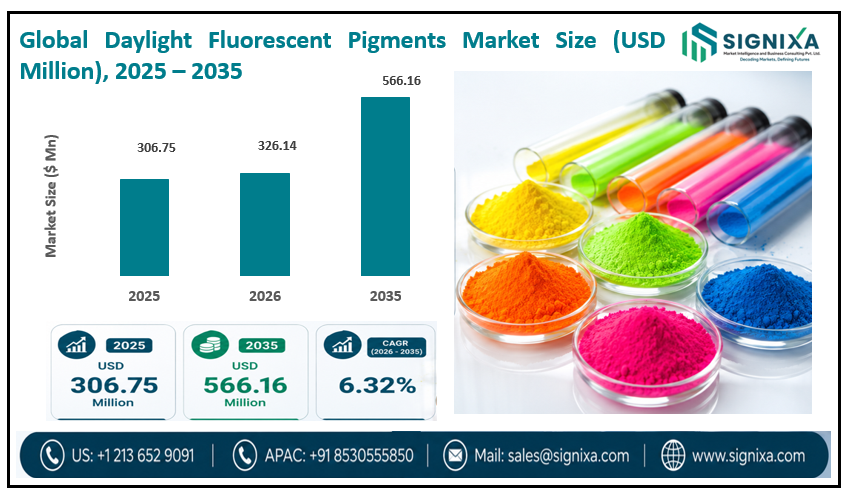
The global Daylight Fluorescent Pigments market was valued at approximately USD 306.41 Million in 2025 and is expected to grow to around USD 559.17 Million by 2035, at a compound annual growth rate (CAGR) of about 6.20% from 2026 to 2035. The report analyzes the Daylight Fluorescent Pigments market’s drivers and restraints, as well as the impact they have on demand throughout the projection period. In addition, the report examines global opportunities in the global Daylight Fluorescent Pigments market.
Daylight Fluorescent Pigments Market Overview: The Daylight Fluorescent Pigments market includes products designed for Paints & Coatings, Printing Inks, Plastics, Textiles, Cosmetics, Art & Craft uses. Daylight fluorescent pigments are bright colorants with extremely high intensity. They absorb UV and visible radiation light and emit the absorbed light as bright visible color that creates the appearance of a glow or fluorescent neon appearance in daylight. The pigments have widespread applications in paints, inks, plastics, textiles, and safety products to enhance visibility and attract the attention of consumers to objects. Growth in the market reflects the increasing availability and amplified usage of high-visibility applications that involve safety for roadways and construction sites where the intensity of color enables individuals to identify threats in the environment. Daylight fluorescent pigments are increasingly being used in consumer goods and advertising industries with graphics and brightly colored packaging, making the consumer market larger and stimulating economic growth. Daylight fluorescent pigments serve a functional and aesthetic purpose in multiple industries, including textiles, automotive applications, and consumer product offerings due to their ability to appear more visible and different from other colored objects when viewed in daylight outlets.
Key Findings
- As per analyst estimates, the global Daylight Fluorescent Pigments market is forecast to expand at a CAGR of approximately 6.20% between 2026 and 2035.
- In terms of revenue, the global Daylight Fluorescent Pigments market size was valued at USD 306.41 Million in 2025 and is projected to reach USD 559.17 Million by 2035.
- Rising demand for high-visibility materials in road safety and construction sectors is driving the use of daylight fluorescent pigments due to their exceptional brightness and visibility under natural light.
- Thermoplastic Pigments segment is growing at a high rate and will continue to dominate the global market as per industry projections.
- On the basis of Form, the Powder segment is anticipated to command the largest market share.
- In terms of Application, the Paints & Coatings segment is anticipated to command the largest market share.
- In terms of End Use Industry, the Construction & Road Safety segment is anticipated to command the largest market share.
- In terms of Distribution Channel, the Direct Sales segment is anticipated to command the largest market share.
- By Region, Asia Pacific is projected to dominate the global market during the forecast period.
- Thermoplastic Pigments
- Thermoset Pigments
- Hybrid Pigments
- Powder
- Paste
- Dispersion
- Paints & Coatings
- Printing Inks
- Plastics
- Textiles
- Cosmetics
- Art & Craft
- Construction & Road Safety
- Consumer Goods
- Textile & Apparel
- Advertising & Packaging
- Stationery
- Cosmetic & Personal Care
- Direct Sales
- Distributors & Dealers
- Online Platforms
-
2026
< Radiant Color NV broadened its range of daylight fluorescent pigments by introducing environmentally friendly formulations developed for high visibility uses such as industrial coatings, safety garments, traffic control products, and specialty inks. The company focused on delivering enhanced brightness, thermal durability, and compliance with evolving environmental standards.
-
2025
RPM International unveiled advanced daylight fluorescent pigment technologies through its specialty coatings business to improve visibility and performance in traffic safety equipment, construction signage, sports accessories, and industrial marking solutions. The innovation emphasized stronger UV resistance and extended color durability.
-
2025
Aron Universal Ltd. expanded its footprint in the daylight fluorescent pigments sector by launching high-brightness pigment solutions for applications including textile printing, plastic masterbatches, inks, and decorative coatings. The products were developed to provide improved dispersion and long-lasting color vibrancy.
-
2024
Vicome Corp. increased its production capacity for fluorescent pigments to address rising demand from packaging, graphic printing, and safety equipment industries. The company concentrated on manufacturing pigments with superior heat resistance and enhanced color intensity for industrial applications.
- Carst & Walker
- Rado Colour Industries
- Neelikon
- NeoVChem
- Veeraco Colourants
- Musclerox
- Skyshade Daylights Pvt Ltd
- DayGlo Color Corp
- Raytop Chemical
- Wanlong Chemicals
- Aron Universal
- Others
- Thermoplastic Pigments
- Thermoset Pigments
- Hybrid Pigments
- Powder
- Paste
- Dispersion
- Paints & Coatings
- Printing Inks
- Plastics
- Textiles
- Cosmetics
- Art & Craft
- Construction & Road Safety
- Consumer Goods
- Textile & Apparel
- Advertising & Packaging
- Stationery
- Cosmetic & Personal Care
- Direct Sales
- Distributors & Dealers
- Online Platforms
- North America
- U.S.
- Canada
- Mexico
- Europe
- Germany
- France
- UK
- Spain
- Italy
- Rest of Europe
- Asia-Pacific
- China
- Japan
- India
- Australia
- South Korea
- Southeast Asia
- Rest of Asia-Pacific
- Latin America
- Brazil
- Argentina
- Rest of Latin America
- The Middle East & Africa
- GCC Countries
- South Africa
- Rest of the Middle East & Africa
Daylight Fluorescent Pigments Market Dynamics
The Daylight Fluorescent Pigments market has been rapidly growing due to the increasing need for high-visibility materials for road safety applications and construction, the growth of the consumer goods and promotional packaging industries and increasing applications in textiles and fashion to create bold, attention-grabbing designs. These pigments are popular for their unparalleled brightness when viewed under natural daylight conditions, improving aesthetics and visibility in many uses. This market has also benefited from government regulations that necessitate safety signage and continues to expand due to brands prioritizing product differentiation through colorful packaging. In growing economies, infrastructure activity and changing lifestyles contribute to demand across segment categories including paints, plastics, and advertising materials.
One of the principal factors fueling the growth of the daylight fluorescent pigments market is the increasing focus on road safety and visibility standards in construction. Governments and regulatory bodies in North America, Europe, Asia, etc., are conducting strict compliance with safety standards and require the use of high visibility materials, including warning signs, traffic cones, and reflective wear. Daylight fluorescent pigments have maximum visibility when exposed to natural light and will be favored for these types of applications. Daylight fluorescent pigments reduce accidents considerably with the improved visibility of hazardous places, objects, or personnel. Continued and increasing demand for materials and products possessing daylight fluorescent pigments in road and parking surface coatings, construction markings, and safety gear is expected to continue due to ongoing infrastructure development (and government-funded smart city initiatives, etc.) in many countries around the globe. Continual strong growth is foreseeable in this segment of applications.
The consumer goods and packaging sectors are continually turning to daylight fluorescent pigments as an attractive way to make products eye-catching, bold, and prominent. These materials provide brands with visual differentiation in incredibly competitive retail environments. Producing bright fluorescent colors in packaging for food and drink, cosmetics, toys, and personal care creates packaging that jumps off the shelf, immediately grabbing consumer attention. Event merchandise, promotional items, and marketing materials also use fluorescent pigments because of their bright glow. This broader usage is helped by digital printing and customized packaging, especially among younger consumers who want their packaging to stand out. The emerging consumer sector in many markets is fueled by the growth in disposable income and urbanization, which will continue to enhance the adoption of daylight fluorescent pigments in both functional and aesthetic applications.
Daylight fluorescent pigments are becoming increasingly prevalent in the textile/apparel marketplace, owing to their vibrant color output that is aligned with ethereal and trend-based designs. These pigments can be utilized in hi-visibility workwear, sportswear, fashion apparel, and event apparel where vibrant/bright colors are desired. The appeal for streetwear, as well as emergent festival fashion applications and functional safety clothing (e.g., cyclists, emergency responders), expands the market. Brands are also exploring neon and fluorescent palettes in mainstream and other niche selected fashion lines aimed at younger consumers each season to give the consumer a product that they can use in making a bold statement in their own designs. Dyeing and printing technology continues to evolve and integrate daylight fluorescent colors into textiles and apparel, with daylight fluorescent pigments remaining favorable options in the fashion apparel and functional apparel markets.
Daylight Fluorescent Pigments Market Segmentation Analysis
By Product Type Segment Analysis
The segmentation of the market is based on product type. Thermoplastic daylight fluorescent pigments are produced from polymers that become soft when heated and can be reshaped any number of times. These daylight fluorescent pigments are widely used in plastics, masterbatches, and molded consumer goods due to their excellent dispersibility and color brilliance. Thermoplastic daylight fluorescent pigments are more commonly used when processing temperatures do not exceed 180°C. Thermoplastic daylight fluorescent pigments are widely used in toys, stationery products, and promotional products. Thermoplastic daylight fluorescent pigments are inexpensive and easy to process, so they are the most widely used daylight fluorescent pigment type, estimated as representing 45–50% of daylight fluorescent pigments consumption by volume. Thermoplastic daylight fluorescent pigments have brilliant color, but moderate lightfastness and heat stability, which limit their usage with outdoor or high-performance applications. Thermoplastic daylight fluorescent pigments are certainly the predominant product for everyday market applications as pertains to mass-market products.
Daylight fluorescent pigments based on thermoset polymers are formulated using cross-linked polymer systems, providing high thermal stability and chemical/solvent resistance. These pigments are well-suited for applications requiring a high-performance coating under extreme heat or harsh environmental conditions, including industrial coatings, automotive finishes, and specialty printing inks. Unlike thermoplastics, thermoset pigments do not melt or deform under extreme heat once they are cured, providing functionality inside and outside for long periods and during extreme conditions. Their use is increasing in the area of road safety paints and UV cured coatings, where durability and brightness are required. Although thermoset pigments are expensive and take longer to process, they are gaining market share—particularly in developed markets—and we expect that they will grow at a CAGR of 6.5%+, over the next 9 years based on building and industrial growth.
Hybrid daylight fluorescent pigments utilize the advantages of thermoplastic and thermoset systems to achieve a balance of processing ease and performance. These pigments are designed with built-in engineered properties to improve heat resistance and chemical restoration, as well as lightfastness, while maintaining good flow and dispersion capabilities in multiple applications. The hybrid pigment market is on the rise, particularly in plastics, specialty coatings, screen printing inks, and high-end packaging, which requires moderate durability along with brilliant color. The range of usage for hybrid daylight fluorescent pigments is relatively new, and currently accounts for a small portion of market share where usage is rising within the electronics (devices), automotive interior design, and fashion accessories markets (example must add clearance to resin and linear degree if hybrid daylight fluorescent is used), but with increasing market demand. Recent advances within the realm of hybrid resin chemistry are improving compatibility with different substrates, posing hybrid daylight fluorescent pigments as an opportunity in product manufacturing, more perceptively to a reasonable price point between processing and efficacious product performance as a broad term.
By Form Segment Analysis
The powder is the most prevalent form of daylight fluorescent pigments, owing to its versatility, easy to store and long shelf life. These dry pigments are commonly used in a variety of applications, such as plastics, coatings, printing inks and textile printing, where they are recognized for their superior colour strength and ability mix easily in a broad array of carriers. Because they are dry pigments, they offer the potential for greater customization and are, therefore, often selected for bulk industrial applications. Powder pigments are estimated to account for 53% of the global market for daylight fluorescent pigments by volume. Additionally, they are light and inexpensive to ship. However, they do need to be handled carefully as dust and require dispersion equipment for even colour distribution. Despite these trade-offs, powder pigments remain the dominant form due to their versatility and relatively low cost as compared to other forms of daylight fluorescent pigments, particularly in developing markets and large-scale applications.
Paste-form daylight fluorescent pigments are incorporated into a liquid carrier that has been pre-dispersed. They are a highly convenient form with good uniformity and can be easily incorporated into the formulation process of inks, paints, and textile screen printing pastes. This form eliminates dust hazards and is efficient, making it a desired form among small- and medium-sized operations that value convenience and quality in application. Paste-form pigments are recognized for good uniformity of colour distribution and are most often used in water- or solvent-based printing inks, particularly for posters, labels, and fashion graphics. While paste-form pigments only comprise a small proportion of the total market, they have become increasingly popular in the arts, crafts, and decorative coatings industry, all of which regard consistent application as a primary attribute. The paste form is most appreciated in developed economies, where the cost of processing is valued less than clean or efficient processing, including labour.
Dispersion form consists of daylight fluorescent pigments that are delivered in a resin or polymeric binder, specifically developed to simplify the end user's experience when producing high-performance coatings, plastics, and automotive paints. The formulation and construction characteristics of dispersions provide excellent colour stability, process time savings, and improved flow properties. The physical properties allow dispersions to be used in automated systems and have a better propensity for industrial scales. Dispersions generally comprise approximately 22% of the market, and the demand is increasing in automotive coatings, flexible packaging, and UV-curable systems, where precision application and performance is essential. Dispersions will reduce the potential for agglomeration of the pigments and will typically increase compatibility with substrates being targeted for application. Dispersions in general are more expensive than concentrates of the same pigment but remain a product of choice for lots of applications that provide an exact and consistent process, increased speed of production, and reduced processing errors. This remains especially true in Europe and North America, where manufacturers tend to rely on automated processes for their production workflow.
By Application Segment Analysis
Application wise, the paint and coatings section is the largest market segment, with over 30% of the global demand share, for daylight fluorescent pigments. Paints and coatings employing daylight fluorescent pigments are used in applications where visibility is a primary concern including; road markings, safety barriers, traffic signs, industrial coatings, and decorative paints. Daylight fluorescent pigments absorb UV light and re-emit it as bright fluorescent colour and are designed to enhance safety in high traffic and low visibility situations. Fluorescent paint used in construction or transportation can improve detection of hazardous objects or stairs. In addition to construction and transportation, creative and architectural uses continue to grow, such as improving the aesthetic appearance of wall finishes and public art installations. As governments intervene and demand for safer infrastructure and design increases, the demand of daylight fluorescent pigments in paint and coatings applications will grow steadily at a CAGR of above 6% through 2035, particularly in the Asian Pacific and North American regions.
Daylight fluorescent pigments are commonly found in printing inks used for highly visible labels, posters, packaging, and advertisements. This segment accounts for approximately 23% market share. They are utilized in flexographic, offset, gravure, and screen-printing with glowing effect in natural and UV light. Their use in retail and FMCG packaging is growing where 'see me' shelf appeal is critical for product differentiation to attract attention. It is also prevalent in the fashion and event promotion industry for merchandise and banners using fluorescent prints. The ongoing shift to digital and short run customized printing points to continued profitability and growth in the printing inks segment—particularly in the rapidly growing personal care, beverage, and promotional packaging markets across Asia and Europe.
The plastics sector accounts for approximately 20% of the daylight fluorescent pigments market, with applications ranging from toys, containers, and casings for consumer electronics, to household items. Fluorescent pigments are added at the stage of processing by extrusion or molding, which produces a glowing, high-impact product. Thermoplastic fluorescent pigments are most common in the plastics market due to their ease of processing. In areas such as stationery, packaging, and children's products, fluorescent plastics are popular not only for aesthetics, but also for safety. There is increasing demand for fluorescent plastic in developing economies due to the continued rise in consumer goods based on plastic. There are also new developments in more transparent and neon-effect plastic packaging for cosmetics and technical accessories, which boost pigments. However, environmental considerations surrounding plastic waste are driving the market toward more recyclable and lower-impact pigment systems.
Textile and clothing account for about 14% of the daylight fluorescent pigment market, given their increasing use in fashion, workwear, and sportswear. The pigments are used through screen printing, dyeing, or digital printing to create colourful, bright designs. High visibility clothing for construction workers and emergency workers, and cyclists, is an important factor. In fashion, fluorescent styles are still popular in streetwear, festival wear, and youth-based brands, which is creating demand for durable pigments that last in brightness after many washes through sunlight exposure. As we see increased growth in fast fashion and innovative textile design, we also see increased demand and consumption from this market segment. Technical advancements in compatibility with synthetic fabrics and eco-friendly binders is also creating new opportunities, especially in the Asia Pacific and Latin America regions, where much of this textile production is concentrated.
Although still a niche market, cosmetics is a rapidly growing area, estimated at around 6% of the daylight fluorescent pigments market. Producers use these pigments in nail polishes, eye shadows, body paints, and hair colours to create a bold glowing effect in daylight or UV light and they are particularly popular for use in party make-up and clubbing, or in bold and creative beauty products where brands are targeting younger and more experimental consumers. Safety and regulatory approval is an important consideration on cosmetic grade fluorescent pigments, so these are formulated with cosmetics in mind and undergo rigorous safety testing for FDA/ EU compliance. Also generally seeing increased influence of social media landscape and consumer demand for expressive and colourful make-up, brands have begun to incorporate these pigments into limited edition and festival make-up options. The growth of this market is shaping up especially well in North America, Europe, and certain parts of Asia, particularly South Korea and Japan.
The Art & Craft niche market is colourful and represents approximately 9% of the overall market. Daylight fluorescent pigments are predominantly used in school supplies, do-it-yourself kits, creative artefacts, and decorator art, lending children and artists the ability to produce visually striking effects in their artwork. Because of their vibrant glow and high mixing ability, Daylight fluorescent pigments are readily used in acrylics, markers, poster paints, and resin hobby products. This niche is primarily driven by seasonal demand, to support education (in developed markets, such as the U.S., Canada, and Europe) as well as crafts, as education in the arts is seen in a positive light. In developing markets, increase disposable income and access to the hobby market are expanding this market. The global trend of increased personalization and creative hobbies, supported by social platforms like Pinterest and Instagram, is expected to further increase the use of daylight fluorescent pigments in crafts.
By End-Use Segment Analysis
By Distribution Channel Segment Analysis
Report Attributes & Market Scope
| Report Attribute | Details |
|---|---|
| Market Size Value in 2025 | USD 306.41 Million |
| Market Size Value in 2035 | USD 559.17 Million |
| CAGR (2026-2035) | 6.20% |
| Base Year Used for Estimation | 2025 |
| Historic Data | 2020 - 2025 |
| Forecast Period | 2026 - 2035 |
| Segments Covered -By Type |
|
| Segments Covered -By Form |
|
| Segments Covered –By Application |
|
| Segments Covered -By End-Use |
|
| Segments Covered -By Distribution Channel |
|
| Regions Covered | North America, Europe, Asia Pacific, Latin America, Middle East and Africa |
| Major Countries Covered | U.S., Canada, Mexico, Germany, UK, France, Italy, Spain, Russia, China, Japan, South Korea, India, Southeast Asia Countries, Brazil, Argentina, GCC Countries, Turkey, Iran, Israel, South Africa, Egypt, Nigeria, etc. |
| Key Companies Profiled | Carst & Walker, Rado colour Industries, Neelikon, NeoVChem, Veeraco Colourants, Musclerox, Skyshade Daylights pvt Ltd, DayGlo Color Corp, Raytop Chemical, Wanlong Chemicals, Aron Universal, and others. |
Daylight Fluorescent Pigments Market Regional Analysis
The global market for Daylight Fluorescent Pigments has all regions expanding, with North America, and Europe leading in innovating and adoption with support from regulations, and their industrial developments. The Asia Pacific region remains the largest and dominant market for daylight fluorescent pigments, accounting for greater than 40 percent of global demand. Growth in daylight fluorescent pigment demand is primarily due to rapid industrialization in the region, along with more construction, manufacturing in countries like China, India, Japan, and South Korea. The Asia Pacific region is one of the leading regions globally for textiles, consumer goods, packaging, and printing; this is important because these are all major application areas of daylight fluorescent pigments. The density of the population and development of urban centers will lead to more road safety and more advertising signage products due to increased use. In addition to these factors contributing to market growth, the presence of the many local pigment manufacturers, investments in infrastructure, and increasing interest in smart cities will add to the demand for this important pigment. Several countries in the Asia Pacific region have a strong government focus on safety regulations, and an increase in the export of products with colored pigments and colored daylight fluorescent pigments will add to the reasons to have Asia Pacific remaining the leading region for Daylight Fluorescent Pigments.
Latin America and the Middle East and Africa (MEA) are two of the most promising emerging regions for daylight fluorescent pigments. Increased retail packaging, road infrastructure, and textile production investment in Latin America (especially Brazil and Mexico) is driving demand in the region. Consumer choice continues to support pigment consumption in cosmetics and art from residents' preference for colorful product designs. In MEA, urbanization and a building boom in countries such as the UAE, Saudi Arabia, and South Africa has developed fluorescent pigment demand for road safety and other sign applications. Increased investment in education and enrollment in school is shortening demand for fluorescent pigments for stationery and craft-related uses. Both regions benefit from increases in imports, government-led infrastructure commitments, and a youthful population interested in purchasing high visibility colorful products.
Recent Developments in the Daylight Fluorescent Pigments Market
Daylight Fluorescent Pigments Market: Competitive Landscape
The global Daylight Fluorescent Pigments market features major players such as Carst & Walker, Rado colour Industries, Neelikon, NeoVChem, Veeraco Colourants, Musclerox, Skyshade Daylights pvt Ltd, DayGlo Color Corp, Raytop Chemical, Wanlong Chemicals, Aron Universal, among others. The Daylight Fluorescent Pigments market is highly competitive, with major players such as Carst & Walker, Rado colour Industries, Neelikon, NeoVChem, Veeraco Colourants, Musclerox, and others driving technological advancements across a range of applications. Companies are competing on factors such as product innovation, cost-efficiency, geographical reach, and sustainability, which are all essential for gaining market share in the growing Daylight Fluorescent Pigments industry. As the market continues to expand, companies will need to focus on further improving the performance of their growing Daylight Fluorescent Pigments and broadening their application scope to capitalize on the growing demand for energy-efficient and effective solutions in Paints & Coatings, Printing Inks, Plastics, Textiles, Cosmetics, Art & Craft applications.
Key Companies Profiled
Global Daylight Fluorescent Pigments Market Segmentation Summary
By Type
By Form
By Application
By End-Use
By Distribution Channel
By Region
Frequently Asked Questions (FAQs) About the Daylight Fluorescent Pigments Market
What is Daylight Fluorescent Pigments?
Daylight fluorescent pigments are bright, color-intense materials that absorb ultraviolet and visible light, then re-emit it at longer wavelengths. This makes them appear exceptionally vivid and glowing under natural or artificial light.
Which key factors will influence the Daylight Fluorescent Pigments market growth over 2026-2035?
Rising demand in safety signage, high-visibility apparel, and novelty products, along with increased use in cosmetics and plastics, is driving the daylight fluorescent pigments market. Their vibrant appearance enhances product appeal across industries.
What will be the value of the Daylight Fluorescent Pigments market during 2026-2035?
According to the study, the global Daylight Fluorescent Pigments market size was worth around USD 306.41 million in 2025 and is predicted to grow to around USD 559.17 million by 2035
What will be the CAGR value of the Daylight Fluorescent Pigments market during 2026-2035?
The CAGR value of the Daylight Fluorescent Pigments market is expected to be around 6.20% during the forecast period from 2026 to 2035.
Which region will contribute notably towards the Daylight Fluorescent Pigments market value?
Asia-Pacific will contribute significantly to the daylight fluorescent pigment market due to growing industrial activity, expanding textiles and plastics sectors, and rising demand for colorful consumer goods in countries like China, India, and Southeast Asia.
Which are the major players leveraging the Daylight Fluorescent Pigments market growth?
The global Daylight Fluorescent Pigments market is led by players such as Carst & Walker, Rado colour Industries, Neelikon, NeoVChem, Veeraco Colourants, Musclerox, Skyshade Daylights pvt Ltd, DayGlo Color Corp, Raytop Chemical, Wanlong Chemicals, Aron Universal.
What can be expected from the global Daylight Fluorescent Pigments market report?
The report explores crucial aspects of the Daylight Fluorescent Pigments market, including a detailed discussion of existing growth factors and restraints while also analyzing future growth opportunities and challenges that impact the market.