
Asthma Therapeutics Market Overview
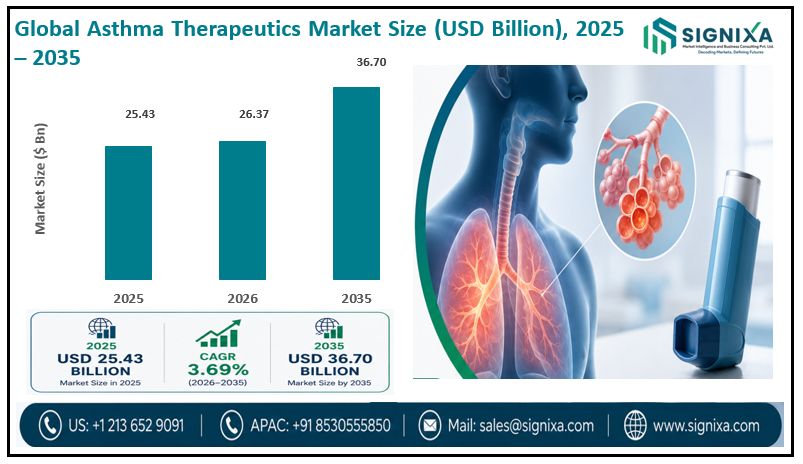
The global asthma therapeutics market was valued at approximately USD 25.43 Billion in 2025 and is expected to reach around USD 36.70 Billion by 2035, growing at a CAGR of about 3.69% during the forecast period. The report examines market trends, key drivers, restraints, and global opportunities in the asthma therapeutics sector.
The asthma therapeutics market comprises a wide range of drug classes, treatment types, and delivery systems tailored to manage acute symptoms and provide long-term disease control. The market is driven by a rising global prevalence of asthma, increased access to healthcare, and continuous innovation in drug delivery technologies.
The asthma therapeutics market is a dynamic and essential segment of the pharmaceutical industry, driven primarily by the growing global prevalence of asthma and the continuous evolution of treatment paradigms aimed at improving patient outcomes and quality of life. Asthma, a chronic respiratory condition characterized by airway inflammation and hyper-responsiveness, affects millions worldwide, spanning all age groups. This widespread incidence, exacerbated by factors such as increasing air pollution, changing environmental allergens, and urbanization, creates a consistent and expanding demand for effective therapeutic interventions. The market encompasses a broad range of drug classes, including inhaled corticosteroids (ICS), bronchodilators (short-acting beta-agonists or SABAs, and long-acting beta-agonists or LABAs), leukotriene modifiers, and increasingly, advanced biologics. The shift from symptom-driven treatment to a more proactive, personalized, and inflammation-focused management approach underscores the need for diverse and innovative therapeutic options that address varying asthma severities and patient profiles.
A significant market dynamic is the paradigm shift towards precision medicine and the escalating importance of biologics in managing severe and uncontrolled asthma. While traditional inhaled corticosteroids and bronchodilators remain the cornerstone of asthma management, a significant subset of patients with severe asthma do not achieve adequate control with standard therapies. This unmet medical need has fueled extensive research and development into biologics, which are monoclonal antibodies specifically designed to target key inflammatory pathways (e.g., IgE, IL-5, IL-4/13, TSLP) involved in asthma pathogenesis. These targeted therapies, such as omalizumab, mepolizumab, dupilumab, and tezepelumab, offer significant improvements in symptom control, reduction in exacerbations, and enhanced lung function for specific patient phenotypes. The increasing understanding of asthma endotypes and biomarkers is enabling healthcare professionals to personalize treatment regimens, selecting the most appropriate biologic for individual patients, thereby driving the adoption and growth of this high-value segment within the asthma therapeutics market.
However, the asthma therapeutics market also faces notable challenges, including the high cost of advanced therapies, issues with patient adherence to treatment regimens, and the need for improved diagnostic capabilities. While biologics offer transformative benefits for severe asthma patients, their premium pricing can pose a significant barrier to access, particularly in healthcare systems with budget constraints or limited reimbursement policies. Furthermore, a persistent challenge across all asthma therapies, especially inhaled medications, is patient non-adherence, which can lead to poor disease control, increased exacerbations, and higher healthcare costs. To address this, there's a growing integration of digital health solutions, such as smart inhalers with Bluetooth connectivity and AI-based monitoring platforms, designed to track medication usage, provide reminders, and facilitate remote patient management, thereby improving adherence. Lastly, the accurate diagnosis and phenotyping of asthma, particularly differentiating it from other respiratory conditions and identifying specific inflammatory drivers, remain crucial for effective treatment selection. Continued advancements in diagnostics and a focus on educational initiatives for both patients and healthcare providers will be essential for further market penetration and optimized patient care.
Key Findings
- The global asthma therapeutics market is forecasted to expand at a CAGR of 3.69% from 2026 to 2035.
- The market was valued at USD 25.43 Billion in 2025 and is projected to reach USD 36.70 Billion by 2035.
- ICS/LABAs Combination Therapies dominate the market in terms of drug class.
- Long-term control medications are anticipated to hold the largest market share by treatment type.
- Injectable and oral routes are gaining traction due to improved bioavailability and patient preference.
- Hospital pharmacies remain the primary distribution channel, but e-commerce is expanding rapidly.
- Hospitals and clinics continue to be the leading end-users of asthma therapeutics.
Asthma Therapeutics Market Dynamics
Rising Global Burden of Asthma Drives Treatment Demand
The increasing global burden of asthma is a key driver of the asthma therapeutics market. According to the Global Asthma Report, over 260 Million individuals suffer from asthma globally. Rising pollution, sedentary lifestyles, and urbanization are aggravating the incidence of asthma. Governments and health organizations are ramping up investments in awareness campaigns, diagnosis, and long-term asthma management programs, further propelling demand for advanced therapeutics.
Innovative Drug Delivery Systems Support Market Growth
Innovative drug delivery systems are also supporting the market's growth. The adoption of smart inhalers and biologic therapies has improved adherence, personalized treatment outcomes, and reduced hospitalization. Pharmaceutical companies are developing biologics that target specific asthma phenotypes. For example, monoclonal antibodies such as omalizumab and mepolizumab have transformed treatment for severe asthma. These high-precision therapies continue to gain market share in developed economies, enhancing the overall value of the asthma therapeutics sector.
Growing Recognition of Asthma Heterogeneity Shapes Treatment Approaches
The asthma therapeutics market is a vast and continuously evolving segment of the pharmaceutical industry, focused on providing treatments that manage symptoms, prevent exacerbations, and improve the quality of life for millions of individuals worldwide living with asthma. It encompasses a diverse range of medications, from bronchodilators and inhaled corticosteroids (ICS) to advanced biologics. The market's growth is driven by rising asthma prevalence, increased awareness and diagnosis, and ongoing innovation in drug development and delivery systems. The heterogeneity of asthma, recognizing that it is not a single disease but rather a collection of phenotypes and endotypes, is a foundational understanding that shapes current and future therapeutic approaches, moving away from a "one-size-fits-all" model.
Paradigm Shift Toward Personalized, Phenotype-Guided Medicine
A crucial market dynamic is the paradigm shift towards personalized medicine and phenotype-guided treatment. Historically, asthma management followed a more generalized approach. However, with advances in understanding the underlying inflammatory pathways and genetic predispositions, treatments are increasingly being tailored to individual patient profiles. This involves identifying specific biomarkers (e.g., eosinophil counts, FeNO levels) to stratify patients into different asthma phenotypes (e.g., eosinophilic, allergic, neutrophilic asthma). This precision approach allows clinicians to select the most effective biologic or combination therapy, optimizing patient outcomes, reducing side effects, and minimizing ineffective treatments, thereby driving demand for diagnostics and targeted therapies.
Expansion of the Severe Asthma Segment and Novel Biologics
The expansion of the severe asthma segment and the emergence of novel biologics are profoundly reshaping the market. While controller medications effectively manage mild to moderate asthma for many, a significant subset of patients suffers from severe, uncontrolled asthma despite optimal conventional therapy. This unmet need has driven intense R&D into biologics (monoclonal antibodies) that target specific inflammatory mediators like IgE, IL-5, IL-4/IL-13, and TSLP. These highly effective therapies dramatically reduce exacerbations, improve lung function, and decrease the reliance on systemic corticosteroids for severe asthma patients, who previously had limited options. The high cost of biologics, however, presents challenges for market access and reimbursement in various healthcare systems.
Continuous Innovation in Smart Inhaler Technologies
Another significant dynamic is the continuous innovation in drug delivery systems and smart inhaler technologies. While the core active pharmaceutical ingredients are crucial, how they are delivered significantly impacts patient adherence, efficacy, and convenience. Developments include more intuitive and user-friendly inhaled devices (e.g., dry powder inhalers, soft mist inhalers), as well as the integration of digital technologies. Smart inhalers, equipped with sensors and Bluetooth connectivity, can track medication usage, provide reminders, and transmit data to healthcare providers. This data enables real-time monitoring of adherence, identifies potential triggers, and facilitates timely interventions, ultimately leading to better asthma control and driving demand for advanced, digitally enabled devices.
Rising Prevalence in Developing Economies and Access Challenges
The growing prevalence of asthma in developing economies and the challenges of access to advanced therapeutics present a complex market dynamic. While developed nations have high rates of diagnosis and access to a wide range of treatments, low- and middle-income countries often face significant barriers, including limited diagnostic capabilities, insufficient healthcare infrastructure, and affordability issues for expensive medications. However, as urbanization, industrialization, and air pollution increase in these regions, asthma prevalence is rising. This creates both a massive unmet medical need and a burgeoning market opportunity, pushing pharmaceutical companies to explore more affordable treatment options, expand distribution networks, and potentially partner with local manufacturers or governments to improve access to essential asthma medicines.
Environmental Factors and Public Health Initiatives Shape Demand
Finally, the impact of environmental factors and public health initiatives on asthma management and prevention is a critical, overarching dynamic. Rising levels of air pollution, allergens, and climate change are exacerbating asthma symptoms and contributing to increased prevalence globally. Public health bodies and environmental agencies are increasingly focused on mitigating these environmental triggers, which indirectly influences the demand for therapeutics by aiming to reduce the burden of the disease. Furthermore, awareness campaigns and educational programs on asthma management, including early diagnosis and adherence to treatment plans, are changing patient behavior and potentially influencing the types and quantities of therapeutics prescribed, fostering a more holistic approach to asthma care.
Asthma Therapeutics Market Segmentation Analysis
By Drug Class Segment Analysis
By Drug Class, Combination therapies (ICS/LABAs) represent the largest market share due to their effectiveness in controlling chronic asthma symptoms and reducing exacerbations. A 2025 GINA (Global Initiative for Asthma) report highlighted that over 60% of patients with persistent asthma are prescribed combination therapies as first-line treatment. LABAs and ICS work synergistically to improve lung function and minimize inflammation. Short-acting beta agonists (SABAs) continue to be widely used for acute symptom relief, while leukotriene modifiers and corticosteroids serve niche roles in personalized care plans.
Combination Therapies (ICS/LABAs)
Combination therapies represent the largest drug class segment, with over 60% of patients with persistent asthma prescribed these treatments as first-line therapy, as LABAs and ICS work synergistically to improve lung function and minimize inflammation.
By Treatment Type Segment Analysis
By Treatment Type, Long-term asthma control medications dominate the market, accounting for nearly 70% of total therapeutic use. These include daily maintenance therapies like ICS and ICS/LABA combinations, which are essential in preventing flare-ups and improving quality of life. Quick-relief medications (e.g., SABAs) serve as emergency treatments for asthma attacks but are not suitable for chronic use. The consistent need for daily medications underscores the long-term market potential of asthma therapeutics.
Long-Term Asthma Control Medications
Long-term asthma control medications dominate the market, accounting for nearly 70% of total therapeutic use. These include daily maintenance therapies like ICS and ICS/LABA combinations, which are essential in preventing flare-ups and improving quality of life.
Quick-Relief (Rescue) Medications
Quick-relief medications (e.g., SABAs) serve as emergency treatments for asthma attacks but are not suitable for chronic use. They remain an essential complement to long-term control therapies within a complete asthma management plan.
By Route of Administration Segment Analysis
By Route of Administration, Injectable are gaining traction, especially for biologic drugs targeting moderate-to-severe asthma. Drugs like dupilumab and benralizumab, administered via subcutaneous injection, offer targeted action with longer-lasting effects. Meanwhile, oral medications remain popular in pediatric and geriatric segments due to ease of use. Topical and inhaled options remain the cornerstone of frontline asthma management, particularly ICS and combination inhalers, which provide direct delivery to the lungs.
By Distribution Channel Segment Analysis
By Distribution Channel, Hospital pharmacies dominate distribution, accounting for over 50% of market share in 2025. These pharmacies provide immediate access to essential asthma medications, especially injectable and emergency-use drugs. However, e-commerce platforms are witnessing rapid growth, with a CAGR of over 6% projected between 2026 and 2035. Online accessibility and subscription-based delivery models for chronic medications are attracting patients looking for convenience and affordability.
Hospital Pharmacies
Hospital pharmacies dominate distribution, accounting for over 50% of market share in 2025, providing immediate access to essential asthma medications, especially injectable and emergency-use drugs.
E-commerce
E-commerce platforms are witnessing rapid growth, with a CAGR of over 6% projected between 2026 and 2035, as online accessibility and subscription-based delivery models for chronic medications attract patients looking for convenience and affordability.
Brick & Mortar
Brick and mortar retail pharmacies continue to serve as an accessible, community-level distribution channel for maintenance asthma medications alongside hospital pharmacies and growing e-commerce platforms.
By End Use Segment Analysis
By End-use, Hospitals and clinics represent the largest end-use segment, as they are primary centres for diagnosis, management, and severe asthma treatment. According to WHO estimates, over 80% of asthma hospitalizations occur in clinics and hospitals, reinforcing their dominance. Ambulatory surgical centres and homecare settings are emerging as important segments, particularly for biologics and inhaler-based maintenance therapies that allow patients to manage the disease outside of traditional healthcare settings.
Hospitals & Clinics
Hospitals and clinics represent the largest end-use segment, as primary centres for diagnosis, management, and severe asthma treatment. According to WHO estimates, over 80% of asthma hospitalizations occur in clinics and hospitals, reinforcing their dominance.
Ambulatory Surgical Centres
Ambulatory surgical centres are emerging as an important segment, particularly for biologics and procedure-based asthma care delivered outside of traditional inpatient hospital settings.
Homecare Settings
Homecare settings are increasingly important, particularly for inhaler-based maintenance therapies that allow patients to manage the disease outside of traditional healthcare settings.
Report Attributes & Market Scope
| Report Attribute | Details |
|---|---|
| Market Size Value in 2025 | USD 25.43 Billion |
| Market Size Value in 2035 | USD 36.70 Billion |
| CAGR (2026–2035) | 3.69% |
| Base Year Used for Estimation | 2025 |
| Historic Data | 2020 - 2025 |
| Forecast Period | 2026 - 2035 |
| Segments Covered – By Drug Class |
|
| Segments Covered – By Treatment Type |
|
| Segments Covered – By Route of Administration |
|
| Segments Covered – By Distribution Channel |
|
| Segments Covered – By End Use |
|
| Regions Covered | North America, Europe, Asia Pacific, Latin America, Middle East and Africa |
| Major Countries Covered | U.S., Canada, Mexico, Germany, UK, France, Italy, Spain, Russia, China, Japan, South Korea, India, Southeast Asia Countries, Brazil, Argentina, GCC Countries, Turkey, Iran, Israel, South Africa, Egypt, Nigeria, etc. |
| Key Companies Profiled | GlaxoSmithKline plc, AstraZeneca, Novartis AG, Teva Pharmaceutical Industries Ltd., Boehringer Ingelheim, Sanofi, Merck & Co., Pfizer Inc., Cipla Inc., and Regeneron Pharmaceuticals. |
Asthma Therapeutics Market Regional Analysis
North America holds the largest market share due to high disease prevalence, favorable reimbursement policies, and rapid adoption of advanced biologics. Europe follows closely, driven by government-backed asthma care programs and aging populations. Asia-Pacific is the fastest-growing market, fueled by increased urbanization, environmental pollution, and expanding healthcare infrastructure. Latin America and the Middle East & Africa are emerging markets, with rising investments in asthma awareness and access to affordable generic medications.
North America (Dominant Region)
North America stands as a dominant force in the asthma therapeutics market, characterized by its high asthma prevalence, advanced healthcare infrastructure, and significant adoption of innovative therapies, particularly biologics. The United States accounts for a substantial share, driven by a large patient population, well-established treatment guidelines (e.g., from the National Asthma Education and Prevention Program - NAEPP, and Global Initiative for Asthma - GINA), and a robust reimbursement landscape that supports access to newer, often high-cost, medications. There's a strong emphasis on personalized medicine, with a growing understanding of asthma phenotypes and endotypes, leading to increased prescribing of targeted biologics for severe and uncontrolled asthma. The presence of major pharmaceutical companies with extensive R&D pipelines and strong marketing capabilities further fuels market growth. Additionally, the region is seeing increasing integration of digital health solutions, such as smart inhalers and remote monitoring platforms, aimed at improving patient adherence and outcomes, especially given the significant economic burden of uncontrolled asthma in the region.
Europe
Europe represents a significant and evolving market for asthma therapeutics, marked by varying levels of asthma prevalence across countries and a strong focus on evidence-based guidelines and patient-centric care. Countries like the UK, Germany, France, and Italy are key contributors, driven by a substantial asthmatic population and established healthcare systems. The European market has seen a steady increase in the adoption of advanced therapies, including biologics, especially for severe asthma, though access and reimbursement policies can differ across national health systems. The European Respiratory Society (ERS) and national guidelines often align with GINA recommendations, emphasizing stepwise management and phenotype-driven therapy. There's a growing awareness of the importance of early diagnosis and effective management to prevent exacerbations and improve quality of life. Furthermore, research and development activities in Europe are robust, with a focus on novel drug targets and improving drug delivery systems, reflecting the region's commitment to advancing asthma care.
Asia-Pacific
The Asia Pacific region is rapidly emerging as a high-growth market for asthma therapeutics, propelled by its vast and aging population, increasing urbanization, rising air pollution, and improving healthcare access and expenditure. Countries like China, India, Japan, and South Korea are key drivers of this growth. While historically the prevalence of asthma in some parts of Asia Pacific has been lower than in Western countries, it has been steadily increasing, particularly in urban areas. The market sees a growing demand for both conventional inhaled corticosteroids and bronchodilators, which form the bedrock of asthma management, as well as a rising uptake of advanced biologics as healthcare infrastructure improves and awareness of severe asthma treatment options grows. Challenges in the region include the diversity of healthcare systems, varying levels of affordability, and the need for greater public awareness and accurate diagnosis, particularly in rural areas. However, government initiatives to strengthen healthcare systems, coupled with the increasing presence of global pharmaceutical companies and local manufacturers, are expected to significantly boost market expansion and access to effective asthma therapeutics across Asia Pacific.
Recent Developments in the Asthma Therapeutics Market
-
2026
GlaxoSmithKline plc (GSK) the U.S. FDA approved Exdensur (depemokimab), a twice-yearly biologic for severe asthma, marking a significant advancement in long-acting treatment options for patients with uncontrolled eosinophilic asthma.
AstraZeneca continued to strengthen its respiratory portfolio by expanding clinical development programs for severe asthma therapies and increasing investment in respiratory research to support next-generation biologic treatments.
-
2025
Sanofi and Regeneron Pharmaceuticals reported continued global growth of Dupixent for severe asthma, supported by expanded adoption in Type 2 inflammatory diseases and broader physician uptake across major healthcare markets.
Teva Pharmaceutical Industries Ltd. advanced its respiratory care strategy by expanding access to its inhaled asthma therapies and strengthening its portfolio of generic and specialty respiratory medicines in key international markets.
Boehringer Ingelheim continued investing in respiratory research through clinical studies focused on innovative inhaled therapies and combination treatments for asthma and other chronic respiratory diseases.
Asthma Therapeutics Market: Competitive Landscape
Leading companies in the asthma therapeutics market include GlaxoSmithKline plc, AstraZeneca, Novartis AG, Teva Pharmaceutical Industries Ltd., Boehringer Ingelheim, Sanofi, Merck & Co., Pfizer Inc., Cipla Inc., and Regeneron Pharmaceuticals. These firms focus on expanding their product pipelines, investing in biologics, and leveraging digital health tools for improved patient adherence. Strategic alliances, FDA approvals, and regional expansions are common strategies adopted by players to strengthen their market position and address unmet needs in asthma management.
The asthma therapeutics market is characterized by intense competition among a few large pharmaceutical companies and a growing number of specialized biotech firms. Competition primarily revolves around developing innovative, targeted therapies, particularly biologics for severe asthma, which offer superior efficacy and reduce exacerbations. Differentiation is also achieved through advanced drug delivery systems, such as smart inhalers that improve adherence and provide data. Pricing strategies, reimbursement policies, and the ability to demonstrate cost-effectiveness in reducing healthcare burden are critical competitive factors. Furthermore, the market faces pressure from patent expirations and the emergence of bio-similar, driving companies to continuously invest in R&D for next-generation treatments and personalized approaches.
Key Companies Profiled
- GlaxoSmithKline plc
- AstraZeneca
- Novartis AG
- Teva Pharmaceutical Industries Ltd.
- Boehringer Ingelheim
- Sanofi
- Merck & Co.
- Pfizer Inc.
- Cipla Inc.
- Regeneron Pharmaceuticals
- Chiesi Farmaceutici S.p.A.
- Amgen Inc.
- F. Hoffmann-La Roche Ltd.
- Vertex Pharmaceuticals Incorporated
- AbbVie Inc.
- Orion Corporation
Global Asthma Therapeutics Market Segmentation Summary
By Drug Class
- Combination Therapies (ICS/LABAs)
- Long-acting Beta Agonists (LABAs)
- Short-acting Beta Agonists (SABAs)
- Inhaled Corticosteroids (ICS)
- Oral and Intravenous Corticosteroids
- Leukotriene Modifiers
- Other Drug Classes
By Treatment Type
- Long-Term Asthma Control Medications
- Quick-Relief (Rescue) Medications
By Route of Administration
- Topical
- Oral
- Injectable
By Distribution Channel
- Brick & Mortar
- Hospital Pharmacies
- E-commerce
By End Use
- Hospitals & Clinics
- Ambulatory Surgical Centres
- Homecare Settings
By Region
- North America
- U.S.
- Canada
- Mexico
- Europe
- Germany
- France
- UK
- Spain
- Italy
- Rest of Europe
- Asia-Pacific
- China
- Japan
- India
- Australia
- South Korea
- Southeast Asia
- Rest of Asia-Pacific
- Latin America
- Brazil
- Argentina
- Rest of Latin America
- The Middle East & Africa
- GCC Countries
- South Africa
- Rest of the Middle East & Africa
Frequently Asked Questions (FAQs) About the Asthma Therapeutics Market
What are asthma therapeutics?
Asthma therapeutics refer to the range of pharmaceutical treatments used to manage and control asthma symptoms. These include inhaled corticosteroids, bronchodilators (such as LABAs and SABAs), leukotriene modifiers, biologics, and other medication classes delivered via inhalers, oral tablets, or injections.
Which key factors will influence the asthma therapeutics market growth over 2026–2035?
The asthma therapeutics market is expected to grow due to rising global asthma prevalence, increasing exposure to environmental triggers such as pollution, advancements in biologic therapies for severe asthma, and a shift toward personalized treatment options.
What will be the value of the asthma therapeutics market during 2026–2035?
According to the study, the global asthma therapeutics market size was worth around USD 25.43 Billion in 2025 and is predicted to grow to around USD 36.70 Billion by 2035.
What will be the CAGR value of the asthma therapeutics market during 2026–2035?
The CAGR value of the asthma therapeutics market is expected to be around 3.69% during the forecast period, driven by the rising global prevalence of asthma, increasing adoption of biologic therapies, and growing awareness of early diagnosis and long-term disease management.
Which region will contribute notably towards the asthma therapeutics market value?
North America is expected to contribute significantly to the asthma therapeutics market due to a high incidence rate, established healthcare infrastructure, and widespread adoption of advanced treatment options. Asia-Pacific is also witnessing growing demand due to rising healthcare awareness and urban pollution levels.
Which are the major players leveraging the asthma therapeutics market growth?
The asthma therapeutics market is led by companies such as AstraZeneca, GlaxoSmithKline (GSK), Merck & Co., Teva Pharmaceutical Industries Ltd., Novartis AG, Sanofi, Boehringer Ingelheim, and others actively investing in novel drug development and clinical trials.
What can be expected from the global asthma therapeutics market report?
The report provides a detailed overview of the asthma therapeutics market, examining current market dynamics, key growth drivers and restraints, segmentation by drug class, treatment type, route of administration, distribution channel, and end use. It also offers insights into regional trends and competitive strategies shaping the market outlook through 2035.