
Cure Drugs for Malaria Market Overview
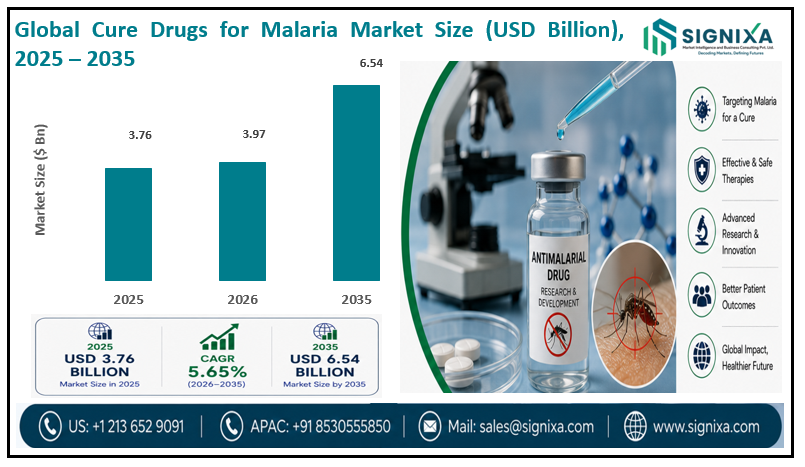
The global cure drugs for malaria market was valued at approximately USD 3.76 Billion in 2025 and is projected to grow to around USD 6.54 Billion by 2035, at a compound annual growth rate (CAGR) of about 5.65% between 2026 and 2035. This report evaluates the market dynamics, growth drivers, and restraining factors impacting demand, while identifying regional opportunities shaping the future of the cure drugs for malaria market.
The cure drugs for malaria market include a variety of antimalarial therapies used to treat the disease caused by Plasmodium parasites. The increasing prevalence of malaria in tropical regions, resurgence in drug-resistant strains, and expanding government and NGO medical campaigns are key factors propelling demand. Modern therapies especially Artemisinin-based Combination Therapies (ACTs) are being widely adopted due to their effectiveness, while distribution infrastructure is improving, enabling broader access to essential drugs in remote and underdeveloped regions. The market is primarily driven by the need for effective treatment regimens capable of addressing Plasmodium falciparum and Plasmodium vivax, the two most prevalent strains causing the disease.
Increasing resistance to first-line drugs has pushed pharmaceutical companies and research institutions to invest in the development of novel antimalarial agents. Public-private partnerships, supported by international organizations including the WHO and the Medicines for Malaria Venture (MMV), have played a critical role in expediting clinical trials and supporting drug distribution in low-resource settings. Pharmaceutical innovation is increasingly focused on long-acting therapies, pediatric formulations, and heat-stable drug profiles suitable for distribution in remote and high-temperature environments, alongside a major shift toward fixed-dose combinations that simplify adherence and enhance patient compliance.
Key Findings
- The global cure drugs for malaria market is expected to grow at a CAGR of 5.65% between 2026 and 2035, with market value rising from USD 3.76 Billion in 2025 to USD 6.54 Billion by 2035.
- Artemisinin-based Combination Therapies (ACTs) dominate the market, accounting for over 40% of global malaria drug revenues, owing to their superior efficacy against Plasmodium falciparum and WHO first-line recommendation status.
- The oral route remains the most widely used mode of administration, holding over 70% market share, due to ease of access and patient compliance.
- Government & NGO medical campaigns are expected to play a key role in increasing drug access, accounting for around 20% of end-user demand.
- Asia-Pacific and Sub-Saharan Africa are projected to remain dominant regional markets due to high malaria incidence and strong government and international health organization intervention.
Cure Drugs for Malaria Market Dynamics
Rising Malaria Burden & Growing Drug Resistance
The rise in malaria incidence, particularly in Sub-Saharan Africa and parts of South Asia, is significantly driving demand for effective antimalarial drugs. According to WHO, there were over 240 Million malaria cases globally in 2023. This burden fuels adoption of faster-acting therapies including ACTs, supported by government subsidies and international funding from organizations including the Global Fund and WHO. A major dynamic shaping the market is growing concern over resistance to frontline antimalarial therapies particularly in Southeast Asia and parts of Sub-Saharan Africa, where strains of Plasmodium falciparum have exhibited declining sensitivity to artemisinin and partner drugs. This resistance threatens to undermine global gains in malaria treatment, accelerating urgency for new, more potent drugs that work through different biochemical pathways, alongside intensifying investment in resistance monitoring systems and early-warning mechanisms to inform drug deployment decisions.
Technological Innovation & Public-Private Partnership Investment
Technological advancements in pharmaceutical R&D are acting as a major enabler for the malaria drug market, particularly in developing next-generation treatments. Researchers are increasingly focusing on new chemical entities (NCEs) capable of addressing multi-drug-resistant strains while also blocking transmission and preventing relapse functions current therapies cannot always perform effectively. Efforts to improve drug formulations, including long-acting injectables and pediatric-friendly tablets, are improving real-world compliance, while triple combination therapies aim to increase potency and reduce resistance development. Public-private partnerships involving global health organizations, pharmaceutical companies, and biotech firms including collaborations with the Medicines for Malaria Venture (MMV) have accelerated clinical trials and expanded access to promising compounds in low-income regions, shifting the landscape toward a more integrated innovation ecosystem.
Access, Affordability & Supply Chain Challenges
Ensuring widespread availability and affordability of malaria cure drugs remains a persistent market challenge. In many low- and middle-income countries, weak health infrastructure and fragmented supply chains impede timely delivery of essential medications poor road networks, lack of temperature-controlled storage, and inconsistent inventory management often result in drug stockouts or spoilage that undermine treatment programs in remote rural areas where malaria prevalence is highest. While ACTs are often subsidized or distributed through government channels, private market prices can still be a barrier for uninsured populations, and parallel importation and counterfeit drugs in informal markets further complicate access while posing serious patient safety risks. In response, organizations are advocating for localization of drug production, integration of real-time supply chain tracking systems, and new last-mile delivery models including drone distribution and community health worker networks to improve reach into underserved endemic areas.
Cure Drugs for Malaria Market Segmentation Analysis
By Drug Type Segment Analysis
Artemisinin-based Combination Therapies (ACTs)
ACTs dominate the market, accounting for over 40% of global malaria drug revenues in 2025. ACTs are recommended as first-line treatment by the WHO due to their rapid parasite clearance and low resistance development relative to monotherapies. Drugs including artemether-lumefantrine and artesunate-amodiaquine are widely used in endemic regions, distributed extensively through public health programs and NGO channels. The fixed-dose combination format simplifies treatment adherence and reduces the risk of incomplete treatment courses that contribute to resistance development, making ACTs the backbone of malaria treatment protocols across virtually all endemic countries globally.
Chloroquine
Chloroquine was once the primary malaria treatment but now holds a reduced share due to widespread resistance, especially against P. falciparum. However, it remains effective for P. vivax cases, particularly in Latin America and parts of Asia where resistance patterns differ from Sub-Saharan African strains. Its continued relevance in specific geographic and parasite-species contexts, combined with its low manufacturing cost and well-established safety profile, ensures chloroquine maintains a meaningful niche role within the broader antimalarial drug portfolio despite its diminished overall market position.
Quinine
Quinine remains a critical option for severe malaria and has maintained moderate market share, especially in hospital settings where intravenous administration for complicated cases is required. Though its usage is declining as IV artesunate gains preference for superior efficacy and fewer side effects, quinine remains vital in resource-limited scenarios or settings where ACTs and IV artesunate are unavailable, ensuring its continued if diminishing presence in the global antimalarial treatment armamentarium.
Primaquine
Primaquine is primarily used to target the dormant liver stage of P. vivax and P. ovale, preventing disease relapse that other antimalarials cannot address. It contributes to a niche but essential segment of the market, especially in Southeast Asia where P. vivax prevalence is significant and relapse prevention is a critical component of comprehensive malaria elimination strategies pursued by national health authorities.
Mefloquine
Mefloquine accounts for a smaller market share, used mostly for travelers and as an alternative to ACTs for prophylaxis. Its neuropsychiatric side effects have limited broader use in endemic populations, restricting its primary commercial relevance to the international travel medicine and military deployment prophylaxis markets in North America and Europe, where patient populations and use cases differ substantially from the curative treatment demand driving the rest of the global market.
By Route of Administration Segment Analysis
Oral
The oral route dominates with over 70% market share in 2025, owing to convenience, ease of mass administration, and cost-efficiency that make it the preferred format for large-scale public health distribution campaigns. Oral ACTs including Coartem are widely distributed through public health programs and NGOs, where the ability to self-administer treatment without requiring clinical infrastructure dramatically expands the population that can be reached, particularly in remote rural areas with limited healthcare facility access.
Intravenous & Intramuscular
Intravenous administration, although less common than oral, is critical in hospital settings for treating severe or complicated malaria cases. IV artesunate is preferred over IV quinine due to superior efficacy and fewer side effects, representing the current standard of care for severe malaria in well-resourced clinical settings. Intramuscular formulations are used when oral and IV options are impractical IM artesunate or artemether is beneficial in rural clinics lacking IV capabilities, and while this segment remains small in overall market share, it is vital for emergency response in settings where rapid treatment access can be lifesaving.
By Distribution Channel Segment Analysis
Hospital pharmacies accounted for the largest distribution channel share in 2025 at around 40%, due to the treatment of severe malaria cases requiring inpatient care and specialist clinical oversight. Retail pharmacies contribute around 30% of the market, catering primarily to urban populations and travelers seeking convenient access to oral antimalarials. Online pharmacies are a growing segment, especially in developed regions, supported by increasing digital penetration and the convenience of home delivery particularly relevant for prophylactic drugs purchased by international travelers ahead of trips to endemic regions.
By End User Segment Analysis
Hospitals
Hospitals held a dominant share of the end-user segment in 2025 due to the need for monitored administration of IV drugs and critical care for severe malaria cases requiring close clinical supervision, laboratory monitoring, and management of treatment complications. The role of hospitals as the primary point of care for the most clinically serious malaria presentations ensures continued strong demand for hospital-based antimalarial drug procurement throughout the forecast period, particularly in regions with high rates of severe disease presentation.
Clinics
Clinics, especially in rural and semi-urban areas, are key access points for malaria treatment, accounting for around 25% of the market and often serving as the first line of care for patients in endemic communities. The accessibility and lower cost structure of clinic-based care relative to hospital admission makes clinics the primary venue through which the majority of uncomplicated malaria cases are diagnosed and treated, particularly in countries with extensive primary healthcare network development.
Homecare
Homecare is gaining traction as oral medications allow for at-home treatment, especially under public distribution campaigns that provide pre-packaged ACT courses directly to community members. Patient awareness and education are critical to this segment's success, as effective homecare treatment depends on patients correctly understanding dosing schedules and recognizing warning signs that warrant escalation to clinical care, making community health education investment an important complement to homecare-based treatment distribution strategies.
Government & NGO Medical Campaigns
Government and NGO medical campaigns play a vital role, accounting for around 20% of the market. Global initiatives including "Roll Back Malaria," along with funding from the Global Fund and USAID, ensure mass drug distribution in vulnerable areas where commercial pharmaceutical distribution channels alone would not reach the populations most affected by malaria. This end-user category represents a structurally important and relatively stable demand driver, as international donor commitment to malaria elimination provides multi-year funding visibility that supports consistent drug procurement planning by participating pharmaceutical manufacturers.
Report Attributes & Market Scope
| Report Attribute | Details |
|---|---|
| Market Size Value in 2025 | USD 3.76 Billion |
| Market Size Value in 2035 | USD 6.54 Billion |
| CAGR (2026–2035) | 5.65% |
| Base Year Used for Estimation | 2025 |
| Historic Data | 2020 – 2025 |
| Forecast Period | 2026 – 2035 |
| Segments Covered – By Drug Type |
|
| Segments Covered – By Route of Administration |
|
| Segments Covered – By Distribution Channel |
|
| Segments Covered – By End User |
|
| Regions Covered | North America, Europe, Asia Pacific, Latin America, Middle East and Africa |
| Major Countries Covered | U.S., Canada, Mexico, Germany, UK, France, Italy, Spain, Russia, China, Japan, South Korea, India, Southeast Asia Countries, Brazil, Argentina, GCC Countries, Turkey, Iran, Israel, South Africa, Egypt, Nigeria, etc. |
| Key Companies Profiled | Novartis AG, Sanofi S.A., Cipla Ltd., Ipca Laboratories, Zydus Lifesciences, GlaxoSmithKline plc, Ajanta Pharma, Mylan N.V., Amneal Pharmaceuticals, and Pfizer Inc. |
Cure Drugs for Malaria Market Regional Analysis
The Asia-Pacific region leads the global market, with countries including India and Indonesia contributing significantly due to high disease prevalence and strong government intervention. Sub-Saharan Africa remains the most impacted region, making it a major market for antimalarial drugs, with significant support from international health organizations. Latin America and the Middle East & Africa are emerging markets with rising malaria incidence and increasing healthcare expenditure. North America and Europe represent smaller shares, primarily in prophylaxis for travelers and military personnel, but play a critical role in R&D and funding support.
Asia-Pacific (Leading Region)
Asia-Pacific leads the global cure drugs for malaria market, with countries including India and Indonesia contributing significantly due to high disease prevalence and strong government intervention through national malaria elimination programs. The region's combination of large at-risk populations, established generic pharmaceutical manufacturing capacity, and active government procurement programs for ACTs and other antimalarial therapies positions it as both a major consumption market and a significant production hub for affordable antimalarial drugs distributed both domestically and internationally to other endemic regions.
Sub-Saharan Africa
Sub-Saharan Africa remains the most impacted region globally by malaria, making it a major market for antimalarial drugs with significant support from international health organizations including the Global Fund, WHO, USAID, and the Bill & Melinda Gates Foundation. The region accounts for the overwhelming majority of global malaria cases and deaths, driving sustained high-volume demand for ACTs and other curative therapies distributed through national health systems, NGO-run treatment programs, and donor-funded mass distribution campaigns that remain central to the region's malaria control and elimination strategy.
Latin America & Middle East and Africa
Latin America and the Middle East & Africa are emerging markets with rising malaria incidence and increasing healthcare expenditure. Government programs and international partnerships are expanding access to effective treatment in these regions, with chloroquine maintaining particular relevance in parts of Latin America where P. vivax remains the dominant malaria-causing species and resistance patterns differ from those observed in Sub-Saharan Africa, requiring region-specific treatment protocols and drug procurement strategies.
North America & Europe
North America and Europe represent smaller shares of the global market, primarily centered on prophylaxis for international travelers and military personnel deployed to malaria-endemic regions, but play a critical role in research and development and funding support for global malaria elimination efforts. The presence of major pharmaceutical companies headquartered in these regions including Novartis, Sanofi, and GlaxoSmithKline concentrates significant antimalarial R&D investment and clinical trial activity in North America and Europe even though the bulk of commercial drug consumption occurs in endemic regions elsewhere.
Recent Developments in the Cure Drugs for Malaria Market
-
2025
Novartis AG reported advancements in the development of a next-generation antimalarial drug candidate aimed at tackling malaria strains that have developed resistance to existing treatments preliminary findings indicate encouraging effectiveness, and the company is preparing to begin clinical trials in regions heavily affected by malaria to further assess safety and therapeutic benefits.
-
2024
GlaxoSmithKline plc expanded efforts to improve the availability of malaria treatment and prevention products by boosting manufacturing output and widening global distribution networks initiatives aligned with international health programs working to reduce malaria incidence in high-burden regions of Africa and Asia.
-
2024
Pfizer Inc. progressed research partnerships focused on identifying new malaria drug candidates and combination therapies, aiming to address rising parasite resistance and enhance treatment effectiveness in regions where malaria remains highly prevalent.
-
2023
Sanofi increased its involvement in malaria control initiatives by expanding the supply of antimalarial medicines and strengthening collaborations with global health organizations, with the objective of improving treatment accessibility in endemic countries and supporting long-term malaria elimination strategies.
Cure Drugs for Malaria Market: Competitive Landscape
Major players in the market include Novartis AG, Sanofi S.A., Cipla Ltd., Ipca Laboratories, Zydus Lifesciences, GlaxoSmithKline plc, Ajanta Pharma, Mylan N.V., Amneal Pharmaceuticals, and Pfizer Inc. These companies are investing in ACT development, pediatric formulations, and partnerships with global health organizations to expand access. Competitive strategies include regulatory approvals, geographic expansion, cost-effective generics, and local manufacturing in endemic countries. As demand for effective malaria treatment continues to grow, innovation and strategic collaboration will remain key success factors in this highly impactful pharmaceutical sector.
The competitive landscape in the cure drugs for malaria market is distinctively shaped by its public health character unlike most pharmaceutical markets, demand and procurement decisions are heavily influenced by WHO treatment guidelines, national malaria control program protocols, and donor-funded bulk procurement mechanisms rather than purely commercial dynamics. Originator pharmaceutical companies including Novartis (developer of the original artemether-lumefantrine combination) compete alongside a substantial generic manufacturing base particularly Indian companies including Cipla, Ipca Laboratories, Zydus Lifesciences, and Ajanta Pharma that produce WHO-prequalified generic ACTs at price points accessible to public health procurement budgets in low-income endemic countries. Competitive differentiation increasingly centers on formulation innovation including pediatric-friendly dispersible tablets, heat-stable formulations suitable for tropical climate distribution without cold chain requirements, and participation in collaborative drug development partnerships with organizations including the Medicines for Malaria Venture that share development risk and cost across multiple stakeholders pursuing shared global health objectives.
Key Companies Profiled
- Novartis AG
- Sanofi S.A.
- Cipla Ltd.
- Ipca Laboratories
- Zydus Lifesciences
- GlaxoSmithKline plc
- Ajanta Pharma
- Mylan N.V.
- Amneal Pharmaceuticals
- Pfizer Inc.
- Sun Pharmaceutical Industries Ltd.
- Strides Pharma Science Limited
- Bayer AG
- Guilin Pharmaceutical Co., Ltd.
- Shin Poong Pharmaceutical Co., Ltd.
Global Cure Drugs for Malaria Market Segmentation Summary
By Drug Type
- Artemisinin-based Combination Therapies (ACTs)
- Chloroquine
- Quinine
- Primaquine
- Mefloquine
- Others
By Route of Administration
- Oral
- Intravenous
- Intramuscular
By Distribution Channel
- Hospital Pharmacies
- Retail Pharmacies
- Online Pharmacies
By End User
- Hospitals
- Clinics
- Homecare
- Government & NGO Medical Campaigns
By Region
- North America
- U.S.
- Canada
- Mexico
- Europe
- Germany
- France
- UK
- Spain
- Italy
- Rest of Europe
- Asia-Pacific
- China
- Japan
- India
- Australia
- South Korea
- Southeast Asia
- Rest of Asia-Pacific
- Latin America
- Brazil
- Argentina
- Rest of Latin America
- The Middle East & Africa
- GCC Countries
- South Africa
- Rest of the Middle East & Africa
Frequently Asked Questions (FAQs) About the Cure Drugs for Malaria Market
What are cure drugs for malaria?
Cure drugs for malaria are pharmaceutical formulations designed to eliminate malaria-causing Plasmodium parasites from the human body. These drugs include antimalarials such as artemisinin-based combination therapies (ACTs), chloroquine, quinine, and mefloquine, used depending on the Plasmodium species and drug resistance patterns.
Which key factors will influence the cure drugs for malaria market growth over 2026–2035?
The global market is expected to grow due to the rising malaria burden in tropical regions, increasing support from international health organizations like WHO and Global Fund, growing resistance to traditional drugs, and advancements in next-generation antimalarial formulations.
What will be the value of the cure drugs for malaria market during 2026–2035?
According to the study, the global cure drugs for malaria market was valued at around USD 3.76 Billion in 2025 and is projected to reach approximately USD 6.54 Billion by 2035, reflecting steady investment in public health infrastructure and pharmaceutical innovation.
What will be the CAGR value of the cure drugs for malaria market during 2026–2035?
The compound annual growth rate (CAGR) of the cure drugs for malaria market is anticipated to be around 5.65% from 2026 to 2035, driven by increasing global health spending and initiatives aimed at malaria eradication.
Which region will contribute notably towards the cure drugs for malaria market value?
The market is expected to witness strong growth in Africa and Asia-Pacific, where malaria is most prevalent. Governments and global NGOs are focusing their efforts in these regions to improve access to effective treatments and reduce malaria-related mortality.
Which are the major players leveraging the cure drugs for malaria market growth?
The cure drugs for malaria market is led by key players such as Novartis AG, Sanofi S.A., Cipla Ltd., Ipca Laboratories, Zydus Lifesciences, GlaxoSmithKline plc, Ajanta Pharma, Mylan N.V., Amneal Pharmaceuticals, and Pfizer Inc.
What can be expected from the global cure drugs for malaria market report?
The report provides comprehensive insights into the cure drugs for malaria market, including key growth drivers and barriers, emerging therapeutic trends, regulatory frameworks, competitive landscape analysis, and future opportunities across various regions and drug categories.