
Sleep Apnea Devices Market Overview
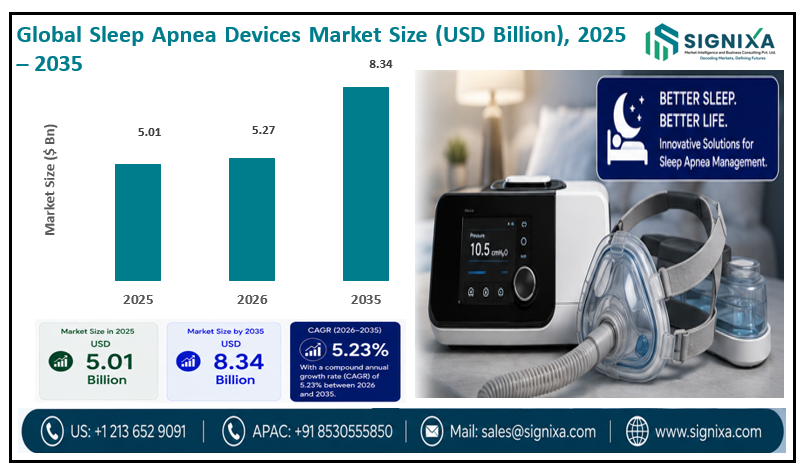
The size of the global sleep apnea devices market was valued at approximately USD 5.01 Billion in 2025 and is projected to reach around USD 8.34 Billion by 2035, growing at a compound annual growth rate (CAGR) of 5.23% between 2026 and 2035. This report examines the key growth drivers and restraints, the impact of technological innovation, and the regional and segment-specific growth opportunities across the sleep apnea devices market.
The sleep apnea devices market includes diagnostic and therapeutic technologies aimed at managing sleep-disordered breathing, especially obstructive sleep apnea (OSA). Rising awareness of sleep-related health risks, increasing obesity rates, and a growing elderly population contribute to rising diagnosis rates and device adoption. The market encompasses a wide array of solutions, from diagnostic tools like polysomnography (PSG) and home sleep apnea testing (HSAT) devices to therapeutic interventions such as Continuous Positive Airway Pressure (CPAP) machines, oral appliances, and even surgical procedures or implantable devices.
A key dynamic in the sleep apnea market is the shift towards earlier and more accessible diagnosis. Historically, diagnosing sleep apnea required an overnight stay in a sleep laboratory for polysomnography, which can be expensive, inconvenient, and have long waiting lists. However, technological advancements have led to the widespread adoption of home sleep apnea testing (HSAT) devices, allowing individuals to conduct sleep studies in the comfort of their own homes, significantly increasing accessibility, reducing costs, and shortening wait times crucial for addressing the vast number of undiagnosed cases estimated to be as high as 80–90% in some regions. The integration of wearable technology such as smartwatches and fitness trackers with sleep monitoring capabilities is also playing a growing role in initial screening and raising awareness.
Key Findings
- The global sleep apnea devices market is projected to grow at a CAGR of 5.23% between 2026 and 2035.
- In 2025, the market was valued at USD 5.01 Billion and is forecast to reach USD 8.34 Billion by 2035.
- Based on Product Type, Therapeutic Devices dominate the market, driven by the demand for CPAP and BiPAP machines.
- Based on End Use, Home Care is gaining traction due to the shift toward at-home management of sleep apnea.
- North America leads the market in terms of share, followed by Europe and Asia-Pacific.
Sleep Apnea Devices Market Dynamics
Rising Awareness of Cardiovascular & Metabolic Health Risks Driving Sleep Apnea Diagnosis & Therapeutic Device Demand
Growing awareness about the dangers of untreated sleep apnea including risks of hypertension, stroke, cardiovascular disease, diabetes, and impaired cognitive function is a major driver for this market. Public health campaigns, insurance coverage expansions, and workplace wellness programs are increasing the number of individuals seeking sleep disorder evaluations, driving demand for both diagnostic and therapeutic devices. This heightened awareness leads to more individuals seeking diagnosis and treatment. Furthermore, the rising global incidence of key risk factors, particularly the escalating rates of obesity and the aging population, directly contributes to the rising prevalence of sleep apnea. As more people are identified with the condition, the demand for diagnostic tools and therapeutic devices naturally increases, continuously expanding the patient pool and fueling the market's progression from a niche area to a mainstream concern through the forecast period.
CPAP Innovation: Quieter, Smarter & More Comfortable Machines with Cloud Integration Improving Patient Compliance
Technological innovation is reshaping the sleep apnea devices market. Modern CPAP machines now come with noise reduction, real-time monitoring, cloud integration, and compact design, improving patient compliance. The market has seen significant advancements in CPAP technology, focusing on improving patient comfort and compliance including the development of smaller, quieter, and more aesthetically pleasing machines, as well as a wider variety of mask designs (nasal pillows, nasal masks, full-face masks, hybrid masks) to enhance fit and reduce discomfort. Beyond CPAP, the market is also seeing the rise of auto-CPAP (APAP) machines, which automatically adjust pressure settings based on real-time breathing patterns, and bi-level positive airway pressure (BiPAP) devices, which provide different pressures for inhalation and exhalation, catering to patients with specific needs. Furthermore, alternative therapies like custom-made oral appliances and innovative implantable devices such as hypoglossal nerve stimulation systems offer alternatives for patients who cannot tolerate traditional PAP therapy, broadening the treatment landscape through the forecast period.
Telemedicine & Remote PAP Monitoring Addressing Compliance Challenges & Expanding Access to Sleep Apnea Care
The sleep apnea market is significantly impacted by patient compliance challenges and the growing role of telemedicine and remote monitoring. Despite the high efficacy of CPAP therapy, patient adherence remains a persistent issue, with many discontinuing use due to discomfort, inconvenience, or perceived lack of immediate benefit. This has spurred innovations not only in device design but also in digital health solutions aimed at improving compliance. Telemedicine is playing an increasingly vital role in sleep apnea management, from initial teleconsultations and remote diagnosis using HSAT data to remote monitoring of PAP therapy adherence and performance. Integrated digital platforms allow healthcare providers to track patient usage data, identify issues, and provide timely interventions, adjustments, and coaching without the need for in-person visits. This remote oversight enhances patient engagement, improves adherence rates, and ultimately leads to better long-term outcomes through the forecast period.
Sleep Apnea Devices Market: Segmentation Analysis
By Product Type Segment Analysis
Therapeutic Devices
Therapeutic devices dominate the market with more than 75% share in 2025. This includes CPAP, BiPAP, APAP machines, and oral appliances. CPAP remains the gold standard, accounting for over 60% of the therapeutic segment's revenue, supported by clinical guidelines and insurance reimbursements. With an increasing elderly population and obesity rates both major risk factors this segment is projected to maintain strong growth. The therapeutic devices category has seen significant innovation focused on improving patient comfort, compliance, and overall efficacy. Auto-CPAP (APAP) machines, which automatically adjust pressure settings based on real-time breathing patterns, and BiPAP devices offering different pressures for inhalation and exhalation provide more personalized and tolerable treatment options for patients who cannot tolerate standard fixed-pressure CPAP therapy. Beyond PAP therapy, the increasing acceptance and development of alternative treatments like custom-made oral appliances (mandibular advancement devices, MADs) and emerging implantable devices such as hypoglossal nerve stimulation (HNS) systems are broadening the treatment landscape and improving overall patient adherence through the forecast period.
Diagnostic Devices
By Product Type, the diagnostic segment includes polysomnography (PSG) systems and home sleep testing (HST) devices. In 2025, this segment accounted for approximately 20% of the total market revenue. Growing preference for home-based sleep testing which costs 60–80% less than in-lab studies is fueling demand. According to the American Academy of Sleep Medicine, over 1.5 Million HSTs were conducted in 2023, a number expected to rise with telehealth integration and remote monitoring adoption. The polysomnography segment remains relevant for complex diagnostic cases, including central sleep apnea evaluation, pediatric sleep disorders, and cases requiring comprehensive physiological monitoring beyond respiratory parameters. However, the rising clinical acceptance of HSAT for straightforward OSA diagnosis in appropriately selected patients, combined with ongoing improvements in HSAT device accuracy and data analysis algorithms, is progressively shifting diagnostic volume toward home-based testing. The integration of digital health solutions including mobile apps and wearable technology with basic sleep monitoring capabilities also plays a role in initial screening and raising patient awareness, complementing formal diagnostic pathways through the forecast period.
By End Use Segment Analysis
Hospitals and Sleep Labs
Hospitals and sleep labs currently hold about 55% of the market share, primarily for complex diagnostic studies and titration of therapy. However, the segment is growing slowly due to the shift toward decentralized care. Large hospitals are now investing in mobile and wearable diagnostics to remain competitive in the evolving landscape. The hospital and sleep lab setting remains essential for managing complex cases of sleep-disordered breathing that require the comprehensive monitoring capabilities of attended polysomnography, including split-night studies, PAP titration procedures, and evaluation of non-respiratory sleep disorders. The growing subspecialty of sleep medicine and the establishment of dedicated sleep centers within major hospital systems is creating a sustained institutional market for high-end polysomnography systems, central monitoring software, and associated diagnostic equipment. Academic medical centers and teaching hospitals also drive demand for advanced diagnostic systems that support sleep medicine research and clinical training programs through the forecast period.
Home Care
The home care segment is witnessing strong momentum, expected to grow at a CAGR of 6.8% through 2035. Increased adoption of portable CPAP machines and smartphone-connected diagnostic devices are making home-based treatment viable and effective. According to a 2023 ResMed survey, over 70% of users preferred home-based CPAP therapy due to convenience, privacy, and reduced costs, reinforcing the segment's future growth trajectory. The proliferation of travel-sized and portable CPAP devices many now equipped with integrated humidification, cellular connectivity, and rechargeable battery options is enabling patients to maintain therapy compliance while traveling, eliminating a historically common therapy interruption scenario. The growing direct-to-consumer sales model for CPAP supplies including masks, filters, and replacement components is expanding the home care ecosystem and creating recurring revenue streams for device manufacturers. The emphasis on user-friendly interfaces, data connectivity through companion apps, and personalized support delivered through digital channels is a crucial dynamic in addressing compliance issues and expanding access to care through the forecast period.
Report Attributes & Market Scope
| Report Attribute | Details |
|---|---|
| Market Size Value in 2024 | USD 5.01 Billion |
| Market Size Value in 2035 | USD 8.34 Billion |
| CAGR (2026–2035) | 5.23% |
| Base Year Used for Estimation | 2025 |
| Historic Data | 2020 - 2025 |
| Forecast Period | 2026 - 2035 |
| Segments Covered – By Product Type |
|
| Segments Covered – By End Use |
|
| Regions Covered | North America, Europe, Asia Pacific, Latin America, Middle East and Africa |
| Major Countries Covered | U.S., Canada, Mexico, Germany, UK, France, Italy, Spain, Russia, China, Japan, South Korea, India, Southeast Asia Countries, Brazil, Argentina, GCC Countries, Turkey, Iran, Israel, South Africa, Egypt, Nigeria, etc. |
| Key Companies Profiled | ResMed Inc., Koninklijke Philips N.V., Fisher & Paykel Healthcare, SomnoMed, Compumedics Limited, Natus Medical Inc., Itamar Medical, Invacare Corporation, BMC Medical, and Löwenstein Medical, among others. |
Sleep Apnea Devices Market Regional Analysis
North America leads the global sleep apnea devices market, accounting for over 40% share in 2025, owing to high awareness, insurance support, and widespread access to diagnostic infrastructure. Europe follows closely, driven by government-funded screening programs and advanced healthcare systems. Asia-Pacific is the fastest-growing market due to rising healthcare investments, increasing diagnosis rates, and a growing population of undiagnosed patients. Latin America and the Middle East & Africa are emerging markets with untapped potential.
North America (Dominant Region)
North America holds a dominant position in the global sleep apnea market, driven by a high prevalence of the disorder, advanced healthcare infrastructure, and strong awareness campaigns. The United States, in particular, accounts for a significant share, with estimates suggesting tens of millions of Americans are affected. The market here benefits from widespread adoption of both in-lab polysomnography (PSG) and, increasingly, convenient home sleep apnea testing (HSAT) devices, making diagnosis more accessible. There's also a high acceptance of CPAP therapy, the gold standard for treatment, supported by robust reimbursement policies from public and private insurers. Technological innovation is a key driver, with manufacturers continually introducing smaller, quieter, and more comfortable CPAP machines, along with a diverse range of masks and accessories. Furthermore, the region is a hotbed for the development and adoption of alternative therapies, including oral appliances and emerging implantable devices, catering to a broader spectrum of patient needs through the forecast period.
Europe
Europe represents a mature and significant market for sleep apnea devices and diagnostics, characterized by well-established healthcare systems and a growing emphasis on public health initiatives. The increasing prevalence of sleep apnea, particularly linked to rising obesity rates and an aging population across the continent, is a primary driver. Countries like Germany, France, and the UK are key contributors to market growth, demonstrating high rates of diagnosis and a strong uptake of therapeutic devices. Europe has also seen substantial investment in technological advancements, with a focus on improving patient comfort and compliance with CPAP therapy. The region is increasingly adopting home sleep apnea testing to streamline diagnostic pathways and reduce the burden on sleep clinics. Furthermore, strong regulatory frameworks and reimbursement policies in many European countries provide a stable environment for market expansion, encouraging both domestic and international players to innovate and broaden their offerings through the forecast period.
Asia-Pacific
The Asia Pacific region is rapidly emerging as a high-growth market for sleep apnea solutions, propelled by its enormous population base, increasing urbanization, and a growing middle class with rising disposable incomes. The prevalence of sleep apnea is on the rise, largely attributed to changing lifestyles, dietary habits leading to higher obesity rates, and the demographic shift towards an aging population. While awareness levels have historically been lower compared to Western countries, there's a concerted effort from healthcare providers and industry players to educate the public and improve diagnostic rates. The adoption of home sleep apnea testing is a critical trend in this region, offering a more scalable and cost-effective approach to diagnosing a vast, previously undiagnosed patient pool. As healthcare infrastructure continues to develop and access to advanced medical technologies improves, the demand for both diagnostic and therapeutic devices, including CPAP machines and oral appliances, is set to surge through the forecast period.
Latin America
Latin America is an emerging market for sleep apnea devices, with urbanization, rising obesity rates, and a growing awareness of sleep-related health risks driving demand across the region. Brazil and Mexico are the largest markets within the region, where a combination of improving healthcare access and a rapidly expanding middle class is increasing awareness of sleep disorders and the availability of treatment options. The gradual expansion of health insurance coverage to include sleep disorder diagnostics and CPAP therapy in some Latin American countries is beginning to address the affordability barriers that have historically limited market growth. The region's large undiagnosed patient population estimated to represent a substantial proportion of the adult population represents a significant long-term market expansion opportunity as diagnostic capacity and patient awareness continue to improve through the forecast period.
Middle East & Africa
The Middle East and Africa (MEA) region presents a nascent but developing market for sleep apnea products, characterized by significant disparities in healthcare infrastructure and awareness levels across its diverse nations. In the GCC states, rising obesity rates and a growing awareness of associated health risks are driving increasing demand for sleep apnea diagnosis and treatment. Investments in modernizing healthcare facilities and a burgeoning expatriate population also contribute to market expansion. However, cultural sensitivities regarding sleep disorders and limited access to specialized sleep clinics in some areas can pose challenges to widespread adoption. In Africa, the market is still in its early stages, primarily driven by increasing urbanization and the slow but steady improvement in healthcare access. The high cost of advanced diagnostic and therapeutic devices remains a barrier in many parts of the continent, and there's a strong need for more affordable and accessible solutions, including basic screening tools and portable devices through the forecast period.
Recent Developments in the Sleep Apnea Devices Market
-
2026
ResMed: Expanded its sleep therapy portfolio with next-generation AI-enabled CPAP devices featuring enhanced remote patient monitoring, personalized therapy adjustments, and improved cloud connectivity to optimize treatment outcomes for obstructive sleep apnea patients.
Koninklijke Philips N.V.: Strengthened its sleep and respiratory care business by introducing advanced sleep apnea therapy solutions with improved patient comfort, digital health integration, and enhanced compliance tracking for home-based care.
Fisher & Paykel Healthcare: Expanded its sleep apnea device portfolio with innovative CPAP masks and humidification technologies designed to improve patient comfort, therapy adherence, and long-term treatment effectiveness.
Inspire Medical Systems: Enhanced its implantable hypoglossal nerve stimulation technology by expanding clinical indications and improving digital patient management capabilities for obstructive sleep apnea treatment.
-
2025
SomnoMed: Expanded its oral appliance therapy portfolio with customized digital sleep apnea solutions and advanced mandibular advancement devices to support patients intolerant to CPAP therapy.
React Health: Strengthened its sleep therapy product portfolio by introducing upgraded CPAP and BiPAP devices with cloud-based connectivity, remote compliance monitoring, and enhanced patient support features for home healthcare providers.
Sleep Apnea Devices Market: Competitive Landscape
Major players in the global sleep apnea devices market include ResMed Inc., Koninklijke Philips N.V., Fisher & Paykel Healthcare, SomnoMed, Compumedics Limited, Natus Medical Inc., Itamar Medical, Invacare Corporation, BMC Medical, and Löwenstein Medical. These companies compete based on product innovation, comfort, therapy compliance, and global distribution. Players are increasingly investing in smart features, wearables, and cloud-based data analytics to personalize sleep therapy and improve outcomes. Strategic partnerships and acquisitions are also shaping the competitive landscape to address the evolving needs of patients and healthcare providers.
Key Companies Profiled
- ResMed Inc.
- Koninklijke Philips N.V.
- Fisher & Paykel Healthcare
- SomnoMed
- Löwenstein Medical
- Compumedics Limited
- Natus Medical Inc.
- Itamar Medical
- BMC Medical
- Invacare Corporation
- Inspire Medical Systems, Inc.
- Drive DeVilbiss Healthcare
- React Health
- Apex Medical Corp.
- Curative Medical Inc.
Global Sleep Apnea Devices Market Segmentation Summary
By Product Type
- Diagnostic Devices
- Therapeutic Devices
By End Use
- Hospitals and Sleep Labs
- Home Care
By Region
- North America
- U.S.
- Canada
- Mexico
- Europe
- Germany
- France
- UK
- Spain
- Italy
- Rest of Europe
- Asia-Pacific
- China
- Japan
- India
- Australia
- South Korea
- Southeast Asia
- Rest of Asia-Pacific
- Latin America
- Brazil
- Argentina
- Rest of Latin America
- The Middle East & Africa
- GCC Countries
- South Africa
- Rest of the Middle East & Africa
Frequently Asked Questions (FAQs) About the Sleep Apnea Devices Market
What are sleep apnea devices?
Sleep apnea devices are medical tools designed to treat and manage sleep apnea — a sleep disorder characterized by repeated pauses in breathing during sleep. These devices include CPAP machines, BiPAP machines, adaptive servo-ventilation systems, oral appliances, and accessories like masks and humidifiers.
Which key factors will influence the sleep apnea devices market growth over 2026–2035?
The market is expected to grow due to the increasing prevalence of obstructive sleep apnea, growing awareness about sleep-related disorders, rising elderly population, and advancements in device technology improving comfort and compliance.
What will be the value of the sleep apnea devices market during 2026–2035?
According to the study, the global sleep apnea devices market size was worth around USD 5.01 Billion in 2025 and is projected to grow to approximately USD 8.34 Billion by 2035.
What will be the CAGR value of the sleep apnea devices market during 2026–2035?
The CAGR value of the sleep apnea devices market is expected to be around 5.23% during the forecast period from 2026 to 2035, driven by the rising prevalence of obstructive sleep apnea, increasing awareness of sleep-related disorders, growing adoption of home-based sleep diagnostic and therapy devices, technological advancements in CPAP, BiPAP, and wearable sleep monitoring systems, expanding geriatric and obese populations, and improving access to sleep healthcare services worldwide.
Which region will contribute notably towards the sleep apnea devices market value?
North America is projected to lead the sleep apnea devices market, driven by higher diagnosis rates, robust healthcare infrastructure, insurance coverage, and strong presence of leading manufacturers.
Which are the major players leveraging the sleep apnea devices market growth?
Key players in the global sleep apnea devices market include ResMed Inc., Koninklijke Philips N.V., Fisher & Paykel Healthcare, SomnoMed, Löwenstein Medical Technology, BMC Medical Co., Ltd., Compumedics Limited, Apex Medical Corp., Itamar Medical Ltd., and Braebon Medical Corporation.
What can be expected from the global sleep apnea devices market report?
The report covers vital elements of the sleep apnea devices market, including detailed analysis of current growth trends, restraining factors, and future opportunities. It also examines regional dynamics, competitive landscape, and key product innovations influencing the market's development.