

EV Battery Enclosure Systems Market Overview
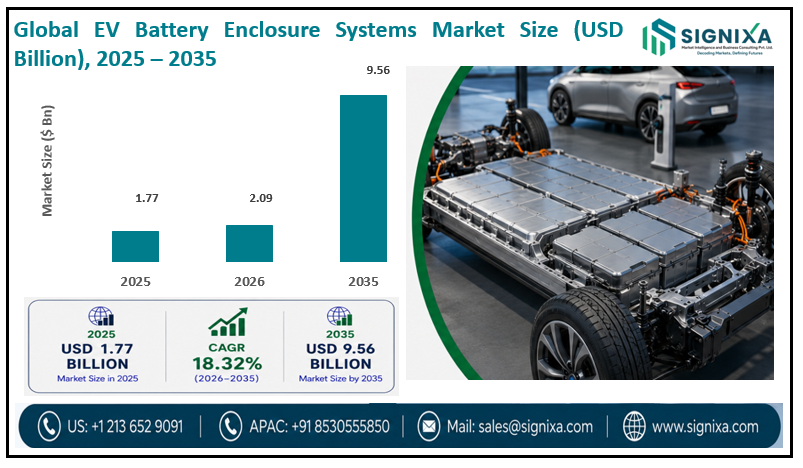
The size of the global EV Battery Enclosure Systems market was worth around USD 1.77 Billion in 2025 and is predicted to grow to around USD 9.56 Billion by 2035, with a compound annual growth rate (CAGR) of roughly 18.32% between 2026 and 2035. The report analyzes the EV Battery Enclosure Systems market's drivers and restraints, as well as their impact on demand throughout the forecast period. In addition, the report examines global opportunities across key regions.
The EV battery enclosure systems market includes protective housings designed to safeguard battery packs in electric vehicles from mechanical damage, thermal stress, and environmental exposure. Increasing production of electric vehicles, evolving battery technologies, and stringent safety regulations drive the demand for lightweight, durable, and thermally efficient enclosure solutions. Automakers are moving toward materials and designs that enhance safety while maintaining vehicle efficiency, boosting innovations across the industry.
The EV battery enclosure system market is a critical and rapidly expanding segment within the electric vehicle industry, serving as the essential protective housing for the sophisticated battery packs that power EVs. These enclosure systems are far more than just simple boxes; they are highly engineered components designed to provide structural integrity, protect against external impacts (crashes, road debris), manage thermal conditions (both heating and cooling), and prevent the ingress of water and dust. The market's robust growth is directly proportional to the accelerating global adoption of electric vehicles, fueled by increasingly stringent emission regulations, rising fuel prices, and growing consumer environmental awareness. As more automakers pivot towards electrification, the demand for innovative, high-performance, and cost-effective battery enclosures escalates, making this market a key enabler for the broader EV revolution.
A primary dynamic shaping the EV battery enclosure system market is the relentless drive towards lightweighting and advanced material utilization. Given that the battery pack is typically the heaviest component in an EV, significantly impacting vehicle range and efficiency, manufacturers are under immense pressure to reduce the weight of the enclosure without compromising safety. This has led to a major shift from traditional steel enclosures to lighter alternatives like aluminum alloys and advanced composite materials (e.g., carbon fiber and glass fiber composites). Each material offers a unique balance of strength, weight, thermal properties, and cost. While metals like aluminum are favored for their strength-to-weight ratio and recyclability, composites are gaining traction due to their even lighter weight and ability to be molded into complex geometries, offering greater design flexibility. The market is witnessing a trend towards multi-material designs, combining the best properties of metals and composites to achieve optimal performance, safety, and cost efficiency.
The market is also profoundly influenced by the evolving demands for enhanced safety, thermal management, and modularity in battery pack design. Battery thermal runaway, although rare, is a critical safety concern in EVs, making the enclosure's ability to contain and manage such events paramount. Manufacturers are integrating advanced fire suppression systems, improved thermal insulation, and efficient cooling channels (often liquid-cooled) directly into the enclosure design to maintain optimal battery operating temperatures and prevent thermal runaway propagation. Furthermore, as battery cell chemistries and form factors (pouch, cylindrical, prismatic) continue to evolve, there is a growing demand for modular and adaptable enclosure designs. Modular battery enclosures allow for greater flexibility in accommodating different battery sizes and configurations across various EV models, simplifying manufacturing processes and potentially reducing costs. The increasing focus on the recyclability and sustainability of battery enclosure materials at the end of the vehicle's life cycle is also becoming a significant factor, aligning with the broader circular economy principles in the automotive industry.
Key Findings
- As per analysis shared by our research analyst, the global EV Battery Enclosure Systems market is estimated to grow annually at a CAGR of 18.32% over the forecast period (2026–2035).
- In terms of revenue, the global EV Battery Enclosure Systems market size was valued at USD 1.77 Billion in 2025 and is projected to reach USD 9.56 Billion by 2035.
- The market is expected to grow at a substantial rate due to rising EV production volumes and stricter vehicle safety standards.
- Based on Material Type, Aluminum is growing at a high rate and will continue to dominate the global market as per industry projections.
- On the basis of Vehicle Type, the Passenger Vehicles segment is anticipated to command the largest market share, and based on Battery Type, the Lithium-ion segment is expected to dominate due to its widespread adoption in EVs.
- In terms of Application, the OEMs segment will account for the largest market share, and by Region, Asia-Pacific is projected to dominate the global market during the forecast period.
EV Battery Enclosure Systems Market Dynamics
Exponential Growth in Global EV Sales
One of the major drivers of the EV battery enclosure systems market is the exponential growth in global electric vehicle sales. According to the International Energy Agency (IEA), electric car sales exceeded 10 Million units in 2023, and this figure is expected to grow further. The rise in EV adoption creates direct demand for advanced, reliable enclosure systems that ensure battery safety, structural integrity, and thermal management, which are critical for vehicle performance and compliance with evolving safety standards.
Growing Emphasis on Lightweighting Initiatives
Growing emphasis on lightweighting initiatives in the automotive sector is another crucial factor boosting the EV battery enclosure systems market. Reducing vehicle weight is essential for enhancing energy efficiency and extending driving range. This is pushing manufacturers to invest in advanced materials such as composites and aluminum for battery enclosures. Lightweight materials help balance the heavy mass of EV batteries without compromising crash safety, making them a strategic focus for automotive OEMs worldwide.
Technological Advancements Reshape Enclosure Design
Technological advancements are significantly reshaping the EV battery enclosure design landscape. Innovations like multi-material construction (combining steel and composites), integrated cooling channels, and enhanced thermal protection features are enabling higher battery energy density and longer life spans. These advancements not only meet safety and efficiency requirements but also reduce production costs, making advanced enclosures more accessible across mass-market and premium EV segments, thus fueling market expansion.
Accelerating Global EV Adoption
The EV battery enclosure systems market is experiencing robust growth driven by the accelerating global adoption of electric vehicles (EVs). This fundamental dynamic is a direct consequence of escalating environmental concerns; stringent government regulations aimed at reducing carbon emissions and rising fuel prices that make EVs an increasingly attractive alternative to internal combustion engine (ICE) vehicles. As EV production scales up rapidly across all vehicle segments from passenger cars and light commercial vehicles to heavy-duty trucks the demand for sophisticated battery enclosure systems rises in tandem. These enclosures are vital for protecting the high-voltage battery packs from external impacts (e.g., crashes, road debris), managing thermal conditions, and preventing moisture ingress. The sheer volume of EVs entering the market, combined with ongoing advancements in battery technology (such as higher energy density and new cell chemistries), necessitates continuous innovation in enclosure design and manufacturing to accommodate diverse battery configurations and ensure optimal performance and safety.
Lightweighting and Enhanced Safety Features in Design
A second critical market dynamic revolves around the relentless pursuit of lightweighting and enhanced safety features in battery enclosure design. Given that the battery pack is the heaviest component in an EV, its weight significantly impacts the vehicle's overall range, efficiency, and driving dynamics. This has led to an intense focus on utilizing advanced materials such as aluminum alloys, high-strength steels, and lightweight composites (e.g., carbon fiber and glass fiber composites). Each material offers a unique balance of properties, and manufacturers are increasingly adopting multi-material solutions to optimize for weight, strength, thermal management, and cost. Beyond weight reduction, safety is paramount. The risk of thermal runaway in battery packs, while rare, necessitates enclosure designs that can contain and mitigate such events. This drives the integration of advanced thermal management systems (like liquid cooling channels), fire suppression mechanisms, and robust impact-resistant structures directly into the enclosure. The continuous evolution of safety standards and crashworthiness requirements by regulatory bodies further compels manufacturers to innovate in these areas.
Demand for Modularity, Scalability & Cost-Efficiency
The EV battery enclosure systems market is significantly influenced by the demand for modularity, scalability, and cost-efficiency. As automakers develop a wider range of EV models across different platforms, there is a growing need for battery enclosure designs that can be easily adapted to accommodate various battery cell formats (cylindrical, pouch, prismatic) and pack sizes. Modular enclosure systems allow for greater flexibility in vehicle design and assembly, streamlining manufacturing processes and potentially reducing production costs. Furthermore, as EV adoption moves towards the mainstream, reducing the overall cost of the battery system, including the enclosure, becomes crucial for making EVs more affordable and competitive with ICE vehicles. This drives innovation in manufacturing processes, material selection, and supply chain optimization to achieve economies of scale. The increasing focus on the sustainability and recyclability of enclosure materials at the end of the vehicle's life cycle is also an emerging dynamic, aligning with broader circular economy principles and pushing for more environmentally friendly manufacturing processes and material choices.
EV Battery Enclosure Systems Market Segmentation Analysis
By Material Type Segment Analysis
Aluminum dominates the material segment and accounted for more than 40% of the market share in 2025 due to its lightweight properties and high strength-to-weight ratio. Aluminum enclosures help improve EV range and offer excellent thermal conductivity for efficient heat management. Steel remains a strong choice in budget models, valued for its cost-effectiveness and crash resistance, holding about 30% of the market share. Composite materials, though currently at around 20% share, are gaining momentum due to their superior strength, corrosion resistance, and lighter weight compared to metals.
By Vehicle Type Segment Analysis
The Passenger Vehicles hold the largest share of the EV battery enclosure systems market, comprising over 65% of the total market in 2025. The rising adoption of EVs among individual consumers and government support for zero-emission mobility is driving this growth. Commercial Vehicles, including electric buses and trucks, accounted for around 25% of the market, propelled by the electrification of public transportation fleets. The others category, including two-wheelers and off-road EVs, contributes about 10% but is anticipated to grow steadily with increasing electrification trends in last-mile logistics.
By Battery Type Segment Analysis
The Lithium-ion battery segment dominates and accounts for over 80% of the market share in 2025, driven by its superior energy density, longer cycle life, and falling costs. Nickel-Metal Hydride (NiMH) batteries, once prominent in hybrid vehicles, now represent less than 10% of the enclosure market due to lower energy efficiency. Solid-State batteries, although nascent, are gaining interest with about 5% market share and are expected to witness rapid growth post-2028 as production scales up and technology matures.
By Application Segment Analysis
The OEMs (Original Equipment Manufacturers) segment held approximately 85% of the market share in 2025, as automakers integrate custom-designed battery enclosures during the vehicle production process. The Aftermarket segment, accounting for around 15%, is emerging slowly, mainly catering to battery replacements, performance upgrades, and retrofitting needs. As EV fleets age and battery replacement becomes more common, the aftermarket for enclosures is anticipated to witness moderate but steady growth through 2035.
Report Attributes & Market Scope
| Report Attribute | Details |
|---|---|
| Market Size Value in 2025 | USD 1.77 Billion |
| Market Size Value in 2035 | USD 9.56 Billion |
| CAGR (2026–2035) | 18.32% |
| Base Year Used for Estimation | 2025 |
| Historic Data | 2020 - 2025 |
| Forecast Period | 2026 - 2035 |
| Segments Covered – By Material Type |
|
| Segments Covered – By Vehicle Type |
|
| Segments Covered – By Battery Type |
|
| Segments Covered – By Application |
|
| Regions Covered | North America, Europe, Asia Pacific, Latin America, Middle East and Africa |
| Major Countries Covered | U.S., Canada, Mexico, Germany, UK, France, Italy, Spain, Russia, China, Japan, South Korea, India, Southeast Asia Countries, Brazil, Argentina, GCC Countries, Turkey, Iran, Israel, South Africa, Egypt, Nigeria, etc. |
| Key Companies Profiled | Novelis Inc., Gestamp, Magna International Inc., Constellium SE, Hexcel Corporation, SGL Carbon, Hanwha Advanced Materials, Nemak, Minth Group, and UACJ Corporation. |
EV Battery Enclosure Systems Market Regional Analysis
Asia-Pacific led the global EV battery enclosure systems market with more than 50% share in 2025, fueled by the rapid expansion of EV manufacturing hubs in China, South Korea, and Japan. Europe held the second-largest share at around 25%, driven by stringent emissions regulations and EV incentives. North America followed closely, accounting for nearly 20% of the market, supported by the U.S. government's push for EV infrastructure and domestic EV production. Latin America, the Middle East, and Africa are emerging regions, with gradual adoption expected as EV penetration increases over the forecast period.
Asia-Pacific (Dominant Region)
The Asia Pacific region currently dominates the global EV battery enclosure system market, primarily due to China's colossal EV production and adoption rates. China, as the world's largest EV market, drives immense demand for battery enclosures across all vehicle segments. This region is characterized by high-volume manufacturing, intense competition, and a strong focus on cost-efficiency alongside performance. While aluminum and steel remain widely used, there's a growing trend towards incorporating composite materials for lightweighting to enhance vehicle range and efficiency. Beyond China, countries like Japan, South Korea, and India are rapidly increasing their EV manufacturing capabilities and expanding charging infrastructure, contributing significantly to market growth. Japanese and South Korean manufacturers are known for their technological prowess, focusing on integrating advanced thermal management solutions and robust safety features within their enclosure designs. The diverse climate conditions across Asia Pacific also necessitate versatile enclosure solutions capable of performing reliably in extreme temperatures, further fueling innovation in thermal management and material science.
Europe
Europe's EV battery enclosure system market is mature and innovative, driven by the region's ambitious climate goals, stringent emission regulations, and a rapidly expanding EV market. European automakers are at the forefront of developing advanced EV platforms, often integrating battery enclosures as structural components of the vehicle chassis, which places high demands on material science and manufacturing precision. The focus on sustainability in Europe also influences material selection, with increasing interest in recyclable and environmentally friendly materials for enclosures. There's a strong drive towards optimizing thermal management within battery enclosures to ensure optimal battery performance and longevity, particularly for fast-charging applications. Additionally, Europe is a leader in exploring Vehicle-to-Grid (V2G) technology, which requires battery enclosures to be part of a sophisticated energy management system. The diverse range of EV models, from compact city cars to luxury sedans and commercial vans, necessitates highly adaptable and modular enclosure designs that can cater to various battery chemistries and form factors while meeting rigorous European safety standards.
North America
North America is a significant and rapidly evolving market for EV battery enclosure systems, largely propelled by the aggressive push towards electrification by major automakers and strong government support for EV adoption. The United States and Canada are witnessing substantial investments in EV manufacturing facilities, including battery production plants, which directly drives the demand for localized and high-quality battery enclosures. The region is characterized by a strong emphasis on vehicle safety standards and crashworthiness, necessitating robust and sophisticated enclosure designs capable of protecting battery packs from severe impacts and mitigating thermal runaway events. This has led to a growing adoption of advanced materials like lightweight aluminum alloys, high-strength steels, and increasingly, composite materials (e.g., carbon fiber reinforced plastics) to optimize for weight, structural integrity, and thermal management. Furthermore, the burgeoning electric truck and commercial vehicle segments in North America are creating demand for larger, more durable, and highly customizable battery enclosures, tailored for demanding operational environments and larger battery capacities.
Middle East & Africa
The Middle East & Africa (MEA) region is an emerging but rapidly developing market for EV battery enclosure systems, driven by ambitious national visions for economic diversification, sustainability, and the gradual adoption of electric mobility. In the Middle East, particularly the GCC countries (UAE, Saudi Arabia), large-scale government investments in smart cities and green transportation initiatives are creating a nascent but growing demand for EV charging infrastructure and, consequently, battery enclosure systems. There's a focus on importing advanced EV technologies and setting up local assembly plants, which will eventually drive demand for locally sourced or regionally manufactured enclosures. In Africa, while EV adoption is still in its early stages in most countries, increasing urbanization, environmental awareness, and pilot projects for electric public transport are slowly laying the groundwork for future market expansion. Challenges in the MEA region include the relatively high upfront cost of EVs and associated infrastructure, varying regulatory frameworks, and the need for significant investment in local manufacturing capabilities for EV components like battery enclosures. However, the long-term potential, driven by decarbonization efforts and the push for sustainable mobility, is expected to gradually stimulate growth in this region.
Recent Developments in the EV Battery Enclosure Systems Market
-
2026
Magna International Inc. expanded its electric vehicle portfolio by introducing next-generation lightweight battery enclosure solutions designed to improve crash protection, thermal management, and overall vehicle efficiency.
Constellium SE advanced its aluminum battery enclosure technologies with new lightweight structural solutions engineered to enhance battery safety and support high-volume electric vehicle production.
Nemak strengthened its e-mobility business by developing advanced aluminum battery housing solutions that improve structural rigidity while reducing overall battery pack weight.
-
2025
Hanwha Advanced Materials expanded its composite material solutions for EV battery enclosures, emphasizing enhanced thermal insulation, lightweight performance, and improved battery protection.
Gestamp expanded its portfolio of lightweight battery enclosure structures, focusing on improved crash performance and sustainable manufacturing for electric vehicle platforms.
Novelis Inc. increased production of high-strength aluminum products for EV battery enclosures, supporting automakers' efforts to reduce vehicle weight and extend driving range.
EV Battery Enclosure Systems Market: Competitive Landscape
Key players operating in the global EV battery enclosure systems market include Novelis Inc., Gestamp, Magna International Inc., Constellium SE, Hexcel Corporation, SGL Carbon, Hanwha Advanced Materials, Nemak, Minth Group, and UACJ Corporation. The market is highly competitive, with companies focusing on innovations in material science, structural design, and cost-effective manufacturing processes. Strategic partnerships with automakers, investments in research and development, and geographic expansion into emerging EV markets are critical strategies being pursued to capture higher market share.
Key Companies Profiled
- Novelis Inc.
- Gestamp
- Magna International Inc.
- Constellium SE
- Hexcel Corporation
- SGL Carbon
- Hanwha Advanced Materials
- Nemak
- Minth Group
- UACJ Corporation
- Thyssenkrupp AG
- Shape Corp.
- Dürr AG
- Covestro AG
- Teijin Limited
- Benteler International AG
- Alumobility
Global EV Battery Enclosure Systems Market Segmentation Summary
By Material Type
- Steel
- Aluminum
- Composite
- Others
By Vehicle Type
- Passenger Vehicles
- Commercial Vehicles
- Others
By Battery Type
- Lithium-Ion
- Nickel-Metal Hydride
- Solid-State
- Others
By Application
- OEMs
- Aftermarket
By Region
- North America
- U.S.
- Canada
- Mexico
- Europe
- Germany
- France
- UK
- Spain
- Italy
- Rest of Europe
- Asia-Pacific
- China
- Japan
- India
- Australia
- South Korea
- Southeast Asia
- Rest of Asia-Pacific
- Latin America
- Brazil
- Argentina
- Rest of Latin America
- The Middle East & Africa
- GCC Countries
- South Africa
- Rest of the Middle East & Africa
Frequently Asked Questions (FAQs) About the EV Battery Enclosure Systems Market
What is an EV Battery Enclosure System?
An EV battery enclosure system is a protective casing designed to house and safeguard electric vehicle battery packs, ensuring structural integrity, thermal management, and safety against impacts, fires, and environmental conditions.
Which key factors will influence the EV Battery Enclosure Systems market growth over 2026-2035?
The global EV Battery Enclosure Systems market is expected to grow due to increasing electric vehicle production, rising demand for lightweight and thermally efficient enclosures, and technological advancements in materials like aluminum, composites, and advanced steels.
What will be the value of the EV Battery Enclosure Systems market during 2026-2035?
According to the study, the global EV Battery Enclosure Systems market size was worth around USD 1.77 Billion in 2025 and is predicted to grow to around USD 9.56 Billion by 2035.
What will be the CAGR value of the EV Battery Enclosure Systems market during 2026-2035?
The CAGR value of the EV Battery Enclosure Systems market is expected to be around 18.32% during 2026-2035, driven by the rapid adoption of electric vehicles, increasing battery safety requirements, and rising demand for lightweight, high-strength enclosure materials.
Which region will contribute notably towards the EV Battery Enclosure Systems market value?
The global EV Battery Enclosure Systems market is led by the Asia-Pacific and North American regions, supported by strong growth in EV production, government incentives, and advancements in lightweight and fire-resistant material technologies.
Which are the major players leveraging the EV Battery Enclosure Systems market growth?
The global EV Battery Enclosure Systems market is led by players such as Constellium SE, Nemak, Gestamp Automoción, Magna International Inc., TRB Lightweight Structures, CSP (Continental Structural Plastics), Novelis Inc., SGL Carbon SE, Thyssenkrupp AG, and Minth Group.
What can be expected from the global EV Battery Enclosure Systems market report?
The report explores crucial aspects of the EV Battery Enclosure Systems market, including a detailed discussion of existing growth factors and restraints while also analyzing future growth opportunities and challenges that impact the market.