
Automotive Power Steering Pump Market Overview
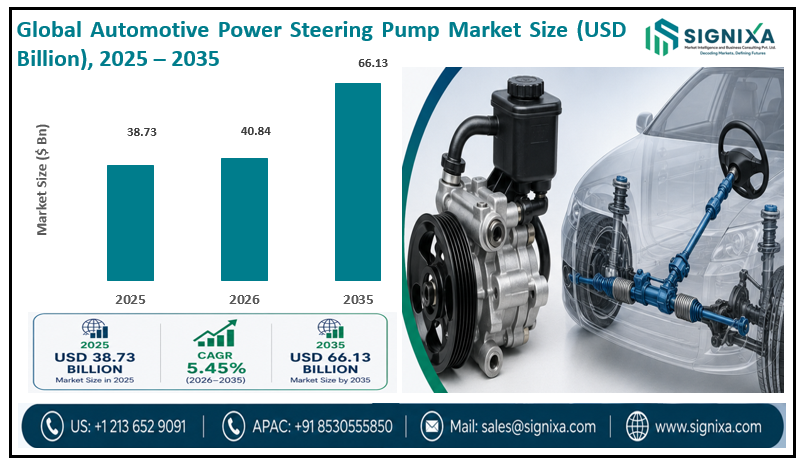
The size of the global Automotive Power Steering Pump Market was valued at approximately USD 38.73 Billion in 2025 and is projected to reach around USD 66.13 Billion by 2035, growing at a compound annual growth rate (CAGR) of 5.45% from 2026 to 2035. The report analyzes the market’s drivers and restraints, and their impact on demand throughout the forecast period. Additionally, it explores global opportunities in the automotive power steering pump market.
The automotive power steering pump market supports a wide range of passenger and commercial vehicles with enhanced drivability and steering response. The increasing integration of advanced steering systems in vehicles, along with the rising production of vehicles globally, is a primary factor driving market growth. Demand for electric and hybrid vehicles is further boosting the shift toward electric power steering (EPS) systems. OEMs are also focused on providing energy-efficient and lightweight steering systems, positively impacting the market.
The automotive power steering pump market plays a pivotal role in enhancing driving comfort, vehicle handling, and safety across various vehicle categories. Power steering pumps are essential components in hydraulic and electro-hydraulic steering systems, providing the necessary hydraulic pressure to assist drivers in maneuvering vehicles with minimal physical effort. The increasing demand for vehicles with improved drivability and precision control has fueled interest in reliable, efficient steering pump systems. Traditional hydraulic systems, although widely used, are gradually evolving with the emergence of more sophisticated pump designs that improve energy efficiency and reduce parasitic engine load. This evolution is particularly evident in mid- and high-end passenger cars and commercial vehicles, where responsiveness and steering accuracy are key performance factors. Additionally, stringent vehicle safety standards and rising consumer expectations for effortless steering across diverse road conditions are encouraging automakers to integrate advanced power steering solutions. Manufacturers are focusing on developing compact, lightweight, and durable pumps that comply with modern automotive design requirements, including space optimization and fuel efficiency. Furthermore, ongoing innovations in materials and fluid dynamics are resulting in quieter, lower-maintenance units that enhance the overall driving experience, ensuring sustained demand for power steering pumps in both OEM and aftermarket segments.
The shift toward electrification and technological sophistication in the automotive sector is reshaping the dynamics of the power steering pump market. Although fully electric vehicles often rely on electric power steering (EPS) systems that do not use conventional pumps, the majority of hybrid and internal combustion engine vehicles still depend on hydraulic or electro-hydraulic pumps. This transitional phase creates a diverse landscape where power steering pumps continue to hold relevance, particularly in commercial vehicles, SUVs, and heavy-duty applications that require robust steering assistance. Fleet operators, in particular, value power steering systems for their ability to reduce driver fatigue and improve control during long-distance hauling or city logistics. In emerging economies, where the penetration of electric vehicles is still modest, hydraulic power steering remains prevalent, further sustaining market activity. The aftermarket also plays a critical role, as aging vehicle populations in several regions drive the need for replacement pumps with enhanced durability and ease of installation. Additionally, global supply chains and localized manufacturing efforts are influencing product availability and cost competitiveness. As the automotive industry navigates the balance between traditional and emerging technologies, the power steering pump remains a vital component for ensuring smooth and responsive vehicle handling in a broad range of driving scenarios.
Key Findings
- The global Automotive Power Steering Pump market is expected to grow at a CAGR of 5.45% during the forecast period (2026–2035).
- The market was valued at USD 38.73 Billion in 2025 and is projected to reach USD 66.13 Billion by 2035.
- The market is projected to grow steadily due to rising global production of passenger and commercial vehicles, increasing demand for fuel-efficient steering systems, and the growing adoption of advanced automotive technologies.
- Based on Power Steering Type, the Electric Power Steering (EPS) segment is expected to hold the largest market share during the forecast period, owing to its superior fuel efficiency, lower maintenance requirements, lightweight design, and compatibility with electric and autonomous vehicles.
- By Product Type, the Rack Assist Type segment is anticipated to dominate the market due to its widespread adoption in modern passenger vehicles, offering improved steering precision, enhanced driving comfort, and cost-effective integration.
- On the basis of Demand Category, the OEM segment is expected to lead the market, driven by increasing vehicle production, rising integration of advanced steering systems in new models, and long-term supply agreements with automotive manufacturers.
- By Region, Asia-Pacific is projected to dominate the global Automotive Power Steering Pump Market during the forecast period, supported by strong automotive manufacturing hubs in China, Japan, India, and South Korea, growing vehicle ownership, and continuous investments in electric vehicle production.
Automotive Power Steering Pump Market Dynamics
Rising Demand for Advanced Steering Systems Driving Market Growth
The global automotive power steering pump market is fueled by the growing demand for advanced driver assistance and enhanced vehicle handling. Consumers today prioritize comfort, and power steering systems significantly reduce driver fatigue, particularly in congested urban environments. Moreover, the global increase in vehicle ownership and production, especially in developing economies, further drives market demand. As automakers shift toward vehicle electrification, the demand for efficient and compact steering pumps has accelerated, benefiting EPS and EPHS solutions.
Transition Toward Electric Steering Technologies Accelerating Innovation
The stringent emission and fuel efficiency standards imposed by governments worldwide. Hydraulic systems are gradually being replaced by electric solutions, which offer reduced energy losses and eliminate the need for hydraulic fluid. Furthermore, the evolution of autonomous and semi-autonomous vehicles is influencing innovations in steering technology. Manufacturers are increasingly integrating power steering systems that offer greater control and are compatible with drive-by-wire setups, pushing further innovation in steering pump technologies.
Increasing Global Vehicle Production Boosting Power Steering Pump Demand
One of the primary factors propelling the automotive power steering pump market is the consistent rise in global vehicle production, particularly in emerging economies. As demand grows for passenger cars, SUVs, and commercial vehicles, automakers are equipping a majority of new models with advanced steering systems to enhance maneuverability and comfort. The power steering pump, which plays a critical role in providing hydraulic or electro-hydraulic assistance to the steering system, remains essential in traditional and hybrid vehicle configurations. In regions such as Asia-Pacific and Latin America, improving economic conditions and rising disposable incomes have contributed to a spike in vehicle ownership. Consumers increasingly prioritize features like effortless steering, smoother control, and reduced driver fatigue, especially in urban environments with frequent turning and parking maneuvers. Consequently, manufacturers are integrating reliable and efficient power steering pumps as standard components across most vehicle segments. Even in budget vehicles, hydraulic power steering remains a preferred option due to its cost-effectiveness and dependable performance. As comfort and driving ease become central to the buyer’s decision-making process, the automotive power steering pump market is experiencing continuous demand growth. This trend is further supported by urbanization, longer driving hours, and the need for precision handling in congested traffic zones.
Evolution of Electro-Hydraulic Power Steering (EHPS) Systems
While traditional hydraulic steering systems have long dominated the automotive landscape, the industry is gradually transitioning toward more energy-efficient and electronically controlled systems. This shift is driven by automakers’ focus on fuel economy, emissions reduction, and seamless integration with vehicle electronics. Electro-hydraulic power steering (EHPS) pumps represent an intermediate step between conventional hydraulic systems and fully electric steering systems, offering the advantages of variable steering assistance and reduced engine load. These pumps use electric motors to drive hydraulic fluid rather than relying on engine power, resulting in lower fuel consumption and more responsive handling. As hybrid and plug-in hybrid vehicles grow in popularity, EHPS pumps are becoming a preferred solution where traditional power steering pumps cannot be used due to the absence of continuous engine operation. Moreover, manufacturers are designing smarter, more compact pumps with embedded sensors for real-time control and diagnostics, which aligns with the broader automotive trend of software-enabled vehicle systems. Although full electrification may eventually reduce reliance on conventional pumps, the transition is expected to take years especially in developing markets allowing EHPS and upgraded hydraulic pumps to remain relevant. This technology evolution is reshaping the power steering pump market, compelling suppliers to innovate and adapt their portfolios for future-ready vehicles.
Commercial and Off-Highway Vehicles Creating New Growth Opportunities
The commercial vehicle and off-highway segments represent a significant growth avenue for the automotive power steering pump market. Unlike passenger cars, which are gradually adopting electric steering systems, heavy-duty trucks, buses, construction equipment, and agricultural vehicles still predominantly rely on hydraulic or electro-hydraulic steering systems due to their high torque requirements. Power steering pumps in these vehicles are engineered to handle more rigorous operating conditions, including heavy loads, uneven terrain, and continuous long-haul driving. Fleet operators in logistics, mining, and public transport sectors prioritize durable steering systems that enhance driver control, reduce fatigue, and maintain operational safety. Additionally, government regulations aimed at improving road safety in commercial operations are encouraging fleet upgrades that include advanced steering solutions. As infrastructure projects and construction activities expand globally especially in regions such as Southeast Asia, the Middle East, and Africa the need for high-performance off-road machinery continues to rise. These applications demand robust and high-capacity power steering pumps that can perform reliably in extreme environments. Furthermore, aftermarket demand for replacement pumps in this sector is strong due to extended vehicle lifecycles and the need for regular maintenance. Consequently, the commercial and off-highway vehicle sectors are emerging as stable, long-term contributors to the power steering pump market.
Growing Aftermarket Demand Supporting Long-Term Market Expansion
The global vehicle fleet is aging, particularly in developed regions like North America and Europe, where vehicle age average now exceeds 11 years. This aging trend fuels consistent demand for replacement parts, including power steering pumps, through the aftermarket. Over time, steering systems are subject to wear and tear due to continuous pressure, exposure to contaminants, and fluid degradation. When power steering pumps fail, symptoms like difficulty in steering, whining noises, and fluid leaks necessitate urgent replacement to maintain safe vehicle operation. The aftermarket offers a cost-effective alternative to OEM parts, often with comparable performance and warranty coverage. Independent garages and DIY consumers contribute heavily to this demand, especially in regions with strong repair-and-maintain cultures. In addition, remanufactured power steering pumps are gaining popularity for their lower cost and environmental benefits, offering a sustainable solution for extending vehicle life. E-commerce platforms have also simplified product discovery and distribution, enabling consumers to access a wide range of compatible parts with detailed specifications. As a result, aftermarket suppliers are expanding their offerings with region-specific and vehicle-specific pump variants. This sector is expected to remain resilient, as older vehicles will continue to require servicing providing a steady revenue stream for aftermarket steering pump manufacturers and distributors.
Supply Chain Challenges and Competitive Landscape Shaping the Market
While the power steering pump market continues to grow, it faces notable challenges related to supply chain disruptions and rising competitive intensity. The global automotive supply chain has experienced stress from semiconductor shortages, fluctuating raw material prices, and logistic bottlenecks—factors that have indirectly impacted power steering pump production and delivery. Additionally, geopolitical tensions and trade restrictions can hinder cross-border sourcing of components such as aluminum housings, seals, or electronic motor parts used in EHPS units. These factors contribute to rising production costs and lengthened lead times, affecting the ability of manufacturers to meet just-in-time supply models. On the competitive front, both global players and regional manufacturers are vying for market share, prompting aggressive pricing strategies and product innovation. While established brands rely on technological advancements and partnerships with OEMs, emerging companies are focusing on affordable and adaptable pump solutions to penetrate cost-sensitive markets. This competitive environment pressures all stakeholders to balance quality, cost, and delivery timelines. To mitigate risk, companies are exploring local sourcing strategies and investing in vertical integration. Thus, managing operational efficiency, supplier relationships, and inventory control has become critical for long-term success in the automotive power steering pump market, especially in a volatile and rapidly evolving global landscape.
Automotive Power Steering Pump Market Segmentation Analysis
By Vehicle Type Segment Analysis
The passenger car segment accounted for the largest share in 2025, with over 70% of total revenue, driven by rising consumer preference for personal mobility and increasing production of compact and mid-size cars. As urbanization intensifies, demand for passenger cars with enhanced steering systems is surging. Commercial vehicles are projected to grow steadily due to infrastructure expansion and logistics development, requiring robust and durable steering pumps.
By Power Steering Type Segment Analysis
Electric Power Steering (EPS) dominated the segment in 2025, accounting for more than 50% of global revenue, owing to its fuel efficiency and reduced component complexity. Hydraulic Power Steering (HPS) is still preferred in heavy-duty vehicles due to its superior torque delivery. However, Electric Power Hydraulic Steering (EPHS) serves as a transitional technology and is gradually declining as OEMs move to fully electric solutions.
By Product Type Segment Analysis
Rack Assist Type held the dominant market share in 2025, contributing over 45% of total demand. Its compact design, high efficiency, and compatibility with passenger and light commercial vehicles make it a preferred solution. Column Assist Type is often used in small and mid-sized cars due to its low weight and simple design. Pinion Assist Type is primarily adopted in cost-sensitive markets where vehicle models focus on affordability and functional design.
By Demand Category Segment Analysis
The OEM segment captured over 70% of the total market share in 2025, driven by increased integration of steering systems at the manufacturing stage and higher demand for factory-fitted advanced solutions. The aftermarket segment is growing moderately, particularly in developing regions where vehicle maintenance and part replacement cycles are longer.
Report Attributes & Market Scope
| Report Attribute | Details |
|---|---|
| Market Size Value in 2025 | USD 38.73 Billion |
| Market Size Value in 2035 | USD 66.13 Billion |
| CAGR (2026–2035) | 5.45% |
| Base Year Used for Estimation | 2025 |
| Historic Data | 2020 - 2025 |
| Forecast Period | 2026 - 2035 |
| Segments Covered – By Vehicle Type |
|
| Segments Covered – By Power Steering Type |
|
| Segments Covered – By Product Type |
|
| Segments Covered – By Demand Category |
|
| Regions Covered | North America, Europe, Asia Pacific, Latin America, Middle East and Africa |
| Major Countries Covered | U.S., Canada, Mexico, Germany, UK, France, Italy, Spain, Russia, China, Japan, South Korea, India, Southeast Asia Countries, Brazil, Argentina, GCC Countries, Turkey, Iran, Israel, South Africa, Egypt, Nigeria, etc. |
| Key Companies Profiled | JTEKT Corporation, Bosch, ZF Friedrichshafen AG, Nexteer Automotive, Mando Corporation, NSK Ltd., Denso Corporation, Hitachi Astemo, Hyundai Mobis, and Showa Corporation, among others. |
Automotive Power Steering Pump Market Regional Analysis
Asia-Pacific accounted for the largest market share in 2025, driven by robust vehicle production in China, India, and Japan. Strong OEM presence and cost-effective manufacturing facilities contribute to regional dominance. North America and Europe follow, with a strong inclination toward electric and hybrid vehicles and supportive regulatory frameworks. Latin America and the Middle East & Africa are emerging regions, with increasing automotive investments and growing aftermarket demand supporting moderate growth during the forecast period.
North America
The North American automotive power steering pump market is shaped by a mature vehicle manufacturing ecosystem, widespread adoption of light trucks and SUVs, and strong aftermarket activity. The U.S. leads the region due to its large vehicle parc, high consumer preference for comfort features, and a significant presence of OEMs and Tier 1 suppliers. Pickup trucks and full-size SUVs, which dominate the market, continue to utilize hydraulic or electro-hydraulic power steering systems due to their towing demands and high steering loads. While electric power steering is gaining ground in compact vehicles, the power steering pump remains essential in hybrid and commercial vehicle segments. In Canada and Mexico, rising vehicle assembly operations and supportive trade agreements with the U.S. sustain steady component demand. Additionally, a growing number of aging vehicles drives the replacement parts market, boosting aftermarket sales of steering pumps. The region also benefits from high digital penetration, which facilitates online distribution and customization of aftermarket pump units. Moreover, increasing interest in off-road and performance vehicles supports demand for high-pressure steering systems. As OEMs upgrade internal combustion and hybrid platforms with enhanced steering systems, North America continues to be a stable and innovation-driven market for power steering pump manufacturers.
Europe
The European automotive power steering pump market reflects the region’s shift toward fuel efficiency, compact car production, and technological sophistication. While electric power steering systems are increasingly adopted in passenger cars to reduce energy loss and improve emissions, hydraulic and electro-hydraulic pumps remain vital in certain segments, such as luxury vehicles, commercial trucks, and utility vans. Germany, being the automotive innovation hub, drives much of the development in precision steering technology, including high-performance pump systems for premium brands. In Southern and Eastern Europe, however, hydraulic systems remain prevalent in mid-range vehicles due to cost-efficiency and long-standing familiarity. The region also sees steady replacement demand due to strict vehicle inspection norms, where worn-out steering components are routinely replaced to meet safety standards. Furthermore, Europe’s robust commercial transport industry spanning long-haul trucks, buses, and delivery vehicles continues to rely on durable power steering pumps to support heavy-duty operations. Sustainability regulations are influencing the design of energy-saving EHPS units that reduce mechanical drag. Additionally, European suppliers are increasingly focusing on low-noise, compact pump designs that align with eco-friendly goals and space-saving architectures in new vehicles. As vehicle electrification advances unevenly across the region, traditional and hybrid platforms continue to ensure a steady demand for power steering pump technologies.
Recent Developments in the Automotive Power Steering Pump Market
-
2026
JTEKT Corporation continued expanding its next-generation Electric Power Steering (EPS) portfolio with a focus on lightweight, high-efficiency steering systems for electric and software-defined vehicles.
Bosch accelerated the development of steer-by-wire and advanced EPS technologies to support ADAS integration, vehicle safety, and autonomous driving platforms.
ZF Friedrichshafen AG strengthened its steer-by-wire and electric steering technologies to improve vehicle handling, energy efficiency, and compatibility with next-generation EV architectures.
Hitachi Astemo increased its focus on integrated electric power steering solutions to meet rising demand for electrified and intelligent mobility systems.
-
2025
HL Mando showcased its latest Steer-by-Wire (Steerite-Fit) technology and advanced electric steering solutions at CES, highlighting innovations for next-generation electric and autonomous mobility applications.
Nexteer Automotive continued expanding its modular Rack-Assist Electric Power Steering (mREPS) solutions designed for electric vehicles and light commercial vehicles, offering greater flexibility for OEMs.
Automotive Power Steering Pump Market: Competitive Landscape
Major players in the global automotive power steering pump market include JTEKT Corporation, Bosch, ZF Friedrichshafen AG, Nexteer Automotive, Mando Corporation, NSK Ltd., Denso Corporation, Hitachi Astemo, Hyundai Mobis, and Showa Corporation. These companies are focusing on R&D and forming strategic partnerships to develop more efficient and compact steering solutions. Competition is driven by technology integration, system efficiency, durability, and cost optimization, as OEMs demand smarter and more sustainable components for next-generation vehicles.
Key Companies Profiled
- JTEKT Corporation
- Bosch
- ZF Friedrichshafen AG
- Nexteer Automotive
- Mando Corporation
- NSK Ltd.
- Denso Corporation
- Hitachi Astemo
- Hyundai Mobis
- Showa Corporation
- BorgWarner Inc.
- thyssenkrupp AG
- Mitsubishi Electric Corporation
- Schaeffler AG
- Robertshaw Controls Company
Global Automotive Power Steering Pump Market Segmentation Summary
By Vehicle Type
- Passenger Car
- Commercial Vehicle
By Power Steering Type
- Hydraulic Power Steering (HPS)
- Electric Power Hydraulic Steering (EPHS)
- Electric Power Steering (EPS)
By Product Type
- Rack Assist Type
- Column Assist Type
- Pinion Assist Type
By Demand Category
- OEM
- Aftermarket
By Region
- North America
- U.S.
- Canada
- Mexico
- Europe
- Germany
- France
- UK
- Spain
- Italy
- Rest of Europe
- Asia-Pacific
- China
- Japan
- India
- Australia
- South Korea
- Southeast Asia
- Rest of Asia-Pacific
- Latin America
- Brazil
- Argentina
- Rest of Latin America
- The Middle East & Africa
- GCC Countries
- South Africa
- Rest of the Middle East & Africa
Frequently Asked Questions (FAQs) About the Automotive Power Steering Pump Market
What is Automotive Power Steering Pump?
An automotive power steering pump is a critical component of a vehicle’s steering system that provides hydraulic or electric power assistance to reduce the effort needed by the driver to steer the vehicle. It enhances handling, maneuverability, and driving comfort.
Which key factors will influence the Automotive Power Steering Pump Market growth over 2026–2035?
The market is expected to grow due to rising vehicle production, growing demand for improved steering comfort and safety, and the shift toward electric and fuel-efficient vehicles that use compact and lightweight steering systems.
What will be the value of the Automotive Power Steering Pump Market during 2026–2035?
The global Automotive Power Steering Pump Market accounted for around USD 38.73 Billion in 2025 and is forecast to attain a value of approximately USD 66.13 Billion by 2035.
What will be the CAGR value of the Automotive Power Steering Pump Market during 2026–2035?
The Automotive Power Steering Pump Market is projected to grow at a CAGR of 5.45% during the forecast period of 2026–2035, driven by rising global vehicle production, increasing adoption of electric and electro-hydraulic steering systems, and growing demand for fuel-efficient, comfortable, and technologically advanced vehicles.
Which region will contribute notably towards the Automotive Power Steering Pump Market value?
The Asia-Pacific region is expected to dominate the market, supported by strong automotive manufacturing in countries like China, India, Japan, and South Korea, along with rising adoption of passenger cars and commercial vehicles.
Which are the major players leveraging the Automotive Power Steering Pump Market growth?
Key companies driving growth in the global market include Bosch, Nexteer Automotive, ZF Friedrichshafen AG, JTEKT Corporation, Hitachi Astemo, Denso Corporation, Mando Corporation, Showa Corporation, KYB Corporation, and TRW Automotive.
What can be expected from the global Automotive Power Steering Pump Market report?
The report offers a comprehensive analysis of the automotive power steering pump market, including current trends, market dynamics, competitive landscape, technological advancements, segment-wise insights, and growth opportunities across regions for the forecast period.