
Enzymes Market Overview
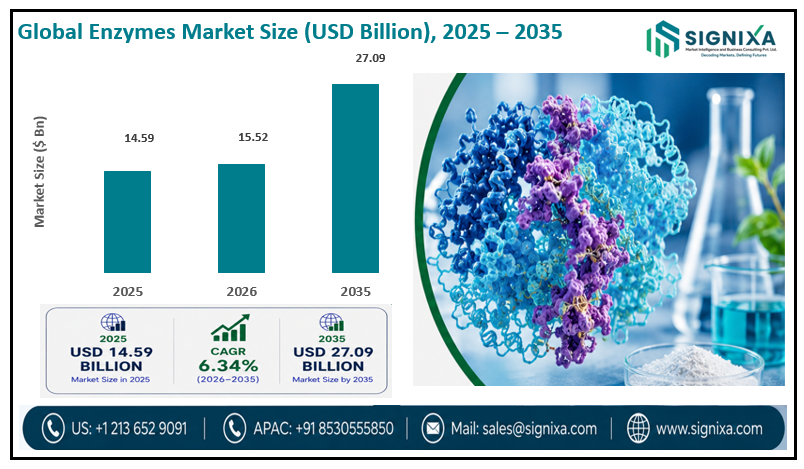
The size of the global enzymes market was worth around USD 14.59 Billion in 2025 and is predicted to grow to around USD 27.09 Billion by 2035, with a compound annual growth rate (CAGR) of roughly 6.34% between 2026 and 2035. The report analyzes the market drivers and restraints for enzymes, as well as their impact on demand throughout the projection period.
The global enzymes market encompasses bio-catalysts that enhance the efficiency of chemical reactions across industrial and specialty applications. Demand is being driven by increased use of enzymes in sectors such as food & beverages, bioenergy, pharmaceuticals, and animal feed. The ongoing shift toward green chemistry, cost-effective production processes, and eco-friendly industrial solutions is boosting the adoption of enzymes. Furthermore, innovations in enzyme engineering and rising awareness regarding health and nutrition are playing a pivotal role in market expansion.
The enzymes market's growth is fundamentally driven by the increasing global demand for sustainable and environmentally friendly industrial processes. Enzymes, as biological catalysts, accelerate specific biochemical reactions with high efficiency and selectivity under mild conditions. Traditional chemical processes often require harsh conditions, high energy input, and produce significant waste. Enzymes offer a 'greener' alternative by enabling reactions at lower temperatures and pressures, reducing energy consumption, minimizing by-products, and decreasing the use of toxic chemicals aligning perfectly with growing regulatory pressures for environmental protection and corporate sustainability goals.
Key Findings
- The global enzymes market is estimated to grow annually at a CAGR of around 6.34% over the forecast period (2026–2035).
- The market size was valued at around USD 14.59 Billion in 2025 and is projected to reach USD 27.09 Billion by 2035.
- The market is projected to grow at a stable rate due to rising demand in industrial processing and medical diagnostics.
- Based on Type, the Industrial Enzymes segment is growing rapidly and expected to maintain dominance through 2035, accounting for over 60% of revenue in 2025.
- On the basis of Product, Carbohydrases accounted for the largest revenue share at over 42% in 2025.
- By Source, the Microorganisms segment held the dominant position and is expected to continue leading due to cost-efficiency and scalability.
- Regionally, North America leads in revenue while Asia-Pacific is the fastest-growing region, projected at 7.5% CAGR through 2035.
Enzymes Market Dynamics
Green Chemistry Imperative & Sustainability-Driven Industrial Enzyme Adoption
The enzymes market is witnessing steady growth driven by the increasing utilization of industrial enzymes across sectors such as food processing, textiles, biofuels, and detergents. These enzymes enhance process efficiency, reduce production costs, and offer environmentally friendly alternatives to harsh chemicals. Carbohydrases and proteases, in particular, play crucial roles in reducing energy and water usage during processing. As industries worldwide face escalating pressure from environmental regulations and growing consumer preference for 'green' products, enzymes offer a highly attractive alternative to traditional chemical methods. The inherent biodegradability of enzymes further enhances their appeal as a sustainable solution, aligning perfectly with global efforts towards a circular economy and reduced carbon footprint. Industries such as food & beverage, detergents, textiles, biofuels, and wastewater treatment are increasingly adopting enzyme-based solutions to enhance efficiency, reduce costs, and improve their ecological footprint.
Biotechnology Advances in Enzyme Engineering Expanding Application Scope
A significant market dynamic is the continuous advancement in biotechnology and enzyme engineering, which constantly expands the scope and applicability of industrial enzymes. Through techniques like genetic engineering, directed evolution, and computational protein design, researchers and enzyme manufacturers modify natural enzymes to enhance their stability, specificity, activity, and tolerance to challenging industrial conditions. This ability to "engineer" enzymes allow for the creation of novel biocatalysts tailored for specific industrial needs overcoming previous limitations and opening up entirely new application areas. Modified enzymes are now more efficient at breaking down complex biomass for biofuel production, performing complex chiral syntheses in pharmaceuticals, or enabling the development of advanced functional foods. Another key driver is the rising demand for specialty enzymes in the pharmaceutical and diagnostics industries, where enzymes such as polymerases and nucleases are vital for biotechnological applications including PCR and DNA manipulation. The growth in personalized medicine, biotechnology innovations, and increased R&D funding are significantly fuelling demand for high-purity, performance-specific enzymes across the life sciences.
High Production Costs & Stringent Regulatory Frameworks as Key Challenges
However, the enzymes market also faces notable challenges, primarily related to high production costs and stringent regulatory frameworks. The industrial-scale production of enzymes often through fermentation of specially selected microorganisms, followed by complex purification steps and quality control measures is capital-intensive and leads to higher manufacturing costs compared to traditional chemical catalysts. This cost factor can sometimes be a barrier for smaller industries. Furthermore, enzymes used in food, feed, and pharmaceutical applications are subject to rigorous regulatory scrutiny and approval processes from bodies like the FDA in North America or EFSA in Europe. Compliance with these diverse and often strict guidelines regarding safety, purity, labelling, and sometimes even the use of GMOs in enzyme production adds significant time and expense to product development and market entry. Navigating this intricate regulatory landscape while simultaneously managing production economics remains a key strategic challenge for players in the enzymes market.
Enzymes Market Segmentation Analysis
By Type Segment Analysis
Industrial Enzymes
The industrial enzymes segment held the largest share of the global enzymes market in 2025, accounting for over 60% of the revenue. These enzymes are widely used in manufacturing, textiles, pulp & paper, and food processing industries due to their ability to improve yield, reduce waste, and lower costs. With increasing demand for bio-based and efficient production methods, this segment is expected to continue its dominance throughout the forecast period. Industrial enzymes are the primary driver behind the sector's green chemistry transition enabling manufacturers in detergent, textile, biofuel, and food processing sectors to replace energy-intensive chemical processes with enzymatic alternatives that operate at ambient temperatures and pH levels, reducing energy consumption, process time, and waste generation while simultaneously improving product quality consistency at commercial scale.
Specialty Enzymes
Specialty enzymes are projected to grow at a CAGR of 7.1% through 2035, supported by their growing application in pharmaceuticals, diagnostics, and research. These enzymes offer high specificity and stability, making them crucial in sensitive applications such as molecular biology and targeted drug delivery. The rising global investment in precision healthcare and biotechnology is anticipated to drive demand for specialty enzymes significantly. The specialty enzymes segment encompasses high-value biological catalysts including restriction enzymes, ligases, polymerases, proteases for therapeutic applications, and diagnostic enzymes that command premium pricing due to their high purity requirements, complex production processes, and critical performance specifications that directly impact the safety and efficacy of the end products in which they are incorporated.
By Product Segment Analysis
The enzymes market is segmented across five core product categories, each serving distinct substrate conversion needs across industrial and specialty applications globally:
Carbohydrases
Carbohydrases dominated the product category in 2025, contributing to more than 42% of global enzymes revenue. Their extensive use in food & beverage, bioethanol production, and animal feed industries boosts demand. Amylases and cellulases are popular carbohydrases due to their ability to break down starch and cellulose into simpler sugars essential in baking, brewing, and dairy applications. Carbohydrases are the most commercially deployed enzyme category globally, reflecting the enormous scale of starch-processing industries from bioethanol production to glucose syrup manufacturing, as well as their widespread use in bakery for dough conditioning, brewing for improved fermentation efficiency, and animal nutrition for enhanced digestibility of plant-based feed ingredients.
Proteases
Proteases are the second-largest product segment, widely used in detergents, leather processing, and pharmaceuticals. In 2025, proteases accounted for approximately 30% of the global enzymes market share. Protease enzymes catalyze the hydrolysis of peptide bonds in proteins a reaction with enormous commercial relevance across the food industry (for cheese making, meat tenderization, and protein hydrolysate production), detergent industry (for protein stain removal at low wash temperatures), pharmaceutical industry (for producing bioactive peptides and therapeutic proteins), and the leather industry (for eco-friendlier bating processes that replace traditional chemical methods). The detergent segment, in particular, has driven protease commercialization at massive industrial scale, with modern laundry detergents typically incorporating multiple enzyme types including proteases, amylases, and lipases to address the full spectrum of common household stains.
Lipases
Lipases represent an important segment for applications in biodiesel production and are expected to grow steadily with increasing demand for high-efficiency solutions in energy sectors. Lipase enzymes catalyze the hydrolysis and interesterification of fats and oils a substrate class of enormous commercial importance across the food industry (for flavor development, fat modification, and cheese production), the biofuel industry (for enzymatic biodiesel production via transesterification of triglycerides), and the pharmaceutical industry (for enantioselective synthesis of chiral pharmaceutical intermediates). The growing global biodiesel market and the food industry's increasing demand for structured lipids and fat replacers are primary commercial growth drivers for lipase enzyme development and production capacity expansion.
Polymerases & Nucleases
Polymerases & Nucleases represent important segments for applications in DNA manipulation and are expected to grow steadily with increasing demand for high-efficiency solutions in biotech sectors. DNA polymerases particularly thermostable variants like Taq polymerase are the essential enzymes that enable polymerase chain reaction (PCR), the foundational technique underlying modern molecular diagnostics, forensic analysis, genetic research, and COVID-19 testing. The extraordinary commercial success of PCR-based diagnostics, amplified enormously by the global pandemic, demonstrated the critical role of polymerase enzymes in healthcare infrastructure and drove massive capacity expansion that will continue to benefit the specialty enzyme market as PCR technology finds new applications in clinical diagnostics, food safety testing, and environmental monitoring.
Others
Other enzyme categories including oxidoreductases, transferases, isomerases, and lyases collectively represent the remaining market share and encompass a diverse array of enzymatic functionalities with specialized industrial applications. Oxidoreductases such as glucose oxidase and laccase find applications in biosensors, textile bleaching, and food preservation. Isomerases, particularly glucose isomerase, are commercially critical for high-fructose corn syrup production. The ongoing expansion of synthetic biology and metabolic engineering is creating new commercial applications for previously niche enzyme categories, as engineered microbial strains are designed to produce novel biochemicals using enzymatic pathways assembled from diverse enzyme families that individually might have limited standalone commercial value but together enable entirely new bio-based production routes.
By Source Segment Analysis
Microorganisms
Microorganisms remained the leading source for enzymes in 2025, contributing over 72% of total market revenue. They offer superior yield, scalability, and cost-effectiveness compared to plant or animal-based enzymes. Bacterial and fungal strains are commonly engineered to produce high-activity enzymes tailored for industrial and pharmaceutical applications. Microbial enzyme production through large-scale fermentation offers inherent advantages over plant or animal extraction routes microbial strains grow rapidly on inexpensive carbon sources, can be genetically engineered to express virtually any enzyme at high titers, and the fermentation process scales readily from laboratory to commercial production volumes. Key enzyme-producing microorganisms include Aspergillus niger and Trichoderma reesei for carbohydrases, Bacillus subtilis and Bacillus licheniformis for proteases, and Candida antarctica for lipases each selected for their naturally high enzyme production capabilities that can be further enhanced through strain improvement programs.
Plants & Animals
Plant-based and animal-based enzyme sources are more niche but serve important roles in food processing and medical diagnostics. Plant-derived enzymes such as papain (from papaya) and bromelain (from pineapple) have established commercial applications in meat tenderization, beer chill-proofing, and digestive supplement products benefiting from a consumer perception of natural origin that commands premium positioning in certain wellness and natural food markets. Animal-derived enzymes, particularly pancreatic lipase, chymotrypsin, and trypsin extracted from porcine or bovine pancreas, maintain specialized roles in pharmaceutical applications where highly specific activity and established regulatory acceptance outweigh the higher raw material cost and supply chain complexity of animal-sourced enzyme production. With advances in biotechnology and genetic engineering, microbial enzymes are expected to continue their dominance, though plant and animal sources retain irreplaceable positions in specific applications where their unique activity profiles or natural origin credentials provide competitive differentiation.
Report Attributes & Market Scope
| Report Attribute | Details |
|---|---|
| Market Size Value in 2025 | USD 14.59 Billion |
| Market Size Value in 2035 | USD 27.09 Billion |
| CAGR (2026–2035) | 6.34% |
| Base Year Used for Estimation | 2025 |
| Historic Data | 2020 - 2025 |
| Forecast Period | 2026 - 2035 |
| Segments Covered – By Type |
|
| Segments Covered – By Product |
|
| Segments Covered – By Source |
|
| Regions Covered | North America, Europe, Asia Pacific, Latin America, Middle East and Africa |
| Major Countries Covered | U.S., Canada, Mexico, Germany, UK, France, Italy, Spain, Russia, China, Japan, South Korea, India, Southeast Asia Countries, Brazil, Argentina, GCC Countries, Turkey, Iran, Israel, South Africa, Egypt, Nigeria, etc. |
| Key Companies Profiled | Novozymes, DuPont (IFF), DSM, BASF SE, Amano Enzyme, AB Enzymes, Advanced Enzyme Technologies, Chr. Hansen, Codexis Inc., and Enzyme Development Corporation. |
Enzymes Market Regional Analysis
North America led in 2025, driven by strong demand from the food and beverage industry, a well-established pharmaceutical sector, and substantial biotechnology investments. Asia-Pacific is the fastest-growing region, projected to expand at a CAGR of 7.5% through 2035. Europe follows closely, driven by strict regulations favoring green manufacturing. Latin America, the Middle East, and Africa are emerging markets with growing potential.
North America (Leading Region)
North America holds a leading position in the global enzymes market, driven by its robust biotechnology industry, advanced R&D capabilities, and significant demand from key end-use sectors. The food and beverage industry is a major consumer, with enzymes widely used in brewing, baking, dairy processing, and juice production to enhance product quality, yield, and shelf life. The biofuels sector, particularly in the U.S. and Canada, heavily utilizes enzymes for the efficient conversion of biomass into ethanol and other biofuels, aligning with government initiatives aimed at reducing greenhouse gas emissions. The pharmaceutical and diagnostics industries also contribute significantly, with specialty enzymes crucial for drug formulation, therapeutic protein production, and advanced diagnostic tests. Stringent regulations by the FDA ensure the safety and efficacy of enzyme-based products. The region's strong focus on sustainable production practices and continuous innovation in enzyme engineering further solidify its market leadership.
Europe
Europe represents a mature and highly diversified market for enzymes, characterized by a strong emphasis on sustainability, technological innovation, and stringent regulatory frameworks. The food and beverage industry is a cornerstone of enzyme demand, with enzymes extensively used in bakery products, dairy, meat processing, and beverages to improve quality, enhance shelf life, and optimize production processes. The region's focus on reducing greenhouse gas emissions and promoting bio-based solutions also drives the adoption of enzymes in the biofuels sector. Europe is a major producer of medicinal, pharmaceutical, and cosmetic products, leading to substantial demand for specialty enzymes in these high-value applications. European regulations, particularly those from the European Food Safety Authority (EFSA), are comprehensive and strict ensuring the safety and labelling of food enzymes while influencing product development and market entry strategies for enzyme manufacturers in the region. The presence of major enzyme producers including Novozymes, BASF, DSM-Firmenich, Chr. Hansen, and AB Enzymes reinforces Europe as both a major production hub and consumption market.
Asia-Pacific (Fastest-Growing Region)
Asia-Pacific is the fastest-growing region in the enzymes market, projected to expand at a CAGR of 7.5% through 2035. Rapid industrialization, population growth, and increasing awareness about sustainable processing in China, India, and Southeast Asia are key factors fueling demand. China's large food processing sector, expanding biofuel programs, and growing pharmaceutical manufacturing base collectively drive substantial enzyme demand across all three major enzyme categories. India's rapidly expanding food processing industry, animal feed sector, and pharmaceutical manufacturing segment are creating strong demand for both industrial and specialty enzymes. Japan remains a significant market due to its highly sophisticated food industry's long tradition of enzyme application in traditional fermented foods alongside modern processed food production. The region's expanding middle class, rising food quality standards, and increasing regulatory pressure for sustainable industrial practices collectively ensure Asia-Pacific's status as the primary growth engine for the global enzymes market through the forecast period.
Middle East & Africa
The Middle East & Africa (MEA) enzymes market is an emerging yet rapidly growing segment, driven by increasing industrialization, population growth, and a rising focus on enhancing food quality and industrial efficiency. In the Middle East, the food and beverage industry is a primary growth driver, fueled by an expanding population and urban development leading to increased demand for high-quality and nutritious processed foods. The textile industry in the region is also seeing augmented use of enzymes for eco-friendlier processing. In Africa, economic growth and burgeoning awareness of feed quality in the animal feed sector are gradually boosting enzyme adoption to improve digestion and nutrient absorption in livestock. The pharmaceutical and cosmetics industries are also anticipated to grow due to increasing health awareness and rising disposable incomes. Challenges such as limited awareness of advanced enzyme applications, varying regulatory landscapes, and the relatively high cost of specialty enzymes can sometimes limit broader market penetration, but the region's trajectory is firmly upward as awareness and infrastructure develop.
Latin America
Latin America is an emerging market with growing potential due to investments in food safety, water treatment, and agricultural productivity. Brazil is a particularly significant enzyme market within Latin America, driven by its world-leading ethanol biofuel program which utilizes enzymatic hydrolysis of sugarcane bagasse for second-generation bioethanol production its large-scale meat and poultry processing industry that uses protease enzymes for meat tenderization and processing, and its major food and beverage manufacturing sector that incorporates enzymes across multiple processing stages. The region's large agricultural sector and food export orientation create strong economic incentives to adopt enzyme-based processing improvements that enhance product quality, reduce waste, and meet international food safety standards required for market access to demanding North American and European importing markets.
Recent Developments in the Enzymes Market
-
2026
Novonesis expanded its biosolutions portfolio by introducing advanced enzyme technologies for food processing, agriculture, and industrial biotechnology, with a focus on improving production efficiency and supporting sustainable manufacturing practices.
DSM-Firmenich continued expanding its specialty enzyme portfolio for nutrition and health applications, emphasizing sustainable ingredients and advanced biotechnology to address growing global demand.
Codexis Inc. advanced its protein engineering platform to develop high-performance enzymes for pharmaceutical manufacturing and industrial biocatalysis, supporting more efficient and sustainable production processes.
-
2025
BASF SE & IFF entered a strategic collaboration to develop next-generation enzyme and polymer technologies for home care, personal care, and industrial cleaning applications, aiming to accelerate innovation in sustainable enzyme-based solutions.
Amano Enzyme expanded the availability of specialty enzymes for food, healthcare, and industrial applications, reinforcing its focus on high-quality biocatalysts and global market expansion.
Advanced Enzyme Technologies strengthened its enzyme offerings for the pharmaceutical, food processing, and animal nutrition sectors through continued product innovation and expanded commercial reach.
Enzymes Market: Competitive Landscape
The global enzymes market features prominent players such as Novozymes, DuPont (IFF), DSM, BASF SE, Amano Enzyme, AB Enzymes, Advanced Enzyme Technologies, Chr. Hansen, Codexis Inc., and Enzyme Development Corporation. These companies are actively investing in R&D to develop enzymes with higher specificity, stability, and efficiency. Key strategies include product innovation, strategic alliances, geographic expansion, and sustainable enzyme production. As global demand rises across industrial and specialty segments, competition is expected to intensify, with emphasis on customization and environmental compliance.
Smaller, specialized firms and biotech startups also contribute, often focusing on niche applications or novel enzyme discoveries. The competitive edge is gained through superior enzyme performance stability, efficiency, and substrate specificity cost-effectiveness of enzymatic processes, strong intellectual property portfolios, and compliance with stringent regulatory requirements across diverse end-use industries. Novozymes maintains the strongest overall market position as the global leader in industrial enzyme production, with a comprehensive portfolio spanning all major application categories and a vast IP estate covering key enzyme technologies. DuPont's enzyme division, expanded through the integration of Danisco, brings together strong positions in food, feed, and biofuel enzyme applications. The merger activity and portfolio integration strategies observed among major players reflect the increasing importance of offering comprehensive, cross-application enzyme solutions rather than competing in isolated product categories.
Key Companies Profiled
- Novozymes
- DuPont (IFF)
- DSM
- BASF SE
- Amano Enzyme
- AB Enzymes
- Advanced Enzyme Technologies
- Chr. Hansen
- Codexis Inc.
- Enzyme Development Corporation
- Kerry Group plc
- Associated British Foods plc (ABF Ingredients)
- Biocatalysts Ltd.
- Creative Enzymes
- Roche Holding AG
- Aumgene Biosciences Pvt. Ltd.
Global Enzymes Market Segmentation Summary
By Type
- Industrial Enzymes
- Specialty Enzymes
By Product
- Carbohydrases (Amylases, Cellulases)
- Proteases
- Lipases
- Polymerases & Nucleases
- Others (Oxidoreductases, Transferases)
By Source
- Microorganisms (Bacterial & Fungal)
- Plants
- Animals
By Region
- North America
- U.S.
- Canada
- Mexico
- Europe
- Germany
- France
- UK
- Spain
- Italy
- Rest of Europe
- Asia-Pacific
- China
- Japan
- India
- Australia
- South Korea
- Southeast Asia
- Rest of Asia-Pacific
- Latin America
- Brazil
- Argentina
- Rest of Latin America
- The Middle East & Africa
- GCC Countries
- South Africa
- Rest of the Middle East & Africa
Frequently Asked Questions (FAQs) About the Enzymes Market
What are enzymes?
Enzymes are biological catalysts made of proteins that accelerate chemical reactions in living organisms. They are widely used in industries such as food & beverage, pharmaceuticals, biofuels, textiles, and cleaning agents to enhance processing efficiency and reduce energy usage.
Which key factors will influence the enzymes market growth over 2026–2035?
The global enzymes market is expected to grow due to increasing demand for processed and functional foods, the rising popularity of enzyme-based pharmaceuticals, and the growing adoption of sustainable and eco-efficient industrial practices.
What will be the value of the enzymes market during 2026–2035?
Rising adoption of enzymes across the food & beverage, pharmaceutical, biofuel, and industrial processing industries is expected to propel the global Enzymes Market from USD 14.59 Billion in 2025 to approximately USD 27.09 Billion by 2035..
What will be the CAGR value of the enzymes market during 2026–2035?
Increasing adoption of enzymes in food & beverage processing, pharmaceuticals, biofuel production, and industrial manufacturing is expected to propel the Enzymes Market at a CAGR of approximately 6.34% during 2026–2035.
Which region will contribute notably towards the enzymes market value?
The global enzymes market is led by the North American and Asia-Pacific regions, driven by advancements in biotechnology, robust industrial processing infrastructure, and a growing inclination toward enzyme-based alternatives in food, pharma, and energy sectors.
Which are the major players leveraging the enzymes market growth?
The global enzymes market is led by players such as Novozymes A/S, DuPont de Nemours Inc., BASF SE, DSM, Chr. Hansen Holding A/S, Amano Enzyme Inc., Associated British Foods plc, Kerry Group plc, Codexis Inc., and Advanced Enzyme Technologies Ltd.
What can be expected from the global enzymes market report?
The report explores crucial aspects of the enzymes market, including a detailed discussion of existing growth factors and restraints while also analyzing future growth opportunities and challenges that impact the market's trajectory between 2026 and 2035.