

Electrical Tape Market Overview
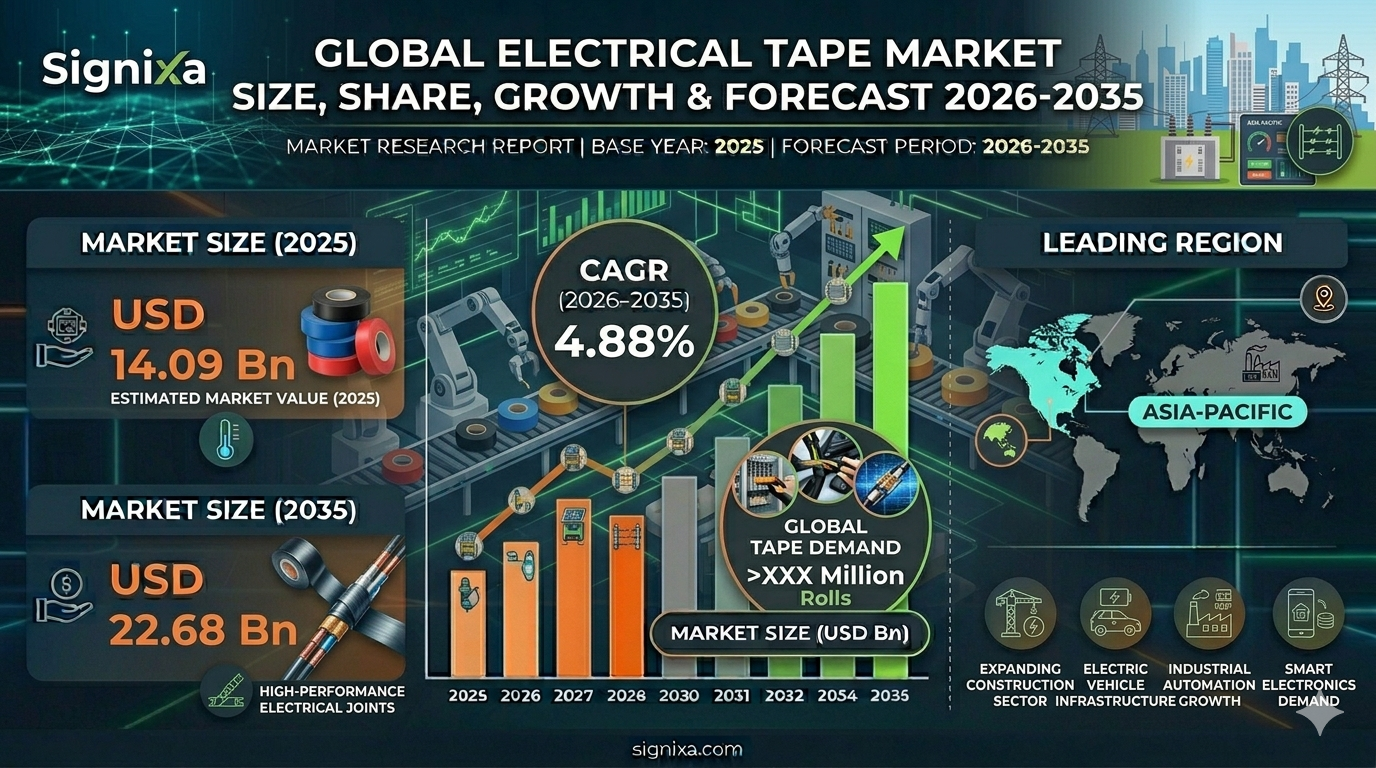
The size of the global Electrical Tape market was worth around USD 14.09 billion in 2025 and is predicted to grow to around USD 22.68 billion by 2035, with a compound annual growth rate (CAGR) of roughly 4.88% between 2026 and 2035. The report analyzes the Electrical Tape market's drivers and restraints, as well as the impact they have on demand throughout the projection period. In addition, the report examines global opportunities in the global Electrical Tape market.
The electrical tape market is an important segment of the electrical and electronics industry, fulfilling insulation, protection, and bundling requirements for wiring systems across various contexts. The market growth is driven by the growing demand for energy-efficient electrical infrastructure, increasing investment in power distribution systems, and the prevalence of smart grid technologies. Additionally, the growth in the aerospace and industrial sector is driving consumption of specialized electrical tapes that meet strict safety and durability requirements.
The electrical tape market plays a key role in the electrical and electronics sectors, serving as a crucial insulating material for wiring, cable joints, and splices. Made from materials like PVC, rubber, and vinyl, electrical tapes are designed to resist moisture, corrosion, abrasion, and fluctuating temperatures, making them ideal for both domestic and industrial applications. The growing demand for energy infrastructure, consumer electronics, and electric vehicles has directly fuelled the use of reliable and high-performance electrical insulation solutions. Flame-retardant and weatherproof variants are gaining popularity in outdoor and high-voltage settings. Moreover, the construction sector's expansion, especially in emerging economies, is pushing the demand for safe electrical installations, thereby boosting market growth. Manufacturers are focusing on innovations such as UV-resistant, biodegradable, and color-coded tapes to meet specific industry standards and environmental expectations. In addition, the rise in smart home systems and IoT devices is also driving low-voltage applications, further contributing to market expansion. North America and Asia Pacific remain major hubs due to their robust electronics manufacturing bases and continuous infrastructure upgrades. Online distribution channels and retail hardware stores are expanding accessibility for both professional and DIY users. As safety standards tighten and advanced technologies evolve, the electrical tape market is poised to see consistent innovation and adoption across diverse sectors.
Key Findings
- As per the analysis shared by our research analyst, the global Electrical Tape market is estimated to grow annually at a CAGR of around 4.88% over the forecast period (2026-2035).
- In terms of revenue, the global Electrical Tape market size was valued at around USD 14.09 Billion in 2025 and is projected to reach USD 22.68 billion by 2035.
- The market is projected to grow at a steady pace due to increasing investments in power distribution networks and demand for flame-retardant, high-temperature resistant tapes.
- Based on Material, the PVC segment is anticipated to dominate the global market due to its cost-effectiveness and insulating properties.
- On the basis of Application, the Electrical & Electronics segment is expected to lead in market share.
- By Region, Asia-Pacific is projected to dominate the global market during the forecast period.
Electrical Tape Market Dynamics
Rising Demand for Safe Electrical Systems & Modernizing Power Infrastructure Driving Tape Market Growth
The increasing demand for safe and efficient electrical systems in industrial, residential, and commercial roles is a key component of the growth of the electrical tape market. Electrical tapes are widely used to insulate and protect wires, cables, and electrical components. As countries modernize their power transmission infrastructure and improve renewable energy integration, the demand for electrical insulation materials is escalating. Additionally, electrical tapes are not only one of the most affordable electrical protection/insulation products available but are also simple to apply and remove. Electrical tapes provide positive evidence that they have provided the insulated wiring quality that exists in one-time or limited-use projects and engineered designs.
Aerospace & Defense Industry Growth Accelerating Demand for High-Performance Specialty Electrical Tapes
The aerospace and defense industry's rapid growth continues to drive demand for high-performance electrical tapes. For aerospace and defense industries to utilize electrical tapes, these tapes need excellent thermal stability, fire resistance, and mechanical strength under difficult conditions. Some specialty tapes made from glass cloth or PET have been proven capable, which is encouraging more users to adopt these high-performance products in wiring systems, avionics, and military-grade electronics. As a result, this trend is driving steady growth in the market into more technical and demanding applications.
Electrical Tape Market Segmentation Analysis
By Material Segment Analysis
The market is segmented by material type, with each offering distinct insulation performance, temperature resistance, and end-use suitability across residential, commercial, industrial, and specialty applications globally:
PVC (Polyvinyl Chloride)
PVC tapes have the largest market share in terms of Material in 2025, as they tend to be flexible, insulated, and inexpensive. In 2025, PVC made up just over 55% of the total global market, as there are many residential and commercial wire applications that use PVC electrical tapes. PVC tapes are widely used in various industries due to their excellent insulation, flexibility, and durability. Made from polyvinyl chloride film and coated with a rubber-based or acrylic adhesive, these tapes are ideal for electrical insulation, color coding, bundling wires, and general-purpose sealing. They offer strong resistance to abrasion, moisture, acids, and UV radiation, making them suitable for both indoor and outdoor applications. PVC tapes are especially favoured in electrical and automotive sectors where secure and long-lasting insulation is critical. Their flame-retardant properties add an extra layer of safety in high-risk environments. In construction and HVAC industries, they are used to wrap air ducts, seal joints, and reinforce protective layers. The availability of PVC tapes in a wide range of colors, widths, and thicknesses allows users to meet specific project needs. With increasing urbanization and the growth of smart infrastructure, demand for reliable insulation and cable management solutions is driving the PVC tape market forward. Additionally, manufacturers are innovating with low-VOC and eco-friendly adhesive options in response to stricter environmental standards. Asia Pacific dominates production and consumption, supported by large-scale manufacturing in China and India.
Glass Cloth
Glass cloth electrical tapes have a larger market than previous years, although the cost is higher, especially given the new restrictions regarding the environmental sustainability of tapes. Glass cloth electrical tapes could become more widespread in aerospace and heavy-duty industry applications with high mechanical resistance and thermal resistance requirements. Their superior performance under elevated temperatures and mechanical stress makes them indispensable in wiring systems requiring long-term reliability. The segment benefits from growing aircraft production volumes and expanding industrial automation programs that demand durable and certified insulation solutions capable of meeting stringent international safety standards.
PET (Polyethylene Terephthalate)
PET-based tapes have a higher dielectric strength and are suitable for new manufacturing applications in electronics and electric vehicle wiring. Their excellent dimensional stability, chemical resistance, and ability to perform reliably in high-temperature environments make them a preferred choice for precision applications. As electric vehicle production scales and consumer electronics continue to miniaturize, the demand for compact, high-performance tapes with superior insulation properties is accelerating adoption of PET-based solutions across advanced manufacturing sectors globally.
Others
The Others segment encompasses specialty electrical tape materials including rubber, mastic, silicone, and polyimide variants, each offering unique performance attributes for demanding applications. Rubber-based tapes provide excellent self-fusing properties for high-voltage cable splicing and repairs. Mastic tapes are widely used for moisture-sealing applications in underground and outdoor installations. Silicone tapes offer exceptional performance at extreme temperatures, making them ideal for aerospace and industrial furnace applications. Polyimide tapes serve semiconductor and electronics manufacturing where ultra-thin, high-temperature stable insulation is required. Growing environmental regulations are also encouraging the development of halogen-free and recyclable variants within this segment.
By Application Segment Analysis
Electrical & Electronics
In 2025, by Application, the electrical & electronics segment accounted for the largest and recorded greater than 45% of the global revenues. The segment is growing due to the increase in global consumer demand for electronic devices, the increasing complexity of printed circuit boards, and the growing smart appliances market. The electrical and electronics segment is a major consumer of adhesive tapes, particularly PVC electrical tapes, due to their essential role in insulation, protection, and wire management. These tapes are widely used for insulating cables, splicing wires, color coding, and bundling in a range of devices and installations. Their dielectric strength, resistance to heat, moisture, and corrosion, and flame-retardant properties make them indispensable in both low- and high-voltage applications. With rapid advancements in consumer electronics, industrial automation, and renewable energy systems, the demand for reliable insulation solutions is growing. In electronics manufacturing, precision tapes are used for masking during soldering, shielding from electromagnetic interference, and protecting sensitive components. Moreover, as electric vehicles and smart devices gain popularity, the need for compact, heat-resistant, and durable tapes increases. Manufacturers are developing tapes with improved temperature tolerance and compliance with RoHS and REACH standards. Asia Pacific, particularly China, Japan, and South Korea, leads the production of electronic components and thus drives tape usage significantly.
Aerospace
The aerospace applications segment is on the rise due to increased numbers of aircraft being manufactured and the electrification of aircraft systems. Electrical tapes used in aerospace must meet stringent specifications for thermal stability, flame resistance, and mechanical durability under extreme operating conditions. Specialty tapes made from glass cloth and PET substrates are increasingly specified in avionics wiring harnesses, engine compartment installations, and military-grade electronic assemblies. The global expansion of commercial aviation and the accelerating development of next-generation aircraft platforms are creating sustained demand for certified, high-performance electrical insulation tape solutions throughout the forecast period.
Industrial
The industrial segment is expected to grow steadily, due to increasing automation where electrical tapes are being used to insulate wiring in machines and control systems. In industrial settings, electrical tapes play a critical role in protecting cables from mechanical abrasion, chemical exposure, and thermal stress in manufacturing plants, processing facilities, and logistics infrastructure. The growing adoption of robotics, programmable logic controllers, and automated production lines is generating sustained demand for durable, high-performance insulation tape solutions. Specialty variants including high-temperature resistant and chemical-proof tapes are increasingly preferred for demanding industrial environments where standard PVC tapes may not provide adequate protection.
Others
The Others segment encompasses diverse applications including construction, automotive wiring harnesses, renewable energy installations, and DIY consumer use. In construction, electrical tapes are essential for wire bundling, junction protection, and maintenance of power distribution systems. The automotive sector relies heavily on color-coded and flame-retardant tapes for vehicle wiring harnesses and component protection. Renewable energy applications, particularly solar panel installations and wind energy systems, require UV-resistant and weatherproof tape variants capable of withstanding long-term outdoor exposure. The growing DIY consumer segment, supported by expanding e-commerce and retail availability, continues to broaden the addressable market for standard PVC electrical tapes across residential maintenance and improvement applications.
Report Attributes & Market Scope
| Report Attribute | Details |
|---|---|
| Market Size Value in 2025 | USD 14.09 Billion |
| Market Size Value in 2035 | USD 22.68 Billion |
| CAGR (2026–2035) | 4.88% |
| Base Year Used for Estimation | 2025 |
| Historic Data | 2020 - 2025 |
| Forecast Period | 2026 - 2035 |
| Segments Covered – By Material |
|
| Segments Covered – By Application |
|
| Regions Covered | North America, Europe, Asia Pacific, Latin America, Middle East and Africa |
| Major Countries Covered | U.S., Canada, Mexico, Germany, UK, France, Italy, Spain, Russia, China, Japan, South Korea, India, Southeast Asia Countries, Brazil, Argentina, GCC Countries, Turkey, Iran, Israel, South Africa, Egypt, Nigeria, etc. |
| Key Companies Profiled | 3M, Tesa SE, Avery Dennison Corporation, Intertape Polymer Group, Nitto Denko Corporation, Scapa Group Ltd., HellermannTyton, Shurtape Technologies LLC, Saint-Gobain, and Advance Tapes, among others. |
Electrical Tape Market Regional Analysis
The Electrical Tape market is primarily dominated by the Asia-Pacific region, responsible for more than 40% of global revenue in 2025, due to rapid industrialization, high level of construction activity, and large-scale investments in power generation and transmission projects. Electrical tapes will continue to be demanded in the region due to industrialized nations such as China, India, and Japan being some of the largest electrical tape consumers for infrastructure construction and electronics manufacturing. North America and Europe are considered mature markets with demand in aerospace innovation and rigorous safety standards in electrical systems driving the use of electrical design and protection standards. Middle East/Africa emerging regions have heightened demand for electrical insulation solutions and investing in infrastructure projects will drive new/upgrade solutions and be considered a consistent area of growth. Demand within Latin America is emerging but could increase rapidly as electrical insulation projects increase or construction of any kind takes off.
Asia-Pacific (Dominant Region)
Asia-Pacific is the largest and fastest growing regional market, responsible for more than 40% of global revenue in 2025, due to rapid industrialization, high level of construction activity, and large-scale investments in power generation and transmission projects. China, India, and Japan are some of the largest electrical tape consumers for infrastructure construction and electronics manufacturing. The region benefits from a massive and expanding electronics manufacturing base, particularly in China and South Korea, which drives substantial consumption of PVC and specialty tapes across circuit board production, consumer electronics assembly, and EV battery manufacturing. Government-led infrastructure modernization programs, expanding renewable energy installations, and the rapid growth of smart grid projects across the region are creating sustained volume demand. Rising urbanization and construction activity in emerging Southeast Asian economies are further broadening the addressable market for standard electrical insulation tape solutions throughout the forecast period.
North America
In North America, the electrical tape market is driven by robust industrial infrastructure, widespread adoption of smart technologies, and high demand for reliable insulation materials across various sectors. The region's strong electrical and electronics manufacturing base — particularly in the U.S. — contributes significantly to the consumption of PVC and specialty tapes used for insulation, circuit protection, and component assembly. With the increasing focus on grid modernization, electrification of transport, and deployment of renewable energy systems, electrical tapes play a crucial role in ensuring safety and efficiency in installations. The construction industry also accounts for a substantial share, using tapes for wire harnessing, junction protection, and maintenance of power lines. Regulatory bodies such as UL (Underwriters Laboratories) and CSA (Canadian Standards Association) enforce strict safety and performance standards, pushing manufacturers to innovate with flame-retardant, low-VOC, and eco-compliant materials. Additionally, the North American region has witnessed an uptick in demand for tapes in automotive manufacturing — especially electric vehicles — as well as in data centers and telecommunications infrastructure, where EMI shielding and thermal management tapes are essential. The presence of technologically advanced production facilities, a mature consumer base, and growing investments in smart grids and electric mobility continue to solidify North America's position as a key player in the global electrical tape market. The U.S. leads, with Canada following as a supportive secondary market.
Europe
Europe's electrical tape market is characterized by its strong emphasis on safety standards, energy efficiency, and sustainable product development. Countries such as Germany, France, the UK, and Italy serve as industrial hubs where electrical tapes are vital for manufacturing, construction, and power distribution systems. The region's push toward renewable energy integration and electric mobility — aligned with the European Green Deal — has increased the demand for high-performance insulation and protective materials. Electrical tapes are widely utilized in solar panel installations, electric vehicle battery packs, and wind energy systems to ensure thermal stability, moisture resistance, and long-term durability. The continent's aging electrical infrastructure has spurred retrofitting activities, boosting tape consumption in grid upgrades, cable wrapping, and splicing applications. Additionally, the automotive sector — particularly in Germany — is heavily reliant on advanced tapes for wire harnessing and EMI shielding in both conventional and electric vehicles. Regulatory mandates from the European Chemicals Agency (ECHA) and REACH regulations compel manufacturers to develop low-emission, halogen-free, and recyclable products. This focus on environmental compliance fuels innovation in material science, with a shift toward silicone, PET, and polyimide-based tapes. With a mature but evolving market, Europe is expected to maintain steady growth supported by ongoing digitalization, industrial automation, and smart grid projects.
Middle East & Africa
The Middle East & Africa (MEA) electrical tape market is evolving steadily, driven by expanding infrastructure, rising power demand, and growing industrialization. Countries such as the United Arab Emirates, Saudi Arabia, and South Africa are leading the regional development, with major investments in energy, construction, and transportation projects. As smart city initiatives and power distribution upgrades gain momentum, the demand for electrical tapes in cable management, insulation, and safety sealing applications is rising. The adoption of renewable energy sources, particularly solar power in the Gulf and wind energy in parts of North Africa, also necessitates durable and UV-resistant electrical tapes suited for harsh environments. In Africa, electrification efforts supported by regional governments and international aid programs are creating new opportunities. Electrical tapes are increasingly used in off-grid systems, residential wiring, and small industrial applications. The need for affordable, reliable, and easy-to-apply solutions favours PVC-based tapes, while heat-resistant and flame-retardant variants gain traction in industrial and automotive settings. Regional regulations related to fire safety and electrical codes are gradually tightening, encouraging the use of standardized and certified products. Import dependence remains high, though local manufacturing initiatives — especially in the UAE and Egypt — are beginning to emerge. As MEA moves toward digital connectivity and energy diversification, electrical tapes play a critical role in ensuring safe and efficient systems. The market is further supported by infrastructure resilience programs, oil & gas sector maintenance, and growing urbanization trends, making MEA a promising yet underpenetrated region for future growth.
Latin America
Demand within Latin America is emerging but could increase rapidly as electrical insulation projects increase or construction of any kind takes off. Brazil and Argentina are the primary contributors, each benefiting from expanding construction activity, growing industrial sectors, and government-led electrification and grid modernization programs that are increasing the consumption of electrical insulation products across residential, commercial, and industrial applications. The expansion of renewable energy installations, particularly solar and wind projects in Brazil and Chile, is creating additional demand for UV-resistant and weatherproof tape variants suited for outdoor and high-exposure environments. Mexico's growing manufacturing sector, including automotive and electronics assembly for export markets, is also contributing to increased consumption of specialty and standard electrical tapes. While import dependency remains a challenge, improving distribution infrastructure and the entry of international tape manufacturers into the regional market are expanding product availability and supporting steady demand growth through the forecast period.
Recent Developments in the Electrical Tape Market
-
2023
3M launched a new range of PVC electrical tapes with enhanced flame-retardant and stretchability properties, aimed at high-voltage applications.
-
2022
Tesa SE introduced glass cloth tapes with self-extinguishing properties for aerospace and heavy industrial use.
Electrical Tape Market: Competitive Landscape
The global electrical tape market is dominated by several prominent firms: 3M, Tesa SE, Avery Dennison Corporation, Intertape Polymer Group, Nitto Denko Corporation, Scapa Group Ltd., HellermannTyton, Shurtape Technologies LLC, Saint-Gobain, and Advance Tapes. These companies are focused on creating high-performance tapes that are compliant with prevailing industry regulations to accommodate rising application demands. Key competitive factors also include innovation in product performance, durability, flame resistance, and environmentally friendly options. To remain in a leadership position while seizing opportunities in emerging markets, these industry giants typically implement objectives such as strategic partnerships, expanding to new regions, and increasing investments in research and development.
The competitive landscape of the electrical tape market is shaped by a mix of global leaders, regional manufacturers, and niche players focusing on specialized applications. Intense competition has led to continuous product innovations, especially in the development of flame-retardant, high-voltage resistant, and environment-specific tapes. Many companies are expanding their product portfolios to cater to varied industrial needs, including high-temperature, UV-resistant, and waterproof variants suited for sectors like automotive, construction, and renewable energy.
Technological integration into product lines — such as tapes with enhanced adhesive strength, thermal insulation, and corrosion protection — is gaining momentum. Advanced formulations using materials like rubber, mastic, and silicone are increasingly adopted for heavy-duty or specialty applications. Meanwhile, sustainability is a growing theme, prompting research into eco-friendly tapes made from recyclable or biodegradable materials. Research and development (R&D) investments are also rising, aiming to improve tape performance in extreme environments. Product testing and certifications are crucial, with emphasis on safety, compliance with international electrical standards, and durability. Customization for application-specific demands — such as color-coded tapes for wire identification or anti-corrosion coatings for marine environments — adds to market differentiation. Strategic partnerships with OEMs and construction contractors, along with expanding distribution networks through e-commerce and retail, are common strategies. Regional players are leveraging local manufacturing advantages, while global firms emphasize branding, innovation, and reliability. The landscape remains dynamic with constant efforts to balance performance, safety, and cost-effectiveness.
Key Companies Profiled
Global Electrical Tape Market Segmentation Summary
By Material
By Application
By Region
Frequently Asked Questions (FAQs) About the Electrical Tape Market
What is Electrical Tape?
Electrical tape is a pressure-sensitive adhesive tape used to insulate and protect electrical wires and components. It is typically made from PVC, glass cloth, PET, or rubber-based materials and is widely applied in sectors such as construction, electronics, automotive, and power distribution.
Which key factors will influence the Electrical Tape market growth over 2026–2035?
The global electrical tape market is expected to grow due to increasing demand for high-performance insulating materials, rising infrastructure and construction projects, growing adoption in electric vehicles, and innovations in flame-retardant and heat-resistant tapes.
What will be the value of the Electrical Tape market during 2026–2035?
According to the study, the global electrical tape market size was worth around USD 14.09 billion in 2025 and is predicted to grow to around USD 22.68 billion by 2035.
What will be the CAGR value of the Electrical Tape market during 2026–2035?
The CAGR value of the electrical tape market is expected to be around 4.88% during 2026–2035.
Which region will contribute notably towards the Electrical Tape market value?
The global electrical tape market is led by the Asia-Pacific region, driven by rapid industrialization, expansion of the electronics industry, and infrastructure development, particularly in China, India, and Southeast Asia.
Which are the major players leveraging the Electrical Tape market growth?
The global electrical tape market is led by players such as 3M Company, Tesa SE, Avery Dennison Corporation, Nitto Denko Corporation, Intertape Polymer Group, Scapa Group Ltd., Shurtape Technologies LLC, HellermannTyton, Saint-Gobain, and Advance Tapes.
What can be expected from the global Electrical Tape market report?
The report explores crucial aspects of the electrical tape market, including a detailed discussion of existing growth factors and restraints while also analyzing future growth opportunities and challenges that impact the market.