

Charging as a Service (CaaS) Market Overview
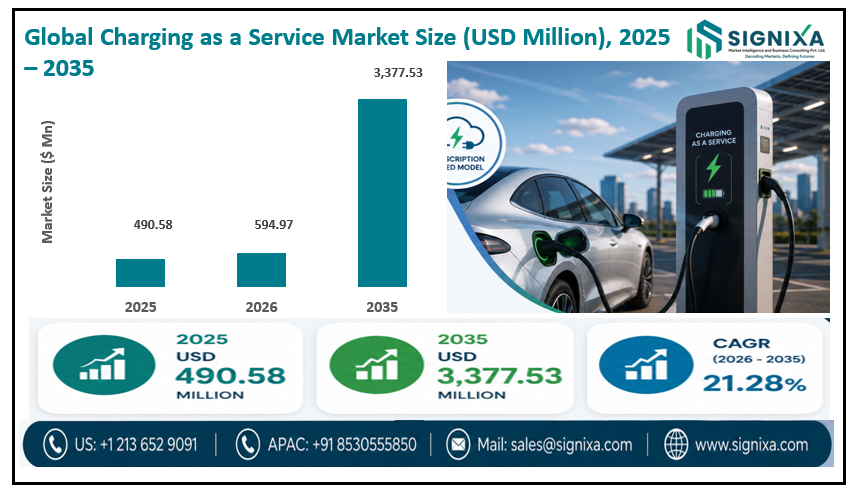
The size of the global Charging as a Service market was worth around USD 490.58 Million in 2025 and is predicted to grow to around USD 3,377.53 Million by 2035, with a compound annual growth rate (CAGR) of roughly 21.20% between 2026 and 2035. The report analyzes the Charging as a Service market's drivers and restraints, as well as the impact they have on demand throughout the projection period. In addition, the report examines global opportunities in the global Charging as a Service market.
The Charging-as-a-Service (CaaS) market offers end-to-end EV charging solutions through subscription or pay-per-use models, eliminating upfront infrastructure investment for fleet operators and commercial users. It includes hardware, software, installation, maintenance, and energy management services. Driven by rising electric vehicle adoption, supportive government policies, and demand for scalable, cost-efficient charging, CaaS ensures reliable uptime and simplified fleet electrification. Major stakeholders include utility providers, mobility-as-a-service operators, and charging network providers. The market is expanding rapidly across North America, Europe, and Asia Pacific due to growing EV infrastructure needs.
The CaaS market is gaining momentum as electric vehicle (EV) adoption surges globally, prompting the need for flexible, accessible, and scalable charging infrastructure. CaaS offers a subscription- or pay-per-use-based model, enabling fleet operators, businesses, and individual users to access charging solutions without the burden of owning or maintaining the infrastructure. This model supports a shift toward operational efficiency and cost predictability, especially for logistics fleets, ride-hailing services, and corporate mobility programs. Providers manage everything from hardware installation and software integration to maintenance and energy management, creating a turnkey solution for clients. Advancements in software platforms allow remote monitoring, energy optimization, and fleet analytics, making CaaS a vital component of smart mobility ecosystems. Moreover, partnerships between EV manufacturers, energy providers, and tech firms are fueling the rollout of robust CaaS networks across urban and highway corridors.
Key Findings
- The global Charging as a Service market is estimated to grow annually at a CAGR of around 21.20% over the forecast period (2026-2035).
- The global CaaS market was valued at around USD 490.58 Million in 2025 and is projected to reach USD 3,377.53 Million by 2035.
- The Commercial segment is the largest application, driven by fleet electrification demand; commercial EV fleets are expected to surpass 15 Million by 2030.
- Global public EV charging points exceeded 4 Million in 2023 (IEA), accelerating Hosted model adoption in retail, office, and hospitality sectors.
- Global EV stock surpassed 40 Million electric vehicles in 2023, while the majority of EV owners prefer home charging, driving residential CaaS growth.
- The U.S. Infrastructure Investment and Jobs Act provides USD 7.5 Billion for EV charging infrastructure, a major policy tailwind for CaaS providers.
- By Region, North America is projected to dominate the global market during the forecast period, with Europe and Asia-Pacific rapidly emerging.
Charging as a Service Market Dynamics
Exponential EV Adoption & Fleet Electrification Wave
The CaaS market is evolving rapidly due to the exponential growth in the adoption of electric vehicles, as well as the increased need for flexible, scalable EV infrastructure. Businesses and fleets are increasingly converting to electric mobility, which creates an expanded need for lightweight or hassle-free charging separately from heavy capital expenses. Government incentives and emission reduction legislation are pushing companies toward sustainable transportation models, as well. In tandem, the demand for managed charging services that provide operational efficiency, grid optimization, and lower total cost of ownership across common public and private EV fleets has been accelerating.
With global EV sales expected to surpass 17 Million vehicles by 2026, fleet operators and individual users are interested in convenient, reliable means for charging vehicles. CaaS provides an affordable, subscription-based service which does not require an upfront investment in infrastructure. Users can scale charging as their vehicles grow, affordably managing controlled charging, and facilitating broader EV adoption in urban and rural settings.
Government Policy U.S. Infrastructure Act & Global Emission Regulations
Governments globally are supporting the transition to electric mobility through subsidies, tax incentives, and emission regulations. For example, the U.S. Infrastructure Investment and Jobs Act provide USD 7.5 Billion for EV charging infrastructure. These policies help motivate businesses and municipalities to transition to electric vehicles (EVs), driving change and demand for charging solutions. Charging-as-a-Service providers are leveraging these changes to provide end-to-end solutions (design, installation, and maintenance) to deploy compliant charging infrastructure at a lower cost, while also modernizing the charging infrastructure of clients to be more future-ready. BloombergNEF estimates EV infrastructure investments will exceed USD 100 Billion a year by 2030, with financing options playing a critical role in enabling large-scale deployments.
Smart Charging Technology - AI Load Management, V2G, Renewable Integration & Fleet Analytics
Advancements in software platforms allow remote monitoring, energy optimization, and fleet analytics, making CaaS a vital component of smart mobility ecosystems. Innovation in AI-powered load management, vehicle-to-grid (V2G) solutions, and mobile-based user interfaces is enhancing service reliability and customer experience. Strategic partnerships with automotive manufacturers, utility companies, and urban planners are becoming crucial for scaling infrastructure. Additionally, the rise of interoperability standards and cross-border collaboration is encouraging new business models that prioritize flexibility and scalability. Firms are also competing by investing in ultra-fast charging technology, modular setups, and carbon-neutral charging operations.
Key Policy Benchmark: Global public EV charging points exceeded 4 Million in 2023 (IEA). The Hosted CaaS model is flourishing with greater commercialization partnerships as retail chains, office parks, and hotels adopt hosted service models to improve customer and employee experience without incurring initial costs or construction risks.
Charging as a Service Market Segmentation Analysis
By Service Model Segment Analysis
Subscription Model
The subscription model is the foundational CaaS offering, providing fleet operators, businesses, and individual users predictable monthly access to EV charging infrastructure including hardware, software, and maintenance -all without upfront capital expenditure. This model is especially popular among logistics companies, corporate campuses, and municipal transport systems that need scalable, predictable charging budgets. Providers manage everything from installation and monitoring to energy optimization, creating a truly turnkey solution. The subscription model supports broader EV adoption by reducing the financial barrier to infrastructure deployment, particularly among mid-size enterprises and public sector organizations transitioning to electric fleets.
Hosted Model
The Hosted model consists of a third-party provider owning, operating, and maintaining the EV charging station on behalf of the client at the client's location. For businesses, this is a win-win situation because they can offer EV charging to their customers or employees without the burden of deciding whether to internally support the operation. While there are challenges in the public charging space, global public charging points exceeded 4 Million in 2023 (IEA), and the hosted model flourishes with greater commercialization partnerships. Retail chains, office parks, and hotels continue to adopt hosted service models with the anticipation of improving the customer experience and employee satisfaction without incurring initial costs and the corresponding construction risks.
Financed Model (PPAs, Loans & Leases)
In the financed model, customers receive customized financial support for EV charging infrastructure through loans, leases, or power purchase agreements (PPAs). This model is becoming attractive to municipalities and other large logistics companies that need to scale up but do not have upfront cash. BloombergNEF estimates EV infrastructure investments will exceed USD 100 Billion a year by 2030, and financing options will be very important. Companies like Blink Charging provide complete, financed options which allow customers to pay for their charging infrastructure over time, facilitate large-scale installations, and align sustainability metrics. This model is particularly suited to government agencies, housing authorities, and large commercial real estate operators.
By Charging Station Type Segment Analysis
AC Charging (Level 1 & Level 2)
AC charging stations, operating at Level 1 (120V) and Level 2 (240V), are the backbone of residential and workplace charging deployments within the CaaS ecosystem. These chargers are well-suited for overnight and workday charging scenarios where vehicles can dwell for extended periods. CaaS providers deploy AC chargers extensively in residential complexes, corporate parking facilities, hotels, and retail locations under hosted and subscription models. Lower installation costs and smart energy management capabilities -including time-of-use pricing, load balancing, and V2G integration -make AC chargers the dominant volume segment in the CaaS market. Smart home integration and apartment shared-charging models further drive AC charger adoption in urban residential settings.
DC Fast Charging (Level 3 / DCFC)
DC fast charging (DCFC) stations represent the premium, high-growth segment within the CaaS market, enabling rapid charge sessions of 20-45 minutes suitable for public charging corridors, highway rest stops, fleet depots, and transit hubs. As cities push for electrification and emission reduction, demand for DC fast chargers -especially those with 150kW+ capacity -continues to accelerate. CaaS providers deploying DCFC under subscription and financed models serve fleet operators running electric buses, delivery vans, and commercial trucks that require high-power, fast-turnaround charging. Advancements in ultra-fast charging (350kW+) and modular charger architectures are enabling more cost-effective DCFC deployments at scale, a critical enabler for the CaaS market's growth trajectory.
By Application Segment Analysis
Commercial (Fleet, Workplace, Retail)
The commercial sector is by far the largest segment of the CaaS market based on the increased need for fleet electrification, workplace charging, and public charging infrastructure. According to BloombergNEF, commercial EV fleets will surpass 15 Million by 2030. Boosting the need for enhanced CaaS offerings are Amazon and FedEx, who are investing significantly in electric delivery fleets. Furthermore, establishments in the retail and hospitality sectors have begun to install EV chargers as a means of attracting customers, as well as meeting a commercial demand cycle for superfleet electrification. Commercial demand is also driven by carbon neutral goals, cost savings for the establishment, and government action mandating sustainable mobility infrastructure.
Residential (Home Charging & Shared Apartment Models)
The residential sector is experiencing gradual growth with the rise of individual EV ownership. According to the IEA, global EV stock surpassed 40 Million electric vehicles in 2023, while the majority of EV owners prefer charging at home. CaaS providers are now offering home charger installations through a subscription or financing model, creating access for homeowners to predictable infrastructure contributions without significant upfront cost. Home charging developed for smart homes and tied to energy management systems has recently gained traction. In dense urban areas, unique models of shared residential charging are becoming appealing as new apartment living models continue to grow, further driving sector growth.
Report Attributes & Market Scope
| Report Attribute | Details |
|---|---|
| Market Size Value in 2025 | USD 490.58 Million |
| Market Size Value in 2035 | USD 3,377.53 Million |
| CAGR (2026-2035) | 21.20% |
| Base Year | 2025 |
| Historic Data | 2020-2025 |
| Forecast Period | 2026-2035 |
| Service Model Segments |
|
| Charging Station Segments |
|
| Application Segments |
|
| Regions Covered | North America, Europe, Asia Pacific, Latin America, Middle East and Africa |
| Major Countries Covered | U.S., Canada, Mexico, Germany, UK, France, Italy, Spain, Russia, China, Japan, South Korea, India, Southeast Asia Countries, Brazil, Argentina, GCC Countries, Turkey, Iran, Israel, South Africa, Egypt, Nigeria, etc. |
| Key Companies Profiled | SparkCharge, BPP Pulse Fleet, Hop Charge, TotalEnergies, Blink Charging, JIO-BP, EVSE Australia, Epec Tec, OBE Power, Tridens Technology, among others. |
Charging as a Service Market Regional Analysis
North America (Market Leader)
North America is a frontrunner in the CaaS market because of the existing and expanding EV infrastructure, strong government support, and increasing uptake of EVs in the U.S. and Canada. The availability of leading CaaS vendors such as ChargePoint and Blink Charging, combined with growth in commercial EV fleets, further solidifies North America's regional share. The U.S. and Canada are seeing increased deployment of subscription-based and pay-per-use charging models, especially for fleet operators and commercial entities seeking cost-effective electrification. Public-private partnerships are accelerating the rollout of smart charging networks, while innovations in energy management, remote monitoring, and fast charging enhance service quality. Urban centers prioritize scalable CaaS solutions for public transit and ride-sharing programs, with growing interest in renewable energy integration.
Europe
Europe is a frontrunner in the CaaS market, supported by strong regulatory frameworks, aggressive climate goals, and a rapidly growing electric vehicle (EV) fleet. Countries like Germany, the Netherlands, Norway, and the UK are leading the charge with widespread deployment of EV charging infrastructure and incentives for zero-emission mobility. The CaaS model is gaining traction among commercial fleet operators, logistics companies, and municipal transport systems looking to electrify their operations without the high upfront investment in charging hardware. European providers offer comprehensive services that include hardware installation, software integration, energy optimization, and ongoing maintenance under subscription or usage-based models. The rise of smart cities and demand for grid-friendly charging solutions is pushing the adoption of energy management tools, dynamic load balancing, and integration with renewable sources. Interoperability and cross-border charging accessibility are key priorities within the EU, making CaaS vital to achieving seamless EV mobility.
Asia-Pacific (Rapidly Emerging)
Asia Pacific is rapidly emerging as a key region in the CaaS market, driven by surging EV adoption, government incentives, and the growing need for scalable charging infrastructure. Countries like China, Japan, South Korea, and India are investing heavily in EV ecosystems, making CaaS an attractive model for both public and private sectors. In China, where EV sales dominate globally, tech-backed startups and state-owned enterprises are collaborating to deploy subscription-based charging solutions across urban and intercity networks. Japan and South Korea focus on integrating CaaS into smart cities and fleet operations, offering bundled services that include energy management and predictive maintenance. India's growing e-mobility segment, particularly in two-wheelers and last-mile delivery fleets, is fueling demand for low-cost, flexible charging access supported by mobile apps and cloud platforms. The region also benefits from a strong manufacturing base and innovation in fast-charging technology, enabling quicker deployments.
Middle East & Africa
The Middle East and Africa (MEA) region is gradually embracing the CaaS model, driven by the growing shift toward sustainable mobility, national decarbonization goals, and ambitious smart city developments. Countries like the UAE, Saudi Arabia, and South Africa are witnessing increased adoption of electric vehicles, prompting investment in flexible, scalable charging solutions that reduce upfront infrastructure costs. In the Gulf region, where sustainability is a core component of Vision 2030 strategies, governments are partnering with private players to deploy public and private EV charging networks powered by renewable energy. African nations are exploring CaaS to address infrastructure challenges, especially in urban centers and industrial hubs, where modular and mobile charging units can bridge power and access gaps. Digital platforms integrated with smart grids are being tested to optimize charging loads and improve energy efficiency.
Latin America
Latin America is an emerging market for Charging as a Service, with growing interest driven by urban mobility needs and green energy ambitions. Brazil, Mexico, and Colombia are the primary markets where EV adoption is beginning to accelerate, supported by government incentives and expanding middle-class purchasing power. The CaaS model is particularly appealing in Latin America because it eliminates the high upfront infrastructure costs that would otherwise slow EV adoption. E-mobility programs for two-wheelers and delivery vehicles in Brazilian and Mexican cities are creating early CaaS demand. International CaaS providers are increasingly exploring Latin America as a growth frontier, particularly in partnership with local utilities and digital platform providers.
Recent Developments
-
2022
Brighton and Hove City Council in the UK embarked on a significant initiative to enhance on-street electric vehicle (EV) charging infrastructure. As part of the government's £380 Million Local Electric Vehicle Infrastructure (LEVI) initiative, the council plans to install 6,000 lamppost-based EV charging points -the largest single installation of its kind in the country. This move aims to address the limited public recharging access, particularly benefiting the 40% of UK households without private driveways, demonstrating the massive scale of hosted CaaS deployment enabled by public policy.
-
2021
L-Charge, a global provider of sustainable off-grid EV charging technology, partnered with ride-hailing company Alto to expand EV fleet operations in Dallas, TX, and Los Angeles, CA. By utilizing L-Charge's rapid-deployment Charging-as-a-Service model, Alto can grow its electric fleet without incurring upfront hardware costs or relying on existing utility infrastructure. This collaboration exemplifies the growing trend of flexible, scalable charging solutions in the EV industry, particularly for ride-hailing and mobility-as-a-service operators seeking rapid fleet electrification.
Charging as a Service Market: Competitive Landscape
The global Charging as a Service market features major players such as SparkCharge, BPP Pulse Fleet, Hop Charge, TotalEnergies, Blink Charging, JIO-BP, EVSE Australia, Epec Tec, OBE Power, Tridens Technology, among others. The CaaS market is highly competitive, with major players driving technological advancements across a range of applications. Companies are competing on factors such as product innovation, cost-efficiency, geographical reach, and sustainability, which are all essential for gaining market share in the growing Charging as a Service industry.
The competitive landscape of the CaaS market is evolving rapidly, characterized by a mix of energy providers, mobility platform developers, infrastructure operators, and technology integrators. Companies are increasingly focused on delivering end-to-end solutions that include charging hardware, software platforms, real-time monitoring, maintenance, and energy optimization services. The market is witnessing intense competition as firms differentiate through pricing models, smart charging capabilities, integration with renewable energy sources, and support for fleet electrification. Customization for different sectors -such as last-mile delivery, public transportation, and corporate fleets -is a key trend, with providers offering tailored subscription-based models or pay-per-use plans. Innovation in AI-powered load management, vehicle-to-grid (V2G) solutions, and mobile-based user interfaces is enhancing service reliability and customer experience. Strategic partnerships with automotive manufacturers, utility companies, and urban planners are becoming crucial for scaling infrastructure.
Key Companies Profiled
- SparkCharge
- BPP Pulse Fleet
- Hop Charge
- TotalEnergies
- JIO-BP
- EVSE Australia
- Epec Tec
- OBE Power
- Tridens Technology
- ChargePoint, Inc.
- Blink Charging Co.
- EVgo Inc.
- Shell Recharge
- Tesla, Inc.
- ABB Ltd.
- Siemens AG
- Schneider Electric
- ENGIE
- E.ON Drive
- Tritium DCFC Limited
- Wallbox N.V.
- Electrify America
- Allego N.V.
Global Charging as a Service Market Segmentation Summary
By Service Model
- Subscription (Fleet & Corporate)
- Hosted (Retail, Hotels, Office Parks)
- Financed (PPAs, Loans, Leases)
By Charging Station Type
- AC Charging (Level 1 & 2 -Residential & Workplace)
- DC Fast Charging (Level 3 / DCFC -Public & Fleet)
By Application
- Commercial
- Residential
By Region
- North America
- U.S.
- Canada
- Mexico
- Europe
- Germany
- France
- UK
- Spain
- Italy
- Rest of Europe
- Asia-Pacific
- China
- Japan
- India
- Australia
- South Korea
- Southeast Asia
- Rest of Asia-Pacific
- Latin America
- Brazil
- Argentina
- Rest of Latin America
- The Middle East & Africa
- GCC Countries
- South Africa
- Rest of the Middle East & Africa
Frequently Asked Questions (FAQs): Charging as a Service Market
What is Charging as a Service (CaaS)?
Charging as a Service (CaaS) is a business model that provides electric vehicle (EV) charging infrastructure and services through subscription or pay-per-use, allowing users to access reliable charging without owning the equipment. It typically includes hardware, software, installation, maintenance, and energy management services.
Which key factors will influence the Charging as a Service market growth over 2026-2035?
Rising EV adoption, government incentives, growing urbanization, and demand for flexible, cost-effective charging infrastructure are key factors driving the Charging as a Service market, along with increasing investments in smart grid and renewable energy integration.
What will be the value of the Charging as a Service market during 2026-2035?
According to the study, the global Charging as a Service market size was worth around USD 404.5 Million in 2025 and is predicted to grow to around USD 3,377.53 Million by 2035.
What will be the CAGR value of the Charging as a Service market during 2026-2035?
The CAGR value of the Charging as a Service market is expected to be around 21.20% during 2026-2035 -one of the highest growth rates among all clean energy markets globally.
Which region will contribute notably towards the Charging as a Service market value?
North America dominates the Charging as a Service market due to widespread electric vehicle adoption, strong government support through the USD 7.5 Billion U.S. Infrastructure Investment and Jobs Act, established EV infrastructure, and investments by major players enhancing service accessibility, scalability, and grid integration across the region.
Which are the major players leveraging the Charging as a Service market growth?
The global Charging as a Service market is led by players such as SparkCharge, BPP Pulse Fleet, Hop Charge, TotalEnergies, Blink Charging, JIO-BP, EVSE Australia, Epec Tec, OBE Power, and Tridens Technology.
What can be expected from the global Charging as a Service market report?
The report explores crucial aspects of the Charging as a Service market, including a detailed discussion of existing growth factors and restraints while also analyzing future growth opportunities and challenges that impact the market.