
Baby Monitor Market Overview
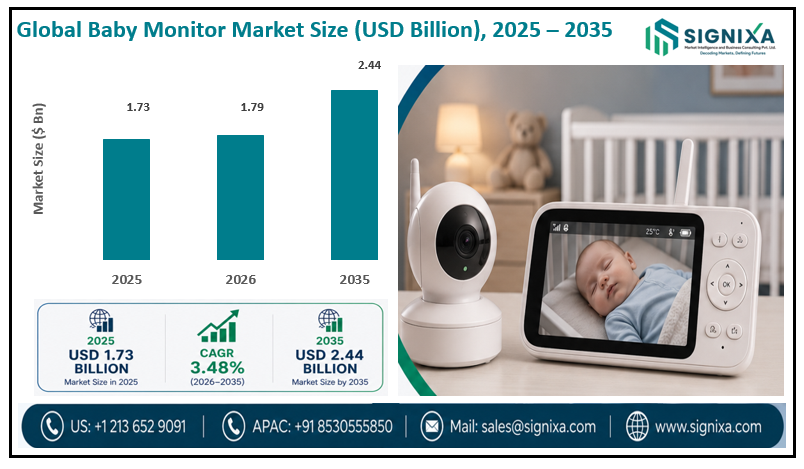
The global baby monitor market was valued at approximately USD 1.73 Billion in 2025 and is projected to reach around USD 2.44 Billion by 2035, growing at a compound annual growth rate (CAGR) of 3.48% between 2026 and 2035. The report provides an in-depth analysis of market trends, drivers, challenges, and regional dynamics, along with a comprehensive segmentation of the baby monitor market.
The baby monitor market includes audio, video, and contact-based monitoring systems designed for infant surveillance in residential and commercial settings. Increasing awareness about infant safety, a rise in dual-income households, and the growing integration of smart home technology are contributing to market growth. Modern baby monitors offer enhanced features such as HD video, temperature sensors, and smartphone connectivity, aligning with consumer preferences for convenient and real-time monitoring solutions.
The baby monitor market has evolved significantly from simple audio devices to sophisticated, internet-connected smart systems, driven primarily by heightened parental concerns for infant safety and security, coupled with the increasing prevalence of dual-income households. Modern parents, especially those with demanding work schedules or living in nuclear families, seek reliable solutions to monitor their infants remotely and ensure their well-being. This fundamental need for peace of mind fuels the demand for devices that can provide real-time updates on a baby's activities, sounds, and even vital signs. The shift from basic audio-only monitors to video monitors with features like night vision, two-way communication, and remote pan-and-tilt capabilities has been a major game-changer, offering parents greater visual reassurance and the ability to soothe their baby from another room. This constant pursuit of enhanced safety and convenience remains the core engine of market growth.
A significant market dynamic is the rapid integration of advanced technologies, particularly AI and IoT, into baby monitor systems. The convergence of smart home technologies with baby care products has led to the emergence of "smart baby monitors" that offer functionalities far beyond traditional monitoring. These advanced devices can connect to smartphones and tablets via Wi-Fi or Bluetooth, providing parents with remote access to live video feeds, audio, and even health data. The integration of Artificial Intelligence (AI) is transforming these monitors, enabling features such as crying detection, sleep pattern analysis, real-time health monitoring (heart rate, oxygen levels, temperature), and even face recognition and movement tracking. Furthermore, multi-device integration allows these smart monitors to connect with other home automation systems like smart speakers and thermostats, creating a more integrated and convenient parenting experience.
However, the baby monitor market also faces challenges, notably concerns regarding data privacy and cybersecurity, as well as the relatively high cost of advanced smart monitors. As baby monitors become increasingly connected to the internet and collect sensitive data (audio, video, and even health metrics), parents are growing more aware of and concerned about potential security vulnerabilities and privacy breaches. Manufacturers are responding by implementing robust encryption mechanisms and secure data storage solutions to build consumer trust and comply with data protection regulations like GDPR. Another factor influencing market dynamics is the price sensitivity, particularly in developing regions, leading to continued demand for more affordable, traditional, or basic smart monitors.
Key Findings
- The global baby monitor market is expected to grow at a CAGR of approximately 3.48% from 2026 to 2035.
- In 2025, the market was valued at USD 1.73 Billion and is projected to reach USD 2.44 Billion by 2035.
- Video Baby Monitors are expected to dominate the market due to increasing demand for visual monitoring solutions.
- Digital Baby Monitors will likely command the largest market share by technology.
- Two-Way Display Monitors are gaining traction among tech-savvy parents.
- Smartphone-enabled baby monitors are emerging as a popular category in connectivity.
- Residential use is projected to remain the dominant usage segment, and North America is expected to lead the market in revenue generation throughout the forecast period.
Baby Monitor Market Dynamics
Rise in Dual-Income Households Drives Demand for Remote Monitoring
One key factor driving growth in the baby monitor market is the rise in dual-income households. As more parents return to work shortly after childbirth, there is a growing reliance on advanced baby monitoring solutions that ensure infant safety remotely. Devices with two-way audio, temperature sensors, and night vision are becoming standard, reflecting consumer preferences for all-in-one, multi-functional baby monitors that reduce caregiving stress.
Integration into Smart Home Ecosystems
Another factor contributing to market growth is the increasing integration of baby monitors into smart home ecosystems. Manufacturers are incorporating features compatible with voice assistants like Alexa and Google Assistant, as well as app-based interfaces that allow real-time updates and alerts. This convergence of IoT and parenting technology is making baby monitors more appealing to tech-oriented families seeking seamless connectivity and control through smartphones and home automation systems.
Evolution from Basic Audio Devices to Connected Smart Systems
The baby monitor market has undergone a significant transformation, moving beyond simple audio devices to sophisticated, internet-connected smart systems, primarily driven by heightened parental concerns for infant safety and security, coupled with the increasing prevalence of dual-income and nuclear households. Modern parents, often balancing demanding careers with childcare responsibilities, seek reliable solutions that offer constant reassurance regarding their child's well-being, even when they cannot be physically present. This fundamental need for peace of mind has fuelled a shift from basic audio-only monitors to advanced video monitors, which often include features like night vision, two-way audio communication, and remote pan-and-tilt capabilities. The ability to visually confirm a baby's state, along with the convenience of communicating with them from another room, directly addresses key parental anxieties and lifestyle demands, making these devices indispensable tools for modern parenting and a core engine for continued market growth.
Rapid Integration of AI and IoT Technologies
A critical market dynamic is the rapid integration of cutting-edge technologies, particularly Artificial Intelligence (AI) and the Internet of Things (IoT), into baby monitor systems. The convergence with smart home technologies has led to the emergence of "smart baby monitors" that offer functionalities far exceeding traditional monitoring. These advanced devices seamlessly connect to smartphones and tablets via Wi-Fi or Bluetooth, providing parents with remote access to live video feeds, audio, and increasingly, real-time health data. AI integration is revolutionizing these monitors by enabling features such as crying detection, sophisticated sleep pattern analysis, real-time vital sign monitoring (e.g., heart rate, oxygen levels, temperature), and even movement tracking. Furthermore, multi-device integration allows these smart monitors to connect with other smart home systems like voice assistants and security cameras, creating a more cohesive and convenient home environment for parents. This continuous technological innovation, driven by consumer demand for more comprehensive, data-rich, and interconnected monitoring solutions, is actively reshaping the competitive landscape and pushing manufacturers to incorporate the latest advancements.
Data Privacy Concerns and Price Sensitivity
Despite the strong growth drivers and technological advancements, the baby monitor market faces significant challenges, notably concerns regarding data privacy and cybersecurity, as well as the price sensitivity of consumers, particularly in emerging markets. As baby monitors become more connected and capable of collecting highly sensitive data (audio, video, and personal health metrics), parental anxieties about potential security vulnerabilities, data breaches, and unauthorized access are rising. Manufacturers are compelled to address these concerns by investing heavily in robust encryption mechanisms, secure cloud storage, and adherence to global data protection regulations (like GDPR) to build and maintain consumer trust. Furthermore, while advanced, AI-enabled smart monitors offer a wealth of features, their higher price point can act as a barrier for a considerable segment of the population, especially in developing regions where disposable incomes may be lower. This necessitates a strategic balance between incorporating cutting-edge features and offering more affordable, feature-optimized models to cater to a broader consumer base, ensuring sustained market expansion amidst a competitive environment.
Baby Monitor Market Segmentation Analysis
By Type Segment Analysis
By Type, Video baby monitors dominate the global market as they provide real-time video streaming, night vision, and zoom functionalities, which are particularly useful for monitoring infants while performing household tasks. As of 2025, video monitors accounted for more than 65% of total market revenue. The visual reassurance they provide enhances their perceived value, especially among first-time parents concerned about infant well-being. Audio monitors, while cost-effective, are gradually losing share due to their limited functionality.
Video Baby Monitors
Video baby monitors dominate the global market as they provide real-time video streaming, night vision, and zoom functionalities, particularly useful for monitoring infants while performing household tasks, accounting for more than 65% of total market revenue in 2025.
Audio Baby Monitors
Audio monitors, while cost-effective, are gradually losing share due to their limited functionality compared to video and smart alternatives.
Contact Baby Monitors
Contact baby monitors are increasingly deployed in commercial settings such as daycare centers and maternity clinics for continuous physiological monitoring, though they still represent a smaller portion of the overall market.
By Technology Segment Analysis
By Technology, Digital baby monitors are forecast to lead the technology segment, accounting for over 70% of the market share in 2025. These devices offer better sound quality, reduced interference, and encrypted signals compared to analog monitors. Hybrid digital baby monitors, which combine digital signals with Wi-Fi capabilities, are expected to witness strong growth as they address privacy concerns while offering smartphone connectivity. Analog monitors are declining in popularity due to signal instability and security vulnerabilities.
Digital Baby Monitors
Digital baby monitors are forecast to lead the technology segment, accounting for over 70% of the market share in 2025, offering better sound quality, reduced interference, and encrypted signals compared to analog monitors.
Digital Hybrid Baby Monitors
Digital hybrid baby monitors, which combine digital signals with Wi-Fi capabilities, are expected to witness strong growth as they address privacy concerns while offering smartphone connectivity.
Analog Baby Monitors
Analog monitors are declining in popularity due to signal instability and security vulnerabilities compared to digital alternatives.
By Display Segment Analysis
By Display, Two-way display monitors are projected to grow significantly, capturing more than 45% of the display segment by 2035. These monitors allow caregivers to see and speak to the baby, creating an interactive environment. One-way display monitors, while still popular, are often limited to video-only communication. Monitors without displays are usually app-dependent and are preferred by tech-savvy users who want to view baby activity directly on their mobile devices.
Two-Way Display
Two-way display monitors are projected to grow significantly, capturing more than 45% of the display segment by 2035, allowing caregivers to see and speak to the baby and creating an interactive environment.
One-Way Display
One-way display monitors, while still popular, are often limited to video-only communication without the ability for caregivers to speak back to the child.
No Display
Monitors without displays are usually app-dependent and are preferred by tech-savvy users who want to view baby activity directly on their mobile devices.
By Connectivity Segment Analysis
By Connectivity, Wireless baby monitors held the largest share of the market in 2025, accounting for over 55% of global revenue. Their flexibility, portability, and ability to cover wide monitoring areas make them popular. Smartphone-enabled monitors are the fastest-growing segment, expected to register a CAGR above 5% during the forecast period, driven by the increasing penetration of smartphones and demand for app-based control. Wired monitors are gradually becoming obsolete due to limited range and setup complexity.
Wireless Baby Monitors
Wireless baby monitors held the largest share of the market in 2025, accounting for over 55% of global revenue, valued for their flexibility, portability, and ability to cover wide monitoring areas.
Smartphone-Enabled Baby Monitors
Smartphone-enabled monitors are the fastest-growing segment, expected to register a CAGR above 5% during the forecast period, driven by the increasing penetration of smartphones and demand for app-based control.
Wired Baby Monitors
Wired monitors are gradually becoming obsolete due to limited range and setup complexity compared to wireless and smartphone-enabled alternatives.
By Usage Segment Analysis
By Usage, Residential applications dominate the baby monitor market, contributing to more than 85% of market revenue in 2025. The rising adoption of baby monitors in urban households, especially in nuclear families, is supporting this trend. In commercial settings such as daycare centers and maternity clinics, contact baby monitors are being increasingly deployed for continuous physiological monitoring, but they still represent a smaller portion of the market.
Residential
Residential applications dominate the baby monitor market, contributing to more than 85% of market revenue in 2025, supported by rising adoption of baby monitors in urban households, especially in nuclear families.
Commercial
In commercial settings such as daycare centers and maternity clinics, contact baby monitors are being increasingly deployed for continuous physiological monitoring, though they still represent a smaller portion of the overall market.
Report Attributes & Market Scope
| Report Attribute | Details |
|---|---|
| Market Size Value in 2025 | USD 1.73 Billion |
| Market Size Value in 2035 | USD 2.44 Billion |
| CAGR (2026–2035) | 3.48% |
| Base Year Used for Estimation | 2025 |
| Historic Data | 2020 - 2025 |
| Forecast Period | 2026 - 2035 |
| Segments Covered – By Type |
|
| Segments Covered – By Technology |
|
| Segments Covered – By Display |
|
| Segments Covered – By Connectivity |
|
| Segments Covered – By Usage |
|
| Regions Covered | North America, Europe, Asia Pacific, Latin America, Middle East and Africa |
| Major Countries Covered | U.S., Canada, Mexico, Germany, UK, France, Italy, Spain, Russia, China, Japan, South Korea, India, Southeast Asia Countries, Brazil, Argentina, GCC Countries, Turkey, Iran, Israel, South Africa, Egypt, Nigeria, etc. |
| Key Companies Profiled | Motorola Mobility LLC, Owlet Baby Care Inc., VTech Holdings Ltd., Nanit, Angelcare Monitor Inc., Samsung Electronics Co. Ltd., Arlo Technologies Inc., iBaby Labs Inc., Summer Infant Inc., and Dorel Industries Inc. |
Baby Monitor Market Regional Analysis
North America led the global baby monitor market in 2025, accounting for over 40% of total revenue. High disposable income, early technology adoption, and the presence of leading manufacturers such as VTech, Motorola, and Infant Optics contribute to regional dominance. Europe follows, driven by growing awareness of child safety and favourable regulations. The Asia-Pacific region is the fastest-growing market, driven by urbanization, rising birth rates, and increasing use of smart home technologies in countries like China, Japan, and India.
North America (Dominant Region)
North America represents a significant and highly sophisticated market for baby monitors, driven by a confluence of factors including high disposable incomes, increasing parental concerns for child safety, and a strong propensity for adopting advanced consumer technologies. The United States and Canada are particularly strong markets, with a growing number of working parents seeking reliable solutions to monitor their infants remotely. This has led to a dominant demand for video baby monitors, often equipped with high-resolution imaging, night vision, and remote pan-and-tilt capabilities, offering comprehensive visual and auditory reassurance. The region is also at the forefront of integrating smart home technologies with baby monitoring, leading to a surge in demand for Wi-Fi-enabled and app-connected monitors. These smart monitors offer advanced features like AI-powered crying detection, sleep tracking, and even vital sign monitoring, leveraging parents' comfort with smartphones and mobile applications. The presence of key market players and a robust e-commerce infrastructure further supports the strong growth and continuous innovation in this region.
Europe
The European baby monitor market is characterized by a high awareness of child safety and a preference for products that combine advanced technology with user-friendliness and reliability. Countries such as Germany, the UK, and France are key contributors to the market, driven by the increasing number of nuclear families and working parents who prioritize monitoring their children's well-being. There's a strong demand for video baby monitors with features like two-way communication and night vision, reflecting parents' desire for both visual reassurance and the ability to soothe their infants remotely. The adoption of smart baby monitors, which integrate with smartphones and offer features like environmental sensors (temperature, humidity) and sleep analysis, is steadily increasing, aligning with Europe's growing smart home trend. While concerns about data privacy and the security of connected devices are prominent in the region, manufacturers are responding by emphasizing robust encryption and data protection measures. The mature retail landscape, including specialty baby stores and online platforms, facilitates broad product availability and consumer access across Europe.
Asia-Pacific
The Asia Pacific region is rapidly emerging as the largest and fastest-growing market for baby monitors globally, fueled by rapid urbanization, rising disposable incomes, and a significant increase in the number of nuclear families and working parents, particularly in countries like China and India. The cultural emphasis on child safety and well-being, combined with a growing acceptance of technology, is driving robust demand for advanced baby monitors. While traditional audio monitors still hold a share, the market is increasingly shifting towards video and smart baby monitors with features such as Wi-Fi connectivity, app control, and AI-powered functionalities like crying detection and sleep tracking. The proliferation of smartphones and expanding internet penetration are key enablers for the adoption of these smart, app-enabled devices. Local manufacturers and international brands are actively competing to cater to the diverse needs of this vast market, focusing on a balance of features, affordability, and reliability to capture the growing consumer base.
Middle East & Africa
The Middle East & Africa (MEA) baby monitor market is experiencing nascent but promising growth, primarily driven by demographic factors, increasing disposable incomes, and a growing awareness of modern childcare practices. In the Middle East, particularly the GCC countries (e.g., UAE, Saudi Arabia), the market is propelled by a rising number of affluent families and expatriates who demand high-quality, technologically advanced baby monitoring solutions. The increasing number of women entering the workforce also contributes to the need for reliable remote monitoring. In Africa, while the market is less developed, urbanization and a gradual improvement in living standards are leading to a greater demand for baby safety products. The adoption of smart baby monitors, often facilitated by increasing smartphone penetration and improving internet infrastructure, is a growing trend. However, challenges such as price sensitivity, limited awareness in some remote areas, and the need for robust local distribution channels remain. As economic development continues and awareness about infant safety grows, the MEA region is expected to witness steady growth in the baby monitor market.
Recent Developments in the Baby Monitor Market
-
2026
Motorola Mobility LLC expanded its smart baby monitoring portfolio by enhancing HD video quality, secure Wi-Fi connectivity, and AI-powered motion and sound detection to improve remote infant monitoring for parents.
Owlet Baby Care Inc. continued strengthening its connected baby care ecosystem with advanced health monitoring features, real-time sleep tracking, and improved mobile app integration for caregivers.
Nanit focused on AI-driven sleep analytics and developmental insights by expanding its smart monitoring platform with enhanced camera intelligence and personalized parenting reports.
-
2025
VTech Holdings Ltd. introduced enhanced smart video baby monitors featuring higher-resolution cameras, remote pan-and-tilt functionality, and encrypted wireless communication for improved home monitoring.
Arlo Technologies Inc. strengthened its AI-powered home security camera platform with enhanced person, sound, and motion detection capabilities, supporting wider adoption of connected monitoring solutions for indoor family monitoring applications.
Baby Monitor Market: Competitive Landscape
The global baby monitor market is competitive, with key players including VTech, Motorola, Owlet, Nanit, Samsung, Angelcare, Infant Optics, Arlo, Summer Infant, and Philips Avent. These companies focus on innovation, user-friendly interfaces, and safety features to differentiate their offerings. Strategies such as partnerships, new product development, and technological integration (e.g., AI and IoT) are being used to gain market share. As competition intensifies, firms are prioritizing wireless and smartphone-enabled models to meet evolving consumer demands.
Key Companies Profiled
- Motorola Mobility LLC
- Owlet Baby Care Inc.
- VTech Holdings Ltd.
- Nanit
- Angelcare Monitor Inc.
- Samsung Electronics Co. Ltd.
- Arlo Technologies Inc.
- iBaby Labs Inc.
- Summer Infant Inc.
- Dorel Industries Inc.
- Infant Optics
- Philips Avent (Koninklijke Philips N.V.)
- BOIFUN
- HelloBaby
- CubbyCam
Global Baby Monitor Market Segmentation Summary
By Type
- Audio Baby Monitors
- Video Baby Monitors
- Contact Baby Monitors
By Technology
- Analog Baby Monitors
- Digital Baby Monitors
- Digital Hybrid Baby Monitors
By Display
- No Display
- One-Way Display
- Two-Way Display
By Connectivity
- Wired Baby Monitors
- Wireless Baby Monitors
- Smartphone-Enabled Baby Monitors
By Usage
- Residential
- Commercial
By Region
- North America
- U.S.
- Canada
- Mexico
- Europe
- Germany
- France
- UK
- Spain
- Italy
- Rest of Europe
- Asia-Pacific
- China
- Japan
- India
- Australia
- South Korea
- Southeast Asia
- Rest of Asia-Pacific
- Latin America
- Brazil
- Argentina
- Rest of Latin America
- The Middle East & Africa
- GCC Countries
- South Africa
- Rest of the Middle East & Africa
Frequently Asked Questions (FAQs) About the Baby Monitor Market
What is a baby monitor?
A baby monitor is an electronic device that enables parents or caregivers to remotely listen to or view their infant's activities. These devices typically include audio, video, or smart monitoring features and are widely used to enhance child safety and parental convenience.
Which key factors will influence the baby monitor market growth over 2026–2035?
The global baby monitor market is expected to grow due to rising concerns about infant safety, the increasing number of nuclear families, growing adoption of smart home technologies, and advancements in video and health monitoring features.
What will be the value of the baby monitor market during 2026–2035?
According to the study, the global baby monitor market size was worth around USD 1.73 Billion in 2025 and is predicted to grow to around USD 2.44 Billion by 2035.
What will be the CAGR value of the baby monitor market during 2026–2035?
The CAGR value of the baby monitor market is expected to be around 3.48% during 2026–2035, driven by increasing parental focus on infant safety, growing adoption of smart home technologies, and rising demand for AI-enabled video and health-monitoring baby monitors.
Which region will contribute notably towards the baby monitor market value?
The global baby monitor market is led by North America, due to strong consumer demand, high awareness regarding child safety, and early adoption of innovative technologies. The Asia-Pacific region is also expected to grow significantly due to rising birth rates and urbanization.
Which are the major players leveraging the baby monitor market growth?
The global baby monitor market is led by players such as Motorola Mobility LLC, Owlet Baby Care Inc., VTech Holdings Ltd., Nanit, Angelcare Monitor Inc., Samsung Electronics Co. Ltd., Arlo Technologies Inc., iBaby Labs Inc., Summer Infant Inc., and Dorel Industries Inc.
What can be expected from the global baby monitor market report?
The report explores critical elements of the baby monitor market, offering insights into growth drivers and restraints, detailed segmentation by product and application, regional trends, competitive landscape, and forecasts for future growth opportunities and industry challenges.