
Coal Tar Pitch Market Overview
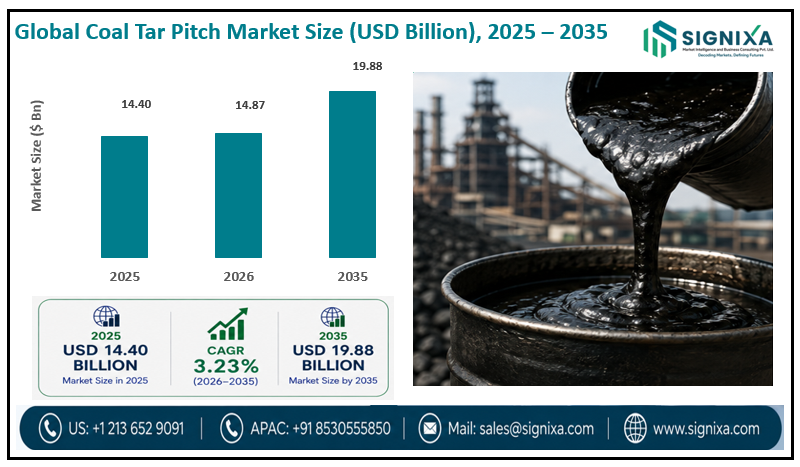
The size of the global Coal Tar Pitch market was valued at around USD 14.40 Billion in 2025 and is projected to grow to approximately USD 19.88 Billion by 2035, with a compound annual growth rate (CAGR) of roughly 3.23% between 2026 and 2035. Coal Tar Pitch is a black, viscous residue produced during the distillation of coal tar and is widely used in industries such as aluminium smelting, graphite manufacturing, roofing, and refractories.
With its strong binding properties and thermal resistance, coal tar pitch is crucial in processes requiring high-temperature stability. Demand for coal tar pitch is primarily influenced by the aluminium and graphite sectors, which consume a significant share of global output for electrode production, furnace linings, and advanced carbon materials. In recent years, the market has benefited from growing investments in infrastructure development, increasing demand for aluminium across the automotive and construction sectors, and the expanding use of graphite electrodes in steel manufacturing.
Additionally, the use of carbon fiber composites in aerospace, automotive, and renewable energy industries has supported demand for high-purity coal tar pitch grades. However, the market must navigate challenges related to environmental concerns and regulatory scrutiny over by-products and emissions, particularly around polycyclic aromatic hydrocarbons (PAHs).
Key Findings
- The global Coal Tar Pitch market is estimated to grow annually at a CAGR of around 3.23% over the forecast period (2026–2035).
- In terms of revenue, the global Coal Tar Pitch market size was valued at around USD 14.40 Billion in 2025 and is projected to reach USD 19.88 Billion by 2035.
- The growth is driven by strong demand from aluminium smelting, refractories, and graphite electrode manufacturing industries.
- Based on Type, the High Temperature Coal Tar Pitch segment is anticipated to command the largest market share.
- Based on Grade, the Aluminium Grade segment is likely to dominate the market throughout the forecast period.
- In terms of Application, the Aluminium Smelting segment is expected to account for the largest share of the global market.
- By Region, Asia-Pacific is projected to dominate the global market, with strong growth in China and India.
Coal Tar Pitch Market Dynamics
Foundational Role as Carbon Anode & Graphite Electrode Binder in Indispensable Aluminium & Steel Production Processes
The coal tar market is primarily driven by its indispensable role as a key raw material in various heavy industries, particularly aluminum and steel production. Coal tar pitch, a major derivative of coal tar, is crucial as a binding agent in the manufacturing of carbon anodes used in aluminum smelting. The global demand for aluminum continues to rise, fueled by its increasing adoption in lightweight automotive components (especially for electric vehicles), aerospace applications, and the construction industry. Similarly, in the steel industry, coal tar pitch is a vital component in the production of graphite electrodes, which are essential for electric arc furnaces. The ongoing urbanization and infrastructure development worldwide further contribute to the demand for steel and aluminum, thereby underpinning the coal tar market's growth. This deep integration into foundational industrial processes ensures consistent demand for coal tar and its derivatives through the forecast period.
Electric Arc Furnace Steelmaking Expansion & Aluminium Lightweighting Trends in EVs Driving Sustained Pitch Demand
The global Coal Tar Pitch market is experiencing steady growth, driven by rising demand from the aluminium and steel sectors. Aluminium production, a major consumer of coal tar pitch, is expanding due to its lightweight properties that align with fuel efficiency goals in transportation. Likewise, steel production through electric arc furnaces (EAFs), which rely heavily on graphite electrodes, is seeing a surge, particularly as sustainability trends encourage scrap-based steelmaking, directly boosting coal tar pitch consumption. The growing need for durable, heat-resistant materials in construction and industrial applications is also contributing to increased use of coal tar pitch in roofing and refractory applications. As urbanization continues, demand for high-performance construction materials that can withstand extreme temperatures and corrosive environments remains strong, supporting market growth through the forecast period.
Carbon Fiber Innovation Opening New Applications in Wind Turbine Blades, Electric Vehicles & Aircraft Components
Technological advancements in carbon-based materials, particularly carbon fiber, are opening new avenues for coal tar pitch use. Coal tar pitch-derived carbon fibers are lighter and stronger, making them ideal for next-generation applications such as wind turbine blades, electric vehicles, and aircraft components. These evolving applications offer significant long-term opportunities for market players willing to innovate and adapt to environmental standards while meeting the growing demand for high-performance materials. The surge in demand for high-strength, lightweight materials in aerospace and renewable energy is positioning coal tar pitch-based carbon fiber as a strategic growth segment beyond the traditional aluminium and steel anchor markets, with rapid growth anticipated through the forecast period.
PAH Environmental Regulations & Greener Alternative Pressures Creating Compliance Cost Burden Across Production Chain
The coal tar market faces significant challenges, primarily related to environmental regulations and health concerns. Coal tar and its derivatives contain polycyclic aromatic hydrocarbons (PAHs), which are known carcinogens and environmental pollutants. This inherent characteristic subjects the production, handling, and use of coal tar to stringent environmental regulations globally. Compliance with these regulations often requires substantial investments in emission control technologies, waste management, and workplace safety protocols, which can significantly increase operational costs for manufacturers. Growing environmental awareness and the push for sustainable practices are leading industries to explore alternative binders and carbon materials that have a lower environmental footprint. While these alternatives may not always match the performance or cost-effectiveness of coal tar pitch, the increasing regulatory pressure and societal preference for greener solutions pose a long-term challenge to the market's expansion through the forecast period.
Coal Tar Pitch Market: Segmentation Analysis
By Type Segment Analysis
High Temperature Coal Tar Pitch
High Temperature Coal Tar Pitch dominated the market, accounting for approximately 52% of the total revenue share in 2025, owing to its widespread application in aluminium and graphite industries. This type offers superior thermal stability and mechanical strength, making it the preferred choice for electrode binders and refractories. The material's performance at temperatures exceeding 300°C ensures consistent demand from heavy industries requiring reliable, heat-resistant materials, especially in primary metal production and heavy engineering sectors. High temperature grades undergo extensive distillation to achieve higher softening points and reduced volatile content, resulting in superior coking value the critical performance attribute that determines binder efficiency in carbon anode and graphite electrode applications. The dominance of this segment is structurally reinforced by the fact that aluminium smelting and graphite electrode production, the two largest application categories, both specifically require the high-temperature grade for optimal performance through the forecast period.
Medium Temperature Coal Tar Pitch
Medium Temperature Coal Tar Pitch accounted for around 32% of the market share in 2025. It is primarily used in specific applications such as roofing, paving, and select carbon-based products where moderate temperature performance is adequate. Medium temperature pitches balance flexibility and performance, making them suitable for semi-industrial applications without the high cost associated with high-temperature grades, supporting their steady uptake across emerging economies and mid-tier manufacturers. The lower processing intensity required for medium temperature pitch production translates into a more favorable cost structure that makes this grade economically attractive for applications where the superior thermal and binding performance of high-temperature grades is not strictly necessary. The growing infrastructure development in emerging economies, where roofing and paving applications represent significant volume demand, is sustaining steady growth for this segment through the forecast period.
Low Temperature Coal Tar Pitch
Low Temperature Coal Tar Pitch captured about 10% of the market share in 2025 and finds limited use in niche applications. It is typically utilized in construction materials where high heat resistance is not critical. Although its demand is relatively modest, it remains relevant in cost-sensitive applications such as waterproofing membranes and specialized industrial coatings. Low temperature pitch offers a more economical entry point for applications that primarily require adhesive and waterproofing properties rather than extreme thermal stability, making it suitable for budget-constrained construction projects in price-sensitive markets. Growth in low-cost infrastructure projects in developing regions particularly affordable housing and basic road infrastructure programs is expected to drive incremental demand for low temperature coal tar pitch through the forecast period.
Others
The Others category accounted for the remaining market share, including specialty blends and customized pitches used in research and development, electronics, and other specialty industries. These products are designed for specific end-uses requiring tailored physical and chemical properties, although they represent a small but growing part of the overall market landscape. Custom-formulated coal tar pitch blends engineered to achieve specific softening points, coking values, or impurity profiles are increasingly sought by manufacturers developing next-generation carbon materials and specialty applications. The growing research interest in coal tar pitch derivatives for energy storage applications, including potential use in battery anode materials and supercapacitor electrodes, represents an emerging opportunity within this category that may expand its market share through the forecast period.
By Grade Segment Analysis
Aluminium Grade
Aluminium Grade Coal Tar Pitch held the largest share, approximately 60% of the global market in 2025, driven by the booming aluminium smelting industry. As aluminium production continues to rise, particularly in Asia Pacific, the demand for high-quality pitch for anode manufacturing is growing, supporting consistent supply-demand dynamics for this grade. It's crucial role in reducing cell voltage and improving energy efficiency in electrolytic cells strengthens its market dominance. Aluminium grade pitch must meet precise specifications for coking value, quinoline insoluble content, and ash content to ensure optimal anode baking performance and minimize impurity contamination of the molten aluminium during electrolysis. The continued expansion of aluminium smelting capacity in China, India, and the Middle East regions investing heavily in primary aluminium production is the primary structural driver sustaining aluminium grade pitch demand growth through the forecast period.
Binder and Impregnating Grade
Binder and Impregnating Grade accounted for about 30% of the market in 2025, used primarily in the production of graphite electrodes and carbon blocks. These grades are essential for producing strong, durable products in steelmaking and high-temperature applications. The increasing focus on electric arc furnace-based steelmaking globally further supports the growth of binder and impregnating-grade pitch products. Impregnating pitch is used in a secondary processing step where baked carbon and graphite products are infiltrated with additional pitch to fill internal porosity, significantly improving density, mechanical strength, and electrical conductivity of the final electrode product. The global steel industry's structural shift toward scrap-based electric arc furnace production driven by lower capital costs, faster construction timelines, and lower carbon emissions relative to traditional blast furnace steelmaking is a durable long-term demand driver for binder and impregnating grade pitch through the forecast period.
Special Grade
Special Grade coal tar pitch represented around 10% of the global share in 2025. These are high-purity, low-contaminant pitches used in specialty applications such as advanced carbon composites, energy storage, and electronics. Growth in the electric vehicle (EV) sector and renewable energy is likely to boost demand for special grades, opening up new opportunities for market participants aiming at high-margin niches. Special grade pitch undergoes additional purification processing to remove quinoline insoluble, sulfur, and other trace contaminants that would compromise performance in high-precision applications such as mesophase pitch precursors for carbon fiber production. The premium pricing commanded by special grade pitch reflecting its more demanding production requirements and smaller production volumes makes this segment particularly attractive for producers seeking to improve overall product mix profitability through the forecast period.
By Application Segment Analysis
Aluminium Smelting
Aluminium Smelting was the largest application segment, capturing nearly 45% of the market revenue in 2025. Aluminium producers use coal tar pitch as a binder in carbon anodes, critical for electrolytic reduction. Strong global demand for aluminium in transportation, packaging, and infrastructure, especially in emerging economies, ensures continued growth in this segment. Carbon anodes, consumed throughout the Hall-Héroult electrolytic reduction process, must be continuously replaced, creating recurring high-volume pitch demand directly proportional to aluminium production output. The growing emphasis on aluminium's role in vehicle lightweighting particularly for electric vehicles where reduced weight directly extends battery range is reinforcing long-term demand growth for primary aluminium production and, consequently, the coal tar pitch consumed in anode manufacturing through the forecast period.
Graphite Electrodes
Graphite Electrodes represented around 25% of the coal tar pitch market share in 2025. The steel industry's pivot towards electric arc furnaces, driven by lower emissions and scrap steel availability, is boosting demand for graphite electrodes, where coal tar pitch acts as a vital binder, further solidifying its market presence. Graphite electrodes are consumable components in EAF steelmaking, gradually eroding during the electric arc melting process and requiring continuous replacement creating consistent recurring demand tied directly to global EAF steel production volume. The accelerating global transition away from traditional blast furnace steelmaking toward more flexible, lower-emission EAF technology is a structural long-term tailwind for graphite electrode and, by extension, coal tar pitch binder demand through the forecast period.
Roofing
Roofing applications accounted for about 12% of the market share. Coal tar pitch is valued in roofing for its waterproofing and weather-resistant properties. Infrastructure development, renovation of aging buildings, and increased urbanization, particularly in North America and Asia Pacific, continue to create steady demand for roofing products. Coal tar pitch's exceptional resistance to water penetration, UV degradation, and temperature cycling makes it a durable choice for built-up roofing systems on commercial and industrial buildings, where service life expectations span decades. The renovation cycle of aging commercial building stock in mature markets like North America provides a relatively stable baseline demand, while new construction activity in rapidly urbanizing Asia-Pacific markets adds incremental growth through the forecast period.
Carbon Fiber
Carbon Fiber applications made up approximately 8% of the market in 2025. Coal tar pitch-based carbon fibers are increasingly sought after for lightweight composites used in aerospace, automotive, and wind energy industries. With the surge in demand for high-strength, lightweight materials, this segment is poised for rapid growth. Mesophase pitch a specially processed high-performance grade of coal tar pitch serves as the precursor material for pitch-based carbon fibers, which offer superior thermal conductivity and modulus relative to PAN-based carbon fibers, making them particularly valuable in applications requiring exceptional stiffness and thermal management performance. The accelerating global deployment of wind energy capacity, requiring increasingly large turbine blades that benefit from lightweight high-strength composite construction, represents a particularly promising growth vector for this application segment through the forecast period.
Refractories
Refractories held about 7% of the market share. Refractories, vital in furnaces, kilns, and reactors, depend on coal tar pitch for enhancing thermal stability and structural integrity. Expansion in heavy industries, steel manufacturing, and non-ferrous metal processing supports continued growth of this application segment. Refractory products bonded with coal tar pitch demonstrate superior resistance to thermal shock and slag penetration compared to alternative binding systems, making them particularly valuable in the most demanding high-temperature industrial process environments such as blast furnaces and steel ladles. The ongoing capacity expansion in heavy industrial sectors across emerging economies, particularly steel and cement production, is sustaining steady demand for high-performance refractory materials that utilize coal tar pitch binders through the forecast period.
Other Applications
Other Applications included niche uses in chemicals, coatings, and specialty carbon products, collectively accounting for the remaining market share. Innovation in energy storage and electronics could unlock new applications for coal tar pitch derivatives over the coming years. Coal tar pitch derivatives serve as precursor materials in various specialty chemical synthesis pathways, including production of certain coating resins and industrial chemical intermediates. The growing research interest in advanced battery materials where coal tar pitch-derived carbon products are being investigated as potential anode materials for next-generation lithium-ion and sodium-ion batteries represents an emerging high-value application area that could meaningfully expand the addressable market for coal tar pitch derivatives through the forecast period.
Report Attributes & Market Scope
| Report Attribute | Details |
|---|---|
| Market Size Value in 2025 | USD 14.40 Billion |
| Market Size Value in 2035 | USD 19.88 Billion |
| CAGR (2026–2035) | 3.23% |
| Base Year Used for Estimation | 2025 |
| Historic Data | 2020 - 2025 |
| Forecast Period | 2026 - 2035 |
| Segments Covered – By Type |
|
| Segments Covered – By Grade |
|
| Segments Covered – By Application |
|
| Regions Covered | North America, Europe, Asia Pacific, Latin America, Middle East and Africa |
| Major Countries Covered | U.S., Canada, Mexico, Germany, UK, France, Italy, Spain, Russia, China, Japan, South Korea, India, Southeast Asia Countries, Brazil, Argentina, GCC Countries, Turkey, Iran, Israel, South Africa, Egypt, Nigeria, etc. |
| Key Companies Profiled | Rain Carbon Inc., Himadri Specialty Chemical Ltd., Epsilon Carbon Private Limited, Koppers Inc., JFE Chemical Corporation, Nippon Steel Chemical & Material Co., Ltd., DEZA A.S., Coopers Creek Chemical Corporation, Shanghai Baosteel Chemical Co., Ltd., and Industrial Química del Nalón, S.A., among others. |
Coal Tar Pitch Market Regional Analysis
Asia Pacific dominated the coal tar pitch market in 2025, holding over 55% of the global share, driven by rapid industrialization, expansion of aluminium production, and growing steel manufacturing in China and India. North America and Europe together accounted for around 35% of the market share, with mature industrial bases. Latin America, the Middle East, and Africa are emerging as promising markets, driven by industrial development and urbanization.
Asia-Pacific (Dominant Region)
Asia Pacific dominated the coal tar pitch market in 2025, holding over 55% of the global share, driven by rapid industrialization, expansion of aluminium production, and growing steel manufacturing in China and India. The region's robust demand for infrastructure, construction materials, and vehicles supports strong coal tar pitch consumption. China's position as the world's largest aluminium producer, combined with its extensive steel manufacturing base utilizing both blast furnace and increasingly electric arc furnace technology, makes it the single largest national market for coal tar pitch globally. India's rapidly expanding aluminium smelting capacity and growing steel production supported by government infrastructure investment programs is creating substantial incremental demand. The region's vertically integrated coal tar value chains, where coal tar byproduct from coking operations is processed domestically into pitch, provide cost advantages that reinforce the region's manufacturing dominance through the forecast period.
North America
North America, together with Europe, accounted for around 35% of the global market share in 2025, with mature industrial bases, high investments in R&D, and stringent environmental standards fostering innovation in high-grade coal tar pitch production. The North American market is characterized by established aluminium smelting and steel manufacturing operations, alongside significant graphite electrode production capacity supporting electric arc furnace steelmaking. The region's stringent environmental compliance requirements have driven the development of cleaner production processes and lower-PAH content pitch grades that meet rigorous regulatory standards. The region's growing carbon fiber composite manufacturing sector supporting aerospace and automotive lightweighting applications is creating incremental demand for specialty grade coal tar pitch derivatives through the forecast period.
Europe
The European coal tar market is characterized by a mature industrial base and stringent environmental regulations, which significantly influence its dynamics. The primary demand driver for coal tar derivatives, especially coal tar pitch, comes from the aluminum industry, where it is a critical binder for manufacturing carbon anodes used in aluminum smelting. Countries like Germany and Norway, with their significant aluminum production capacities, are key consumers. The steel industry's reliance on graphite electrodes in electric arc furnaces also contributes to demand. While Europe is actively pursuing green initiatives and a circular economy, which can encourage alternatives, the unique properties of coal tar pitch in these core industrial applications maintain its demand. The market faces continuous pressure from the European Union's strict environmental regulations, particularly concerning polycyclic aromatic hydrocarbons (PAHs), necessitating substantial investments in emission control, worker safety, and cleaner production methods. The revitalization of the chemical manufacturing sector and growing applications in carbon black production for tires also contribute to steady demand through the forecast period.
Latin America & Middle East and Africa
Latin America, the Middle East, and Africa are emerging as promising markets for coal tar pitch, driven by industrial development, urbanization, and increased demand for aluminium and construction materials. In Latin America, Brazil's significant aluminium smelting industry and growing steel production base create steady regional demand. The expansion of infrastructure and construction activity across Latin American economies is supporting growth in roofing and refractory applications. In the Middle East, the GCC countries' substantial primary aluminium smelting capacity among the largest globally, supported by access to low-cost energy for the energy-intensive smelting process creates significant demand for aluminium grade coal tar pitch. Africa's gradually industrializing economies, with growing construction and infrastructure development activity, are creating emerging demand for coal tar pitch in roofing and waterproofing applications through the forecast period.
Recent Developments in the Coal Tar Pitch Market
-
2025
Koppers Holdings Inc. expanded its carbon materials business by strengthening production and distribution of coal tar pitch for aluminium smelters and industrial carbon applications, reflecting increasing demand for high-purity pitch in energy-intensive manufacturing sectors.
-
2024
Rain Industries Limited increased investments in its carbon and advanced materials segment, focusing on improving coal tar pitch production efficiency and supply for aluminium and graphite electrode manufacturers, supporting growing global demand from the aluminium and steel sectors.
-
2024
JFE Chemical Corporation continued advancing high-quality coal tar pitch production technologies to supply specialty pitch grades for aluminium anodes and carbon materials, aiming to enhance product performance and meet strict industrial quality standards.
-
2023
Himadri Speciality Chemical Ltd. announced plans to expand its coal tar distillation capacity to address increasing demand from the aluminium smelting and graphite electrode industries, strengthening supply capabilities for coal tar pitch used in anode production.
Coal Tar Pitch Market: Competitive Landscape
The global Coal Tar Pitch market features major players such as Rain Carbon Inc., Himadri Specialty Chemical Ltd., Koppers Inc., Shanghai Baosteel Chemical Co., Ltd., JFE Chemical Corporation, Nippon Steel Chemical Co., Ltd., C-Chem Co., Ltd., Shandong Gude Chemical Co., Ltd., PMC Group, and Baoshun Technology Co., Ltd. Market competition is driven by factors such as product innovation, capacity expansion, pricing strategies, and regional partnerships. As the demand for higher-grade and environmentally compliant products rises, companies are increasingly focusing on sustainable production techniques, research and development investments, and strategic collaborations to strengthen their market position.
Key Companies Profiled
- Rain Carbon Inc.
- Koppers Inc.
- Himadri Specialty Chemical Ltd.
- Epsilon Carbon Private Limited
- JFE Chemical Corporation
- Nippon Steel Chemical & Material Co.
- Shanghai Baosteel Chemical Co.
- DEZA A.S.
- Industrial Química del Nalón
- C-Chem Co. Ltd.
- Shandong Gude Chemical Co., Ltd.
- Baowu Carbon Materials Technology Co., Ltd.
- Asbury Carbons
- OCI Company Ltd.
- China Steel Chemical Corporation
Global Coal Tar Pitch Market Segmentation Summary
By Type
- High Temperature Coal Tar Pitch
- Medium Temperature Coal Tar Pitch
- Low Temperature Coal Tar Pitch
- Others
By Grade
- Aluminium Grade
- Binder and Impregnating Grade
- Special Grade
By Application
- Aluminium Smelting
- Graphite Electrodes
- Roofing
- Carbon Fiber
- Refractories
- Other Applications
By Region
- North America
- U.S.
- Canada
- Mexico
- Europe
- Germany
- France
- UK
- Spain
- Italy
- Rest of Europe
- Asia-Pacific
- China
- Japan
- India
- Australia
- South Korea
- Southeast Asia
- Rest of Asia-Pacific
- Latin America
- Brazil
- Argentina
- Rest of Latin America
- The Middle East & Africa
- GCC Countries
- South Africa
- Rest of the Middle East & Africa
Frequently Asked Questions (FAQs) About the Coal Tar Pitch Market
What is Coal Tar Pitch?
Coal tar pitch is a thick, black, sticky residue derived from the distillation of coal tar. It is primarily used as a binder in aluminum production, graphite electrodes, roofing, and paving applications, offering excellent adhesive and waterproofing properties.
Which key factors will influence the Coal Tar Pitch market growth over 2026–2035?
The global coal tar pitch market is expected to grow due to increasing demand from the aluminum and graphite electrode industries, infrastructure development activities, and the rising need for durable and high-performance construction materials.
What will be the value of the Coal Tar Pitch market during 2026–2035?
According to the study, the global Coal Tar Pitch market size was worth around USD 14.40 Billion in 2025 and is predicted to grow to around USD 19.88 Billion by 2035.
What will be the CAGR value of the Coal Tar Pitch market during 2026–2035?
The CAGR value of the Coal Tar Pitch market is expected to be around 3.23% during 2026–2035, primarily driven by the increasing demand for graphite electrodes and aluminum anodes used in steel manufacturing and aluminum smelting industries.
Which region will contribute notably towards the Coal Tar Pitch market value?
The global Coal Tar Pitch market is led by the Asia-Pacific region, supported by the strong presence of aluminum smelting facilities, rapid industrialization, and growing investments in construction and infrastructure projects.
Which are the major players leveraging the Coal Tar Pitch market growth?
The global coal tar pitch market is led by players such as Koppers Inc., Himadri Speciality Chemical Ltd., Rain Carbon Inc., Epsilon Carbon Pvt. Ltd., JFE Chemical Corporation, OCI Company Ltd., Shanghai Baosteel Chemical Co., Ltd., Shandong Gude Chemical Co., Ltd., Petrochemical Trading Ltd., and C-Chem Co., Ltd.
What can be expected from the global Coal Tar Pitch market report?
The report explores crucial aspects of the coal tar pitch market, including a detailed discussion of existing growth factors and restraints while also analyzing future growth opportunities and challenges that impact the market.