
Diamond Jewelry Market Overview
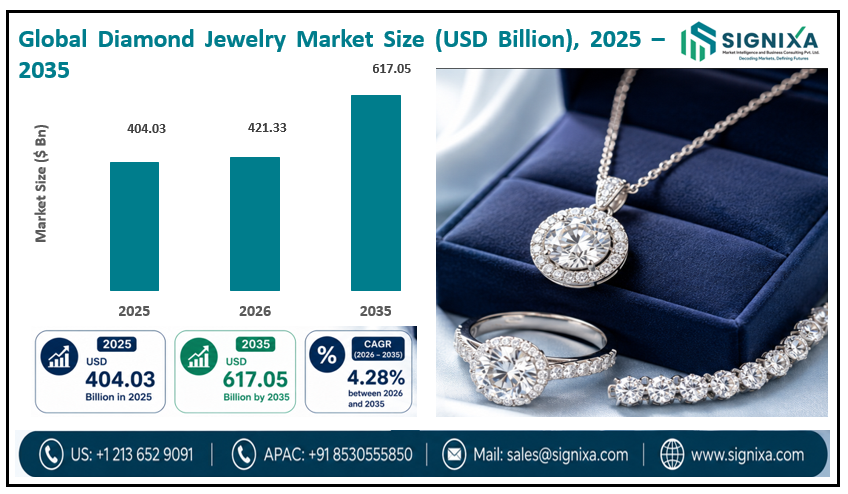
The global diamond jewelry market was valued at approximately USD 404.03 Billion in 2025 and is projected to reach around USD 617.05 Billion in 2035, growing at a compound annual growth rate (CAGR) of roughly 4.28% between 2026 and 2035. This growth is driven by increasing disposable incomes, evolving consumer preferences, and the rising demand for ethically sourced and sustainable diamond products.
The diamond jewelry market encompasses a wide range of products, including rings, necklaces, earrings, bracelets, pendants, and other ornaments. These products are distributed through various sales channels such as jewelry stores, online platforms, specialty stores, and departmental stores, catering to diverse consumer segments including women, men, and unisex categories. The market's expansion is fuelled by factors like cultural significance, fashion trends, and technological advancements in jewelry design and retail.
The global diamond jewelry market is a fascinating blend of tradition, luxury, and evolving consumer preferences. For centuries, diamonds have been quintessential symbols of love, commitment, and celebration, driving consistent demand for engagement rings, wedding bands, and anniversary gifts. This enduring cultural significance remains a foundational pillar of the market, particularly in Western countries and increasingly in burgeoning Asian economies where such traditions are gaining traction. Beyond bridal wear, diamond jewelry is also a significant component of fashion and fine jewelry, with consumers seeking pieces for self-expression, status, and everyday wear. The market is influenced by global economic conditions; during periods of economic stability and rising disposable incomes, consumer spending on luxury items like diamond jewelry tends to increase. Furthermore, the expansion of e-commerce and the growing digital fluency of consumers have transformed the retail landscape, making diamond jewelry more accessible to a wider audience through online platforms, virtual try-ons, and enhanced transparency in sourcing and certification.
A pivotal shift reshaping the diamond jewelry market is the burgeoning popularity of lab-grown diamonds (LGDs). These diamonds, chemically, physically, and optically identical to natural diamonds, offer a more affordable and often more ethically or sustainably perceived alternative. This has created a dual market, where natural diamonds continue to command premium prices due to their rarity and unique geological formation, while LGDs appeal to a segment of consumers who prioritize value, ethical sourcing, and larger carat sizes for their budget. This trend is particularly evident among younger generations, such as millennials and Gen Z, who are often more conscious of environmental and social impact and are comfortable with the concept of a human-made diamond. The rise of LGDs has also spurred innovation in design and accessibility, with direct-to-consumer brands leveraging online channels to offer customized and unique pieces. As the market continues to evolve, the interplay between natural and lab-grown diamonds, alongside shifting consumer values towards transparency and sustainability, will define its future trajectory.
Key Findings
- The market is expected to grow from USD 404.03 Billion in 2025 to USD 617.05 Billion in 2035, at a CAGR of 4.28%.
- Rings continue to dominate the product segment, driven by engagement and wedding traditions.
- Jewelry stores remain the leading sales channel, though online platforms are rapidly gaining traction due to convenience and broader reach.
- Women constitute the largest consumer segment, but there is a noticeable increase in demand from men and unisex categories.
- Asia-Pacific leads the market, with significant contributions from countries like India and China.
Diamond Jewelry Market Dynamics
Cultural Significance and Disposable Income: The enduring cultural importance of diamond jewelry in ceremonies and celebrations, especially in regions like Asia-Pacific, continues to drive demand. Coupled with rising disposable incomes, consumers are more inclined to invest in luxury items that symbolize status and personal milestones.Ethical Sourcing and Sustainability: There's a growing consumer preference for ethically sourced and sustainable diamonds. This shift has led to increased interest in lab-grown diamonds, which offer a more affordable and environmentally friendly alternative to mined diamonds. Brands are responding by diversifying their offerings to include such options.
The diamond jewelry market is currently navigating a complex and dynamic landscape, significantly influenced by evolving consumer values and the emergence of new product categories. Traditionally, natural diamonds have held an almost unassailable position as symbols of eternal love and status, particularly in the bridal segment. This deeply ingrained cultural significance, especially in Western markets and increasingly in affluent Asian countries, continues to drive a substantial portion of demand. However, there's a discernible shift among younger demographics, such as millennials and Gen Z, who are increasingly prioritizing factors beyond traditional prestige. These consumers often demonstrate a heightened awareness of ethical sourcing, environmental impact, and value for money. This has led to a greater demand for transparency in the supply chain, with many consumers wanting to know the origin of their diamonds and ensuring they are conflict-free and responsibly sourced. Brands that can effectively communicate their commitment to ethical practices and sustainability are gaining a competitive edge, using technologies like blockchain to provide verifiable origins for their stones.
A transformative force in the market is the rapid rise of lab-grown diamonds (LGDs). These diamonds, which are chemically, physically, and optically identical to their mined counterparts but created in a controlled laboratory environment, offer a compelling alternative. Their primary appeal lies in their significantly lower price point, allowing consumers to acquire larger or higher-quality stones for the same budget. Furthermore, LGDs are marketed with a strong narrative of sustainability and ethical production, appealing directly to environmentally and socially conscious consumers who may have reservations about traditional diamond mining practices. This has created a dual market where both natural and lab-grown diamonds coexist, each catering to different consumer segments. While natural diamonds retain their allure of rarity and unique geological history, LGDs are rapidly gaining acceptance, particularly in fashion jewelry and among younger buyers. This competition is driving innovation across the entire industry, forcing natural diamond producers to enhance their transparency initiatives and marketing efforts to re-emphasize the unique value proposition of their products. The ongoing interplay and market share evolution between these two diamond categories will remain a central dynamic for the foreseeable future.
Diamond Jewelry Market Segmentation Analysis
By Product Type Segment Analysis
By Product Type wise, Rings represented over 35% of the global market in 2025 due to their deep-rooted association with engagements and weddings. The demand is particularly strong in North America and Asia-Pacific. As couples increasingly opt for customized and solitaire styles, premium ring sales are expected to continue growing through 2035. Necklaces captured around 20% of the global share in 2025, driven by gifting trends, ceremonial use, and cultural affinity, especially in India and the Middle East. High-value necklaces with intricate designs and statement pieces are popular in the premium segment.
Earrings accounted for approximately 17% of the market in 2025. They appeal to a wide consumer base, from daily wearers to those seeking statement styles. Innovations such as convertible designs and dual-wear models are further enhancing appeal across men and women. Holding around 10% share in 2025, bracelets are especially favoured for their elegance and layering versatility. Tennis bracelets and bangles embedded with diamonds are gaining popularity in Western and Asian markets, particularly among affluent consumers. Pendants made up roughly 8% of the market in 2025. Minimalist trends and rising youth preferences are fuelling growth. Personalized pendants, including initials or zodiac designs, are increasingly popular on online platforms. This segment, comprising brooches, anklets, and nose pins, held around 10% share in 2025. These products are mostly region-specific, with nose pins in South Asia and brooches in Europe witnessing steady demand.
By Sales Channel Segment Analysis
By Sales Channel wise, in 2025, jewelry stores accounted for 48% of global sales, reflecting trust and consumer loyalty. High-value transactions and custom fittings remain key drivers. These stores are particularly dominant in Asia-Pacific and the Middle East. Online channels constituted 23% of the market in 2025. Growing internet penetration, e-commerce reliability, and AR-based virtual try-ons are boosting online jewelry purchases, especially among millennials and Gen Z.
Specialty outlets held a 15% share in 2025. These stores offer premium designer collections, limited editions, and bespoke services. Demand is high in urban centers where consumers seek exclusivity. Contributing about 8% to the market in 2025, departmental stores offer a curated selection of affordable diamond jewelry. These are favored for gifting during holidays and festivals. Other channels, including duty-free shops, exhibitions, and pop-ups, made up the remaining 6%. These cater mainly to travelers and impulse buyers looking for convenience and unique finds.
By End Users Segment Analysis
By End User wise, Women comprised 68% of global demand in 2025. From wedding jewelry to self-purchase trends, women remain the dominant consumer group. Style-conscious millennials and professional women are significantly influencing buying behavior. Men represented 20% of the market in 2025. Diamond rings, cufflinks, studs, and bracelets are becoming mainstream among men, especially in the U.S., Europe, and the Middle East. Brand campaigns are increasingly targeting male buyers. The unisex category accounted for 12% share in 2025, driven by demand for minimalist and gender-fluid styles. Urban youth and Gen Z consumers favor designs that transcend traditional gender lines, creating a robust niche.
Report Attributes & Market Scope
| Report Attribute | Details |
|---|---|
| Market Size Value in 2025 | USD 404.03 Billion |
| Market Size Value in 2035 | USD 617.05 Billion |
| CAGR (2026–2035) | 4.28% |
| Base Year Used for Estimation | 2025 |
| Historic Data | 2020-2025 |
| Forecast Period | 2026-2035 |
| Segments Covered — By Product Type |
|
| Segments Covered — By Sales Channel |
|
| Segments Covered — By End Users |
|
| Regions Covered | North America, Europe, Asia Pacific, Latin America, Middle East and Africa |
| Major Countries Covered | U.S., Canada, Mexico, Germany, UK, France, Italy, Spain, Russia, China, Japan, South Korea, India, Southeast Asia Countries, Brazil, Argentina, GCC Countries, Turkey, Iran, Israel, South Africa, Egypt, Nigeria, etc. |
| Key Companies Profiled | De Beers Group, Signet Jewelers, Chow Tai Fook, LVMH Moët Hennessy Louis Vuitton, Tiffany & Co., Graff Diamonds, Blue Nile, Harry Winston, Malabar Gold & Diamonds, and Cartier, among others. |
Diamond Jewelry Market Regional Analysis
Leading with over 42% share in 2025, Asia-Pacific is driven by cultural preferences, weddings, and increasing middle-class wealth. India and China are major contributors, supported by domestic brands and global luxury players. With 28% of the market in 2025, North America is fuelled by luxury spending, gifting trends, and growing acceptance of lab-grown diamonds. The U.S. remains the top market for bridal diamond jewelry. Representing 18% share in 2025, Europe continues to value craftsmanship and heritage brands. The UK, France, and Italy are major players, with online luxury retail also witnessing steady growth. Together, the Middle East, Africa, and Latin America accounted for 12% of the market in 2025. In the Middle East, high per capita spending and gold-diamond fusion jewelry drive demand. In Latin America, urbanization and rising disposable income are key contributors.
Asia-Pacific (Largest Region)
The Asia Pacific region is the largest and most rapidly expanding market for diamond jewelry globally, fuelled by rising disposable incomes, a burgeoning middle class, and evolving consumer aspirations in countries like China and India. Cultural significance plays a crucial role, with diamond jewelry being an integral part of weddings, festivals, and celebratory events. While traditional designs remain popular, there is a growing appetite for modern, contemporary, and fusion designs that blend traditional aesthetics with global trends. The rapid urbanization and increasing influence of Western lifestyles have also contributed to the adoption of diamond engagement rings. The region's vibrant e-commerce landscape is a significant growth driver, making diamond jewelry more accessible to a vast consumer base. The demand for lab-grown diamonds is also gaining traction, particularly in markets like India, driven by their affordability and perceived ethical advantages. As consumer awareness about responsible sourcing grows, transparency in the supply chain is becoming increasingly important, influencing purchasing decisions across the region.
North America
North America continues to be a dominant force in the global diamond jewelry market, with the United States leading the regional demand. This dominance is underpinned by a robust economy, high disposable incomes, and a strong cultural tradition of diamond engagement rings and bridal jewelry. The market here is characterized by a significant presence of both established luxury brands and a burgeoning segment of direct-to-consumer (DTC) online retailers. There is a growing trend towards personalization and customization, as consumers seek unique pieces that reflect their individuality, whether through bespoke designs, specific diamond shapes, or the incorporation of cultured diamonds and gemstones. The popularity of lab-grown diamonds is also particularly pronounced in North America, with a significant portion of younger consumers showing a preference for these ethically and sustainably marketed alternatives. This demographic shift is pushing traditional jewelers to diversify their offerings and enhance transparency in their supply chains, often leveraging technologies like blockchain to provide verified provenance. The strong retail infrastructure, both offline and online, further facilitates consumer access to a wide range of diamond jewelry options.
Europe
Europe represents a mature and sophisticated market for diamond jewelry, driven by a rich heritage of luxury goods and a discerning consumer base. Key markets like Germany, the UK, France, and Italy exhibit a strong demand for high-quality, artisanal, and branded diamond pieces. While traditional bridal jewelry remains a significant segment, there is a growing interest in fashion-forward diamond jewelry for self-adornment and gifting occasions beyond traditional milestones. European consumers are increasingly influenced by sustainability and ethical sourcing, pushing brands to demonstrate responsible practices throughout their supply chains. This has led to a greater acceptance and demand for lab-grown diamonds, as consumers seek alternatives that align with their values. Moreover, the robust tourism sector in Europe, particularly in luxury shopping hubs like Paris and Milan, contributes significantly to sales, as international visitors seek high-end diamond jewelry as souvenirs or investment pieces. Digitalization and e-commerce penetration are also rapidly transforming the European market, offering consumers greater choice and convenience.
Middle East & Africa
The Middle East and Africa (MEA) region presents a dynamic and growing market for diamond jewelry, characterized by a strong cultural affinity for luxury goods and traditional gifting practices. The Gulf Cooperation Council (GCC) countries, with their high per capita incomes and a culture of lavish celebrations, are key drivers of demand for high-end and bespoke diamond jewelry. Diamonds are highly valued as symbols of wealth, status, and inheritance. Traditional designs, often intricate and elaborate, remain popular, but there is also a rising interest in contemporary and international styles. The region is a significant hub for luxury tourism, attracting affluent visitors who contribute to sales of high-value diamond pieces. While the market is relatively smaller compared to other regions, it offers significant growth potential due to increasing disposable incomes and a young, fashion-conscious population. Challenges include political instabilities in certain parts of Africa and the Middle East, which can impact consumer confidence, but ongoing economic diversification efforts and strategic investments in luxury retail are expected to continue driving demand for diamond jewelry in the region.
Latin America
In Latin America, urbanization and rising disposable income are key contributors to the diamond jewelry market. Countries like Brazil and Argentina are witnessing growing consumer interest in luxury and fashion jewelry. The expanding middle class and increasing brand awareness, coupled with the rise of e-commerce platforms, are making diamond jewelry more accessible to a broader consumer base across the region.
Recent Developments in the Diamond Jewelry Market
-
2025
Pandora launched its first lab-grown diamond collection in North America and expanded it to Europe, marking a significant milestone in the mainstreaming of lab-grown diamond jewelry for mass-market consumers.
-
2023
Tiffany & Co. focused on transparency and sustainability, introducing blockchain-enabled diamond traceability across collections, allowing consumers to verify the provenance and ethical sourcing of their diamonds.
Diamond Jewelry Market: Competitive Landscape
The global diamond jewelry market features prominent players such as De Beers Group, Signet Jewelers, Chow Tai Fook, LVMH Moët Hennessy Louis Vuitton, Tiffany & Co., Graff Diamonds, Blue Nile, Harry Winston, Malabar Gold & Diamonds, and Cartier. These companies compete based on product exclusivity, craftsmanship, brand heritage, pricing strategies, and expanding omnichannel presence.
Major brands are investing in lab-grown diamonds, customization technologies, and digital retailing to appeal to younger consumers. Strategic collaborations and acquisitions are being used to strengthen brand equity and extend global reach. For example, Signet Jewelers' acquisition of Blue Nile and LVMH's acquisition of Tiffany & Co. highlight how market leaders are reinforcing their luxury jewelry portfolios to capture evolving consumer demand. Sustainability certifications and ethical sourcing are becoming central to brand strategies to build consumer trust and differentiate in a highly competitive landscape.
The competitive landscape of the diamond jewelry market is characterized by a blend of long-standing prestige brands, rapidly emerging online retailers, and the disruptive influence of lab-grown diamonds. Traditional jewelers, with their established legacies and physical storefronts, emphasize heritage, craftsmanship, and the enduring emotional value of natural diamonds. Their strategies often revolve around creating exclusive collections, offering personalized customer experiences, and leveraging strong brand storytelling to justify premium pricing.
However, the rise of e-commerce has democratized access to diamond jewelry, allowing smaller, agile brands to enter the market with lower overheads and often more competitive pricing. These online players frequently focus on transparency in sourcing, simplified purchasing processes, and a direct-to-consumer model that resonates with digital-native consumers. The competitive dynamic is further intensified by the growing acceptance of lab-grown diamonds, which offer a value proposition centered on affordability and perceived ethical advantages. Brands specializing in lab-grown diamonds are challenging conventional notions of luxury, appealing to a consumer base that prioritizes size, environmental impact, and modern aesthetics. This ongoing shift necessitates innovation in marketing, supply chain transparency, and product differentiation across the entire industry.
Key Companies Profiled
- LVMH Moët Hennessy Louis Vuitton
- Signet Jewelers Ltd.
- Tiffany & Co.
- Pandora A/S
- Chow Tai Fook Jewellery Group Ltd.
- Harry Winston, Inc.
- Graff Diamonds International Ltd.
- Cartier
- Bvlgari
- Van Cleef & Arpels
- De Beers Group
- Blue Nile, Inc.
- Malabar Gold & Diamonds
- Titan Company Limited (Tanishq)
- Kalyan Jewellers India Limited
- Rajesh Exports Limited
Global Diamond Jewelry Market Segmentation Summary
By Product Type
- Rings
- Necklaces
- Earrings
- Bracelets
- Pendants
- Others
By Sales Channel
- Jewelry Stores
- Online
- Specialty Stores
- Departmental Stores
- Others
By End Users
- Women
- Men
- Unisex
By Region
- North America
- U.S.
- Canada
- Mexico
- Europe
- Germany
- France
- UK
- Spain
- Italy
- Rest of Europe
- Asia-Pacific
- China
- Japan
- India
- Australia
- South Korea
- Southeast Asia
- Rest of Asia-Pacific
- Latin America
- Brazil
- Argentina
- Rest of Latin America
- The Middle East & Africa
- GCC Countries
- South Africa
- Rest of the Middle East & Africa
Frequently Asked Questions (FAQs) About the Diamond Jewelry Market
What is Diamond Jewelry?
Diamond jewelry refers to personal ornaments such as rings, necklaces, bracelets, earrings, and pendants that feature diamonds as the primary decorative gemstone. These are widely used for adornment, gifting, engagement, and investment purposes due to their brilliance, rarity, and symbolic value.
Which key factors will influence the Diamond Jewelry market growth over 2026-2035?
The global diamond jewelry market is expected to grow due to increasing disposable income, rising demand for luxury goods, growth in branded and lab-grown diamonds, expanding online retail platforms, and evolving consumer preferences for personalized and certified jewelry.
What will be the value of the Diamond Jewelry market during 2026-2035?
According to the study, the global Diamond Jewelry market size was worth around USD 404.03 Billion in 2025 and is predicted to grow to around USD 617.05 Billion in 2035.
What will be the CAGR value of the Diamond Jewelry market during 2026-2035?
The CAGR value of the Diamond Jewelry market is expected to be around 4.21% during 2026–2035.
Which region will contribute notably towards the Diamond Jewelry market value?
The global Diamond Jewelry market is led by Asia-Pacific and North America, driven by strong consumer spending, evolving fashion trends, the presence of affluent populations, and rapid expansion of e-commerce and branded jewelry offerings in these regions.
Which are the major players leveraging the Diamond Jewelry market growth?
The global Diamond Jewelry market is led by players such as De Beers Group, Signet Jewelers, Chow Tai Fook, LVMH Moët Hennessy Louis Vuitton, Tiffany & Co., Graff Diamonds, Blue Nile, Harry Winston, Malabar Gold & Diamonds, and Cartier.
What can be expected from the global Diamond Jewelry market report?
The report explores crucial aspects of the Diamond Jewelry market, including a detailed discussion of current growth drivers and restraints, along with comprehensive segmentation analysis, regional insights, and future opportunities and challenges shaping the industry outlook through 2035.