
Hard Luxury Goods Market Overview
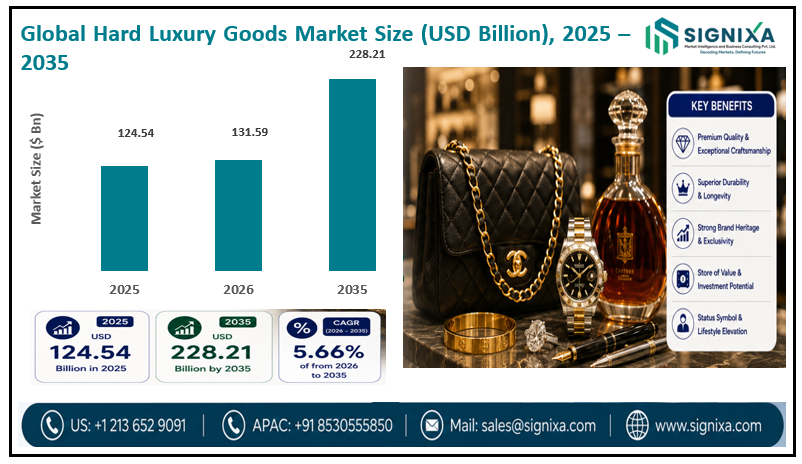
The global hard luxury goods market was valued at around USD 124.54 Billion in 2025 and is projected to grow to approximately USD 228.21 Billion by 2035, with a compound annual growth rate (CAGR) of 5.66% from 2026 to 2035. The report offers a comprehensive analysis of the hard luxury goods market’s drivers and restraints, with a focus on key growth factors and emerging opportunities that will shape the market over the coming years.
The hard luxury goods market encompasses an exclusive segment of high-end consumer products, primarily defined by exquisite craftsmanship, enduring value, and the use of precious materials. This category predominantly includes luxury watches and fine jewelry, crafted from materials such as gold, platinum, diamonds, and rare gemstones. These items are not merely functional objects but are deeply intertwined with notions of status, prestige, and personal expression. The allure of hard luxury lies in its timeless appeal, often passed down through generations, embodying heritage and artistry. Consumers in this market segment are typically affluent individuals who prioritize authenticity, exclusivity, and the intrinsic value of an item, often viewing these purchases as both a personal indulgence and a tangible investment. The market thrives on aspirational desires, with products frequently serving as symbols of achievement, celebrations of significant life events, or expressions of personal taste and identity.
Beyond traditional sales channels, the hard luxury market is also witnessing a resurgence of interest in vintage and pre-owned pieces, driven by both sustainability concerns and the pursuit of unique, historically significant items. The secondary market for high-end watches and collectible jewelry has gained considerable momentum, appealing to discerning collectors and a new generation of buyers seeking value and uniqueness. This trend underscores the enduring quality and investment potential of hard luxury goods. Moreover, the market is continually refreshed by innovation in design, material science, and even the integration of technology, particularly in smart luxury watches. Brands are constantly striving to differentiate themselves through limited editions, bespoke services, and collaborations with artists or designers, ensuring exclusivity and maintaining desirability. The interplay of heritage, innovation, and evolving consumer values towards both tangible assets and sustainable luxury continues to define the dynamic trajectory of this exclusive market segment.
Key Findings
- The global hard luxury goods market is projected to grow at a CAGR of 5.66% between 2026 and 2035.
- In 2025, the market was valued at USD 124.54 Billion and is anticipated to reach USD 228.21 Billion by 2035.
- Based on product type, the Watches segment dominates the market in terms of value
- By material type, the Diamond segment holds a significant market share due to its desirability and investment appeal.
- In terms of end users, the Women's segment leads the market, driven by sustained demand for jewelry and watches.
- Offline sales continue to dominate, but online channels are rapidly gaining traction, especially among younger consumers.
- Regionally, Europe holds the largest market share due to its rich heritage of craftsmanship and luxury brand presence.
Hard Luxury Goods Market Dynamics
Rising disposable income levels, especially in emerging economies, are driving demand for hard luxury products. Consumers are increasingly inclined to spend on high-value, long-lasting luxury goods as status symbols and expressions of personal style. Moreover, the growing influence of social media influencers and celebrities endorsing luxury brands significantly boosts market visibility and aspirational value. As luxury consumption becomes more mainstream, companies are expanding accessibility without diluting exclusivity.
The market is also benefiting from digital transformation in the luxury retail space. E-commerce platforms are playing a growing role in how luxury products are marketed and sold, with virtual try-on tools and personalized recommendations enhancing the customer experience. Additionally, the trend toward sustainability and ethical sourcing is encouraging brands to highlight the provenance of materials like gold, platinum, and diamonds, which resonates with environmentally conscious luxury consumers.
The hard luxury goods market is currently undergoing a significant transformation, primarily driven by evolving consumer demographics and purchasing behaviors. Traditionally, the market has relied on established brands, heritage, and exclusivity to appeal to an older, affluent clientele who value timeless design and investment potential. However, the rise of younger generations, particularly millennials and Gen Z, is introducing new dynamics. These consumers, while still appreciating quality and craftsmanship, also place a strong emphasis on factors like sustainability, ethical sourcing, and personalization. This shift is compelling luxury brands to re-evaluate their supply chains, implement more transparent practices, and communicate their commitment to environmental and social responsibility. Brands that can authentically convey their efforts in these areas are gaining a competitive edge, as consumers are increasingly willing to pay a premium for products that align with their values. Furthermore, the concept of "value" is evolving, with some younger buyers questioning sharp price increases and seeking perceived value alongside brand prestige, leading to a more discerning consumer base.
Another pivotal dynamic is the disruptive influence of digital transformation and the burgeoning pre-owned market. While hard luxury historically thrived on in-person retail experiences, the acceleration of e-commerce has fundamentally reshaped how consumers discover, research, and purchase these goods. Brands are investing heavily in sophisticated online platforms, virtual try-on technologies, and immersive digital content to replicate the luxury in-store experience and build stronger online relationships with customers. Social media and influencer marketing have also become powerful tools for brand building and trendsetting, particularly among younger, digitally native consumers. Simultaneously, the secondary market for luxury watches and jewelry is experiencing unprecedented growth. This trend is fueled by a desire for unique, vintage pieces, a focus on sustainable consumption through extending product lifecycles, and the perception of certain hard luxury items as strong investment assets. The thriving pre-owned market challenges traditional notions of luxury consumption and provides alternative entry points for new buyers, creating both opportunities and competitive pressures for primary market players.
The market dynamics are further complicated by global economic shifts and the emergence of new wealth centers. While core markets in North America and Europe remain significant, the rapid growth of affluent populations in Asia Pacific, particularly in China and India, is becoming an increasingly powerful driver of demand. These regions are not only adopting traditional luxury consumption patterns but are also influencing design trends and introducing new cultural nuances to the market. However, economic uncertainties, such as inflation and geopolitical tensions, can lead to cautious consumer spending, especially among aspirational luxury consumers who are more price sensitive. This necessitates brands to balance their exclusive positioning with perceived value and strategic pricing. Moreover, increased competition from "affordable luxury" brands, which offer similar aesthetics and quality without the ultra-premium price tag, is forcing established players to continually innovate in product design, customer experience, and storytelling to maintain their allure and differentiate themselves in an increasingly crowded market.
Hard Luxury Goods Market Segmentation Analysis
By Product Segment Analysis
By Product Type, Watches lead the product type segment, contributing a significant share to the global market due to their dual functionality and heritage appeal. Swiss watchmakers and premium fashion brands are seeing high demand from collectors and young professionals alike. According to industry reports, watches accounted for over 35% of total hard luxury sales in 2025. Jewelry follows closely, driven by cultural traditions and gifting trends. Luxury eyewear and writing instruments cater to niche segments but are gaining popularity through brand collaborations and designer endorsements.
By Material Segment Analysis
By Material Type, Diamonds dominate the material type category, accounting for a substantial share of over 30% in 2025. Their association with exclusivity, love, and prestige makes them highly desirable for both personal use and gifting. Gold ranks next, with strong demand from emerging markets and traditional consumers. Platinum and silver are favored for high-end custom jewelry. Steel, often used in luxury watchmaking, continues to hold relevance for its sleek design and durability. Other precious materials include rare gemstones and specialty alloys.
By End Use Segment Analysis
By End User wise, Women represent the largest end-user group in the hard luxury market, accounting for more than 50% of revenue in 2025. This is due to sustained demand for jewelry and watches as gifts and personal indulgences. Men's segment is growing steadily, particularly in premium watches and accessories. Unisex designs are on the rise, reflecting a broader shift toward gender-neutral luxury. Meanwhile, the kids' segment, though small, is expanding in markets like Asia, where cultural traditions encourage gifting luxury goods at a young age.
By Sales Channel Segment Analysis
By Sales Channel wise, Offline sales dominate the sales channel category, with more than 70% of purchases made through flagship stores, boutiques, and multi-brand retailers in 2025. These physical outlets offer curated luxury experiences and brand storytelling that attract loyal customers. However, online sales are witnessing rapid growth, projected to grow at a CAGR above 8% through 2035. Luxury e-commerce is thriving due to the convenience of home delivery, wider accessibility, and advancements in virtual showroom technology.
Report Attributes & Market Scope
| Report Attribute | Details |
|---|---|
| Market Size Value in 2025 | USD 124.54 Billion |
| Market Size Value in 2035 | USD 228.21 Billion |
| CAGR (2026–2035) | 5.66% |
| Base Year Used for Estimation | 2025 |
| Historic Data | 2020 - 2025 |
| Forecast Period | 2026 - 2035 |
| Segments Covered – By Product |
|
| Segments Covered – By Material |
|
| Segments Covered – By End Use |
|
| Segments Covered – By Sales Channel |
|
| Regions Covered | North America, Europe, Asia Pacific, Latin America, Middle East and Africa |
| Major Countries Covered | U.S., Canada, Mexico, Germany, UK, France, Italy, Spain, Russia, China, Japan, South Korea, India, Southeast Asia Countries, Brazil, Argentina, GCC Countries, Turkey, Iran, Israel, South Africa, Egypt, Nigeria, etc. |
| Key Companies Profiled | LVMH Moet Hennessy Louis Vuitton, Richemont, Swatch Group, Rolex SA, Kering Group, Chow Tai Fook, Compagnie Financiere Richemont SA, Patek Philippe SA, Graff Diamonds, and Bulgari, among others. |
Hard Luxury Goods Market Regional Analysis
Europe holds the largest share of the global hard luxury goods market, driven by the presence of iconic brands such as Cartier, Rolex, and Patek Philippe, along with a well-established culture of craftsmanship and heritage. Asia-Pacific is the fastest-growing region, fueled by rising affluence in China, India, and Southeast Asia. North America remains a mature but stable market, supported by steady demand for premium goods. Latin America and the Middle East & Africa show promising potential due to increasing urbanization and aspirational middle-class populations.
North America stands as a cornerstone of the hard luxury goods market, deeply influenced by its strong consumer purchasing power, sophisticated retail landscape, and evolving cultural preferences. The United States, in particular, is a dominant force, with high disposable incomes driving significant demand for both luxury watches and fine jewelry. The market here is characterized by a blend of traditional brick-and-mortar luxury boutiques and a rapidly expanding e-commerce presence, allowing consumers diverse avenues for purchase. There's a notable trend towards customization and personalization in jewelry, with consumers seeking unique pieces that reflect individual style. The region has also seen a significant uptake of lab-grown diamonds, especially among younger demographics who prioritize ethical sourcing and value for money, creating a dual market dynamic. Additionally, the pre-owned and vintage luxury watch market is thriving in North America, driven by collectors and enthusiasts seeking rare or investment-worthy timepieces, further solidifying the region's diverse and dynamic hard luxury landscape.
Europe, with its rich heritage of luxury craftsmanship and design, remains a pivotal market for hard luxury goods. Countries like Switzerland, France, Italy, and Germany are not only major production hubs for high-end watches and jewelry but also significant consumer markets. The European consumer base for hard luxury is discerning, valuing artisanal quality, brand legacy, and timeless elegance. Tourist spending, particularly from affluent visitors from Asia and the Middle East, plays a substantial role in bolstering sales in key luxury shopping destinations like Paris, Milan, and Geneva. While traditional values of exclusivity and prestige continue to drive demand, European brands are also increasingly embracing sustainability and ethical sourcing, aligning with the growing consciousness of their consumer base. The market also sees a strong appreciation for mechanical watches and intricate jewelry designs that showcase centuries of craftsmanship, ensuring Europe's enduring influence on global hard luxury trends.
The Asia Pacific region has emerged as the largest and most rapidly expanding market for hard luxury goods, primarily propelled by the burgeoning affluent populations and evolving consumer aspirations in countries like China and India. Rapid urbanization, increasing disposable incomes, and the growing influence of Western luxury consumption patterns have fueled an unprecedented demand for luxury watches and fine jewelry. While gold jewelry holds significant cultural importance in markets like India for weddings and traditional events, there's a growing appetite for diamond jewelry and international watch brands as symbols of status and modern luxury. The e-commerce landscape is particularly dynamic in Asia Pacific, with brands heavily investing in online platforms and digital marketing to reach a vast and tech-savvy consumer base. The region's consumers are also increasingly brand conscious and aspirational, leading to strong demand for iconic luxury names, even as local brands continue to play a significant role.
The Middle East and Africa (MEA) region constitutes a distinctive and growing market for hard luxury goods, driven by high disposable incomes, cultural values, and a strong preference for opulent and exclusive items. The Gulf Cooperation Council (GCC) countries, including the UAE and Saudi Arabia, are at the forefront of this demand, characterized by a penchant for elaborate jewelry designs featuring large diamonds and precious gemstones, as well as high-end luxury watches. Diamonds and gold hold significant cultural and investment value, often incorporated into traditional celebrations and as symbols of wealth and status. The region's robust luxury tourism sector further contributes to sales, attracting affluent international visitors seeking high-value purchases. While a strong emphasis remains on traditional retail experiences in luxurious malls and boutiques, there is also a growing digital adoption. As economies diversify and disposable incomes continue to rise across the region, the demand for unique, high-quality, and prestigious hard luxury goods is expected to maintain its upward trajectory.
Recent Developments in the Hard Luxury Goods Market
-
2026
Richemont maintained strong momentum in its luxury jewelry business, with continued consumer demand for flagship brands such as Cartier and Van Cleef & Arpels helping the company achieve growth despite softer conditions in parts of the broader luxury goods sector.
Several leading European luxury companies, including LVMH, Gucci, Moncler, and Zegna, increased their focus on the U.S. market by expanding retail presence, marketing activities, and customer engagement initiatives aimed at affluent consumers with rising disposable incomes.
-
2025
Richemont strengthened its position in the hard luxury segment through the acquisition of Italian jewelry brand Vhernier and the divestment of its online luxury retail business, allowing the company to concentrate more heavily on its core jewelry and watchmaking operations.
LVMH reported encouraging business performance across key luxury categories, reflecting improving consumer confidence and a gradual recovery in demand across major markets such as North America and Asia.
Hard Luxury Goods Market: Competitive Landscape
Key players in the hard luxury goods market include LVMH Moet Hennessy Louis Vuitton, Richemont, Swatch Group, Rolex SA, Kering Group, Chow Tai Fook, Compagnie Financiere Richemont SA, Patek Philippe SA, Graff Diamonds, and Bulgari. These companies focus on craftsmanship, exclusivity, and strategic brand positioning. Competitive strategies include limited-edition collections, celebrity endorsements, and omnichannel retail expansion. As demand for luxury evolves, innovation and heritage will remain central to maintaining brand loyalty and market share.
Key Companies Profiled
- LVMH Moet Hennessy Louis Vuitton
- Richemont
- Swatch Group
- Rolex SA
- Kering Group
- Chow Tai Fook
- Compagnie Financiere Richemont SA
- Patek Philippe SA
- Graff Diamonds
- Bulgari
- Compagnie Financière Richemont
- Audemars Piguet
- Chopard
- Bvlgari
- Tiffany & Co.
- Cartier
- Van Cleef & Arpels
- Harry Winston
- Pandora
Global Horticulture Bioplastic Market Segmentation Summary
By Application
- Watches
- Jewelry
- Luxury Eyewear
- Writing Instruments
- Other Accessories
By Material
- Gold
- Silver
- Diamond
- Platinum
- Steel
- Other Precious Material
By End Use
- Men
- Women
- Unisex
- Kids
By Sales Channel
- Offline Sales
- Online Sales
By Region
- North America
- U.S.
- Canada
- Mexico
- Europe
- Germany
- France
- UK
- Spain
- Italy
- Rest of Europe
- Asia-Pacific
- China
- Japan
- India
- Australia
- South Korea
- Southeast Asia
- Rest of Asia-Pacific
- Latin America
- Brazil
- Argentina
- Rest of Latin America
- The Middle East & Africa
- GCC Countries
- South Africa
- Rest of the Middle East & Africa
Frequently Asked Questions (FAQs) About the Hard Luxury Goods Market
What is Hard Luxury Goods?
Hard Luxury Goods refer to high-end, durable items such as watches, fine jewelry, luxury eyewear, and writing instruments. These products are often purchased for their craftsmanship, long-term value, and prestige appeal, and are considered investment pieces or status symbols in luxury consumption.
Which key factors will influence the Hard Luxury Goods Market growth over 2026–2035?
The global Hard Luxury Goods market is expected to grow due to rising disposable incomes in emerging economies, increasing interest in premium lifestyle and fashion, growing digital retail channels, and expanding demand for customized and limited-edition products across jewelry and watch segments.
What will be the value of the Hard Luxury Goods Market during 2026–2035?
According to the study, the global Hard Luxury Goods market size was worth around USD 124.54 Billion in 2025 and is predicted to grow to around USD 228.21 Billion by 2035.
What will be the CAGR value of the Hard Luxury Goods Market during 2026–2035?
The CAGR value of the hard luxury goods market is expected to be around 5.66% during 2026-2035, driven by rising demand for sustainable and biodegradable alternatives.
Which region will contribute notably towards the Hard Luxury Goods Market value?
The global Hard Luxury Goods market is led by Europe, driven by the presence of major luxury brands and traditional craftsmanship. Asia-Pacific is the fastest-growing region, fueled by rising affluence and aspirational spending in countries like China and India.
Which are the major players leveraging the Hard Luxury Goods Market growth?
The global Hard Luxury Goods market is led by players such as LVMH Moet Hennessy Louis Vuitton, Richemont, Swatch Group, Rolex SA, Kering Group, Chow Tai Fook, Compagnie Financiere Richemont SA, Patek Philippe SA, Graff Diamonds, and Bulgari.
What can be expected from the global Hard Luxury Goods Market report?
The report explores crucial aspects of the Hard Luxury Goods market, including a detailed discussion of existing growth factors and restraints while also analyzing future growth opportunities and challenges that impact the market. It provides in-depth segmentation by product type, material type, end user, and sales channel, along with regional performance insights and competitive landscape analysis.