
Water Utility Services Market Overview
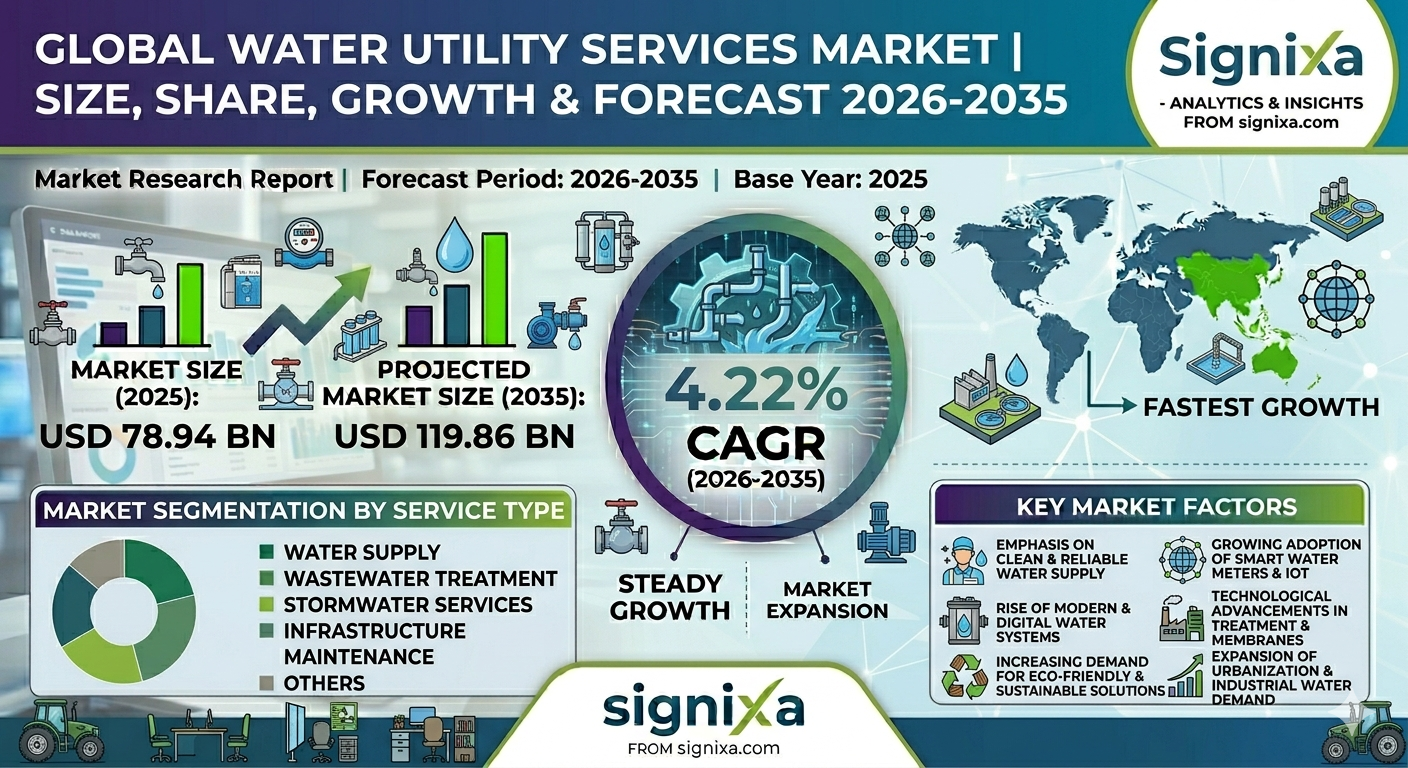
The size of the global Water Utility Services market was worth around USD 78.94 Billion in 2025 and is predicted to grow to around USD 119.86 Billion by 2035, with a compound annual growth rate (CAGR) of roughly 4.22% between 2026 and 2035. The report analyzes the market's key drivers and restraints and examines their impact on demand throughout the forecast period. Additionally, the report explores global opportunities and innovations shaping the water utility landscape.
The Water Utility Services market encompasses services related to the treatment, distribution, and management of water and wastewater across residential, commercial, industrial, and municipal sectors. Growth in this market is primarily driven by increasing global water demand, aging infrastructure, rising concerns around clean water access, and environmental regulations promoting efficient water resource management. Advances in smart metering, digital water networks, and sustainability practices further enhance the market's potential.
Key Findings
- As per the analysis shared by our research analyst, the global Water Utility Services market is estimated to grow annually at a CAGR of around 4.22% over the forecast period (2026–2035).
- In terms of revenue, the global Water Utility Services market size was valued at around USD 78.94 Billion in 2025 and is projected to reach USD 119.86 Billion by 2035.
- The market is projected to grow significantly due to increasing infrastructure investments, water scarcity concerns, and technological advancements in utility management.
- Based on Type, the Drinking Water segment is growing at a high rate and is expected to dominate the global market due to rising urbanization and demand for potable water.
- On the basis of Application, the Residential segment is anticipated to command the largest market share, driven by population growth and increased domestic water consumption.
- In terms of Services, the Water Supply & Distribution segment is projected to lead the market, supported by efforts to upgrade and modernize water infrastructure.
- By Region, North America is projected to dominate the global market during the forecast period, thanks to advanced infrastructure, digital transformation of utilities, and strong regulatory frameworks. However, Asia-Pacific is expected to exhibit the fastest growth rate, fueled by urban expansion and government-led water infrastructure development programs.
Water Utility Services Market Dynamics
The Water Utility Services market is undergoing significant transformation, fueled by growing urbanization, increasing demand for clean water, aging infrastructure, climate change concerns, and the adoption of digital technologies across utility operations. These factors collectively drive the need for more sustainable, efficient, and resilient water utility services globally.
Rising Demand for Clean and Safe Water Supplies
One of the primary growth drivers of the Water Utility Services market is the escalating global demand for drinking water due to rapid population growth and urban expansion. With urban populations increasing, especially in emerging economies, utilities face pressure to ensure uninterrupted access to clean and safe water. The demand for high-quality water for domestic, agricultural, and industrial consumption continues to rise, reinforcing the importance of efficient and reliable water supply systems. Drinking water utilities are investing heavily in pipeline expansion, leak detection technologies, and smart metering solutions to improve distribution efficiency and reduce water loss.
Infrastructure Development and Modernization
Aging infrastructure is a growing concern, particularly in developed economies. Many water and wastewater systems were built decades ago and are now reaching or exceeding their operational lifespans. This necessitates significant investments in residential, commercial, industrial, and municipal water systems. Governments and private sector players are increasingly allocating budgets for rehabilitating and upgrading water networks, treatment plants, and storage facilities. As infrastructure modernizes, it enables improved water delivery, treatment capacity, and real-time system monitoring. In industrial and municipal applications, demand is surging for advanced wastewater treatment solutions and water reuse systems that support circular economy principles.
Growing environmental awareness and regulatory pressures are prompting utilities to improve sewage treatment and water quality monitoring services. In response to water pollution, climate-induced water stress, and stringent government mandates, utilities are adopting more robust wastewater treatment technologies. Water quality monitoring services are also seeing increased investment as part of proactive management to ensure compliance with safety standards and environmental norms. Utilities are implementing real-time sensor networks and IoT-enabled platforms to track water quality parameters across entire systems.
Technological Innovation and Digitalization of Utility Operations
The shift toward smart water management is revolutionizing utility services. Water utilities are adopting digital tools such as advanced metering infrastructure (AMI), SCADA systems, AI-based leak detection, and predictive maintenance algorithms to improve service delivery and operational efficiency. These innovations enable utilities to reduce energy usage, prevent system failures, optimize resource allocation, and enhance customer satisfaction through billing and customer services platforms. The integration of cloud computing and data analytics also allows for more accurate demand forecasting and real-time decision-making.
Environmental and Climate Change Pressures
As climate change accelerates, issues like droughts, floods, and shifting precipitation patterns are affecting water availability and quality. Utilities are investing in resilient water supply and distribution systems that can adapt to these challenges. This includes diversification of water sources, stormwater management systems, desalination technologies, and the use of alternative water sources such as greywater reuse. In polluted urban centers, investments in purification technologies are rising to ensure air and water safety for growing populations.
Water Utility Services Market Segmentation Analysis
By Type: Drinking Water Supply vs. Wastewater Treatment
Drinking Water Supply Services
The Water Utility Services market is segmented by type into drinking water supply and wastewater treatment services, each playing a vital role in ensuring sustainable water management across urban and rural areas. Drinking water supply services focus on the sourcing, treatment, and distribution of potable water to households, industries, and municipalities. This segment is increasingly adopting advanced filtration, UV disinfection, and chemical treatment methods to ensure water meets stringent safety standards. Smart metering and pressure management technologies are also being deployed to minimize water loss and improve delivery efficiency.
Wastewater Treatment Services
Wastewater treatment services involve the collection and processing of used water from residential, commercial, and industrial sources. These services are crucial for preventing environmental pollution and for enabling water reuse in agriculture and industrial applications. The treatment process typically includes primary, secondary, and tertiary treatments to remove contaminants and harmful microorganisms. With growing concerns around water scarcity and environmental degradation, the wastewater treatment segment is seeing rapid innovation in biological and membrane-based filtration technologies that enhance recovery rates and reduce energy consumption.
By Application: Residential, Industrial, Municipal & Commercial
Residential Application
The Water Utility Services market spans multiple applications, including residential, industrial, commercial, and municipal sectors. Among these, the residential segment represents a substantial share due to the rising demand for consistent, clean, and safe drinking water in growing urban populations. Utilities are focusing on enhancing service reliability, reducing leakages, and expanding pipeline infrastructure to serve expanding suburban and peri-urban areas.
Industrial Application
In the industrial sector, water utility services are used for process water, cooling systems, and effluent treatment. Heavy industries such as chemicals, power generation, mining, and food processing are increasingly partnering with utility providers to ensure access to sustainable water sources and advanced wastewater recycling solutions. Regulations around effluent discharge have pushed industries to upgrade treatment facilities and adopt zero liquid discharge (ZLD) systems in collaboration with water utilities.
Municipal Application
The municipal application is also critical, encompassing the provision of water supply and sanitation services to public institutions, schools, government buildings, and urban infrastructure. Municipal utilities are leading investments in smart water management systems, integrating digital sensors and SCADA platforms for real-time monitoring and system optimization. Urban municipalities are particularly focused on upgrading aging infrastructure and improving resilience to climate-related stressors such as droughts and flooding.
By Services: Supply, Treatment, Metering, Monitoring & Support
Water Supply & Distribution Services
The Water Utility Services market also segments by service type, which includes water supply & distribution, sewage treatment, metering & billing, customer support, and water quality monitoring. Water supply and distribution services are the backbone of the market, ensuring consistent delivery of potable water through networks of pipes, pumps, and storage facilities. These services are being modernized with pressure optimization technologies and leak detection tools that help reduce non-revenue water and improve sustainability.
Sewage Collection & Treatment Services
Sewage treatment services are equally critical, with a growing emphasis on sustainable and decentralized systems that can serve both dense urban environments and remote rural areas. Advanced biological and membrane technologies are helping utilities enhance treatment efficiency and support water reuse initiatives.
Metering & Billing Services
Metering and billing services are becoming more sophisticated with the deployment of smart meters and integrated billing platforms. These services offer real-time consumption data to both providers and consumers, improving transparency and enabling demand-side water management. Utilities are also investing in digital customer support platforms, enabling easier access to information, service requests, and usage tracking.
Water Quality Monitoring Services
Water quality monitoring services ensure compliance with environmental regulations and safeguard public health. These services rely on a network of sensors and laboratories that continuously test for chemical, biological, and physical parameters, allowing utilities to respond quickly to contamination events or infrastructure failures.
Global Water Utility Services Market Segmentation Summary
| Segment Category | Segments |
|---|---|
| By Type |
|
| By Application |
|
| By Services |
|
| By Region |
|
Water Utility Services Market Regional Analysis
The global water utility services market is expanding across all regions, with North America and Europe being leaders in innovation and adoption due to strong regulatory support and high levels of industrial development. The Asia-Pacific region is the largest and fastest-growing market, driven by industrialization, population growth, and a focus on sanitation and hygiene. Latin America and the Middle East & Africa are emerging markets, where Water Utility Services adoption is expected to accelerate in response to growing infrastructure needs, public health concerns, and the need for energy-efficient solutions. As Water Utility Services technology continues to evolve, its adoption is likely to increase across all regions, fueled by the growing demand for sustainable and cost-effective solutions in various industries.
North America (Dominant Region)
North America leads the market thanks to advanced infrastructure, digital transformation of utilities, and strong regulatory frameworks. The U.S. and Canada are at the forefront of smart water technology adoption, driven by government support, infrastructure modernization investments, and the presence of major utility providers. Favorable policies around clean water standards continue to accelerate market growth in this region.
Europe
Europe is a significant contributor to the global water utility services market, backed by stringent environmental regulations, high levels of industrial activity, and strong government support for sustainable water management. Countries such as Germany, France, the UK, Spain, and Italy are leading the modernization of water infrastructure and adoption of digital water solutions. EU-driven climate neutrality goals are accelerating investments in water recycling and smart utility systems.
Asia-Pacific (Fastest Growing)
Asia-Pacific is the largest and fastest-growing market for water utility services, driven by industrialization, rapid population growth, and a strong focus on sanitation and hygiene. Governments across China, India, Japan, South Korea, and Southeast Asia are investing heavily in smart city projects, drinking water infrastructure, and wastewater treatment upgrades. Government-led programs and public-private partnerships are expected to further accelerate adoption of water utility services across the region through 2032.
Latin America (Emerging Market)
Latin America is an emerging market for water utility services, with countries like Brazil and Argentina focusing on expanding access to safe drinking water and improving wastewater treatment capabilities. Public health concerns, growing urban populations, and infrastructure investment needs are driving demand for modern water utility solutions across the region.
Middle East & Africa (Emerging Market)
The Middle East & Africa region is witnessing accelerating adoption of water utility services in response to growing infrastructure needs, water scarcity challenges, and energy-efficient solution requirements. GCC countries, South Africa, and other nations are investing in desalination, stormwater management, and smart water infrastructure as part of broader sustainability agendas.
Recent Developments in the Water Utility Services Market
-
2023
Veolia launched a smart water monitoring system using AI-driven sensors to detect leaks and optimize water distribution efficiency in urban infrastructure.
-
2022
Suez Group introduced an advanced wastewater treatment process utilizing membrane bioreactor (MBR) technology to enhance water recycling capacity in industrial zones.
-
2021
American Water partnered with IBM to roll out predictive analytics and cloud-based asset management solutions aimed at modernizing aging water infrastructure across several U.S. states.
Water Utility Services Market: Competitive Landscape
The global water utility services market is dominated by key players such as Veolia Environnement S.A., Suez Group, American Water, Thames Water, Aqua America, China Water Affairs Group, Manila Water Company, SABESP, Severn Trent, and United Utilities, among others. The competitive landscape is shaped by growing regulatory pressures, rising water demand, and aging infrastructure — factors pushing companies to adopt innovative technologies and sustainable practices.
Leading players are actively investing in smart water technologies, decentralized water treatment systems, and non-revenue water reduction strategies to improve service delivery and environmental outcomes. Many are also expanding their global footprint through acquisitions and public-private partnerships (PPPs). As climate change and urbanization challenge traditional water management systems, utilities that offer digitally integrated, resilient, and environmentally responsible services are best positioned to lead the market.
Key Companies Profiled
Frequently Asked Questions (FAQs) About the Water Utility Services Market
What is Water Utility Services?
Water utility services refer to the management and delivery of water-related services such as potable water supply, wastewater treatment, recycled water distribution, and stormwater management to residential, industrial, commercial, and municipal users. These services ensure the sustainable, safe, and efficient handling of water resources.
Which key factors will influence the Water Utility Services market growth over 2026-2035?
The global water utility services market is expected to grow significantly due to rising urbanization, increased awareness of water conservation, aging water infrastructure, climate change impacts, and regulatory mandates for safe drinking water and wastewater treatment. Smart water technologies and digital monitoring systems will also play a key role in driving market growth.
What will be the value of the Water Utility Services market during 2026-2035?
According to the study, the global water utility services market was valued at approximately USD 78.94 billion in 2025 and is projected to reach around USD 119.86 billion by 2035, driven by rising demand for clean and sustainable water infrastructure across developing and developed economies.
What will be the CAGR value of the Water Utility Services market during 2026-2035?
The CAGR value of the water utility services market is expected to be around 4.18% from 2025 to 2032, supported by infrastructure investments, digital transformation in utilities, and a shift toward decentralized water treatment systems.
Which region will contribute notably towards the Water Utility Services market value?
The Asia-Pacific region is anticipated to lead the market due to population growth, rapid industrialization, and government investments in smart city and water infrastructure projects. North America and Europe will also contribute significantly, backed by modernization initiatives and stricter environmental regulations.
Which are the major players leveraging the Water Utility Services market growth?
Key players driving the water utility services market include Veolia Environnement S.A., Suez Group, American Water Works Company Inc., Thames Water Utilities Ltd, Aqua America Inc., China Water Affairs Group Ltd, SABESP, Severn Trent plc, United Utilities Group PLC, and Manila Water Company. These companies are focusing on innovation, digital water management, and sustainability initiatives.
What can be expected from the global Water Utility Services market report?
The report offers comprehensive insights into the water utility services market, including analysis of key drivers, trends, challenges, and opportunities. It also covers segmentation by type (e.g., drinking water, wastewater, stormwater), application (residential, industrial, municipal, commercial), and services (distribution, treatment, metering, monitoring, customer support) to help stakeholders make informed decisions and strategic investments.