
Alcoholic Drinks Market Overview
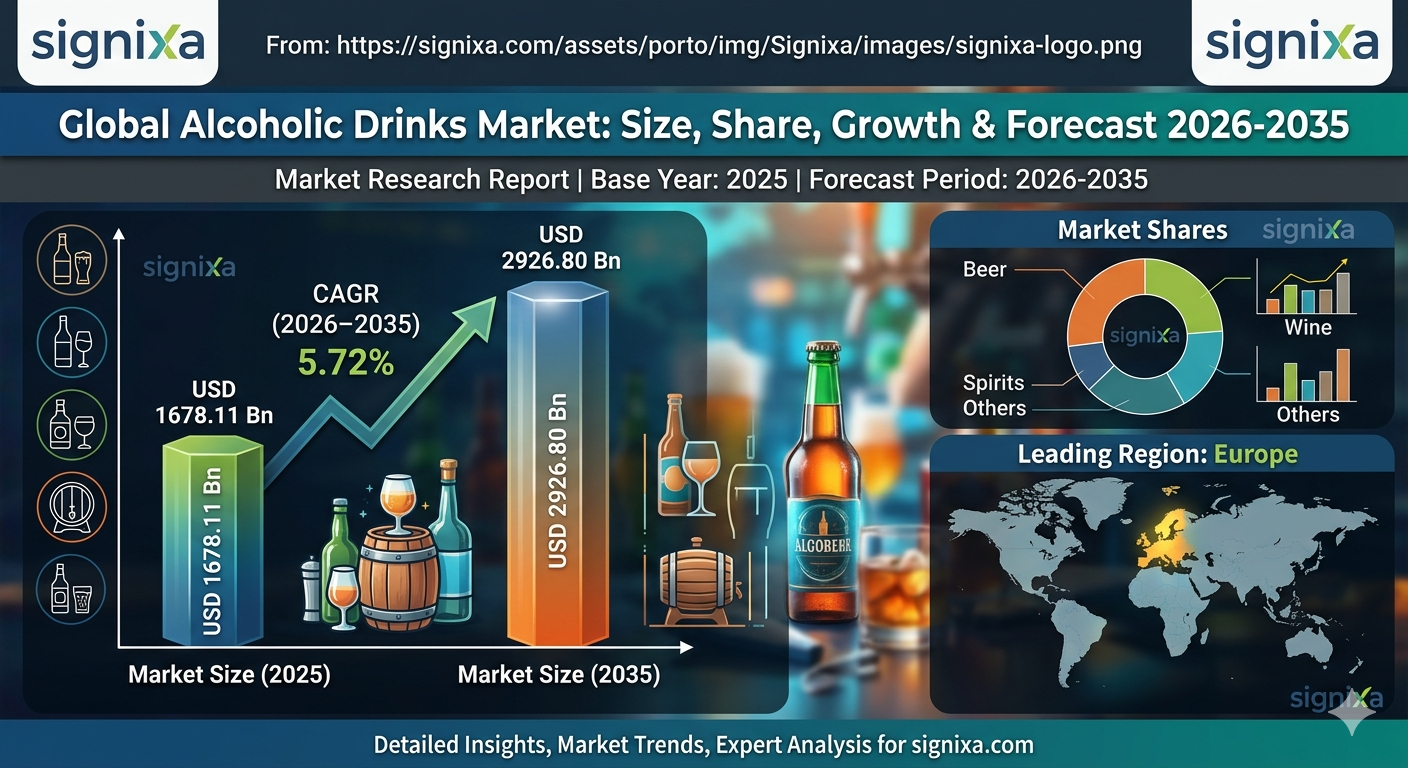
The size of the global alcoholic drinks market was worth around USD 1678.11 billion in 2025 and is predicted to grow to around USD 2926.80 billion by 2035, with a compound annual growth rate (CAGR) of roughly 5.72% between 2025 and 2035. The report analyzes the market drivers and restraints, along with the impact they have on demand during the forecast period. It also explores key global opportunities in the alcoholic drinks market.
The alcoholic drinks market encompasses a broad range of products including beer, wine, spirits, and emerging segments such as hard seltzers. A growing shift in consumer preferences toward premium, craft, and health-conscious alcoholic beverages is transforming the industry. The rise of experiential drinking in social settings, increased global alcohol consumption, and product innovation are supporting growth. Additionally, e-commerce is playing a greater role in retail alcohol sales, giving consumers access to a wider variety of choices.
The alcoholic drinks market is a vast and complex global industry, constantly evolving in response to shifting consumer preferences, socio-cultural trends, and regulatory landscapes. At its core, the market encompasses a diverse array of categories including beer, wine, spirits (such as whisky, vodka, rum, gin, tequila, and brandy), and the rapidly growing ready-to-drink (RTD) segment. This extensive variety caters to a wide spectrum of tastes, occasions, and price points, from mass-produced lagers to artisanal craft beers, from everyday table wines to premium vintage selections, and from standard spirits to ultra-premium and limited-edition expressions. The industry's stability is underpinned by its long-standing cultural significance in many societies, where alcoholic beverages are deeply integrated into social rituals, celebrations, and culinary experiences. However, manufacturers are continually challenged to innovate and adapt, not just in terms of new product development and flavor profiles, but also in marketing and distribution strategies to reach an increasingly segmented and discerning consumer base. This involves navigating complex regulations related to advertising, sales, and consumption that vary significantly across different countries and even within regions of the same country.
A major overarching trend influencing the alcoholic drinks market is the sustained move towards premiumization across nearly all categories. Consumers, particularly those with rising disposable incomes in emerging markets and financially insulated higher-income drinkers in established markets, are increasingly willing to pay more for products perceived as higher quality, more authentic, or offering a unique experience. This trend manifests in the surging popularity of craft spirits, artisanal beers, and premium wines, often with a focus on provenance, unique ingredients, and sophisticated production methods. This isn't just about higher alcohol content; it's about the entire consumption experience, including the brand story, packaging aesthetics, and perceived craftsmanship. Alongside premiumization, there's a growing appetite for flavor innovation, especially within the spirits and RTD categories. Consumers are eager to experiment with novel taste combinations, exotic ingredients, and unique infusions, driving manufacturers to constantly develop new products that capture attention and cater to evolving palates. This dynamic interplay between premium quality and novel flavors is crucial for brands seeking to differentiate themselves in a crowded market.
Another transformative dynamic in the alcoholic drinks market is the dual trend of moderation and the rapid rise of no- and low-alcohol (NoLo) alternatives. While traditional alcoholic beverages continue to be consumed, a significant segment of consumers, especially younger demographics, is becoming more health-conscious and mindful of their alcohol intake. This has led to an increase in "light" drinkers who consume less frequently or in smaller quantities, and a growing number of individuals practicing temporary abstinence. In response, the NoLo category, particularly no-alcohol beer and spirits, is experiencing exponential growth, offering consumers the social experience and sophisticated flavors of alcoholic beverages without the alcohol content. This trend is not about total abstinence for everyone, but rather about having diverse options that fit different lifestyles and occasions. This shift necessitates significant investment from traditional alcoholic beverage companies into developing appealing NoLo portfolios, showcasing the industry's adaptability to evolving consumer values and health priorities. Furthermore, the rise of e-commerce and digital platforms is revolutionizing how alcoholic drinks are bought and sold, providing unprecedented convenience and access, and forcing traditional brick-and-mortar retailers to innovate their offerings and services.
Key Findings
- As per analysis by our research analyst, the global alcoholic drinks market is estimated to grow annually at a CAGR of around 5.72% over the forecast period (2026-2035).
- In terms of revenue, the market was valued at USD 1678.11 billion in 2025 and is expected to reach USD 2926.80 billion by 2035.
- The market growth is supported by increased demand for premium and craft alcohol.
- Based on Type, Beer is the dominant segment with a substantial share of the global market.
- Hard Seltzer is projected to grow at the fastest CAGR during the forecast period.
- By Distribution Channel, Supermarkets account for the largest revenue share globally.
- By Region, Europe currently leads the global market, followed closely by Asia-Pacific.
Alcoholic Drinks Market Dynamics
Rising Popularity of Premium & Craft Alcoholic Beverages
One of the major growth drivers is the rising popularity of premium and craft alcoholic beverages. Consumers, particularly millennials and Gen Z, are gravitating toward high-quality, artisanal drinks with unique flavors and authentic brand stories. This shift is especially evident in the beer and spirits segments, where craft breweries and boutique distilleries are seeing increased market penetration. The willingness to pay more for premium experiences is fuelling innovation and encouraging brands to experiment with ingredients and aging techniques to differentiate their offerings.
Urbanization, Rising Disposable Incomes & Post-Pandemic Hospitality Recovery
Changing lifestyles and increased socialization are also positively influencing the alcoholic drinks market. Urbanization, rising disposable incomes, and evolving consumer preferences are contributing to increased alcohol consumption, especially in emerging markets. Social drinking occasions, such as gatherings at pubs, bars, and restaurants, as well as at-home consumption fuelled by online delivery services, are reinforcing this trend. Post-pandemic recovery in the hospitality sector is further driving demand, while regulatory relaxations in retail alcohol sales are opening new growth avenues.
Digital Transformation & E-Commerce Expansion in Alcohol Retail
Digital transformation is reshaping distribution strategies in the alcoholic drinks market. E-commerce platforms are becoming key channels for alcohol purchases, particularly among tech-savvy and convenience-seeking consumers. Online retailing allows access to a broader product range, brand discovery, and easy delivery, making it a favourable option. The pandemic further accelerated this trend, prompting both brands and traditional retailers to enhance their digital presence. As digital infrastructure improves globally, online alcohol sales are poised for sustained growth.
Premiumization, Flavor Innovation & Shifting Consumer Values
The alcoholic drinks market is undergoing a significant transformation, propelled by evolving consumer preferences and a global drive towards premiumization. Consumers are increasingly discerning, seeking not just a drink, but an experience. This manifests as a willingness to pay more for products perceived as higher quality, more authentic, or offering a unique story. This trend is evident across all categories, from the surge in craft beers and artisanal spirits to the growing demand for premium and super-premium wines. The focus shifts from sheer volume consumption to "drinking less but drinking better." Brands are responding by emphasizing provenance, traditional craftsmanship, innovative production methods, and sophisticated packaging. This also aligns with a growing desire for transparency and authenticity in product sourcing and manufacturing. Furthermore, flavor innovation is a crucial driver, particularly in the spirits and ready-to-drink (RTD) segments. Consumers, especially younger demographics, are eager to experiment with novel taste combinations, exotic ingredients, and unique infusions, pushing manufacturers to continuously introduce new products that capture attention and cater to evolving palates. This dynamic interplay between premium quality and novel flavors is crucial for brands seeking to differentiate themselves in a crowded and competitive market.
NoLo Movement, Health Consciousness & Regulatory Complexity
Another pivotal dynamic is the accelerating trend of moderation and the exponential growth of no- and low-alcohol (NoLo) beverages. A growing segment of consumers, driven by health and wellness concerns, is actively seeking to reduce their alcohol intake, or opting for periods of complete abstinence. This doesn't necessarily mean a complete rejection of alcohol, but rather a desire for more diverse options that fit various lifestyles and occasions. Consequently, the NoLo category, particularly in beer and spirits, has witnessed unprecedented growth. These alternatives offer consumers the social experience, complex flavors, and sophisticated packaging of traditional alcoholic beverages without the intoxicating effects. This trend is forcing established alcoholic beverage companies to invest significantly in developing appealing NoLo portfolios, often leveraging their existing brand recognition to introduce alcohol-free versions of popular drinks. The market also faces complex and often fragmented regulatory environments, with alcohol sales highly regulated through differing laws regarding production, distribution, advertising, and taxation across countries and regions. Frequent policy changes, particularly related to taxation and advertising restrictions, pose ongoing challenges for manufacturers and distributors, requiring constant adaptation and compliance efforts to navigate the intricate global landscape.
Alcoholic Drinks Market Segmentation Analysis
By Type Segment Analysis
The market is segmented by type, with each category exhibiting distinct consumer drivers and growth trajectories:
Beer
Based on Type, the Beer segment dominated the market in 2025, accounting for over 35% of the global revenue. Beer remains the most widely consumed alcoholic beverage, especially in countries such as China, the U.S., Germany, and Brazil. The rise of craft beer breweries and flavored beers has expanded consumer choices and spurred market expansion. Additionally, sports events and casual gatherings continue to drive beer consumption globally. Product diversification and new flavor profiles are expected to further elevate demand over the forecast period.
Spirits
The Spirits segment, which includes whisky, vodka, rum, and gin, held the second-largest market share in 2025. Rising disposable incomes and the premiumization trend have driven consumption of aged and luxury spirits, particularly in North America and Europe. According to IWSR, global spirits volume grew by over 2.5% in 2023, with premium segments outpacing standard categories. Innovations like low-sugar and botanical infusions are appealing to health-conscious consumers and are projected to drive sustained growth.
Wine
The Wine segment captured around 18% of the global revenue in 2025. The segment continues to grow due to increasing demand for red and sparkling wines across developed regions. Countries like France, Italy, and the U.S. are major consumers, while emerging economies are witnessing a surge in wine culture and education. Organic and biodynamic wines are gaining popularity, particularly among environmentally conscious and health-oriented consumers.
Hard Seltzer
Hard Seltzer emerged as the fastest-growing segment with a projected CAGR exceeding 8% from 2025 to 2035. The segment's explosive growth is driven by its low calorie, low sugar profile, and popularity among younger consumers. Brands like White Claw and Truly have set strong precedents in North America, and the trend is now expanding to Europe and Asia-Pacific. Product innovation, including cocktail-inspired and functional ingredient-infused seltzers, is expected to boost adoption further.
Cider, Perry & Rice Wine
The Cider, Perry & Rice Wine segment caters to region-specific preferences and growing consumer interest in fruit-based and traditional fermented beverages. Cider is particularly popular in Western Europe and parts of North America, while rice wine holds deep cultural significance across Asia-Pacific markets. The segment is benefiting from growing awareness of artisanal production methods and the broader premiumization trend, with manufacturers introducing premium variants, flavored options, and organic formulations to attract broader consumer demographics.
Others
The Others segment encompasses a variety of emerging and niche alcoholic beverages including flavored alcoholic beverages (FABs), mead, sake, and ready-to-drink (RTD) cocktails. This segment is witnessing growing interest driven by consumer curiosity for new and exotic drinking experiences. RTD cocktails, in particular, are gaining strong traction globally due to their convenience, consistent quality, and diverse flavor options. Manufacturers are increasingly innovating within this space to capitalize on the experiential drinking trend and appeal to adventurous, younger consumer demographics.
By Distribution Channel Segment Analysis
Supermarkets
In terms of Distribution Channel, Supermarkets accounted for the largest share in 2025, contributing over 32% of the total market revenue. Supermarkets offer convenience, competitive pricing, and a wide variety of options, making them the preferred choice for household alcohol purchases. They also benefit from high foot traffic and in-store promotions that influence purchase decisions.
Pub, Bars & Restaurants
Pub, Bars & Restaurants remain a significant channel, accounting for nearly 28% of the global share. Social consumption continues to drive alcohol sales in this segment, which is rebounding strongly after the pandemic-induced slowdown. The resurgence of nightlife, tourism, and food service establishments is expected to boost revenues from this channel significantly over the next few years.
Internet Retailing
Internet Retailing is growing at the fastest rate within the distribution channel segment, with online alcohol sales rising sharply in both mature and emerging markets. With consumers seeking convenience, home delivery, and wider product availability, this channel saw an over 35% year-on-year growth in several key regions in 2023. Increased investment in digital platforms by alcohol brands is also enhancing the online purchase experience.
Liquor Stores
Liquor Stores serve as dedicated specialist retail outlets offering a curated and extensive selection of alcoholic beverages across all categories. They cater primarily to consumers seeking premium, rare, or specialty products that may not be available through mainstream supermarket channels. Staff expertise and personalized service are key competitive advantages for this channel. Liquor stores maintain a loyal customer base, particularly among premium and craft alcohol enthusiasts, and continue to be an important part of the overall distribution ecosystem in both North America and Europe.
Grocery Shops
Grocery Shops represent a convenient and accessible channel for everyday alcohol purchases, particularly in regions where supermarket penetration is lower or where consumers prefer neighbourhood-level shopping. This channel is especially relevant in densely populated urban areas and in certain emerging markets where modern retail infrastructure is still developing. While individual transaction values tend to be lower compared to supermarkets and liquor stores, grocery shops contribute meaningfully to overall market volume through high purchase frequency and their deep embeddedness within local community shopping habits.
Report Attributes & Market Scope
| Report Attribute | Details |
|---|---|
| Market Size Value in 2025 | USD 1678.11 Billion |
| Market Size Value in 2035 | USD 2926.80 Billion |
| CAGR (2026–2035) | 5.72% |
| Base Year Used for Estimation | 2025 |
| Historic Data | 2020 - 2025 |
| Forecast Period | 2026 - 2035 |
| Segments Covered – By Type |
|
| Segments Covered – By Distribution Channel |
|
| Regions Covered | North America, Europe, Asia Pacific, Latin America, Middle East and Africa |
| Major Countries Covered | U.S., Canada, Mexico, Germany, UK, France, Italy, Spain, Russia, China, Japan, South Korea, India, Southeast Asia Countries, Brazil, Argentina, GCC Countries, Turkey, Iran, Israel, South Africa, Egypt, Nigeria, etc. |
| Key Companies Profiled | Anheuser-Busch InBev, Diageo plc, Pernod Ricard, Heineken N.V., Carlsberg Group, Bacardi Limited, Constellation Brands, Molson Coors Beverage Company, Asahi Group Holdings, and Beam Suntory Inc. |
Alcoholic Drinks Market Regional Analysis
Europe dominated the global alcoholic drinks market in 2025, driven by long-standing drinking cultures, premium product offerings, and a strong retail infrastructure. Countries such as Germany, France, and the UK continue to be major revenue contributors. Meanwhile, Asia-Pacific is the fastest-growing region, fuelled by expanding middle-class populations, increased urbanization, and growing alcohol acceptance. China and India are key growth engines in the region. North America maintains a robust share, led by the U.S., where premiumization and innovation drive demand across segments like spirits and hard seltzers. Latin America and the Middle East & Africa are emerging markets witnessing gradual shifts in consumption patterns due to socio-economic changes.
Europe (Dominant Region)
Europe's alcoholic drinks market is characterized by its deep-rooted cultural traditions, diverse consumption patterns, and a strong emphasis on provenance and quality. Countries like France, Italy, and Spain maintain strong traditions in wine consumption, while Central and Eastern European nations show a preference for beer and spirits, respectively. The premiumization trend is highly significant across the continent, with consumers willing to invest in high-quality wines, craft beers, and artisanal spirits that reflect regional heritage and superior craftsmanship. However, Europe is also at the forefront of the moderation trend, with an increasing number of consumers, particularly younger generations, opting for no- and low-alcohol alternatives. This has led to substantial innovation in the NoLo beer and spirits categories. Strict regulatory environments regarding alcohol advertising, sales, and health warnings vary significantly across European nations, influencing market strategies and product positioning. Despite challenges like high taxation in some areas, the enduring cultural significance of alcoholic beverages ensures a resilient and evolving market.
Asia-Pacific
The Asia Pacific region stands as the largest and most rapidly expanding market for alcoholic drinks, fuelled by rising disposable incomes, rapid urbanization, and a burgeoning middle class, especially in economic powerhouses like China and India. While traditional local beverages hold strong cultural significance, there's a growing inclination towards Western alcoholic categories such as wine, spirits, and beer, driven by changing lifestyles, increased exposure to international trends, and the influence of a vibrant nightlife culture. Premiumization is a strong underlying current, with consumers seeking high-end imported spirits and wines as status symbols. Ready-to-drink (RTD) beverages are also gaining significant traction due to their convenience and diverse flavor offerings. The sheer population size and the aspirational nature of consumption contribute immensely to market growth, despite varying regulatory landscapes and cultural norms surrounding alcohol consumption across the diverse countries within the region. E-commerce platforms are playing an increasingly vital role in distribution, expanding reach to a vast consumer base.
North America
North America's alcoholic drinks market is a dynamic landscape shaped by evolving consumer preferences towards premiumization, health consciousness, and convenience. The United States and Canada are witnessing a significant surge in demand for craft beers, artisanal spirits, and premium wines, as consumers increasingly prioritize quality, unique flavor profiles, and authentic brand stories over volume. Alongside this premiumization trend, there's a strong and growing movement towards moderation, driving exponential growth in the no- and low-alcohol (NoLo) beverage segment, including non-alcoholic beers, spirits, and ready-to-drink (RTD) options. Hard seltzers, in particular, have carved out a substantial niche, appealing to younger demographics seeking lighter, flavored alcoholic beverages. The region's robust e-commerce infrastructure has also revolutionized distribution, making a wider array of products accessible to consumers and accelerating the discovery of new brands. Regulatory frameworks, while generally well-established, continue to evolve, especially concerning new product categories and online sales, influencing market entry and marketing strategies.
Middle East & Africa
The Middle East and Africa (MEA) region presents a highly diverse and evolving alcoholic drinks market, significantly influenced by religious and cultural sensitivities, varying regulatory environments, and disparate economic conditions. In many Middle Eastern countries, alcohol consumption is heavily restricted or prohibited due to Islamic law, leading to a strong demand for non-alcoholic alternatives, particularly non-alcoholic beer. However, in areas with significant expatriate populations or more liberal regulations, such as parts of the UAE or South Africa, there is a growing demand for premium spirits, wines, and international beer brands. South Africa, in particular, is a major market with a well-developed local industry and a growing interest in craft beers and ciders. Across Africa, rising disposable incomes and urbanization are gradually contributing to increased consumption, though infrastructure challenges and varying government policies remain key considerations for market penetration. The trend towards premiumization and a cautious exploration of diverse product categories is evident in regions where consumption is permitted.
Latin America
Latin America is an emerging market for alcoholic drinks, witnessing gradual shifts in consumption patterns due to socio-economic changes, rising disposable incomes, and evolving lifestyle preferences. Brazil and Mexico are the dominant markets in the region, each with distinct preferences — Brazil for beer and cachaça, Mexico for tequila and mezcal, both of which are experiencing growing international demand as premium export categories. Argentina's wine heritage also contributes meaningfully to the regional market profile. The expansion of modern retail formats, growing middle-class demographics, and improving e-commerce infrastructure are facilitating broader product access. However, economic volatility, taxation policies, and regulatory differences across countries present ongoing challenges that manufacturers must navigate to successfully capitalize on the region's long-term growth potential.
Recent Developments in the Alcoholic Drinks Market
-
2023
Diageo launched a new low-alcohol spirits brand catering to mindful drinking trends.
-
2022
AB InBev expanded its e-commerce operations through strategic partnerships with delivery platforms in Europe and Latin America.
Alcoholic Drinks Market: Competitive Landscape
The global alcoholic drinks market features leading players such as Anheuser-Busch InBev, Diageo plc, Pernod Ricard, Heineken N.V., Carlsberg Group, Bacardi Limited, Constellation Brands, Molson Coors Beverage Company, Asahi Group Holdings, and Beam Suntory Inc. Competition is driven by brand equity, innovation, global distribution, and pricing strategies. Companies are focusing on product diversification, digital transformation, and regional expansion to strengthen their market positions. Sustainability, health-focused offerings, and experiential marketing are expected to play pivotal roles in shaping competitive dynamics going forward.
The competitive landscape of the alcoholic drinks market is defined by a blend of global beverage conglomerates, regional heritage brands, and a rapidly expanding ecosystem of craft and independent producers. Leading multinationals leverage their vast distribution networks, strong brand portfolios spanning multiple categories, and substantial marketing budgets to maintain dominance across key markets. Their strategies revolve around portfolio diversification through both organic innovation and strategic acquisitions, allowing them to capture growth across premium, mid-range, and emerging beverage categories simultaneously. Investment in sustainability initiatives and transparent supply chains is increasingly becoming a competitive differentiator, particularly for brands targeting younger, values-driven consumer segments.
The rise of direct-to-consumer (DTC) channels and the democratization of brand discovery through social media are creating new competitive dynamics, enabling smaller craft producers to challenge established players in premium and niche segments. Meanwhile, the NoLo movement is reshaping competitive positioning across the board, with major players accelerating the development of alcohol-free and low-alcohol alternatives under both existing and new brand identities. Mergers, acquisitions, and strategic partnerships with technology and logistics companies are increasingly being used to strengthen digital capabilities, enhance supply chain resilience, and accelerate entry into high-growth emerging markets globally.
Key Companies Profiled
Global Alcoholic Drinks Market Segmentation Summary
By Type
By Distribution Channel
By Region
Frequently Asked Questions (FAQs) About the Alcoholic Drinks Market
What are alcoholic drinks?
Alcoholic drinks are beverages that contain ethanol (alcohol) as an active ingredient, produced through the fermentation of sugars by yeasts. Common types include beer, spirits, wine, cider, perry, rice wine, and hard seltzer, consumed globally for recreational, cultural, and social purposes.
Which key factors will influence the Alcoholic Drinks market growth over 2026-2035?
The global alcoholic drinks market is expected to grow due to rising disposable incomes, increasing urbanization, the premiumization trend, evolving consumer preferences toward flavored and specialty drinks, and the expansion of online alcohol retailing.
What will be the value of the Alcoholic Drinks market during 2026-2035?
According to the study, the global alcoholic drinks market size was worth around USD 1678.11 Billion in 2025 and is predicted to grow to around USD 2926.80 Billion by 2035.
What will be the CAGR value of the Alcoholic Drinks market during 2026-2035?
The CAGR value of the Alcoholic Drinks market is expected to be around 5.72% during the forecast period from 2026 to 2035.
Which region will contribute notably towards the Alcoholic Drinks market value?
The Asia-Pacific and North American regions are expected to contribute significantly to the market value due to increasing alcohol consumption in developing countries, interest in agave-based spirits, and expanding e-commerce platforms. Europe currently leads globally as the dominant market.
Which are the major players leveraging the Alcoholic Drinks market growth?
The global Alcoholic Drinks market is led by companies such as Anheuser-Busch InBev, Diageo, Heineken N.V., Pernod Ricard, Asahi Group Holdings, Molson Coors Beverage Company, Constellation Brands, Carlsberg Group, Suntory Holdings, and Brown-Forman Corporation.
What can be expected from the global Alcoholic Drinks market report?
The report explores crucial aspects of the alcoholic drinks market, including a detailed analysis of current trends, key market drivers and restraints, regional dynamics, growth opportunities, distribution channels, and competitive landscape, while also providing forecasts up to 2035.