

Microfluidic Devices Market Overview
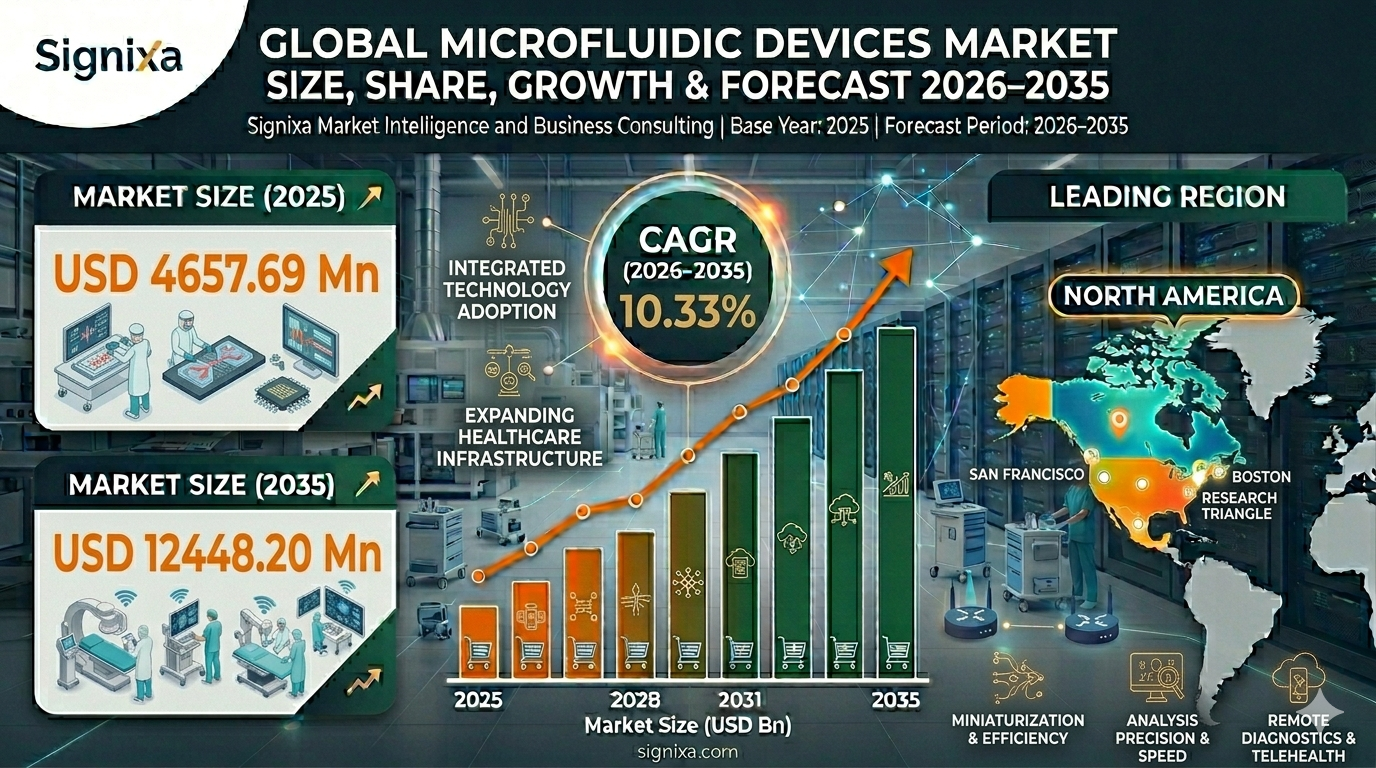
The size of the global Microfluidic Devices market was worth around USD 4657.69 million in 2024 and is predicted to grow to around USD 12448.20 million by 2035, with a compound annual growth rate (CAGR) of roughly 10.33% between 2026 and 2035. The report analyzes the Microfluidic Devices market's drivers and restraints, as well as the impact they have on demand throughout the projection period, and examines global opportunities across this expanding technology sector.
The global microfluidic devices market consists of systems that manipulate small amounts of fluids — typically at a microliter or nanoliter scale — within microscale channels and structures. This market includes components such as microfluidic chips, pumps, valves, sensors, and integrated diagnostic devices, with applications spanning medical diagnostics, drug delivery, biotechnology, chemical testing, and environmental monitoring. The growing demand for point-of-care diagnostics that provide rapid and cost-effective solutions for disease detection at or near the patient represents a primary market driver. The expansion of personalized medicine and targeted drug delivery systems, combined with the growing adoption of lab-on-a-chip (LOC) devices within research and diagnostics sectors, has improved laboratory test accuracy while simultaneously reducing cost and turnaround time compared to traditional laboratory workflows.
Microfluidic devices offer a powerful combination of precision, cost-effectiveness, speed, and portability that positions them as essential tools in modern scientific and medical innovation. Their miniaturization reduces reagent consumption and waste, resulting in cost savings and environmental benefits. The portability of these devices supports decentralized testing, which is particularly vital in remote or resource-limited settings — broadening access to vital medical services in markets where traditional laboratory infrastructure is limited. Ongoing advances in lab-on-a-chip technology, automation, artificial intelligence integration, and improved manufacturing methods are continuously expanding the capabilities and addressable applications of microfluidic devices across healthcare and non-healthcare sectors globally through the forecast period.
Key Findings
- The global Microfluidic Devices market is estimated to grow annually at a CAGR of 10.33% over the forecast period (2026–2035), with market size growing from USD 4657.69 million in 2025 to USD 12448.20 million by 2035.
- The increasing demand for point-of-care diagnostics is a primary driver, as microfluidic devices enable rapid, accurate, and cost-effective testing that improves patient outcomes and reduces healthcare costs.
- Based on Product Type, the Microfluidic Chips segment is growing at the highest rate and will continue to dominate the global market, projected at a segment CAGR of approximately 11.5%.
- By Application, the In-vitro Diagnostics segment is anticipated to command the largest market share, driven by widespread adoption of lab-on-a-chip platforms for clinical diagnostics.
- By Material Type, the Polymer-based Microfluidics segment is anticipated to command the largest market share, owing to cost advantages, fabrication flexibility, and versatility across applications.
- By Region, North America is projected to dominate the global market throughout the forecast period, supported by advanced healthcare infrastructure and significant R&D investment.
Microfluidic Devices Market Dynamics
Growing Demand for Point-of-Care Diagnostics & Rapid Testing
The growing demand for fast and accurate diagnostics is one of the primary factors driving the microfluidic devices market. Point-of-care diagnostics provide healthcare professionals with the ability to test patients and obtain results quickly, especially in remote settings or those with limited laboratory resources. Microfluidic devices are compact, affordable, capable of performing multiple tests simultaneously, and require very little sample volume — enabling on-site testing that eliminates the time and cost associated with sending samples to central laboratories. These advantages are particularly significant in infectious disease diagnosis, chronic disease management, and emergency care settings where rapid clinical decision-making is essential to patient outcomes. The COVID-19 pandemic significantly accelerated investment in and awareness of POC diagnostic capabilities globally, creating lasting structural demand for microfluidic POC platforms across all major healthcare markets through the forecast period.
Personalized Medicine & Drug Discovery Applications Expansion
The healthcare trend toward personalized medicine is substantially increasing demand for microfluidic devices across drug discovery, biomarker detection, and precision drug delivery applications. Personalized medicine requires tailoring medical treatment to the individual characteristics of each patient — including their genetic makeup and specific health conditions — which necessitates the high-throughput testing and analysis capabilities that microfluidic devices uniquely enable. In pharmaceutical drug discovery, microfluidic platforms accelerate high-throughput screening of drug candidates at dramatically reduced reagent volumes and costs compared to conventional screening approaches. Microfluidics are also enabling the development of next-generation drug delivery systems — including nanoformulations and controlled-release micro-dosing platforms — that improve therapeutic specificity and reduce systemic side effects. This combination of precision, scalability, and application breadth positions microfluidics as a foundational technology for the personalized healthcare paradigm through the forecast period.
Lab-on-a-Chip Technological Advances & Automation Integration
Ongoing advances in microfluidic device technology have dramatically expanded their capabilities and are contributing significantly to market growth. The development of lab-on-a-chip devices — which integrate multiple laboratory functions including sample preparation, mixing, reaction, separation, and detection onto a single compact chip — provides exceptional benefits to diagnostics, drug delivery, and research workflows. Modern microfluidic devices are becoming more automated, more efficient, easier to use, and more accurate, with improved scalability that allows the same technology to serve both high-throughput research laboratory applications and single-test point-of-care deployments. Integration with AI-driven data analysis, advanced imaging, and IoT connectivity is further expanding the data utility of microfluidic measurements beyond simple test results toward real-time physiological monitoring and predictive health analytics. These advances are expanding microfluidics adoption across clinical care, research laboratories, and industrial applications globally.
Microfluidic Devices Market Segmentation Analysis
By Product Type Segment Analysis
The microfluidic devices market is categorized across five product type segments, each serving distinct functional roles within microfluidic systems across diagnostic, pharmaceutical, and research applications:
Microfluidic Chips
Microfluidic chips are the leading product type in the market due to their functional versatility across applications including diagnostics, drug development, and environmental monitoring. These chips perform multiple integrated functions — mixing, pumping, sensing, separation, and detection — in a streamlined miniaturized format that replaces entire laboratory workflows on a device smaller than a credit card. The microfluidic chips market is expected to witness a significant CAGR of approximately 11.5% driven by expanding use of lab-on-a-chip platforms for point-of-care diagnostics and clinical applications. Their ability to work with very small sample volumes while delivering rapid, inexpensive, and accurate results makes them indispensable across healthcare diagnostics, biotechnology research, and pharmaceutical development environments that demand high throughput with low per-test cost.
Micro Pumps
Micro pumps play a key role in microfluidic devices by yielding accurate, controllable fluid movement at microscale. They are deployed in drug delivery, diagnostics, and laboratory analysis applications where precise and reliable fluid handling is critical to assay accuracy and reproducibility. In pharmaceutical applications, micro pumps control drug delivery with great precision — enabling personalized, adjustable treatment regimens including implantable drug delivery systems and wearable therapeutic devices. The global micro pump market is a high-growth segment projected to expand at a CAGR of approximately 16.2%, reflecting broad adoption across medical, industrial, and research applications. The increasing demand for accurate and reliable fluid handling systems — particularly in healthcare applications including insulin delivery, pain management infusion, and continuous biomarker monitoring — is driving robust growth in this product segment.
Microvalves
Microvalves are essential components for controlling liquid flow within microfluidic devices, enabling precise sequential fluid routing between channels, chambers, and reaction zones within lab-on-a-chip architectures. They are widely adopted in lab-on-a-chip applications for fluidic control, drug delivery, and diagnostics where accurate and reproducible fluid sequencing is critical to assay validity. The microvalve market is rapidly expanding due to growing demand for accurate fluid management in miniaturized devices, projected to expand at a CAGR of approximately 12.1%. The need for accuracy and reproducibility in both experimental research workflows and clinical diagnostic assays is driving this demand — particularly as multiplexed microfluidic assays requiring complex sequential fluid handling become more prevalent in advanced molecular diagnostic platforms for infectious disease, oncology, and genetic testing applications.
Microfluidic sensor technology enables simultaneous monitoring and data acquisition for diagnostics, environmental analysis, and industrial use. These sensors — typically integrated within lab-on-a-chip formats — are critical for monitoring chemical, biological, and environmental variables in real time with unprecedented sensitivity and minimal sample volume requirements. The microfluidic sensor market is projected to grow at a CAGR of approximately 14.5%, driven by the strong demand for point-of-care diagnostics and expanding biosensor applications. In healthcare, microfluidic sensors can detect disease biomarkers at the very early stages of pathological changes — enabling earlier diagnosis and more timely treatment intervention that improves patient outcomes and reduces healthcare system costs. Environmental monitoring applications including real-time water quality testing, air pollution sensing, and food contaminant detection represent additional high-growth application domains for microfluidic sensor technology.
Others (Actuators, Controllers & Mixers)
The "Others" product segment consists of various components including actuators, controllers, mixers, connectors, and interfaces that support the overall function of microfluidic systems. While the primary product categories command the largest revenue shares, components in the "Others" category provide essential functions enabling more complex and integrated features in advanced microfluidic device architectures. The segment is expected to see modest but consistent growth driven by increasing demand for more integrated microfluidic solutions that combine multiple functional subsystems — including fluid management, thermal control, optical detection, and electronic signal processing — into single, application-specific devices that reduce system complexity and improve ease of use for clinical and research end-users.
By Application Segment Analysis
In-vitro Diagnostics (IVD)
In-vitro diagnostics stands out as one of the largest and fastest-growing applications of microfluidic devices. These devices enable rapid, accurate, and inexpensive diagnostic tests through integrated sample preparation, analysis, and detection — all in a single compact device that can be used at the point of care. Microfluidic platforms including lab-on-a-chip systems are an essential component of next-generation POC diagnostics, as they can provide faster results with considerably smaller sample volumes than conventional laboratory assays. The broader IVD market is undergoing significant expansion driven by the increasing prevalence of chronic diseases, infectious disease outbreaks, cancer screening programs, and reproductive health testing — all of which generate high-volume demand for rapid, accessible diagnostic solutions that microfluidic platforms are uniquely positioned to deliver. The growth of companion diagnostics for targeted oncology therapies is a particularly significant emerging demand driver for high-sensitivity microfluidic IVD platforms.
Drug Delivery & Pharmaceuticals
The pharmaceutical industry utilizes microfluidic devices with increasing frequency for both drug delivery system development and pharmaceutical manufacturing processes. Microfluidic devices enable precise control of fluid dynamics at the nanoscale, allowing more efficient drug delivery systems including sustained-release, controlled-release, and targeted-release formulations. In personalized medicine applications, microfluidic platforms are used to create patient-specific nanoformulations that improve therapeutic efficacy while minimizing systemic side effects. Microfluidics play a particularly significant role in the production of lipid nanoparticles (LNPs) — the delivery vehicle used in mRNA vaccines and gene therapies — where precise control of nanoparticle size and composition during formulation is critical to therapeutic efficacy. The continued innovation of microfluidics in drug delivery systems, combined with the rapid expansion of biologics and gene therapy manufacturing, is sustaining strong growth momentum in this application segment through the forecast period.
By Material Type Segment Analysis
The material composition of microfluidic devices fundamentally determines their optical properties, chemical compatibility, thermal performance, fabrication cost, and suitability across different application environments:
Polymer-based Microfluidics
Microfluidic devices are predominantly polymer-based due to their outstanding balance of cost efficiency, fabrication flexibility, and broad application versatility. Materials including PDMS (polydimethylsiloxane) and PMMA (polymethylmethacrylate) are the most commonly used polymers in microfluidics manufacturing. These polymers offer exceptional flexibility and optical transparency — making them advantageous for a wide range of microfluidic applications including lab-on-a-chip diagnostic devices where optical detection of assay results is required. The polymer-based microfluidics segment is expected to grow at a CAGR of approximately 10.9% and reach USD 2.5 billion by 2028. This demand is driven by the increasing use of microfluidic devices in healthcare diagnostics and environmental monitoring, where the materials' combination of low-cost manufacturing, rapid prototyping capability, and biocompatibility make them the preferred choice for both high-volume disposable diagnostic cartridges and research prototype devices.
Glass-based Microfluidics
Microfluidic devices made of glass offer exceptional chemical stability, outstanding optical clarity, and superior surface chemistry control — providing remarkable advantages for applications that require the highest levels of precision and analytical reliability. Glass-based microfluidic systems are typically deployed in high-end applications including high-throughput screening, analytical chemistry, and advanced bioanalysis where polymer alternatives may introduce unwanted chemical interactions with assay reagents or biological samples. Glass-based devices also offer superior thermal conductivity, making them suitable for temperature-sensitive applications including PCR (polymerase chain reaction) and enzyme kinetics studies. The global glass-based microfluidics segment is expected to grow at a CAGR of approximately 9.7%, driven by increasing utilization in scientific research, medical diagnostics, and bioengineering — where glass remains the preferred material for applications demanding the highest optical, chemical, and thermal performance standards.
Silicon-based Microfluidics
Silicon-based microfluidics deliver a high degree of fabrication precision through leveraging established semiconductor manufacturing processes — including photolithography, deep reactive ion etching, and thin-film deposition — that enable complex, highly integrated microfluidic architectures with sub-micron feature resolution. The compatibility of silicon with CMOS semiconductor fabrication processes allows microfluidic functions to be directly integrated with electronic sensing and signal processing circuits on the same substrate — enabling highly miniaturized, monolithic biosensors and lab-on-chip systems. Silicon-based microfluidic systems are particularly valued in sophisticated sensor networks and biosensor applications where integration with electronic readout circuitry is required. The market for silicon-based microfluidics is anticipated to reach USD 1.5 billion by 2026, driven by the growing trend toward device miniaturization and integration in medical diagnostic and drug testing applications that benefit from silicon's scalable manufacturing precision.
Others (Metals, Ceramics & Hybrid Materials)
The "Others" material segment in microfluidics consists of metals, ceramics, paper-based substrates, and hybrid materials that provide unique properties for specialized high-performance applications. These materials are generally beneficial in demanding applications including chemical analysis under harsh conditions, high-temperature reactions, environmental monitoring, and energy generation — where polymer and glass alternatives may lack the required durability, chemical resistance, or thermal stability. The use of metals and ceramics in microfluidic applications is expanding significantly due to their durability, heat resistance, and compatibility with MEMS (microelectromechanical systems) fabrication processes. This segment is estimated to grow at a CAGR of approximately 10.3%, with expected market sales reaching USD 1.8 billion by 2028, driven by the increasing integration of advanced materials for complex, high-performance microfluidic applications that exceed the capability envelope of conventional polymer and glass platforms.
Report Attributes & Market Scope
| Report Attribute | Details |
|---|---|
| Market Size Value in 2025 | USD 4657.69 Million |
| Market Size Value in 2035 | USD 12448.20 Million |
| CAGR (2026–2035) | 10.33% |
| Base Year Used for Estimation | 2025 |
| Historic Data | 2020 – 2025 |
| Forecast Period | 2026 – 2035 |
| Segments Covered – By Product Type |
|
| Segments Covered – By Application |
|
| Segments Covered – By Material Type |
|
| Regions Covered | North America, Europe, Asia Pacific, Latin America, Middle East and Africa |
| Major Countries Covered | U.S., Canada, Mexico, Germany, UK, France, Italy, Spain, Russia, China, Japan, South Korea, India, Southeast Asia Countries, Brazil, Argentina, GCC Countries, Turkey, Iran, Israel, South Africa, Egypt, Nigeria, etc. |
| Key Companies Profiled | uFluidix, Sandur Fluid Controls Pvt. Ltd., Microfluidic ChipShop, Philips, Micronit, Whmicro, Fluigent, Schott, Microfluidizer, Vantiva Precisions BioDevices, Aline Inc., among others. |
Microfluidic Devices Market Regional Analysis
North America leads the global microfluidic devices market due to its strong presence of major companies, advancing technologies, and established healthcare infrastructure. The high volume of in-vitro diagnostics, drug delivery system development, and lab-on-a-chip innovation in the region drives major market expansion. Asia-Pacific is making strong gains with increasing healthcare demands, expanding technology capabilities, and growing investment in healthcare infrastructure — particularly in China and India — creating significant regional market expansion alongside the established North American and European leaders.
North America (Dominant Region)
North America dominates the global microfluidic devices market due to its advanced healthcare infrastructure, strong presence of key market players across the full microfluidics value chain, high demand for point-of-care diagnostics, and significant public and private investment in biomedical R&D. The United States specifically leads the market, with world-class research universities including MIT and Stanford contributing to foundational microfluidics innovations that translate into commercially deployable technologies. Federal research funding through the NIH, NSF, and DARPA sustains a rich innovation pipeline for microfluidic diagnostic and drug delivery platforms, while the presence of major medical device, diagnostic, and pharmaceutical companies creates robust commercial demand for advanced microfluidic components and systems. Favorable FDA regulatory pathways for novel diagnostic devices and strong early adoption of innovative medical technologies by US healthcare institutions ensure continued North American market leadership through the forecast period.
Europe
Europe represents a major and well-developed market for microfluidic devices, supported by strong academic research institutions, well-funded national healthcare systems with established procurement pathways for novel diagnostic technologies, and a dense ecosystem of innovative medical technology companies. Germany, the UK, France, the Netherlands, and Switzerland are primary European contributors to both microfluidics R&D and commercial adoption. The EU's Horizon research programs have sustained significant investment in microfluidics research for healthcare, environmental monitoring, and chemical analysis applications over multiple funding cycles. Europe's mature in-vitro diagnostics market — which is subject to rigorous IVD Regulation (IVDR) requirements that are accelerating the transition to higher-performance analytical technologies — is creating structured demand for advanced microfluidic diagnostic platforms that can meet the elevated performance and quality standards of the European regulatory environment.
Asia Pacific (Fastest-Growing Region)
Asia-Pacific is the fastest-growing regional market for microfluidic devices, driven by rapidly increasing healthcare demands, expanding technology capabilities, and major government investments in healthcare infrastructure across China, India, Japan, South Korea, and Southeast Asia. China is a particularly significant growth market, combining massive public investment in biomedical research infrastructure with a growing commercial diagnostics industry that is increasingly adopting microfluidic POC testing platforms for infectious disease surveillance, chronic disease management, and cancer screening. India's rapidly expanding healthcare access programs and growing biotechnology sector are creating new demand for affordable microfluidic diagnostic solutions designed for resource-limited settings. Japan and South Korea contribute through their advanced electronics and precision manufacturing industries, which provide critical components and manufacturing capabilities for high-performance microfluidic device production. The region's combination of large population scale, rising healthcare expenditure, and manufacturing competitiveness positions it for the highest regional market growth rate through the forecast period.
Latin America
Latin America is an emerging market for microfluidic devices, with growing adoption driven by healthcare infrastructure development, increasing prevalence of infectious and chronic diseases that require rapid diagnostic solutions, and expanding biotechnology research activities across Brazil, Mexico, Colombia, Argentina, and Chile. Brazil and Mexico represent the primary revenue contributors within the region, supported by their larger healthcare systems, government investment in diagnostic infrastructure, and growing private sector engagement in biomedical research. The persistent burden of infectious diseases — including dengue, Zika, chikungunya, and tuberculosis — across Latin America creates specific demand for affordable, rapid, field-deployable microfluidic diagnostic platforms that can support surveillance and outbreak response programs in settings where central laboratory access is limited. International development programs supporting healthcare access expansion across the region are also creating demand for microfluidic POC diagnostic solutions designed for resource-limited environments.
Middle East & Africa
The Middle East and Africa region represents an emerging and growing market for microfluidic devices, driven by expanding healthcare access programs, infectious disease surveillance needs, and growing government investment in healthcare infrastructure across GCC countries and major African economies. In the Middle East — particularly in the UAE, Saudi Arabia, and Qatar — advanced healthcare systems and substantial medical research investment are creating demand for high-performance microfluidic diagnostic and research platforms aligned with regional ambitions to establish world-class biomedical research ecosystems. Across Africa, the microfluidic market is largely driven by public health needs — including rapid diagnostics for HIV, malaria, tuberculosis, and emerging infectious disease outbreaks — where portable, affordable, microfluidic POC platforms offer significant advantages over centralized laboratory testing in geographically dispersed, resource-limited healthcare settings. International health organizations and development finance institutions are actively supporting the adoption of microfluidic diagnostic technologies across the African continent as part of broader healthcare access and health security programs.
Recent Developments in the Microfluidic Devices Market
-
2021
uFluidix expanded its portfolio of coatings for microfluidic devices to meet growing demand in diagnostic applications and detection strategies, following a significant increase in manufacturing capacity that enhanced the company's ability to deliver advanced microchannel coating solutions for improved biosensor performance and reduced non-specific binding across diverse microfluidic diagnostic formats.
-
2021
Sandur Fluid Controls Pvt. Ltd. launched advanced precision-molded plastic Microfluidic Chips for medical and healthcare research applications, offering efficient, cost-effective, disposable testing with contamination-free bonding technologies that improve optical transparency and assay productivity for clinical diagnostic and life sciences research customers.
Microfluidic Devices Market: Competitive Landscape
The global Microfluidic Devices market features major players such as uFluidix, Sandur Fluid Controls Pvt. Ltd., Microfluidic ChipShop, Philips, Micronit, Whmicro, Fluigent, Schott, Microfluidizer, Vantiva Precisions BioDevices, and Aline Inc. The market is highly competitive, with companies driving technological advancements across a wide range of applications including diagnostics, drug delivery, environmental monitoring, and chemical analysis. Companies are competing on factors including product innovation, cost-efficiency, geographical reach, and sustainability — all essential for gaining market share in the growing microfluidic devices industry.
The competitive landscape of the microfluidic devices market is characterized by a diverse mix of large established companies with broad microfluidic product portfolios alongside numerous specialized smaller companies focused on specific product types, materials, or application niches. Competition is particularly intense in the microfluidic chip segment — which serves as the core integration platform for the majority of lab-on-a-chip and POC diagnostic applications — where differentiation is achieved through chip design innovation, manufacturing precision, surface chemistry expertise, and the ability to offer complete integrated solutions that include both the microfluidic chip and the detection instrumentation or reader system. Polymer material expertise, manufacturing scalability, and clean room production capabilities are critical competitive requirements for companies targeting the high-volume disposable microfluidic diagnostic cartridge market. Custom design and development services — enabling healthcare companies, pharmaceutical firms, and research institutions to develop application-specific microfluidic platforms — represent a significant and growing revenue stream for companies with deep microfluidic engineering expertise and flexible manufacturing capabilities.
Key Companies Profiled
Global Microfluidic Devices Market Segmentation Summary
By Product Type
By Application
By Material Type
By Region
Frequently Asked Questions (FAQs) About the Microfluidic Devices Market
What are Microfluidic Devices?
Microfluidic devices manipulate small volumes of liquids within micro-scale channels, typically ranging from nanoliters to picoliters. They are used in applications like diagnostics, drug delivery, and lab-on-a-chip systems, enabling precise fluid control and analysis across healthcare, pharmaceuticals, and research settings.
Which key factors will influence the Microfluidic Devices market growth over 2026–2035?
Key factors influencing the microfluidic devices market include advancements in diagnostic technologies, increased demand for point-of-care testing, growing applications in pharmaceuticals and healthcare, miniaturization of devices, and rising investments in research and development.
What will be the value of the Microfluidic Devices market during 2026–2035?
According to the study, the global Microfluidic Devices market size was worth around USD 4657.69 million in 2025 and is predicted to grow to around USD 12448.20 million by 2035.
What will be the CAGR value of the Microfluidic Devices market during 2026–2035?
The CAGR value of the Microfluidic Devices market is expected to be around 10.33% during the forecast period of 2026 to 2035.
Which region will contribute notably towards the Microfluidic Devices market value?
North America dominates the microfluidic devices market due to its advanced healthcare infrastructure, strong presence of key market players, high demand for point-of-care diagnostics, significant investments in R&D, and favorable government initiatives supporting medical innovations. Asia-Pacific is the fastest-growing region driven by expanding healthcare investment in China and India.
Which are the major players leveraging the Microfluidic Devices market growth?
The global Microfluidic Devices market is led by players such as uFluidix, Sandur Fluid Controls Pvt. Ltd., Microfluidic ChipShop, Philips, Micronit, Whmicro, Fluigent, Schott, Microfluidizer, Vantiva Precisions BioDevices, and Aline Inc., among others.
What can be expected from the global Microfluidic Devices market report?
The report explores crucial aspects of the Microfluidic Devices market, including a detailed discussion of existing growth factors and restraints while also analyzing future growth opportunities and challenges, segmentation by product type, application, and material type, regional analysis across five major global regions, and competitive landscape insights covering the forecast period 2026 to 2035.