
CBD Oil Market Overview
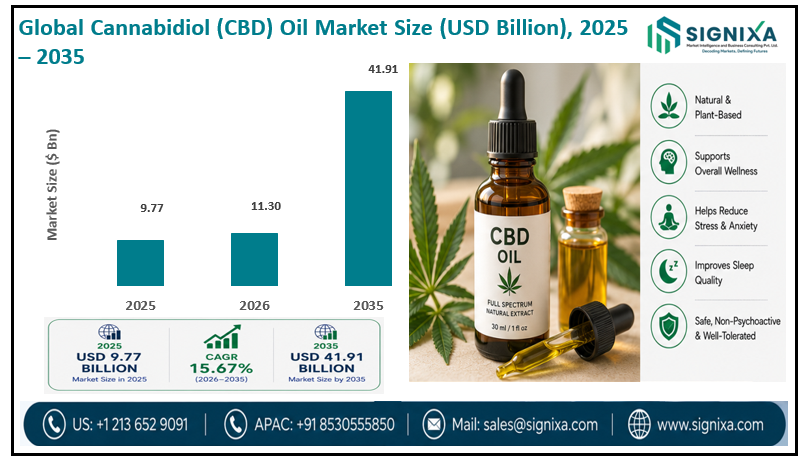
The size of the global cannabidiol (CBD) oil market was worth around USD 9.77 Billion in 2025 and is predicted to grow to around USD 41.91 Billion by 2035, with a compound annual growth rate (CAGR) of roughly 15.67% between 2026 and 2035. The report analyzes the CBD oil market's drivers and restraints, as well as the impact they have on demand throughout the projection period.
The CBD oil market comprises a range of formulations and applications across nutraceuticals, pharmaceuticals, and wellness sectors. Increasing public awareness of the therapeutic properties of cannabidiol such as its role in pain relief, anxiety reduction, and inflammation control is propelling demand. Regulatory relaxations, especially for hemp-derived products, are further expanding market reach globally. Cannabidiol, a non-psychoactive compound derived from the cannabis plant, has gained widespread recognition for its potential to alleviate various ailments without the psychoactive effects associated with THC.
A significant market dynamic is the rapid diversification of product offerings and innovative delivery methods. Beyond traditional tinctures and oils, manufacturers are continuously introducing CBD-infused edibles, beverages, topicals, capsules, and pet products. Technological advancements in extraction methods (like supercritical CO2) ensure higher purity and potency, while innovations in delivery systems, such as nano-emulsification, aim to improve bioavailability and absorption. The emphasis on "full-spectrum" and "broad-spectrum" CBD products, which leverage the "entourage effect" by including other beneficial cannabinoids and terpenes, is also a key trend appealing to consumers seeking a more holistic approach to wellness.
Key Findings
- The global CBD oil market is estimated to grow annually at a CAGR of around 15.67% over the forecast period (2026–2035).
- The market size was valued at around USD 9.77 Billion in 2025 and is projected to reach USD 41.91 Billion by 2035.
- Based on Source, the hemp-derived CBD oil segment dominates the global market due to lower THC content and greater legal accessibility, with over 68% share in 2025.
- On the basis of Product Type, the Original CBD oil segment commands the largest market share at over 56% in 2025.
- In terms of Application, the Nutraceuticals segment leads with a share exceeding 52% in 2025.
- By Formulation, Drops hold the largest market share at over 38% in 2025, owing to faster sublingual absorption.
- By Distribution Channel, Online accounted for approximately 61% of market share in 2025.
- North America is projected to dominate the global CBD oil market, holding over 40% of global revenues in 2025.
CBD Oil Market Dynamics
Shift Toward Plant-Based Therapies & Growing Distrust of Synthetic Pharmaceuticals
The market is being significantly driven by the increasing consumer inclination toward alternative and plant-based therapies. Consumers are moving away from synthetic pharmaceutical drugs due to side effects and long-term health concerns. Cannabidiol, derived naturally from hemp or marijuana, offers a non-intoxicating and effective option for managing stress, chronic pain, epilepsy, and inflammation. This growing perception of CBD oil as a wellness enhancer is increasing its adoption in both preventive and therapeutic care. As scientific research continues to validate CBD's efficacy for conditions like anxiety, chronic pain, inflammation, and sleep disorders, consumer confidence grows, further propelling market expansion and mainstream acceptance beyond the early-adopter wellness community into broader population segments.
Progressive Legalization, Regulatory Clarity & Expanding E-Commerce Distribution
A key driver is the expansion of legal frameworks surrounding CBD oil products across major regions. Countries such as the U.S., Canada, and several EU nations have streamlined regulations for hemp-based CBD, encouraging producers and retailers to invest in this sector. Legal clarity is allowing companies to innovate product formulations, develop new applications, and widen their distribution networks, especially via e-commerce. The progressive legalization and decriminalization of cannabis and hemp cultivation in numerous countries, particularly in North America and parts of Europe, have been instrumental in opening up new markets, reducing stigma, and encouraging investment in research and product development. With the increasing inclusion of CBD in functional foods and skincare, this trend will continue fueling the global market.
Regulatory Fragmentation & Quality Standardization Challenges Constraining Scale
The CBD oil market also faces considerable challenges, notably persistent regulatory ambiguity and the critical need for standardized quality control. Despite widespread legalization efforts, the regulatory landscape for CBD remains fragmented and often inconsistent, varying significantly between countries and even within different jurisdictions of the same country. This lack of clear, uniform regulations creates uncertainty for manufacturers regarding product formulation, labelling requirements, marketing claims, and sales channels, hindering scalability and international trade. The absence of universally accepted quality standards, stringent manufacturing practices, and mandatory third-party testing protocols has led to inconsistencies in product purity, potency, and safety across the market. Instances of mislabelled or contaminated products can erode consumer trust, making industry-wide collaboration on quality benchmarks paramount for sustained long-term growth.
CBD Oil Market Segmentation Analysis
By Source Segment Analysis
Hemp (Dominant Source)
Hemp-derived CBD oil accounted for over 68% of global revenue in 2025 due to its widespread legality and minimal THC content (less than 0.3%). Hemp plants are rich in cannabidiol and are cultivated in large-scale farms globally, especially in North America and parts of Europe. This segment benefits from regulatory clarity and increasing demand for wellness products that are THC-free. The legal distinction between hemp (defined by THC content below 0.3%) and marijuana has created a structurally favorable regulatory environment for hemp-derived CBD, enabling it to be sold through mainstream retail and e-commerce channels without the licensing restrictions that govern cannabis-derived products. Large-scale industrial hemp cultivation, supported by agricultural policy reforms like the U.S. 2018 Farm Bill, has built the supply chain infrastructure necessary to support hemp-derived CBD's continued market dominance through the forecast period.
Marijuana
The marijuana-derived segment, while restricted in several regions, is witnessing gradual growth in areas where recreational or medical cannabis is legalized. Marijuana-derived CBD oil typically contains higher concentrations of accompanying cannabinoids including measurable THC levels that some consumers and medical practitioners believe enhance the therapeutic "entourage effect" beyond what is achievable with hemp-derived isolates. This segment is concentrated in jurisdictions with comprehensive medical or recreational cannabis legalization frameworks, including Canada, several U.S. states, and an expanding set of countries gradually liberalizing their cannabis policies. As more jurisdictions move toward legalization, this segment is positioned to capture growing market share, particularly among consumers seeking products specifically formulated for stronger or more comprehensive cannabinoid profiles than hemp-derived alternatives can legally provide.
By Product Type & Category Segment Analysis
Original (Dominant Product Type)
The original CBD oil segment held the largest share in 2025, accounting for over 56% of the total market. This dominance is attributed to its versatility in various applications such as tinctures, edibles, topicals, and supplements. Original CBD oil contains full-spectrum or broad-spectrum extracts, offering a range of cannabinoids that enhance therapeutic effects through the "entourage effect." Blended products are growing, particularly among new users seeking milder formulations with added flavors, vitamins, or herbal infusions for enhanced appeal. Original CBD oil's versatility as a base ingredient that can be incorporated into countless downstream product formats — from tinctures to topicals to edibles gives manufacturers significant flexibility in developing differentiated product lines from a common extraction and processing infrastructure, supporting its sustained category leadership.
Unflavored vs. Flavored CBD Oil
Unflavored CBD oil captured the larger market share in 2025, valued for its purity and direct therapeutic impact. It is preferred by users seeking unaltered, potent dosages and is widely used in clinical and nutraceutical settings. Flavoured CBD oils are gaining traction, especially among younger consumers and first-time users, for whom taste and sensory experience influence purchase decisions. Innovations in natural flavouring and clean-label trends are helping this category expand rapidly. The flavored segment's growth trajectory reflects a broader consumer wellness trend toward more palatable, lifestyle-integrated supplement formats, mirroring patterns observed in other nutraceutical categories where taste experience has become a key purchase driver for first-time and habitual users alike, gradually narrowing the share gap with the traditionally dominant unflavored category.
By Application Segment Analysis
Nutraceuticals (Dominant Application)
The nutraceuticals segment led the CBD oil market in 2025 with a share exceeding 52%, driven by increasing health-consciousness and preventive healthcare approaches. CBD oil is commonly used in dietary supplements, functional beverages, and wellness gummies for anxiety relief, sleep improvement, and general well-being. The nutraceuticals segment benefits from lower regulatory barriers compared to pharmaceutical applications, as supplement-format CBD products in most jurisdictions can reach consumers without the extensive clinical trial and regulatory approval processes required for pharmaceutical drug products. This regulatory advantage, combined with the broad consumer appeal of preventive wellness products, has established nutraceuticals as the most commercially accessible and rapidly scalable application category in the CBD oil market.
Pharmaceuticals (Fastest-Growing Application)
The pharmaceuticals segment is projected to grow at a faster pace due to clinical trials validating CBD's efficacy in treating epilepsy, chronic pain, and multiple sclerosis. Regulatory approvals for drugs like Epidiolex further support this segment. The successful regulatory approval and commercialization of CBD-based pharmaceutical drugs represents a landmark validation of cannabidiol's therapeutic legitimacy, opening pathways for additional indication expansion and new drug development programs targeting other neurological and inflammatory conditions. As more pharmaceutical-grade CBD products complete clinical development and secure regulatory approvals across major markets, this segment is positioned to capture an increasing share of overall CBD oil market value, particularly as healthcare systems and insurance providers begin to recognize and reimburse CBD-based pharmaceutical treatments for clinically validated indications.
By Formulation Segment Analysis
The CBD oil market is segmented by formulation format, with each delivery method addressing distinct consumer preferences around absorption speed, dosing precision, and application convenience across wellness and therapeutic use cases:
Drops
Drops commanded the largest market share in 2025, accounting for over 38% of global revenues. Drops are the most convenient and easily dosable formulation, often consumed sublingually for faster absorption and effectiveness. The sublingual administration route bypasses first-pass liver metabolism, allowing CBD to enter the bloodstream more rapidly than oral ingestion methods a pharmacokinetic advantage that appeals strongly to consumers seeking rapid symptom relief, particularly for acute anxiety or pain episodes. The simplicity of the dropper-bottle format, combined with flexible dose titration that allows consumers to precisely adjust their intake by counting drops, makes this formulation particularly accessible to both first-time users experimenting with optimal dosing and experienced users with established dosing regimens.
Pills & Capsules
Pills and capsules are popular for their standard dosing and are widely adopted in the medical community. The pre-measured, standardized dosing format of capsules eliminates the dose variability inherent in dropper-based liquid formulations, making them particularly attractive to healthcare providers and patients who prioritize dosing consistency and ease of integration into existing medication routines. The capsule format's familiarity mirroring conventional pharmaceutical and supplement packaging also reduces the psychological barrier to CBD adoption among more conservative or medically oriented consumers who may be less comfortable with the more overtly "alternative wellness" positioning of tinctures and other CBD formats.
Creams & Roll-Ons
Creams and roll-ons are rising in popularity for localized pain and skin-related issues. Topical CBD formulations allow targeted application directly to areas experiencing muscle soreness, joint pain, or skin inflammation, providing localized relief without systemic absorption an appealing characteristic for consumers seeking pain management without the broader physiological effects associated with oral or sublingual CBD consumption. The topical category benefits from cross-over appeal with the broader skincare and personal care markets, as CBD-infused creams and balms are increasingly marketed alongside anti-inflammatory and skin-soothing claims that resonate with consumers already familiar with topical wellness product categories.
Transdermal Patches & Other Formulations
Transdermal patches offer sustained release, providing extended-duration dosing convenience that appeals to consumers managing chronic conditions who prefer not to take multiple daily doses. The "other formulations" category including beverages, gummies, and sprays is expanding rapidly due to innovation, as manufacturers continuously develop new consumption formats that improve palatability, convenience, and lifestyle integration. CBD-infused beverages and gummies in particular are capturing significant growth momentum by aligning with established consumer habits around functional beverages and confectionery, lowering the barrier to entry for CBD-curious consumers who may find tinctures or capsules less approachable than familiar food and drink formats.
By Distribution Channel Segment Analysis
Online (Dominant Channel)
The online segment accounted for approximately 61% of market share in 2025, reflecting the growing preference for digital shopping platforms that offer wide product variety, convenience, and consumer education. Online channels enable brands to reach a global audience and implement targeted marketing strategies. The online channel's dominance is particularly pronounced in the CBD category due to the persistent reluctance of many traditional retail platforms including major payment processors and advertising networks to fully embrace CBD products given lingering regulatory ambiguity, pushing brands toward direct-to-consumer e-commerce models where they maintain greater control over product positioning, educational content, and customer relationships. The online format also supports the detailed product information, lab testing certificates, and consumer education content that purchasers increasingly demand before trusting a CBD brand's quality and safety claims.
Offline
Offline distribution remains essential for medical-grade products sold via pharmacies, dispensaries, and specialty health stores, especially where legal frameworks require controlled sales through physical outlets. Physical retail channels retain particular importance for pharmaceutical-grade CBD products requiring prescription or medical oversight, as well as in jurisdictions with strict regulatory requirements mandating sales through licensed dispensaries or pharmacies rather than unrestricted e-commerce. Specialty health stores and wellness retailers also serve an important product discovery and consumer education function, where in-person staff guidance helps first-time CBD purchasers navigate product selection and dosing considerations that online-only purchasing experiences may not adequately address for less digitally confident consumer segments.
Report Attributes & Market Scope
| Report Attribute | Details |
|---|---|
| Market Size Value in 2025 | USD 9.77 Billion |
| Market Size Value in 2035 | USD 41.91 Billion |
| CAGR (2026–2035) | 15.67% |
| Base Year Used for Estimation | 2025 |
| Historic Data | 2020 - 2025 |
| Forecast Period | 2026 - 2035 |
| Segments Covered – By Source |
|
| Segments Covered – By Product Type |
|
| Segments Covered – By Category |
|
| Segments Covered – By Application |
|
| Segments Covered – By Formulation |
|
| Segments Covered – By Distribution Channel |
|
| Regions Covered | North America, Europe, Asia Pacific, Latin America, Middle East and Africa |
| Major Countries Covered | U.S., Canada, Mexico, Germany, UK, France, Italy, Spain, Russia, China, Japan, South Korea, India, Southeast Asia Countries, Brazil, Argentina, GCC Countries, Turkey, Iran, Israel, South Africa, Egypt, Nigeria, etc. |
| Key Companies Profiled | Charlotte's Web, Aurora Cannabis, CV Sciences, Medical Marijuana Inc., Endoca, Elixinol, Green Roads, Cannabidiol Life, NuLeaf Naturals, and Joy Organics, among others. |
CBD Oil Market Regional Analysis
North America dominates the global CBD oil market, holding over 40% of global revenues in 2025. Europe follows closely with growing consumer awareness and investment in hemp cultivation. The Asia-Pacific region is projected to witness the fastest CAGR, driven by evolving regulatory policies. Latin America and the Middle East & Africa are emerging markets where changing laws and rising chronic illness burden are expected to boost adoption.
North America (Leading Region)
North America stands as a global leader in the CBD oil market, primarily driven by its progressive legal landscape and a highly health-conscious consumer base. The landmark 2018 Farm Bill in the U.S. federally legalized hemp-derived CBD (containing less than 0.3% THC), opening vast opportunities for cultivation, processing, and sales. Canada also has a mature recreational and medicinal cannabis market, which includes CBD. This legal clarity, though still with some state-level nuances, has significantly reduced stigma and fostered robust investment in the industry. The region also benefits from a sophisticated retail infrastructure, including specialized CBD stores, pharmacies, health food stores, and a booming e-commerce sector, ensuring wide product accessibility. Continuous innovation in product formulation, extraction technologies, and marketing strategies by key players further solidifies North America's dominant position.
Europe
The European CBD oil market is experiencing rapid growth, albeit characterized by a fragmented and evolving regulatory landscape across its diverse countries. While the European Union has generally deemed CBD as not a narcotic, individual member states retain authority to set their own regulations regarding THC limits, novel food status, and permissible product categories. This creates a complex environment for manufacturers, as compliance varies significantly from one country to another (e.g., higher THC limits in Switzerland vs. stricter rules in France or Ireland). Despite these regulatory hurdles, consumer interest in CBD is surging across Europe, driven by increasing health and wellness trends. The UK, Germany, and the Netherlands are key markets, showing strong consumer adoption of CBD oils, capsules, and topicals. The market is also seeing a rise in "novel food" applications for ingestible CBD products, indicating a move towards greater regulatory clarity and market legitimacy.
Asia Pacific (Fastest-Growing Region)
The Asia Pacific CBD oil market is an emerging yet high-potential region, characterized by varying degrees of legalization and cultural acceptance. While some countries maintain strict prohibitions on cannabis and its derivatives, there's a gradual shift towards recognizing the medical and wellness potential of CBD. Australia and New Zealand have made significant strides in legalizing medical cannabis and allowing the sale of certain low-THC CBD products. Japan has a market for highly purified CBD isolates with zero THC. In contrast, major markets like China and India are still navigating complex regulatory environments, though there's growing interest in industrial hemp cultivation for CBD extraction. Cultural influences, including traditional herbal medicine practices, can sometimes facilitate the acceptance of plant-derived wellness products like CBD. Overcoming the pervasive stigma associated with cannabis and establishing clear regulatory frameworks will be crucial for widespread adoption across this diverse region.
Middle East & Africa
The Middle East & Africa region represents an emerging CBD oil market where changing laws and rising chronic illness burden are expected to boost adoption over the forecast period. The region's traditionally conservative stance on cannabis-derived products has historically limited market development, but gradual regulatory evolution in certain markets is beginning to create openings for hemp-derived CBD wellness products with negligible THC content. As awareness of CBD's potential therapeutic applications for pain management, anxiety, and inflammation-related conditions grows among healthcare providers and consumers, and as regional governments observe the economic and public health benefits realized in more established CBD markets, additional regulatory liberalization is anticipated to gradually expand market access across the region's diverse jurisdictions.
Latin America
Latin America represents an emerging market for CBD oil, with changing laws and rising chronic illness burden expected to boost adoption. Several Latin American countries have begun liberalizing their cannabis and hemp policies, creating new opportunities for both domestic cultivation and CBD product commercialization. The region's large population base, growing middle class, and increasing health and wellness consciousness create a substantial long-term opportunity for CBD oil market expansion as regulatory frameworks continue to mature and provide the legal clarity that manufacturers and retailers require to invest confidently in product development, marketing, and distribution infrastructure across these developing CBD markets.
Recent Developments in the CBD Oil Market
-
2025
Canopy Growth Corporation expanded its CBD product lineup by introducing new oil formulations and wellness blends under its CBD brands, focusing on improving product accessibility and capturing growing demand for natural health supplements in regulated cannabis markets.
-
2024
CV Sciences, Inc. expanded its PlusCBD Oil portfolio by launching new full-spectrum and THC-free CBD oil formulations aimed at improving sleep, relaxation, and immune support, reflecting increasing consumer demand for functional hemp-derived wellness products across retail and e-commerce channels.
-
2024
Aurora Cannabis Inc. broadened its CBD wellness offerings with the introduction of premium hemp-derived CBD oil products targeted at health and lifestyle consumers in North America, aiming to strengthen its position in the rapidly expanding CBD wellness market.
-
2023
Charlotte's Web Holdings, Inc. introduced a new range of THC-free flavored CBD oils designed for wellness-oriented consumers seeking plant-based supplements for stress relief and overall health, focusing on improved taste profiles and convenient daily use.
-
2022
Aurora Cannabis expanded its footprint in Europe with a pharmaceutical-grade CBD oil line approved for use in Germany.
CBD Oil Market: Competitive Landscape
The global CBD oil market features major players such as Charlotte's Web, Aurora Cannabis, CV Sciences, Medical Marijuana Inc., Endoca, Elixinol, Green Roads, Cannabidiol Life, NuLeaf Naturals, and Joy Organics, among others. Competitive factors include formulation innovation, brand credibility, regulatory compliance, and distribution reach. As product awareness increases, companies are investing in clinical trials, expanding into international markets, and launching diversified product lines across formats.
Partnerships with wellness retailers and healthcare providers are becoming key strategies to capture market share. The competitive landscape is shaped significantly by regulatory navigation capability companies that have successfully built compliant, third party-tested supply chains with transparent lab certification practices are establishing stronger brand trust and consumer loyalty than competitors with less rigorous quality assurance programs. Vertically integrated companies that control cultivation, extraction, and product formulation are demonstrating advantages in cost control and quality consistency compared to companies relying on third-party sourcing. Geographic expansion into newly liberalizing markets in Europe, Asia-Pacific, and Latin America represents a key growth strategy for established North American CBD brands seeking to diversify beyond their increasingly competitive home market.
Key Companies Profiled
- Charlotte's Web
- Aurora Cannabis
- CV Sciences
- Medical Marijuana Inc.
- Endoca
- Elixinol
- Green Roads
- Cannabidiol Life
- NuLeaf Naturals
- Joy Organics
- Canopy Growth Corporation
- Tilray Brands, Inc.
- CBDistillery
- Lazarus Naturals
- Isodiol International Inc.
Global CBD Oil Market Segmentation Summary
By Source
- Hemp
- Marijuana
By Product Type
- Original
- Blended
By Category
- Flavoured CBD Oil
- Unflavoured CBD Oil
By Application
- Nutraceuticals
- Pharmaceuticals
By Formulation
- Drops
- Pills & Capsules
- Creams & Roll-Ons
- Transdermal Patches
- Other Formulations
By Distribution Channel
- Online
- Offline
By Region
- North America
- U.S.
- Canada
- Mexico
- Europe
- Germany
- France
- UK
- Spain
- Italy
- Rest of Europe
- Asia-Pacific
- China
- Japan
- India
- Australia
- South Korea
- Southeast Asia
- Rest of Asia-Pacific
- Latin America
- Brazil
- Argentina
- Rest of Latin America
- The Middle East & Africa
- GCC Countries
- South Africa
- Rest of the Middle East & Africa
Frequently Asked Questions (FAQs) About the CBD Oil Market
What is Cannabidiol (CBD) Oil?
Cannabidiol (CBD) oil is a natural extract derived primarily from hemp or marijuana plants. It contains CBD, a non-psychoactive compound known for its potential therapeutic effects such as pain relief, anxiety reduction, and anti-inflammatory properties. It is widely used in wellness, pharmaceuticals, nutraceuticals, and personal care applications.
Which key factors will influence the CBD oil market growth over 2026–2035?
The global CBD oil market will expand due to increasing legalization of cannabis-based products, growing consumer awareness about the benefits of CBD, and rising use in nutraceutical and pharmaceutical sectors. Technological advancements in extraction and product formulation are also accelerating market adoption.
What will be the value of the CBD oil market during 2026–2035?
According to the study, the global CBD oil market size was worth around USD 9.77 Billion in 2025 and is predicted to grow to approximately USD 41.91 Billion by 2035.
What will be the CAGR value of the CBD oil market during 2026–2035?
The CBD oil market is projected to grow at a compound annual growth rate (CAGR) of around 15.67% from 2026 to 2035, primarily driven by the increasing consumer preference for natural wellness products, growing acceptance of hemp-derived CBD for pain management, anxiety.
Which region will contribute notably towards the CBD oil market value?
The CBD oil market is primarily driven by North America, owing to favourable regulatory frameworks, established distribution networks, and rising consumer demand. Europe and Asia-Pacific are also emerging as high-potential regions due to changing legal landscapes and increased investment in CBD-based wellness products.
Which are the major players leveraging the CBD oil market growth?
The leading players in the global CBD oil market include Aurora Cannabis Inc., Canopy Growth Corporation, Elixinol, Medical Marijuana Inc., Endoca, NuLeaf Naturals, CV Sciences Inc., Charlotte's Web Holdings, Isodiol International Inc., and Medterra CBD. These companies are focusing on product innovation, strategic collaborations, and global expansion.
What can be expected from the global CBD oil market report?
The report offers an in-depth analysis of the CBD oil market, covering key drivers, restraints, opportunities, and challenges. It includes comprehensive segmentation by source, product type, application, formulation, and distribution channel, along with detailed regional insights and competitive landscape analysis.