
RPA Market Overview
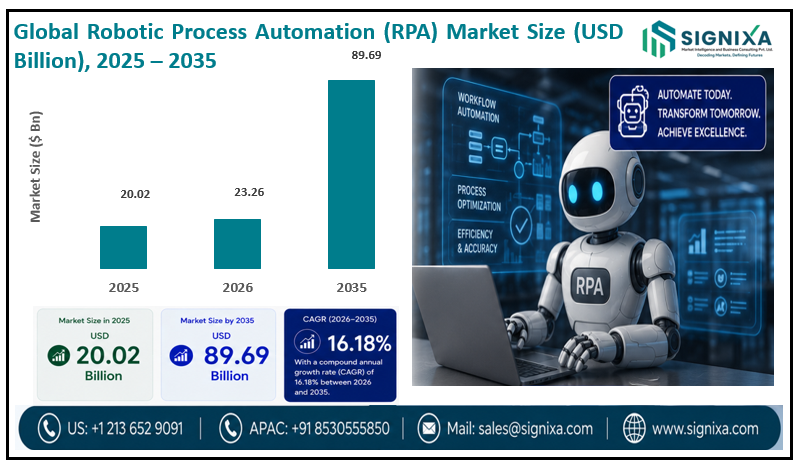
The size of the global RPA market was worth around USD 20.02 Billion in 2025 and is predicted to grow to around USD 89.69 Billion by 2035, with a compound annual growth rate (CAGR) of roughly 16.18% between 2026 and 2035. The report analyzes the RPA market's drivers and restraints, as well as the impact they have on demand throughout the projection period.
The Robotic Process Automation market contains automation and process improvement solutions to support routine operational tasks across multiple industry sectors, including, but not limited to, finance, healthcare, customer service, and supply chain. The growing need for operational efficiency and risk reduction from human error has led to the increase in RPA adoption across multiple industries. Organizations across sectors are automating processes, including data entry, billing, and customer support, to drive operational efficiency and cost savings.
The Robotic Process Automation (RPA) market is evolving rapidly as organizations seek to streamline repetitive, rule-based tasks across various functions, including finance, HR, and customer support. Initially focused on mimicking human actions through basic scripts, RPA now integrates advanced technologies such as artificial intelligence (AI), machine learning, and natural language processing. This shift enables bots to handle semi-structured and unstructured data more effectively. A growing number of companies are adopting cloud-based RPA platforms for their scalability and ease of deployment, making automation more accessible to small and mid-sized businesses. The trend toward hyperautomation combining RPA with analytics, process mining, and AI underscores the market's shift toward intelligent, end-to-end automation strategies.
Key Findings
- The global RPA market is estimated to grow annually at a CAGR of around 16.18% over the forecast period (2026–2035).
- The market was valued at around USD 20.02 Billion in 2025 and is projected to reach USD 89.69 Billion by 2035.
- The adoption of RPA in the Healthcare and BFSI sectors is accelerating, driven by the need for data management, reporting, and customer service automation.
- By component, the Software segment is expected to dominate the market, with a growing preference for low-code automation tools.
- In terms of application, Customer Support is the leading application segment, driven by the need to enhance customer satisfaction and automate repetitive tasks.
- By region, North America and Europe are anticipated to continue leading the market, while Asia-Pacific is expected to witness the fastest growth.
RPA Market Dynamics
Rising Demand for Operational Efficiency & Enhanced Customer Service Driving Enterprise RPA Adoption
The RPA market is rapidly growing due to several factors including the increasing demand for automation to drive operational efficiency, lower costs, and simplify processes. One of the main drivers of the market is the increasing focus on improving customer service. Utilizing RPA, companies can automate customer interactions, thereby increasing efficiency and decreasing the load on human agents. Additionally, RPA allows the company to operate around the clock while providing a better customer experience, ultimately resulting in higher customer satisfaction and retention. Organizations across industries are under pressure to do more with fewer resources, and RPA offers a non-intrusive way to integrate with existing systems. It enables the automation of repetitive, high-volume tasks such as data entry, invoice processing, and customer on-boarding, while supporting 24/7 operations without fatigue, reducing human error and freeing up employees for strategic tasks. The financial services, healthcare, and telecom sectors are particularly strong adopters through the forecast period.
AI & Machine Learning Integration Enabling Cognitive Automation Beyond Traditional Rule-Based RPA
Another important influence is the increasing acceptance of AI and machine learning-based RPA solutions that allow businesses to improve decision-making and enhance the precision of automated processes. AI-driven RPA can manage more complex tasks, such as natural language processing (NLP) and image recognition, and provide improved functions beyond traditional rule-based automation. As a consequence, organizations are utilizing AI-powered RPA solutions to automate not only simple repetitive tasks but also complex decision-making and cognitive functions. The growing integration of AI and machine learning with RPA leading to Intelligent Process Automation (IPA) presents substantial growth opportunities, enabling bots to make context-based decisions and handle unstructured data and unlocking advanced use cases that were previously unattainable with conventional scripted automation through the forecast period.
Low-Code/No-Code Platforms Lowering Entry Barriers & Expanding SME Adoption Despite Integration Challenges
Despite its benefits, RPA adoption faces challenges such as high initial setup costs, change management resistance, and complexities in scaling bots across enterprise functions. Legacy systems may pose integration issues, especially in large organizations with fragmented IT infrastructure. However, the rise of low-code/no-code platforms is lowering the entry barrier, allowing business users to design automation workflows without specialized programming expertise. Expanding use in SMEs and developing economies signals long-term growth potential, as cloud-based RPA platforms make automation accessible and affordable to organizations that previously lacked the resources for enterprise-grade automation deployments. The shift toward digital transformation, especially post-pandemic, further accelerates investment in automation tools across organizations of all sizes through the forecast period.
RPA Market: Segmentation Analysis
By Component Segment Analysis
Software
Structure wise, the software category of the market currently has the highest share, as automation of rule-based and knowledge-based procedures through RPA platforms becomes more reliant. A report done by IDC suggests that RPA software is anticipated to grow at a CAGR of 18.50% from 2026 to 2035. Organizations are continuing to invest in software-based solutions that are more intuitive, flexible, and allow for greater scalability for RPA implementations. The shift toward cloud-native RPA software architectures which eliminate the infrastructure management burden associated with on-premises bot deployment and enable rapid scaling of automation capacity is a significant driver of software segment growth. The expanding ecosystem of pre-built automation components, process templates, and AI model integrations available within modern RPA software platforms is reducing implementation time and technical complexity, making sophisticated automation accessible to a broader range of enterprise users through the forecast period.
Services
Similarly, it is noticeable that there is also considerable growth in the services segment. This segment is being driven by the increasing demand for consulting, implementation, and support services that ensure RPA solutions are more effectively embedded into business processes, allowing businesses to leverage the full benefits of automation. The complexity of large-scale RPA deployments particularly those involving process discovery, bot orchestration across multiple departments, and integration with diverse legacy enterprise systems creates substantial demand for specialized implementation partners and systems integrators with deep automation expertise. The growing market for managed RPA services, where third-party providers handle ongoing bot maintenance, monitoring, and optimization on behalf of client organizations, is an emerging services sub-segment that allows enterprises to access automation benefits without building extensive in-house technical capabilities through the forecast period.
By Operation Segment Analysis
Rule-Based
In terms of Operation based, the rule-based RPA segment is the currently most widely adopted, driven by industries that want to automate repetitive, structured tasks like data entry, invoicing, and customer inquiries. According to Gartner, rule-based RPA will make up 70% of the market in 2025. The demand in this segment is quickly growing due to the simplicity and scalability of rule-based automation solutions. Rule-based bots operate on clearly defined "if-then" logic that mirrors documented standard operating procedures, making them straightforward to design, test, and validate before deployment a significant advantage for organizations seeking predictable, auditable automation outcomes in regulated industries. The maturity of rule-based RPA technology, combined with the extensive library of proven use cases across finance, HR, and supply chain operations, continues to drive its dominant adoption as organizations prioritize quick-win automation projects with demonstrable ROI through the forecast period.
Knowledge-Based
Knowledge-driven RPA, which utilizes AI and machine learning algorithms, is being increasingly applied to more complex and cognitive tasks such as customer services automation and fraud detection. This segment is projected to grow at a higher rate than rule-based RPA, with a projected CAGR of 18% during the forecast period. Knowledge-based RPA systems can interpret unstructured data, learn from historical patterns, and make probabilistic decisions in scenarios where rigid rule-based logic would be insufficient capabilities particularly valuable in fraud detection, where pattern recognition across vast transaction datasets significantly outperforms manually coded rule sets. The growing sophistication of natural language processing and computer vision technologies embedded within knowledge-based RPA platforms is expanding the range of cognitive tasks that can be automated, including document understanding, sentiment analysis in customer communications, and predictive maintenance scheduling through the forecast period.
By Application Segment Analysis
Customer Support
The customer support area is one of the most important and fastest-growing application segments for RPA. Companies are automating processes such as responding to inquiries, providing order information, and resolving customer complaints. Research estimates that approximately 40% of customer service processes will be automated by RPA in the next five years, contributing to the growth of this application segment. The integration of RPA bots with chatbot interfaces and CRM systems enables end-to-end automation of common customer service workflows from initial inquiry triage and information retrieval through to case resolution and follow-up communication significantly reducing average handling time while maintaining service consistency. The growing consumer expectation for instant, 24/7 customer service response, particularly in e-commerce and digital banking, is a sustained structural driver for customer support automation investment through the forecast period.
Administration and Reporting
In terms of applications, the administration and reporting application segment is expected to soar in popularity as the need for RPA to automate routine administrative tasks such as reporting, data gathering, and document management continues. Companies are employing RPA to improve data accuracy, reduce time spent on manual reporting, and enhance decision making. The automation of recurring management reporting cycles including monthly financial close processes, regulatory compliance reports, and operational performance dashboards provides organizations with significant time savings while reducing the data entry errors that commonly affect manually prepared reports. The growing complexity of regulatory reporting requirements across financial services, healthcare, and other regulated industries is driving demand for RPA solutions that can reliably extract, validate, and compile data from multiple source systems into standardized reporting formats through the forecast period.
Data Migration & Capture Extraction
The data migration and capture extraction section is growing due to the need for automating data capabilities in industries such as banking, insurance, and healthcare, which deal with large amounts of data that need to be processed quickly. RPA bots equipped with optical character recognition (OCR) and intelligent document processing capabilities can extract structured data from invoices, claims forms, and other semi-structured documents with significantly higher throughput and accuracy than manual data entry processes. System migration projects where organizations transition between legacy and modern enterprise software platforms increasingly rely on RPA bots to automate the validation and transfer of large data volumes, reducing the time and risk associated with these traditionally labor-intensive technology transitions through the forecast period.
Analysis
The analysis segment, centred around data analytics, is forecast to grow due to the growing need for sophisticated analytics solutions in RPA tools, so organizations can extract actionable insights from their automated processes. The integration of process mining and analytics capabilities directly into RPA platforms allows organizations to continuously monitor bot performance, identify process bottlenecks, and discover new automation opportunities based on actual workflow execution data rather than theoretical process documentation. This data-driven approach to automation program management where analytics inform iterative refinement of existing bots and prioritization of future automation investments is becoming a standard practice among mature RPA adopter organizations seeking to maximize return on their automation investments through the forecast period.
Others
Additionally, the market is being driven by other applications, such as automation of IT processes, finance and accounting, and human resource management. RPA is being installed at an accelerating pace because it can automate all end-to-end processes in these sectors. In IT operations, RPA bots handle routine system monitoring, password resets, and software provisioning tasks that previously required dedicated help desk staff. In finance and accounting, RPA automates accounts payable and receivable processing, reconciliation tasks, and audit trail documentation. Human resource departments are deploying RPA for employee onboarding workflows, benefits administration, and payroll processing applications that benefit significantly from RPA's ability to maintain consistent, auditable execution of standardized HR procedures across the forecast period.
Report Attributes & Market Scope
| Report Attribute | Details |
|---|---|
| Market Size Value in 2025 | USD 20.02 Billion |
| Market Size Value in 2035 | USD 89.69 Billion |
| CAGR (2026–2035) | 16.18% |
| Base Year Used for Estimation | 2025 |
| Historic Data | 2020 - 2025 |
| Forecast Period | 2026 - 2035 |
| Segments Covered – By Component |
|
| Segments Covered – By Operation |
|
| Segments Covered – By Application |
|
| Regions Covered | North America, Europe, Asia Pacific, Latin America, Middle East and Africa |
| Major Countries Covered | U.S., Canada, Mexico, Germany, UK, France, Italy, Spain, Russia, China, Japan, South Korea, India, Southeast Asia Countries, Brazil, Argentina, GCC Countries, Turkey, Iran, Israel, South Africa, Egypt, Nigeria, etc. |
| Key Companies Profiled | UiPath, Automation Anywhere, Blue Prism, WorkFusion, Kofax, NICE Systems, Pegasystems, HelpSystems, AntWorks, and Softomotive, among others. |
RPA Market Regional Analysis
The RPA market is advancing in all regions, but North America and Europe are leading the way in adoption because of strict regulations to follow, as well as a strong technological infrastructure and industrial development. Asia-Pacific is the fastest growing market due to rapid industrialization, a strategy for digital transformation, and the growing desire for economical automation processes. Latin America and Middle East & Africa are considered emerging markets, adopting RPA at a rapid pace due to growing infrastructure requirements and digitalization.
North America (Dominant Region)
North America holds a dominant position in the Robotic Process Automation (RPA) market due to the early adoption of advanced technologies and the strong presence of tech-savvy enterprises. The U.S., in particular, leads the regional market, driven by significant investments in digital transformation initiatives across sectors like banking, insurance, healthcare, and retail. Enterprises are increasingly deploying RPA solutions to streamline back-office operations, reduce costs, and improve compliance. The region's highly regulated industries are leveraging RPA to maintain audit trails and adhere to standards, especially in finance and healthcare. Additionally, the availability of skilled RPA professionals and strong support from vendors enhances implementation efficiency. Government agencies in North America are also adopting RPA to modernize legacy systems and improve citizen services. The increasing integration of AI with RPA to form intelligent automation is gaining traction, especially among Fortune 500 companies, while the rise of start-ups and partnerships with automation vendors fosters innovation and scalability through the forecast period.
Europe
Europe's Robotic Process Automation (RPA) market is witnessing strong growth, driven by widespread digital transformation across key sectors such as manufacturing, finance, healthcare, telecom, and government. Countries like Germany, the UK, France, and the Netherlands are at the forefront, embracing automation to improve business efficiency and reduce operational costs. European enterprises are increasingly adopting RPA solutions to automate repetitive tasks in finance and accounting, HR, supply chain, and customer service. A key trend in Europe is the integration of RPA with artificial intelligence and machine learning to enable smarter process automation, often referred to as intelligent automation. The region's focus on compliance with stringent data protection regulations, such as GDPR, is prompting the adoption of secure, audit-compliant RPA platforms. Public sector entities across the continent are deploying RPA to improve service delivery, manage workloads, and enhance transparency, with collaborations between RPA vendors and European system integrators increasing to scale deployments through the forecast period.
Asia-Pacific
The Asia Pacific Robotic Process Automation (RPA) market is expanding rapidly, fueled by a surge in digital transformation initiatives across industries such as banking, healthcare, telecommunications, and e-commerce. Countries including China, India, Japan, South Korea, and Australia are actively deploying RPA to improve process efficiency, cut labor costs, and accelerate service delivery. A key driver is the region's growing IT and BPO sector, especially in India and the Philippines, where RPA is being widely integrated into backend operations like invoice processing, payroll, and customer onboarding. In China and Japan, manufacturing and logistics sectors are using RPA to automate inventory management and supply chain functions, aligning with smart factory trends. The presence of a large SME base presents strong growth opportunities as cloud-based RPA platforms make automation accessible and affordable, with organizations also investing in workforce reskilling programs to bridge the digital skills gap through the forecast period.
Middle East & Africa
The Middle East and Africa (MEA) Robotic Process Automation (RPA) market is witnessing significant growth driven by increasing digitalization efforts across sectors such as banking, telecommunications, healthcare, and government services. Countries like the UAE, Saudi Arabia, South Africa, and Egypt are leading the adoption of RPA to streamline business operations, reduce manual errors, and enhance customer experiences. In banking and finance, RPA is transforming processes like compliance checks, loan processing, and fraud detection, enabling faster turnaround times and improved accuracy. Government initiatives aimed at digital transformation, such as Saudi Arabia's Vision 2030 and the UAE's Smart Government programs, are accelerating RPA implementation in public services. Challenges remain, including the need for skilled talent and data security concerns, but growing investments in IT infrastructure and cloud technologies are addressing these barriers through the forecast period.
Recent Developments in the RPA Market
-
2026
UiPath: Expanded its agentic automation platform with new AI agents, enhanced orchestration capabilities, and enterprise automation tools designed to integrate robotic process automation (RPA), generative AI, and human workflows for end-to-end business process automation.
Automation Anywhere: Strengthened its cloud-native automation platform by advancing Agentic Process Automation (APA), introducing AI-powered agents and an enhanced Process Reasoning Engine to improve intelligent decision-making and enterprise-scale workflow automation.
SS&C Blue Prism: Enhanced its intelligent automation platform with AI-powered digital workers and advanced orchestration capabilities, enabling secure, scalable, and enterprise-wide automation across finance, healthcare, and shared services.
Microsoft: Expanded Microsoft Power Automate with new AI-driven automation capabilities and deeper integration across the Microsoft ecosystem, enabling organizations to automate complex workflows using low-code development and intelligent process automation.
-
2025
Pegasystems: Expanded its intelligent automation portfolio by integrating AI-powered workflow automation and robotic process automation capabilities to improve customer service, case management, and enterprise operational efficiency.
WorkFusion: Enhanced its AI-driven digital workforce platform with intelligent document processing and industry-specific automation solutions, helping financial services and healthcare organizations streamline compliance and back-office operations.
RPA Market: Competitive Landscape
The global RPA market features major players such as UiPath, Automation Anywhere, Blue Prism, WorkFusion, Kofax, NICE Systems, Pegasystems, HelpSystems, AntWorks, and Softomotive. The market is highly competitive, with major players focusing on product innovation, cost-efficiency, and expanding their geographical reach. Companies are investing heavily in AI and machine learning-based RPA solutions, offering more advanced capabilities and automating more complex tasks.
The competitive landscape in the Robotic Process Automation (RPA) market is marked by rapid innovation and continuous research focused on enhancing automation capabilities and broadening application areas. Companies are heavily investing in developing more intelligent, scalable, and user-friendly RPA platforms that integrate advanced technologies such as artificial intelligence (AI), machine learning (ML), and natural language processing (NLP). Research efforts are also aimed at increasing the interoperability of RPA tools with existing enterprise systems, including legacy software, cloud applications, and big data platforms. Enhanced security features and compliance automation are receiving particular attention due to growing concerns about data privacy and regulatory requirements. Furthermore, there is a significant emphasis on improving user experience through low-code or no-code platforms, enabling non-technical users to design and manage automation processes effectively.
Key Companies Profiled
- UiPath
- Automation Anywhere
- Blue Prism (SS&C Blue Prism)
- WorkFusion
- Kofax
- NICE Systems
- Pegasystems
- HelpSystems
- AntWorks
- Softomotive
- Microsoft Corporation (Power Automate)
- IBM Corporation
- SAP SE
- Appian Corporation
- EdgeVerve Systems (Infosys)
Global RPA Market Segmentation Summary
By Component
- Software
- Services
By Operation
- Rule-Based
- Knowledge-Based
By Application
- Administration and Reporting
- Customer Support
- Data Migration & Capture Extraction
- Analysis
- Others
By Region
- North America
- U.S.
- Canada
- Mexico
- Europe
- Germany
- France
- UK
- Spain
- Italy
- Rest of Europe
- Asia-Pacific
- China
- Japan
- India
- Australia
- South Korea
- Southeast Asia
- Rest of Asia-Pacific
- Latin America
- Brazil
- Argentina
- Rest of Latin America
- The Middle East & Africa
- GCC Countries
- South Africa
- Rest of the Middle East & Africa
Frequently Asked Questions (FAQs) About the RPA Market
What is RPA?
Robotic Process Automation (RPA) refers to the use of software robots or "bots" to automate repetitive and rule-based tasks in business processes. It helps in improving efficiency, reducing errors, and increasing productivity across industries.
Which key factors will influence the RPA market growth over 2026–2035?
The global RPA market is anticipated to grow due to increased demand for automation in business processes, cost efficiency, and the adoption of AI and machine learning to enhance decision-making in industries such as banking, healthcare, and manufacturing.
What will be the value of the RPA market during 2026–2035?
According to the study, the global RPA market was valued at approximately USD 20.02 Billion in 2025 and is projected to grow to around USD 89.69 Billion by 2035, driven by growing automation demand across enterprises.
What will be the CAGR value of the RPA market during 2026–2035?
The RPA market is expected to grow at a Compound Annual Growth Rate (CAGR) of 16.18% from 2026 to 2035, supported by advancements in automation technologies and businesses looking to streamline operations.
Which region will contribute notably towards the RPA market value?
North America, particularly the United States, is expected to lead the RPA market due to its strong IT infrastructure, high adoption rate of advanced technologies, and high concentration of major RPA vendors. The Asia-Pacific region is also seeing rapid growth, driven by technological advancements in India, China, and Japan.
Which are the major players leveraging the RPA market growth?
Key players in the RPA market include UiPath, Automation Anywhere, Blue Prism, WorkFusion, Kofax, and Pega Systems. These companies are at the forefront of technological innovation, offering enterprise-grade RPA solutions to optimize business processes.
What can be expected from the global RPA market report?
The report explores critical insights into the RPA market, covering market trends, growth drivers, challenges, and opportunities. It provides a detailed segmentation analysis by component, operation, and application, along with a competitive landscape and regional outlook to help businesses navigate the evolving automation space.