
Resistant Maltodextrin Market Overview
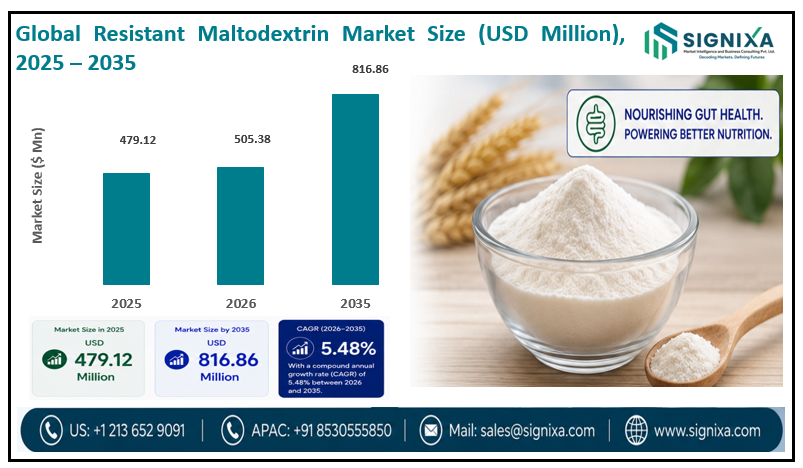
The global resistant maltodextrin market size was valued at USD 479.12 Million in 2025 and is projected to reach USD 816.86 Million by 2035, growing at a compound annual growth rate (CAGR) of 5.48% between 2026 and 2035. This report analyzes the resistant maltodextrin market's drivers and restraints, as well as the impact they have on demand throughout the forecast period, and explores global opportunities, future growth prospects, and challenges.
Resistant maltodextrin is a food-grade carbohydrate derived from various starches including corn, wheat, potato, and cassava. It is used as a soluble dietary fiber and functional ingredient across a wide range of applications including beverages, food products, and pharmaceuticals. Due to its versatile functional properties — including prebiotic effects that support gut microbiome health, low glycemic index, and low-calorie content resistant maltodextrin is gaining significant attention from food manufacturers, nutraceutical developers, and the pharmaceutical industry. It fits the growing consumer preference for clean label, plant-based, minimally processed ingredients that deliver recognizable health benefits while enabling manufacturers to improve the nutritional profile of products without compromising taste, texture, or manufacturing processability.
The increasing demand for functional foods and beverages, nutraceuticals, and dietary supplements is a key catalyst for the resistant maltodextrin market. Resistant maltodextrin, being plant-based and derived through enzymatic hydrolysis, aligns with the clean label trend while offering the versatility to be incorporated across beverages, dairy products, bakery items, confectionery, and even animal feed and pharmaceuticals. The powder form currently dominates the market due to its ease of use and broad applicability across feed manufacturing processes, while ongoing R&D efforts are focused on developing novel formulations with enhanced functionalities and wider application scope across emerging product categories and geographic markets.
Key Findings
- The global resistant maltodextrin market is projected to grow at a CAGR of 5.48% over the forecast period (2026–2035), with market value rising from USD 479.12 Million in 2025 to USD 816.86 Million by 2035.
- The corn-based segment leads the source segment, accounting for nearly 50% of market share due to high raw material availability and established cost-effective production infrastructure.
- The spray-dried powder form is anticipated to dominate the market due to its ease of use, excellent solubility, and broad applicability across powdered drink, bakery, and ready-to-mix beverage formulations.
- Beverages are the leading application segment, contributing more than 40% of total market share, driven by rising popularity of functional drinks including sports beverages, diet sodas, and fiber-enriched hydration products.
- North America and Europe are the major established markets, while Asia-Pacific is projected to exhibit the most significant growth due to rising demand for healthy food products across China, India, and Southeast Asian countries.
Resistant Maltodextrin Market Dynamics
Surging Health Consciousness & Functional Food Demand
The global consumer shift toward healthier food options particularly a heightened awareness of digestive health, blood sugar management, and weight control is the primary factor propelling the resistant maltodextrin market. As a low-calorie soluble fiber, resistant maltodextrin is widely used to enhance fiber content in foods and beverages without adding significant calories or sugar directly aligning with the growing health-conscious consumer base seeking functional foods that offer proactive health benefits. The rising global prevalence of lifestyle-related diseases including obesity, diabetes, and cardiovascular conditions is significantly reinforcing this demand, as consumers actively seek products that support metabolic health and gut wellbeing. Resistant maltodextrin's prebiotic properties supporting beneficial gut flora, improving gut motility, and promoting satiety directly address these health concerns, making it an increasingly preferred functional ingredient for manufacturers developing better-for-you product lines across the food, beverage, and supplement categories.
Growing Beverage Industry Demand & Clean Label Ingredient Trend
The beverage industry particularly the functional drink segment including diet sodas, sports beverages, energy drinks, and weight management products is a major demand driver for resistant maltodextrin. The increasing consumer preference for low-calorie, high-fiber beverages is encouraging manufacturers to incorporate resistant maltodextrin as a key functional ingredient that simultaneously adds soluble fiber content and supports gut health claims without altering the sensory profile of the finished product. Simultaneously, as health regulations become stricter and consumer scrutiny of food additives intensifies, manufacturers are turning to clean-label ingredients like resistant maltodextrin as a natural and transparent alternative to traditional synthetic additives and high-glycemic index fillers. Its plant-derived origin, enzymatic production process, and recognizable nature make it highly compatible with the clean label positioning that is increasingly required for premium product positioning across developed food markets.
High Production Costs, Regulatory Complexity & Sensory Sensitivity Challenges
Despite the promising growth trajectory, the resistant maltodextrin market faces several significant challenges. High production costs associated with advanced enzymatic processes and stringent quality controls required for its manufacturing make resistant maltodextrin a more expensive ingredient compared to conventional starches or bulking agents potentially limiting its adoption in price-sensitive markets and product categories where cost competitiveness is the primary purchase criterion. Navigating the complex and often varying regulatory landscapes across different countries for food additives and dietary fibers presents another material challenge different regions have varying approval processes, labeling requirements, and permissible usage levels that can delay product launches and increase compliance costs for manufacturers seeking global market reach. While resistant maltodextrin generally has minimal impact on product taste and texture, even subtle sensory alterations can be a concern for manufacturers given consumers' high sensitivity to product quality changes requiring careful formulation development to ensure that fiber enrichment does not negatively impact the sensory experience that drives repeat purchase.
Resistant Maltodextrin Market Segmentation Analysis
By Source Segment Analysis
Resistant maltodextrin is produced from diverse starch sources, each offering distinct cost, availability, functional, and clean-label positioning characteristics that determine their suitability across different application and market contexts:
Corn-Based
Corn-based resistant maltodextrin holds the largest market share, accounting for approximately 50% of the total market, due to its combination of cost-effectiveness, high raw material availability, and well-established production infrastructure. Corn is the world's most widely produced starch crop, making it the preferred and most economically accessible source for resistant maltodextrin production globally. The large-scale and mature corn starch processing industry across North America, China, and other major markets provides the production infrastructure and raw material supply reliability that support consistent, cost-competitive resistant maltodextrin manufacturing at scale. Corn-based resistant maltodextrin is the benchmark product in the market — widely used across beverage, food, and nutraceutical applications and provides the cost-performance reference point against which alternative source products are evaluated for their premium positioning justification.
Wheat-Based
Wheat-based resistant maltodextrin is used primarily in the European and North American markets where wheat starch production infrastructure is well established, and the ingredient's European regulatory approval and traceability profile align well with regional food industry requirements. This segment is projected to grow at a CAGR of approximately 5.0%, driven by increasing demand for dietary fiber in health-conscious food and beverage formulations across these mature markets. Wheat-based resistant maltodextrin offers functional characteristics comparable to corn-based alternatives and is particularly well-established in European bakery and dairy applications where wheat-derived functional ingredients have long-standing market acceptance and technical integration in existing formulations. Note that wheat-based products require allergen labeling in markets that mandate wheat allergen declaration a consideration that influences application suitability assessment by food manufacturers.
Potato-Based
Potato-based resistant maltodextrin is gaining popularity due to its naturally neutral taste profile, excellent clarity in solution, and broadly clean label appeal as a recognizable vegetable-derived ingredient. It is commonly used in food and beverage applications including health supplements, dairy products, and specialty beverages where its neutral sensory contribution is particularly valued by formulators seeking to minimize any flavor impact from fiber fortification. The segment is expected to experience steady growth with a CAGR of approximately 4.6% through the forecast period, sustained by growing consumer preference for non-GMO and naturally sourced functional ingredients in developed markets where provenance transparency is a premium positioning driver. Potato starch availability in Europe and North America supports a stable regional supply chain for potato-based resistant maltodextrin production.
Cassava-Based
Cassava-based resistant maltodextrin is gaining significant traction particularly in Southeast Asia and Latin America where cassava is abundantly produced and represents a major local agricultural commodity and is the fastest-growing source segment at an expected CAGR of approximately 6.0%. Its appeal is strongly driven by its naturally gluten-free status and non-GMO classification, making it particularly attractive to health-conscious consumers with gluten sensitivity, celiac disease, or preferences for products free from genetically modified crops. As gluten-free labeling and non-GMO positioning become increasingly valued consumer purchase drivers globally, cassava-based resistant maltodextrin offers manufacturers in Southeast Asia, Latin America, and other cassava-producing regions a cost-competitive, locally sourced, and marketing-friendly dietary fiber ingredient that simultaneously meets local agricultural utilization priorities and global functional food trends.
By Form Segment Analysis
Spray-Dried Powder
Spray-dried powder holds the largest market share in the form segment, projected to grow at approximately 5.5% CAGR through the forecast period. It is easy to incorporate into food and beverage formulations, offering excellent solubility, good flowability for automated dosing systems, and excellent stability during storage at ambient conditions. Spray-dried resistant maltodextrin powder is the preferred form for large-scale food manufacturing operations across powdered drink mixes, bakery products, ready-to-mix beverages, nutritional supplements, and infant formula applications where uniform ingredient distribution, handling efficiency, and batch-to-batch consistency are priority manufacturing requirements. The spray drying process produces a product with controlled particle size, density, and moisture content characteristics that can be optimized for specific application requirements, making spray-dried powder the most versatile and broadly applicable physical form of resistant maltodextrin across the full range of food and beverage industry applications.
Instantized / Agglomerated
Instantized or agglomerated resistant maltodextrin is a rapidly growing form segment, projected at approximately 4.9% CAGR, due to its enhanced instant solubility in cold liquids a critical functional advantage for ready-to-drink beverage and on-the-go supplement applications where room temperature or cold-water reconstitution without mixing equipment is required. The agglomeration process creates larger, more porous particle structures that disperse and dissolve more rapidly in aqueous systems than conventional spray-dried powder, significantly improving the end-consumer experience with home preparation of fiber-enriched beverage products. This form is particularly favored in pharmaceutical supplement applications where dosage convenience and patient compliance benefit from easy-dissolving formulations and in the premium functional beverage segment where instant solubility performance is a differentiating quality attribute that supports premium retail pricing and brand positioning relative to conventional dietary fiber products that require active agitation for dissolution.
By Application Segment Analysis
Beverages
The beverage segment dominates the resistant maltodextrin market, contributing more than 40% of total market share and projected to grow at a CAGR of approximately 5.7% the fastest among all application segments. The rising popularity of functional beverages including sports drinks, diet beverages, fiber-enriched water products, and digestive health drinks is the primary demand driver, as manufacturers seek ingredients that can add meaningful dietary fiber content and prebiotic function while maintaining the clarity, taste, and mouthfeel attributes that consumers expect from premium beverage products. Resistant maltodextrin's excellent solubility, neutral sensory contribution, stability across a wide pH range, and heat stability during pasteurization and UHT processing make it particularly well-suited to beverage applications that other dietary fiber options including inulin, FOS, or psyllium may not accommodate due to viscosity, cloudiness, or taste impacts. The shift toward healthier hydration options including fiber-fortified water, protein-fiber beverages, and gut health drinks continues to accelerate demand for resistant maltodextrin across the global beverage industry.
Food
The food segment is another major application area for resistant maltodextrin, growing at approximately 5.3% CAGR, driven by demand for healthier bakery products, gluten-free formulations, fiber-enriched snacks, and improved-nutrition dairy products. In bakery applications, resistant maltodextrin serves as a versatile functional ingredient that improves moisture retention, extends shelf life, and adds dietary fiber content without significantly altering the crumb structure or eating quality of finished bread, cake, and cracker products. In dairy applications including yogurt, processed cheese, and ice cream it functions as a prebiotic fiber that supports gut health claims while also providing mild textural contributions compatible with dairy processing parameters. Frozen food, confectionery, and breakfast cereal applications are also growing usage contexts as food manufacturers across all categories seek to improve fiber content and reduce glycemic impact in response to consumer nutritional expectations and evolving front-of-pack labeling frameworks that highlight fiber content and sugar reduction.
Pharmaceuticals
The pharmaceuticals segment is emerging as a significant and increasingly important end-user of resistant maltodextrin, projected to grow at approximately 4.8% CAGR as the global focus on wellness and preventive healthcare intensifies. Resistant maltodextrin is used in dietary supplements including capsule, tablet, and powdered formulations targeting digestive health, blood sugar management, weight management, and general gut wellness where its prebiotic properties, low caloric contribution, and excellent compatibility with vitamin, mineral, and botanical active ingredients make it a preferred excipient and functional co-ingredient in supplement formulations. Growing clinical research validating resistant maltodextrin's specific benefits in blood glucose regulation, cholesterol management, and gut microbiome modulation is expanding its application in functional pharmaceutical products beyond standard supplement formats toward more specific therapeutic positioning. The expansion of the nutraceutical and evidence-based supplement market in North America, Europe, and increasingly in Asia-Pacific is creating consistent incremental demand for high-quality resistant maltodextrin with pharmaceutical-grade production standards.
Report Attributes & Market Scope
| Report Attribute | Details |
|---|---|
| Market Size Value in 2025 | USD 479.12 Million |
| Market Size Value in 2035 | USD 816.86 Million |
| CAGR (2026–2035) | 5.48% |
| Base Year Used for Estimation | 2025 |
| Historic Data | 2020 – 2025 |
| Forecast Period | 2026 – 2035 |
| Segments Covered – By Source |
|
| Segments Covered – By Form |
|
| Segments Covered – By Application |
|
| Regions Covered | North America, Europe, Asia Pacific, Latin America, Middle East and Africa |
| Major Countries Covered | U.S., Canada, Mexico, Germany, UK, France, Italy, Spain, Russia, China, Japan, South Korea, India, Southeast Asia Countries, Brazil, Argentina, GCC Countries, Turkey, Iran, Israel, South Africa, Egypt, Nigeria, etc. |
| Key Companies Profiled | Tate & Lyle PLC, Cargill Inc., Ingredion Incorporated, Archer Daniels Midland Company, and Roquette Frères, among others. |
Resistant Maltodextrin Market Regional Analysis
North America is the leading market for resistant maltodextrin, driven by the region's strong food and beverage industry and health-conscious consumer base. Europe is another significant market with increasing adoption across food, beverage, and pharmaceutical industries. Asia-Pacific is the fastest-growing region, driven by population growth, urbanization, and increasing awareness of healthy eating habits. Latin America and the Middle East & Africa are emerging markets where demand is expected to accelerate due to improving healthcare infrastructure and growing awareness of health and wellness.
North America (Leading Region)
North America holds a substantial share of the global resistant maltodextrin market, driven by a heightened consumer focus on health and wellness particularly digestive health, weight management, and blood sugar control. The increasing prevalence of lifestyle-related diseases including obesity, diabetes, and gastrointestinal conditions is significantly boosting demand for functional food ingredients like resistant maltodextrin. U.S. and Canadian consumers are actively seeking low-calorie, high-fiber, and clean-label food products, which resistant maltodextrin as a plant-based soluble dietary fiber perfectly addresses. This drives its widespread incorporation into fortified beverages, dairy products, bakery items, and dietary supplements across the region. The robust nutraceutical industry in North America is a key demand generator, as awareness of the benefits of dietary fiber and prebiotics continues to grow and consumers opt for supplements targeting gut health and metabolic wellness. Major food and beverage manufacturers are actively replacing traditional high-glycemic index sweeteners and fillers with resistant maltodextrin to improve nutritional profiles without compromising taste or texture.
Europe
Europe is another significant resistant maltodextrin market, with increasing adoption driven by growing consumer demand for gluten-free, low-calorie, and high-fiber food and beverage products across mature Western European markets. The UK and Germany are expected to lead the European market, supported by well-developed functional food and nutraceutical industries and strong consumer engagement with dietary fiber and gut health claims. The EU's regulatory framework for dietary fiber labeling and functional food health claims which requires substantiated scientific evidence for nutrient claims has paradoxically strengthened market development by building consumer trust in fiber-fortified products that carry legitimate health benefit communications. France, the Netherlands, and Scandinavia are additional significant European market contributors, with Roquette Frères headquartered in France representing a major domestic producer that supports regional supply chain development. The growing pet food and pharmaceutical supplement segments are expanding the addressable market beyond traditional food and beverage applications across the European region.
Asia Pacific (Fastest-Growing Region)
Asia-Pacific is the fastest-growing region for the resistant maltodextrin market, driven by population growth, rapid urbanization, rising disposable incomes, and dramatically increasing awareness of healthy eating habits across China, India, Japan, South Korea, and Southeast Asian countries. China represents the largest and most rapidly evolving market in the region driven by a large and health-conscious urban middle-class consumer base, a rapidly expanding functional food and beverage industry, and strong domestic starch processing capabilities that support cost-competitive local resistant maltodextrin production. India's growing health food market, expanding modern retail infrastructure, and rising diabetes prevalence are all contributing to accelerating demand for low-glycemic, fiber-rich functional ingredients. Japan and South Korea, with their sophisticated health food cultures and strong nutraceutical traditions, represent premium application markets for high-quality resistant maltodextrin in functional beverage and supplement formats. Southeast Asian markets are experiencing growing demand driven by cassava-based local sourcing advantages and rising dietary fiber awareness among urbanizing consumer populations.
Latin America
Latin America is an emerging market for resistant maltodextrin, with Brazil, Mexico, Argentina, and Colombia as the primary growth contributors. The region benefits from significant cassava and corn production resources that provide a competitive raw material supply base for resistant maltodextrin production particularly cassava-based variants that are gaining market relevance as non-GMO and gluten-free positioning becomes a product differentiator in the region's developing premium food and beverage segment. Brazil's large food processing industry and growing consumer interest in functional foods are creating demand for dietary fiber ingredients across beverage, dairy, and bakery applications. Mexico's proximity to North American functional food trends and its growing middle-class health awareness are supporting adoption of resistant maltodextrin in supplement and functional beverage products. The region's evolving healthcare infrastructure and growing awareness of the link between diet and chronic disease prevention are expected to sustain market growth through the forecast period.
Middle East & Africa
The Middle East and Africa resistant maltodextrin market is in an emerging phase, demonstrating promising growth potential driven by evolving dietary habits, increasing health awareness, and growing investments in the food and beverage industry. In the Middle East particularly GCC countries rising disposable incomes and exposure to Western health trends are leading to growing demand for functional foods and beverages that offer digestive health, blood sugar management, and weight control benefits. The UAE and Saudi Arabia are at the forefront of functional ingredient adoption in the region, supported by sophisticated retail environments and a health-conscious consumer segment that engages actively with premium food and supplement products. In Africa, while the market remains nascent, urbanization and a gradually improving standard of living are contributing to subtle but growing demand for processed and functional food products. Challenges including greater reliance on imports, varying regulatory frameworks across countries, and the higher cost of resistant maltodextrin compared to conventional ingredients limit near-term adoption, but ongoing public health investment and rising awareness of diabetes and obesity as significant health burdens are creating conditions for progressive market development through the forecast period.
Recent Developments in the Resistant Maltodextrin Market
-
2026
Tate & Lyle PLC: Expanded its soluble fiber ingredient portfolio to support growing demand for digestive health, sugar reduction, and functional food applications.
Roquette Frères: Expanded its nutritional ingredient business with increased focus on prebiotic fibers and health-oriented food formulations.
Archer Daniels Midland Company (ADM): Expanded its health and wellness ingredient platform through investments in specialty nutrition and dietary fiber solutions.
-
2025
Matsutani Chemical Industry Co., Ltd.: Increased production capacity for resistant maltodextrin ingredients to meet rising demand from food, beverage, and nutraceutical manufacturers.
Baolingbao Biology Co., Ltd.: Expanded its dietary fiber product portfolio with a focus on digestive health and functional nutrition applications.
MGP Ingredients, Inc.: Expanded its specialty ingredient business with increased focus on nutritional and functional food ingredient solutions.
Resistant Maltodextrin Market: Competitive Landscape
The resistant maltodextrin market is highly competitive, featuring key players such as Tate & Lyle PLC, Cargill Inc., Ingredion Incorporated, Archer Daniels Midland Company, and Roquette Frères. These companies are focusing on product innovation, sustainability, and strategic acquisitions to expand their product portfolios and strengthen their market positions. Companies are increasingly developing functional ingredients that cater to the growing demand for health-conscious and fiber-rich products across food, beverage, and pharmaceutical industries.
The competitive landscape is characterized by a mix of established global ingredient manufacturers with extensive portfolios in starches and functional ingredients dominating a significant portion of market share. These large players leverage robust R&D capabilities, extensive global distribution networks, and strong relationships with major food and beverage manufacturers to maintain leading positions. They compete on product quality, consistency, and the ability to offer customized solutions including proprietary product grades with specific fiber content levels, particle sizes, and solubility profiles that integrate seamlessly into complex food formulations across beverage, bakery, dairy, and nutraceutical application contexts.
Innovation in product development is a key competitive differentiator companies are investing in research to explore new source materials including potato, rice, cassava, and banana starch to cater to specific dietary needs such as non-GMO and allergen-free positioning. The development of different physical forms with varying degrees of fiber content, solubility, and functionalization is allowing manufacturers to tailor products for specific application requirements. Clean-label provenance transparency, sustainability credentials including supply chain traceability and low-carbon production processes, and the ability to provide compelling clinical substantiation for health benefit claims are becoming critical competitive advantages. Strategic initiatives including mergers, acquisitions, and co-development partnerships between ingredient suppliers and food manufacturers are actively shaping competitive dynamics in this growing functional ingredient market.
Key Companies Profiled
- Tate & Lyle PLC
- Cargill Inc.
- Ingredion Incorporated
- Archer Daniels Midland Company (ADM)
- Roquette Frères
- Matsutani Chemical Industry Co., Ltd.
- Baolingbao Biology Co., Ltd.
- Shandong Bailong Chuangyuan Bio-Tech Co., Ltd.
- Futaste Co., Ltd.
- MGP Ingredients, Inc.
Global Resistant Maltodextrin Market Segmentation Summary
By Source
- Corn-Based
- Wheat-Based
- Potato-Based
- Cassava-Based
- Others
By Form
- Spray-Dried Powder
- Instantized/Agglomerated
By Application
- Beverages
- Food
- Pharmaceuticals
By Region
- North America
- U.S.
- Canada
- Mexico
- Europe
- Germany
- France
- UK
- Spain
- Italy
- Rest of Europe
- Asia-Pacific
- China
- Japan
- India
- Australia
- South Korea
- Southeast Asia
- Rest of Asia-Pacific
- Latin America
- Brazil
- Argentina
- Rest of Latin America
- The Middle East & Africa
- GCC Countries
- South Africa
- Rest of the Middle East & Africa
Frequently Asked Questions (FAQs) About the Resistant Maltodextrin Market
What is Resistant Maltodextrin?
Resistant Maltodextrin is a type of dietary fiber derived from starch. It is commonly used as a prebiotic fiber and a bulking agent in food and beverages, providing functional benefits such as improved digestive health and blood sugar regulation.
Which key factors will influence the Resistant Maltodextrin market growth over 2026–2035?
The growth of the global Resistant Maltodextrin market is driven by the increasing demand for dietary fibers in functional foods and beverages, rising consumer awareness about digestive health, and the growing popularity of low-calorie, high-fiber food products.
What will be the value of the Resistant Maltodextrin market during 2026–2035?
The global Resistant Maltodextrin market is projected to grow from USD 479.12 Million in 2025 to USD 816.86 Million by 2035, registering a Compound Annual Growth Rate (CAGR) of 5.48% during the forecast period.
What will be the CAGR value of the Resistant Maltodextrin market during 2026–2035?
The CAGR of the Resistant Maltodextrin market is expected to be approximately 5.48% from 2026 to 2035, driven by increasing consumer awareness regarding digestive health, weight management, and overall wellness.
Which region will contribute notably towards the Resistant Maltodextrin market value?
The North American and European regions are expected to contribute significantly to the growth of the Resistant Maltodextrin market due to increasing health-conscious consumer trends and the adoption of dietary fibers in food products. Asia-Pacific is the fastest-growing region, driven by urbanization and rising healthy eating awareness across China, India, and Southeast Asia.
Which are the major players leveraging the Resistant Maltodextrin market growth?
Key players in the global Resistant Maltodextrin market include Roquette Frères, Cargill Incorporated, Ingredion Incorporated, Tate & Lyle, and ADM. These companies lead the market by innovating in product offerings and expanding their reach across global markets.
What can be expected from the global Resistant Maltodextrin market report?
The report provides a comprehensive analysis of the market dynamics, including detailed insights on the drivers, restraints, and opportunities influencing the market. It also covers segmentation analysis by source, form, and application, regional trends, and the competitive landscape, offering valuable insights for stakeholders across the food, beverage, and pharmaceutical industries from 2026 to 2035.