
Matting Agents Market Overview
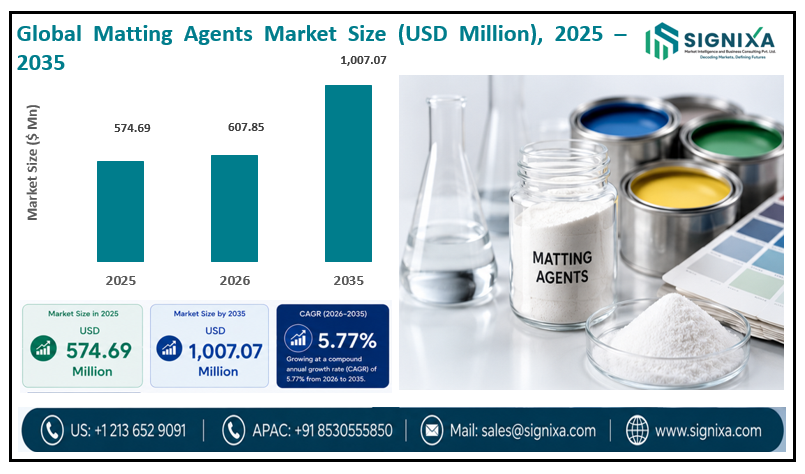
The size of the global Matting Agents Market was valued at approximately USD 574.69 Million in 2025 and is projected to reach around USD 1,007.07 Million by 2035, growing at a compound annual growth rate (CAGR) of 5.77% from 2026 to 2035. The report offers a detailed analysis of the key drivers, trends, and challenges shaping the market along with global opportunities in the coatings and surface finishing industries.
Matting agents are additives used in paints and coatings to reduce gloss and provide a matte or satin finish to surfaces. They are widely employed in industrial, architectural, wood, and leather coating applications. The growing demand for aesthetically appealing low-gloss finishes and rising adoption of advanced coating technologies in construction, automotive, and furniture industries are major growth catalysts. Innovations in waterborne and UV-curable coatings further support the growth of matting agents, especially with increasing regulatory pressure on volatile organic compounds (VOCs).
The matting agents market is experiencing steady growth, driven by increasing demand for high-quality finishes in coatings, paints, and inks across various industries. These agents are essential for achieving desired gloss levels, enhancing surface aesthetics, and improving durability. The automotive, architectural, and industrial coatings sectors are significant contributors to market expansion, as they prioritize surface quality and performance. Advancements in nanotechnology and the development of eco-friendly formulations are influencing product innovation, leading to the introduction of matting agents that offer improved performance and environmental benefits. Additionally, the trend towards low-VOC and water-based coatings is prompting the development of matting agents that align with environmental regulations. Geographically, regions with robust manufacturing sectors, such as Asia-Pacific and Europe, are witnessing increased adoption of matting agents, further propelling market growth. Despite challenges like fluctuating raw material prices.
Key Findings
- The global Matting Agents market is expected to grow at a CAGR of 5.77% during the forecast period (2026–2035).
- The market was valued at USD 574.69 Million in 2025 and is projected to reach USD 1,007.07 Million by 2035.
- The Inorganic segment is projected to dominate the market owing to its high efficiency, excellent matting performance, and superior durability across various coating applications.
- The Waterborne Coatings segment is expected to witness rapid growth due to increasing regulatory support for low-VOC and environmentally friendly coating solutions.
- Industrial Coatings represent the leading application area, driven by strong demand from the automotive, machinery, heavy equipment, and manufacturing sectors.
- Asia-Pacific is projected to be the fastest-growing regional market, while Europe and North America continue to maintain significant demand supported by their well-established coating industries and technological advancements.
Matting Agents Market Dynamics
Rising demand for low gloss finishes in coatings applications is a key driver for the matting agent's market. In automotive, furniture, and architectural applications, matte finishes are increasingly favored due to their elegant appearance, fingerprint resistance, and anti-glare properties. As consumers demand more customized and functional finishes, matting agents are gaining traction across decorative and functional coating systems. The proliferation of premium interior products and design-forward consumer preferences is helping fuel this trend globally.
Stringent environmental regulations regarding VOC emissions are propelling the shift toward eco-friendly matting agent formulations. Waterborne and UV/EB curable formulations are gaining favor as industries comply with REACH, EPA, and other regulatory frameworks. Matting agents tailored for these systems allow coatings manufacturers to reduce solvent content without compromising surface appearance or durability. This has led to innovations in silica-based and wax-based matting agents compatible with waterborne technologies.
Technological advancements in formulation chemistry are expanding the application scope of matting agents. New product developments include finely milled silica-based agents, thermoplastic resin beads, and advanced organic compounds that provide high matting efficiency with minimal haze. These agents are engineered to deliver consistent performance across substrates like wood, metal, leather, and plastic. As coating manufacturers invest in R&D, the role of high-performance matting agents in improving surface functionality and finish uniformity becomes critical.
Matting Agents Market Segmentation Analysis
By Product Type Segment Analysis
Inorganic matting agents such as silica and silicate compounds dominate the market owing to their superior matting efficiency, thermal stability, and wide applicability. Fumed silica, precipitated silica, and natural silicates are frequently used in high-performance coatings where scratch resistance and durability are critical. In 2025, inorganic agents held over 65% of the market share due to their compatibility with solvent borne and waterborne systems. Organic matting agents, including wax-based and thermoplastic resins, offer enhanced slip, smoothness, and gloss control. While they account for a smaller share, their demand is rising in niche applications due to ease of dispersion and application flexibility. Inorganic matting agents play a crucial role in providing matte finishes across various industries such as coatings, plastics, and cosmetics. These agents are typically composed of materials like silica, alumina, calcium carbonate, and talc, valued for their excellent opacity, durability, and resistance to heat and chemicals. Their particulate nature helps scatter light, reducing gloss and creating a uniform matte effect. Inorganic matting agents are preferred in applications requiring high scratch resistance and stability under harsh conditions, such as automotive coatings and industrial plastics. They also contribute to improved surface texture and feel in cosmetic products like powders and foundations. Ongoing research focuses on enhancing the dispersion and compatibility of these agents with different formulations to optimize performance without compromising clarity or color. Additionally, inorganic matting agents are favored for their environmental stability and low toxicity, aligning with stricter regulatory demands. Manufacturers are innovating to produce finer particle sizes and surface-treated variants that improve application ease and final product aesthetics. Overall, inorganic matting agents remain essential for achieving desired matte effects while ensuring functional performance and regulatory compliance across diverse applications.
By Formulation Segment Analysis
Waterborne coatings represent the fastest-growing formulation segment for matting agents, driven by increasing demand for eco-friendly coatings. These systems accounted for approximately 36% of the total formulation share in 2025 and are expected to gain further traction due to regulatory and consumer preference for low-VOC products. Solvent borne coatings still dominate in certain industrial and automotive applications where performance requirements are stringent. UV/EB coatings are seeing high growth in wood coatings and electronics due to rapid curing and energy efficiency, while powder coatings and other niche systems like coil and can coatings use matting agents tailored to specific substrates and curing profiles. Formulation matting agents are specialized additives designed to reduce gloss and impart a matte finish in various products such as paints, coatings, plastics, and cosmetics. These agents work by scattering light on the surface, creating a non-reflective appearance that enhances the aesthetic appeal and hides surface imperfections. In formulation, matting agents must be carefully selected to ensure compatibility with the base material, maintaining stability without negatively affecting other properties like color, texture, or durability. Both organic and inorganic types are used depending on the application requirements. Organic matting agents offer flexibility and smooth finishes, while inorganic agents provide superior durability and resistance to heat and chemicals. Advances in formulation science focus on improving dispersion techniques to prevent clumping, which can cause defects. Surface modification of particles enhances compatibility and performance in different media, resulting in more consistent and high-quality matte effects. Additionally, formulation matting agents are developed to meet environmental regulations by minimizing volatile organic compounds (VOCs) and using sustainable raw materials. This combination of performance and sustainability is driving innovation, making formulation matting agents vital in industries demanding high-quality matte finishes with functional benefits.
By Application Segment Analysis
Industrial coatings dominate the application landscape, accounting for nearly 40% of the total market in 2025. The segment benefits from increasing demand in automotive components, general manufacturing, and heavy equipment sectors, where surface appearance and durability are crucial. Wood coatings hold a substantial share, especially in high-end furniture and flooring, where matte finishes are preferred for aesthetics and wear resistance. Architectural coatings also represent a key segment, with growing adoption of low-gloss emulsions in both interior and exterior applications. Leather and other specialized coatings are emerging areas where matting agents are used to enhance texture and finish. Industrial coating matting agents are essential additives used to achieve matte or low gloss finishes in various industrial coatings applied on metals, plastics, wood, and concrete. These agents reduce surface reflectivity by scattering light, improving aesthetics and hiding surface imperfections like scratches or unevenness. In industrial applications, durability, chemical resistance, and thermal stability are critical, making inorganic matting agents such as silica, alumina, and calcium carbonate popular choices due to their robustness under harsh conditions. Organic matting agents are also used when flexibility and smooth finishes are required. The selection depends on the specific coating system, whether solvent-based, water-based, or powder coatings. Recent advancements focus on enhancing dispersion to prevent particle agglomeration, which can impact coating uniformity and performance. Surface-treated matting agents improve compatibility with various binders, ensuring consistent matte effects and maintaining coating integrity. Industrial coatings with matting agents are widely applied in automotive, aerospace, machinery, and construction sectors where both functionality and aesthetics are crucial. Growing demand for eco-friendly coatings has also led to development of low-VOC and sustainable matting agents, driving innovation in this segment. Overall, industrial coating matting agents are pivotal for combining visual appeal with long-term protection.
Report Attributes & Market Scope
| Report Attribute | Details |
|---|---|
| Market Size Value in 2025 | USD 574.69 Million |
| Market Size Value in 2035 | USD 1,007.07 Million |
| CAGR (2026–2035) | 5.77% |
| Base Year Used for Estimation | 2025 |
| Historic Data | 2020 - 2025 |
| Forecast Period | 2026 - 2035 |
| Segments Covered – By Product Type |
|
| Segments Covered – By Formulation |
|
| Segments Covered – By Application |
|
| Regions Covered | North America, Europe, Asia Pacific, Latin America, Middle East and Africa |
| Major Countries Covered | U.S., Canada, Mexico, Germany, UK, France, Italy, Spain, Russia, China, Japan, South Korea, India, Southeast Asia Countries, Brazil, Argentina, GCC Countries, Turkey, Iran, Israel, South Africa, Egypt, Nigeria, etc. |
| Key Companies Profiled | Evonik Industries AG, PPG Industries Inc., W.R. Grace & Co., Michelman Inc., Huntsman Corporation, Deuteron GmbH, J.M. Huber Corporation, BYK Additives & Instruments (Altana AG), Imerys Minerals, and Lubrizol Corporation, among others. |
Matting Agents Market Regional Analysis
Asia-Pacific leads the global matting agents' market and is projected to grow at the highest CAGR during the forecast period. This growth is driven by rapid urbanization, strong construction activity, and expanding automotive and wood furniture industries in countries like China, India, and Southeast Asia. Demand for waterborne coatings in this region is increasing due to rising environmental awareness and evolving regulatory frameworks. The Asia Pacific gas station market is rapidly growing due to increasing vehicle ownership, urbanization, and rising energy demand. Countries like China and India are expanding fuel retail networks, supported by higher disposable incomes and infrastructure improvements. China leads in submersible pump usage, which makes up over 77% of its fuel dispenser revenue because of their efficiency. India’s market is growing steadily, driven by a young population and increased vehicle sales. The region is also shifting toward alternative fuels, with investments in LNG for trucking and hydrogen fueling stations, especially in Japan, South Korea, and Australia. Advanced technologies like AI, IoT, and digital payments are enhancing customer experience and operational efficiency. Despite challenges like volatile oil prices and regulatory hurdles, innovation and diversification in energy sources position the Asia Pacific gas station market for strong, sustained growth in the coming years.
Europe holds a significant share of the market, supported by a mature coatings industry, stringent VOC emission norms, and high adoption of sustainable coatings technologies. Countries like Germany, Italy, and France are major consumers of matting agents in architectural and wood coating segments. The European gas station market is evolving rapidly, driven by strong sustainability goals and changing consumer preferences. Traditional fuel stations are transforming into multi-functional energy hubs, with operators expanding electric vehicle (EV) charging infrastructure significantly—from around 54,000 points today to an expected 200,000 by 2030. This shift supports the EU’s broader strategy to reduce fossil fuel use and promote cleaner energy. Advanced technologies like AI, machine learning, and IoT are enhancing customer experience through dynamic pricing, predictive maintenance, and personalized services. While the market faces challenges such as volatile energy prices and the need for heavy infrastructure investment, continued innovation and regulatory backing are fueling growth. The focus on alternative fuels and smart technologies positions Europe’s gas station market for a sustainable, technology-driven future.
North America remains a robust market, especially for industrial and architectural coatings. The U.S. is a key contributor, with well-established players and a rising focus on green coatings. Growth is further driven by investments in R&D and smart coatings technologies. The North American gas station market is experiencing steady evolution driven by increasing demand for alternative fuels and technological integration. The region is witnessing a gradual shift from traditional gasoline and diesel pumps toward electric vehicle (EV) charging infrastructure, supported by government incentives and growing consumer adoption of EVs. In the United States and Canada, major fuel retailers are investing heavily in upgrading their stations to include fast-charging facilities and convenience services, catering to changing customer expectations. Advanced technologies such as IoT, AI, and data analytics are being adopted to optimize operations, improve fuel management, and enhance customer experiences with features like mobile payments and personalized promotions. Additionally, the emergence of hydrogen fueling stations complements the region’s clean energy initiatives, targeting sectors like heavy-duty transportation. However, challenges such as fluctuating crude oil prices and regulatory compliance costs persist. Despite these hurdles, North America’s gas station market is poised for growth by embracing energy diversification, digital innovation, and sustainability efforts. The ongoing transformation reflects a broader transition in the energy landscape, balancing traditional fuel demands with the accelerating adoption of clean and smart fueling solutions.
Latin America and Middle East & Africa are emerging markets with rising demand for decorative paints and protective coatings in infrastructure and housing sectors. Increasing industrial activity and rising disposable income are likely to fuel future demand for coatings and matting agents in these regions. The gas station markets in Latin America, the Middle East, and Africa are evolving due to technological advances and sustainability efforts. In Latin America, countries like Brazil and Mexico see rapid expansion, with companies adding convenience stores and digital payments to enhance customer experience. The Middle East focuses on multi-functional energy hubs; the UAE develops compact stations for residential areas, while Saudi Arabia’s Vision 2030 boosts electric vehicle adoption and charging infrastructure growth. Africa’s market is shifting towards cleaner fuels, with South Africa expanding its LPG sector amid rising electricity costs, and countries like Ghana and Tanzania improving LPG infrastructure to reduce traditional fuel use. Overall, these regions are embracing technology, cleaner energy, and diversified services to meet changing consumer needs and global energy trends.
Recent Developments in the Matting Agents Market
-
2026
BASF SE expanded its coatings additives portfolio with advanced matting agents designed to improve surface texture control, durability, and aesthetic performance in industrial coatings.
BYK Additives & Instruments (Altana AG) expanded production of advanced matting agents to support rising demand from automotive, architectural, and industrial coating sectors.
-
2025
Huntsman Corporation expanded its coatings additives portfolio with improved surface modification solutions for industrial and decorative applications.
Cabot Corporation expanded its fumed silica-based matting agent production to meet rising demand from coatings manufacturers.
Momentive Performance Materials Inc. introduced improved silica-based additives to enhance matting efficiency and surface performance in coatings.
Matting Agents Market: Competitive Landscape
The global matting agents' market is moderately consolidated, with key players focusing on innovation and eco-friendly formulations to meet evolving industry standards. Major companies such as Evonik Industries, PPG Industries, W.R. Grace, Michelman, and BYK Additives (Altana AG) lead the market with strong product portfolios in silica and wax-based technologies. These firms are investing in R&D to enhance performance in waterborne and UV-curable systems. Strategic partnerships, geographic expansion, and acquisitions are common strategies used to strengthen their market position and cater to the growing demand across industrial, architectural, and wood coatings applications. The competitive landscape of the matting agent's market is marked by intense innovation and strategic collaborations among manufacturers to meet diverse industry demands. Companies are focusing on developing advanced matting agents with improved compatibility, durability, and environmental safety to cater to applications in coatings, plastics, cosmetics, and printing inks. Emphasis on research and development is driving the creation of bio-based and sustainable matting agents, responding to stricter regulations and consumer preference for eco-friendly products. Strategic partnerships and mergers are common to expand product portfolios and geographic reach. Additionally, manufacturers are investing in advanced manufacturing technologies to enhance production efficiency and reduce costs. Regional players are increasingly entering the market, intensifying competition and fostering localized solutions tailored to specific market needs. The competitive environment is also influenced by price sensitivity and the need to balance performance with cost-effectiveness. Continuous innovation, customer-centric product development, and adherence to regulatory standards remain key to gaining a competitive edge. The market’s dynamic nature requires agility and ongoing adaptation to evolving technological trends and end-user requirements.
Key Companies Profiled
- Evonik Industries
- PPG Industries
- W.R. Grace
- Arkema
- Michelman
- BYK Additives (Altana AG)
- PPG Industries
- BASF SE
- Dow Inc.
- Covestro AG
- Clariant AG
- Elementis plc
- Cabot Corporation
- Imerys
- Huntsman Corporation
- Lubrizol Corporation
Global Matting Agents Market Segmentation Summary
By Product Type
- Organic
- Inorganic
By Formulation
- Waterborne
- Solvent Borne
- Powder
- UV/EB
- Others
By Application
- Industrial Coatings
- Wood Coatings
- Leather Coatings
- Architectural
- Others
By Region
- North America
- U.S.
- Canada
- Mexico
- Europe
- Germany
- France
- UK
- Spain
- Italy
- Rest of Europe
- Asia-Pacific
- China
- Japan
- India
- Australia
- South Korea
- Southeast Asia
- Rest of Asia-Pacific
- Latin America
- Brazil
- Argentina
- Rest of Latin America
- The Middle East & Africa
- GCC Countries
- South Africa
- Rest of the Middle East & Africa
Frequently Asked Questions (FAQs) About the Matting Agents Market
What is Matting Agents?
Matting agents are additives used in paints and coatings to reduce gloss, producing a matte or satin finish. They improve surface texture and enhance the aesthetic appeal of coatings applied across various applications such as industrial, wood, leather, and architectural finishes.
Which key factors will influence the Matting Agents Market growth over 2026–2035?
The market is expected to grow due to increasing demand for low-gloss, high-performance coatings driven by consumer preferences, strict environmental regulations encouraging low-VOC formulations, and advancements in waterborne and UV-curable coating technologies that require specialized matting agents.
What will be the value of the Matting Agents Market during 2026–2035?
The global Matting Agents Market accounted for around USD 574.69 Million in 2025 and is forecast to attain a value of approximately USD 1,007.07 Million by 2035, reflecting stable market dynamics and continuous innovation in product formulations.
What will be the CAGR value of the Matting Agents Market during 2026–2035?
The Matting Agents Market is projected to grow at a CAGR of 5.77% during the forecast period of 2026–2035, due to rising demand for matte finishes across coatings, plastics, automotive, and packaging industries, along with the shift toward eco-friendly, low-VOC formulations and continuous innovation in advanced matting technologies.
Which region will contribute notably towards the Matting Agents Market value?
Asia-Pacific is projected to be the fastest-growing region due to robust construction activity, expanding automotive and furniture industries, and increasing demand for advanced coatings. Europe and North America also maintain significant shares owing to high consumer awareness and stringent environmental regulations.
Which are the major players leveraging the Matting Agents Market growth?
Key market players include Evonik Industries AG, PPG Industries Inc., W.R. Grace & Co., Michelman Inc., Huntsman Corporation, Deuteron GmbH, J.M. Huber Corporation, BYK Additives & Instruments (Altana AG), Imerys Minerals, and Lubrizol Corporation. These companies focus on product innovation, strategic collaborations, and geographic expansion to meet diverse industry requirements.
What can be expected from the global Matting Agents Market report?
The report provides a comprehensive analysis of the matting agents market, detailing existing growth drivers, challenges, and emerging trends. It offers insights into market segmentation by product, formulation, and application, alongside regional analyses and a competitive landscape overview, thereby helping industry stakeholders make informed strategic decisions.