
IoT in Smart Cities Market Overview
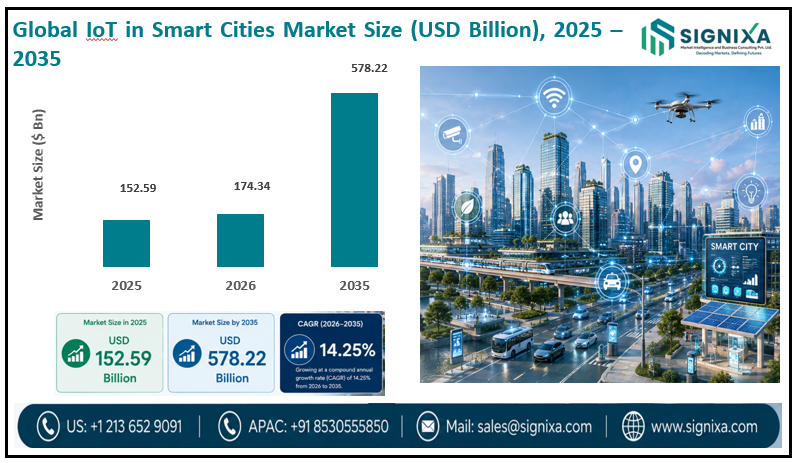
The size of the global IoT in Smart Cities Market was valued at approximately USD 152.59 Billion in 2025 and is projected to reach around USD 578.22 Billion by 2035, growing at a compound annual growth rate (CAGR) of 14.25% from 2026 to 2035. The report delves into the market’s drivers and restraints, evaluating their impact on demand over the forecast period. Furthermore, it highlights growth opportunities in this rapidly expanding sector.
The IoT in Smart Cities market encompasses solutions and services that enable the integration of intelligent systems across urban infrastructures. This includes smart transportation, buildings, utilities, and citizen services. IoT technologies such as sensors, cloud computing, and data analytics are becoming fundamental in improving city management, environmental sustainability, and quality of life. The rise in smart infrastructure investments, a growing need for efficient resource management, and increasing urbanization are driving the demand for IoT in smart cities.
The IoT in Smart Cities Market is expanding steadily as cities around the world invest in digital technologies to improve urban living and manage resources more effectively. IoT-enabled solutions allow municipalities to connect infrastructure, services, and devices through real-time data exchange, helping optimize transportation systems, energy consumption, water distribution, waste collection, and public safety operations. Growing urban populations and increasing pressure on city infrastructure are encouraging local governments to adopt smart technologies that improve efficiency, reduce operational costs, and enhance citizen services. The widespread availability of connected sensors, wireless communication networks, and cloud-based platforms is supporting the development of intelligent urban ecosystems capable of responding quickly to changing conditions. In addition, ongoing investments in smart mobility, environmental monitoring, and sustainable infrastructure projects are creating new opportunities for market growth. As cities continue to prioritize digital transformation and sustainable development, the adoption of IoT solutions is expected to increase across a wide range of smart city applications over the coming years.
Key Findings
- The global IoT in Smart Cities market is expected to grow at a CAGR of 14.25% during the forecast period (2026–2035).
- The market was valued at USD 152.59 Billion in 2025 and is projected to reach USD 578.22 Billion by 2035.
- Demand is driven by the adoption of IoT technologies for smart transportation, smart buildings, and smart utilities.
- The smart transportation segment is projected to have the largest market share, with a notable increase in demand for traffic monitoring and management systems
- Asia-Pacific region is anticipated to witness the fastest growth due to rapid urbanization and large-scale smart city projects.
IoT in Smart Cities Market Dynamics
The rapid adoption of IoT technologies in smart cities is fueled by the need for efficient resource management and environmental sustainability. Urbanization is putting immense pressure on city infrastructures, driving the demand for technologies that enhance operational efficiency, improve public safety, and reduce energy consumption. IoT helps address these issues by providing real-time data, enabling optimized decision-making for city planning, transport, energy, and water management. The integration of IoT solutions in cities facilitates automation and the provision of better citizen services.
Technological advancements in IoT have also played a key role in market growth. The introduction of 5G networks, edge computing, and AI-powered analytics has further enhanced the capabilities of IoT solutions. These technologies enable real-time monitoring, predictive maintenance, and more accurate decision-making. Additionally, the ongoing development of smart city frameworks by governments and private organizations to improve urban living standards is expected to propel the market. Increased investments in research and development and government initiatives further contribute to market expansion.
The demand for smart buildings and smart utilities is growing in parallel with the global push for energy-efficient and eco-friendly solutions. IoT technologies are being used to optimize building management, monitor air quality, and improve energy consumption. Smart meters and sensors play a significant role in providing real-time data on energy usage, while IoT-enabled systems in utilities enhance water and waste management, making urban spaces more sustainable and liveable.
The Internet of Things (IoT) in smart cities market is primarily driven by the rapid pace of urbanization and the increasing need for efficient resource management. As populations continue to flock to urban centers globally, cities face mounting pressure on their infrastructure, services, and environmental resources. IoT solutions offer a powerful means to address these challenges by enabling real-time data collection, analysis, and automated responses. For instance, smart traffic management systems, equipped with IoT sensors and AI, can dynamically adjust traffic signals to reduce congestion and emissions. Similarly, IoT-enabled smart grids optimize energy distribution, minimizing waste and promoting renewable energy integration. Smart waste management systems utilize sensors to monitor fill levels in bins, optimizing collection routes and reducing operational costs. The fundamental dynamic here is the desire of city governments and urban planners to create more sustainable, liveable, and efficient environments for their growing populations, leading to significant investments in IoT infrastructure across various urban domains.
Another critical dynamic is the advancement and widespread adoption of connectivity technologies, particularly 5G, and the evolution of edge computing. The effectiveness of IoT in smart cities hinges on seamless and high-speed data transmission between countless sensors, devices, and central platforms. The rollout of 5G networks provides the necessary bandwidth and low latency to support the massive scale of IoT deployments in urban areas, enabling real-time applications like autonomous vehicles, pervasive video surveillance, and immediate emergency response systems. Furthermore, edge computing, which processes data closer to the source (at the "edge" of the network), complements 5G by reducing latency and minimizing the amount of data sent to the cloud. This is crucial for applications where instantaneous decision-making is vital, such as traffic control or public safety. The continuous innovation in wireless communication technologies and the increasing maturity of edge computing solutions are accelerating the deployment of sophisticated IoT ecosystems in smart cities, unlocking new possibilities for urban intelligence and responsiveness.
Despite the immense potential, the IoT in smart cities market faces significant challenges, primarily related to data privacy, cybersecurity, and the high initial investment required. As billions of IoT devices collect vast amounts of data, including potentially sensitive information about citizens' movements, habits, and public infrastructure, concerns about data privacy and security are paramount. Ensuring robust encryption, secure communication protocols, and adherence to strict data protection regulations (like GDPR) is a constant challenge for city authorities and solution providers. The interconnected nature of IoT systems also creates a larger attack surface, making smart city infrastructure vulnerable to cyber threats that could disrupt essential services or compromise critical data. Beyond security, the substantial upfront capital expenditure required for deploying comprehensive IoT infrastructure – including sensors, communication networks, platforms, and integration services – can be a significant barrier for many cities, particularly those with limited budgets or a lack of technical expertise. Overcoming these financial, security, and privacy hurdles through collaborative public-private partnerships, standardized protocols, and transparent data governance frameworks is crucial for the sustainable growth and widespread adoption of IoT in smart cities.
IoT in Smart Cities Market Segmentation Analysis
By Offering Segment Analysis
The solutions segment dominates the market, driven by innovations in smart sensors, data analytics, and cloud platforms. IoT solutions help optimize traffic flow, manage utilities, and enhance public safety in cities. The market for IoT solutions is growing due to their role in enhancing city services, improving energy efficiency, and enabling real-time data collection for urban management. The market is projected to grow at a CAGR of 13.9% from 2026-2035.
The services segment is expected to grow at a higher CAGR of 14.7%, driven by the increasing need for integration and maintenance services. As cities adopt IoT solutions, the demand for professional services, including system integration, cloud services, and data management, is on the rise. Service providers offering end-to-end solutions and consulting are expected to see significant growth during the forecast period.
By Application Segment Analysis
Smart Transportation segment is projected to dominate the market, with an anticipated CAGR of 15.3%. The integration of IoT in traffic management systems, vehicle tracking, and public transportation networks enhances urban mobility and reduces congestion. According to a recent report, global investments in smart transportation solutions reached USD 34.5 billion in 2025, with a forecasted 20% increase by 2035.
Smart Building: The smart building segment is growing rapidly, with an expected CAGR of 13.8%. Smart building technologies such as IoT-enabled energy management systems, smart lighting, and HVAC control are becoming increasingly popular in commercial and residential spaces. As of 2025, the market for smart building solutions was valued at USD 20.8 billion, with expected growth of 19% by 2035.
Smart Utilities: IoT in smart utilities is gaining traction, with an estimated CAGR of 14.0%. IoT solutions for water, electricity, and gas management are improving efficiency and sustainability in urban infrastructures. The adoption of smart meters and sensors for monitoring utilities has been widespread, with the global smart grid market valued at USD 23 billion in 2025.
Smart Citizen Services: This application is expected to experience significant growth, driven by the rising demand for improved urban services such as waste management, smart policing, and emergency response. The market for smart citizen services is projected to grow at a CAGR of 14.5%, with investments in digital public services increasing rapidly across developed and developing cities.
Report Attributes & Market Scope
| Report Attribute | Details |
|---|---|
| Market Size Value in 2025 | USD 152.59 Billion |
| Market Size Value in 2035 | USD 578.22 Billion |
| CAGR (2026–2035) | 14.25% |
| Base Year Used for Estimation | 2025 |
| Historic Data | 2020 - 2025 |
| Forecast Period | 2026 - 2035 |
| Segments Covered – By offering |
|
| Segments Covered – By Application |
|
| Regions Covered | North America, Europe, Asia Pacific, Latin America, Middle East and Africa |
| Major Countries Covered | U.S., Canada, Mexico, Germany, UK, France, Italy, Spain, Russia, China, Japan, South Korea, India, Southeast Asia Countries, Brazil, Argentina, GCC Countries, Turkey, Iran, Israel, South Africa, Egypt, Nigeria, etc. |
| Key Companies Profiled | Cisco Systems, IBM Corporation, Huawei Technologies Co., Ltd., Siemens AG, Intel Corporation, Microsoft Corporation, Google LLC, Vodafone Group, Qualcomm Technologies, and Ericsson, among others. |
IoT in Smart Cities Market Regional Analysis
North America is expected to maintain dominance in the IoT in Smart Cities market, with significant investments in smart city initiatives and regulatory support for IoT innovations. The region has seen robust growth in smart transportation and smart utility systems, which are expected to continue expanding through 2035. The Asia-Pacific region is forecasted to experience the fastest growth, with several countries like China, India, and Japan increasing their focus on urban infrastructure and smart city projects. As urbanization continues, the need for IoT solutions to address transportation, energy, and resource management challenges will increase.
North America (Leading Region)
North America stands as a leading market for barcode software, driven by its highly digitized industrial landscape, widespread adoption of automation technologies, and a mature retail and e-commerce sector. The United States, in particular, showcases significant traction, with businesses across manufacturing, logistics, healthcare, and retail heavily relying on barcode solutions for efficient inventory management, asset tracking, and point-of-sale operations. The region benefits from the presence of numerous key barcode software providers and a strong emphasis on integrating barcode data with enterprise resource planning (ERP) and warehouse management systems (WMS). The increasing digitalization trend across industries, coupled with the growing preference for cloud-based barcode software solutions for their scalability and accessibility, further fuels market expansion. The continuous evolution towards 2D barcodes and the adoption of AI-powered barcode readers for enhanced accuracy in challenging environments are also prominent trends shaping the North American market, as companies seek to optimize supply chains and improve overall operational efficiency.
Europe
Europe represents a well-established and significant market for barcode software, characterized by a strong focus on industrial automation, efficient supply chain management, and compliance with stringent regulations. Countries like Germany, the UK, and France are leading adopters, with manufacturing, retail, and healthcare sectors being key verticals driving demand. The region's emphasis on streamlining operations, reducing errors, and improving traceability across complex supply chains drives the widespread use of barcode software for inventory control, asset tracking, and package tracking. The increasing adoption of digital label printing solutions and the rising demand for labelled and packaged food & beverages also contribute to market growth. European businesses are increasingly leveraging barcode software for seamless integration with existing systems to achieve time optimization, reduce errors, and ensure on-time delivery, underscoring the vital role of this technology in the region's industrial and commercial efficiency. Furthermore, the push for sustainability and the need for greater transparency in product lifecycles also contribute to the demand for robust barcode software solutions.
Asia Pacific (Fastest-Growing Region)
The Asia Pacific region is the fastest-growing market for barcode software globally, propelled by rapid industrialization, burgeoning e-commerce, and massive government initiatives promoting digitalization across various sectors. Countries like China, India, and Japan are experiencing explosive growth in manufacturing, logistics, and retail, all of which heavily rely on barcode solutions for efficient operations. The enormous volume of goods produced and consumed in this region necessitates robust barcode software for inventory management, supply chain visibility, and product authentication. The increasing adoption of 2D barcodes (like QR codes) is particularly prevalent due to their versatility and ability to store more data, catering to complex traceability requirements and consumer engagement initiatives. Government support for "Industry 4.0" and smart factory concepts, coupled with the widespread proliferation of smartphones and mobile payment systems, further accelerates the demand for advanced barcode software solutions capable of handling high-volume data and supporting diverse applications, positioning Asia Pacific as a key growth engine for the global market.
Middle East & Africa
The Middle East & Africa (MEA) region is an emerging but increasingly important market for barcode software, showing significant growth potential driven by economic diversification efforts, increasing industrialization, and a rising focus on enhancing supply chain efficiency. In the Middle East, particularly the Gulf Cooperation Council (GCC) countries, significant investments in logistics hubs, retail expansion, and healthcare infrastructure are fueling the adoption of barcode software for inventory management, asset tracking, and streamlining operations. The region's growing e-commerce sector and the need for robust traceability solutions to combat counterfeiting are also key drivers. In Africa, while the market is still in its early stages, increasing foreign direct investment in manufacturing and retail, coupled with a push for digitalization, is creating opportunities. Challenges related to varying levels of technological infrastructure, the high initial cost of advanced solutions for some smaller businesses, and the need for greater awareness of the benefits of barcode automation remain factors influencing the pace of adoption. However, the continuous drive towards operational excellence and supply chain visibility positions the MEA region for steady growth in the barcode software market.
Recent Developments in the IoT in Smart Cities Market
-
2026
Ericsson entered a multi-year partnership with NTT DATA to deploy private 5G and edge computing solutions for smart city applications, supporting traffic management, public safety monitoring, and improved municipal service operations.
Cisco partnered with AT&T to introduce a 5G Standalone-native IoT platform designed to support smart city infrastructure, connected transportation networks, and low-latency urban services.
Intel expanded its collaboration with Ericsson to advance 6G connectivity technologies and strengthen the development of next-generation smart city and IoT ecosystems.
-
2025
Siemens collaborated with Microsoft to improve interoperability between Building X and Azure IoT Operations, facilitating more efficient integration of connected building systems and urban infrastructure.
Vodafone Idea Business expanded its IoT portfolio with Smart Gas Metering solutions for city gas distribution networks, supporting the modernization of utility infrastructure and energy management systems.
Siemens broadened its smart infrastructure portfolio with intelligent transportation and urban mobility solutions designed to improve traffic flow, operational efficiency, and sustainability in urban environments.
IoT in Smart Cities Market: Competitive Landscape
The global IoT in Smart Cities market is highly competitive, featuring key players such as Cisco Systems, IBM Corporation, Intel Corporation, Microsoft Corporation, Huawei Technologies, Siemens AG, Schneider Electric, and Oracle Corporation. These players are competing in areas such as product innovation, strategic partnerships, and offering comprehensive IoT solutions for smart cities. Additionally, smaller startups are emerging with specialized IoT services, further intensifying competition. The growing focus on enhancing city sustainability and resource optimization presents significant opportunities for these companies.
Key Companies Profiled
- Cisco Systems, Inc.
- IBM Corporation
- Intel Corporation
- Microsoft Corporation
- Huawei Technologies Co., Ltd.
- Siemens AG
- Schneider Electric SE
- Oracle Corporation
- Ericsson AB
- Bosch Group
- Hitachi, Ltd.
- Honeywell International Inc.
- ABB Ltd.
- SAP SE
- Thales Group
Global IoT in Smart Cities Market Segmentation Summary
By Offering
- Solutions
- Services
By Application
- Smart Transportation
- Smart Building
- Smart Utilities
- Smart Citizen Services
By Region
- North America
- U.S.
- Canada
- Mexico
- Europe
- Germany
- France
- UK
- Spain
- Italy
- Rest of Europe
- Asia-Pacific
- China
- Japan
- India
- Australia
- South Korea
- Southeast Asia
- Rest of Asia-Pacific
- Latin America
- Brazil
- Argentina
- Rest of Latin America
- The Middle East & Africa
- GCC Countries
- South Africa
- Rest of the Middle East & Africa
Frequently Asked Questions (FAQs) About the IoT in Smart Cities Market
What is an IoT in Smart Cities?
IoT (Internet of Things) in Smart Cities refers to the network of connected devices, sensors, and technologies that work together to improve urban living by enhancing efficiency, sustainability, and the quality of services in transportation, energy management, healthcare, and other civic services.
Which key factors will influence the IoT in Smart Cities Market growth over 2026–2035?
The global IoT in Smart Cities market is expected to grow due to increasing urbanization, rising demand for efficient resource management, advancements in IoT technology, and government initiatives to develop smart infrastructure, all of which drive the need for connected devices and intelligent city management solutions.
What will be the value of the IoT in Smart Cities Market during 2026–2035?
The global IoT in Smart Cities Market was valued at approximately USD 152.59 Billion in 2025 and is projected to reach around USD 578.22 Billion by 2035, growing at a significant pace over the forecast period.
What will be the CAGR value of the IoT in Smart Cities Market during 2026–2035?
The IoT in Smart Cities Market is expected to expand at a CAGR of 14.25% between 2026 and 2035.
Which region will contribute notably towards the IoT in Smart Cities Market value?
The global IoT in Smart Cities market is anticipated to see significant contributions from North America, Europe, and the Asia-Pacific region, driven by technological innovation, governmental support for smart city projects, and increased investments in urban infrastructure development.
Which are the major players leveraging the IoT in Smart Cities Market growth?
The global IoT in Smart Cities market features major players such as Cisco Systems, IBM Corporation, Huawei Technologies Co., Ltd., Siemens AG, Intel Corporation, Microsoft Corporation, Google LLC, Vodafone Group, Qualcomm Technologies, and Ericsson.
What can be expected from the global IoT in Smart Cities Market report?
The report provides an in-depth analysis of the IoT in Smart Cities market, covering key growth drivers, challenges, and future opportunities. It highlights technological advancements, regional developments, and the key players dominating the market, while also addressing the impact of smart city projects on urban management and sustainability.