
Wind Turbine Rotor Blade Market Overview
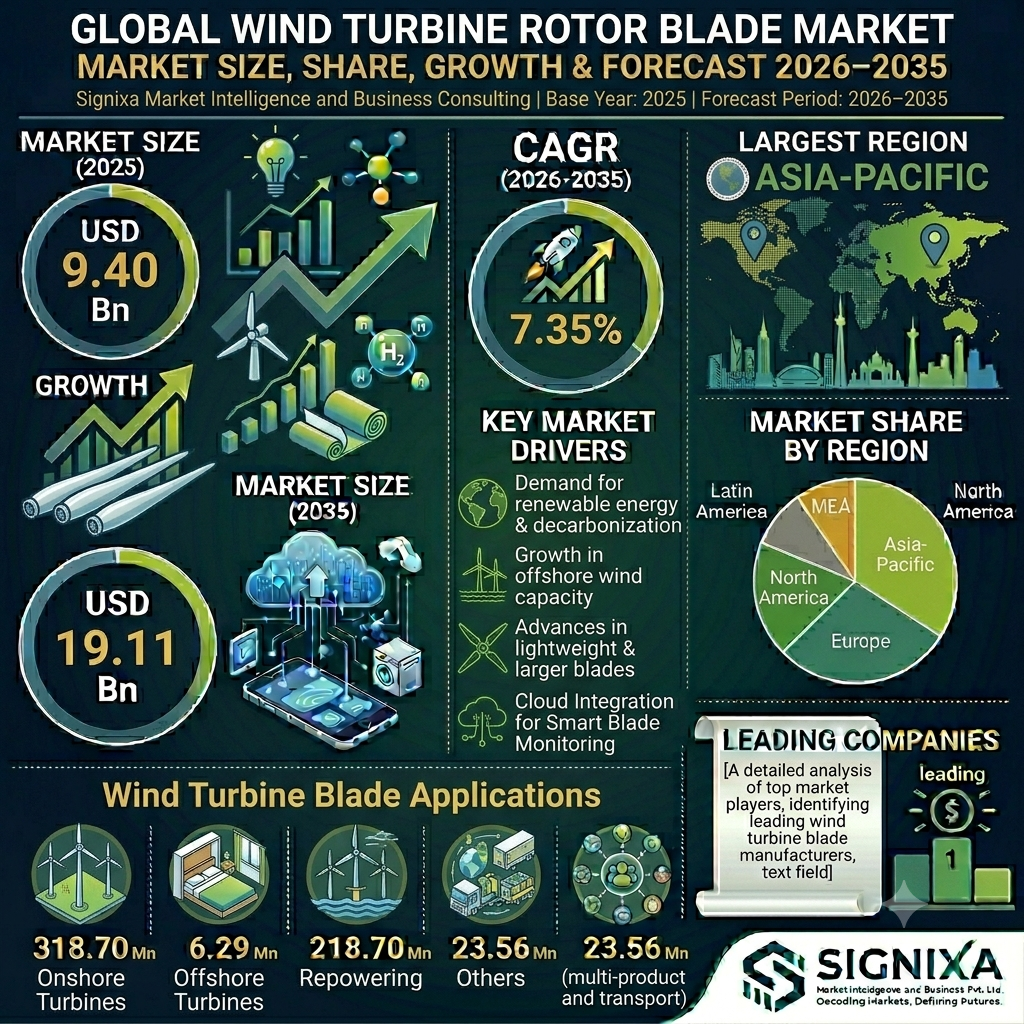
The size of the global wind turbine rotor blade market was approximately USD 9.40 billion in 2025 and is projected to reach USD 19.11 billion by 2035, growing at a CAGR of 7.35% between 2026 and 2035. This report provides insights into market trends, growth drivers, constraints, and key opportunities shaping the future of the global wind turbine rotor blade industry.
The wind turbine rotor blade market is a critical and rapidly evolving segment within the broader renewable energy sector, directly influenced by the global imperative to transition from fossil fuels toward cleaner power sources. Rotor blades are the fundamental components responsible for capturing wind energy and converting it into rotational motion that drives the turbine's generator to produce electricity. The market encompasses components engineered for capturing wind energy in both onshore and offshore wind turbines, and its growth is intrinsically linked to the increasing worldwide installation of wind energy capacity — driven by supportive government policies, declining levelized costs of wind power generation, and growing environmental concerns requiring rapid decarbonization of electricity supply.
A significant trend shaping the rotor blade market is the ongoing advancement in materials science and manufacturing processes. Historically dominated by fiberglass composites, the industry is increasingly adopting carbon fiber, which offers a superior strength-to-weight ratio that allows for the design of longer blades without compromising structural integrity — enabling larger turbines that can sweep a greater area and generate more power. Research into hybrid composites combining synthetic fibers with natural fibers is gaining traction, driven by sustainability goals and the desire to reduce the environmental footprint of blade production. The market is also witnessing a strong push toward smarter blades with embedded sensors for real-time condition monitoring, active pitch control systems, and advanced aerodynamic designs including swept-back profiles and winglets inspired by aviation that reduce drag and minimize noise.
Key Findings
- The global wind turbine rotor blade market is projected to grow at a CAGR of approximately 7.35% between 2026 and 2035, with market size rising from USD 9.40 billion in 2025 to USD 19.11 billion by 2035.
- Growth is driven by increasing wind energy capacity additions worldwide, particularly in emerging markets across Asia-Pacific, with over 100 GW of new wind capacity added globally in 2023 alone.
- The glass fiber segment dominates by material with over 60% market share in 2025, while carbon composite is witnessing faster growth due to its superior performance characteristics for large offshore blades.
- Onshore applications hold the majority share at over 70% in 2025, while offshore is expected to grow at a higher CAGR exceeding 9%, driven by expanding large-scale offshore wind projects in Europe, China, and the U.S.
- Asia-Pacific leads the global market, followed by Europe and North America, with China and India accounting for more than 50% of global wind energy capacity in 2025.
Wind Turbine Rotor Blade Market Dynamics
Escalating Global Wind Energy Capacity & Repowering Demand
As global wind energy capacity expands rapidly — particularly in China, India, the U.S., and across European nations — demand for wind turbine rotor blades is rising significantly. Rotor blades are among the most crucial and cost-intensive components of wind turbines, and the increasing number of new installations directly contributes to higher demand for both new blades and replacement units as the existing installed base ages. The anticipated repowering of aging wind infrastructure represents a particularly significant opportunity, as older turbines are upgraded with longer, lighter, more aerodynamically efficient blades that deliver substantially higher energy output from the same site footprint, improving the economic performance of wind farms that have already paid off their initial capital costs. Supportive government policies, ambitious national renewable energy targets, and the declining Levelized Cost of Energy (LCOE) for wind power make it an increasingly competitive alternative to traditional power generation, further accelerating the pace of new wind installations globally.
Turbine Upscaling Trend & Offshore Wind Sector Expansion
The offshore wind sector is emerging as a major growth area, particularly in Europe, China, and the United States — requiring larger, more robust blades due to higher wind speeds, harsher marine environments, and the drive to maximize energy capture per installed unit. Offshore turbines now reach rotor diameters exceeding 220 meters, demanding advanced blade technologies that only carbon fiber and hybrid composite materials can feasibly enable at these dimensions. This shift is expanding demand for carbon fiber and hybrid composite blades, creating significant manufacturing and engineering opportunities for companies positioned to serve this premium market segment. The development of floating wind technology — which extends the geographic range of viable offshore wind development to deeper waters — further enhances offshore blade demand by opening previously inaccessible sites to wind development. Innovations in aerodynamics, modular blade structures for easier transport and on-site assembly, and active pitch control systems are also key drivers supporting continued market growth by enabling turbines to capture more wind energy across a wider range of wind speed conditions.
Manufacturing Complexity, Cost Pressures & End-of-Life Recyclability
The wind turbine rotor blade market faces several significant challenges that must be addressed for sustained long-term growth. The high cost of research and development for advanced blade designs and new materials — particularly hybrid composites incorporating nanotechnology — requires substantial investment that often limits cutting-edge innovation to a small number of major players, potentially concentrating market advantages and slowing broader adoption of breakthrough technologies. Manufacturing large, complex composite structures is a capital-intensive and labor-intensive process requiring specialized facilities, skilled labor, and stringent quality control that adds materially to production cost. Supply chain volatility for key raw materials including resins, fiberglass, and carbon fiber can disrupt production schedules and compress margins. A growing and increasingly pressing concern is the end-of-life management and recyclability of composite blades — as thousands of older turbines reach the end of their operational lifespans, the challenge of recycling large, non-biodegradable composite structures is driving investment in sustainable material alternatives and novel recycling technologies that can process decommissioned blades into valuable secondary materials rather than landfill disposal.
Wind Turbine Rotor Blade Market Segmentation Analysis
By Material Segment Analysis
Glass Fiber
Glass fiber remains the most widely used material for wind turbine rotor blades, accounting for over 60% of the global market share in 2025. Its balance of cost, performance, and durability makes it well-suited for onshore wind turbine applications where cost-efficiency is paramount over maximum performance. With manufacturers continuously refining resin systems and structural design, glass fiber composites continue to provide competitive mechanical properties at a lower unit cost than carbon alternatives — particularly for mid-sized onshore blades where the weight and performance advantages of carbon fiber do not justify the significant cost premium. Glass fiber dominance is expected to persist through the forecast period, supported by the high volume of onshore installations in cost-sensitive emerging markets across Asia-Pacific, Africa, and Latin America where glass fiber economics remain compelling.
Carbon Composite
Carbon composite materials are gaining traction in the wind turbine rotor blade market, particularly in offshore and large-scale onshore turbine applications. In 2025, the segment accounted for about 35% of market revenue but is expected to grow faster than glass fiber through 2035, driven by its superior strength-to-weight ratio and fatigue resistance that enables the design of significantly longer blades that achieve greater energy capture per turbine. Despite higher initial material and fabrication costs, carbon composites are strongly favored in markets focused on performance maximization — particularly offshore Europe and the U.S. East Coast — where the incremental energy yield from longer, lighter carbon fiber blades over a 20+ year operational lifespan more than justifies the upfront capital premium. The trend toward ever-larger offshore turbines will continue driving carbon composite adoption as glass fiber cannot economically achieve the required structural performance at extreme blade lengths.
By Application Segment Analysis
Onshore
Onshore wind turbines dominated the application segment in 2025, contributing over 70% of total market share. The onshore segment benefits from lower installation and maintenance costs compared to offshore and continues to grow strongly in developing regions including Asia-Pacific, Africa, and Latin America. Countries including India, Brazil, and Vietnam are aggressively expanding their onshore wind capacity — driving demand for rotor blades made with cost-effective glass fiber materials optimized for the lower wind speeds and diverse terrain characteristics that define most high-potential onshore sites across these regions. Onshore wind development also benefits from shorter project development timelines and lower permitting complexity relative to offshore, allowing faster capital deployment in countries seeking rapid renewable energy capacity expansion.
Offshore
The offshore application segment is witnessing the highest growth rate, with a projected CAGR exceeding 9% from 2026 to 2035. Offshore wind farms — particularly in Northern Europe, the U.S. East Coast, and China's coastal provinces — are deploying increasingly larger turbines with rotor blades exceeding 100 meters in length that require advanced composite materials and high-precision manufacturing. Investment in floating wind technology is further enhancing offshore blade demand by opening deepwater sites that were previously inaccessible to conventional fixed-bottom offshore foundations. The offshore segment's faster CAGR relative to onshore reflects both the scale of capital investment flowing into offshore wind globally and the higher per-blade value associated with the advanced materials and precision manufacturing required for the extreme operating conditions of marine environments, where blade durability, fatigue resistance, and resistance to salt spray and biofouling are critical to achieving the designed 25+ year operational lifespan.
Report Attributes & Market Scope
| Report Attribute | Details |
|---|---|
| Market Size Value in 2025 | USD 9.40 Billion |
| Market Size Value in 2035 | USD 19.11 Billion |
| CAGR (2026–2035) | 7.35% |
| Base Year Used for Estimation | 2025 |
| Historic Data | 2020 – 2025 |
| Forecast Period | 2026 – 2035 |
| Segments Covered – By Material |
|
| Segments Covered – By Application |
|
| Regions Covered | North America, Europe, Asia Pacific, Latin America, Middle East and Africa |
| Major Countries Covered | U.S., Canada, Mexico, Germany, UK, France, Italy, Spain, Russia, China, Japan, South Korea, India, Southeast Asia Countries, Brazil, Argentina, GCC Countries, Turkey, Iran, Israel, South Africa, Egypt, Nigeria, etc. |
| Key Companies Profiled | LM Wind Power, TPI Composites, Siemens Gamesa, Vestas, Nordex, GE Vernova, Mingyang Smart Energy, Goldwind, Enercon, and Suzlon, among others. |
Wind Turbine Rotor Blade Market Regional Analysis
Asia-Pacific leads the global wind turbine rotor blade market, accounting for more than 50% of global wind energy capacity in 2025. Europe remains a hub for offshore wind, driven by the UK, Germany, Denmark, and the Netherlands. North America is accelerating wind investments, particularly offshore. Latin America, the Middle East, and Africa are emerging as promising markets, supported by growing energy needs and favorable renewable energy policies.
Asia Pacific (Largest Market)
Asia Pacific stands as the largest and most rapidly growing market for wind turbine rotor blades globally. This exponential growth is primarily fuelled by massive government investments in renewable energy, rapid industrialization, and escalating energy demand — particularly in China and India. China is a dominant force not only in installed wind capacity but also in blade manufacturing, producing some of the world's longest and most powerful blades for its vast onshore and burgeoning offshore wind projects. The region's focus is on scaling up production volumes while continuously improving blade efficiency and reducing costs. While glass fiber remains a primary material, there is a clear trend toward increased carbon fiber adoption for larger, more efficient turbines. The demand is driven by ambitious national renewable energy targets and the imperative to meet the energy needs of rapidly expanding economies and urban populations, making Asia Pacific a critical hub for both innovation and production in the global rotor blade market.
Europe
Europe remains a global leader and highly developed market for wind turbine rotor blades, driven by ambitious renewable energy targets, stringent decarbonization policies, and a strong heritage in wind energy technology. Countries including Germany, the UK, Denmark, and Spain are at the forefront, with significant investments in both onshore and — crucially — offshore wind farms that necessitate the production of very long and robust blades incorporating advanced materials including carbon fiber for optimal performance. Research and development in aerodynamics and materials science are highly active, aimed at pushing the boundaries of blade efficiency and durability. The focus on circular economy principles and recyclability of composite blade materials is gaining traction, influencing design and manufacturing processes to ensure more sustainable end-of-life solutions as the first generation of large-scale wind farms begins to reach decommissioning age across the region.
North America
North America's wind turbine rotor blade market is experiencing moderate but consistent growth, driven by federal and state-level initiatives promoting renewable energy alongside increasing investments in both onshore expansion and the nascent offshore wind sector. The United States is the primary contributor, with abundant wind resources in the Midwest and Texas supporting extensive onshore wind farm development. There is a growing emphasis on advanced materials including carbon fiber for longer and lighter blades as the industry eyes larger turbines for enhanced energy capture. The development of offshore wind projects along the East and West coasts is a key emerging opportunity, requiring larger and more durable blades designed to withstand harsh marine environments. Repowering of older onshore wind farms with more efficient, modern blades further contributes to demand, reflecting a commitment to optimizing existing infrastructure for greater energy output without requiring new permitting and grid connection processes.
Middle East & Africa
The Middle East and Africa region is an emerging, yet increasingly significant market for wind turbine rotor blades. GCC countries — particularly the UAE and Saudi Arabia — are investing heavily in large-scale wind power projects as part of national visions to reduce fossil fuel dependence and achieve sustainable development goals, including both onshore and offshore wind initiatives requiring robust, high-performance rotor blades. In Africa, South Africa and North African nations are showing growing interest and investment in wind energy to address rising energy demand and expand electricity access. The region currently relies heavily on imported blades and specialized engineering expertise, though a gradual trend toward developing local manufacturing capabilities is emerging. The unique environmental conditions — including high temperatures and dust in desert regions — drive demand for specialized blade coatings and materials that maintain structural and aerodynamic performance across harsh operating environments that differ significantly from temperate-climate wind markets.
Recent Developments in the Wind Turbine Rotor Blade Market
-
2025
TPI Composites expanded its production capacity in India to meet growing demand for onshore rotor blades — positioning the company to capitalize on India's accelerating wind energy deployment program and establishing manufacturing scale in one of the world's fastest-growing onshore wind markets where domestic blade production capability is a strategic priority for supply chain resilience.
-
2023
LM Wind Power unveiled a 115-meter blade designed for offshore turbines, targeting increased output efficiency at the utility scale required for next-generation offshore wind projects — pushing the frontier of blade length engineering and demonstrating the continued industry momentum toward larger rotor diameters that maximize energy capture from offshore wind resources.
Wind Turbine Rotor Blade Market: Competitive Landscape
The global rotor blade market includes key players such as LM Wind Power, TPI Composites, Siemens Gamesa, Vestas, Nordex, GE Vernova, Mingyang Smart Energy, Goldwind, Enercon, and Suzlon. These companies compete based on blade length capability, material technology, cost-efficiency, and regional manufacturing proximity to wind installation markets. With the growing demand for longer and more durable blades, manufacturers are investing heavily in R&D and expanding production in emerging wind markets to maintain competitiveness and capture greater share of this dynamic and evolving market.
The competitive landscape in wind turbine rotor blades features two distinct strategic models — integrated turbine OEMs that manufacture blades for their own turbines (Siemens Gamesa, Vestas, Goldwind, Enercon) and independent blade manufacturers that supply to multiple OEM customers (LM Wind Power, TPI Composites). Independent blade manufacturers benefit from multi-customer diversification and geographic flexibility, while integrated OEMs can optimize blade design specifically for their proprietary turbine architectures and maintain tighter quality control over the complete turbine assembly. Competition centers on blade length extension capability — as the race toward longer blades continues, manufacturers that can design, manufacture, and logistically deliver world-record-length blades for offshore applications command premium market positioning. The ability to manufacture blades close to installation sites is a growing competitive factor as blade dimensions increasingly challenge road transport logistics, driving investment in regional manufacturing facilities in key growth markets including India, Brazil, and emerging offshore markets. Sustainability credentials — particularly progress toward recyclable blade designs and low-carbon manufacturing processes — are becoming an increasingly important competitive dimension as wind farm operators and governments demand lifecycle environmental accountability throughout the renewable energy supply chain.
Key Companies Profiled
Global Wind Turbine Rotor Blade Market Segmentation Summary
By Material
By Application
By Region
Frequently Asked Questions (FAQs) About the Wind Turbine Rotor Blade Market
What is a Wind Turbine Rotor Blade?
A wind turbine rotor blade is a critical aerodynamic component attached to the turbine hub, designed to convert wind energy into rotational energy for electricity generation. These blades are typically constructed from advanced composite materials for strength, flexibility, and performance in onshore and offshore environments.
Which key factors will influence the wind turbine rotor blade market growth over 2026–2035?
Market growth will be driven by increasing global wind energy capacity additions, rising adoption of offshore wind projects, and advancements in blade materials and design. Emerging markets and government initiatives supporting renewable energy are also playing a pivotal role.
What will be the value of the wind turbine rotor blade market during 2026–2035?
According to the study, the global wind turbine rotor blade market size was worth around USD 9.40 billion in 2025 and is projected to reach approximately USD 19.11 billion by 2035.
What will be the CAGR value of the wind turbine rotor blade market during 2026–2035?
The compound annual growth rate (CAGR) of the wind turbine rotor blade market is expected to be around 7.35% between 2026 and 2035.
Which region will contribute notably towards the wind turbine rotor blade market value?
Asia-Pacific will lead the global market due to large-scale wind installations in China and India. Europe and North America will also contribute significantly, especially through offshore wind expansion.
Which are the major players leveraging the wind turbine rotor blade market growth?
Key market players include LM Wind Power, TPI Composites, Siemens Gamesa, Vestas, Nordex, GE Vernova, Mingyang Smart Energy, Goldwind, Enercon, and Suzlon. These companies are actively innovating in blade design and material technology to meet rising demand.
What can be expected from the global wind turbine rotor blade market report?
The report delivers an in-depth analysis of market dynamics, trends, opportunities, and challenges. It provides detailed segmentation by material, application, and region, supported by forecasts and profiles of leading players across the wind turbine rotor blade industry.