
Synthetic Rubber Market Overview
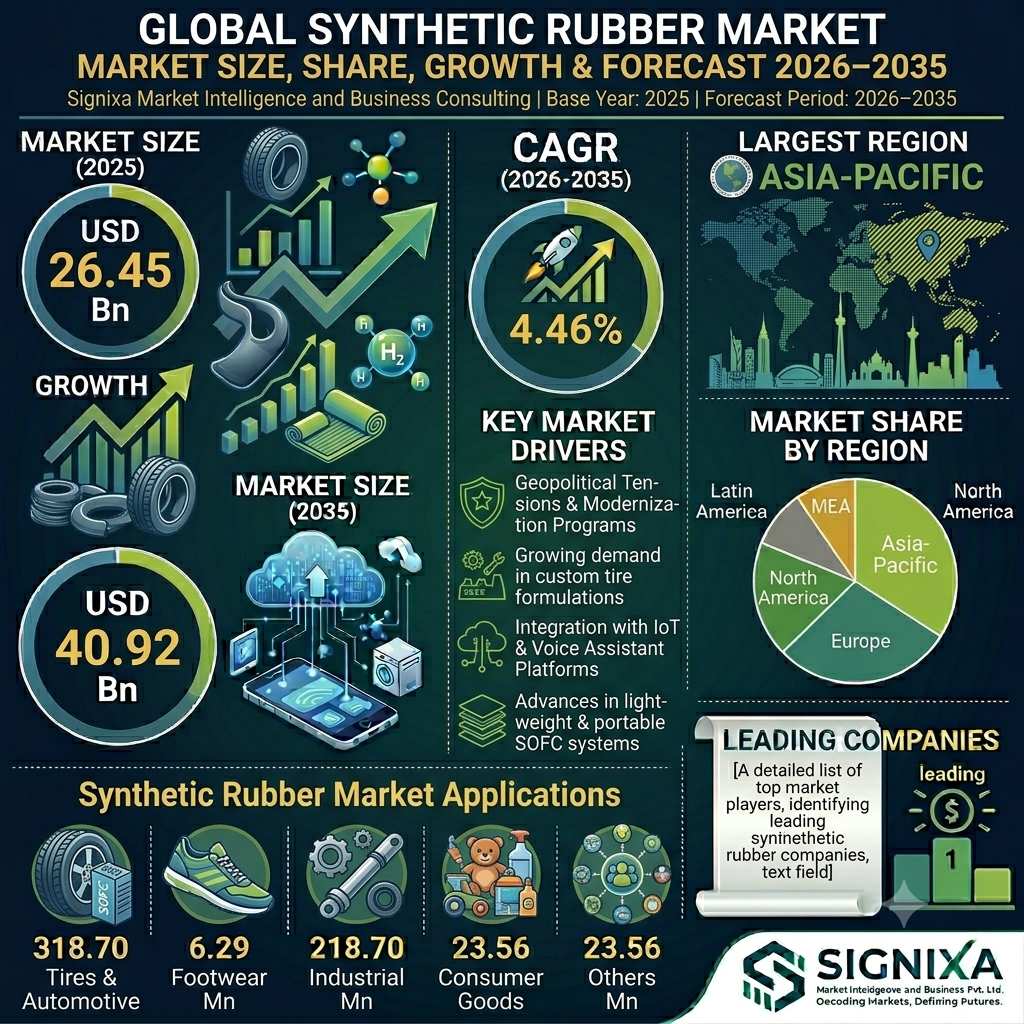
The size of the global synthetic rubber market was worth around USD 26.45 billion in 2025 and is predicted to grow to around USD 40.92 billion by 2035, with a compound annual growth rate (CAGR) of roughly 4.46% between 2026 and 2035. The report analyzes the synthetic rubber market's key drivers and restraints, as well as their impact on demand during the forecast period, and explores global opportunities across this broad-based elastomers industry.
The synthetic rubber market comprises man-made elastomers synthesized from petrochemical feedstock, primarily used across the automotive, construction, industrial, and consumer goods sectors. This growth is primarily driven by the increasing demand for high-performance elastomers that offer superior properties compared to natural rubber, including enhanced thermal stability, resistance to oils, chemicals, and oxidizing agents such as ozone. Styrene-Butadiene Rubber (SBR) remains the largest segment by type, holding approximately 32% of the market share in 2025, largely due to its extensive use in tire manufacturing where it provides excellent abrasion resistance and wet grip. Other types including Ethylene-Propylene-Diene Monomer (EPDM) are gaining significant traction due to their weatherability and electrical insulation properties, finding growing application in construction, wire and cable sheathing, and sealing for renewable energy infrastructure.
The overall market is also influenced by advancements in polymerization techniques — including solution polymerization and advanced continuous polymerization — which allow for more precise control over rubber properties and reduced environmental impact. The rise of electric vehicles is impacting market dynamics, as their heavier battery packs and instant torque necessitate tires made with specific solution-polymerized SBR grades that offer lower rolling resistance and extended lifespan. While the market continues to expand, it navigates challenges including butadiene feedstock price volatility, stringent environmental regulations pushing toward sustainable production, and competitive pressure from both natural rubber and alternative materials across specific applications.
Key Findings
- The global synthetic rubber market is expected to grow at a CAGR of 4.46% from 2026 to 2035, with revenue rising from USD 26.45 billion in 2025 to USD 40.92 billion by 2035.
- The market is expanding due to strong demand for synthetic rubber in tire manufacturing, automotive seals and gaskets, and a wide range of industrial goods applications.
- SBR dominates the market by type with over 32% share in 2025, driven by its high use in tire production and its ability to blend with natural rubber for enhanced performance.
- The Tire segment accounts for the largest application share, representing over 58% of market revenue in 2025, driven by global vehicle production and replacement tire demand.
- Asia-Pacific leads the global market, holding over 45% of revenue in 2025, attributed to high automotive production in China, India, and Southeast Asia and strong demand from tire and footwear manufacturing.
Synthetic Rubber Market Dynamics
Automotive Industry Demand — Tire Manufacturing & EV Transition
The synthetic rubber market is primarily driven by the robust and ever-evolving demands of the automotive industry. Around 60% of synthetic rubber is consumed in tire production — particularly SBR and BR — due to their abrasion resistance, durability, and cost-efficiency. Rapid urbanization and automobile ownership growth in Asia-Pacific are fuelling tire replacements and new vehicle production at scale. The shift toward electric vehicles is further shaping this dynamic, as EVs with heavier battery packs and instant torque necessitate specialized high-performance tire formulations — particularly solution-polymerized SBR grades — that offer lower rolling resistance, increased durability, and enhanced grip to maximize battery range. Beyond tires, synthetic rubber is critical for a myriad of non-tire automotive components including seals, gaskets, hoses, belts, and anti-vibration mounts, where its resistance to heat, oil, and under-the-hood chemicals is indispensable to component longevity and vehicle reliability.
Non-Tire Applications Growth & Industrial Diversification
The rise in non-tire applications represents a significant growth vector for the synthetic rubber market. EPDM and NBR are increasingly used for their heat, weather, and oil resistance in automotive hoses, seals, gaskets, and vibration-dampening components, as OEMs seek more reliable and longer-lasting parts to extend vehicle service intervals. The footwear industry's shift toward lightweight, flexible, and durable soles is driving SBC demand, while the industrial sector relies on synthetic rubber for conveyor belts, rollers, seals, and insulation materials that must maintain performance under demanding operating conditions. The growing use of disposable NBR gloves in healthcare and food processing industries represents another expanding demand stream, while construction applications including roofing membranes, window sealing systems, and adhesives leverage EPDM's exceptional weatherability and service life in exterior exposure conditions.
Raw Material Volatility, Environmental Regulations & Sustainable Innovation
The synthetic rubber market faces significant challenges from the volatility of raw material prices — particularly petrochemical feedstocks including butadiene, styrene, and isoprene, which are derivatives of crude oil. Geopolitical tensions, supply chain disruptions, and fluctuations in global oil prices directly impact production costs and profitability, making long-term planning difficult for manufacturers. Increasing environmental scrutiny is also a structural pressure, as the energy-intensive production of synthetic rubber generates significant emissions and waste, prompting governments and environmental bodies to impose stricter standards that require manufacturers to invest in cleaner production processes and explore bio-based alternatives. These challenges are simultaneously creating opportunities: continuous technological advancements in rubber formulations are producing high-performance materials with improved heat resistance, better abrasion resistance, and reduced rolling resistance, while growing demand for eco-friendly and sustainable synthetic rubbers — including bio-based variants derived from renewable resources — presents significant avenues for innovation and competitive differentiation across the forecast period.
Synthetic Rubber Market Segmentation Analysis
By Type Segment Analysis
Styrene Butadiene Rubber (SBR)
SBR held over 32% of the market share in 2025, driven by its cost-effectiveness and superior abrasion resistance. It is the single most widely used synthetic rubber in the tire segment, accounting for over 50% of all synthetic rubber used in tire applications. Its ability to blend readily with natural rubber enhances its performance across a wide range of automotive and industrial uses, and the development of solution-polymerized SBR grades specifically targeting EV tire requirements — offering lower rolling resistance and extended tread life — is creating a significant growth opportunity within this already-dominant product category through the forecast period.
Polybutadiene Rubber (BR)
Polybutadiene Rubber accounted for around 18% of the market in 2025. It offers high resilience and low heat build-up, making it ideal for high-durability tire treads and golf balls where rolling efficiency and wear resistance are paramount. BR also enhances wear resistance and improves cold flexibility when blended with SBR, particularly for winter tire applications requiring maintained pliability at low temperatures. Its role as a blend component in the dominant tire segment ensures consistent demand across a wide range of tire types and vehicle categories.
Ethylene-Propylene-Diene Rubber (EPDM)
EPDM constituted 14% of the market in 2025. Known for superior weather, UV, and ozone resistance, it is used in automotive weather stripping, radiator hoses, and roofing membranes. Its flexibility at low temperatures enhances its appeal for automotive sealing systems that must maintain integrity across a wide range of climatic conditions. EPDM is projected to grow at a higher CAGR relative to many other types, driven by its expanding applications in renewable energy infrastructure sealing, wire and cable sheathing, and green building construction applications where long-term environmental exposure resistance is critical.
Acrylonitrile Butadiene Rubber (NBR)
NBR made up around 16% of the market in 2025. With strong oil, fuel, and chemical resistance that exceeds most other synthetic rubber types, NBR is heavily used in industrial seals, gaskets, hoses, and protective gloves for applications involving petroleum products and industrial solvents. The growing use of disposable NBR examination gloves in healthcare, food processing, and pharmaceutical manufacturing — as a latex-free alternative for users with natural rubber allergies — is a significant and expanding demand driver that provides NBR with meaningful consumption growth momentum beyond its traditional industrial market.
Styrene Block Copolymer (SBC)
SBC captured about 11% of the market share in 2025. Its combination of elastic properties, transparency, and high-impact resistance makes it favorable for footwear outsoles, pressure-sensitive adhesives, and plastics modification applications. SBC is also widely preferred in bitumen modification for road paving, where it improves asphalt flexibility, durability, and resistance to temperature-induced cracking — a significant application in infrastructure-intensive emerging markets. The rising demand for high-performance and casual athletic footwear globally is supporting continued SBC consumption growth.
Butyl Rubber (IIR)
Butyl Rubber represented about 9% of the total market in 2025. Its exceptional air impermeability — far superior to other rubber types — makes it the preferred material for tire inner liners and inner tubes, a captive application that ensures consistent demand across all vehicle categories globally. IIR also blends well with other rubbers for vibration isolation and sound dampening applications, where its high damping characteristics reduce noise and vibration transmission in automotive and industrial equipment applications requiring acoustic performance.
By Application Segment Analysis
Tire
The tire segment dominated with over 58% market share in 2025. Synthetic rubbers including SBR, BR, and IIR are critical to tire manufacturing due to their wear resistance, wet grip, and performance characteristics across all operating conditions. Increasing global vehicle production — particularly in Asia-Pacific — and the substantial aftermarket for replacement tires ensure consistent, high-volume demand. The shift toward premium and high-performance tires for passenger vehicles, along with specialized requirements from the expanding EV fleet, is encouraging the development of advanced synthetic rubber formulations that offer improved combinations of rolling resistance, longevity, and wet traction beyond what conventional rubber grades can achieve.
Automotive (Non-Tire)
The automotive non-tire segment held nearly 15% of the market in 2025. Applications include engine mounts, drive belts, radiator hoses, door seals, and weather strips using EPDM and NBR as primary materials. Electrification trends are increasing reliance on synthetic rubber-based parts in EV-specific applications — including battery pack sealing, thermal management system components, and high-voltage cable insulation — while the broader lightweighting trend is driving substitution of metal components with precision-engineered rubber parts that reduce vehicle weight without compromising durability or noise performance.
Industrial Goods
Industrial goods represent around 10% of the market, encompassing conveyor belts, industrial seals, rollers, and hoses in manufacturing and construction sectors. EPDM, NBR, and BR are key materials in these applications, where synthetic rubber's chemical resistance, mechanical durability, and ability to maintain performance across wide temperature ranges make it essential for process equipment operating in demanding industrial environments. Growth in this segment is supported by the global expansion of manufacturing capacity, particularly in emerging economies, and the increasing adoption of automated production systems that rely on high-durability conveyor and sealing components.
Footwear
The footwear industry accounted for 8% of market revenue in 2025. SBC and SBR are widely used in shoe outsoles and sportswear applications due to their cushioning, elasticity, and durability characteristics that enhance comfort and product longevity. Rising global demand for performance athletic footwear, athleisure, and premium casual footwear is supporting this segment, while the shift toward lighter, more flexible sole construction — enabled by SBC's thermoplastic elastomer properties that allow injection molding at lower processing temperatures — is driving progressive substitution of traditional vulcanized rubber soles in mid-range footwear categories.
Consumer Goods
The consumer goods segment, contributing about 4% of the market, includes household items such as anti-slip mats, grips, toys, and sporting goods where SBR and NBR offer softness, flexibility, and chemical resistance suitable for daily-use products. While relatively small in revenue share, this segment benefits from consistent baseline demand driven by population growth and increasing consumer purchasing power in emerging markets, where branded consumer goods incorporating rubber components are experiencing above-average growth.
Textiles
Textiles account for around 3% of the market, with synthetic rubber used in elastic threads, coated industrial fabrics, and performance swimwear and activewear. NBR and SBC provide the stretchability, water resistance, and chemical durability required for these applications, with demand supported by the growing global athleisure apparel market and industrial textile applications in sectors including agriculture, construction, and protective equipment manufacturing.
Report Attributes & Market Scope
| Report Attribute | Details |
|---|---|
| Market Size Value in 2025 | USD 26.45 Billion |
| Market Size Value in 2035 | USD 40.92 Billion |
| CAGR (2026–2035) | 4.46% |
| Base Year Used for Estimation | 2025 |
| Historic Data | 2020 – 2025 |
| Forecast Period | 2026 – 2035 |
| Segments Covered – By Type |
|
| Segments Covered – By Application |
|
| Regions Covered | North America, Europe, Asia Pacific, Latin America, Middle East and Africa |
| Major Countries Covered | U.S., Canada, Mexico, Germany, UK, France, Italy, Spain, Russia, China, Japan, South Korea, India, Southeast Asia Countries, Brazil, Argentina, GCC Countries, Turkey, Iran, Israel, South Africa, Egypt, Nigeria, etc. |
| Key Companies Profiled | Arlanxeo, Sinopec, Kumho Petrochemical, LG Chem, Zeon Corporation, JSR Corporation, Versalis, TSRC Corporation, ExxonMobil, and Lanxess, among others. |
Synthetic Rubber Market Regional Analysis
Asia-Pacific is the largest and fastest-growing region, holding over 45% of the market in 2025, driven by high automotive production in China, India, and Southeast Asia. North America and Europe follow, driven by mature automotive markets, industrial infrastructure, and innovation in sustainable rubber formulations. Latin America and the Middle East & Africa are emerging markets with rising demand for tires and automotive components as urbanization and income levels improve.
Asia Pacific (Largest & Fastest-Growing Region)
Asia Pacific is the largest and fastest-growing market for synthetic rubber globally, driven by rapid industrialization, urbanization, and the immense growth of automotive and manufacturing sectors. China and India are the leading countries in terms of both production and consumption, owing to their massive vehicle production capacities and a booming middle class that fuels demand for automotive and consumer goods. The region's expanding infrastructure development further boosts demand for synthetic rubber in construction materials including sealants, roofing membranes, and insulation. The increasing penetration of electric vehicles — particularly in China — is a significant growth driver, leading to higher demand for specialized synthetic rubber for high-performance tires and other EV components. While raw material price volatility and environmental concerns remain challenges, the sheer scale of manufacturing and consumption, coupled with ongoing investments in production capabilities, ensures Asia Pacific's continued dominance and high growth trajectory through 2035.
North America
North America stands as a mature and significant market for synthetic rubber, primarily driven by its robust automotive industry and a strong focus on advanced materials development. The United States is a key consumer, with its large vehicle production base and substantial aftermarket for replacement tires generating consistent demand. The demand for high-performance synthetic rubber — especially specialized grades for electric vehicle tires offering lower rolling resistance and extended battery range — is a notable growth trend. The construction sector further contributes demand for synthetic rubber in adhesives, sealants, and roofing insulation applications. The presence of major global synthetic rubber manufacturers and advanced R&D facilities in the region fosters continuous innovation in sustainable manufacturing practices and next-generation elastomer formulations that address both performance and environmental objectives simultaneously.
Europe
Europe represents a well-established synthetic rubber market with a strong emphasis on sustainability and high-quality applications. Countries including Germany, Italy, and France are prominent consumers, largely driven by their sophisticated automotive industries. The European market is characterized by stringent environmental regulations that are pushing manufacturers toward eco-friendlier production processes and the development of sustainable and bio-based synthetic rubber alternatives — an area where European chemical companies are making significant R&D investments to maintain competitive advantage. The increasing adoption of electric vehicles in the region is stimulating demand for specialized synthetic rubber types that meet unique EV tire and component requirements, while construction, industrial goods, and footwear applications provide diversified demand support across the regional supply base.
Middle East & Africa
The Middle East and Africa is a developing but increasingly important market for synthetic rubber, with growth propelled by expanding industrialization in the construction and automotive sectors and increasing infrastructure investment. GCC countries are leading demand, driven by robust economic growth and ambitious construction and industrial development programs. The region's abundant access to petrochemical feedstock — a key raw material for synthetic rubber production — provides a competitive advantage for local manufacturing initiatives seeking to reduce import dependence. Challenges including political instability in certain areas, fluctuating oil prices affecting raw material costs, and less developed manufacturing bases compared to other regions exist, though ongoing economic diversification efforts and industrialization programs are expected to foster continued growth in synthetic rubber demand across the MEA region.
Recent Developments in the Synthetic Rubber Market
-
2023
LG Chem announced an expansion of its BR and SBR production capacity in South Korea to meet growing tire industry demand — increasing throughput at its Korean facilities to serve the rising requirements of domestic and export tire manufacturers transitioning to higher-performance rubber grades for next-generation vehicle and EV tire applications.
-
2022
Arlanxeo launched a new high-performance EPDM grade specifically targeting automotive weatherstrip applications — delivering improved compression set resistance and low-temperature flexibility properties that enable automakers to maintain weatherstrip seal performance integrity across the broader temperature ranges experienced in extreme-climate markets globally.
Synthetic Rubber Market: Competitive Landscape
The global synthetic rubber market includes major players including Arlanxeo, Sinopec, Kumho Petrochemical, LG Chem, Zeon Corporation, JSR Corporation, Versalis, TSRC Corporation, ExxonMobil, and Lanxess. Competition is shaped by production capacity, product innovation, cost efficiency, and strategic partnerships with automotive and tire OEMs. Leading players are focusing on developing advanced rubber grades with improved performance characteristics, environmental compliance, and longer service life to command premium pricing against standard commodity grades.
The competitive landscape in synthetic rubber is characterized by significant scale advantages — large-scale petrochemical-integrated producers can access butadiene feedstock at lower cost and operate rubber polymerization at lower unit costs than smaller, standalone producers. Strategic co-location with major tire and automotive manufacturing clusters is a key competitive positioning factor, as just-in-time delivery requirements and the logistical cost of transporting bulk rubber make proximity to end customers a meaningful competitive advantage. At the product innovation level, competition centers on developing solution-polymerized SBR and BR grades optimized for EV tire applications, bio-based and recycled-content synthetic rubber formulations that address sustainability requirements from automotive OEM customers, and specialty rubber types tailored for high-value niche applications in healthcare, electronics, and renewable energy infrastructure where performance requirements justify premium pricing. Major players are investing in establishing and expanding production capacity in Asia-Pacific to be closer to the region's dominant tier-one tire manufacturing base, while also maintaining research partnerships with leading tire companies to develop next-generation rubber formulations aligned with evolving vehicle electrification requirements.
Key Companies Profiled
Global Synthetic Rubber Market Segmentation Summary
By Type
By Application
By Region
Frequently Asked Questions (FAQs) About the Synthetic Rubber Market
What is synthetic rubber?
Synthetic rubber is an artificial elastomer produced through the polymerization of petroleum-based monomers such as butadiene, styrene, and isoprene. It is widely used in tires, automotive components, industrial goods, footwear, and consumer products due to its excellent elasticity, durability, and resistance to heat, abrasion, and chemicals.
Which key factors will influence the synthetic rubber market growth over 2026–2035?
The synthetic rubber market will experience growth driven by rising demand in the automotive industry — especially for tires — expanding industrialization in emerging economies, increased usage in consumer and industrial goods, and advancements in synthetic rubber technologies offering improved performance and versatility.
What will be the value of the synthetic rubber market during 2026–2035?
According to the study, the global synthetic rubber market was valued at approximately USD 26.45 billion in 2025 and is projected to reach around USD 40.92 billion by 2035.
What will be the CAGR value of the synthetic rubber market during 2026–2035?
The compound annual growth rate (CAGR) of the synthetic rubber market is expected to be around 4.46% during the forecast period from 2026 to 2035.
Which region will contribute notably towards the synthetic rubber market value?
The Asia-Pacific region will contribute significantly to the synthetic rubber market value, owing to robust automotive manufacturing, high tire production, expanding industrial infrastructure, and increasing demand from countries such as China, India, and Japan.
Which are the major players leveraging the synthetic rubber market growth?
Key players in the synthetic rubber market include Lanxess AG, Kumho Petrochemical Co., Ltd., JSR Corporation, LG Chem, Sinopec, Trinseo, TSRC Corporation, SIBUR, Zeon Corporation, and Asahi Kasei Corporation.
What can be expected from the global synthetic rubber market report?
The report provides an in-depth analysis of the synthetic rubber market, highlighting key trends, current and future growth drivers, market challenges, and restraints. It includes detailed segmentation by type and application, regional insights, competitive landscape, and market forecasts for the period 2026–2035.