
Specialty Gases Market Overview
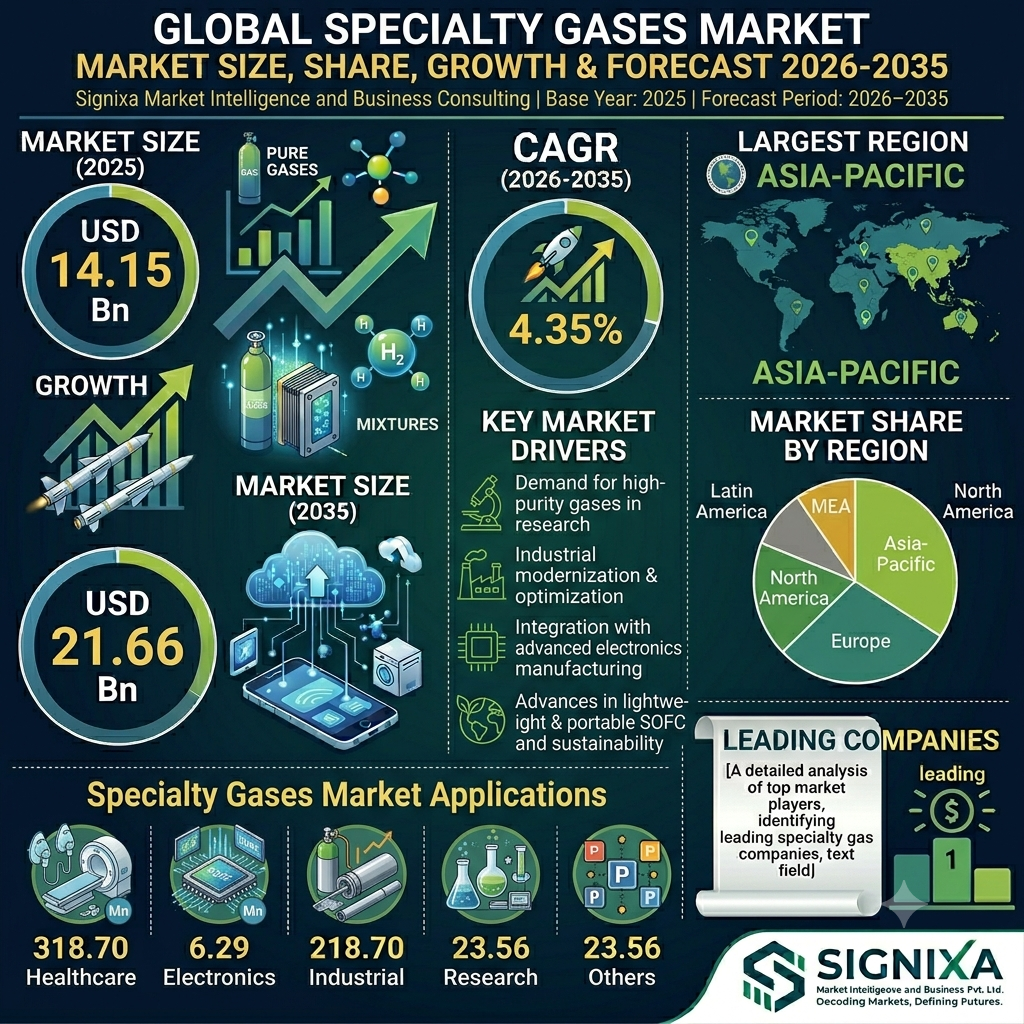
The global specialty gases market was valued at approximately USD 14.15 billion in 2025 and is projected to reach around USD 21.66 billion by 2035, growing at a compound annual growth rate (CAGR) of 4.35% between 2026 and 2035. This report highlights key drivers and restraints and evaluates their influence on market demand over the forecast period, while also outlining potential opportunities across the global specialty gases landscape.
The specialty gases market is a niche but rapidly expanding sector within the broader industrial gases industry, driven by increasing demand for ultra-high purity gases and precise gas mixtures across diverse high-tech applications. These gases — including noble gases, carbon gases, halogen gases, and highly purified versions of common industrial gases such as nitrogen and oxygen — are critical for processes requiring exact specifications, minimal impurities, and reliable performance. The market includes ultra-high purity gases and rare gas blends used across electronics, healthcare, manufacturing, and research institutions, with growing adoption accelerated by advanced technology requirements and stringent quality control standards across high-value industrial sectors.
A primary driver of this growth is the booming electronics and semiconductor industry, where the manufacturing of microchips, flat-panel displays, and advanced electronic components requires extremely pure gases for chemical vapor deposition (CVD), etching, doping, and wafer cleaning processes. As integrated circuits shrink and become more complex, the demand for even higher purity gases intensifies. The healthcare sector represents a significant and growing application area, utilizing specialty gases for medical imaging (including helium for MRI), anesthesia, respiratory therapies, instrument calibration, and drug manufacturing. Rising adoption in analytical laboratories, environmental monitoring for air and water quality analysis, and the expanding renewable energy sector — including solar panel manufacturing — are further contributing to the market's robust expansion.
Key Findings
- The global specialty gases market is expected to grow at a CAGR of 4.35% during the forecast period from 2026 to 2035, with market size rising from USD 14.15 billion in 2025 to USD 21.66 billion by 2035.
- Increasing use of high-purity gases in electronics and healthcare is the primary driver of market growth, with these two sectors collectively representing nearly half of total market demand.
- Ultra-high Purity Gases and Noble Gases are the most significant product categories, collectively accounting for over 57% of global revenue in 2025.
- Electronics is the fastest-growing application segment, while Manufacturing holds the largest application share at 30% of 2025 revenue.
- Asia-Pacific is the largest and fastest-growing region, driven by rapid industrialization, dominant semiconductor manufacturing hubs, and expanding medical and pharmaceutical sectors.
Specialty Gases Market Dynamics
Semiconductor & Electronics Manufacturing Demand
The increasing demand from the electronics industry is a major growth driver for the specialty gases market. Specialty gases are critical for semiconductor manufacturing, where high-purity gases including nitrogen trifluoride and silane are used for etching, deposition, and cleaning processes where even minute impurities can lead to significant product defects and yield losses. The growth in global semiconductor sales — especially in Asia-Pacific — fuels specialty gas demand, reinforced by government initiatives supporting domestic semiconductor manufacturing capacity and chip shortages elevating production urgency worldwide. As electronic devices become smaller, more powerful, and increasingly complex, purity requirements for specialty gases become even more stringent, continuously pushing the technological boundaries for gas purification and blending that only established specialty gas producers can cost-effectively meet at scale.
Healthcare Sector Expansion & Advanced Diagnostics
Rising demand in the healthcare sector is further propelling the specialty gases market. These gases are used across medical imaging, diagnostics, cryogenics, cryopreservation, and surgical procedures — with helium essential in MRI machines and medical-grade gases including nitrous oxide and carbon dioxide used in anesthesia and laparoscopic surgeries. As global healthcare expenditure increases and diagnostic technologies advance, the need for high-quality specialty gases is becoming more critical in hospitals and laboratories worldwide. The expanding healthcare and pharmaceutical sectors in emerging markets, coupled with increasing focus on critical care and the rising demand for diagnostic imaging across aging populations in developed economies, will sustain strong and consistent demand for medical-grade specialty gases through the forecast period.
Environmental Regulations, Green Technologies & Supply Chain Challenges
Environmental regulations and the shift toward cleaner technologies are influencing the specialty gases market in a dual capacity — driving demand while also imposing compliance requirements. Industries under pressure to reduce emissions have driven adoption of low-emission gas mixtures and calibration gases for emission monitoring that enable accurate measurements and regulatory compliance verification. The rise of green hydrogen and carbon capture technologies creates new avenues for specialty gases including high-purity hydrogen and carbon dioxide, while solar panel and fuel cell manufacturing require specific specialty gas inputs. Against these demand tailwinds, the market faces challenges from high production costs for achieving ultra-high purity levels, the specialized logistics and safety protocols required for transporting hazardous or sensitive gases, and the complex and evolving regulatory landscape for medical and environmental applications — including pharmacopoeia standards for healthcare gases and specific calibration requirements for environmental monitoring gases — all of which add substantial overhead costs and create meaningful barriers to market entry.
Specialty Gases Market Segmentation Analysis
By Product Type Segment Analysis
Ultra-High Purity Gases
Ultra-high Purity Gases dominate the market due to their critical role in semiconductor manufacturing, laboratory analysis, and pharmaceutical applications. These gases — including ultra-pure nitrogen, argon, and hydrogen — are essential for maintaining clean, contamination-free environments in high-precision applications where even parts-per-billion impurity levels can compromise process outcomes or product quality. In 2025, this segment accounted for over 33% of global revenue. Their increasing adoption in advanced chip fabrication processes and medical diagnostics will continue to drive growth, particularly as next-generation semiconductor nodes require increasingly stringent purity specifications that push gas producers toward new purification technology investments.
Noble Gases
Noble gases including helium, neon, argon, krypton, and xenon are widely used in electronics, lighting, and medical imaging applications. Helium alone accounts for a significant portion of this segment due to its irreplaceable use in MRI superconducting magnets and sensitive leak detection systems, while argon is widely used in semiconductor wafer processing. In 2025, noble gases represented approximately 24% of the market. As demand for high-performance imaging and diagnostics equipment rises — and as semiconductor fabs expand globally — this segment is expected to maintain steady growth, though supply vulnerability for rare noble gases including neon and krypton, which are predominantly produced as by-products of steel manufacturing in a small number of countries, introduces periodic price volatility.
Carbon Gases
Carbon gases — including carbon dioxide, carbon monoxide, and methane — are primarily used in beverage carbonation, analytical calibration, fire suppression, and cryogenic applications. In 2025, carbon gases contributed around 18% of market share. The segment is expected to grow moderately, driven by stable demand in food and industrial applications, as well as increasing use of high-purity carbon dioxide in waste treatment processes and the emerging carbon capture, utilization, and storage (CCUS) technology sector, which requires precisely specified CO₂ streams for geological sequestration and industrial re-use applications.
Halogen Gases
Halogen gases — including chlorine, fluorine, and sulfur hexafluoride — are mainly used for etching, electrical insulation, and dielectric applications in the electronics and power sectors. This segment accounted for nearly 12% of the market in 2025. Growth is projected due to expanded use in gas-insulated switchgear for high-voltage power infrastructure and continued demand for semiconductor etching gases in advanced cleanroom environments, even as environmental concerns about the high global warming potential of sulfur hexafluoride are driving research into lower-impact alternative dielectric gases for next-generation electrical equipment applications.
Others (Reactive & Rare Gas Mixtures)
Others include reactive and rare gas mixtures tailored for niche applications, including fundamental research, aerospace material testing, and specialty chemical processing. Representing approximately 13% of the market in 2025, this segment is expected to witness gradual growth as innovation in advanced material sciences, quantum computing research, and specialty chemicals continues to create demand for highly customized gas formulations that fall outside standard product categories maintained by the major industrial gas producers.
By Application Segment Analysis
Manufacturing
Manufacturing remains the largest application segment, accounting for 30% of the market in 2025. Specialty gases are used for precision welding, metal cutting, controlled atmosphere heat treatment, and leak detection across a wide range of industrial processes. The shift toward automation and Industry 4.0 is creating higher demand for precision gas usage in manufacturing environments where process consistency and quality control are increasingly data-driven. Growth will be driven by increased adoption of smart manufacturing solutions in both developed and developing economies, particularly in sectors including automotive, aerospace, and precision engineering where gas-assisted manufacturing processes are integral to product quality and production efficiency.
Electronics
Electronics is the fastest-growing application segment, with a 2025 market share of approximately 28%. Specialty gases are indispensable in chip fabrication, flat panel display manufacturing, and LED production, where ultra-pure process gases directly determine device performance and manufacturing yield. The surge in demand for consumer electronics, IoT devices, and electric vehicle batteries — alongside massive government-backed investment in domestic semiconductor fabrication capacity — is fuelling the need for precision gas mixtures and ultra-pure gases, particularly in Asia-Pacific semiconductor and display manufacturing hubs in countries including China, South Korea, and Taiwan that collectively produce the majority of the world's advanced electronic components.
Healthcare
Healthcare applications accounted for 21% of the market in 2025. Specialty gases are used for respiratory therapies, anesthesia delivery, cryopreservation of biological samples, and instrument sterilization — applications where product quality and purity have direct implications for patient safety and regulatory compliance. The expansion of medical infrastructure in emerging markets and the rising demand for diagnostic imaging equipment — particularly MRI systems requiring significant quantities of liquid helium — are key growth contributors. Increasing focus on critical care capabilities and the growing volume of surgical procedures globally will sustain robust demand for medical-grade specialty gases that meet stringent pharmacopoeia purity and traceability standards.
Institutions (Universities, Research & Testing Labs)
Research institutions, universities, and independent testing laboratories represented about 11% of the market in 2025. Specialty gases are vital for experiments requiring precisely controlled atmospheric conditions, analytical instrument calibration, and advanced materials research where gas purity directly determines measurement accuracy and experimental reproducibility. The global push for scientific innovation and increased funding in advanced R&D programs — particularly in quantum computing, nanotechnology, and life sciences — will encourage continued specialty gas consumption in institutional settings, with custom gas mixture specifications and stringent traceability documentation requirements that favor established specialty gas producers over commodity industrial gas suppliers.
Others (Aerospace, Environmental Testing, Specialty Coatings)
Others cover a wide range of niche applications including aerospace component testing, environmental air and water quality monitoring, and specialty surface coatings. This segment made up the remaining 10% of the market in 2025. While relatively small, it is expected to grow as new technologies and tightening emissions regulations drive demand for precision gases in emerging fields — particularly calibration gas mixtures required for continuous emissions monitoring systems (CEMS) at industrial facilities regulated under increasingly stringent environmental standards across major economies globally.
Report Attributes & Market Scope
| Report Attribute | Details |
|---|---|
| Market Size Value in 2025 | USD 14.15 Billion |
| Market Size Value in 2035 | USD 21.66 Billion |
| CAGR (2026–2035) | 4.35% |
| Base Year Used for Estimation | 2025 |
| Historic Data | 2020 – 2025 |
| Forecast Period | 2026 – 2035 |
| Segments Covered – By Product Type |
|
| Segments Covered – By Application |
|
| Regions Covered | North America, Europe, Asia Pacific, Latin America, Middle East and Africa |
| Major Countries Covered | U.S., Canada, Mexico, Germany, UK, France, Italy, Spain, Russia, China, Japan, South Korea, India, Southeast Asia Countries, Brazil, Argentina, GCC Countries, Turkey, Iran, Israel, South Africa, Egypt, Nigeria, etc. |
| Key Companies Profiled | Linde plc, Air Liquide, Air Products and Chemicals Inc., Praxair Technology Inc., Messer Group, Showa Denko, Iwatani Corporation, Taiyo Nippon Sanso, Coregas Pty Ltd, and SOL Group, among others. |
Specialty Gases Market Regional Analysis
The Asia-Pacific region dominates the specialty gases market, accounting for the largest share in 2025, driven by robust growth in semiconductor and healthcare industries. North America and Europe hold steady shares due to their mature industries and strong regulatory frameworks. Latin America and the Middle East & Africa are emerging markets due to infrastructure development, growing research capabilities, and rising industrialization.
Asia Pacific (Largest & Fastest-Growing Region)
Asia Pacific is both the largest and fastest-growing market for specialty gases globally, propelled by rapid industrialization, dominant electronics manufacturing capacity, and expanding healthcare and pharmaceutical sectors. China, South Korea, Japan, and Taiwan are at the epicenter of this growth, largely due to their dominant position in global semiconductor and display panel production — the massive scale of manufacturing in these countries creates an immense demand for ultra-high purity process gases across fabrication steps including etching, CVD, and wafer cleaning. India is also emerging as a significant market, driven by a rapidly growing pharmaceutical and healthcare industry coupled with government initiatives to boost domestic manufacturing capability. The increasing focus on renewable energy and the expansion of analytical and calibration laboratories across the region further contribute, and while diverse regulatory landscapes and varying infrastructure development present challenges, the sheer volume of high-tech manufacturing ensures continued robust growth for specialty gases throughout Asia Pacific.
North America
North America holds a significant share in the global specialty gases market, driven by its robust and technologically advanced industries — particularly electronics, healthcare, and chemicals. The United States is the largest regional contributor, owing to extensive R&D activities, a strong domestic semiconductor manufacturing base, and high healthcare expenditure. Increasing demand for ultra-high purity gases for etching, doping, and cleaning in chip fabrication — as microchips become progressively smaller and more complex — is a major growth driver. In healthcare, specialty gases are crucial for MRI imaging, anaesthesia delivery, and diagnostic testing. Stringent environmental regulations in North America are boosting demand for calibration gases used in emissions monitoring and environmental testing, while the presence of major global specialty gas manufacturers and continuous technological innovation in gas production and purification further solidify North America's strong regional position.
Europe
Europe represents a mature and technologically sophisticated market for specialty gases, with a strong focus on high-value applications across various industries. Countries including Germany, France, and the UK are key contributors, driven by well-established electronics, healthcare, and manufacturing sectors. The region's stringent environmental regulations and ambitious push toward decarbonization and green energy initiatives are significantly driving demand for specialty gases used in emissions control, renewable energy production, and advanced scientific research. The healthcare sector remains a strong consumer, with demand for medical-grade gases for diagnostics, therapeutics, and laboratory applications. While Europe faces challenges including high energy costs and complex regulatory compliance requirements — including REACH chemical substance regulations — continuous investment in R&D, emphasis on high-quality manufacturing, and commitment to environmental sustainability ensure a stable and growing specialty gases market across the region.
Middle East & Africa
The Middle East and Africa specialty gases market is an emerging yet growing region, driven by significant industrial expansion, increasing healthcare investments, and ambitious economic diversification plans. In the Middle East, particularly the GCC countries including Saudi Arabia and the UAE, substantial investments are being made in developing manufacturing capabilities across petrochemicals, electronics, and advanced materials — industries that are major consumers of specialty gases for processes requiring high purity and precision. The oil and gas sector continues to be a crucial application area, utilizing specialty gases for calibration, laboratory analysis, and enhanced oil recovery techniques. Africa, while earlier in the adoption cycle, is gradually creating opportunities for specialty gas solutions as increasing internet penetration, rising industrialization, and expanding healthcare infrastructure create demand for higher-purity gas products across the continent's growing commercial and scientific sectors.
Recent Developments in the Specialty Gases Market
-
2023
Linde plc announced plans to expand its specialty gases production capacity in South Korea to meet rising demand from the country's electronics sector — capitalizing on South Korea's position as a major global hub for semiconductor and display panel manufacturing that requires consistent, high-volume supply of ultra-high purity process gases to support advanced fabrication operations.
-
2022
Air Products and Chemicals Inc. launched a new line of high-purity specialty gas mixtures tailored for medical and laboratory applications — expanding the company's portfolio of precision-specified gas products for healthcare customers requiring traceable, pharmacopoeia-compliant gas compositions for patient care, diagnostic instrument calibration, and analytical laboratory research applications.
Specialty Gases Market: Competitive Landscape
The specialty gases market is dominated by global players including Linde plc, Air Liquide, Air Products and Chemicals Inc., Praxair Technology Inc., Messer Group, Showa Denko, Iwatani Corporation, Taiyo Nippon Sanso, Coregas Pty Ltd, and SOL Group. These companies focus on expanding production capabilities, strategic partnerships, and continuous innovation to maintain competitiveness in a market where product quality, distribution efficiency, and rigorous compliance with purity standards are the primary competitive differentiators.
The competitive landscape in specialty gases is shaped by significant barriers to entry — the capital-intensive nature of ultra-high purity gas production facilities, the specialized analytical equipment required for quality verification, and the complex logistics networks needed for maintaining gas purity throughout distribution all favor established, well-capitalized players with extensive global infrastructure. The largest specialty gas producers — particularly Linde plc and Air Liquide — compete across all major product categories and geographies, leveraging scale advantages in production and distribution to offer customers a comprehensive single-source supply solution. Smaller regional specialists compete by focusing on specific high-value niches, custom gas mixture formulations, and superior technical service capabilities for specialized applications where standardized large-producer offerings are insufficient. Strategic expansion into high-growth markets — particularly semiconductor-intensive economies in Asia-Pacific and emerging healthcare markets — is a common competitive priority across the industry, with on-site gas generation partnerships with major semiconductor fabrication facilities representing a particularly valuable and defensible competitive position that provides assured demand and limits customer churn.
Key Companies Profiled
Global Specialty Gases Market Segmentation Summary
By Product Type
By Application
By Region
Frequently Asked Questions (FAQs) About the Specialty Gases Market
What are Specialty Gases?
Specialty gases are high-purity gases or gas mixtures used for specific industrial, medical, and research applications. These include calibration gases, rare gases, and high-performance mixtures used in semiconductors, electronics, healthcare, and analytical instruments.
Which key factors will influence the Specialty Gases market growth over 2026–2035?
The global specialty gases market is expected to grow due to increasing demand in semiconductor and electronics manufacturing, rapid development of healthcare diagnostics, expansion in research activities, and rising environmental monitoring regulations.
What will be the value of the Specialty Gases market during 2026–2035?
According to the study, the global specialty gases market size was worth around USD 14.15 billion in 2025 and is predicted to grow to around USD 21.66 billion by 2035.
What will be the CAGR value of the Specialty Gases market during 2026–2035?
The CAGR value of the specialty gases market is expected to be around 4.35% during the forecast period of 2026 to 2035.
Which region will contribute notably towards the Specialty Gases market value?
The global specialty gases market is led by the Asia-Pacific and North American regions, driven by growing electronics production, strong industrial infrastructure, and rising research and healthcare investments.
Which are the major players leveraging the Specialty Gases market growth?
The global specialty gases market is led by players such as Linde plc, Air Liquide, Taiyo Nippon Sanso Corporation, Messer Group GmbH, Air Products and Chemicals Inc., Showa Denko K.K., Coregas Pty Ltd, Matheson Tri-Gas Inc., Iwatani Corporation, and Praxair Technology Inc.
What can be expected from the global Specialty Gases market report?
The report explores crucial aspects of the specialty gases market, including a detailed discussion of current growth drivers and restraints, while also analyzing future opportunities, demand trends, and potential challenges that impact market expansion across industries and regions.