
Solid Oxide Fuel Cell (SOFC) Market Overview
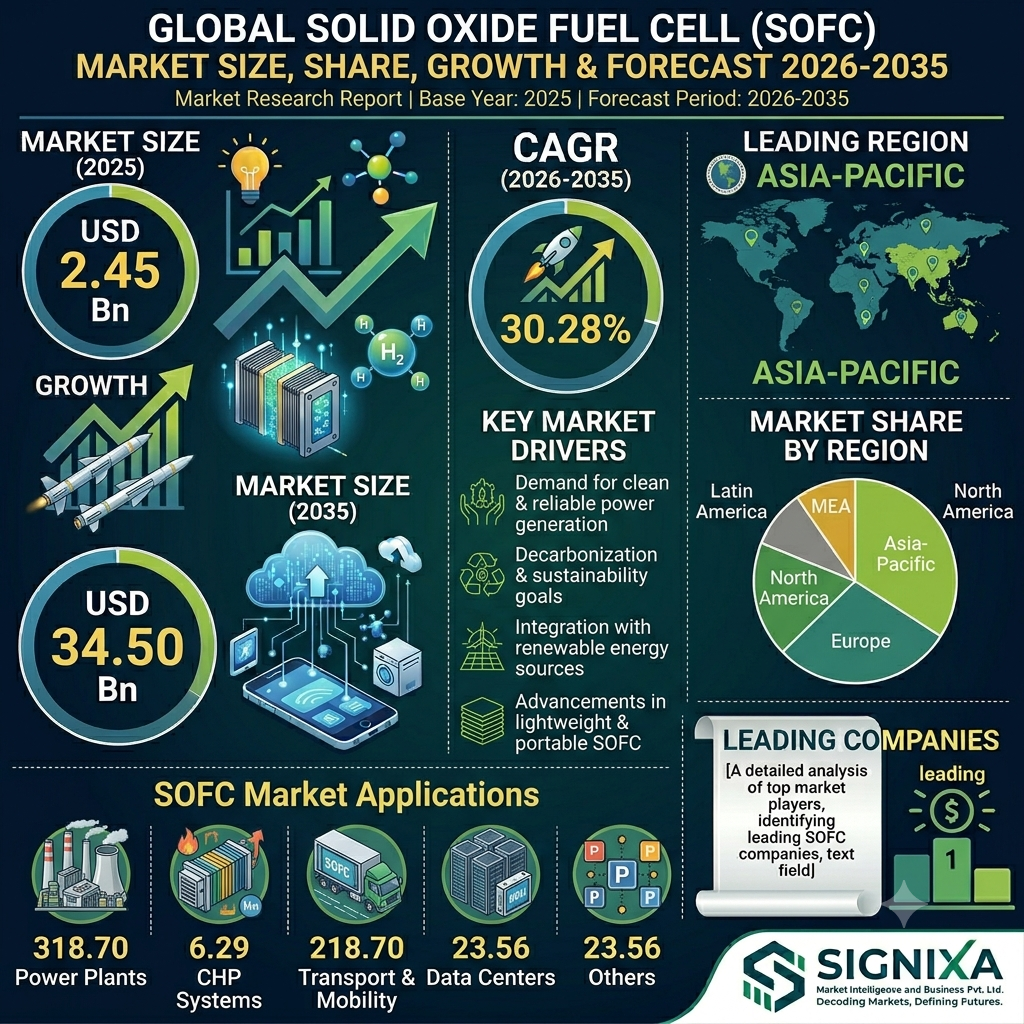
The size of the global Solid Oxide Fuel Cell (SOFC) market was worth around USD 2.45 billion in 2025 and is predicted to grow to around USD 34.50 billion by 2035, with a compound annual growth rate (CAGR) of roughly 30.28% between 2026 and 2035 — one of the highest growth rates among energy technology markets globally. The Solid Oxide Fuel Cell marketplace encompasses products specified for stationary, portable power, and transportation applications.
SOFCs are characterized by their high fuel efficiency, long-term stability, and fuel flexibility, especially suited for combined heat and power (CHP) applications. Increasing investment in hydrogen infrastructure, combined with a heightened focus on reducing carbon emissions, have contributed to broad acceptance of SOFCs, particularly in countries looking to meet net-zero objectives. Further, the ability to use conventional fuels — such as natural gas and biogas — enhances the attractiveness of this technology as a transitional energy option while hydrogen infrastructure continues to mature.
Solid oxide fuel cells operate without producing NOx or SOx, unlike traditional combustion-based power systems, making them valuable technology for clean energy plans. SOFCs achieve 60% and higher electrical energy efficiency and even higher overall efficiencies in combined heat and power (CHP) platforms — providing a means to reduce overall fuel utilization while delivering both electricity and useful thermal energy simultaneously. This makes SOFC technology attractive to commercial and industrial end-users seeking to reduce operating costs and carbon emissions. As businesses and governments look for more reliable and sustainable power alternatives, SOFC technology is becoming a prominent energy source fuelling growth across all markets.
Key Findings
- The global SOFC market is estimated to grow annually at a CAGR of around 30.28% over the forecast period (2026–2035).
- In terms of revenue, the global SOFC market size was valued at around USD 2.45 billion in 2025 and is projected to reach USD 34.50 billion by 2035.
- Growing demand for high-efficiency, low-emission power generation in commercial and industrial sectors is driving adoption, especially for CHP applications.
- Based on Product Type, the Planar segment (approximately 61% market share) is growing at a high rate and will continue to dominate the global market.
- On the basis of Application, the Stationary segment (approximately 81.49% revenue share) is anticipated to command the largest market share.
- In terms of End Users, the Commercial segment is anticipated to command the largest market share.
- In terms of Components, the Cell Stack segment is anticipated to command the largest market share.
- By Region, Asia-Pacific is projected to dominate the global market during the forecast period.
Solid Oxide Fuel Cell (SOFC) Market Dynamics
High Electrical Efficiency & CHP Capability Positioning SOFCs as Premier Clean Energy Solution for Commercial & Industrial Decarbonization
Solid oxide fuel cells are coming into prominence because they can efficiently convert chemical energy into electricity in a clean manner. SOFCs operate without producing NOx or SOx, unlike traditional combustion-based power systems, making them excellent technology for clean energy plans. SOFCs achieve 60%+ electrical efficiency and up to 90% combined efficiency in CHP applications — providing a means to lessen overall fuel utilization and dramatically reduce carbon emissions per unit of useful energy output. This makes SOFC technology attractive to commercial and industrial end-users trying to reduce operating costs and carbon footprint. As businesses and governments look for more reliable and sustainable power alternatives, SOFC technology is becoming a prominent energy source across all markets. The growing corporate sustainability commitment and the increasing cost of carbon — whether through regulatory carbon pricing or voluntary emission reduction targets — is making the superior efficiency of SOFCs increasingly compelling relative to conventional power generation alternatives through the forecast period.
Global Hydrogen Infrastructure Investment — Japan, Germany & South Korea Leading National Hydrogen Strategies Directly Benefiting SOFC Adoption
Governments and private investors worldwide are increasing investment in hydrogen as an energy fuel of the future, which directly benefits SOFCs. SOFCs are capable of utilizing hydrogen as fuel with very high efficiency and low emissions, making them well-suited for a variety of hydrogen-based applications. Leading the way are countries such as Japan, Germany, and South Korea, who are investing in infrastructure, production processes, and pilot studies to support multiple strategies for hydrogen production. Japan's ENE-FARM project alone has installed over 400,000 residential SOFCs by 2023. These initiatives develop not only a hydrogen supply chain but demand the hydrogen via technologies such as SOFC. The EU's Hydrogen Strategy targeting 40GW of electrolyzer capacity by 2030 and the U.S. DOE's H2@Scale initiative are further creating a structural pipeline of hydrogen demand that will support SOFC deployment at commercial scale through the forecast period.
Distributed Energy Systems Expansion & Grid Resilience Requirements Accelerating Decentralized SOFC Deployment
The movement toward decentralized and distributed energy production is yet another important driver of the SOFC market. Decentralized systems generate energy close to the location where it is used, providing additional reliability and reducing transmission losses, as opposed to traditional centralized grids. SOFCs are naturally suited for decentralized power generation because they are compact, flexible in fuel choice, and can provide continuous and stable operation with minimal maintenance. They are being used increasingly for on-site power and combined heat and power (CHP) applications in commercial buildings, data centers, and healthcare facilities. As energy demand increases and grid resilience becomes a requirement — especially in areas that experience routine blackouts or instability — decentralized SOFCs provide a reliable, efficient, and viable solution. The growing risk of extreme weather events disrupting centralized power supply, combined with increasing digitalization creating critical power availability requirements for data centers and communication infrastructure, is creating persistent demand for SOFC-based distributed power through the forecast period.
Solid Oxide Fuel Cell (SOFC) Market: Segmentation Analysis
By Type Segment Analysis
Planar
Planar SOFCs are defined by their flat, layered structure where the components — including the electrolyte, anode, and cathode — are stacked in flat plate structures. Stacking these components in a planar orientation enables a more efficient manufacturing process and a higher power density. The planar segment accounted for a market share of approximately 61% and continues to dominate the SOFC market due to their relatively easy construction, greater power generation capacity, and cost-effectiveness of production. Planar SOFCs are used broadly in compact and efficient energy applications such as residential combined heat and power (CHP) systems, portable power devices, and data centers. Planar SOFC technology benefits from ongoing material science and manufacturing advancements — including improvements in ceramic electrolyte thin-film deposition, electrode material formulation, and metallic interconnect coating — which continue to improve performance and reduce the cost of production. The ability to manufacture planar SOFC stacks using scalable thin-film deposition techniques and industrial roll-to-plate processing enables cost reductions through manufacturing economies of scale through the forecast period.
Tubular
SOFCs are designed as tubes, where each cell component is arranged to form a cylindrical tube. The tube shape provides advantages from a mechanical point of view, allowing the cell to be engineered with a more reliable and robust seal against gas leaks and enables thermal expansion without affecting the mechanical integrity of the cell. Tubular SOFCs tend to yield less power density than planar SOFCs and are more complicated to manufacture, making these units costlier than planar SOFCs. Although tubular SOFCs have these disadvantages, they are characterized by durability and have particular value in stationary power generation applications where durability and longevity are the primary concern. The tolerance of tubular configurations to rapid thermal cycling — where the tube's geometry accommodates differential thermal expansion without inducing delamination or seal failure — makes them suitable for applications requiring frequent start-stop operations. Research continues to make tubular designs more efficient and cost-effective through the forecast period.
Others
Apart from the planar and tubular type designs, other types of SOFC configurations include monolithic and segmented-in-series configurations. Monolithic SOFCs involve integrating the cell components into a single compact design, seeking to include both the benefits associated with the planar and tubular designs — such as high power density and structural integrity. Segmented-in-series designs involve connecting multiple small cells into series to achieve desired voltage outputs with added flexibility in design and application. These alternative designs are presently in experimental or developmental status and have not yet achieved considerable commercial deployment. As the research continues, these designs may provide opportunities for unique solutions to certain market challenges associated with SOFCs, potentially leading to specialty applications that take advantage of their unique characteristics. Material science advances enabling novel cell geometries and integrated manufacturing processes are expected to progressively increase the commercial viability of alternative SOFC configurations through the forecast period.
By Application Segment Analysis
Stationary
Stationary applications will be the most prominent technology segment, with expected revenue shares accounting for roughly 81.49% of the SOFC technology revenue in 2025. Primary power generation and combined heat and power (CHP) systems for commercial buildings, data centers, and industrial applications are stationary applications. The tremendous electrical efficiency of SOFC — often surpassing 60% — and overall efficiencies possible up to 90% with CHP makes SOFC technology especially favourable for stationary applications. The global initiative for clean and efficient energy is a key influence, especially in regions like Europe and Asia-Pacific, which have prompted many investments into commercial stationary SOFC systems. Countries in Europe like France and the UK are dedicatedly investing in SOFC R&D specifically for power generation applications. Additionally, reliable scalability and fuel flexibility pose additional benefits when developing stationary applications for SOFC technology — SOFCs can utilize hydrogen, natural gas, or biogas as fuel, providing a technology pathway that works with current fuel infrastructure while progressively transitioning to zero-carbon hydrogen as it becomes available through the forecast period.
Portable Power
Portable solid oxide fuel cell systems currently have a smaller percentage of the market share in comparison to stationary applications, but are projected to gain popularity because of their high energy density and adaptability in fuels. These devices will be ideal for off-grid and remote applications, providing reliable power for military missions, camping, or emergency backup. Because SOFC-based applications can operate on a variety of fuels — including diesel or propane — this is especially useful for portable applications where fuel access might be a challenge. Innovation in materials and manufacturing processes should enable shorter SOFC startup times and lighter, more compact designs that lend themselves better to portable applications. Research is continuing to improve durability and reduce time-to-generate-power, which are two challenges preventing broader application for portable SOFC applications. The growing use of portable SOFCs in unmanned systems and emergency response equipment — where extended runtime without refueling is a critical operational requirement — is creating expanding niche market demand through the forecast period.
Transportation
The transportation sector is an exciting, rapidly growing area for SOFC technology that includes auxiliary power units (APUs) for trucks, marine sector applications, and opportunities for incorporation into hybrid electric vehicles. The global focus on decreasing transportation emissions has created an interest in SOFCs because of their efficiency and environmental profile. SOFC development companies are collaborating with transport sector companies to develop SOFC-based systems — for example, in December 2023, AVL and Ceres established a strategic collaboration to expedite the growth and application of SOFC technology in stationary and transport applications. The transportation segment currently has a smaller share of the SOFC market. However, technical improvements addressing system size, weight, and thermal management are progressively making SOFC integration into transportation platforms more viable. The marine sector — where large vessel auxiliary power requirements and long operational durations favor high-efficiency fuel cell systems over conventional diesel generators — represents a particularly promising near-term transportation application through the forecast period.
By End User Segment Analysis
Commercial
The commercial and industrial end-user segment plays a crucial role in driving the SOFC market, as many institutions — including offices, hospitals, retail stores, and manufacturing facilities — require reliable and effective power solutions. This segment represented around 37.81% of the market share. The implementation of SOFCs in this sector can be attributed to several factors including their high efficiency, flexibility of fuel choices, and potential to reduce greenhouse gas emissions as part of corporate sustainable policies. SOFCs are designed to work with multiple fuels such as natural gas and hydrogen, which allows organizations to have flexibility in how they source their energy. Increasing focus on reducing operational costs and securing energy needs will also support growth in demand for SOFCs in commercial and industrial settings. The growing commercial sector adoption of science-based emissions reduction targets — aligned with the Paris Agreement 1.5°C pathway — is creating corporate procurement mandates for clean energy solutions like SOFCs through the forecast period.
Industrial (Data Centers)
Data centers are a significant and growing segment of the SOFC market, due to their high energy demand and need for reliable, uninterruptible power. In 2022, data centers had over 38% revenue share in the SOFC market. According to the International Energy Agency (IEA), data centers used around 198 terawatt-hours of electricity in 2018, illustrating the sector's enormous energy demands. To reduce operational costs and improve energy efficiency, data center owners are starting to use SOFCs for distributed power generation. Google, IBM, and Equinix, for example, have utilized SOFC systems for reliable, sustainable power while decreasing reliance on the traditional grid and reducing carbon behavior. The extraordinary growth of AI-driven computing workloads — which is dramatically increasing data center power consumption globally — is creating an urgent need for reliable, high-density power generation that SOFCs can efficiently provide at the facility scale. The combination of power reliability, thermal efficiency, and carbon reduction that SOFCs offer aligns closely with the operating requirements of mission-critical data center infrastructure through the forecast period.
Residential
The residential sector is rapidly becoming a key market for SOFCs, particularly in areas prioritizing decentralized energy systems and the usage of clean energy. SOFCs enable combined heat and power (CHP) systems in which both power and heating are delivered to homes simultaneously, significantly improving overall energy efficiency compared to separate electricity and heating provision. The increase in consumer awareness of energy efficiency and energy independence is creating demand for residential SOFC systems. Japan's residential SOFC deployment — through the ENE-FARM program which has surpassed 400,000 installed units — demonstrates the commercial viability and consumer acceptance of residential SOFC-CHP. While this sector occupies a smaller global market share presently, it is anticipated to grow substantially as advances in technology lower costs and improve system efficiencies, increasing access to SOFCs for homeowners globally beyond Japan's pioneer market through the forecast period.
Defense & Aerospace
The military and defense sector is experiencing a gradual increase in the implementation of solid oxide fuel cell (SOFC) technology due to the necessity for efficient, quiet, and portable energy sources. SOFCs are used in a variety of military applications, including portable power devices for soldiers, unmanned aerial vehicles (UAVs), and underwater vehicles, because of their high energy density and low acoustic signatures — a critical tactical advantage. The capacity of SOFCs to use a variety of fuels allows for increased operational flexibility in uncertain and remote operating environments where specific fuel types may not be reliably available. As military operations continue to focus on energy efficiency and sustainability, and as the electrification of military systems accelerates, SOFCs will have an increasing role to play as reliable sources of energy in support of critical missions. Both public and private sector development of SOFCs for defense applications will continue to expand through the forecast period.
Utilities
Utilities are evaluating SOFC technology to broaden energy generation portfolios and facilitate compliance with stricter environmental regulations. SOFCs present a way for utilities to adopt cleaner energy technology with high efficiencies and reliability. While the utility sector remains a small share of the SOFC market at present, it is accelerating through pilot studies and investments in renewable energy systems demonstrating healthy interest. Utilities are expected to deploy SOFCs as the world pivots to sustainable energy solutions — SOFCs can support current power generation capabilities while rapidly reducing carbon production. The ability of SOFCs to operate as dispatchable, controllable distributed generation assets — complementing intermittent solar and wind resources — positions them as a valuable portfolio addition for utilities seeking to balance reliability and decarbonization requirements through the forecast period.
By Components Segment Analysis
Cell Stack
An SOFC system's core is the cell stack, where the electrochemical reactions take place to generate electricity. The cell stack consists of multiple cells, each comprised of an electrolyte sandwiched between an anode and cathode. The SOFC performance and efficiency are influenced by the quality and design of the cell stack. Improvements in materials and fabrication techniques — including advances in yttria-stabilized zirconia (YSZ) electrolytes, mixed ionic-electronic conductor cathodes, and nickel-ceramic cermet anodes — have led to significant gains in cell stack durability and efficiency. Current SOFCs can achieve electrical efficiencies over 60%, which is particularly appealing for applications. The reliability and durability of the cell stack are important parameters as they directly affect the operating life and the maintenance costs associated with the SOFC system. Advances in cell stack manufacturing — particularly the development of more robust interconnect materials and sealing systems that maintain performance over tens of thousands of operating hours — are critical enablers for commercial SOFC cost reduction through the forecast period.
Fuel Processors/Reformer
The fuel processor or reformer converts hydrocarbon fuels including natural gas or biogas into hydrogen-rich gas that can be safely introduced inside the SOFC. The fuel processor is a key component for systems that do not utilize pure hydrogen as a fuel source. The efficiency of the processor is a determinant of the overall performance of the SOFC system — working efficiently in processing fuels conserves fuel and reduces cost of operation, making the fuel processor a key component in the system. Internal reforming — where fuel reforming takes place within the SOFC cell stack itself using the high operating temperature — represents a technically elegant approach that eliminates the need for a separate external reformer component, reducing system complexity and cost. The development of compact, highly efficient reformers that can handle a wide range of fuel compositions — including biogas with varying methane content — is expanding the practical utility of SOFC systems in real-world applications through the forecast period.
An inverter (also known as a power conditioner) changes the direct current (DC) from the solid oxide fuel cell to alternating current (AC) for compatibility with electrical devices and the power grid. This equipment provides the right voltage and frequency for safe and efficient use of the generated electricity. The efficiency of the inverter is crucial to the overall efficiency of the system, with new designs reaching efficiencies of above 95% and minimized losses during conversion. As SOFC systems are increasingly adopted for retrofitting existing applications in residential, commercial, and industrial situations, power conditioners are increasingly important in the overall energy management and operation of the system. The development of bidirectional inverters — which can both convert SOFC DC output to AC for building use and import grid AC for SOFC system startup — is improving system flexibility and simplifying grid interconnection through the forecast period.
Balance of Plant
The Balance of Plant (BOP) refers to all of the supporting components and systems necessary to operate the SOFC, excluding the cell stack, fuel processor, and power conditioner. These components consist of systems for thermal management, air and fuel supply, control systems, and safety features. The BOP is essential for maintaining optimal operating conditions, controlling the heat produced during operation, and ensuring the safety and efficiency of the entire SOFC system. The global market for fuel cell BOP is anticipated to experience rapid growth, with estimates nearing USD 34.50 billion in 2035, as more fuel cell technologies are adopted in various segments. Proper BOP design enhances the overall compactness, reliability, and affordability of SOFC systems, making them more feasible for widespread use. The progressive standardization of BOP components — particularly control systems, safety valves, and heat exchangers — across multiple SOFC system configurations is enabling supply chain efficiencies and component cost reductions that improve the overall economics of SOFC deployment through the forecast period.
Report Attributes & Market Scope
| Report Attribute | Details |
|---|---|
| Market Size Value in 2025 | USD 2.45 Billion |
| Market Size Value in 2035 | USD 34.50 Billion |
| CAGR (2026–2035) | 30.28% |
| Base Year Used for Estimation | 2025 |
| Historic Data | 2020 - 2025 |
| Forecast Period | 2026 - 2035 |
| Segments Covered – By Type |
|
| Segments Covered – By Application |
|
| Segments Covered – By End Users |
|
| Segments Covered – By Components |
|
| Regions Covered | North America, Europe, Asia Pacific, Latin America, Middle East and Africa |
| Major Countries Covered | U.S., Canada, Mexico, Germany, UK, France, Italy, Spain, Russia, China, Japan, South Korea, India, Southeast Asia Countries, Brazil, Argentina, GCC Countries, Turkey, Iran, Israel, South Africa, Egypt, Nigeria, etc. |
| Key Companies Profiled | Elcogen, Fuel Cell Energy, H2E Power, Nexceris, Watt Fuel Cell, Bloom Energy, Mitsubishi Heavy Industries, Special Power Sources, Keko Equipment, WOBO Industrial Group Corp, Fuel Cell Works, Kyocera Group, AVL Home, among others. |
Solid Oxide Fuel Cell (SOFC) Market Regional Analysis
The Asia-Pacific region leads the global SOFC market due to great investments and government-based fuel cell programs supporting clean energy, especially in Japan, South Korea, and China. North America is developing into an important market, driven by growing demand for decentralized energy systems and key industry players. Europe is also showing momentum, aided by the EU's Hydrogen Strategy.
Asia-Pacific (Dominant Region)
The regional leader in the solid oxide fuel cell (SOFC) market is the Asia Pacific region due to great investments and government-based fuel cell programs to support clean energy, especially in Japan, South Korea, and China. Japan's ENE-FARM project has installed over 400,000 residential SOFCs by 2023, representing the most extensive residential SOFC deployment program in the world. South Korea is using multi-megawatt SOFC installations to develop SOFC capacity for grid stability and carbon neutrality efforts, with large-scale commercial SOFC facilities deployed by major utilities. China has focused infrastructure development around hydrogen to further support SOFC adoption. Additionally, strong manufacturing capabilities, local technology developers, and supportive regulations all contribute to the leadership of this region, which has captured a significant, and increasingly large, share of global SOFC demand in residential, industrial, and utility demand through the forecast period.
North America
North America is developing into an important market for SOFCs, driven by the growing demand for decentralized energy systems and a number of key industry players, including Bloom Energy. The U.S. is committing funding to clean hydrogen and fuel cell technologies led by H2@Scale at the Department of Energy (DOE). By 2023, North America was estimated to have over 20% of global SOFC deployments, in particular for data centers and commercial power generation applications. Bloom Energy's commercially deployed SOFC systems — which serve hyperscale data centers, hospitals, universities, and utilities across the U.S. — have demonstrated the commercial viability of SOFC technology at megawatt scale in real-world applications. The U.S. Inflation Reduction Act's clean energy tax credits and hydrogen production incentives are providing additional financial support for SOFC project economics through the forecast period.
Europe
Europe is also showing momentum, aided by the EU's Hydrogen Strategy for 40GW of electrolyzer capacity by 2030. Countries such as Germany, the UK, and Denmark have funded pilot projects that couple SOFCs and smart grids, and include SOFCs in residential heating applications. Rising environmental awareness and decarbonization targets are further pushing adoption in this region. The EU's Fit for 55 package — committing to a 55% reduction in greenhouse gas emissions by 2030 relative to 1990 levels — is creating regulatory pressure on commercial and industrial energy users to decarbonize their power and heat supply, driving evaluation and adoption of SOFC-CHP systems as a practical decarbonization tool. European grid operators' increasing need for distributed flexible generation assets that can support grid balancing as renewable energy penetration rises is also creating institutional demand for SOFC-based distributed power systems through the forecast period.
Latin America & Middle East/Africa
Latin America and the Middle East & Africa represent emerging opportunities for SOFC technology, particularly in industrial power security and off-grid applications. In Latin America, Brazil's growing industrial sector and commitment to clean energy — including significant biofuel and biogas resources that are well-suited as SOFC feedstocks — create natural synergies for SOFC adoption as part of decarbonization strategies. In the Middle East, particularly the GCC countries pursuing economic diversification and clean energy transitions aligned with Vision 2030 initiatives, SOFCs offer a path to high-efficiency power generation that leverages the region's abundant natural gas resources as a transitional fuel while hydrogen infrastructure develops. The high value placed on energy security and power reliability in these regions — where grid quality can be variable — creates a compelling use case for SOFC-based on-site distributed power through the forecast period.
Recent Developments in the SOFC Market
-
2026
Bosch announced its exit from the solid oxide fuel cell (SOFC) market to focus on hydrogen electrolyzers, especially PEM stacks. Despite SOFC pilot success, market challenges prompted the strategic shift. Bosch remains committed to hydrogen technologies for mobile and industrial applications.
-
2025
Bloom Energy unveiled a hydrogen-powered solid oxide fuel cell with approximately 60% electrical efficiency and 90% combined heat and power efficiency, supporting clean, distributed energy generation and enabling lower emissions with hydrogen and gas blending capability.
Solid Oxide Fuel Cell (SOFC) Market: Competitive Landscape
The global Solid Oxide Fuel Cell (SOFC) market features major players such as Elcogen, Fuel Cell Energy, H2E Power, Nexceris, Watt Fuel Cell, Bloom Energy, Mitsubishi Heavy Industries, Special Power Sources, Keko Equipment, WOBO Industrial Group Corp, Fuel Cell Works, Kyocera Group, and AVL Home. The SOFC market is highly competitive, with major players driving technological advancements across a range of applications. Companies are competing on factors such as product innovation, cost-efficiency, geographical reach, and sustainability. As the market continues to expand, companies will need to focus on further improving the performance of their SOFC systems and broadening their application scope to capitalize on the growing demand for energy-efficient and effective solutions in stationary, portable power, and transportation applications.
Key Companies Profiled
Global SOFC Market Segmentation Summary
By Type
By Application
By End Users
By Components
By Region
Frequently Asked Questions (FAQs) About the SOFC Market
What is a Solid Oxide Fuel Cell (SOFC)?
A Solid Oxide Fuel Cell (SOFC) is a high-temperature electrochemical device that converts chemical energy from fuels like hydrogen or natural gas directly into electricity with high efficiency and low emissions.
Which key factors will influence the SOFC market growth over 2026–2035?
Key factors influencing the Solid Oxide Fuel Cell (SOFC) market include rising demand for clean energy, advancements in fuel cell efficiency, growing industrial and commercial applications, and supportive government policies promoting hydrogen and distributed power generation.
What will be the value of the SOFC market during 2026–2035?
According to the study, the global Solid Oxide Fuel Cell (SOFC) market size was worth around USD 2.45 billion in 2025 and is predicted to grow to around USD 34.50 billion by 2035.
What will be the CAGR value of the SOFC market during 2026–2035?
The CAGR value of the Solid Oxide Fuel Cell (SOFC) market is expected to be around 33.10% during 2026–2035.
Which region will contribute notably towards the SOFC market value?
Asia Pacific is driving the SOFC market due to strong government support for hydrogen initiatives, rapid industrialization, growing energy demand, and major investments by countries like Japan, South Korea, and China in clean energy technologies.
Which are the major players leveraging the SOFC market growth?
The global SOFC market is led by players such as Elcogen, Fuel Cell Energy, H2E Power, Nexceris, Watt Fuel Cell, Bloom Energy, Mitsubishi Heavy Industries, Special Power Sources, Keko Equipment, WOBO Industrial Group Corp, Fuel Cell Works, Kyocera Group, and AVL Home.
What can be expected from the global SOFC market report?
The report explores crucial aspects of the Solid Oxide Fuel Cell (SOFC) market, including a detailed discussion of existing growth factors and restraints while also analyzing future growth opportunities and challenges that impact the market.