

Smart Weapons Market Overview
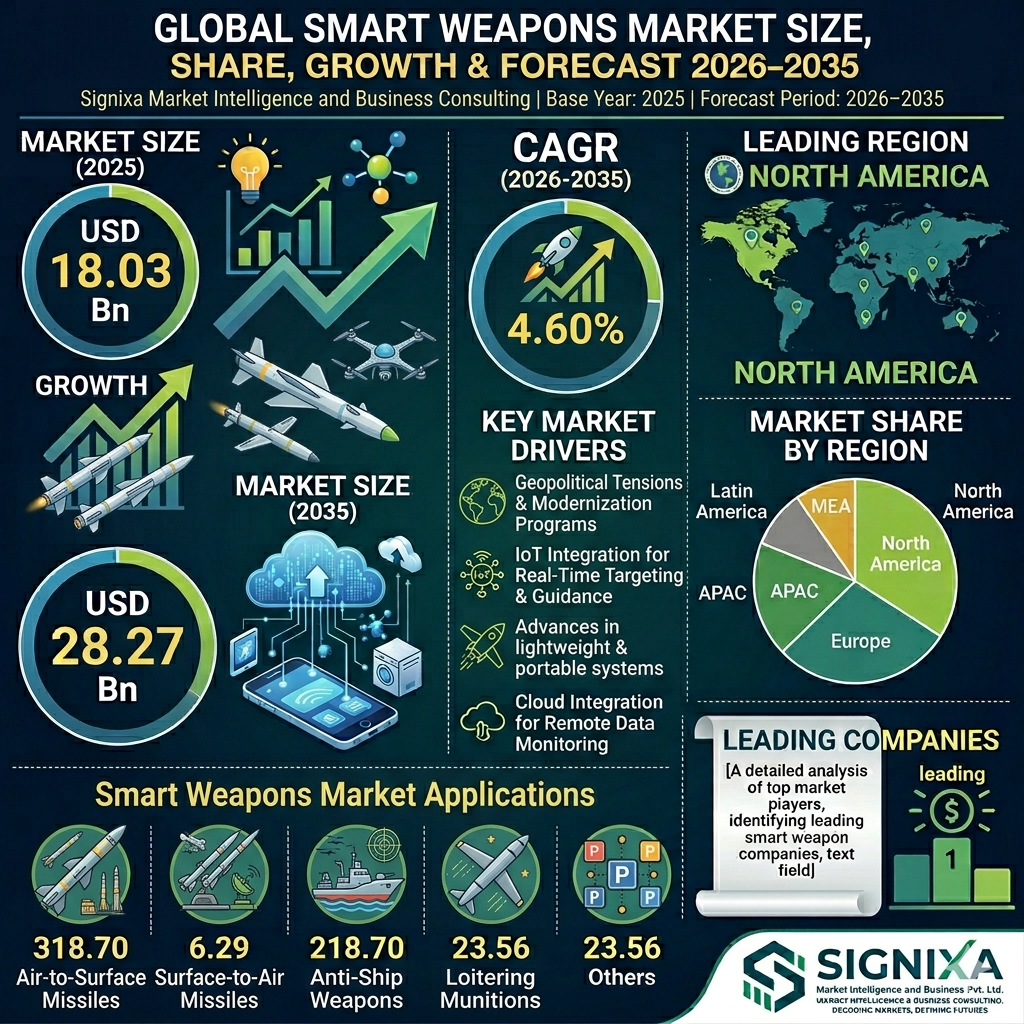
The global smart weapons market was valued at approximately USD 18.03 billion in 2025 and is projected to reach USD 28.27 billion by 2035, growing at a compound annual growth rate (CAGR) of 4.60% during the forecast period. This report provides a comprehensive analysis of market drivers, challenges, opportunities, and trends, offering insights into regional and segmental performance for informed decision-making.
Smart weapons refer to precision-guided munitions (PGMs) that utilize advanced targeting systems such as GPS, infrared, or laser guidance. These weapons are designed to improve strike accuracy, reduce collateral damage, and enhance military operational effectiveness. Their growing deployment across land, air, and naval platforms — driven by defense modernization programs, increasing geopolitical tensions, and asymmetric warfare strategies — is fuelling market growth. Smart weapons leverage cutting-edge technologies including artificial intelligence, advanced sensors, sophisticated guidance systems, and real-time data processing to achieve unparalleled accuracy in targeting — representing a fundamental shift in how military forces approach precision engagement.
The increasing demand for enhanced situational awareness, improved target accuracy, and reduced human risk in combat operations is propelling the development and adoption of these advanced weapon systems across global defense forces. The shift toward asymmetric warfare and the emphasis on surgical strikes over large-scale engagements further underscores the indispensable role of smart weapons in modern military doctrines. Despite its strong growth trajectory, the market faces challenges including the high cost of research, development, and procurement, ethical debates surrounding increasing weapon autonomy, and the complex regulatory landscape governing arms transfers and export controls.
Key Findings
- The global smart weapons market is expected to grow at a CAGR of 4.60% between 2026 and 2035, with market size rising from USD 18.03 billion in 2025 to USD 28.27 billion by 2035.
- The Missiles segment is anticipated to dominate the market based on product type, with over 35% of precision-guided weapons spending in 2023 directed toward smart missiles across offensive and defensive applications.
- Among technologies, GPS-based smart weapons lead the market, accounting for over 30% of smart weapon deployments in 2025, due to high integration in modern military platforms and scalable precision strike capability.
- Airborne platforms dominate deployment, accounting for over 45% of global market share in 2025, driven by ongoing procurement of multirole aircraft optimized for precision-guided payloads.
- North America is expected to lead the market, followed by Europe and Asia-Pacific, with Asia-Pacific emerging as the fastest-growing region driven by escalating defense budgets and military modernization programs.
Smart Weapons Market Dynamics
Rising Defense Spending & Precision Strike Doctrine Adoption
The smart weapons market is witnessing sustained growth, driven by increased global defense spending, heightened geopolitical tensions, and the ongoing modernization of military forces worldwide. One of the primary factors driving market growth is the military's growing preference for energy-efficient and cost-effective strike systems — traditional munitions often require extensive logistics, manpower, and multiple rounds to neutralize targets, whereas smart weapons offer one-shot-one-kill capabilities that reduce operational costs and logistic complexity. According to SIPRI data, global military spending exceeded USD 2.2 trillion in 2023, with a considerable portion allocated to precision-guided systems, reflecting this fundamental shift in defense strategy. These weapons also help minimize civilian casualties and collateral destruction, aligning with modern warfare doctrines that emphasize surgical precision and stringent rules of engagement in densely populated conflict zones.
Asymmetric Warfare Environments & Network-Centric Military Modernization
The nature of global conflicts is shifting toward urban environments and asymmetric threats where conventional firepower proves less effective — smart weapons including laser-guided bombs, GPS-enabled missiles, and radar-tracked projectiles are increasingly deployed for counterterrorism operations, peacekeeping missions, and surgical airstrikes, particularly in conflict zones where precision engagement is essential to minimize civilian impact. Global military modernization is another key driver, as nations focus on building network-centric warfare capabilities that integrate sensors, satellites, drones, and precision weapons into unified connected combat systems. Smart weapons play a pivotal role in this digital battlefield, enabling real-time data-based target acquisition and autonomous guidance. Programs including the U.S. Army's Long Range Precision Fires (LRPF) and Europe's Future Combat Air System (FCAS) are centered around next-generation precision weapon systems, encouraging governments to allocate larger defense budgets to upgrade legacy capabilities.
High Development Costs & Ethical Challenges Around Weapon Autonomy
Despite its critical importance and strong growth trajectory, the smart weapons market faces several complex challenges. The high cost associated with research, development, and procurement of these advanced systems limits widespread adoption, particularly for nations with smaller defense budgets — the integration of AI, advanced guidance mechanisms, and sensor fusion makes smart weapons significantly more expensive than conventional munitions, while technological complexity translates into longer development cycles and higher lifecycle maintenance costs. Ethical and regulatory concerns surrounding increasing weapon autonomy present another considerable challenge, as the development of fully autonomous weapon systems capable of selecting and engaging targets without human intervention raises profound debates about accountability, human control over lethal force, and the potential for unintended consequences. International regulations and arms transfer controls create additional complexities, while the risk of proliferation of these advanced technologies to non-state actors or hostile entities necessitates stringent export controls and comprehensive security measures.
Smart Weapons Market Segmentation Analysis
By Product Type Segment Analysis
Missiles
Missiles dominate the smart weapons market due to their long-range precision, advanced guidance systems, and strategic strike capabilities across both offensive and defensive operational roles. Nations invest heavily in missile modernization programs to ensure regional deterrence, with cruise and ballistic missiles representing the largest procurement categories across the major military powers. Applications spanning air-to-air, air-to-surface, surface-to-air, and anti-ship roles drive consistent demand across all three service domains, with the United States, Russia, China, and India leading global development and deployment programs. According to SIPRI data, over 35% of precision-guided weapons spending in 2023 was directed toward smart missiles — a share expected to remain robust as strategic deterrence requirements continue to drive premium investment in extended-range precision strike capabilities.
Munitions
Smart munitions — including guided artillery shells and precision bombs — are increasingly used in tactical battlefield operations and accounted for over 25% of the global smart weapons market in 2025. These weapons, equipped with GPS, laser, or radar-based targeting, reduce civilian casualties in counterinsurgency and urban warfare contexts where conventional unguided munitions present unacceptable collateral damage risks. Demand is expected to surge as NATO countries adopt precision artillery systems including the Excalibur GPS-guided projectile and the GMLRS, and the munitions segment is projected to witness the fastest growth among all product categories as nations seek cost-effective precision strike capabilities at the tactical level.
Guided Projectiles
Guided projectiles are seeing rapid growth due to their relatively low cost and high precision in short-range combat scenarios, making them vital for mobile artillery units and naval platforms requiring real-time guidance capability against moving targets. The segment is expected to grow at a CAGR of approximately 5.2% from 2025 to 2035, fuelled by procurement programs across Asia-Pacific and North America aimed at improving ground troop fire support capabilities with precision munitions that can engage time-sensitive targets without the flight time or cost of conventional missiles.
Guided Rockets
Guided rockets combine the destructive power of traditional rockets with precision targeting, making them effective against fortified positions and light armored vehicles across a variety of operational environments. In 2025, guided rockets represented approximately 10% of total smart weapon deployments, with particularly prominent application in HIMARS and MLRS systems that have demonstrated effectiveness in contemporary conflict environments in Eastern Europe and the Middle East. These systems are expected to witness increased adoption due to their strategic mobility, rapid emplacement capability, and quick-response precision strike potential that provides commanders with a flexible, responsive precision fires capability at the operational and tactical levels.
Guided Firearms & Others (Loitering Munitions)
This category includes loitering munitions — also known as autonomous loitering munitions or "kamikaze drones" — and drone-deployed precision weapons, which have surged in operational relevance due to their demonstrated effectiveness in asymmetric warfare environments. Countries including Ukraine, Israel, and Azerbaijan have showcased their tactical importance in recent conflicts, validating the loitering munition concept as a cost-effective, highly adaptable option for modern warfare. This segment is projected to grow at over 6.5% CAGR through 2035 — the highest growth rate among all product categories — as these systems offer autonomous target identification and engagement capability at significantly lower cost than conventional missiles, making them increasingly accessible to a broader range of military forces.
By Technology Segment Analysis
GPS Guidance
GPS-guided weapons use satellite data for real-time location tracking, offering superior accuracy and ease of integration with existing targeting systems across all weapon categories. The U.S. JDAM (Joint Direct Attack Munition) — which converts unguided bombs into precision-guided weapons through a GPS guidance kit — is a widely deployed example. GPS guidance accounted for over 30% of smart weapon deployments in 2025, making it the single largest technology segment. Demand is expected to remain robust as global military forces seek scalable, cost-effective precision strike capabilities that can be rapidly integrated into legacy platforms and adapted to both conventional and hybrid warfare operational scenarios.
Laser Guidance
Laser-guided systems offer pinpoint accuracy and are widely used in air-to-surface bombs and missiles, relying on illuminating the target with a laser designator while the munition homes in on the reflected energy. As of 2025, laser-guided weapons made up 28% of the smart weapons market, with rising demand from air forces deploying platforms including Paveway and Hellfire for precision close air support and deep strike missions. The integration of semi-active laser seekers and dual-mode guidance systems combining laser with GPS or infrared capability continues to expand their operational appeal across complex battlefield environments where single-mode guidance may be defeated by countermeasures.
Radar Guidance
Radar-guided weapons can track and engage targets through adverse weather conditions, dust, smoke, and other environmental obscurants that defeat optical guidance systems — offering a decisive operational advantage in environments where laser and infrared systems are degraded. These systems are predominantly used in anti-ship and air defense applications. In 2025, radar-guided systems accounted for 24% of the smart weapons technology share, with significant deployment in naval defense systems including Aegis and Patriot missile batteries. The increasing threat of advanced missile attacks against naval fleets and fixed military installations continues to push investment in radar-guided interceptors and active radar homing anti-ship missiles globally.
Infrared (IR) Guidance
Infrared guidance enables smart weapons to lock onto heat signatures from aircraft engines, vehicle exhaust, and other thermal sources — making them highly effective against aircraft, vehicles, and personnel in low-visibility environments including night operations and adverse weather conditions. IR guidance is extensively used in air-to-air missiles and short-range surface-to-air missile systems. The market for IR-guided systems is expected to grow at approximately 4.7% CAGR through 2035, driven by advancements in thermal imaging resolution and dual-mode seekers that combine infrared imaging with other guidance modalities for improved resistance to countermeasures including flares and electronic jamming.
By Platform Segment Analysis
Airborne Platforms
Airborne platforms dominate smart weapon deployment due to the combination of speed, altitude, reach, and payload flexibility that fighter aircraft, bombers, drones, and attack helicopters provide. In 2025, air-based deployment accounted for over 45% of global market share, and demand is expected to rise with ongoing procurement of multirole aircraft including the F-35 and Rafale that are specifically optimized for precision-guided weapon payloads. The integration of smart weapons into unmanned aerial vehicles (UAVs) is creating new operational concepts that extend precision strike capability to lower-cost, lower-risk platforms, expanding the addressable market for air-delivered smart weapons beyond traditional manned aircraft procurement programs.
Land Platforms
Land-based platforms — including mobile launchers, artillery units, and ground combat vehicles integrated with guided munitions — represented nearly 32% of the smart weapons market in 2025. Nations are focusing on modernizing armored brigades and artillery formations with smart artillery systems, especially in regions with active conventional conflict including Eastern Europe. Systems including India's Pinaka multi-barrel rocket launcher and Russia's Tornado-S are driving adoption through enhanced battlefield precision, range, and lethality that allows ground forces to engage targets previously requiring air support, improving operational independence and responsiveness at the tactical level.
Maritime / Naval Platforms
Naval platforms rely on smart weapons for both offensive strike missions and layered defensive operations, including anti-ship missile attacks, cruise missile strike, and missile interception systems. In 2025, naval platforms accounted for around 23% of the market, with strong demand from the U.S., Chinese, and UK navies. Increased investment in littoral combat ships, Aegis-equipped destroyers, and submarine-launched cruise missile programs is bolstering this segment, as naval forces seek to maintain maritime strike capability and fleet defense effectiveness against the increasingly capable anti-ship missile threats deployed by potential adversaries across multiple theaters.
Report Attributes & Market Scope
| Report Attribute | Details |
|---|---|
| Market Size Value in 2025 | USD 18.03 Billion |
| Market Size Value in 2035 | USD 28.27 Billion |
| CAGR (2026–2035) | 4.60% |
| Base Year Used for Estimation | 2025 |
| Historic Data | 2020 – 2025 |
| Forecast Period | 2026 – 2035 |
| Segments Covered – By Product Type |
|
| Segments Covered – By Technology |
|
| Segments Covered – By Platform |
|
| Regions Covered | North America, Europe, Asia Pacific, Latin America, Middle East and Africa |
| Major Countries Covered | U.S., Canada, Mexico, Germany, UK, France, Italy, Spain, Russia, China, Japan, South Korea, India, Southeast Asia Countries, Brazil, Argentina, GCC Countries, Turkey, Iran, Israel, South Africa, Egypt, Nigeria, etc. |
| Key Companies Profiled | Lockheed Martin Corporation, Raytheon Technologies Corporation, Northrop Grumman Corporation, BAE Systems, Thales Group, MBDA, Rafael Advanced Defense Systems, Boeing, General Dynamics Corporation, and Elbit Systems, among others. |
Smart Weapons Market Regional Analysis
North America dominates the smart weapons market due to its substantial defense budget, advanced military infrastructure, and continuous R&D investment. Europe follows, with collaborative defense initiatives and growing collective NATO spending driving precision munitions modernization. Asia-Pacific is the fastest-growing region, driven by escalating defense budgets and widespread military modernization across China, India, Japan, and South Korea. Latin America and the Middle East & Africa are emerging markets increasingly investing in smart weapon capabilities for regional deterrence and counterterrorism operations.
North America (Leading Region)
North America holds the largest share of the global smart weapons market and serves as the leading hub for innovation, production, and deployment of precision-guided munitions globally. This dominance is primarily driven by consistently high defense budgets, a robust domestic defense industrial base anchored by Lockheed Martin, Raytheon, Northrop Grumman, and Boeing, and a strategic focus on maintaining technological military superiority. The U.S. Department of Defense invests heavily in R&D for advanced PGMs incorporating AI, machine learning, and sophisticated sensor fusion technologies. Key trends in North America include the development of long-range precision missiles, the integration of smart weapon capabilities into UAVs and drone swarm concepts, and exploration of directed energy weapons as complementary or alternative precision engagement systems. A significant focus on cybersecurity measures for smart weapon systems — to prevent signal spoofing and operational integrity compromise — reflects the region's comprehensive approach to maintaining technological leadership across all dimensions of precision warfare.
Europe
The European smart weapons market is characterized by a strong emphasis on collaborative defense initiatives and growing collective defense spending, particularly among NATO members. Faced with evolving geopolitical tensions and the need to modernize military capabilities rapidly, European nations are increasingly investing in precision-guided munitions and advanced weapon systems through both national procurement and joint European programs including the European Defence Fund (EDF). Demand in Europe spans air-to-surface missiles, precision artillery munitions, and smart bombs, with active pursuit of AI and advanced targeting technology integration to enhance accuracy and situational awareness. The region grapples with ethical debates surrounding autonomous weapon systems and the need for clear regulatory frameworks, while also facing budget constraints in some member states — but ongoing military modernization efforts and the push for greater interoperability among European forces will continue to drive smart weapon market growth through the forecast period.
Asia Pacific (Fastest-Growing Region)
Asia Pacific is rapidly emerging as the fastest-growing market for smart weapons, driven by escalating defense budgets, widespread military modernization programs, and increasing geopolitical tensions, particularly in the South China Sea and along various international borders. Countries including China, India, Japan, and South Korea are making significant investments in acquiring and developing advanced precision-guided munitions, missiles, and smart bombs to enhance both defensive and offensive capabilities. China is rapidly expanding its smart weapon portfolio through indigenous development and substantial R&D investments in AI and autonomous weapon systems. India's extensive missile modernization programs — including the Pinaka rocket system and domestic development of advanced cruise and ballistic missiles — reflect the country's strategic priority of building a comprehensive precision strike capability. The region's growing defense industrial base is increasingly enabling domestic smart weapon development and production, reducing historical dependence on imported systems.
Middle East & Africa
The Middle East has been one of the most active operational theaters for smart weapon deployment, with the region's densely populated conflict zones driving urgent demand for precision engagement capabilities that minimize civilian casualties. Countries including Israel, Saudi Arabia, and the UAE are significant buyers and, in Israel's case, major developers and exporters of smart weapon systems. The demand in the region spans air-to-surface precision munitions, anti-tank guided missiles, and loitering munitions, with ongoing conflicts and counterterrorism operations creating consistent operational consumption of precision-guided systems. Africa remains a smaller market but is gradually developing smart weapon procurement interest driven by counterterrorism requirements in the Sahel region and evolving inter-state security dynamics. Geopolitical dynamics and stringent export control regimes from supplier nations significantly influence procurement patterns across the MEA region.
Recent Developments in the Smart Weapons Market
-
2025
Raytheon Technologies unveiled its next-generation Excalibur precision-guided artillery shell with enhanced GPS and radar guidance — extending the effective range and terminal accuracy of the combat-proven system to meet evolving requirements for long-range precision fires in contested battlefield environments where GPS signal integrity may be challenged by adversary jamming capabilities.
-
2023
Lockheed Martin expanded its production of GMLRS (Guided Multiple Launch Rocket System) munitions in response to sharply rising demand from Ukraine and NATO allies — significantly increasing production throughput to address both immediate operational requirements and the need to rebuild national stockpiles that had been drawn down through sustained combat use.
-
2022
Rafael Advanced Defense Systems developed a new laser-guided Spike missile variant with dual-mode targeting specifically optimized for urban warfare environments — combining laser designation with electro-optical/infrared seeker capability to maintain high precision engagement effectiveness in complex terrain and against targets with degraded thermal signatures.
Smart Weapons Market: Competitive Landscape
The smart weapons market is highly competitive and includes several global defense contractors and emerging technology providers. Leading players including Lockheed Martin Corporation, Raytheon Technologies Corporation, Northrop Grumman Corporation, BAE Systems, and Thales Group dominate the market through wide-ranging defense portfolios, extensive R&D budgets, and established long-term government contracts. Lockheed Martin remains a key supplier of precision-guided munitions, cruise missiles, and smart bomb kits to the U.S. Department of Defense and allied nations. Raytheon is a pioneer in air-to-air and surface-to-air smart missile systems, including the AIM-120 AMRAAM and the Patriot missile family. Northrop Grumman specializes in autonomous systems and advanced guidance technologies for air-launched smart weapons and unmanned combat platforms.
European players including MBDA — a multinational joint venture between Airbus, BAE Systems, and Leonardo — and Thales Group compete effectively in the European and export markets through collaborative development programs including Meteor, Storm Shadow, and SCALP, while Israeli firm Rafael Advanced Defense Systems and Elbit Systems have established significant international market positions through proven export performance in the Spike missile family, Spice guidance kit, and loitering munition product lines. The competitive landscape is increasingly shaped by the pace of AI and autonomous systems integration, as defense contractors race to develop and field weapons with enhanced target recognition, autonomous course correction, and reduced dependence on datalink communications that may be vulnerable to adversary electronic warfare. Export controls, government-to-government agreements, and long-term partnership frameworks between prime contractors and national defense procurement agencies are critical competitive determinants in this heavily regulated, defense-government-centric market.
Key Companies Profiled
Global Smart Weapons Market Segmentation Summary
By Product Type
By Technology
By Platform
By Region
Frequently Asked Questions (FAQs) About the Smart Weapons Market
What is a Smart Weapon?
Smart weapons are advanced military munitions equipped with precision guidance systems, such as GPS, infrared, or laser targeting. These weapons are designed to accurately hit specific targets while minimizing collateral damage, and they are widely used across air, land, and naval platforms.
Which key factors will influence the smart weapons market growth over 2026–2035?
The global smart weapons market is expected to grow due to rising geopolitical tensions, increasing defense budgets, demand for precision-strike capabilities, and growing investments in AI-integrated missile guidance and autonomous targeting systems.
What will be the value of the smart weapons market during 2026–2035?
According to the study, the global smart weapons market size was worth around USD 18.03 billion in 2025 and is predicted to grow to around USD 28.27 billion by 2035.
What will be the CAGR value of the smart weapons market during 2026–2035?
The CAGR value of the smart weapons market is expected to be around 4.60% during the forecast period of 2026 to 2035.
Which region will contribute notably towards the smart weapons market value?
The global smart weapons market is led by North America, driven by significant defense investments from the U.S. Department of Defense, followed by Asia-Pacific, where countries like China and India are rapidly enhancing indigenous smart weapon capabilities.
Which are the major players leveraging the smart weapons market growth?
The global smart weapons market is led by players such as Lockheed Martin Corporation, Raytheon Technologies Corporation, Northrop Grumman Corporation, BAE Systems, Thales Group, MBDA, Rafael Advanced Defense Systems, Boeing, General Dynamics Corporation, and Elbit Systems.
What can be expected from the global smart weapons market report?
The report explores crucial aspects of the smart weapons market, including a detailed discussion of existing growth factors and restraints, while also analyzing future growth opportunities and challenges that impact the market across product type, technology, platform, and regional dimensions through 2035.