

Smart Parking Market Overview
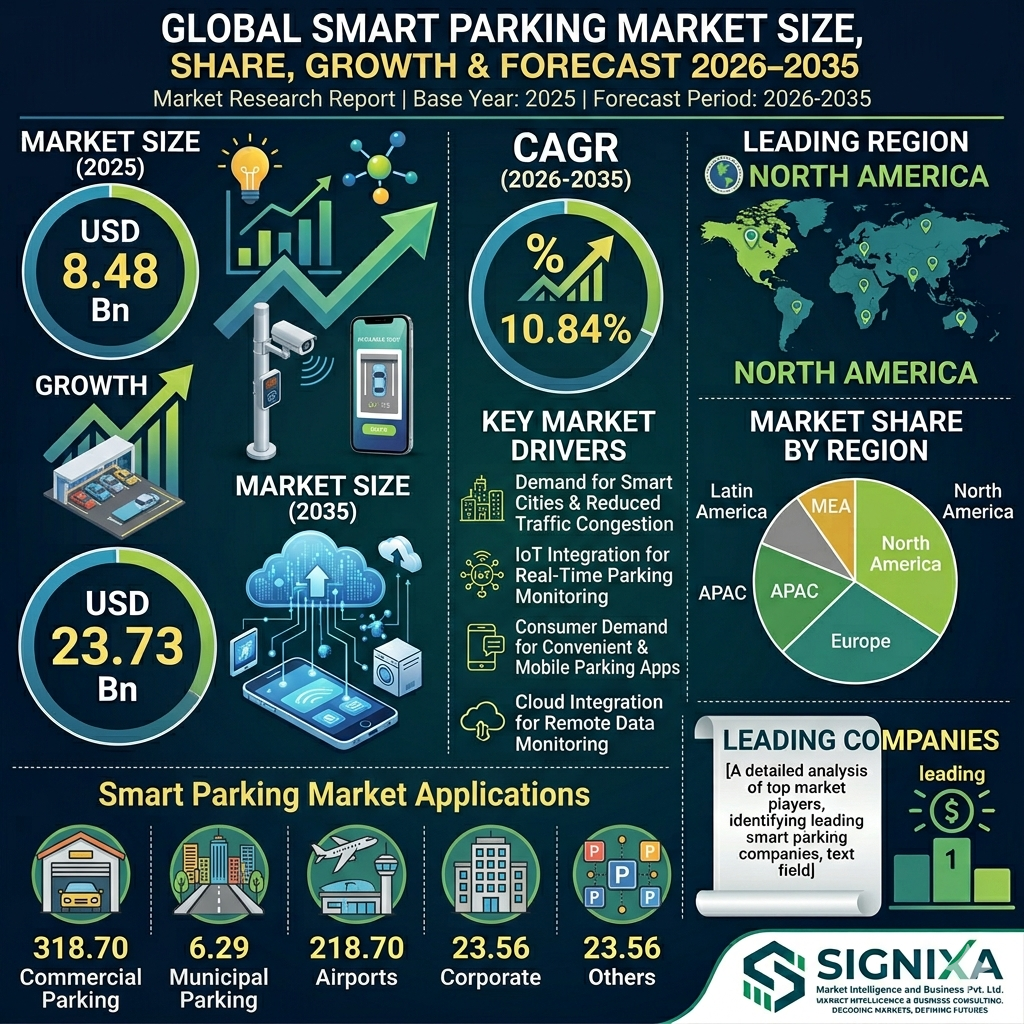
The size of the global smart parking market was worth around USD 8.48 billion in 2025 and is predicted to grow to around USD 23.73 billion by 2035, with a compound annual growth rate (CAGR) of roughly 10.84% between 2026 and 2035. The smart parking market encompasses advanced systems using integrated hardware and software to optimize vehicle parking operations, helping reduce traffic congestion, fuel usage, and time wastage, while enhancing convenience and space utilization.
The increasing number of vehicles globally, coupled with rapid urbanization, has created an acute need for efficient parking management solutions. Smart parking addresses these issues by optimizing space utilization in both on-street and off-street parking facilities. Beyond convenience, these systems contribute to environmental sustainability by reducing vehicle emissions caused by drivers circling for parking. The market is witnessing a strong trend towards contactless payment systems, cloud-based parking management, and AI-driven predictive analytics, all aimed at enhancing user experience and operational efficiency. Furthermore, the development of autonomous vehicles and electric vehicles (EVs) is expected to further propel the market, as smart parking solutions will be crucial for seamless integration with these future mobility trends.
Despite its rapid growth and numerous benefits, the smart parking market faces several challenges. One significant hurdle is the high initial investment cost associated with deploying the necessary hardware (sensors, cameras, gates) and software infrastructure. Another challenge lies in the complex integration of smart parking systems with existing urban infrastructure and diverse legacy systems. Data privacy and security concerns regarding the collection and use of vehicle and driver data also present challenges that manufacturers and service providers must address through robust cybersecurity measures and transparent data handling policies.
Key Findings
- The global smart parking market is projected to grow at a CAGR of 10.84% between 2026 and 2035.
- In 2025, the market size was valued at USD 8.48 billion and is forecast to reach USD 23.73 billion by 2035.
- Off-street parking sites are expected to dominate due to greater deployment in commercial areas.
- IoT-based systems are anticipated to lead among system types, offering real-time insights.
- In terms of application, E-parking and license plate recognition will continue expanding.
- North America is projected to hold the largest regional share, followed closely by Asia-Pacific.
Smart Parking Market Dynamics
Urbanization & Vehicle Ownership Surge Creating Acute Parking Scarcity Driving Smart System Demand Globally
The smart parking market's dynamics are intensely shaped by the ever-increasing urban population and the corresponding surge in vehicle ownership. As cities worldwide become more densely populated, the availability of traditional parking spaces dwindles, leading to severe traffic congestion and increased commuter frustration. Drivers often spend significant time circling for vacant spots, contributing to fuel consumption and harmful emissions. This acute pain point serves as a primary driver for smart parking solutions. These systems, utilizing a combination of sensors, cameras, and real-time data analytics, optimize the use of existing parking infrastructure by guiding drivers directly to available spaces. This not only alleviates traffic but also maximizes the utilization of parking facilities. Supportive government initiatives promoting smart city development and environmental sustainability are further propelling adoption, with cities deploying intelligent parking meters, integrated sensors, and mobile apps to streamline urban mobility through the forecast period.
IoT, AI & Mobile Connectivity Enabling Predictive Analytics, Dynamic Pricing & Contactless Payment Innovation
Rapid technological advancements, particularly in the realm of IoT, artificial intelligence (AI), and mobile connectivity, are profoundly influencing the market's dynamics. IoT-based sensor networks embedded in parking spaces provide real-time occupancy data, which is then processed by cloud-based platforms and delivered to users via mobile applications or digital signage. AI and machine learning algorithms are increasingly being used to predict parking patterns, optimize dynamic pricing strategies, and enhance the accuracy of license plate recognition (LPR) systems. The widespread adoption of smartphones has also made mobile parking apps — offering features like reservation, navigation, and contactless payment — a crucial component of the smart parking ecosystem. These technological innovations not only improve the user experience but also empower parking operators and city authorities with actionable insights to manage parking resources more effectively, driving continuous evolution in the market through the forecast period.
High Upfront Infrastructure Costs & Legacy System Integration Challenges Moderating Adoption Speed in Emerging Markets
The smart parking market also faces significant dynamic challenges that can temper its growth and widespread adoption. A major hurdle is the substantial initial investment required for the deployment of smart parking infrastructure, including the cost of sensors, cameras, communication networks, and sophisticated software platforms. This high upfront cost can be a deterrent for many municipalities and private parking operators, especially in developing regions where budget constraints are more pronounced. Moreover, integrating new smart parking systems with existing, often disparate, legacy urban infrastructure and IT systems can be technically complex and time-consuming. Ensuring interoperability between different vendors' solutions and maintaining data privacy and security of collected information (vehicle movements, payment details) are ongoing concerns. Overcoming these financial, technical integration, and data governance challenges through scalable solutions, flexible business models, and clear regulatory guidelines is critical for the sustained expansion of smart parking solutions globally through the forecast period.
Smart Parking Market: Segmentation Analysis
By Component Segment Analysis
Hardware
Hardware solutions dominate the component segment due to widespread installation of sensors, meters, and cameras, accounting for over 60% of revenue share in 2025. Hardware solutions are the foundational elements of any smart parking system, enabling real-time data collection and operational control. These include sensors — detecting vehicle presence using ultrasonic, infrared, magnetic, or radar technologies — and cameras with License Plate Recognition (LPR) for vehicle identification, entry/exit management, and security. Other key hardware components include smart parking meters that support various payment options, digital signage and LED displays to guide drivers to available spaces, and barrier gates for controlled access in off-street facilities. Communication devices, such as Wi-Fi or cellular modules, transmit data from sensors to central management platforms. The effective integration and robust performance of these hardware elements are vital for the overall functionality and reliability of a smart parking solution through the forecast period.
Software
The software segment is growing rapidly, driven by cloud-based platforms and AI-enabled analytics that enable real-time parking management, booking, and monitoring services. Smart parking software encompasses a broad spectrum of capabilities — from parking management systems (PMS) that orchestrate space allocation, pricing, and access control, to consumer-facing mobile applications that provide real-time availability mapping, advance reservation, and seamless digital payment processing. Cloud-based software-as-a-service (SaaS) deployment models are gaining traction as they reduce upfront capital expenditure, enable rapid feature updates, and facilitate integration with broader smart city data platforms. The growing adoption of data analytics dashboards — which provide parking operators and municipal authorities with occupancy trends, revenue performance, and utilization patterns — is creating consistent demand for advanced parking intelligence software solutions through the forecast period.
By Parking Site Segment Analysis
Off-Street
Off-street parking held the largest market share in 2025, driven by its integration into commercial and public structures like malls, airports, and office complexes. These locations benefit from scalability and reduced on-road traffic impact. The enclosed, controlled environment of off-street parking facilities — which includes multi-story car parks, underground parking structures, and surface-level lots adjacent to commercial properties — creates an ideal deployment environment for comprehensive smart parking solutions. Off-street facilities benefit from the ability to install fully integrated access control systems, featuring barrier gates, LPR cameras, and automated payment kiosks, that create a seamless, frictionless parking experience from entry to exit. The growing development of mixed-use urban real estate projects — combining retail, hospitality, office, and residential uses — is consistently creating demand for sophisticated off-street smart parking systems that can serve multiple user types with different parking duration patterns through the forecast period.
On-Street
On-street parking is gaining traction, particularly in high-density cities, with governments implementing smart meters and sensor-based spot tracking to manage limited space. On-street parking represents a critical component of urban mobility — accounting for a significant proportion of available parking in most city centers — but has historically been managed through basic coin-operated meters with limited capacity for data collection or dynamic management. The deployment of networked smart meters and in-ground sensors on public streets enables real-time occupancy monitoring, dynamic pricing based on demand levels, and digital enforcement capabilities. The growing adoption of permit-free digital payment for on-street parking — where drivers pay via mobile app using GPS or QR-based space identification — is progressively eliminating the need for physical parking meters while improving the user experience and reducing municipal maintenance costs through the forecast period.
By System Type Segment Analysis
Ground Sensor Technology
Ground sensor technology accounted for a dominant share due to its high accuracy in detecting vehicle presence and compatibility with existing infrastructure. These sensors are cost-effective and widely adopted in off-street environments. Ground sensors — typically installed flush with the parking surface within individual spaces — use magnetic field detection or piezoelectric technology to register the presence of a vehicle with high reliability. Their low power consumption (many operate on battery power for several years), minimal visual impact, and resistance to harsh environmental conditions make them well-suited for large-scale deployment across both surface-level and multi-story parking facilities. The absence of a line-of-sight requirement — unlike camera or ultrasonic systems — means ground sensors function reliably in environments with obstructions, poor lighting, or adverse weather conditions through the forecast period.
Counter Technology
Counter technology, although useful in gated parking facilities, holds a smaller market share due to its limited adaptability for dynamic urban environments. Vehicle counters — installed at entry and exit points of parking facilities — provide aggregate occupancy data by tracking the net flow of vehicles into and out of a facility, rather than monitoring individual space availability. This approach is simpler and less expensive to deploy than space-level sensor networks, making it an attractive option for facilities where aggregate capacity management rather than space-specific guidance is the primary requirement. Counter technology is particularly well-suited for facilities that display only total available spaces (rather than guiding to specific spaces) and for high-throughput applications such as stadium parking or event venues where rapid entry and exit processing is the operational priority through the forecast period.
Camera-Based Technology
Camera-based systems are widely adopted for surveillance and license plate recognition (LPR), providing comprehensive monitoring capabilities beyond simple occupancy detection. Modern camera-based parking systems combine high-resolution imaging with AI-powered video analytics to simultaneously track vehicle occupancy across multiple spaces, capture and validate license plate numbers for access control and billing, and monitor security events in real time. The growing capability of camera-based systems to detect vehicle type, size, and permit status through computer vision algorithms is expanding their application scope beyond basic occupancy detection toward intelligent space allocation and specialized access management. The trend toward barrier-free parking — where cameras capture license plates on entry and exit, enabling frictionless throughput and automated digital billing without physical access control barriers — is a particularly strong driver for camera-based system growth in high-traffic locations through the forecast period.
By Technology Segment Analysis
Internet of Things (IoT)
IoT-based systems commanded a significant market share in 2025, accounting for more than 40% of global revenue. These systems allow real-time data collection, predictive analysis, and cloud connectivity. IoT-enabled smart parking systems create an interconnected network of sensors, actuators, communication modules, and cloud platforms that enable comprehensive real-time management of parking resources across entire cities or facility portfolios. The ability to aggregate and analyze occupancy data from thousands of parking spaces simultaneously enables parking operators and municipal authorities to make data-driven decisions about pricing, capacity planning, and maintenance scheduling. The growing integration of smart parking IoT platforms with broader city management systems — including traffic signal control, public transit coordination, and environmental monitoring — is creating powerful synergies that extend the value of parking data beyond the parking facility itself through the forecast period.
Ultrasonic
Ultrasonic systems are preferred in enclosed parking spaces for precise vehicle detection. Ultrasonic sensors — typically mounted on the ceiling above individual parking spaces — emit high-frequency sound waves and measure the reflection time to determine whether a space is occupied. This overhead detection approach provides reliable performance in enclosed multi-story parking structures, where consistent ceiling heights and controlled lighting conditions create an ideal operating environment. Each sensor unit integrates an LED indicator that displays the space availability status in real time (green for empty, red for occupied), guiding drivers to available spaces without requiring them to navigate by digital signage or mobile apps. The growing trend toward sensor-per-space guidance systems in premium parking facilities — where minimizing driver search time is a key component of the value proposition — is supporting continued ultrasonic sensor deployment through the forecast period.
RFID
RFID technology is used for access control and automated billing in private and commercial parking lots. RFID parking systems use radio frequency identification tags — attached to vehicles in the form of windshield stickers or transponders — to enable automatic identification and authentication of registered vehicles at parking facility entry and exit points. This enables frictionless access for authorized vehicles (employees, residents, season permit holders) without requiring any driver action beyond approaching the entry lane, significantly improving throughput and user experience for frequent parkers. RFID-based parking systems are particularly prevalent in corporate campus parking, residential complexes, and subscription-based commercial parking programs where consistent, reliable access management for a defined vehicle population is the primary operational requirement through the forecast period.
By Application Segment Analysis
E-Parking
E-parking applications, which enable users to find, reserve, and pay for spots in advance, dominate the application segment due to their growing popularity among urban drivers. E-parking platforms — available as standalone mobile applications or integrated into mapping and navigation services — provide urban drivers with real-time information about available parking spaces, pricing, and walking distance to destinations, enabling advance reservation and guaranteed spot availability. The integration of e-parking with connected vehicle infotainment systems and navigation apps (including Google Maps and Apple Maps, which now incorporate parking availability data in many cities) is progressively shifting e-parking from a standalone specialty app to an embedded feature of the broader urban mobility ecosystem. The development of aggregator platforms that consolidate parking inventory from multiple operators into a single booking interface — similar to hotel booking platforms — is standardizing the e-parking user experience and expanding consumer adoption through the forecast period.
License Plate Recognition
License plate recognition is rapidly expanding, particularly in regions with automated toll and access control systems. LPR technology enables the automatic reading and recording of vehicle license plates using optical character recognition algorithms applied to camera footage, creating a digital record of every vehicle entering and exiting a parking facility or passing a monitoring point. LPR systems are increasingly being deployed for parking enforcement applications — automatically identifying vehicles that have exceeded their permitted parking duration or parked without payment, generating enforcement notices without requiring manual patrol officers to physically check each vehicle. The growing use of LPR for multi-site parking subscription management — where a single account enables authorized parking across multiple facilities based on plate recognition rather than physical access credentials — is creating a scalable, customer-convenient model that is driving adoption through the forecast period.
Security and Surveillance
Security and surveillance technologies are essential for enhancing safety, particularly in large parking complexes. The integration of high-definition surveillance cameras with AI-powered video analytics enables proactive security monitoring — including automatic detection of loitering, suspicious behavior, abandoned objects, and unauthorized vehicle access — while providing comprehensive incident documentation for post-event investigation. The growing deployment of video-based emergency call stations throughout parking facilities provides users with immediate access to security assistance from any location within the facility. The integration of smart parking security systems with building management and incident response systems — enabling automatic notification of security personnel when anomalous events are detected — is improving response times and reducing the staffing requirements for large parking facility security operations through the forecast period.
Smart Payment Systems
Smart payment systems represent a fast-growing segment, offering users cashless and contactless options for parking transactions. These systems improve convenience and reduce operational costs. Modern smart parking payment solutions support a comprehensive range of payment modalities — including NFC contactless card payments, mobile wallet payments (Apple Pay, Google Pay), QR code scanning, license plate-linked automatic billing, and subscription-based parking pass management — providing users with the flexibility to choose their preferred payment method while eliminating the need for cash handling. The growing adoption of dynamic demand-responsive pricing in smart parking payment systems — where parking rates automatically adjust based on real-time occupancy levels and time of day — enables operators to optimize revenue while distributing parking demand more evenly across available facilities through the forecast period.
By End User Segment Analysis
Commercial
Commercial sectors led the market in 2025, supported by demand from shopping malls, airports, and business parks. These users prioritize customer convenience and operational efficiency. Commercial parking operators have a strong business case for smart parking investment — improved parking guidance and payment convenience directly translate into higher customer satisfaction and increased facility revenue through higher throughput, reduced cash handling costs, and enhanced enforcement capability. Airports — which combine high parking volume, premium pricing, and diverse user types (short-term departures, long-term travelers, employee parking, rental car returns) — represent one of the most complex and high-value commercial smart parking applications, requiring integrated multi-zone guidance, LPR-based access management, and multi-tier pricing systems. The growing deployment of smart parking as a revenue center in commercial real estate — where parking management is increasingly professionalized and actively optimized for yield — is sustaining commercial sector leadership through the forecast period.
Government
The government segment is expanding steadily, with municipalities deploying smart parking to reduce traffic congestion and manage public infrastructure more effectively. Municipal governments are increasingly recognizing smart parking as a foundational component of broader smart city strategies — providing real-time data on urban mobility patterns that informs transport planning, reduces emissions from unnecessary vehicle circulation, and generates revenue through optimized parking pricing. Government smart parking deployments typically focus on on-street public parking management, including networked smart meters, sensor-based space monitoring, and digital enforcement systems. The growing integration of municipal smart parking data with city-wide traffic management and public transit systems is enabling a data-driven approach to urban mobility coordination that extends the value of parking infrastructure investments well beyond parking revenue optimization through the forecast period.
Report Attributes & Market Scope
| Report Attribute | Details |
|---|---|
| Market Size Value in 2025 | USD 8.48 Billion |
| Market Size Value in 2035 | USD 23.73 Billion |
| CAGR (2026–2035) | 10.84% |
| Base Year Used for Estimation | 2025 |
| Historic Data | 2020 - 2025 |
| Forecast Period | 2026 - 2035 |
| Segments Covered – By Component |
|
| Segments Covered – By Type (Parking Site) |
|
| Segments Covered – By System Type |
|
| Segments Covered – By Technology |
|
| Segments Covered – By Application |
|
| Segments Covered – By End User |
|
| Regions Covered | North America, Europe, Asia Pacific, Latin America, Middle East and Africa |
| Major Countries Covered | U.S., Canada, Mexico, Germany, UK, France, Italy, Spain, Russia, China, Japan, South Korea, India, Southeast Asia Countries, Brazil, Argentina, GCC Countries, Turkey, Iran, Israel, South Africa, Egypt, Nigeria, etc. |
| Key Companies Profiled | Smart Parking Ltd., Bosch, Amano Corporation, Siemens AG, ParkMobile, Cisco Systems, Kapsch TrafficCom, Nedap N.V., Cubic Corporation, and SKIDATA GmbH, among others. |
Smart Parking Market Regional Analysis
North America remains the leading region in the global smart parking market, driven by high vehicle penetration, advanced infrastructure, and strong investments in smart city initiatives. Asia-Pacific is the fastest-growing region, bolstered by urbanization in China and India, along with rising government support. Europe follows closely due to environmental regulations and innovative mobility solutions.
North America (Dominant Region)
North America is a leading region in the global smart parking market, characterized by significant technological adoption, a mature urban infrastructure, and a strong drive to address traffic congestion and optimize parking space utilization. The United States, in particular, dominates the market, with major cities actively investing in smart city initiatives that integrate smart parking solutions — including the deployment of IoT-enabled sensors, License Plate Recognition cameras, smart meters, and dynamic pricing systems to provide real-time parking availability via mobile applications and digital signage. The high rate of vehicle ownership and the challenges of finding parking in densely populated urban centers are key growth drivers. Both public and private sectors are investing in these solutions to enhance urban mobility, reduce emissions from circling cars, and improve the overall user experience. The presence of key technology providers and ongoing advancements in AI and data analytics further solidifies North America's position through the forecast period.
Europe
Europe represents a significant and growing market for smart parking systems, driven by ambitious smart city initiatives, stringent environmental regulations aimed at reducing urban pollution, and a strong focus on sustainable urban mobility. Countries such as Germany, the UK, France, and the Netherlands are at the forefront of implementing smart parking solutions to alleviate congestion and optimize existing parking infrastructure. European cities are increasingly integrating smart parking into broader intelligent transportation systems (ITS) to enhance traffic flow and improve air quality. There's a notable emphasis on solutions that offer seamless digital payment options, real-time guidance, and integrated parking management platforms. The overarching commitment to creating greener and more efficient urban environments, coupled with the need to accommodate a growing number of vehicles within limited urban spaces, fuels the adoption of smart parking technologies through the forecast period.
Asia-Pacific
The Asia Pacific region is rapidly emerging as the fastest-growing market for smart parking, largely due to rapid urbanization, burgeoning populations, and a dramatic increase in vehicle ownership. Countries like China, India, Japan, and South Korea are experiencing unprecedented levels of traffic congestion and parking scarcity, making smart parking solutions essential. Governments in these nations are heavily investing in smart city projects, with smart parking being a core component to enhance urban planning and quality of life. There's a strong trend towards mobile application-based parking services, allowing users to find, reserve, and pay for parking spaces conveniently. The rapid adoption of digital technologies and the proliferation of smartphones facilitate the widespread deployment of these solutions. While the market faces challenges related to diverse regulatory landscapes and high initial investment requirements, the sheer scale of the parking problem and the strong governmental push for smart city development ensure robust and sustained growth through the forecast period.
Middle East & Africa
The Middle East & Africa (MEA) smart parking market is in an emerging phase, demonstrating significant growth potential driven by ambitious urban development projects, a focus on smart city initiatives, and increasing vehicle ownership in key economies. In the Middle East, particularly the GCC countries (UAE, Saudi Arabia), there are substantial government investments in creating futuristic smart cities where intelligent parking management is a crucial element. These initiatives aim to enhance urban living, manage growing populations, and improve infrastructure efficiency. In Africa, the adoption is more gradual, but urbanization and a growing middle class are slowly increasing vehicle numbers and creating demand for more efficient parking solutions, particularly in major cities. As smart city concepts gain traction and governments prioritize sustainable urban development, the MEA region is expected to witness steady growth in its smart parking market through the forecast period.
Recent Developments in the Smart Parking Market
-
2023
Smart Parking Ltd. launched a new cloud-based parking management platform across Australia and New Zealand.
-
2022
Bosch partnered with Mercedes-Benz to expand automated valet parking services using IoT and camera-based systems.
Smart Parking Market: Competitive Landscape
Leading players in the global smart parking market include Smart Parking Ltd., Bosch, Amano Corporation, Siemens AG, ParkMobile, Cisco Systems, Kapsch TrafficCom, Nedap N.V., Cubic Corporation, and SKIDATA GmbH. These companies focus on enhancing user experience through data analytics, mobile integration, and strategic partnerships. The competitive landscape is shaped by innovation, pricing strategies, and regional expansions targeting high-traffic urban centers.
The smart parking market's competitive landscape is dynamic and multifaceted, with competition primarily revolving around technological innovation, the comprehensiveness of integrated solutions, and the ability to offer cost-effective and scalable deployments. Companies are fiercely competing to develop cutting-edge sensor technologies (ultrasonic, radar, image-based), sophisticated LPR systems, and robust cloud-based parking management software platforms. The drive to integrate AI and machine learning for predictive analytics, dynamic pricing, and enhanced user experience is a key differentiator. Competitive advantage also stems from the ability to provide end-to-end solutions, including hardware installation, software integration with existing urban infrastructure, ongoing maintenance, and seamless mobile payment solutions. The emphasis on sustainability and eco-friendly solutions, aligning with smart city initiatives, plays an increasingly important role in competitive positioning.
Key Companies Profiled
Global Smart Parking Market Segmentation Summary
By Component
By Type (Parking Site)
By System Type
By Technology
By Application
By End User
By Region
Frequently Asked Questions (FAQs) About the Smart Parking Market
What is Smart Parking?
Smart Parking refers to an intelligent parking system that uses technologies like sensors, cameras, mobile apps, and IoT to detect available parking spaces, manage vehicle flow, and optimize parking operations in real-time.
Which key factors will influence the Smart Parking market growth over 2026–2035?
The global Smart Parking market is expected to grow due to increasing urbanization, growing demand for efficient traffic management, adoption of smart city initiatives, and the integration of AI and IoT technologies in parking infrastructure.
What will be the value of the Smart Parking market during 2026–2035?
According to the study, the global Smart Parking market size was worth around USD 8.48 billion in 2025 and is predicted to grow to around USD 23.73 billion by 2035.
What will be the CAGR value of the Smart Parking market during 2026–2035?
The CAGR value of the Smart Parking market is expected to be around 10.84% during 2026–2035.
Which region will contribute notably towards the Smart Parking market value?
The global Smart Parking market is led by Europe and North America, driven by smart mobility trends, stringent vehicle emission regulations, and heavy investments in smart infrastructure.
Which are the major players leveraging the Smart Parking market growth?
The global Smart Parking market is led by players such as Siemens AG, Amano Corporation, Bosch Mobility Solutions, APCOA PARKING, ParkMobile, Nedap N.V., SKIDATA GmbH, IPS Group Inc., Kapsch TrafficCom, and Streetline Inc.
What can be expected from the global Smart Parking market report?
The report explores crucial aspects of the Smart Parking market, including a detailed discussion of existing growth factors and restraints while also analyzing future growth opportunities and challenges that impact the market.