
Smart Label Market Overview
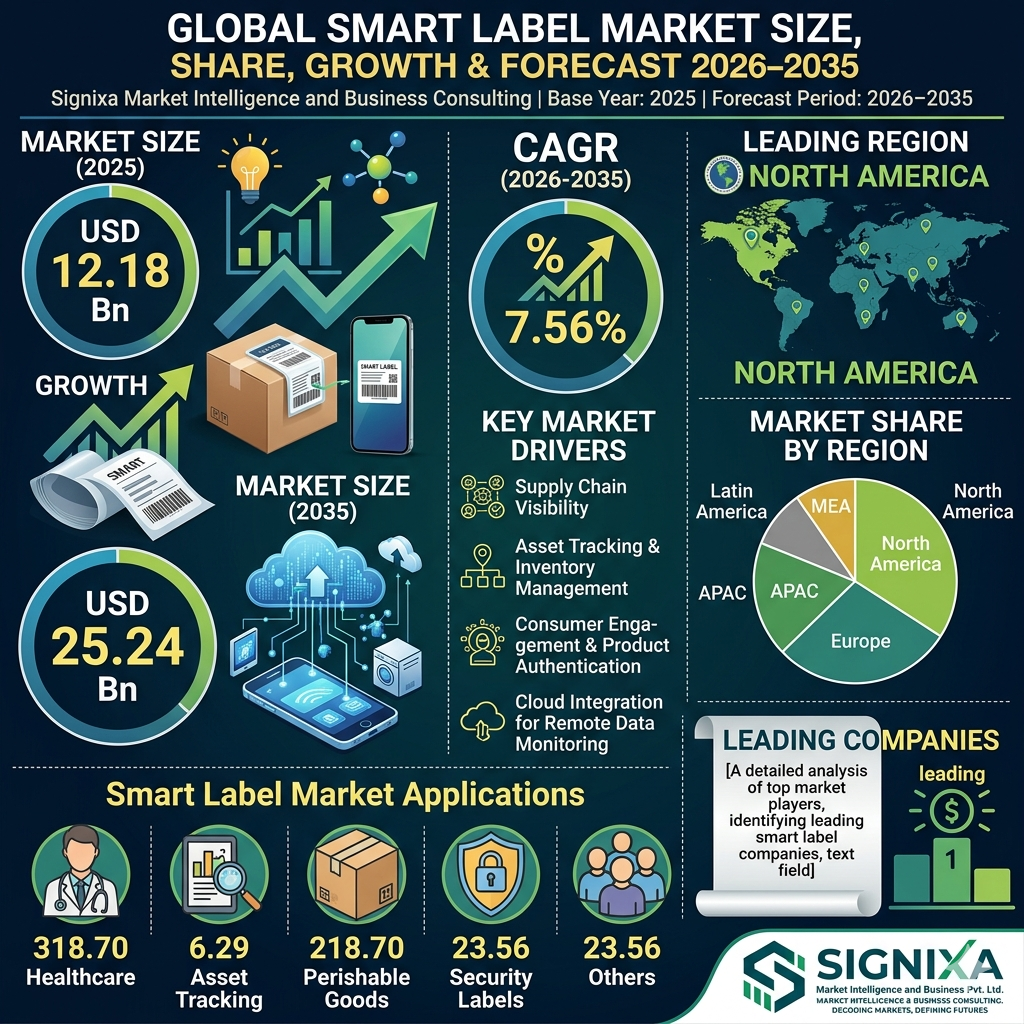
The size of the global Smart Label market was worth around USD 12.18 billion in 2025 and is predicted to grow to around USD 25.24 billion by 2035, with a compound annual growth rate (CAGR) of roughly 7.56% between 2026 and 2035. The report analyzes the Smart Label market's drivers and restraints, as well as the impact they have on demand throughout the projection period, and examines global opportunities across this rapidly digitalizing labeling industry.
The smart label market includes digitally enabled labelling solutions that combine intelligent technology — such as RFID and NFC — with traditional labels to track, monitor, and improve inventory and asset management. With rising demand from retail, logistics, healthcare, and FMCG industries, smart labels provide real-time visibility, improve traceability, and enhance operational efficiency. A smart label is essentially a traditional label augmented with embedded digital technologies including QR codes, RFID tags, NFC chips, or sensors that enable the label to store and transmit a wealth of data beyond what can be physically printed — facilitating real-time tracking, product authentication, inventory management, and enhanced consumer engagement.
The market's expansion is fundamentally driven by the growing need for greater transparency in supply chains, increasing concerns about product counterfeiting, and rising consumer demand for detailed and accessible product information. From pharmaceuticals requiring precise temperature monitoring to food products needing traceability and authentication, smart labels are becoming indispensable across a myriad of industries. QR codes and NFC tags on smart labels allow brands to provide instant access to rich digital content — including product descriptions, ingredients, sourcing information, sustainability credentials, and personalized promotions — simply by scanning with a smartphone, fostering deeper brand-consumer engagement while simultaneously supporting regulatory compliance around traceability and allergen disclosure.
Key Findings
- The global Smart Label market is projected to grow at a CAGR of 7.56% between 2026 and 2035, with market value rising from USD 12.18 billion in 2025 to USD 25.24 billion by 2035.
- RFID Labels are expected to dominate the market in terms of technology, accounting for over 42% of global revenue in 2025 due to their automated, line-of-sight-free item identification capabilities.
- Retail & Inventory Tracking is anticipated to hold the highest share in applications, exceeding 48% in 2025, as retailers deploy RFID-enabled labels to enhance inventory accuracy and support omnichannel fulfilment.
- FMCG and Retail are projected to be the key end-use sectors, with FMCG alone accounting for over 35% of revenue in 2025, driven by the growing need for transparency, authenticity, and consumer interaction.
- North America is expected to maintain the dominant market position during the forecast period, supported by strong retail and e-commerce penetration and early RFID technology adoption.
Smart Label Market Dynamics
Supply Chain Transparency & Real-Time Inventory Visibility
The smart label market is undergoing significant transformation, propelled by the ever-increasing demand for supply chain transparency and efficiency across diverse industries. In today's complex globalized economy, businesses face immense pressure to track products in real time, from the point of origin through manufacturing, distribution, and finally to the end consumer — driven by factors including optimizing inventory management, minimizing losses due to theft or damage, ensuring timely deliveries, and complying with stringent traceability regulations, particularly in food & beverage and pharmaceuticals. Smart labels, often leveraging RFID technology, offer unparalleled capabilities for automated data capture and real-time visibility that far surpass traditional barcodes — the ability to scan multiple items simultaneously without a direct line of sight drastically reduces manual labour, human error, and operational costs in warehouses and logistics hubs.
Anti-Counterfeiting, Brand Protection & Regulatory Serialization Mandates
Another powerful dynamic shaping the smart label market is escalating concern over product counterfeiting and the imperative for brand protection. The proliferation of fake goods across industries — from luxury items and electronics to critical pharmaceuticals and food products — poses significant threats to consumer safety, brand reputation, and revenue streams. Smart labels, by embedding unique digital identifiers such as serialized RFID tags or secure QR codes that can be easily authenticated, provide a robust anti-counterfeiting solution that allows consumers to verify product authenticity using their smartphones while enabling brands to track individual items through the supply chain to detect diversion or gray market activities. Regulatory mandates — especially in the pharmaceutical sector requiring serialization and traceability of drugs to combat counterfeiting — are compelling manufacturers to adopt smart labelling solutions that ensure compliance while enhancing product security throughout the distribution network.
High Implementation Costs & Data Privacy Considerations
Despite strong growth potential, the smart label market faces considerable challenges that can impede broader adoption. A significant hurdle is the relatively high initial cost associated with implementing smart label technology, particularly for solutions involving active RFID tags or sophisticated sensing capabilities — this includes not just the cost of the labels themselves, but also investment in readers, software infrastructure, and system integration, which can be substantial for small and medium-sized enterprises. While smart labels promise long-term ROI through improved efficiency and loss prevention, the upfront capital expenditure can be a meaningful barrier to entry. Data privacy and security concerns present another challenge, as smart labels collect and transmit potentially sensitive data, raising questions about data ownership, usage, and protection from unauthorized access or cyber threats — ensuring robust encryption, secure communication protocols, and compliance with data protection regulations including GDPR is paramount, particularly in sectors handling personal or sensitive product information.
Smart Label Market Segmentation Analysis
By Technology Segment Analysis
RFID Labels
RFID Labels dominated the market in 2025, accounting for over 42% of global revenue. Their widespread use in logistics, retail, and warehouse management is driven by their ability to provide automated item identification without requiring line-of-sight scanning — a fundamental advantage over traditional barcode systems that enables bulk scanning of entire pallets or shelves in seconds. RFID's role as the backbone of large-scale automated inventory tracking systems across major retail chains and distribution networks ensures its continued dominance as the technology of choice for high-volume, automation-driven supply chain applications through the forecast period.
NFC Labels
NFC Labels are gaining popularity in consumer engagement and brand protection applications, particularly in the retail and luxury goods sectors, where their close-proximity tap-to-scan functionality enables direct, secure interaction between consumers and embedded product data using widely available smartphone hardware. NFC's strength lies in its dual capability to deliver rich interactive content — including authentication verification, product storytelling, and loyalty program access — while simultaneously serving as a tamper-evident authentication mechanism for high-value goods where counterfeiting risk justifies the premium cost of NFC-enabled labeling relative to simpler QR code alternatives.
Sensing Labels
Sensing Labels, which detect environmental conditions including temperature and humidity, are critical for food and pharmaceutical logistics where maintaining product integrity throughout transit and storage is both a quality and regulatory imperative. These labels provide continuous condition monitoring that allows supply chain stakeholders to verify cold chain compliance, detect excursions outside acceptable temperature ranges, and make real-time decisions about product disposition before spoiled or compromised goods reach end consumers — a capability of particular importance in vaccine distribution, biologics logistics, and perishable food supply chains where condition monitoring directly impacts product safety and efficacy.
Others (EAS & QR-Based Labels)
Other smart label technologies include Electronic Article Surveillance (EAS) labels — widely used for theft prevention in retail environments — and QR-based labels that offer a low-cost, widely accessible entry point into smart labeling for brands prioritizing consumer engagement and information access over the automated tracking capabilities of RFID. QR-based labels in particular benefit from near-universal smartphone camera compatibility without requiring specialized NFC hardware, making them an accessible choice for brands targeting broad consumer engagement campaigns across markets with varying smartphone capability levels.
By Application Segment Analysis
Retail & Inventory Tracking
Retail & Inventory Tracking led the smart label market with over 48% share in 2025. Retailers are increasingly deploying RFID-enabled labels to enhance inventory accuracy, reduce shrinkage, and support omnichannel fulfilment strategies that require precise, real-time stock visibility across physical stores, distribution centers, and e-commerce fulfillment operations simultaneously. The ability to conduct rapid, automated cycle counts using handheld or fixed RFID readers — rather than time-consuming manual stock checks — has made RFID-based inventory tracking a near-standard practice among major apparel, footwear, and general merchandise retailers seeking to minimize stockouts and overstock situations that directly erode profitability.
Pallet Tracking
Pallet Tracking is witnessing strong growth, particularly in large-scale warehousing and cold-chain logistics, where the ability to track pallets through various transit stages helps minimize losses, ensure regulatory compliance, and streamline supply chain processes across multi-node distribution networks. Pallet-level RFID tagging enables logistics operators to maintain continuous chain-of-custody visibility as goods move between manufacturing facilities, distribution centers, and retail destinations — a capability that has become increasingly valuable as supply chains have grown more complex and geographically distributed in the post-pandemic logistics environment.
By End Use Segment Analysis
FMCG
FMCG accounted for the largest revenue share at over 35% in 2025, owing to the growing need for transparency, authenticity, and consumer interaction. Smart labels are used to ensure product traceability, expiry tracking, and supply chain optimization — capabilities increasingly demanded by both regulators and consumers seeking assurance about product origin, freshness, and authenticity in a sector characterized by high product turnover, dense distribution networks, and significant exposure to counterfeiting risk for premium and branded goods.
Logistics
The logistics sector showed robust adoption due to demand for real-time asset monitoring and route optimization, as logistics operators increasingly rely on smart labels to maintain visibility over high-value or sensitive cargo throughout multi-leg transportation journeys spanning different carriers, modes, and jurisdictions. The integration of smart label data with broader transportation management and fleet tracking systems is enabling logistics providers to offer customers increasingly granular, real-time shipment visibility as a competitive service differentiator.
Retail
The retail industry continues to invest heavily in smart labels for shelf management, theft prevention, and consumer engagement — leveraging RFID for loss prevention and inventory accuracy while deploying NFC and QR-enabled labels to deliver interactive product information and personalized promotions directly to shoppers' smartphones at the point of purchase decision, blending operational efficiency gains with customer experience enhancement in a single labeling investment.
Healthcare
Healthcare is an emerging segment, where smart labels support medical supply tracking, dosage adherence, and product authentication — applications of growing importance as healthcare systems seek to reduce medication errors, combat pharmaceutical counterfeiting, and maintain precise inventory control over high-value medical devices and controlled substances. The convergence of regulatory serialization mandates and hospital systems' own operational efficiency goals is positioning healthcare as one of the fastest-developing end-use segments for advanced smart label adoption going forward.
By Component Segment Analysis
Smart labels are constructed from several core hardware components, each contributing distinct functional capabilities to the finished product:
Transceivers held the highest market share among components, contributing over 30% in 2025, as they are essential for wireless communication in RFID and NFC-based systems. Memories are crucial for storing item-level data and have seen consistent demand growth, while batteries are primarily used in active smart labels requiring long-range communication. Microprocessors allow advanced processing within smart labels, particularly in sensing applications, with other components including antennas, sensors, and printed electronics facilitating signal transmission and interaction.
Report Attributes & Market Scope
| Report Attribute | Details |
|---|---|
| Market Size Value in 2025 | USD 12.18 Billion |
| Market Size Value in 2035 | USD 25.24 Billion |
| CAGR (2026–2035) | 7.56% |
| Base Year Used for Estimation | 2025 |
| Historic Data | 2020 – 2025 |
| Forecast Period | 2026 – 2035 |
| Segments Covered – By Technology |
|
| Segments Covered – By Application |
|
| Segments Covered – By End Use |
|
| Segments Covered – By Component |
|
| Regions Covered | North America, Europe, Asia Pacific, Latin America, Middle East and Africa |
| Major Countries Covered | U.S., Canada, Mexico, Germany, UK, France, Italy, Spain, Russia, China, Japan, South Korea, India, Southeast Asia Countries, Brazil, Argentina, GCC Countries, Turkey, Iran, Israel, South Africa, Egypt, Nigeria, etc. |
| Key Companies Profiled | Avery Dennison Corporation, Zebra Technologies, CCL Industries Inc., SATO Holdings Corporation, Checkpoint Systems Inc., Smartrac N.V., Thin Film Electronics ASA, Invengo Information Technology Co. Ltd., Identiv Inc., and Intermec Inc., among others. |
Smart Label Market Regional Analysis
North America led the global smart label market in 2025, with over 34% share, driven by strong retail and e-commerce penetration, early adoption of RFID technology, and supportive regulatory frameworks. Europe followed, with advanced logistics infrastructure and rising focus on product authenticity and sustainability. Asia-Pacific is the fastest-growing region, fuelled by the booming manufacturing sector, growing retail presence, and government initiatives for digital transformation. Latin America and the Middle East & Africa are gradually adopting smart labels in response to growing demand for operational efficiency and counterfeiting prevention.
North America (Leading Region)
North America stands as a leading market for smart labels, driven by early adoption of advanced technologies, well-established digital infrastructure, and high consumer demand for product transparency and security. The United States showcases significant traction, with widespread implementation of RFID technology in retail for inventory management and anti-theft solutions. The region's burgeoning e-commerce sector also plays a crucial role, necessitating efficient tracking, traceability, and customer engagement through smart labels. Industries including pharmaceuticals, food & beverage, and logistics are increasingly integrating smart labels to comply with stringent regulatory requirements for product traceability and authentication, enhance supply chain visibility, and combat counterfeiting — supported by a strong penetration of smartphones and internet usage that facilitates widespread deployment of QR code and NFC-based smart labels for interactive consumer experiences.
Europe
Europe's smart label market is robust and mature, influenced by strong regulatory frameworks and a significant emphasis on sustainability and traceability across industries. The European Union's regulations — including the Falsified Medicines Directive (FMD) for pharmaceuticals — have been a key driver for adoption of serialization and authentication solutions, predominantly through smart labels. The region's focus on circular economy principles and reducing waste also promotes the use of smart labels for better inventory management, tracking of perishable goods to minimize spoilage, and enabling recycling initiatives. Industries including retail, logistics, and healthcare are actively leveraging RFID and NFC technologies to enhance operational efficiency, improve supply chain transparency, and elevate consumer engagement, supported by the presence of numerous smart label manufacturers and a high level of digital transformation across European businesses.
Asia Pacific (Fastest-Growing Region)
Asia Pacific is rapidly emerging as the fastest-growing market for smart labels globally, fuelled by massive economic growth, rapid urbanization, and a surging e-commerce sector — particularly in China, India, and Southeast Asian nations. Increasing demand for product authentication and anti-counterfeiting measures, especially for high-value goods and pharmaceuticals, is a significant driver. The proliferation of smartphones and QR code scanning culture in daily life makes QR code-based smart labels highly effective for consumer engagement and providing product information, while governments across the region are increasingly promoting digitalization and smart manufacturing initiatives that further boost smart label adoption for supply chain optimization and industrial automation. There is a clear trend toward adoption of more advanced RFID and NFC solutions as businesses recognize their long-term benefits in efficiency, traceability, and brand protection.
Middle East & Africa
The Middle East and Africa region presents a developing yet promising market for smart labels. In the Middle East, ambitious economic diversification plans and significant investments in smart city initiatives are driving the adoption of advanced technologies, including smart labels, across various sectors. The focus on enhancing supply chain security, combating counterfeiting, and improving logistics efficiency — particularly in high-value industries including luxury goods, pharmaceuticals, and consumer electronics — is a key driver, with RFID technology gaining traction for asset tracking and inventory management alongside widespread QR code use for consumer engagement. In Africa, the market remains in its nascent stages, but increasing internet penetration, rising smartphone adoption, and a growing focus on formalizing supply chains are gradually creating opportunities for smart label solutions across the broader MEA region.
Recent Developments in the Smart Label Market
-
2023
Avery Dennison expanded its smart label product line with sustainable and recyclable RFID solutions for FMCG and retail sectors — reinforcing the company's commitment to circular economy principles while meeting growing customer demand for environmentally responsible labeling solutions that maintain full RFID tracking functionality.
-
2022
Smartrac (a part of Avery Dennison) launched new temperature-sensitive smart labels targeting pharmaceutical cold-chain applications — expanding the sensing label segment with purpose-built solutions for monitoring and verifying temperature-controlled product integrity throughout complex global pharmaceutical distribution networks.
Smart Label Market: Competitive Landscape
Major players in the global smart label market include Avery Dennison Corporation, Zebra Technologies, CCL Industries Inc., SATO Holdings Corporation, Checkpoint Systems Inc., Smartrac N.V., Thin Film Electronics ASA, Invengo Information Technology Co. Ltd., Identiv Inc., and Intermec Inc. The competitive landscape is characterized by rapid innovation, partnerships with packaging and technology companies, and increasing investments in R&D to enhance product functionality and reduce costs. Key strategies include product differentiation, sustainable label development, and expansion into emerging economies to capitalize on untapped growth potential.
Competition in the smart label market plays out across several dimensions simultaneously. At the technology level, vendors differentiate through proprietary chip designs, antenna efficiency, and read-range performance that directly influence labeling cost-per-unit economics for high-volume retail and logistics customers. At the sustainability level, growing customer demand for recyclable and environmentally responsible labeling materials is creating competitive differentiation opportunities for manufacturers who can credibly demonstrate reduced environmental impact without compromising tracking functionality. At the integration level, vendors that can offer end-to-end solutions spanning label production, reader hardware, and software platforms for data management hold an advantage in large enterprise deals where customers prefer a single accountable technology partner over assembling a multi-vendor solution stack. Strategic partnerships between label manufacturers and major retail or pharmaceutical customers — often involving co-development of application-specific solutions — are an increasingly important mechanism for securing long-term, high-volume supply relationships in this competitive and rapidly evolving market.
Key Companies Profiled
Global Smart Label Market Segmentation Summary
By Technology
By Application
By End Use
By Component
By Region
Frequently Asked Questions (FAQs) About the Smart Label Market
What is a Smart Label?
A smart label is an advanced label embedded with technologies such as RFID, NFC, or sensors, enabling real-time tracking, authentication, and data communication. These labels are widely used in retail, logistics, FMCG, and healthcare for inventory management, supply chain visibility, and consumer engagement.
Which key factors will influence the Smart Label market growth over 2026–2035?
The global smart label market is set to grow due to increasing demand for real-time inventory tracking, anti-counterfeiting solutions, supply chain transparency, and automation in retail and logistics sectors. Technological advancements in printed electronics and IoT integration further support this growth.
What will be the value of the Smart Label market during 2026–2035?
According to the study, the global smart label market size was worth around USD 12.18 billion in 2025 and is predicted to grow to around USD 25.24 billion by 2035.
What will be the CAGR value of the Smart Label market during 2026–2035?
The CAGR value of the Smart Label market is expected to be around 7.56% during the forecast period of 2026 to 2035.
Which region will contribute notably towards the Smart Label market value?
The global Smart Label market is led by North America, driven by strong adoption of RFID, mature retail infrastructure, and regulatory initiatives supporting traceability and digitalization. Asia-Pacific is the fastest-growing region due to rapid industrialization and expansion of retail and manufacturing sectors.
Which are the major players leveraging the Smart Label market growth?
Key players in the global Smart Label market include Avery Dennison Corporation, Zebra Technologies, CCL Industries Inc., SATO Holdings Corporation, Checkpoint Systems Inc., Smartrac N.V., Thin Film Electronics ASA, Invengo Information Technology Co. Ltd., Identiv Inc., and Intermec Inc.
What can be expected from the global Smart Label market report?
The report offers a comprehensive analysis of the Smart Label market, highlighting growth drivers, restraints, opportunities, and challenges. It includes detailed segmentation by technology, application, end use, and region, along with competitive landscape insights and future outlook for market expansion across industries.