

Neurosurgical Robotics Market Overview
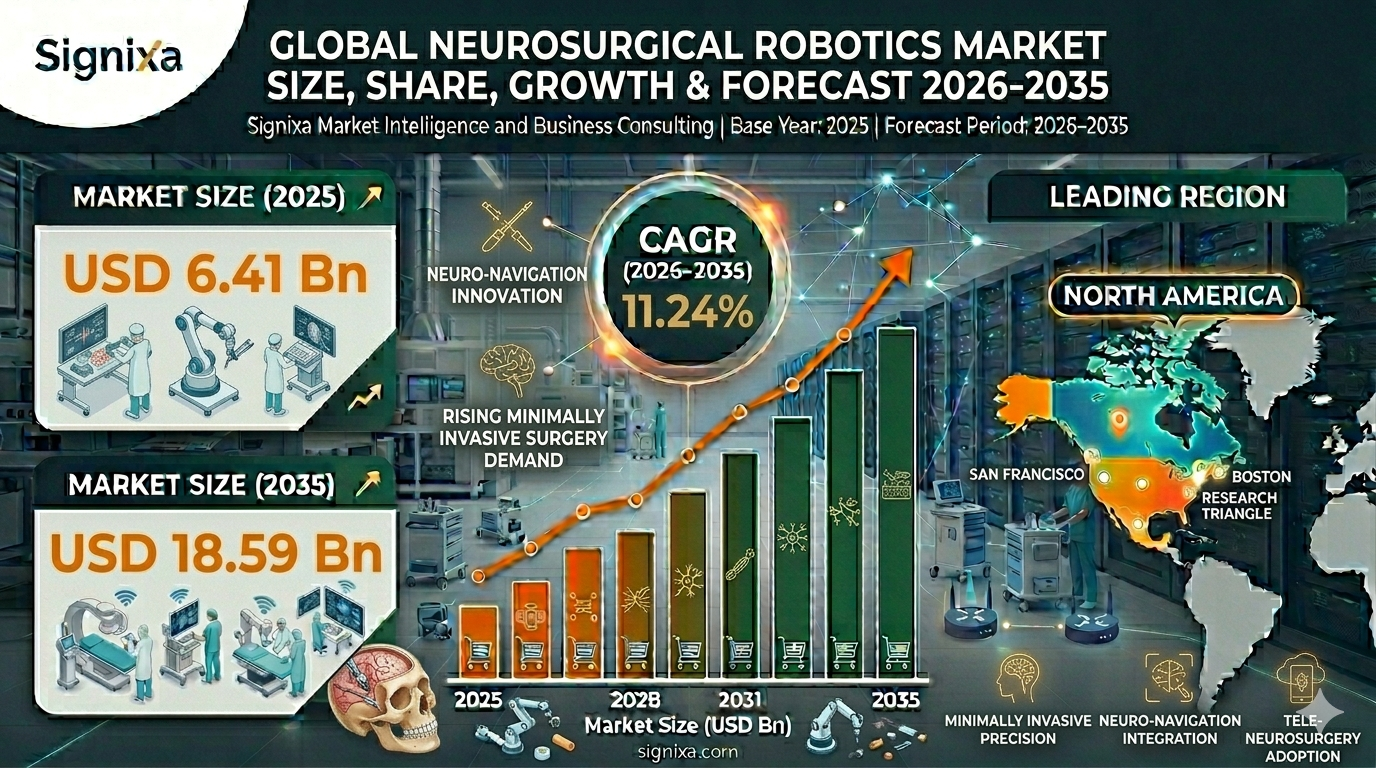
The size of the global neurosurgical robotics market was valued at approximately USD 6.41billion in 2025 and is projected to reach around USD 18.59 billion by 2035, growing at a compound annual growth rate (CAGR) of 11.24% during the forecast period. This report evaluates the market's growth potential, current trends, major drivers and restraints, and highlights global and regional opportunities.
The neurosurgical robotics market encompasses advanced robotic systems designed to support surgeons in performing intricate neurosurgical procedures. These include robotic systems for high-precision tasks such as tumour resection, spinal alignment, and vascular intervention. Rising demand for minimally invasive procedures, growing adoption of surgical automation, and technological advancements are collectively driving this market. Robotics enable increased surgical precision, reduced recovery times, and improved outcomes, making them increasingly attractive to healthcare providers.
Globally, over 55 million people suffer from neurological conditions like brain tumours, spinal injuries, and aneurysms. Robotic systems allow for precise interventions, reducing damage to healthy tissues and improving recovery times. Companies are introducing systems with enhanced imaging integration, haptic feedback, and AI-powered navigation. These features improve surgical accuracy and enable real-time decision-making during operations. Government and private funding in surgical robotics R&D is creating a favorable environment for market expansion, with recent FDA approvals of robotic platforms with improved safety features further legitimizing their use in clinical settings.
Key Findings
- The global neurosurgical robotics market will expand at a CAGR of 11.24% between 2026 and 2035.
- The market was valued at USD 6.41billion in 2025 and is expected to reach USD 18.59 billion by 2035.
- The growth is attributed to increasing demand for minimally invasive neurosurgeries and improved patient outcomes using robotics.
- By Robot Type, Precision Robotic Systems are projected to lead the market in terms of revenue, accounting for over 40% of robot type market revenue.
- In terms of Application, Tumour Resection is forecasted to hold the dominant share, accounting for nearly 45% of total application share in 2025.
- By End Users, Hospitals are expected to be the primary adopters, accounting for more than 70% of the global market in 2025.
- Ambulatory Surgical Centers are emerging as a growing segment with an 11.5% CAGR during the forecast period.
- North America is projected to dominate the global market, holding over 40% of market share in 2025.
Neurosurgical Robotics Market Dynamics
Rising Neurological Disease Burden & Aging Population Requiring High-Precision Interventions
The rising prevalence of neurological disorders is significantly driving demand for neurosurgical robotics. Globally, over 55 million people suffer from neurological conditions like brain tumours, spinal injuries, and aneurysms. Robotic systems allow for precise interventions, reducing damage to healthy tissues and improving recovery times. These benefits, along with the rising aging population susceptible to such conditions, support the long-term growth of this market. Advanced robotics provide a reliable alternative to traditional methods in highly sensitive brain and spinal surgeries. The growing incidence of conditions such as glioblastoma multiforme, spinal stenosis, cerebral aneurysms, and arteriovenous malformations — each requiring surgical precision beyond consistent human hand capability — creates compelling clinical justification for robotic assistance in neurosurgical procedures across all major healthcare systems globally.
AI Integration, Enhanced Imaging, Haptic Feedback & Real-Time Navigation Innovation
Technological advancements and growing investments in surgical robotics are boosting market growth. Companies are introducing systems with enhanced imaging integration, haptic feedback, and AI-powered navigation. These features improve surgical accuracy and enable real-time decision-making during operations. For instance, recent FDA approvals of robotic platforms with improved safety features have further legitimized their use in clinical settings. Additionally, government and private funding in surgical robotics R&D is creating a favorable environment for market expansion. The integration of preoperative imaging data — including MRI, CT, and functional brain mapping — with intraoperative robotic guidance systems enables surgeons to execute pre-planned surgical trajectories with sub-millimeter accuracy, substantially reducing the risk of inadvertent damage to eloquent brain areas and critical neural pathways during complex resections and electrode placement procedures.
Minimally Invasive Surgery Demand, Shorter Recovery Times & Value-Based Care Incentives
The growing demand for minimally invasive neurosurgical procedures is a fundamental structural driver of the neurosurgical robotics market. Patients and healthcare payers increasingly prefer surgical approaches that minimize tissue trauma, reduce blood loss, shorten hospital stays, and accelerate return to normal function. Robotic neurosurgical systems enable surgeons to perform highly complex intracranial and spinal procedures through smaller incisions with greater dexterity than conventional open surgery, directly addressing these preferences. The shift toward value-based healthcare models — where providers are rewarded for clinical outcomes and cost efficiency rather than procedure volume — creates a compelling economic case for robotic systems that demonstrably reduce complication rates, minimize revision surgery needs, and shorten hospital length of stay, justifying their substantial capital investment through improved downstream healthcare economics.
Neurosurgical Robotics Market Segmentation Analysis
By Robot Type Segment Analysis
The neurosurgical robotics market is segmented by robot type, with each system configuration addressing distinct surgical precision, visualization, and assistance requirements across brain, spinal, and vascular neurosurgical applications globally:
Precision Robotic Systems
Precision Robotic Systems are expected to dominate the segment with a strong CAGR, driven by their role in highly targeted procedures. These systems offer sub-millimeter accuracy, crucial in brain and spinal surgeries where minor errors can cause major complications. The ROSA Brain robotic platform exemplifies this category, enabling pinpoint accuracy in electrode placement for epilepsy surgeries. Precision these systems offer leads to fewer complications, faster recovery, and accounts for over 40% of the total robot type market revenue. These systems integrate preoperative imaging data with intraoperative tracking technology to guide surgical instruments along precisely planned trajectories, eliminating the cumulative positional errors inherent to freehand surgical technique. Their application in stereotactic neurosurgery, deep brain stimulation implantation, and laser ablation therapy for drug-resistant epilepsy represents the highest-value use cases in the segment.
Navigation Systems
Navigation Systems are gaining traction as they help surgeons visualize anatomical structures in real-time using 3D imaging and integrated software. Their market growth is supported by advancements in image-guided surgery and augmented reality interfaces. Navigation systems reduce surgical time and increase confidence during complex procedures. In 2025, this segment contributed to approximately 30% of the robot type share due to its extensive use in spinal and brain surgeries across hospitals globally. These systems function as the "GPS" of neurosurgery, registering the patient's imaging data to their physical anatomy and tracking surgical instrument positions in real time relative to critical structures. Advances in intraoperative MRI and CT integration, fluorescence-guided imaging, and AR overlay displays are continuously expanding the clinical scenarios in which navigation systems add demonstrable value to surgical outcomes.
Surgical Assist Systems
Surgical Assist Systems are essential in aiding neurosurgeons through steady mechanical arm movements and microsurgical support. These systems are particularly useful in long-duration surgeries, reducing surgeon fatigue and improving outcomes. In 2025, this segment represented around 25% of the market and is expected to grow steadily due to increasing hospital adoption in both developed and emerging economies for complex neurological operations. Surgical assist systems provide mechanical stability that compensates for natural physiological hand tremor — which can be significant during lengthy microsurgical procedures — while simultaneously enabling the application of precisely controlled forces for tissue retraction and manipulation. As robotic surgical assist platforms become increasingly compact and cost-effective, their adoption is expanding beyond high-volume academic neurosurgery centers to a broader range of regional and community hospital neurosurgical programs globally.
By Application Segment Analysis
Tumour Resection (Leading Application)
Tumour Resection leads the application segment due to increasing brain tumour incidence and the need for precise excision methods. Neurosurgical robots provide the accuracy required to remove tumours near critical brain structures. In 2025, tumour resection accounted for nearly 45% of total application share. Robotic assistance in these procedures minimizes post-operative complications and supports better prognosis, making it the most widely adopted application in the neurosurgical robotics domain. The growing global incidence of primary brain tumours — including glioblastoma, meningioma, and pituitary adenoma — combined with increasing secondary metastatic brain tumour burden driven by improved cancer detection and survival rates in other malignancies, creates a large and expanding patient population requiring precision craniotomy and tumour resection procedures where robotic assistance provides clear clinical and safety advantages over conventional freehand neurosurgical technique.
Spinal Surgery (Second-Largest Application)
Spinal Surgery represents the second-largest application, accounting for about 35% of the market share in 2025. Robotic systems enable improved screw placement and alignment in spinal fusion procedures, reducing the need for revision surgeries. The growing aging population and increasing cases of spinal degeneration are contributing to the robust demand for robotic systems in spinal procedures worldwide. Robotic spinal surgery platforms enable surgeons to place pedicle screws with significantly greater accuracy than freehand techniques — robotic-assisted placement consistently demonstrates superior accuracy in clinical studies — reducing the risk of neurovascular injury from misplaced hardware and minimizing the revision surgery burden. The massive and growing volume of spinal fusion procedures globally, driven by aging population demographics and rising obesity-related spinal degenerative disease, makes spinal surgery robotics one of the highest commercial opportunity segments in the broader surgical robotics market.
By End Users Segment Analysis
Hospitals (Dominant End User)
Hospitals dominate the end-user segment, accounting for more than 70% of the global market in 2025. These institutions are better equipped to invest in expensive robotic systems and also have skilled neurosurgeons to operate them. The growing focus on improving surgical outcomes and reducing hospital stay duration is further promoting hospital-based adoption of neurosurgical robotics. Academic medical centers and large tertiary care hospitals are the primary early adopters of new neurosurgical robotic platforms, establishing clinical programs that generate the evidence base and institutional expertise that subsequently drives broader adoption across the hospital system network. The ability of neurosurgical robotic systems to serve as differentiating capabilities in competitive healthcare markets — attracting complex case referrals from community hospitals — creates a strategic rationale for hospital investment that extends beyond direct per-procedure cost justification.
Ambulatory Surgical Centers (Fastest-Growing Segment)
Ambulatory Surgical Centers (ASCs) are emerging as a growing segment with an 11.5% CAGR during the forecast period. In 2025, ASCs contributed around 25% to the market share, driven by the trend toward outpatient procedures and reduced patient recovery times. Their adoption of compact robotic systems for specialized neurosurgical interventions is contributing to market diversification. As minimally invasive neurosurgical techniques advance and robotic platforms become more compact and cost-effective, certain neurosurgical procedures — including select spinal fusion procedures, endoscopic brain surgeries, and stereotactic biopsies — are migrating from inpatient hospital settings to ASC environments. Healthcare payers' preference for lower-cost outpatient settings and patients' preference for same-day discharge are structural forces accelerating this trend, creating a new and rapidly expanding customer segment for compact neurosurgical robotic systems purpose-designed for ASC workflows and space constraints.
Report Attributes & Market Scope
| Report Attribute | Details |
|---|---|
| Market Size Value in 2025 | USD 6.41Billion |
| Market Size Value in 2035 | USD 18.59 Billion |
| CAGR (2026–2035) | 11.24% |
| Base Year Used for Estimation | 2025 |
| Historic Data | 2020 - 2025 |
| Forecast Period | 2026 - 2035 |
| Segments Covered – By Robot Type |
|
| Segments Covered – By Application |
|
| Segments Covered – By End Users |
|
| Regions Covered | North America, Europe, Asia Pacific, Latin America, Middle East and Africa |
| Major Countries Covered | U.S., Canada, Mexico, Germany, UK, France, Italy, Spain, Russia, China, Japan, South Korea, India, Southeast Asia Countries, Brazil, Argentina, GCC Countries, Turkey, Iran, Israel, South Africa, Egypt, Nigeria, etc. |
| Key Companies Profiled | Medtronic plc, Brainlab AG, Zimmer Biomet, Renishaw plc, Globus Medical, Stryker Corporation, Smith & Nephew plc, Synaptive Medical, Monteris Medical, and Siemens Healthineers, among others. |
Neurosurgical Robotics Market Regional Analysis
The neurosurgical robotics market is dominated by North America, owing to high healthcare spending, early technology adoption, and the presence of leading market players, holding over 40% of market share in 2025. Europe follows with significant adoption, particularly in Germany, the UK, and France. Asia-Pacific is the fastest-growing region, driven by large patient populations and growing government support for medical technology. Latin America and the Middle East & Africa are emerging regions with increasing demand for minimally invasive neurosurgery and growing private healthcare investments.
North America (Leading Region)
North America dominates the global neurosurgical robotics market, owing to high healthcare spending, early technology adoption, and the presence of leading market players. In 2025, it held over 40% of the market share. The U.S. leads in robotic-assisted neurosurgical procedures due to advanced hospital infrastructure and favorable reimbursement policies. The U.S. hosts the world's highest concentration of academic neurosurgery programs and neuroengineering research institutions, creating a fertile ecosystem for developing, testing, and commercializing new neurosurgical robotic technologies. FDA's established pathway for clearing surgical robotic devices, combined with strong private venture capital investment in surgical robotics startups, ensures a continuous pipeline of innovative platforms reaching clinical adoption. The high prevalence of neurological conditions in the U.S. aging population and the strong culture of technology adoption in American healthcare create sustained premium market demand.
Europe
Europe follows with significant adoption of neurosurgical robotics, particularly in Germany, the UK, and France. The region is characterized by a strong focus on healthcare innovation and increasing investments in surgical automation. European healthcare systems' emphasis on evidence-based medicine and long-term outcome measurement has supported rigorous clinical evaluation of neurosurgical robotic platforms, building the evidence base that drives broader clinical adoption. Germany's strong medtech industry and university hospital neurosurgery programs position it as both a key adopter and developer of neurosurgical robotic technologies. The UK's NHS innovation pathway, combined with France's university hospital neurosurgery centers, further drive European market demand. EU regulatory harmonization under the Medical Device Regulation (MDR) framework, while demanding, creates a single broad market for validated neurosurgical robotic platforms that achieve CE marking, enabling rapid commercial deployment across EU member states.
Asia Pacific (Fastest-Growing Region)
Asia-Pacific is the fastest-growing region, driven by large patient populations, rising healthcare awareness, and growing government support for medical technology in countries like China, Japan, and India. China's significant public hospital modernization investment and its 14th Five-Year Plan emphasis on upgrading surgical technology capabilities are creating large-scale institutional procurement opportunities for neurosurgical robotic systems. Japan's precision engineering culture and strong government support for domestic medtech innovation have established a vibrant local neurosurgical robotics ecosystem. South Korea and Australia are increasingly adopting robotic neurosurgery platforms in their university hospital networks. India's expanding private hospital sector and medical tourism market are driving demand for high-technology neurosurgery capabilities, including robotic-assisted procedures that attract both domestic patients and international medical tourists seeking world-class neurological care.
Middle East & Africa
The Middle East & Africa represents an emerging region with increasing demand for minimally invasive neurosurgery and growing private healthcare investments. GCC countries — particularly the UAE and Saudi Arabia — are investing heavily in establishing world-class neurosurgical capabilities as part of their ambitious healthcare transformation programs. These nations are building state-of-the-art tertiary care hospitals specifically designed to incorporate the latest surgical robotics infrastructure, attracting internationally trained neurosurgeons and competing for complex case referrals and medical tourism from across the region and globally. The Vision 2030 programs in Saudi Arabia and healthcare authority modernization initiatives in the UAE are creating sustained structural demand for advanced neurosurgical robotic systems that position these facilities at the international frontier of neurosurgical excellence and innovation.
Latin America
Latin America is an emerging region for neurosurgical robotics, with increasing demand for minimally invasive neurosurgery and growing private healthcare investments driving early-stage market development. Brazil and Mexico are the primary regional contributors, each home to leading neurosurgery centers at academic hospitals and major private healthcare groups that are beginning to adopt robotic neurosurgical platforms to differentiate their clinical capabilities. The growing middle class across major Latin American markets, combined with expanding private health insurance coverage, is creating a patient population willing and able to access premium robotic-assisted neurosurgical procedures. As robotic system costs decline and regional distribution networks mature, neurosurgical robotics adoption is expected to expand progressively from elite academic centers to a broader range of tertiary care facilities across Brazil, Mexico, Colombia, Argentina, and Chile through the forecast period.
Recent Developments in the Neurosurgical Robotics Market
-
2025
Medtronic launched its next-gen cranial robotic system with integrated AI-based planning tools, advancing the state of the art in pre-operative surgical planning and intraoperative guidance and reinforcing the company's leadership position in the global neurosurgical robotics market with a platform designed to streamline complex cranial procedure workflows.
-
2023
Brainlab collaborated with Siemens Healthineers to develop a comprehensive neurosurgical suite with robotic assistance, combining Brainlab's surgical navigation and planning software expertise with Siemens Healthineers' advanced imaging technology to create an integrated intraoperative environment that enhances real-time surgical decision-making and procedural precision.
Neurosurgical Robotics Market: Competitive Landscape
Key players in the global neurosurgical robotics market include Medtronic plc, Brainlab AG, Zimmer Biomet, Renishaw plc, Globus Medical, Stryker Corporation, Smith & Nephew plc, Synaptive Medical, Monteris Medical, and Siemens Healthineers. The market is highly competitive, with firms focusing on innovation, miniaturization, and integration with AI and imaging technologies. Strategic partnerships and acquisitions are common, enabling companies to expand their product offerings and geographic reach. Continued R&D and FDA approvals are expected to define the next phase of growth and competitiveness in this field.
Competition in the neurosurgical robotics market is driven by technological differentiation across three key dimensions: precision and accuracy of robotic guidance, integration with intraoperative imaging modalities, and the breadth of clinical applications supported by the platform. Companies with multi-modal platforms that address both cranial and spinal neurosurgery across a single robotic ecosystem gain important commercial advantages through broader hospital capital utilization and stronger institutional relationships. The integration of AI-driven surgical planning, real-time anatomical registration, and outcome analytics capabilities is becoming a key competitive frontier, as healthcare systems increasingly seek robotic platforms that not only assist in procedure execution but also contribute to pre-operative planning optimization and post-operative outcome tracking. Miniaturization of robotic systems to enable deployment in ASC settings, and development of cloud-connected platforms that enable remote supervision and training, represent additional competitive dimensions that are reshaping the market's future structure.
Key Companies Profiled
Global Neurosurgical Robotics Market Segmentation Summary
By Robot Type
By Application
By End Users
By Region
Frequently Asked Questions (FAQs) About the Neurosurgical Robotics Market
What is neurosurgical robotics?
Neurosurgical robotics refers to the use of advanced robotic systems to assist in neurological surgeries, offering enhanced precision, control, and minimally invasive options in procedures such as tumor resection, spinal surgery, and vascular interventions.
Which key factors will influence the neurosurgical robotics market growth over 2026–2035?
The market is expected to grow due to rising neurological disorder cases, technological advancements in robotic systems, increased demand for minimally invasive surgeries, and growing investments in healthcare infrastructure.
What will be the value of the neurosurgical robotics market during 2026–2035?
According to the study, the global neurosurgical robotics market size was worth around USD 6.41billion in 2025 and is predicted to grow to around USD 18.59 billion by 2035.
What will be the CAGR value of the neurosurgical robotics market during 2026–2035?
The CAGR value of the neurosurgical robotics market is expected to be around 11.24% during the forecast period from 2026 to 2035.
Which region will contribute notably towards the neurosurgical robotics market value?
North America is expected to contribute significantly due to its advanced healthcare infrastructure, high adoption rate of robotic systems, and robust R&D activities. Asia-Pacific is also emerging rapidly owing to rising healthcare investments and increasing demand for robotic-assisted surgeries.
Which are the major players leveraging the neurosurgical robotics market growth?
Major players in the neurosurgical robotics market include Medtronic, Zimmer Biomet, Brainlab AG, Renishaw plc, Globus Medical, Stryker Corporation, Synaptive Medical, Monteris Medical, and Siemens Healthineers, among others.
What can be expected from the global neurosurgical robotics market report?
The report provides a comprehensive analysis of the neurosurgical robotics market, examining market trends, drivers, restraints, and opportunities. It also includes detailed segmentation by robot type, application, and end users, along with competitive landscape, regional outlook, and forecasts for 2026–2035.