
Industrial UPS Market Overview
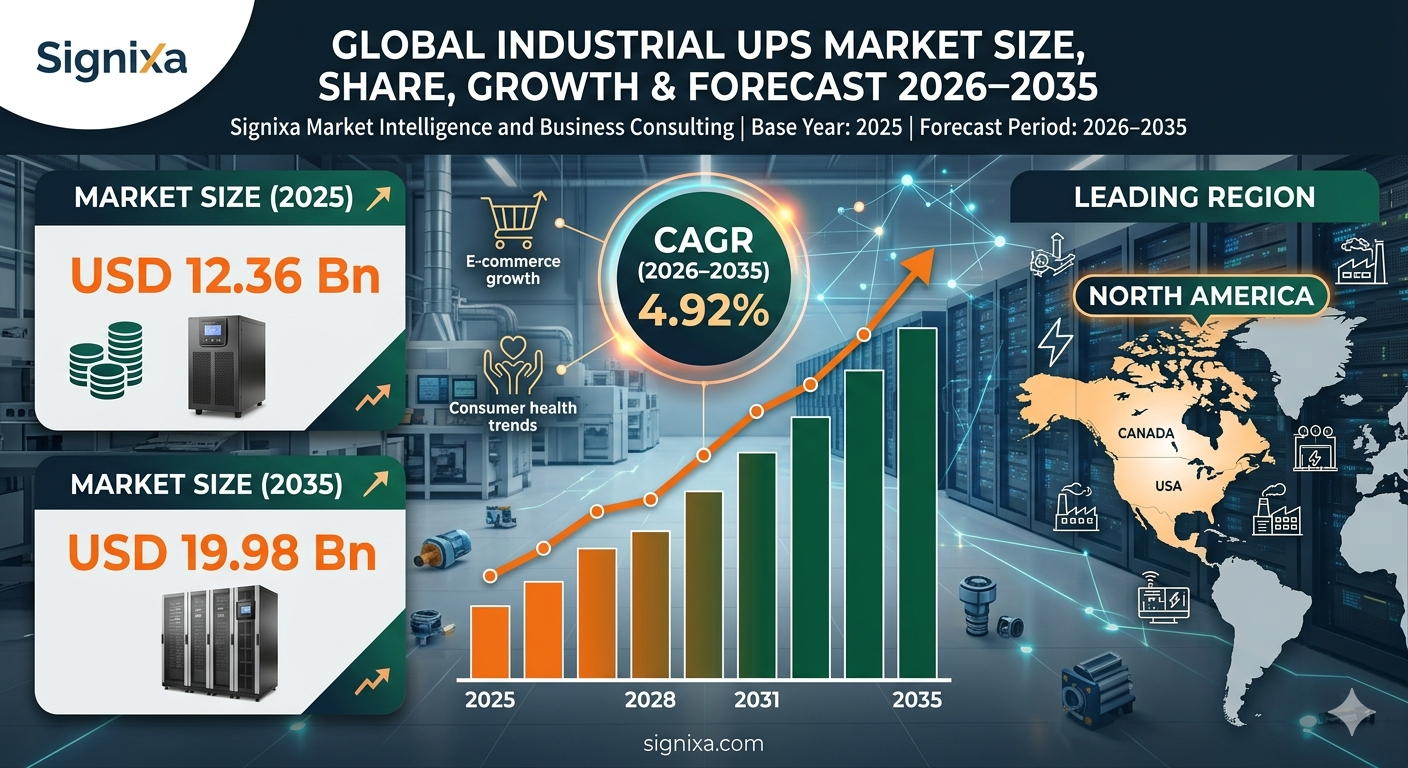
The global Industrial UPS (Uninterruptible Power Supply) market was valued at USD 12.36 billion in 2025 and is expected to grow to USD 19.98 billion by 2035, with a compound annual growth rate (CAGR) of 4.92% during the forecast period from 2026 to 2035. This market growth is driven by the increasing demand for reliable, uninterrupted power in various industrial applications and rising energy consumption globally.
The Industrial UPS market plays a critical role in ensuring the stability and reliability of power supply in industrial operations, providing backup power during grid failures and protecting sensitive equipment from electrical disruptions including voltage sags, spikes, surges, and complete outages. The market's growth is primarily driven by increasing industrial automation, advancements in power electronics, and growing energy needs across industries such as manufacturing, pharmaceuticals, telecom, and data centers. UPS systems are becoming more energy-efficient, compact, and reliable — fostering broader adoption across sectors that require business continuity regardless of grid conditions. With industries becoming more reliant on uninterrupted power, the demand for industrial UPS systems is expected to rise sharply through the forecast period.
Another key factor influencing market dynamics is the increasing demand for energy-efficient UPS systems. Manufacturers are focusing on innovations that allow for lower energy consumption, reduced operational costs, and enhanced environmental sustainability. Furthermore, the continuous development of battery technologies — particularly lithium-ion and hybrid battery alternatives to traditional VRLA (valve-regulated lead-acid) batteries — is significantly improving the performance, lifespan, and energy efficiency of industrial UPS systems. Lithium-ion UPS systems offer substantially longer service life, faster recharge times, smaller footprints, and better performance across temperature ranges compared to conventional lead-acid alternatives, creating a growing replacement and upgrade cycle that will drive market value growth through 2035.
Key Findings
- The global Industrial UPS market is estimated to grow at a CAGR of 4.92% between 2026 and 2035, with market size projected to reach USD 19.98 billion by 2035 from USD 12.36 billion in 2025.
- By Product Type, the Online/Double Conversion UPS segment is expected to dominate, accounting for approximately 45% of market share in 2025, growing at a CAGR of 5.2%.
- By Application, the Manufacturing sector is projected to command the largest share of the market, driven by widespread automation and machinery integration, growing at a CAGR of 5.0%.
- The Data Centre segment is the fastest-growing application with a CAGR of 6.0%, driven by escalating demand for cloud computing, AI infrastructure, and data storage services.
- By Region, North America is expected to hold a significant share owing to its strong industrial base and high adoption of advanced UPS technologies, while Asia-Pacific is the fastest-growing region.
Industrial UPS Market Dynamics
Industrial Automation Growth & Critical Infrastructure Power Reliability Requirements
The growth of the Industrial UPS market is primarily driven by the rising need for uninterrupted power supply in industries where any power failure can lead to significant production losses, equipment damage, or safety hazards. In manufacturing, any power interruption to automated production lines can result in substantial downtime costs and product quality failures. In pharmaceuticals, power fluctuations can compromise temperature-controlled environments required for drug storage and production, potentially resulting in batch failures and regulatory violations. The increased reliance on digital technologies in industrial processes — including programmable logic controllers (PLCs), distributed control systems (DCS), and industrial IoT (IIoT) sensors — has amplified the consequences of even momentary power interruptions, fundamentally elevating the baseline demand for power protection across all industrial verticals through the forecast period.
Lithium-Ion Battery Technology Revolution & Energy Efficiency Innovation
A key dynamic reshaping the industrial UPS market is the accelerating transition from traditional VRLA lead-acid battery technology to lithium-ion and other advanced battery chemistries. Lithium-ion UPS systems offer dramatically superior performance across multiple dimensions — service lives of 10–15 years compared to 3–5 years for VRLA alternatives, recharge times up to five times faster, operating temperature ranges that eliminate the need for temperature-controlled battery rooms in many installations, and significantly smaller footprints that reduce data center and industrial facility space requirements. Manufacturers are also focusing on innovations that lower overall energy consumption through higher efficiency power conversion topologies, including ECO mode and double-conversion online UPS architectures that achieve efficiencies exceeding 96–97%. These technology advancements are creating a large replacement and upgrade market that is expected to sustain steady revenue growth through the forecast period.
Data Center Expansion, Cloud Computing & 5G Infrastructure Investment
The explosive growth of cloud computing, artificial intelligence workloads, and 5G telecommunications infrastructure is creating a powerful structural demand driver for high-reliability industrial UPS systems. Data centers — which consume enormous amounts of continuously available electrical power to maintain server uptime and prevent data loss — represent the fastest-growing application segment for industrial UPS at a CAGR of 6.0%. The proliferation of edge computing facilities, content delivery networks, and hyperscale data centers in suburban and rural markets is broadening the geographic distribution of UPS demand beyond traditional urban data center clusters. Simultaneously, the global 5G network buildout is requiring massive investment in telecom base station power backup infrastructure, with each 5G base station requiring higher power capacity UPS systems than its 4G predecessor to support the denser antenna configurations and active cooling requirements of 5G radio units.
Industrial UPS Market Segmentation Analysis
By Product Type Segment Analysis
The industrial UPS market is segmented by product topology, with each type offering distinct trade-offs between protection level, efficiency, cost, and application suitability across industrial environments:
Online / Double Conversion UPS
The Online/Double Conversion UPS segment is expected to hold the largest market share at approximately 45% in 2025, growing at a CAGR of 5.2% through the forecast period. This system provides the highest level of power protection by continuously conditioning incoming power — converting AC to DC and back to AC — completely isolating connected equipment from all upstream power quality problems including voltage fluctuations, frequency variations, harmonic distortion, and complete power failures with zero transfer time. This makes it ideal for mission-critical applications including data centers, healthcare IT, precision manufacturing, and telecommunications infrastructure. Its superior protection profile justifies the higher initial cost and slightly lower efficiency compared to line-interactive alternatives, and is the topology of choice wherever power quality problems are frequent or the consequences of power disruptions are severe.
Line-Interactive UPS
The Line-Interactive UPS segment offers a well-established balance between cost and performance, providing reliable power protection without the need for constant power conversion. Projected to account for approximately 30% of market share by 2035 and growing at a CAGR of 4.2%, this topology is particularly prevalent in small to medium-sized industrial applications including manufacturing plants, small telecom operations, and commercial facilities where budget constraints make double conversion systems economically difficult to justify at scale. Line-interactive systems automatically regulate voltage within acceptable ranges using an autotransformer — correcting brownouts and overvoltages without switching to battery — while maintaining battery reserves for complete power failures. Their higher efficiency compared to double conversion UPS, combined with adequate protection for most industrial applications, makes them the volume workhouse of the industrial UPS market across price-sensitive deployments.
Offline / Standby UPS
The Offline/Standby UPS segment provides basic power protection and is ideal for applications with lower power demands and less stringent protection requirements, such as retail point-of-sale systems, basic office environments, and residential applications. Expected to hold approximately 25% of the market by 2035 with a steady growth rate of 3.8%, this topology only engages battery backup when complete power failure is detected — with a brief transfer time of 8–25ms. This makes it less suitable for highly sensitive industrial equipment that cannot tolerate any power interruption, including pharmaceutical production systems and data center servers. However, its lower cost, high efficiency during normal operation, and simple maintenance profile ensure continued strong volume demand in less critical applications where budget efficiency is prioritized over maximum protection level.
By Application Segment Analysis
The industrial UPS market serves a broad and diverse array of application sectors, each with distinct power reliability requirements, downtime cost profiles, and UPS technology preferences:
Manufacturing
Manufacturing facilities rely heavily on UPS systems to protect critical machinery and maintain production processes. The manufacturing sector is projected to command the largest application share of the industrial UPS market due to widespread automation and machinery integration, growing at a CAGR of 5.0%. Modern manufacturing environments deploy hundreds of microprocessor-controlled machines, robots, and automated material handling systems that are highly sensitive to power quality events. Even a momentary voltage sag can cause PLCs and servo drives to trip, halting production lines and requiring time-consuming restart and quality inspection procedures. The Industry 4.0 transformation — integrating industrial IoT sensors, edge computing, and real-time data analytics into factory floor operations — is further elevating the power protection requirements of manufacturing environments as the consequences of unprotected power events extend beyond physical equipment to critical digital infrastructure.
Data Centre
Data centers are one of the largest and fastest-growing users of industrial UPS systems, with the segment expected to experience strong growth at a CAGR of 6.0% — the highest of any application segment in the report. The relentless expansion of cloud computing services, enterprise data center consolidation, streaming content delivery, and AI training infrastructure is creating sustained demand for high-reliability UPS systems capable of protecting millions of dollars of IT equipment and the data they process. Modular UPS architectures — where power capacity can be expanded by adding power modules to existing frames without shutting down the system — are particularly valued in data center environments where capacity requirements are difficult to predict and any maintenance-related shutdown represents significant service risk and financial exposure to data center operators.
Telecom
Telecom companies require UPS systems to ensure the continuity of their communication networks across mobile base stations, central office exchanges, and data transmission facilities. The telecom sector is expected to grow at a CAGR of 4.9%, driven by expanding mobile network infrastructure — particularly the global 5G rollout — and the proliferation of data centers that underpin streaming, cloud services, and enterprise connectivity. 5G base stations require significantly higher power capacity than their 4G predecessors, and the massive densification of small cells in urban 5G deployments creates millions of individual power protection requirements that represent a major new volume opportunity for compact industrial UPS systems. The requirement for 99.999% network uptime (five-nines availability) in telecommunications makes UPS investment a non-negotiable infrastructure requirement rather than an optional safety measure.
Mining
The mining sector requires robust power solutions to ensure equipment runs smoothly in harsh, often remote environments where grid connectivity is unreliable or nonexistent. The mining application segment is expected to grow at a CAGR of 5.1%, driven by increasing mining activities in emerging markets across Latin America, Africa, and Asia-Pacific. Industrial UPS systems in mining applications prevent unexpected equipment shutdowns caused by power outages, ensuring both operational safety and continuity for critical systems including ventilation, water pumping, hoisting machinery, and mine communications. The increasing electrification of mining equipment — including autonomous vehicles, electric drills, and electrified conveyor systems — as part of mining sector decarbonization programs is creating new power protection requirements at mining sites that drive UPS demand growth across the forecast period.
Oil & Gas
In the oil and gas industry, reliable power systems are critical to ensure uninterrupted operation of critical equipment including pumps, compressors, drilling machinery, safety shutdown systems, and process control computers. The oil and gas sector's high demand for continuous power protection — particularly for safety-instrumented systems (SIS) and distributed control systems (DCS) that monitor and control hazardous processes — is expected to push the Industrial UPS market in this vertical to grow at a CAGR of 4.8%. UPS systems specified for oil and gas applications must meet stringent safety standards including ATEX and IECEx certification for use in potentially explosive atmospheres, and must operate reliably across extreme temperature ranges in both offshore and onshore environments. The ongoing development of LNG facilities and the digitalization of oilfield operations are creating new power protection requirements across the sector.
Pharmaceuticals
In pharmaceuticals, consistent power is essential to maintain the integrity of sensitive products and to comply with Good Manufacturing Practice (GMP) regulations that mandate validated environmental controls in production and storage facilities. Industrial UPS systems are critical to maintaining temperature-controlled environments in pharmaceutical cleanrooms, cold storage facilities, and bioreactor suites where power interruptions could compromise batch integrity and result in millions of dollars of product losses. The pharmaceutical sector is projected to grow at a CAGR of 4.3%, driven by the increasing production of complex biologics, gene therapies, and personalized medicines that require sophisticated manufacturing environments with the highest standards of environmental control. The COVID-19 pandemic's acceleration of vaccine manufacturing capacity expansion globally contributed to a significant wave of pharmaceutical facility UPS investment that is sustaining ongoing market demand.
Construction
As construction sites adopt more advanced technologies including automated machinery, building information modeling (BIM) systems, and real-time project management platforms, the demand for uninterrupted power protection is rising. Industrial UPS systems protect heavy machinery control systems, temporary site offices, safety monitoring equipment, and on-site communication infrastructure from power fluctuations and outages. The construction sector is projected to witness significant growth at a CAGR of 4.4%, contributing substantially to the overall industrial UPS market. The increasing integration of digital tools and IoT sensors into construction site management — supporting real-time equipment tracking, worker safety monitoring, and automated material logistics — creates power protection requirements that extend well beyond simple backup power for site offices into the protection of sophisticated digital construction management infrastructure.
Marine
The marine industry requires reliable backup power solutions for onboard operations, navigation systems, engine control systems, and safety equipment across commercial vessels, offshore platforms, and military marine assets. The marine application segment is expected to experience steady growth at a CAGR of 4.6%, fuelled by increased demand for power protection in both commercial and military marine operations. Marine-specified UPS systems must meet stringent certification requirements from classification societies including Lloyd's Register, DNV, and Bureau Veritas, and must operate reliably in high-humidity, high-vibration, and salt-spray environments that place exceptional demands on component reliability. The electrification of commercial shipping — including hybrid and fully electric vessels entering service — is creating new power architecture requirements that include advanced UPS and energy storage systems for onboard power management across the transition to low-carbon maritime transport.
Report Attributes & Market Scope
| Report Attribute | Details |
|---|---|
| Market Size Value in 2025 | USD 12.36 Billion |
| Market Size Value in 2035 | USD 19.98 Billion |
| CAGR (2026–2035) | 4.92% |
| Base Year Used for Estimation | 2025 |
| Historic Data | 2020 – 2025 |
| Forecast Period | 2026 – 2035 |
| Segments Covered – By Product Type |
|
| Segments Covered – By Application |
|
| Regions Covered | North America, Europe, Asia Pacific, Latin America, Middle East and Africa |
| Major Countries Covered | U.S., Canada, Mexico, Germany, UK, France, Italy, Spain, Russia, China, Japan, South Korea, India, Southeast Asia Countries, Brazil, Argentina, GCC Countries, Turkey, Iran, Israel, South Africa, Egypt, Nigeria, etc. |
| Key Companies Profiled | Schneider Electric, Eaton, Vertiv, ABB, Siemens, Toshiba, Huawei Technologies, Socomec, Fuji Electric, and Emerson Network Power, among others. |
Industrial UPS Market Regional Analysis
The global Industrial UPS market is experiencing significant growth across all regions, with North America and Europe leading due to advanced industrialization, higher adoption of automation, and stringent power reliability regulations. The Asia-Pacific region is expected to emerge as the fastest-growing market, fuelled by industrial expansion particularly in China, India, and Southeast Asia. Latin America and the Middle East & Africa are also projected to see increased demand, driven by infrastructure development and the need for reliable power in emerging markets.
North America (Leading Region)
North America holds a significant share of the global Industrial UPS market, owing to its strong industrial base, high adoption of advanced UPS technologies, and robust demand from data centers, manufacturing facilities, and telecom infrastructure operators. The United States is the primary revenue contributor, driven by its world-leading data center industry — which represents the largest concentration of colocation and hyperscale data center capacity globally — and by significant investment in domestic manufacturing expansion under reshoring and nearshoring programs. The growing adoption of lithium-ion battery-based UPS systems in North American data centers and critical facilities is driving average system value uplift that sustains market revenue growth even in periods of stable unit volume. Stringent regulatory requirements for operational continuity in healthcare, financial services, and defense sectors further underpin consistent demand for high-reliability industrial UPS solutions throughout the region.
Europe
Europe is a major and mature market for industrial UPS systems, driven by advanced industrialization, stringent energy efficiency regulations, and significant demand from the automotive manufacturing, pharmaceutical, chemical, and data center sectors. The EU's ambitious energy efficiency directives — including the Ecodesign Regulation requirements that set mandatory efficiency standards for UPS systems — are accelerating the replacement of older, less efficient UPS installations with modern high-efficiency double-conversion and line-interactive systems. Germany, the UK, and France represent the largest national markets within Europe, driven by their major manufacturing sectors and growing data center footprints. The rapid growth of hyperscale data centers in Ireland, the Netherlands, and the Nordics — attracted by renewable energy availability and favorable power pricing — is creating concentrated UPS demand in these markets that is driving strong regional market expansion alongside established industrial UPS demand from the continent's manufacturing heartland.
Asia Pacific (Fastest-Growing Region)
The Asia-Pacific region is expected to emerge as the fastest-growing Industrial UPS market, fuelled by rapid industrial expansion particularly in China, India, Southeast Asia, and South Korea. China is the dominant market within the region, combining enormous manufacturing scale — supporting the world's largest manufacturing economy — with rapidly growing data center capacity driven by cloud computing adoption and digital economy expansion. India's manufacturing sector expansion under the Production Linked Incentive (PLI) scheme, combined with massive data center investment from global cloud providers establishing local infrastructure, is creating strong and growing UPS demand. Southeast Asian nations including Vietnam, Thailand, and Indonesia are experiencing manufacturing sector growth as supply chain diversification strategies redirect investment from China, further expanding the regional UPS addressable market. Japan and South Korea maintain sophisticated, high-value industrial UPS markets serving their advanced semiconductor, electronics, and automotive manufacturing sectors.
Latin America
Latin America is an emerging growth market for industrial UPS systems, driven by infrastructure development programs, growing manufacturing sectors, and increasing demand for reliable power in emerging economies across Brazil, Mexico, Chile, Colombia, and Argentina. Brazil and Mexico are the primary contributors, driven by significant industrial bases in automotive, food processing, and petrochemical manufacturing, combined with growing data center investment from major technology companies establishing regional infrastructure for rapidly expanding Latin American digital economy users. The region's telecommunications expansion — including ongoing 5G network rollout in major urban markets — is creating new UPS demand at mobile network base station sites. Frequent power quality challenges in parts of Latin America's grid infrastructure, including voltage instability and outage frequency, create strong economic justification for UPS investment that positions the market for sustained growth through the forecast period.
Middle East & Africa
The Middle East and Africa region represents an emerging and growing market for industrial UPS systems, driven by infrastructure development, oil and gas sector investment, and ambitious smart city development programs in GCC countries. Saudi Arabia, UAE, Qatar, and Kuwait are investing heavily in non-oil economic diversification programs that include large-scale data center development, advanced manufacturing zones, and telecommunications infrastructure upgrades — all of which require reliable UPS protection. The UAE's ambition to establish itself as a regional data center hub is particularly significant, with multiple hyperscale data center campus projects attracting global cloud providers and creating concentrated UPS demand in Dubai and Abu Dhabi. In Africa, South Africa, Nigeria, Kenya, and Egypt represent the primary UPS markets, driven by telecommunications network expansion, banking sector IT infrastructure investment, and industrial manufacturing growth in these continental economic leaders.
Recent Developments in the Industrial UPS Market
-
2023
Schneider Electric launched a new range of high-efficiency UPS solutions designed for energy-intensive applications in manufacturing and telecom sectors, featuring advanced power conversion topologies and lithium-ion battery compatibility to reduce total cost of ownership and carbon footprint across industrial power protection deployments.
-
2021
Vertiv expanded its line of lithium-ion battery UPS systems to offer longer runtimes and faster recharging for critical operations in data centers and healthcare facilities, enabling customers to reduce battery room footprint while extending backup power duration — a key competitive differentiator as data center power density requirements escalate with AI and high-performance computing workloads.
Industrial UPS Market: Competitive Landscape
Key players in the global Industrial UPS market include Schneider Electric, Eaton, Vertiv, ABB, Siemens, Toshiba, Huawei Technologies, Socomec, Fuji Electric, and Emerson Network Power. These companies are focusing on product innovation — including advancements in battery technologies and energy-efficient designs — to gain competitive advantage. Additionally, they are expanding their global presence through strategic partnerships and acquisitions while tapping into emerging markets with increasing demand for reliable power solutions across industries.
The competitive landscape of the industrial UPS market is defined by a mix of global power management conglomerates — including Schneider Electric, Eaton, and ABB — who offer comprehensive product portfolios spanning the full spectrum from small single-phase UPS systems to multi-megawatt modular data center power systems, alongside more specialized players including Vertiv, Socomec, and Fuji Electric who compete on technical depth and application expertise within specific industrial verticals. The transition to lithium-ion battery technology is a significant competitive battleground, as each major vendor develops proprietary lithium-ion battery management systems and integrated UPS-battery solutions that differentiate on safety certification, warranty terms, and total cost of ownership projections. Chinese vendors including Huawei Technologies are gaining significant market share in Asia-Pacific and emerging markets by offering highly competitive pricing on modern, technically capable UPS platforms, challenging the established Western and Japanese vendors' pricing power across the global market.
Cloud-connected UPS monitoring and predictive maintenance capabilities are emerging as important competitive differentiators as operators demand remote visibility into UPS health, battery state, and power quality metrics across geographically distributed installations. Integration with building management systems (BMS) and data center infrastructure management (DCIM) platforms via open protocols is increasingly a purchasing criterion for large enterprise and data center customers. Companies that can demonstrate measurable improvements in energy efficiency, total cost of ownership, and operational simplicity through digitally integrated UPS solutions are gaining ground across all market segments through the forecast period.
Key Companies Profiled
Global Industrial UPS Market Segmentation Summary
By Product Type
By Application
By Region
Frequently Asked Questions (FAQs) About the Industrial UPS Market
What is Industrial UPS?
Industrial UPS (Uninterruptible Power Supply) is a power protection solution designed to provide backup power during interruptions, ensuring that critical systems in industrial applications continue to function without disruption. These systems are essential for maintaining the power supply in industries like mining, oil and gas, construction, and telecom.
Which key factors will influence the Industrial UPS market growth over 2026–2035?
The Industrial UPS market is expected to grow due to the increasing demand for reliable power backup systems in various industries such as telecom, manufacturing, pharmaceuticals, and data centers. Factors such as industrial automation, the growing adoption of renewable energy, and the need for power protection in critical infrastructure will drive market growth.
What will be the value of the Industrial UPS market during 2026–2035?
According to the study, the global Industrial UPS market size was worth around USD 12.36 billion in 2025 and is predicted to grow to around USD 19.98 billion by 2035.
What will be the CAGR value of the Industrial UPS market during 2026–2035?
The CAGR value of the Industrial UPS market is expected to be around 4.92% during the forecast period of 2026 to 2035.
Which region will contribute notably towards the Industrial UPS market value?
The Industrial UPS market is led by North America and Europe, driven by technological advancements, industrial development, and the need for power protection across critical industries. The Asia-Pacific region is also showing significant growth due to industrial expansion and increased demand for continuous power supply in emerging markets.
Which are the major players leveraging the Industrial UPS market growth?
Major players in the Industrial UPS market include Schneider Electric, Eaton Corporation, Emerson Electric, ABB, Toshiba, Vertiv, Mitsubishi Electric, and Legrand, among others. These companies are focusing on innovation and expanding their product portfolios to cater to the growing demand for reliable power backup solutions.
What can be expected from the global Industrial UPS market report?
The report provides a comprehensive analysis of the Industrial UPS market, including detailed insights into market drivers, restraints, and opportunities. It covers key trends, competitive landscape, and regional analysis to help stakeholders make informed decisions and understand the future growth prospects in the industrial UPS sector through the forecast period 2026 to 2035.