
Gastrointestinal Surgery Suture Thread Market Market Overview
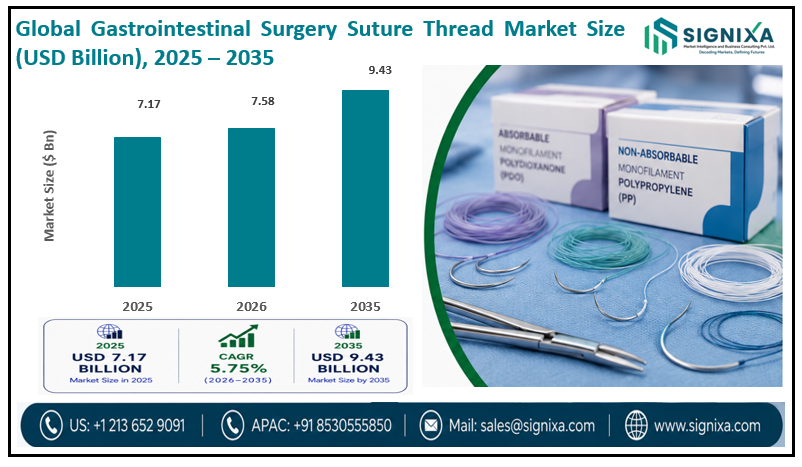
The size of the global Gastrointestinal Surgery Suture Thread Market was valued at approximately USD 7.17 Billion in 2025 and is projected to reach around USD 9.43 Billion by 2035, growing at a compound annual growth rate (CAGR) of 5.75% from 2026 to 2035. This report delves into the major drivers, restraints, and opportunities shaping the market while evaluating regional dynamics and competitive strategies.
The gastrointestinal surgery suture thread market includes products used to close surgical incisions or wounds in the digestive tract. Rising surgical volumes, an aging population, increasing prevalence of gastrointestinal disorders, and technological advancements in suture materials are key factors driving growth. Growing demand for minimally invasive procedures and robotic-assisted suturing is also expanding the scope of market adoption.
The Gastrointestinal (GI) Surgery Suture Thread market is a critical component of the broader surgical sutures industry, driven by the increasing global prevalence of gastrointestinal disorders and the rising volume of surgical procedures performed to treat them. Conditions such as appendicitis, inflammatory bowel disease, colorectal cancer, ulcers, and hernias necessitate surgical intervention, creating a consistent demand for high-quality suture threads. These threads are essential for approximating tissues, closing incisions, and ligating vessels within the delicate and often challenging environment of the GI tract. The market's evolution is heavily influenced by the need for sutures that offer optimal tensile strength to withstand the stresses of the digestive system, while also promoting effective healing and minimizing complications like anastomotic leaks or infections. Furthermore, the growing elderly population, which is more susceptible to GI-related ailments, contributes significantly to the increasing number of surgical procedures, thereby fuelling the demand for advanced suture materials.
A significant market dynamic is the continuous innovation in suture material science and design, with a strong emphasis on absorbable, antimicrobial, and specialized sutures for minimally invasive surgery. Resorbable sutures, which degrade naturally within the body, are gaining significant traction in GI surgery as they eliminate the need for suture removal and can reduce the risk of foreign body reactions or long-term complications. Manufacturers are developing synthetic absorbable polymers like polydioxanone (PDO), polyglycolic acid (PGA), and polyglactin 910, offering varying rates of absorption and tensile strength retention tailored to specific GI tissue healing times. Moreover, the battle against surgical site infections (SSIs) is driving the development of antimicrobial-coated sutures (e.g., with triclosan or silver nanoparticles), which aim to reduce bacterial colonization at the surgical site and improve patient outcomes. The widespread adoption of minimally invasive surgical techniques, such as laparoscopy and robotics, also necessitates specialized suture threads that offer enhanced knot security, smooth passage through tissue, and ease of handling in confined spaces, pushing for innovation in barbed or knotless designs.
However, the GI surgery suture thread market also faces notable challenges, including the availability of alternative wound closure techniques, the constant pressure to reduce healthcare costs, and stringent regulatory approval processes. While sutures remain the gold standard for many GI procedures, alternative methods like surgical staples, tissue adhesives (surgical glue), and wound closure strips are increasingly being utilized, particularly in certain types of anastomoses or less complex closures. This competition from alternative wound closure devices can impact market share for traditional sutures. Additionally, healthcare providers are under constant pressure to contain costs, leading to a demand for cost-effective suture solutions, which can challenge manufacturers' profit margins, especially for premium, innovative products. Furthermore, new suture materials and designs, particularly those with antimicrobial properties or drug-eluting capabilities, must undergo rigorous testing and lengthy regulatory approval processes (e.g., FDA clearance in the US, CE Mark in Europe) to ensure their safety and efficacy, which can delay market entry and increase development costs.
Key Findings
- The global Gastrointestinal Surgery Suture Thread Market is expected to grow at a CAGR of around 5.75% between 2026 and 2035.
- In terms of revenue, the market size is projected to increase from USD 7.17 Billion in 2025 to USD 9.43 Billion by 2035.
- Based on product type, suture threads dominate the market owing to their widespread use, affordability, and effectiveness in gastrointestinal surgical procedures.
- By type, monofilament sutures are expected to account for the largest market share due to their lower infection risk, smooth tissue passage, and reduced tissue trauma.
- Based on form, synthetic sutures are projected to lead the market because of their superior tensile strength, predictable absorption, and excellent biocompatibility.
- In terms of application, general surgery is expected to remain the largest segment, driven by the high volume of gastrointestinal surgical procedures performed globally.
- Among end users, hospitals represent the dominant market share due to their advanced surgical infrastructure, skilled healthcare professionals, and high patient admissions.
- North America is expected to dominate the global Gastrointestinal Surgery Suture Thread Market throughout the forecast period, supported by advanced healthcare facilities, rising surgical volumes, and the presence of leading medical device manufacturers.
Gastrointestinal Surgery Suture Thread Market Dynamics
Rising Gastrointestinal Surgeries and Digestive Disorders Driving Market Growth
Rising demand for gastrointestinal procedures, driven by an aging population and an increase in digestive tract disorders, is significantly fueling market expansion. Conditions such as colorectal cancer, inflammatory bowel disease, and ulcers are becoming more prevalent worldwide. This, combined with advances in laparoscopic and robotic surgery techniques, is increasing the adoption of precision suturing products. Surgeons are demanding sutures that offer high tensile strength, lower risk of infection, and better handling characteristics, which is supporting the market's upward trajectory.
Modern Suturing Technologies Expanding the Gastrointestinal Surgery Suture Thread Market
Innovation in suture materials and techniques is also a critical driver of market growth. The transition from traditional natural sutures to synthetic absorbable and non-absorbable sutures has enhanced healing outcomes and reduced postoperative complications. Additionally, automated suturing devices are gaining traction due to their ability to reduce operation times, standardize suturing techniques, and support minimally invasive surgeries. These advancements are making procedures more accessible in ambulatory surgical centers and physician offices, broadening the market footprint.
Increasing Gastrointestinal Surgical Procedures Fueling Market Expansion
The Gastrointestinal (GI) Surgery Suture Thread market is a critical component of the broader surgical sutures industry, driven by the increasing global prevalence of gastrointestinal disorders and the rising volume of surgical procedures performed to treat them. Conditions such as appendicitis, inflammatory bowel disease, colorectal cancer, ulcers, and hernias necessitate surgical intervention, creating a consistent demand for high-quality suture threads. These threads are essential for approximating tissues, closing incisions, and ligating vessels within the delicate and often challenging environment of the GI tract. The market's evolution is heavily influenced by the need for sutures that offer optimal tensile strength to withstand the stresses of the digestive system, while also promoting effective healing and minimizing complications like anastomotic leaks or infections. Furthermore, the growing elderly population, which is more susceptible to GI-related ailments and often requires multiple surgical interventions, contributes significantly to the increasing number of surgical procedures, thereby fueling the demand for advanced suture materials.
Innovation in Absorbable and Antimicrobial Sutures Driving Market Growth
A significant market dynamic is the continuous innovation in suture material science and design, with a strong emphasis on absorbable, antimicrobial, and specialized sutures for minimally invasive surgery. Resorbable sutures, which degrade naturally within the body, are gaining significant traction in GI surgery as they eliminate the need for suture removal and can reduce the risk of foreign body reactions or long-term complications. Manufacturers are developing advanced synthetic absorbable polymers (e.g., polydioxanone (PDO), polyglycolic acid (PGA), polyglactin 910) that offer predictable degradation profiles, varying rates of absorption, and tailored tensile strength retention to match specific GI tissue healing times. Moreover, the critical imperative to reduce surgical site infections (SSIs) is a major driver behind the development of antimicrobial-coated sutures (e.g., those impregnated with triclosan or silver nanoparticles), which aim to inhibit bacterial colonization at the surgical site and significantly improve patient outcomes. The widespread adoption of minimally invasive surgical techniques, such as laparoscopy and robotics, also necessitates specialized suture threads that offer enhanced knot security, smooth passage through cannulas, and ease of handling in confined anatomical spaces, pushing for innovation in barbed or knotless designs.
Stringent Regulatory Approvals Creating Challenges for Suture Thread Manufacturers
The GI surgery suture thread market also faces notable challenges, including the availability of alternative wound closure techniques, the constant pressure to reduce healthcare costs, and stringent regulatory approval processes. While sutures remain the gold standard for many GI procedures due to their versatility and strength, alternative methods like surgical staples, tissue adhesives (surgical glue), and wound closure strips are increasingly being utilized, particularly in certain types of anastomoses or less complex closures, thereby posing competition to traditional sutures. Additionally, healthcare providers globally are under constant pressure to contain costs, leading to a demand for more cost-effective suture solutions. This can challenge manufacturers' profit margins, especially for premium, innovative products that incorporate advanced materials or coatings. Furthermore, new suture materials and designs, particularly those with novel properties (e.g., antimicrobial agents, drug-eluting capabilities), must undergo rigorous testing and lengthy regulatory approval processes by bodies such as the FDA in the US or the CE Mark in Europe to ensure their safety and efficacy. These stringent requirements can delay market entry, increase development costs, and pose a significant barrier for new innovations.
Gastrointestinal Surgery Suture Thread Market Segmentation Analysis
By Product Type Segment Analysis
Suture threads accounted for the largest share in 2025, contributing over 65% of the total market value, due to their routine use in a variety of surgeries. Automated suturing devices are gaining momentum, particularly in robotic and laparoscopic surgeries, due to their precision and efficiency.
By Type Segment Analysis
Monofilament sutures are projected to hold a dominant share, accounting for more than 58% of the market in 2025. Their single-strand structure reduces the risk of harboring bacteria, thus minimizing postoperative infection. Multifilament sutures, though easier to handle, are more prone to infection, limiting their usage in contaminated surgical environments.
By Form Segment Analysis
Synthetic sutures are expected to dominate with over 70% of market share by 2035. Their predictable absorption rates, higher tensile strength, and reduced tissue reaction make them preferable for a wide range of gastrointestinal surgeries. Natural sutures, including catgut, are declining due to variability in absorption and higher immunogenic response.
By Application Segment Analysis
General surgery leads the application segment with over 40% share in 2025, as it includes appendectomies, hernia repairs, and gastric bypass procedures. Cardiovascular and gynecological surgeries also contribute substantially, supported by the increasing adoption of minimally invasive techniques.
By End User Segment Analysis
Hospitals dominate the end-user segment with over 60% share in 2025, benefiting from their large surgical caseloads and access to advanced infrastructure. Ambulatory surgical centers and clinics are emerging as strong contenders due to shorter recovery times and cost-effective treatments.
Report Attributes & Market Scope
| Report Attribute | Details |
|---|---|
| Market Size Value in 2025 | USD 7.17 Billion |
| Market Size Value in 2035 | USD 9.43 Billion |
| CAGR (2026–2035) | 5.75% |
| Base Year Used for Estimation | 2025 |
| Historic Data | 2020 - 2025 |
| Forecast Period | 2026 - 2035 |
| Segments Covered – By Product Type |
|
| Segments Covered – By Type |
|
| Segments Covered – By Form |
|
| Segments Covered – By Application |
|
| Segments Covered – By End-User |
|
| Regions Covered | North America, Europe, Asia Pacific, Latin America, Middle East and Africa |
| Major Countries Covered | U.S., Canada, Mexico, Germany, UK, France, Italy, Spain, Russia, China, Japan, South Korea, India, Southeast Asia Countries, Brazil, Argentina, GCC Countries, Turkey, Iran, Israel, South Africa, Egypt, Nigeria, etc. |
| Key Companies Profiled | Ethicon (Johnson & Johnson), Medtronic, B. Braun Melsungen AG, Smith & Nephew, Boston Scientific, Sutures India, Teleflex Incorporated, Peters Surgical, Mellon Medical, DemeTech, among others. |
Gastrointestinal Surgery Suture Thread Market Regional Analysis
North America is expected to remain the leading region, driven by high surgical procedure volumes, well-established healthcare infrastructure, and rapid adoption of advanced suturing techniques. Asia-Pacific is projected to witness the fastest growth during the forecast period, fueled by a growing patient pool, increasing healthcare investments, and improving surgical expertise in countries like China and India. Europe maintains a steady share, benefiting from rising demand for minimally invasive surgeries and strong regulatory support. Emerging markets in Latin America and the Middle East & Africa are poised for growth as healthcare access improves.
North America (Leading Region)
North America holds a leading position in the Gastrointestinal (GI) Surgery Suture Thread market, driven by its advanced healthcare infrastructure, high prevalence of GI disorders, and a strong emphasis on adopting innovative surgical techniques. The United States, in particular, accounts for a significant share due to a large number of GI surgical procedures, including those for colorectal cancer, inflammatory bowel disease, and bariatric surgery. The market here is characterized by a strong preference for absorbable sutures due to their convenience and reduced risk of complications, aligning with trends towards minimally invasive surgeries. There's also increasing adoption of antimicrobial-coated sutures to combat surgical site infections (SSIs), a critical concern in abdominal procedures. Leading medical device manufacturers with extensive R&D capabilities and wide distribution networks dominate the landscape, constantly introducing advanced materials and designs tailored for improved knot security, tissue approximation, and healing in the challenging GI environment. The presence of well-established reimbursement policies and a high level of patient awareness further contribute to the market's robust growth in the region.
Europe
Europe represents a mature and highly innovative market for GI surgery suture threads, heavily influenced by its aging population, increasing incidence of chronic GI diseases, and a strong focus on patient safety and cost-effectiveness. Countries like Germany, the UK, and France are key contributors to market demand, driven by a high volume of general and specialized GI surgeries. The European market shows a significant shift towards synthetic absorbable sutures due to their predictable absorption profiles and reduced biological reaction. There's also a growing adoption of specialized sutures for laparoscopic and robotic-assisted GI procedures, emphasizing features like smooth tissue passage, secure knotting, and ease of handling in confined spaces. Regulatory bodies like the European Medicines Agency (EMA) and national health authorities ensure stringent quality and safety standards, impacting product development and market entry. The emphasis on reducing healthcare-associated infections also fuels the demand for antimicrobial-coated sutures. Furthermore, the strong presence of major global medical device companies and a robust research ecosystem continually drive innovation in suture materials and designs across the region.
Asia Pacific
The Asia Pacific region is rapidly emerging as the fastest-growing market for GI surgery suture threads, primarily due to its vast and aging population, rising disposable incomes, and significant improvements in healthcare infrastructure. Countries like China and India are experiencing a surge in GI surgeries driven by increasing prevalence of lifestyle-related gastrointestinal disorders and expanding access to surgical care. This region exhibits a growing demand for both absorbable and non-absorbable sutures, with absorbable sutures gaining particular traction due to their convenience and favorable patient outcomes. The adoption of minimally invasive surgical techniques is also increasing, which in turn boosts the demand for specialized sutures compatible with laparoscopic and robotic procedures. While cost-effectiveness remains a crucial factor in many parts of the region, there's a growing willingness to adopt technologically advanced sutures that offer better performance and reduced complication rates. Local manufacturers are playing an increasingly important role, often competing on price and adapting products to regional needs, while global players are expanding their distribution networks and focusing on market penetration in this high-growth area.
Middle East and Africa
The Middle East & Africa (MEA) GI surgery suture thread market is in its nascent but rapidly developing phase, driven by increasing healthcare expenditure, growing medical tourism, and a rising awareness of advanced surgical techniques. Countries in the Middle East, particularly the UAE, Saudi Arabia, and Qatar, are investing heavily in modernizing their healthcare systems and building world-class medical facilities, which includes equipping them with advanced surgical tools like high-quality sutures. The increasing prevalence of lifestyle diseases leading to GI complications, coupled with an expanding expatriate population seeking medical services, contributes to the demand for GI surgeries. In Africa, while the market is still emerging, there's a gradual improvement in healthcare access and a growing focus on addressing infectious and non-infectious GI diseases, slowly increasing the volume of surgical procedures. The demand in MEA is for a balance of cost-effectiveness and quality, with a growing interest in absorbable and antimicrobial sutures to improve patient outcomes. However, challenges such as varying healthcare spending capabilities, limited awareness of advanced suture technologies in some sub-regions, and fragmented distribution channels can impact market penetration.
Recent Developments in the Gastrointestinal Surgery Suture Thread Market
-
2026
Johnson & Johnson MedTech (Ethicon) expanded its portfolio of advanced wound closure solutions by strengthening its focus on antimicrobial and absorbable suture technologies designed to improve tissue healing and reduce surgical site infections in gastrointestinal procedures. The development supports the growing demand for high-performance sutures in minimally invasive GI surgeries.
B. Braun continued to invest in next-generation synthetic absorbable sutures with enhanced tensile strength and predictable absorption profiles, addressing the increasing need for reliable wound closure products used in gastrointestinal and general surgical procedures.
Medtronic plc accelerated its focus on minimally invasive and robotic-assisted surgery solutions, supporting the adoption of advanced suturing technologies that improve procedural precision and clinical outcomes in complex gastrointestinal surgeries.
-
2025
Smith+Nephew continued expanding its advanced wound management portfolio, emphasizing technologies that enhance surgical healing and reduce postoperative complications, supporting demand across gastrointestinal surgical applications.
Teleflex Incorporated strengthened its surgical product portfolio by advancing minimally invasive surgical solutions and precision surgical instruments, reinforcing its position in gastrointestinal and general surgery markets where efficient wound closure remains essential.
Gastrointestinal Surgery Suture Thread Market: Competitive Landscape
Key players in the global market include Ethicon (Johnson & Johnson), Medtronic, B. Braun Melsungen AG, Smith & Nephew, Boston Scientific, Sutures India, Teleflex Incorporated, Peters Surgical, Mellon Medical, and DemeTech. Competition revolves around product innovation, material advancement, global distribution reach, and integration with robotic surgery platforms. Strategic mergers and acquisitions, along with regional expansion, remain common growth tactics to capture market share in both developed and emerging economies.
Key Companies Profiled
- Ethicon (Johnson & Johnson)
- Medtronic plc
- B. Braun Melsungen AG
- Smith & Nephew plc
- Boston Scientific Corporation
- Sutures India Pvt. Ltd.
- Teleflex Incorporated
- Peters Surgical
- Mellon Medical B.V.
- DemeTECH Corporation
- Corza Medical
- Healthium Medtech Limited
- Advanced Medical Solutions Group plc
- Dolphin Sutures (Futura Surgicare Pvt. Ltd.)
- Meril Life Sciences Pvt. Ltd.
- Assut Europe S.p.A.
- Internacional Farmacéutica S.A. de C.V. (Atramat)
Global Gastrointestinal Surgery Suture Thread Market Segmentation Summary
By Product Type
- Suture Threads
- Automated Suturing Devices
By Type
- Multifilament
- Monofilament Sutures
By Form
- Natural
- Synthetic Sutures
By Application
- Cardiovascular Surgery
- General Surgery
- Gynecological Surgery
- Orthopedic Surgeries
By End-User
- Hospitals
- Ambulatory Surgical Centers (ASCs)
- Clinics
- Physician Offices
By Region
- North America
- U.S.
- Canada
- Mexico
- Europe
- Germany
- France
- UK
- Spain
- Italy
- Rest of Europe
- Asia-Pacific
- China
- Japan
- India
- Australia
- South Korea
- Southeast Asia
- Rest of Asia-Pacific
- Latin America
- Brazil
- Argentina
- Rest of Latin America
- The Middle East & Africa
- GCC Countries
- South Africa
- Rest of the Middle East & Africa
Frequently Asked Questions (FAQs) About the Gastrointestinal Surgery Suture Thread Market
What is Gastrointestinal Surgery Suture Thread?
Gastrointestinal surgery suture threads are sterile surgical threads used to close wounds and incisions after gastrointestinal surgeries. These sutures may be absorbable or non-absorbable and can be made from synthetic or natural materials. They are essential for ensuring proper wound healing and preventing complications.
Which key factors will influence the Gastrointestinal Surgery Suture Thread Market growth over 2026–2035?
The market will grow due to increasing cases of gastrointestinal diseases, a rise in surgical procedures, aging population, advancements in suture material technology, and greater adoption of minimally invasive surgeries using robotic and laparoscopic techniques.
What will be the value of the Gastrointestinal Surgery Suture Thread Market during 2026–2035?
The global Gastrointestinal Surgery Suture Thread Market accounted for around USD 7.17 Billion in 2025 and is forecast to attain a value of approximately USD 9.43 Billion by 2035.
What will be the CAGR value of the Gastrointestinal Surgery Suture Thread Market during 2026–2035?
The Gastrointestinal Surgery Suture Thread Market is projected to grow at a CAGR of 5.75% during the forecast period of 2026–2035, driven by the rising prevalence of gastrointestinal disorders, increasing surgical procedures, advancements in suture technologies, and growing adoption of minimally invasive surgeries.
Which region will contribute notably towards the Gastrointestinal Surgery Suture Thread Market value?
North America will contribute significantly to the market, followed closely by Asia-Pacific. This is due to factors like high surgical volumes, advanced healthcare systems, rising healthcare spending, and the presence of major medical device manufacturers.
Which are the major players leveraging the Gastrointestinal Surgery Suture Thread Market growth?
Key players in the global gastrointestinal surgery suture thread market include Ethicon (Johnson & Johnson), Medtronic, B. Braun Melsungen AG, Smith & Nephew, Boston Scientific, Sutures India, Teleflex Incorporated, Peters Surgical, Mellon Medical, and DemeTech.
What can be expected from the global Gastrointestinal Surgery Suture Thread Market report?
The report provides a comprehensive analysis of the market including growth drivers, restraints, and opportunities. It includes segmentation by product type, form, application, and end user, as well as competitive landscape, regional trends, recent developments, and detailed forecasts from 2026 to 2035.