

EV Charging Software Market Overview
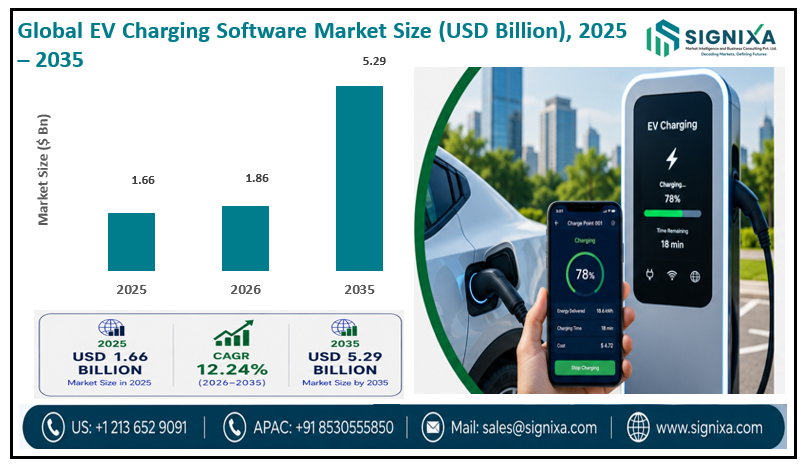
The size of the global EV Charging Software market was valued at around USD 1.66 Billion in 2025 and is projected to reach USD 5.29 Billion by 2035, growing at a compound annual growth rate (CAGR) of 12.24% between 2026 and 2035. The report provides a comprehensive analysis of the drivers and restraints influencing demand, along with opportunities in the EV charging software landscape.
The EV charging software market comprises digital platforms that manage and optimize electric vehicle (EV) charging operations across public and private networks. This includes applications for billing, scheduling, energy management, diagnostics, and user experience enhancements. As the EV ecosystem expands, robust and scalable software is essential to support growing charging infrastructures globally. Increasing adoption of EVs, demand for smart charging features, and the shift toward renewable energy integration are key growth contributors.
The EV charging software market is a pivotal and rapidly evolving segment at the core of the electric vehicle ecosystem, driven by the accelerating global adoption of electric vehicles and the increasing complexity of managing extensive charging infrastructure. As the number of EVs on roads worldwide continues to surge, the demand for efficient, reliable, and scalable software solutions to manage charging stations, optimize energy flow, and enhance user experience has become paramount. This software forms the backbone of any charging network, whether public, commercial, or residential, enabling functionalities like real-time monitoring of charger status, remote diagnostics, user authentication, and payment processing. The necessity to ensure seamless operation of a rapidly expanding and geographically dispersed network of charging points, coupled with the need to integrate these operations with grid management systems, is a fundamental driver propelling the growth of this market.
A significant market dynamic is the continuous innovation and expansion of functionalities within EV charging software platforms, moving beyond basic charger management to sophisticated energy optimization and customer engagement tools. Modern EV charging software is increasingly incorporating advanced features such as dynamic load management, which intelligently distributes power among multiple chargers to prevent grid overloads and reduce energy costs. Furthermore, the integration of Artificial Intelligence (AI) and machine learning (ML) is enabling predictive maintenance for charging stations, optimizing charging schedules based on electricity prices and grid conditions, and providing personalized recommendations to EV drivers. The emphasis on enhancing the user experience is also a key differentiator, leading to the development of intuitive mobile applications that offer features like charger discovery, real-time availability updates, reservation systems, and diverse payment options. This ongoing technological evolution, driven by the need for more efficient, user-friendly, and cost-effective charging solutions, is continually expanding the market's capabilities and attracting new investments.
The EV charging software market also faces notable challenges, primarily related to regulatory fragmentation, interoperability issues, and cybersecurity concerns. The absence of globally harmonized standards and consistent regulations across different regions and even within countries creates complexities for software providers, affecting development, deployment, and scalability. Interoperability between different charging hardware manufacturers and software platforms is another significant hurdle; while protocols like OCPP (Open Charge Point Protocol) are gaining traction, ensuring seamless communication across a diverse ecosystem remains a challenge. Moreover, as charging networks become more connected and reliant on software, the risk of cyber-attacks targeting user data, payment systems, or even grid infrastructure increases. Addressing these security vulnerabilities through robust encryption and resilient software architecture is crucial for building consumer trust and ensuring the long-term stability of the market. Overcoming these technical, regulatory, and security challenges will be vital for the continued growth and maturity of the EV charging software market.
Key Findings
- The EV charging software market is projected to grow at a CAGR of 12.24% during the forecast period (2026–2035).
- In revenue terms, the market size will increase from USD 1.66 Billion in 2025 to USD 5.29 Billion by 2035.
- Public charging sites are expected to dominate the market due to large-scale infrastructure projects, and Level 2 Chargers are anticipated to command the largest share among charger types.
- Personal E-Cars will dominate the vehicle type segment due to rising EV ownership and growing demand for smart charging solutions.
- Asia-Pacific is likely to emerge as the fastest-growing regional market, while North America will retain a strong share due to its established EV ecosystem.
EV Charging Software Market Dynamics
Global Acceleration in EV Adoption Across Urban Areas
A major growth driver for the EV charging software market is the global acceleration in EV adoption, especially across urban areas. Governments are rolling out aggressive emission reduction targets and subsidies for EV infrastructure. As charging networks expand, the need for integrated platforms that can offer real-time monitoring, predictive maintenance, and efficient load management is rising. Charging software acts as the backbone of intelligent energy utilization, helping users manage costs and optimize grid loads.
Surge in Demand for Smart Energy Management Features
Another important dynamic is the surge in demand for smart energy management features that allow real-time charging insights, integration with renewable energy sources, and dynamic pricing capabilities. As utilities embrace demand response mechanisms and time-of-use tariffs, EV charging software platforms help EV owners and commercial operators manage consumption patterns more efficiently. This ensures grid stability while enabling cost-effective charging during off-peak hours, supporting the shift toward sustainable urban mobility.
Managing Complexity of Expanding Charging Infrastructure
The EV charging software market is a pivotal and rapidly evolving segment at the core of the electric vehicle ecosystem, driven by the accelerating global adoption of electric vehicles and the increasing complexity of managing extensive charging infrastructure. As the number of EVs on roads worldwide continues to surge, the demand for efficient, reliable, and scalable software solutions to manage charging stations, optimize energy flow, and enhance user experience has become paramount. This software forms the backbone of any charging network, whether public, commercial, or residential, enabling crucial functionalities like real-time monitoring of charger status, remote diagnostics, user authentication, and payment processing. The necessity to ensure seamless operation of a rapidly expanding and geographically dispersed network of charging points, coupled with the growing need to integrate these operations with grid management systems (including for Vehicle-to-Grid, or V2G, capabilities), is a fundamental driver propelling the growth of this market. Governments worldwide are also increasingly implementing policies and incentives that encourage smart charging and grid integration, further bolstering demand for sophisticated software solutions.
Expansion of Software Functionalities and AI Integration
A significant market dynamic is the continuous innovation and expansion of functionalities within EV charging software platforms, moving beyond basic charger management to sophisticated energy optimization, smart grid integration, and enhanced customer engagement tools. Modern EV charging software is increasingly incorporating advanced features such as dynamic load management, which intelligently distributes power among multiple chargers at a site to prevent grid overloads, reduce energy costs, and maximize charger utilization. The integration of Artificial Intelligence (AI) and machine learning (ML) is a transformative trend, enabling predictive maintenance for charging stations to minimize downtime, optimizing charging schedules based on real-time electricity prices, grid conditions, and renewable energy availability, and providing personalized recommendations to EV drivers. This shift towards intelligent, data-driven solutions allows for more efficient energy consumption, better grid stability, and a more seamless experience for EV owners. The emphasis on enhancing the user experience also drives innovation, leading to intuitive mobile applications offering features like charger discovery, real-time availability updates, reservation systems, and diverse, convenient payment options, all of which are critical for driving broader EV adoption.
Regulatory Fragmentation, Interoperability & Cybersecurity Concerns
The EV charging software market also faces notable challenges, primarily related to regulatory fragmentation, persistent interoperability issues, and rising cybersecurity concerns. The absence of globally harmonized standards and consistent regulations across different regions and even within countries creates significant complexities for software providers, affecting product development, deployment strategies, and scalability. This fragmentation can hinder seamless roaming experiences for EV drivers and complicate the integration of diverse hardware. While protocols like OCPP (Open Charge Point Protocol) and OCPI (Open Charge Point Interface) are gaining traction in promoting interoperability, ensuring truly seamless communication and data exchange across a diverse ecosystem of charger manufacturers, software platforms, and utility systems remains an ongoing challenge. Moreover, as charging networks become increasingly connected and reliant on software, the risk of cyber-attacks targeting user data, payment systems, or even grid infrastructure increases. Addressing these security vulnerabilities through robust encryption, secure communication protocols, and resilient software architecture is crucial for building and maintaining consumer trust and ensuring the long-term stability and reliability of the EV charging infrastructure.
EV Charging Software Market Segmentation Analysis
By Charging Site Segment Analysis
Public
Public charging sites are projected to dominate the EV charging software market, backed by large-scale investments in urban infrastructure and highway charging corridors. As of 2025, over 65% of global EV charging stations were located in public spaces, and this share is expected to increase with government incentives and public-private partnerships. The need for user-friendly software interfaces, real-time charger availability tracking, and cross-network billing support will continue driving public segment growth.
Private
Private charging segments, including home and workplace installations, are gaining traction due to the rising number of residential EV users. Software supporting private charging needs often includes load balancing across household appliances, scheduled charging to match energy rates, and integration with rooftop solar. In 2025, private EV charging installations accounted for approximately 35% of total EV infrastructure, and this share is expected to rise steadily as more consumers adopt EVs and seek convenience and cost control at home.
By Charger Type Segment Analysis
Level 1
Level 1 chargers, offering slow AC charging, are mainly used in residential settings and are typically bundled with new EVs. Despite their slower speed, they are suitable for overnight charging. However, their limited utility in public and commercial applications restricts their growth. In 2025, Level 1 chargers accounted for under 10% of total EV charging software usage.
Level 2
Level 2 chargers are expected to hold the largest market share throughout the forecast period. These chargers provide a balanced solution between cost and speed, supporting home, workplace, and public environments. In 2025, Level 2 infrastructure constituted around 60% of installed EV charging systems globally. EV charging software for this category is often equipped with scheduling tools, payment integration, and load-sharing capabilities.
Level 3
Level 3 chargers, or DC fast chargers, are increasingly adopted in commercial, fleet, and highway scenarios. Though they accounted for 30% of total installations in 2025, their usage is expected to grow rapidly. EV software tailored to these systems offers advanced energy analytics, remote diagnostics, and predictive maintenance. High capital costs and power requirements are limiting factors, but increasing EV battery capacities and highway electrification projects are driving demand.
By Vehicle Type Segment Analysis
E-2Wheelers
E-2Wheelers represent a large portion of EVs in Asian countries, particularly in India and China. While charging infrastructure needs are modest, software solutions tailored to micro-mobility and shared charging infrastructure are gaining relevance. In 2025, E-2Wheelers accounted for over 25% of EV charging sessions in Asia-Pacific.
E-3Wheelers
E-3Wheelers are crucial for urban delivery and logistics, especially in emerging economies. Their commercial use requires efficient fleet charging solutions with features like charge prioritization, route optimization, and maintenance alerts. Software that caters to group scheduling and load distribution has seen adoption across commercial logistics hubs.
Personal E-cars
Personal E-cars remain the largest contributor to the EV charging software market. With over 14 million units sold globally in 2025, the demand for residential and public charging management tools continues to rise. Features like mobile-based control, scheduled charging, and integration with home energy management systems are key in this segment.
Commercial E-cars
Commercial E-cars, including ride-sharing and taxi fleets, require high-availability, high-efficiency charging infrastructure. In 2025, commercial fleets made up around 15% of global EVs, with a strong focus on fast-charging, route planning, and driver management. EV charging software for this segment emphasizes energy efficiency, downtime minimization, and fleet-level analytics.
Report Attributes & Market Scope
| Report Attribute | Details |
|---|---|
| Market Size Value in 2025 | USD 1.66 Billion |
| Market Size Value in 2035 | USD 5.29 Billion |
| CAGR (2026–2035) | 12.24% |
| Base Year Used for Estimation | 2025 |
| Historic Data | 2020 - 2025 |
| Forecast Period | 2026 - 2035 |
| Segments Covered – By Charging Site |
|
| Segments Covered – By Charger Type |
|
| Segments Covered – By Vehicle Type |
|
| Regions Covered | North America, Europe, Asia Pacific, Latin America, Middle East and Africa |
| Major Countries Covered | U.S., Canada, Mexico, Germany, UK, France, Italy, Spain, Russia, China, Japan, South Korea, India, Southeast Asia Countries, Brazil, Argentina, GCC Countries, Turkey, Iran, Israel, South Africa, Egypt, Nigeria, etc. |
| Key Companies Profiled | Tesla, Inc., ChargePoint, Inc., ABB Ltd., Siemens AG, Schneider Electric, Enel X, Greenlots, Eaton Corporation, PowerFlex Systems, Volta Charging, among others. |
EV Charging Software Market Regional Analysis
North America holds a significant share of the global EV charging software market, supported by government incentives, established EV infrastructure, and technological innovation. The U.S. and Canada lead in public charging network expansion and integration of smart charging platforms. The Asia-Pacific region is the fastest-growing market, driven by the large-scale adoption of EVs in China, India, South Korea, and Japan. Regional governments are investing heavily in charging stations, and the demand for software to manage these networks is rising rapidly. Europe is another leading market with strict emission regulations and widespread EV incentives. Countries like Norway, Germany, and the Netherlands are integrating EV charging software with smart grids and renewable energy sources. Latin America, the Middle East, and Africa are emerging markets with growing interest in sustainable transportation. Infrastructure expansion, coupled with urban population growth, is expected to increase EV software adoption in these regions.
North America (Leading Region)
North America represents a mature and leading market for EV charging software, driven by a confluence of factors including aggressive EV adoption targets, significant government incentives, and a highly developed technology infrastructure. The United States, in particular, benefits from substantial federal and state-level investments in EV charging infrastructure, which inherently necessitates robust software solutions for management, operation, and user experience. The market is characterized by a strong demand for advanced features such as dynamic load management, which optimizes power distribution at charging sites to prevent grid overload and reduce operational costs. There's also a significant focus on Vehicle-to-Grid (V2G) pilot projects and early commercial deployments, with software playing a critical role in enabling bidirectional energy flow and grid services. Key players in this region, including ChargePoint and EV Connect, are constantly innovating their platforms to offer seamless integration with various charger hardware, provide intuitive mobile applications for drivers, and offer comprehensive data analytics for charge point operators. The increasing push for fleet electrification also creates substantial demand for sophisticated fleet management software that can optimize charging schedules and track vehicle performance.
Europe
Europe is a dynamic and highly competitive market for EV charging software, propelled by ambitious decarbonization goals, stringent EU-level regulations, and a strong emphasis on smart grid integration. The European Union's Green Deal and various directives on alternative fuels infrastructure are accelerating EV adoption and fostering the development of sophisticated charging ecosystems. European markets, particularly in countries like Germany, the UK, and the Nordics, prioritize interoperability and open standards like OCPP and OCPI to ensure seamless communication and roaming across different charging networks and hardware manufacturers. This focus on open protocols drives software innovation and competition. European utilities are actively exploring advanced energy management solutions within charging software to facilitate the integration of renewable energy sources and support grid stability through demand response and potentially V2G capabilities. The market is also characterized by a strong emphasis on user-centric features, including intuitive mobile apps for charger discovery, real-time availability, and diverse payment options. As the number of EV charge points continues to grow exponentially, the demand for scalable, reliable, and future-proof charging management software remains incredibly high.
Asia-Pacific
The Asia Pacific region is rapidly emerging as the largest and fastest-growing market for EV charging software, primarily driven by the sheer volume of EV sales, particularly in countries like China, and aggressive government policies promoting electric mobility. China's unparalleled growth in EV adoption has necessitated a rapid expansion of charging infrastructure, creating immense demand for robust software to manage these vast networks. Beyond basic charging functionalities, the region is seeing a strong push for advanced features such as intelligent energy management, smart scheduling, and mobile payment integration, reflecting a tech-savvy consumer base. Other countries like South Korea, Japan, and India are also significantly investing in their EV ecosystems, leading to increased demand for software solutions that can optimize charging operations for both public and private charging stations. Challenges include diverse regulatory landscapes across countries, varying levels of technological maturity, and the need for scalable solutions that can cater to both urban centers and more rural areas. However, the immense potential of this market, coupled with significant government support and rapid technological absorption, makes Asia Pacific a pivotal region for the global EV charging software industry.
Recent Developments in the EV Charging Software Market
-
2026
ChargePoint, Inc. expanded its cloud-based charging software platform with enhanced fleet management, real-time analytics, and smart energy optimization features, helping businesses manage large-scale EV charging networks more efficiently.
ABB Ltd. strengthened its EV charging software portfolio by integrating intelligent energy management, remote diagnostics, and predictive maintenance capabilities for public and commercial charging infrastructure.
Schneider Electric introduced advanced software solutions for EV charging that enable dynamic load balancing, remote monitoring, and energy optimization for commercial and residential charging installations.
-
2025
Tesla, Inc. continued expanding its Supercharger software ecosystem by improving charger availability, payment integration, and support for non-Tesla electric vehicles through the North American Charging Standard (NACS).
Siemens AG enhanced its digital EV charging management solutions with cloud connectivity and smart grid integration to improve charger utilization and energy efficiency across charging networks.
Wallbox N.V. expanded its smart charging software capabilities by adding AI-powered energy management, mobile app enhancements, and renewable energy integration to support intelligent EV charging operations.
EV Charging Software Market: Competitive Landscape
The global EV charging software market is highly competitive, with key players including ChargePoint, EVBox, ABB, Siemens, Schneider Electric, Blink Charging, Greenlots (Shell), Flo, Driivz, and Clenergy EV. These companies focus on real-time analytics, API integrations, and scalable platforms to meet growing EV infrastructure demands. Innovation in cloud-based systems, security compliance, and AI-enhanced energy optimization is helping leading firms gain competitive advantage. The market is expected to witness increased collaboration between hardware providers, software firms, and energy companies to offer integrated charging solutions.
Key Companies Profiled
- Tesla, Inc.
- ChargePoint, Inc.
- ABB Ltd.
- Siemens AG
- Schneider Electric
- Enel X
- Greenlots
- Eaton Corporation
- PowerFlex Systems
- Volta Charging
- EVBox
- Blink Charging Co.
- Wallbox N.V.
- bp pulse
- Shell Recharge Solutions
- ChargeLab Inc.
- Driivz Ltd.
Global EV Charging Software Market Segmentation Summary
By Charging Site
- Public
- Private
By Charger Type
- Level 1
- Level 2
- Level 3
By Vehicle Type
- E-2 Wheeler
- E-3 Wheeler
- E-Car (Personal)
- E-Car (Commercial)
By Region
- North America
- U.S.
- Canada
- Mexico
- Europe
- Germany
- France
- UK
- Spain
- Italy
- Rest of Europe
- Asia-Pacific
- China
- Japan
- India
- Australia
- South Korea
- Southeast Asia
- Rest of Asia-Pacific
- Latin America
- Brazil
- Argentina
- Rest of Latin America
- The Middle East & Africa
- GCC Countries
- South Africa
- Rest of the Middle East & Africa
Frequently Asked Questions (FAQs) About the EV Charging Software Market
What is EV Charging Software?
EV Charging Software is a platform that manages and optimizes the charging process for electric vehicles. It enables functionalities such as user authentication, billing, energy management, load balancing, and integration with renewable energy sources to ensure efficient and seamless operation of EV charging stations.
Which key factors will influence the EV Charging Software market growth over 2026-2035?
The EV Charging Software market is expected to grow due to the increasing adoption of electric vehicles (EVs), the expansion of public and private charging infrastructure, the need for smart energy management solutions, and government initiatives supporting the EV ecosystem.
What will be the value of the EV Charging Software market during 2026-2035?
According to the study, the global EV Charging Software market size was worth around USD 1.66 Billion in 2025 and is predicted to grow to around USD 5.29 Billion by 2035.
What will be the CAGR value of the EV Charging Software market during 2026-2035?
Rapid growth in electric vehicle adoption, expanding charging infrastructure, and increasing demand for intelligent charging management, billing, and energy optimization solutions are expected to drive the EV Charging Software Market at a CAGR of approximately 12.24% during 2026–2035.
Which region will contribute notably towards the EV Charging Software market value?
The global EV Charging Software market is led by the Asia-Pacific and North America regions, driven by rapid urbanization, strong government support for EV adoption, and the expansion of public and private charging infrastructure.
Which are the major players leveraging the EV Charging Software market growth?
The global EV Charging Software market is led by players such as ChargePoint, ABB, Siemens, Schneider Electric, EVBox, Greenlots, Webasto, Enel X, and Tesla.
What can be expected from the global EV Charging Software market report?
The report explores crucial aspects of the EV Charging Software market, including a detailed discussion of existing growth factors and restraints, while also analyzing future growth opportunities and challenges. The report provides insights into market segmentation, regional trends, and competitive strategies of key players in the industry.