
Electrochemical Cells Market Overview
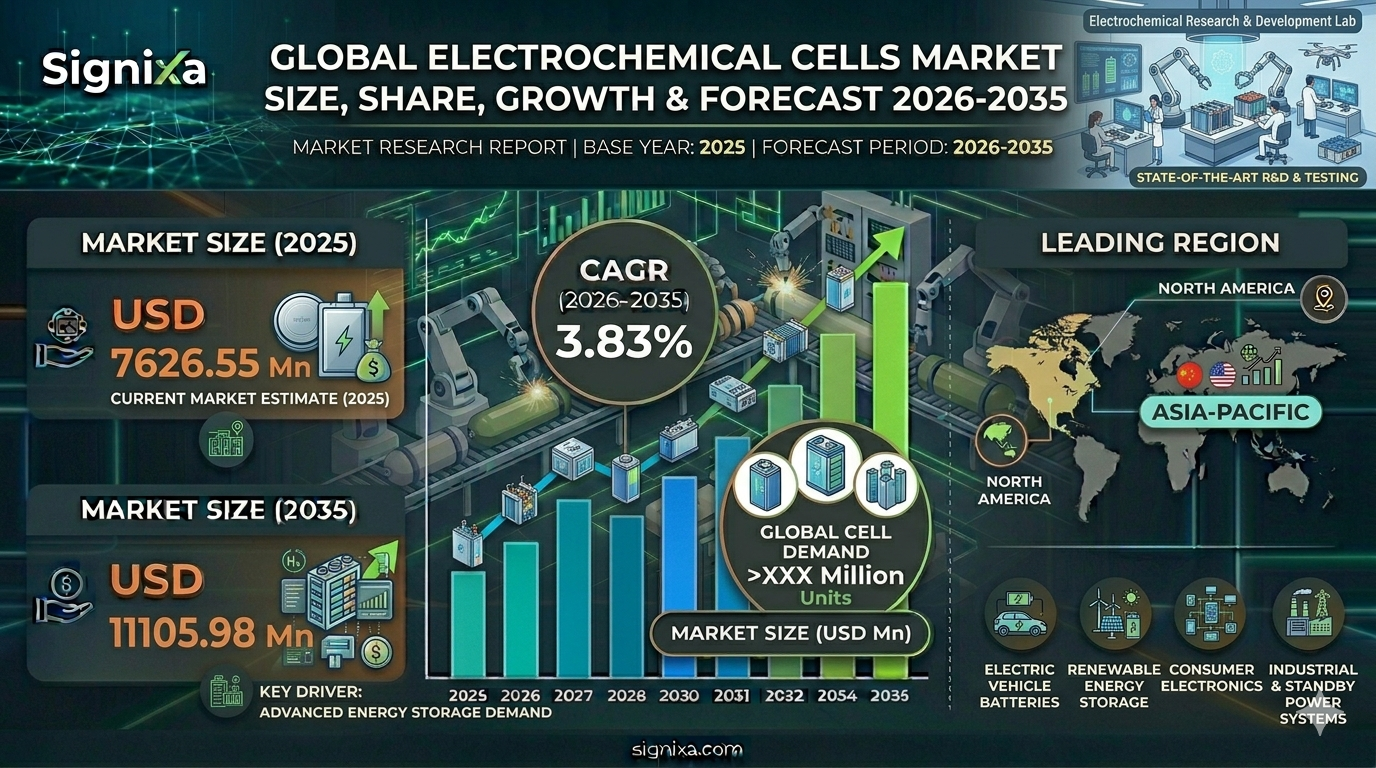
The size of the global electrochemical cells market was worth around USD 7626.55million in 2025 and is predicted to grow to around USD 11105.98 million by 2035, with a compound annual growth rate (CAGR) of roughly 3.83% between 2026 and 2035. The report analyzes the electrochemical cells market's drivers and restraints, as well as their impact on demand throughout the forecast period. It also examines global opportunities in this steadily growing market.
The electrochemical cells market encompasses devices that convert chemical energy into electrical energy or vice versa. These are categorized into primary (non-rechargeable) and secondary (rechargeable) cells and are widely used in consumer electronics, automotive, medical devices, industrial equipment, and defense systems. Growing demand for reliable energy storage solutions, increasing miniaturization of electronics, and advancements in solid-state battery technologies are major contributors to market expansion.
This growth is heavily influenced by the global imperative to reduce carbon emissions and achieve net-zero goals, making electrochemical processes vital for clean energy production, storage, and utilization. The surge in electric vehicle adoption worldwide is a monumental driver, as lithium-ion batteries and other advanced battery technologies, which are electrochemical cells, are essential components of EVs. Similarly, the expanding consumer electronics sector, including smartphones, laptops, and wearables, necessitates compact, high-performing, and reliable power sources, fuelling the demand for electrochemical cells. Beyond energy, these cells find applications in various industrial processes, environmental monitoring (e.g., electrochemical sensors), and chemical manufacturing, further broadening their market scope and contributing to their sustained expansion.
Key Findings
- The global electrochemical cells market is estimated to grow annually at a CAGR of around 3.83% from 2026 to 2035.
- In terms of revenue, the global market size was valued at around USD 7626.55million in 2025 and is projected to reach USD 11105.98 million by 2035.
- Rising demand for portable energy sources in consumer electronics and smart devices is a primary driver of market expansion.
- Based on Type, the Secondary Cells segment is expected to dominate the market due to rising demand in electric mobility and portable electronics.
- By Voltage Capacity, High Voltage Cells are projected to witness the fastest growth due to industrial and automotive applications.
- In End User segmentation, Consumer Electronics will hold the largest share due to the volume of devices powered by compact cells.
- By Region, Asia-Pacific is anticipated to be the leading and fastest-growing market during the forecast period.
Electrochemical Cells Market Dynamics
Accelerating Global Transition Toward Sustainable Energy & Electric Vehicles
The electrochemical cells market's dynamics are fundamentally driven by the accelerating global transition towards sustainable energy and the burgeoning demand for electric vehicles (EVs). Governments worldwide are enacting stringent regulations to reduce carbon emissions and promote renewable energy sources, such as solar and wind power. This creates a critical need for efficient and reliable energy storage solutions to balance the intermittent nature of renewables. Electrochemical cells, particularly in the form of advanced batteries (like lithium-ion, solid-state, and flow batteries) and fuel cells, are central to these solutions, enabling grid-scale energy storage, powering EVs, and facilitating the decentralization of energy systems. The rapid growth of the EV market, fuelled by consumer adoption, government incentives, and advancements in battery technology, is a monumental driver, as electrochemical cells are the core components determining vehicle range, charging speed, and overall performance.
Rising Demand for Portable Energy in Consumer Electronics & Industrial Applications
The electrochemical cells market is expanding steadily, driven by rising demand for portable energy sources in consumer electronics and smart devices. Continuous usage of smartphones, wearables, laptops, and tablets is contributing to the mass-scale requirement of high-performance, compact, and rechargeable cells. The trend toward wireless and IoT-connected devices further fuels the need for energy-dense electrochemical cells that offer longer operating life and faster charging capabilities. Additionally, industrial demand for stable power solutions, especially in robotics, factory automation, and energy backup systems, is pushing adoption of high-voltage and solid-state cell technologies. In automotive and defense sectors, high-voltage and ruggedized battery systems are needed for energy-intensive applications where performance reliability and safety are paramount.
Continuous Technological Advancements & Diversification of Applications
Continuous technological advancements and diversification of applications are powerful dynamics shaping the electrochemical cells market. Research and development efforts are intensely focused on improving the energy density, lifespan, safety, and cost-effectiveness of electrochemical cells. Innovations such as solid-state batteries promise higher energy density and improved safety profiles, while advancements in electrode materials, electrolytes, and cell designs are pushing the boundaries of performance. Beyond energy storage and transportation, electrochemical cells are finding increasing applications in highly sensitive electrochemical sensors for environmental monitoring, medical diagnostics, and industrial process control, as well as electrolytic cells used in chemical production and metal refining. The versatility and adaptability of electrochemical cell technology across these varied industries contribute significantly to its market expansion and long-term growth potential.
Electrochemical Cells Market Segmentation Analysis
By Type Segment Analysis
The electrochemical cells market is segmented by cell type, with each classification offering distinct rechargeability characteristics, cost profiles, and suitability across a wide range of end-use applications globally:
Secondary Cells
Secondary cells dominate the electrochemical cells market with around 72% share, led by demand in rechargeable consumer gadgets, automotive, and power tools. Their reusability, improving cycle life, and falling costs make them more economical for high-usage applications. Lithium-ion secondary cells are the backbone of modern EV battery packs, grid storage systems, and portable electronics. Continued improvements in energy density and charging speed, combined with rapidly declining production costs due to gigafactory scale-up, are accelerating the displacement of primary cells across many traditional single-use applications, further entrenching secondary cells as the dominant segment through the forecast period.
Primary Cells
Primary cells are non-rechargeable and used for single-use applications like remote controls, medical sensors, and clocks, contributing to approximately 28% of the market in 2025. These cells offer a long shelf life, stable voltage, and are preferred for low-drain devices where recharging infrastructure is impractical or cost-prohibitive. They remain essential in applications such as hearing aids, implantable medical devices, smart meters, and emergency backup equipment where reliability over extended dormancy periods is critical. Advances in primary cell chemistry, including lithium-thionyl chloride and zinc-air formulations, continue to extend their shelf life and performance in specialized industrial and medical applications.
By Voltage Capacity Segment Analysis
Medium Voltage Cells (1.5V–6V)
Medium voltage cells hold a 43% market share and are common in toys, cameras, and flashlights due to their adaptability across a broad range of consumer and commercial applications. Their balance of energy output, cost, and physical size makes them the most widely deployed voltage class across general consumer electronics, portable tools, and small-scale industrial equipment. The versatility of medium voltage cells across alkaline, nickel-metal hydride, and lithium chemistries ensures their continued relevance as the largest voltage segment, serving both primary and secondary cell applications across residential, commercial, and light industrial end-use environments.
High Voltage Cells (>6V)
High voltage cells are gaining traction, particularly in automotive, defense, and large-scale industrial backup systems, and are expected to register the fastest CAGR of 4.2% through the forecast period. With increasing demand in EVs and aerospace, this segment's growth is underpinned by the proliferation of battery packs requiring series-connected high-voltage configurations to deliver the power density required for electric drivetrains and grid storage systems. The development of high-nickel cathode chemistries, advanced battery management systems, and thermal management solutions is enabling safe and reliable high-voltage cell deployment across the most demanding industrial, automotive, and defense applications.
By End Users Segment Analysis
Consumer Electronics
Consumer electronics remain the largest segment, contributing over 45% of total demand in 2025. Increasing usage of portable electronics, wearables, and smart gadgets drives growth. The proliferation of smartphones, tablets, laptops, wireless earbuds, smartwatches, and IoT-connected home devices creates an enormous and sustained volume demand for compact, energy-dense electrochemical cells. The trend toward thinner, lighter devices with longer battery life is driving continuous innovation in cell chemistry and packaging, with cylindrical, pouch, and prismatic cell formats all seeing active development investment. As 5G connectivity and advanced AI processing features increase device power consumption, the consumer electronics segment will continue to drive electrochemical cell market expansion.
Automotive
The automotive sector accounts for 18% of the market, with battery-powered vehicles and hybrid electric vehicles creating new demand for rechargeable, high-energy-density cells. Vehicle electrification is one of the most transformative forces in the electrochemical cells market, requiring battery packs with thousands of individual cells per vehicle. The rapid expansion of EV production across China, Europe, and North America, combined with increasing electrification of commercial vehicles, buses, and two-wheelers, is driving extraordinary growth in automotive electrochemical cell demand. Beyond traction batteries, automotive applications include 12V auxiliary systems, start-stop batteries, and advanced driver assistance system power supplies, each with distinct cell technology requirements.
Industrial
Industrial users make up 16% of the market, driven by applications in machinery and energy storage systems. The push toward factory automation, robotics, and Industry 4.0 connectivity is creating demand for reliable electrochemical cells across automated guided vehicles, wireless sensors, programmable logic controllers, and uninterruptible power supplies. Grid-scale and behind-the-meter energy storage deployments, powered by lithium-ion and flow battery systems, represent a fast-growing industrial application as utilities and commercial operators seek to optimize renewable energy integration and peak demand management. The segment's growth is further supported by increasing adoption of off-grid and backup power solutions across remote industrial facilities and critical infrastructure.
Medical Devices
Medical devices hold a 12% share, used in pacemakers, insulin pumps, and diagnostic tools. Electrochemical cells in medical applications must meet exceptionally stringent requirements for reliability, longevity, biocompatibility, and safety, as failure can have life-threatening consequences. Primary lithium cells are the preferred power source for implantable devices due to their long shelf life and stable voltage output, while rechargeable lithium-ion cells power wearable health monitors, portable diagnostic equipment, and powered surgical instruments. The aging global population, rising prevalence of chronic diseases, and expansion of remote patient monitoring are driving sustained demand growth for medical-grade electrochemical cells with enhanced performance and miniaturization characteristics.
Aerospace & Defense
Aerospace & defense stands at 9% of the market, demanding robust, high-voltage systems for drones, satellites, and remote operations. Defense applications require electrochemical cells that can operate reliably across extreme temperature ranges, withstand mechanical shock and vibration, and deliver consistent performance in mission-critical scenarios where failure is not an option. The growing deployment of unmanned aerial vehicles, autonomous ground systems, soldier-worn electronics, and directed energy weapons is driving demand for high-specific-energy electrochemical cells with enhanced thermal stability. Space applications, including satellite power systems and planetary exploration equipment, require specialized primary lithium cells with decade-long operational lifespans under extreme environmental conditions.
By Electrolyte Type Segment Analysis
Liquid Electrolyte Cells
Liquid electrolyte cells dominate the market with a 64% share in 2025 due to their well-established performance and cost-effectiveness across a wide range of applications. These are common in traditional Li-ion and alkaline cells where decades of manufacturing optimization have resulted in highly cost-competitive production at global scale. The established supply chain for liquid electrolyte cell components, combined with proven safety management systems including thermal management and battery management electronics, ensures their continued dominance across consumer electronics, automotive, and industrial energy storage applications throughout the forecast period, despite the growing competitive pressure from emerging solid-state alternatives.
Solid-State Cells
Solid-state cells are an emerging segment, currently capturing about 36% market share, but forecasted to grow rapidly due to enhanced safety, miniaturization, and energy density advantages over liquid electrolyte counterparts. Their usage in advanced medical implants and next-generation EVs makes them a key area of R&D investment, with leading automotive OEMs and battery manufacturers committing billions in development capital to commercialize solid-state battery technology. By eliminating flammable liquid electrolytes, solid-state cells offer inherently safer operation, enabling higher-voltage electrode materials that can significantly boost energy density. As manufacturing scalability challenges are progressively overcome, solid-state cells are expected to capture increasing market share across premium automotive, medical, and aerospace applications through the forecast period.
Report Attributes & Market Scope
| Report Attribute | Details |
|---|---|
| Market Size Value in 2025 | USD 7626.55Million |
| Market Size Value in 2035 | USD 11105.98 Million |
| CAGR (2026–2035) | 3.83% |
| Base Year Used for Estimation | 2025 |
| Historic Data | 2020 - 2025 |
| Forecast Period | 2026 - 2035 |
| Segments Covered – By Type |
|
| Segments Covered – By Voltage Capacity |
|
| Segments Covered – By End Users |
|
| Segments Covered – By Electrolyte Type |
|
| Regions Covered | North America, Europe, Asia Pacific, Latin America, Middle East and Africa |
| Major Countries Covered | U.S., Canada, Mexico, Germany, UK, France, Italy, Spain, Russia, China, Japan, South Korea, India, Southeast Asia Countries, Brazil, Argentina, GCC Countries, Turkey, Iran, Israel, South Africa, Egypt, Nigeria, etc. |
| Key Companies Profiled | Panasonic Corporation, Duracell Inc., Energizer Holdings, LG Chem Ltd., Samsung SDI Co., BYD Company Ltd., Saft Groupe SA, Johnson Controls, VARTA AG, and Hitachi Chemical Co. Ltd., among others. |
Electrochemical Cells Market Regional Analysis
The electrochemical cells market is primarily dominated by the Asia-Pacific region, which holds over 40% market share in 2025, driven by strong consumer electronics manufacturing in China, South Korea, and Japan, along with high demand in automotive and industrial sectors. North America holds about 26% share, led by advancements in defense tech, medical devices, and EV adoption in the U.S. Europe, with a 21% share, supports solid-state innovation and stringent battery regulations. Latin America and the Middle East & Africa together hold 13% and are emerging as promising regions with growing electronics and automotive assembly activities.
Asia Pacific (Dominant Region)
The Asia Pacific region is the largest and fastest-growing market for electrochemical cells globally, primarily driven by its dominant position in electronics manufacturing and the rapid expansion of the electric vehicle industry. Countries like China, South Korea, and Japan are global leaders in battery production, especially lithium-ion cells, serving both the massive consumer electronics market and the rapidly growing EV sector. China, in particular, has seen unprecedented growth in EV adoption and battery manufacturing capacity, heavily supported by government policies and incentives. The region's vast and urbanizing populations contribute to the demand for portable electronic devices, further boosting the need for compact electrochemical cells. Additionally, increasing investments in renewable energy projects and grid modernization initiatives across countries like India and Australia are driving demand for large-scale energy storage solutions.
North America
North America is a leading region in the electrochemical cells market, driven by significant investments in renewable energy, the accelerating adoption of electric vehicles (EVs), and a robust R&D ecosystem. The United States is at the forefront, with substantial government initiatives and private sector funding aimed at transitioning to cleaner energy sources and developing advanced battery technologies. The increasing demand for grid-scale energy storage solutions to support solar and wind power integration is a major driver for electrochemical cells like large-scale batteries. The rapid expansion of the EV market in North America also fuels the demand for high-performance lithium-ion batteries. Furthermore, the region has a strong base for research in areas such as solid-state batteries and fuel cells. The focus on energy resilience, grid modernization, and corporate sustainability goals further propels the adoption of electrochemical energy storage systems across commercial and industrial sectors.
Europe
Europe represents a significant and rapidly growing market for electrochemical cells, strongly influenced by ambitious decarbonization targets, stringent environmental regulations, and a concerted effort to establish a robust domestic battery manufacturing industry. The European Union's "Fit for 55" package and the REPowerEU Plan highlight the commitment to green hydrogen production through electrolysis, a key application for electrochemical cells (electrolyzers). Countries like Germany, France, and the UK are investing heavily in gigafactories for battery production to support their burgeoning EV markets and energy storage needs. There's a strong focus on developing advanced battery chemistries, including solid-state and sodium-ion batteries. European research institutions and industries are also at the forefront of fuel cell technology, particularly for heavy-duty transport and stationary power, while the circular economy push drives investment in advanced battery recycling infrastructure.
Middle East & Africa
The Middle East & Africa (MEA) electrochemical cells market is an emerging region with significant growth potential, largely driven by ambitious national diversification strategies, increasing energy demand, and a growing focus on renewable energy. In the Middle East, particularly the GCC countries, there are substantial investments in large-scale solar and wind projects, necessitating robust energy storage solutions based on electrochemical cells. Countries like the UAE and Saudi Arabia are actively exploring green hydrogen production via electrolysis, which relies heavily on advanced electrochemical cell technology. In Africa, a growing need for off-grid power solutions and increased access to reliable electricity is leading to gradual adoption of battery storage for residential and commercial applications. Challenges include high initial costs for advanced electrochemical systems, need for skilled labor, and varying regulatory frameworks across the region.
Latin America
Latin America represents an emerging growth opportunity in the electrochemical cells market, with Brazil and Mexico leading regional demand through expanding electronics manufacturing, growing automotive assembly operations, and increasing consumer adoption of smart devices and electric mobility solutions. Government-backed initiatives to promote renewable energy and reduce fossil fuel dependency are creating early-stage demand for grid-scale electrochemical storage systems. The region's abundant lithium reserves, particularly in Argentina, Bolivia, and Chile — the so-called "Lithium Triangle" — are attracting significant investment interest from global battery manufacturers seeking supply chain diversification. As local manufacturing capabilities develop and EV adoption accelerates alongside improving charging infrastructure, Latin America is well-positioned for sustained electrochemical cells market growth through the forecast period.
Recent Developments in the Electrochemical Cells Market
-
2023
Panasonic Energy announced expansion of its secondary cell production line for EV batteries in Japan and the U.S., reinforcing its position as a key supplier to major automotive OEMs and responding to accelerating global EV demand.
-
2022
Samsung SDI unveiled its roadmap for solid-state battery integration in future consumer and medical devices, signaling the company's strategic commitment to next-generation electrochemical cell technology and its commercialization timeline through the end of the decade.
Electrochemical Cells Market: Competitive Landscape
The electrochemical cells market features major players such as Panasonic Corporation, Duracell Inc., Energizer Holdings, LG Chem Ltd., Samsung SDI Co., BYD Company Ltd., Saft Groupe SA, Johnson Controls, VARTA AG, and Hitachi Chemical Co. Ltd. Companies are focusing on innovation in solid-state and high-voltage battery chemistries, improved cycle life, and faster recharge times. Collaborations with automakers, medical tech firms, and defense agencies are enabling product diversification. Cost efficiency, reliability, and safety are key factors influencing competitive positioning in the market.
The competitive landscape of the electrochemical cells market is highly dynamic and intensely competitive, characterized by a mix of established global conglomerates and innovative startups. Major players, often with vast resources and diversified portfolios, are vying for market dominance across various applications, from consumer electronics and electric vehicles to grid-scale energy storage and industrial processes. Competition primarily hinges on technological leadership, particularly in achieving higher energy density, longer cycle life, faster charging capabilities, and improved safety features for batteries. Companies are heavily investing in R&D to explore next-generation chemistries like solid-state batteries, lithium-sulfur, and sodium-ion technologies, aiming to overcome the limitations of current lithium-ion cells and gain a competitive edge.
Beyond raw performance, differentiation is increasingly driven by supply chain integration, cost efficiency, and strategic partnerships. Companies are striving to secure reliable and sustainable access to critical raw materials, such as lithium, cobalt, and nickel, often through long-term contracts or direct investments in mining operations. The ability to scale manufacturing operations to meet rapidly expanding demand, particularly from the automotive and energy storage sectors, is also a crucial competitive advantage. Furthermore, collaborations between battery manufacturers, automotive OEMs, and energy companies are forming strategic alliances to accelerate innovation, optimize production, and expand market reach. The race to develop advanced recycling technologies for end-of-life batteries is another emerging competitive arena, driven by sustainability goals and the potential for a circular economy of materials.
Key Companies Profiled
Global Electrochemical Cells Market Segmentation Summary
By Type
By Voltage Capacity
By End Users
By Electrolyte Type
By Region
Frequently Asked Questions (FAQs) About the Electrochemical Cells Market
What are electrochemical cells?
Electrochemical cells are devices that convert chemical energy into electrical energy through redox reactions. They include both primary (non-rechargeable) and secondary (rechargeable) cells, widely used in consumer electronics, automotive, industrial, and medical applications.
Which key factors will influence the electrochemical cells market growth over 2026–2035?
The market is expected to grow due to the rising demand for portable energy sources in consumer electronics, the growing adoption of electric vehicles, increasing investment in energy storage technologies, and innovations in battery chemistry and solid-state cells.
What will be the value of the electrochemical cells market during 2026–2035?
According to the study, the global electrochemical cells market size was valued at around USD 7626.55million in 2025 and is projected to reach approximately USD 11105.98 million by 2035.
What will be the CAGR value of the electrochemical cells market during 2026–2035?
The global electrochemical cells market is expected to grow at a CAGR of 3.83% during the forecast period from 2026 to 2035.
Which region will contribute notably towards the electrochemical cells market value?
The Asia-Pacific region is expected to dominate the market, supported by a strong manufacturing base, increasing adoption of electric vehicles, and technological advancements in battery production. North America and Europe also hold substantial shares due to R&D efforts and supportive policies.
Which are the major players leveraging the electrochemical cells market growth?
Key players driving the electrochemical cells market include Panasonic Corporation, Samsung SDI Co., LG Chem Ltd., BYD Company Ltd., and Johnson Controls, along with Duracell Inc., Energizer Holdings, Saft Groupe SA, VARTA AG, and Hitachi Chemical Co. Ltd., focusing on innovations in battery technologies and expanding production capabilities.
What can be expected from the global electrochemical cells market report?
The report provides a comprehensive analysis of the electrochemical cells market, including market size and forecast, key growth drivers and challenges, detailed segmentation by type, voltage capacity, end user, and electrolyte type, regional outlook, competitive landscape, and recent developments shaping the industry from 2026 to 2035.