
Electric Tricycle Market Overview
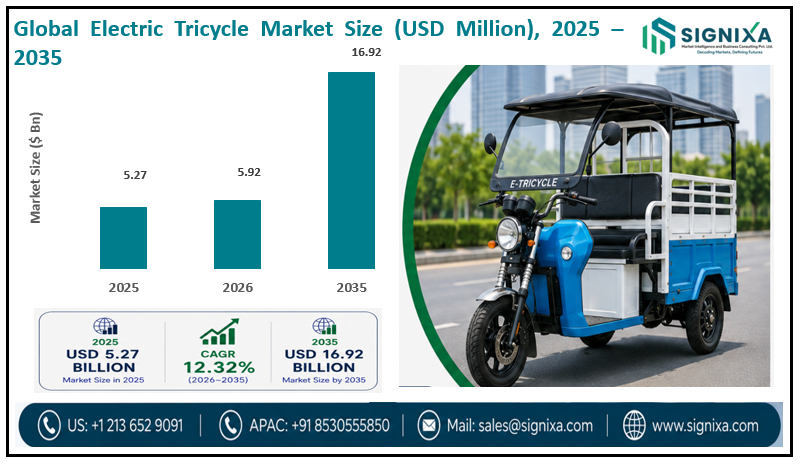
The size of the global electric tricycle market was valued at approximately USD 5.27 Billion in 2025 and is expected to grow to about USD 16.92 Billion by 2035, registering a compound annual growth rate (CAGR) of around 12.32% between 2026 and 2035. The report explores the key drivers, market constraints, and future opportunities shaping demand across regions. It further includes an analysis of competitive strategies and innovations defining the market outlook.
The electric tricycle market comprises a range of three-wheeled electric vehicles designed for personal mobility and cargo transportation. These vehicles are increasingly adopted across urban and rural regions due to their affordability, efficiency, and low environmental impact. Key trends include rising fuel prices, demand for sustainable transport, government incentives for electric vehicles, and technological enhancements in battery performance. This transition is prompting both logistics players and individual consumers to opt for electric tricycles as a reliable, cost-effective transportation mode.
The global electric tricycle market is gaining significant momentum, driven by increasing demand for sustainable, low-emission transportation solutions in both urban and rural areas. Electric tricycles (e-trikes), which typically feature three wheels and are powered by battery-operated electric motors, offer enhanced stability and payload capacity compared to two-wheelers, making them ideal for cargo delivery, passenger transport, and personal mobility. As cities worldwide push for cleaner last-mile connectivity, e-trikes have emerged as a practical alternative to conventional auto-rickshaws and internal combustion vehicles. Governments across Asia, Africa, and Latin America are actively promoting electric tricycle adoption through subsidies, tax incentives, and favorable licensing norms. The market is also benefiting from falling battery prices, rising fuel costs, and increasing urban congestion. In emerging markets like India, China, and the Philippines, e-trikes are helping to reduce noise and air pollution while generating employment in the informal transport sector.
Rapid advancements in battery technology, motor efficiency, and lightweight materials are driving product innovation in the electric tricycle market. Lithium-ion batteries are increasingly replacing lead-acid variants, offering longer ranges, reduced charging times, and improved lifecycle costs. Manufacturers are introducing modular and customizable designs to cater to different applications ranging from food delivery and waste collection to elderly mobility and school transport. Additionally, smart connectivity features such as GPS tracking, remote diagnostics, and fleet management systems are being integrated, particularly in commercial e-trike fleets. Asia-Pacific dominates the market, with China being the largest producer and exporter of electric tricycles, while India is witnessing exponential adoption in its Tier II and Tier III cities. Europe and North America are also exploring electric tricycles for urban logistics and last-mile solutions amid growing e-commerce activity. However, challenges such as limited charging infrastructure, high upfront costs, and fragmented supply chains persist. Despite these, the electric tricycle market is set to grow robustly due to rising environmental consciousness, supportive government policies, and evolving urban mobility needs.
Key Findings
- The global electric tricycle market is projected to expand at a CAGR of approximately 12.32% from 2026 to 2035.
- In terms of revenue, the market stood at USD 5.27 Billion in 2025 and is anticipated to reach USD 16.92 Billion by 2035.
- Rising demand for eco-friendly last-mile delivery vehicles is accelerating market growth.
- Among types, Cargo Electric Tricycles are anticipated to dominate the market due to increased adoption in delivery services.
- In terms of application, both personal mobility and commercial transport are key segments, with a growing tilt toward logistics.
- By Region, Asia-Pacific is forecast to dominate the global market owing to high population density and government subsidies.
Electric Tricycle Market Dynamics
Environmental Regulations and Government Support Encourage Adoption
Rising environmental concerns and supportive government regulations are propelling the adoption of electric tricycles globally. Governments in developing countries are offering subsidies, tax rebates, and incentives to promote electric vehicle adoption, which in turn supports manufacturers and end-users. Furthermore, emission regulations in urban areas are pushing transportation companies to switch to electric alternatives for last-mile deliveries. These policy shifts are instrumental in shaping both consumer behavior and industry investments in e-mobility solutions such as electric tricycles.
Growing E-Commerce and Last-Mile Delivery Demand
Increasing e-commerce penetration and the demand for last-mile delivery are major factors boosting cargo electric tricycle adoption. With businesses looking to reduce fuel expenses and minimize carbon emissions, electric tricycles provide a highly economical solution, especially for intra-city deliveries. Their compact size, low maintenance costs, and ease of navigation in congested streets make them ideal for logistics companies. As companies scale up their delivery operations, the demand for sustainable, small-format electric vehicles are expected to soar.
Advances in Lithium-Ion Battery Technology
The expansion of lithium-ion battery technology has further enhanced electric tricycle performance. Longer battery life, faster charging capabilities, and reduced costs are making electric tricycles more practical for both passenger and cargo transport. Additionally, improvements in load-bearing capacity, suspension systems, and safety features are increasing consumer confidence in electric tricycles as reliable alternatives to traditional vehicles. As battery technology evolves, its impact on driving range and vehicle performance will be a critical enabler for market growth.
Favorable Policies, Incentives & Regulatory Frameworks
One of the most influential factors driving the electric tricycle market is strong government support through favorable policies, incentives, and regulatory frameworks. Several countries, particularly in Asia and Africa, have implemented subsidy programs and tax exemptions to promote electric mobility, including e-trikes. Governments are offering financial support for vehicle purchases, battery replacements, and local manufacturing to encourage adoption at scale. In India, the FAME (Faster Adoption and Manufacturing of Hybrid and Electric Vehicles) scheme provides direct subsidies for electric three-wheelers, while countries like the Philippines have launched e-trike replacement programs for traditional motorized tricycles. Local municipalities are also integrating e-trikes into urban transport systems as part of green mobility missions. Moreover, relaxed licensing norms, easier financing, and low-interest loans make electric tricycles more accessible to low-income and small business owners. These government-led initiatives are essential in offsetting high initial costs and improving market penetration. As cities aim to reduce carbon emissions and traffic congestion, electric tricycles are gaining regulatory backing as a sustainable and inclusive mobility solution, boosting both consumer demand and manufacturer confidence.
Rising Fuel Prices Strengthen the Cost Advantage of E-Trikes
Escalating fuel prices globally are making traditional internal combustion vehicles increasingly expensive to operate, especially for commercial users who rely on them for daily transportation or delivery services. Electric tricycles offer a cost-effective alternative with significantly lower operating and maintenance costs. With electricity being cheaper and more stable in price than gasoline or diesel, e-trike owners benefit from better long-term savings. This is particularly appealing in emerging economies where many depend on three-wheelers for their livelihoods. The low cost-per-kilometer advantage of electric tricycles is attracting users ranging from street vendors and courier companies to urban commuters. Battery-swapping models and affordable charging infrastructure are further enhancing economic feasibility. Additionally, reduced wear-and-tear on electric drivetrains compared to combustion engines lowers servicing frequency and downtime, directly translating to increased productivity. The return on investment becomes highly favorable, especially when vehicles are used for cargo or public transport over long hours. As economic considerations continue to dominate purchasing decisions, the shift from fossil-fueled to electric tricycles is expected to accelerate, driven by clear financial advantages.
Urbanization Fuels Demand for Last-Mile Mobility Solutions
Urbanization is reshaping transportation needs, and electric tricycles are becoming a preferred solution for last-mile mobility in congested cities. As traffic density increases and environmental regulations tighten, the demand for compact, low-speed, and clean mobility options has surged. E-trikes fill this gap by offering efficient transport for both passengers and goods in crowded urban landscapes where large vehicles are impractical. From ride-sharing and school pickups to e-commerce deliveries and municipal services, the utility of electric tricycles is expanding. Moreover, the growing popularity of smart cities has driven interest in integrating e-trikes into public transport networks, enabling multimodal connectivity with buses, metros, and trains. Their small turning radius, easy maneuverability, and quiet operation make them ideal for narrow streets, gated communities, and campus environments. Micro-mobility start-ups are also exploring e-trike-based platforms to offer subscription or pay-per-use models. As cities seek to balance mobility with sustainability and space optimization, electric tricycles are emerging as a strategic component in urban planning and transport innovation.
Technology Integration Enhances Product Appeal
Technology plays a critical role in advancing the appeal and functionality of electric tricycles. Innovations in battery chemistry, such as the widespread adoption of lithium-ion over lead-acid, have improved energy density, extended vehicle range, and reduced charging time. At the same time, brushless DC motors and regenerative braking systems enhance performance and energy efficiency. Lightweight composite materials are being used in frames to reduce overall weight without compromising durability. Furthermore, smart features like GPS tracking, digital dashboards, mobile app integration, and anti-theft systems are increasingly being embedded in modern e-trikes, especially in urban and commercial models. Manufacturers are also introducing modular and customized designs to serve varied applications, including refrigerated cargo units, foldable passenger seats, and accessible trikes for the elderly or disabled. These advancements are not only improving user experience and safety but also attracting tech-savvy urban buyers. With continuous R&D and design refinement, electric tricycles are transforming from basic utility vehicles into intelligent mobility solutions. This tech-driven evolution is essential for attracting diverse user segments and differentiating offerings in a highly competitive market.
Electric Tricycle Market Segmentation Analysis
By Type Segment Analysis
By Type, electric tricycles are categorized based on frame design and portability, each suited to different commuting and utility needs:
Folding Electric Tricycle
Folding electric tricycles are compact and designed for urban commuters. Their demand is increasing in developed cities where portability and space-saving are major concerns. In 2025, folding electric tricycles held approximately 12% of the total market share. They are popular among elderly users and city dwellers who use them for short commutes and recreational purposes due to their convenient storage and easy maneuverability.
Non-Folding Electric Tricycle
Non-folding electric tricycles, offering robust frame strength and larger battery capacity, are preferred for longer-distance travel and heavier loads. They accounted for around 18% of the market in 2025. These models are commonly used in both suburban and rural areas where portability is less critical. Their fixed-frame design supports larger wheels and enhanced stability, making them suitable for everyday utility and commercial applications.
By Application Segment Analysis
By Application, electric tricycles serve both commercial and personal transportation needs, with commercial applications, particularly in the logistics and e-commerce sectors, dominating with over 55% share in 2025:
Cargo Electric Tricycle
Cargo electric tricycles represent the largest segment, contributing nearly 42% of the global market share in 2025. This dominance is driven by growing demand from delivery services, especially in densely populated cities. These vehicles are widely used by e-commerce companies, postal services, and food delivery platforms to reduce logistics costs and environmental impact. Government support for cargo e-mobility further enhances their adoption.
Passenger Electric Tricycle
Passenger electric tricycles are primarily used in ride-sharing, tourism, and personal commuting. They held a market share of roughly 28% in 2025. As urban mobility needs evolve and traffic congestion worsens, passenger electric tricycles offer an affordable and green transport solution. Cities in Southeast Asia, Africa, and Latin America are seeing increased uptake due to their low operational costs and ease of licensing.
Report Attributes & Market Scope
| Report Attribute | Details |
|---|---|
| Market Size Value in 2025 | USD 5.27 Billion |
| Market Size Value in 2035 | USD 16.92 Billion |
| CAGR (2026–2035) | 12.32% |
| Base Year Used for Estimation | 2025 |
| Historic Data | 2020 - 2025 |
| Forecast Period | 2026 - 2035 |
| Segments Covered – By Type |
|
| Segments Covered – By Application |
|
| Regions Covered | North America, Europe, Asia Pacific, Latin America, Middle East and Africa |
| Major Countries Covered | U.S., Canada, Mexico, Germany, UK, France, Italy, Spain, Russia, China, Japan, South Korea, India, Southeast Asia Countries, Brazil, Argentina, GCC Countries, Turkey, Iran, Israel, South Africa, Egypt, Nigeria, etc. |
| Key Companies Profiled | Mahindra Electric, Piaggio, Terra Motors, Yadea Group, Bajaj Auto, Jorvik Tricycles, AIMA, Worksman Cycles, GOVECS AG, and Hero Electric. |
Electric Tricycle Market Regional Analysis
Asia-Pacific leads the global electric tricycle market, accounting for over 65% of the total share in 2025, driven by high urbanization, government subsidies, and strong presence of local manufacturers in China and India. North America and Europe are emerging markets, with growing investments in electric mobility infrastructure and environmental regulations encouraging e-tricycle usage. Latin America and the Middle East & Africa are expected to register steady growth through 2035, supported by expanding delivery networks and increasing urban population density.
Asia-Pacific (Dominant Region)
Asia-Pacific is the largest and fastest-growing market for electric tricycles, led by widespread adoption in China, India, the Philippines, and Thailand. These vehicles are critical to the region's informal transport economy, offering affordable, low-emission alternatives for last-mile delivery, passenger services, and small-scale logistics. Government-backed initiatives such as China's e-trike manufacturing subsidies and India's FAME program are accelerating adoption, especially in Tier II and III cities. In densely populated urban areas, electric tricycles are preferred for their maneuverability, low operational cost, and reduced pollution levels. Several regional manufacturers are rapidly innovating, producing customizable e-trike models with improved battery life, payload capacity, and safety features. Furthermore, Asia-Pacific's e-commerce boom and food delivery sector have created substantial demand for electric cargo trikes. Local production also helps lower costs and supports job creation. Despite infrastructure and standardization challenges, rapid urbanization, increasing consumer awareness, and supportive government policies continue to push the electric tricycle market forward. Asia-Pacific is expected to dominate the global market volume well into the next decade.
North America
The electric tricycle market in North America is evolving steadily, driven by increased focus on sustainable transportation, urban delivery efficiency, and senior mobility solutions. In the United States and Canada, electric tricycles are gaining traction among aging populations seeking safe and stable personal transport, as well as businesses looking for compact last-mile delivery vehicles in congested urban areas. Municipal initiatives to reduce greenhouse gas emissions are supporting the deployment of electric cargo trikes in sectors like food delivery, postal services, and warehouse logistics. Companies are integrating advanced features like lithium-ion batteries, smart sensors, and digital dashboards to appeal to tech-savvy users. Though adoption remains niche compared to electric bikes or scooters, growth is visible in commercial and mobility-assistive applications. Incentives from state and local governments are supporting pilot programs for e-trike fleets, especially in California and New York. The market's trajectory is expected to rise steadily as infrastructure for urban micro-mobility expands, and consumer interest in cost-effective, eco-friendly transport solutions continues to grow in densely populated metro areas.
Europe
Europe's electric tricycle market is gaining momentum due to strong environmental policies, an aging population, and a robust micro-mobility culture. Cities like Amsterdam, Berlin, and Copenhagen are championing zero-emission urban logistics, encouraging businesses to adopt electric cargo tricycles for local deliveries. Regulatory support through subsidies, emissions zones, and congestion charges further incentivizes the shift from fuel-powered three-wheelers to electric alternatives. The market is also growing in the personal mobility segment, with elderly and differently abled populations seeking stable and low-speed vehicles for independent travel. European consumers demand high-quality, safe, and sustainable transport solutions, prompting manufacturers to focus on ergonomic designs, premium materials, and compliance with EU safety standards. Additionally, bike-sharing programs and mobility-as-a-service (MaaS) platforms are beginning to incorporate electric tricycles for enhanced accessibility. Europe's commitment to the Green Deal and smart cities initiative strengthens the case for e-trikes in the broader transportation ecosystem. With rising fuel prices and space constraints in heritage urban layouts, electric tricycles are emerging as a practical and accepted choice for short-distance, eco-conscious mobility.
Middle East & Africa
The electric tricycle market in the Middle East & Africa is in a nascent stage but shows significant potential due to increasing urbanization, youth population growth, and a shift toward clean energy. In the Middle East, especially in the UAE and Saudi Arabia, e-trikes are gaining visibility in niche sectors such as resort transport, delivery services in urban centres, and sustainable tourism. Government investments in smart cities and green mobility are opening new opportunities for electric tricycles, particularly in controlled environments like campuses, malls, and industrial parks. In Africa, where informal transportation dominates, electric tricycles present a viable alternative to high fuel costs and limited vehicle maintenance options. Countries like Kenya, Nigeria, and Rwanda are beginning to explore e-trike solutions for commercial transport and local goods movement. However, challenges such as lack of charging infrastructure, limited financing options, and import dependence slow widespread adoption. Still, increasing international collaboration, pilot programs, and renewable energy integration suggest a promising future. As awareness grows and regulatory frameworks evolve, the region may emerge as a valuable long-term growth frontier for the global electric tricycle market.
Recent Developments in the Electric Tricycle Market
-
2026
Mahindra Electric expanded its electric three-wheeler portfolio by enhancing battery efficiency, vehicle connectivity, and last-mile mobility solutions to strengthen its position in the commercial EV segment.
Bajaj Auto continued expanding its electric three-wheeler business with new product enhancements, increased manufacturing capacity, and wider distribution to meet the growing demand for sustainable last-mile mobility.
Terra Motors accelerated the deployment of electric three-wheelers in Asia by expanding its dealer network and introducing upgraded battery technologies for commercial transportation.
-
2025
Yadea Group increased investments in next-generation electric mobility technologies, including high-performance battery systems and smart connected electric three-wheelers for urban transportation.
Piaggio strengthened its electric cargo and passenger three-wheeler lineup by focusing on improved range, lower operating costs, and fleet-oriented mobility solutions across emerging markets.
Electric Tricycle Market: Competitive Landscape
The global electric tricycle market includes major players such as Mahindra Electric, Piaggio, Terra Motors, Yadea Group, Bajaj Auto, Jorvik Tricycles, AIMA, Worksman Cycles, GOVECS AG, and Hero Electric. These companies focus on developing high-efficiency battery technologies, expanding dealer networks, and innovating design features to strengthen market presence. Competitive factors include cost-effectiveness, range, payload capacity, and after-sales support. As adoption increases, strategic partnerships and localization will be key to gaining a competitive edge in this rapidly growing sector.
Key Companies Profiled
- Mahindra Electric
- Piaggio
- Terra Motors
- Yadea Group
- Bajaj Auto
- Jorvik Tricycles
- AIMA
- Worksman Cycles
- GOVECS AG
- Hero Electric
- Jiangsu Xinri E-Vehicle Co., Ltd. (SUNRA)
- Doohan Technology Co., Ltd.
- Kinetic Green Energy & Power Solutions Ltd.
- Lohia Auto Industries
- Atul Auto Limited
Global Electric Tricycle Market Segmentation Summary
By Type
- Folding Electric Tricycle
- Non-Folding Electric Tricycle
By Application
- Cargo Electric Tricycle
- Passenger Electric Tricycle
By Region
- North America
- U.S.
- Canada
- Mexico
- Europe
- Germany
- France
- UK
- Spain
- Italy
- Rest of Europe
- Asia-Pacific
- China
- Japan
- India
- Australia
- South Korea
- Southeast Asia
- Rest of Asia-Pacific
- Latin America
- Brazil
- Argentina
- Rest of Latin America
- The Middle East & Africa
- GCC Countries
- South Africa
- Rest of the Middle East & Africa
Frequently Asked Questions (FAQs) About the Electric Tricycle Market
What is an electric tricycle?
An electric tricycle (e-tricycle or e-trike) is a three-wheeled electric vehicle powered by a battery-operated motor. It is widely used for passenger transport, cargo delivery, and personal mobility due to its stability, eco-friendliness, and cost efficiency.
Which key factors will influence the electric tricycle market growth over 2026–2035?
The global electric tricycle market is expected to grow due to rising demand for last-mile connectivity, government incentives for electric mobility, increased urbanization, and growing use in logistics and personal transport segments.
What will be the value of the electric tricycle market during 2026–2035?
According to the study, the global electric tricycle market size was worth around USD 5.27 Billion in 2025 and is predicted to grow to around USD 16.92 Billion by 2035.
What will be the CAGR value of the electric tricycle market during 2025–2035?
The CAGR value of the electric tricycle market is expected to be around 12.32% during 2026–2035, driven by rising demand for eco-friendly transportation, government incentives for electric vehicles, and growing adoption of electric tricycles for last-mile passenger and cargo mobility.
Which region will contribute notably towards the electric tricycle market value?
Asia-Pacific is expected to lead the global electric tricycle market, supported by large-scale adoption in countries like China and India, favorable government policies, and strong domestic manufacturing capabilities.
Which are the major players leveraging the electric tricycle market growth?
Key players in the global electric tricycle market include Mahindra Electric Mobility, Terra Motors Corporation, Kinetic Green, Piaggio & C. SpA, Yadea Group Holdings, Bodo Vehicle Group, Jiangsu Xinri E-Vehicle Co. Ltd, Hero Electric, Zongshen Industrial Group, and Lohia Auto Industries.
What can be expected from the global electric tricycle market report?
The report covers critical elements of the electric tricycle market, including comprehensive analysis of market trends, segment performance, regional outlook, competitive landscape, current growth drivers, and future opportunities and challenges across the forecast period.