

Electric Car Chargers Market Overview
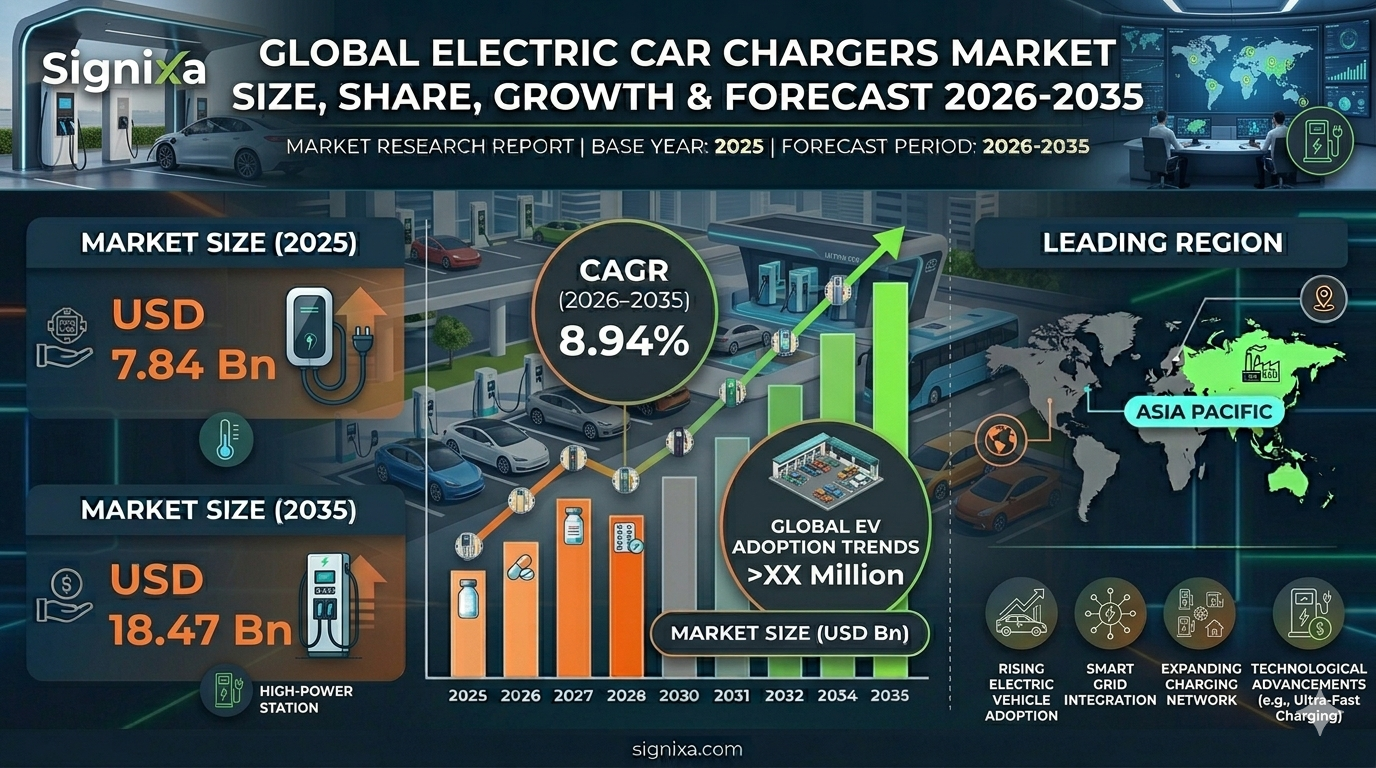
The size of the global Electric Car Chargers market was worth around USD 7.84 Billion in 2025 and is predicted to grow to around USD 18.47 billion by 2035, with a compound annual growth rate (CAGR) of roughly 8.94% between 2026 and 2035. The report analyzes the Electric Car Chargers market's drivers and restraints, as well as the impact they have on demand throughout the projection period. In addition, the report examines global opportunities in the global Electric Car Chargers market.
Electric Car Chargers Market Summary: Electric car chargers consist of different chargers: Level 1, Level 2, and DC fast chargers, adjusted to meet the various speeds and power for charging. The market is influenced by the growing acceptance of electric vehicles, due to growing awareness of environmental concerns and government initiatives for cleaner transportation. The development of charging infrastructure for electric vehicles in urban and rural regions for electric vehicles is increasingly important. Advances in charging technology, including quicker charging times and better efficiency, are encouraging demand for electric car chargers across geographies.
The electric vehicle (EV) charger market is expanding rapidly, driven by the global push toward cleaner transportation, supportive government policies, and the growing adoption of electric vehicles. Demand spans residential, commercial, and highway charging solutions, with Level 2 home chargers and fast DC public chargers seeing significant uptake. Innovations such as smart charging systems, which optimize energy usage and integrate with the grid, are becoming mainstream. The development of vehicle-to-grid (V2G) technology is also enhancing the role of EV chargers in energy storage and load balancing. Urban areas are focusing on dense charger networks to address range anxiety, while rural and highway locations are seeing infrastructure growth to support long-distance travel. Standardization efforts, digital payment systems, and real-time charger status apps are improving user experience. As automakers, energy firms, and tech companies collaborate, the charger market is becoming a critical pillar of the global EV ecosystem.
Key Findings
- As per the analysis shared by our research analyst, the global Electric Car Chargers market is estimated to grow annually at a CAGR of around 8.94% over the forecast period (2026-2035).
- In terms of revenue, the global Electric Car Chargers market size was valued at around USD 7.84 Billion in 2025 and is projected to reach USD 18.47 billion by 2035.
- The growing adoption of electric vehicles, driven by environmental concerns and supportive government policies, significantly boosts the demand for electric car chargers, creating a need for expanded charging infrastructure and faster technology.
- Based on Charging Type, the off-board chargers segment is growing at a high rate and will continue to dominate the global market as per industry projections.
- On the basis of Vehicle Category, the passenger vehicles segment is anticipated to command the largest market share.
- In terms of Power Output, the DC Fast Chargers segment is anticipated to command the largest market share.
- By Region, Europe is projected to dominate the global market during the forecast period.
Electric Car Chargers Market Dynamics
Government Incentives, Policies & Expanding EV Adoption Driving Charging Infrastructure Demand
Government incentives and policies like subsidies and tax rebates are facilitating the widespread adoption of electric vehicles (EVs) and the increasing demand for charging infrastructure. As adoption of EVs grows, the need for charging stations to make the use of EVs widespread and efficient becomes greater, further coupled with improvements in vehicle battery technology and range. There are also advancements in charging infrastructure technology that continue to improve the user experience, notably the introduction of DC fast chargers with quicker charging times, making it more convenient for consumers. All these factors are significantly driving growth in the electric vehicle charging market.
Government Subsidies, Tax Breaks & Stricter Emission Standards Accelerating EV Market Growth
Government actions, which include subsidies, tax breaks, and more stringent emissions standards, underpin growth in the electric vehicle (EV) sector. These support mechanisms lower the cost of EVs and increase their attractiveness to customers; and they encourage the establishment of charging infrastructure. By investing in charging stations and establishing aggressive emission reduction targets, governments spur the transition to clean energy transportation with resultant increases in the supply and demand for EVs and charging solutions.
Rising Consumer Demand for Electric Vehicles Fuelling Charging Infrastructure Expansion
The growing adoption of electric vehicles is a primary driver of growth of the EV charging market. More consumers are making decisions to support EVs due to environmental conditions, lower price to operate, and better performance. With the advent of larger capacity batteries and range, combined with the decreased price of EVs, the number of consumers choosing to purchase them will grow and drive the market for charging infrastructure that supports the growth in electric vehicle ownership.
DC Fast Charging Technology Advancements Addressing Convenience & Reducing EV Adoption Barriers
The market for EV charging is also progressing thanks to improvements in technology, especially fast-charging technologies such as DC fast chargers. These developments greatly reduce charging time and are addressing one of the most significant barriers to EV adoption: convenience. With faster-charging speeds and more effective systems, the user experience is improving, making it easier for users to use EVs for long-distance journeys and daily commuting. As technology advances, EVs become more attractive to users, and this will be driven by advancements allowing for more substantial charging networks to emerge.
Electric Car Chargers Market Segmentation Analysis
By Charging Type Segment Analysis
The market is classified according to charging types, with each format offering distinct integration levels, charging speeds, and end-use suitability across residential, commercial, and public charging applications globally:
On Board Chargers
On-board chargers are housed inside the electric vehicle and allow it to change AC (Alternating Current) power from the grid into DC (Direct Current) in order to charge the vehicle. On-board chargers tend to offer slower rates than off-board chargers and are typically used for home or residential charging. The rates that on-board chargers provide are generally between 1.5 kW and 10 kW, with Level 1 charging capacities of about 1.4 kW and Level 2 charging capabilities of about 6 kW. It is anticipated that roughly 80% of electric vehicle charging occurs at home with on-board charging as of 2023, underscoring the vital function of on-board chargers in daily electric vehicle usage.
Off Board Chargers
Off-board chargers are external stations that supply AC or DC power directly to the vehicle's battery. DC fast chargers are a type of off-board charger, commonly used for public charging stations, because they charge dramatically faster than an on-board charger. DC fast chargers can charge electric vehicles at speeds ranging from 50 kW to over 350 kW. The global market of DC fast chargers was valued at around USD 4.1 billion in 2022 with an estimated compound annual growth rate (CAGR) of 30% through 2030, revealing the growing demand for off-board fast charging solutions.
By Vehicle Category Segment Analysis
Passenger Vehicles
When categorizing vehicle types, it is clear that passenger vehicles represent the largest segment of the electric vehicle (EV) market and account for the largest share of global EV sales volume. In 2023, world sales of electric passenger vehicles exceeded 10 million and represented nearly 14% of all vehicle sales. The continued high demand for cleaner means of transportation, increasing consumer awareness, and government incentives are all fuelling this segment's growth. Additional developments in automotive OEMs highlight that they are focused on growing electric passenger vehicle sales as demonstrated by countries like China and the U.S. planning to have electric passenger vehicles account for 50% of overall vehicle sales by 2030.
Commercial Vehicles
The sector of commercial vehicles within the electric vehicle market is expanding swiftly due to the demand for sustainability in public forces and logistics. As of 2023, commercial electric vehicles, such as electric buses, trucks, and vans made up about 2-3% of aggregated global sales of commercial vehicles. This share is expected to grow significantly, with a global electric truck market expected to reach USD 150 billion by 2030, growing at a CAGR of 40%. The growth of electric commercial vehicles is based on the government's interest in reducing greenhouse gas emissions in commercial fleets and advancements in batteries.
By Power Output Segment Analysis
Slow Chargers
Slow chargers are typically Level 1 chargers, offering charging rates that are likely within 1–2 kW and typically are used for home charging. These types of chargers use standard household sockets, and charging a vehicle may take anywhere from 8 to 20 hours depending on the battery size. Fast chargers will charge batteries overnight, but that may not be good for long-distance travel or if a more rapid charge is desired. In 2023, about 70% of electric vehicle (EV) owners still primarily use Level 1 chargers to charge at home while the availability of fast chargers increases and their market share is expected to decline.
Fast Chargers
Level 2 chargers, or fast chargers, deliver charging rates from 3 kW to 22 kW, allowing them to charge faster than slow chargers. Level 2 chargers are usually found in homes, workplaces, or public locations and will charge a car in approximately four to six hours. In 2022, there were nearly 500,000 Level 2 chargers in total in the world. The demand for Level 2 chargers is expected to grow as the demand for electric vehicles grows even faster. According to industry estimates, the number of Level 2 chargers will increase over 25% annually until 2030, largely due to increased adoption of private electric vehicles and growing assets to support charging infrastructure.
DC Fast Chargers
DC fast chargers are a way to charge your EV faster, providing charging speeds in the range of 50 kW – 350 kW. Charging time is reduced to less than 30 minutes on average to charge most EVs. The main use of these types of chargers is located at public charging stations, highways, and commercial locations for long-distance travel and fast turnaround times. In 2022 the global market value of DC Fast Chargers was USD 4.1 Billion and is expected to grow at a Compound Annual Growth Rate of 30% through 2030. There are over 70,000 DC fast chargers installed worldwide in 2023, and demand is expected to increase as the adoption of electric vehicles increases.
Report Attributes & Market Scope
| Report Attribute | Details |
|---|---|
| Market Size Value in 2025 | USD 7.84 Billion |
| Market Size Value in 2035 | USD 18.47 Billion |
| CAGR (2026–2035) | 8.94% |
| Base Year Used for Estimation | 2025 |
| Historic Data | 2020 - 2025 |
| Forecast Period | 2026 - 2035 |
| Segments Covered – By Charging Type |
|
| Segments Covered – By Vehicle Category |
|
| Segments Covered – By Power Output |
|
| Regions Covered | North America, Europe, Asia Pacific, Latin America, Middle East and Africa |
| Major Countries Covered | U.S., Canada, Mexico, Germany, UK, France, Italy, Spain, Russia, China, Japan, South Korea, India, Southeast Asia Countries, Brazil, Argentina, GCC Countries, Turkey, Iran, Israel, South Africa, Egypt, Nigeria, etc. |
| Key Companies Profiled | Bolt Earth, VVDN Technologies, ABB group, JT Mobility Pvt Ltd, Statiq EV Charging Stations, Charge Point, Plugmart, Axonify Tech Systems, Prozeal Tech Systems, BTC Power, Volty Nxt Energy, among others. |
Electric Car Chargers Market Regional Analysis
The Electric Car Chargers market is primarily dominated by the Europe region, supported by government policies, environmental regulations, as well as the development of extensive charging infrastructure. Europe reached a reported 300,000 charging points by 2023, with roughly 25% of the total availability for charging points in the wider world. Emerging regions, especially in Asia-Pacific and Latin America, are growing rapidly as the incentive to adopt EVs gains traction, with countries such as China and India expanding their own networks of charging points based on urbanization, environmental issues, and government-driven collaboration.
Europe (Dominant Region)
Europe is a leading market for electric vehicle (EV) charging, supported by government policies, environmental regulations, as well as the development of extensive charging infrastructure. Countries such as Norway, the Netherlands, and Germany have all been able to advance EV adoption significantly as they adopted fairly lenient policies including subsidies, tax breaks, and emission reduction goals. By 2023, Europe reached a reported 300,000 charging points with roughly 25% of the total availability for charging points in the wider world. Europe's electric vehicle (EV) charger market is progressing swiftly, driven by strong climate policies, EU-wide emission targets, and widespread EV adoption. The region is deploying dense networks of both AC and DC chargers across highways, urban centers, and rural areas, supported by initiatives like the European Green Deal and the Alternative Fuels Infrastructure Regulation (AFIR). Countries such as Germany, France, the Netherlands, and Norway lead in charger density and innovation. The market features growing integration of smart charging systems and vehicle-to-grid (V2G) technology, enabling better energy management and grid stability. Public-private partnerships are accelerating deployment, with retail chains, parking operators, and utility companies adding chargers at scale. Europe is also standardizing connectors through Combined Charging System (CCS) adoption, improving user experience across brands. This coordinated development positions Europe as a global benchmark for EV infrastructure and a key enabler of transport electrification.
North America
North America is rapidly advancing in the electric vehicle (EV) charger market, supported by strong government initiatives, rising EV adoption, and public-private partnerships. The U.S. is leading with programs like the National Electric Vehicle Infrastructure (NEVI) plan, aiming to install 500,000 public chargers by 2030, focusing on both urban centers and interstate corridors. There's a growing mix of Level 2 chargers for homes and workplaces, and DC fast chargers for long-distance travel. Innovations such as plug-and-charge technology and integration with renewable energy sources are enhancing convenience and sustainability. Major charging networks are expanding, while automakers and utility companies are investing in building infrastructure to meet surging demand. Tesla opening its Supercharger network to other brands is also reshaping interoperability standards. With increasing collaboration across sectors, North America is building a robust and scalable EV charging ecosystem to support long-term electrification goals.
Asia Pacific
Asia Pacific is witnessing rapid growth in the electric vehicle (EV) charger market, fueled by strong government incentives, urbanization, and the rising adoption of EVs across countries like China, Japan, South Korea, and India. China dominates the region, with the largest EV charging network globally, supported by extensive public and residential installations. Japan and South Korea are advancing fast-charging technologies and smart infrastructure integration to support expanding EV fleets. India, though in earlier stages, is accelerating rollout through government schemes like FAME and PLI, encouraging investment in charging infrastructure and domestic manufacturing. The region is also seeing innovation in ultra-fast charging, mobile charging units, and solar-powered EV stations. Smart city projects and public-private partnerships are further enhancing deployment in metropolitan areas. As automakers and tech companies collaborate with energy providers, Asia Pacific is becoming a crucial hub for EV charger innovation and infrastructure expansion.
Middle East & Africa
The Middle East and Africa are gradually emerging in the electric vehicle (EV) charger market, with key developments taking place in urban hubs and high-income nations. In the Middle East, countries like the UAE and Saudi Arabia are leading the transition with ambitious sustainability goals and smart city initiatives such as NEOM. Dubai has established a growing public EV charging network under its "Green Charger" initiative, while Saudi Arabia is investing in EV infrastructure to support its Vision 2030 goals. These efforts include partnerships with global charger manufacturers and investments in fast-charging stations along major highways and cities. In Africa, the market is still in its infancy, but momentum is building in countries like South Africa, Kenya, and Rwanda, driven by rising fuel costs and urban air pollution. Challenges include limited grid capacity and infrastructure gaps, but solar-powered EV chargers and localized pilot projects are gaining traction. International collaborations and green finance are expected to support broader deployment across the region.
Latin America
Emerging regions in Latin America are growing rapidly as the incentive to adopt EVs gain traction. Countries such as China and India, as well as Brazil and Mexico in Latin America, are expanding their own networks of charging points based on urbanization, environmental issues, and government-driven collaboration as they are becoming the next frontiers in infrastructure development for EV charging stations. Brazil and Mexico are the primary contributors, each benefiting from government-backed energy efficiency programs, expanding urban construction activity, and growing commercial retail and industrial sectors that are increasingly specifying LED-based lighting solutions. The expansion of public street lighting replacement programs and increasing consumer awareness of long-term energy cost savings are accelerating adoption throughout the region, with improving access to EV charger products through expanding distribution networks driving further growth.
Recent Developments in the Electric Car Chargers Market
-
2022
VVDN Technologies, with over a decade of experience, offers end-to-end EV charging solutions, including AC, DC Fast Chargers, and bi-directional chargers. Their services cover hardware, software, testing, cloud integration, and certification, supporting OEMs with fast, compliant, and reliable solutions globally.
-
2022
ABB's e-mobility unit acquired a controlling 72% stake in Numocity, an Indian EV charging platform, expanding its presence in Southeast Asia and the Middle East. This move strengthens ABB's role in the growing Indian EV market and infrastructure development.
Electric Car Chargers Market: Competitive Landscape
The global Electric Car Chargers market features major players such as Bolt Earth, VVDN Technologies, ABB group, JT Mobility Pvt Ltd, Statiq EV Charging Stations, Charge Point, Plugmart, Axonify Tech Systems, Prozeal Tech Systems, BTC Power, Volty Nxt Energy, among others. The Electric Car Chargers market is highly competitive, with major players such as Bolt Earth, VVDN Technologies, ABB group, JT Mobility Pvt Ltd, and others driving technological advancements across a range of applications. Companies are competing on factors such as product innovation, cost-efficiency, geographical reach, and sustainability, which are all essential for gaining market share in the growing Electric Car Chargers industry.
Key Companies Profiled
Global Electric Car Chargers Market Segmentation Summary
By Charging Type
By Vehicle Category
By Power Output
By Region
Frequently Asked Questions (FAQs) About the Electric Car Chargers Market
What is Electric Car Chargers?
An electric vehicle (EV) charger is a device that supplies electrical energy to an electric vehicle's battery. It converts electricity from a power source to the appropriate voltage and current needed to charge the vehicle's battery.
Which key factors will influence the Electric Car Chargers market growth over 2026–2035?
Key factors driving the EV charger market include government incentives, growing EV adoption, advancements in charging technology, increasing demand for fast charging, expansion of charging infrastructure, and environmental concerns pushing for sustainable transportation solutions.
What will be the value of the Electric Car Chargers market during 2026–2035?
According to the study, the global Electric Car Chargers market size was worth around USD 7.2 billion in 2025 and is predicted to grow to around USD 18.9 billion by 2035.
What will be the CAGR value of the Electric Car Chargers market during 2026–2035?
The CAGR value of the Electric Car Chargers market is expected to be around 8.94% during 2026–2035.
Which region will contribute notably towards the Electric Car Chargers market value?
Europe dominates the EV charger market due to strong government incentives, stringent environmental regulations, extensive charging infrastructure, and high electric vehicle adoption rates, making it a leader in sustainable mobility and clean energy solutions.
Which are the major players leveraging the Electric Car Chargers market growth?
The global Electric Car Chargers market is led by players such as Bolt Earth, VVDN Technologies, ABB group, JT Mobility Pvt Ltd, Statiq EV Charging Stations, Charge Point, Plugmart, Axonify Tech Systems, Prozeal Tech Systems, BTC Power, Volty Nxt Energy, among others.
What can be expected from the global Electric Car Chargers market report?
The report explores crucial aspects of the Electric Car Chargers market, including a detailed discussion of existing growth factors and restraints while also analyzing future growth opportunities and challenges that impact the market.